
MEKELLE UNIVERSITY
COLLEGE OF HEALTH SCIENCES
DEPARTMENT OF PUBLIC HEALTH
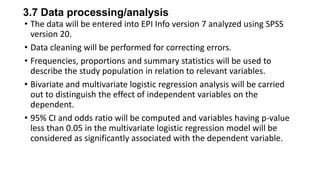
Prevalence and factors associated with road traffic accident in
Mekelle Town, Northern Ethiopia.
By: Nigus G.medhin Assefa (B. Pharm, MPH RH fellow)

Advisors:
Dr. Lalit Ingale ( MSc, PhD)
Ashenafi Shumey (BSc, MPH)

January, 2014
Contents
• Introduction
• Objectives
• Method
• Study design
• Study area and time
• Sample size determination
• Variables
• Data collection
• Operational definition
• Data analysis

• Ethical clearance
• Dissemination and utilization
of results
• Sample references
• Questionnaire
1. Introduction
• Road traffic accident is the current serious public health
problem, especially to middle and low-income countries.
• Approximately 1.24 million people die every year on the world’s roads
and 20 to 50 million people sustain nonfatal injuries.
• Over 90% of traffic accidents occur in low-income and middle-income
countries, which have only 48% of worlds vehicles.
• In Africa, deaths due to road traffic accidents are highest among the
most economically active population aged 15-59 years and it
constitute 25% of all injury-related deaths.
• The increased rate of fatal road traffic accident is duet to increased
motorization.
1. Introduction, continued
• RTAs cost low and middle income countries between 1- 2% of their
gross national product (GNP).
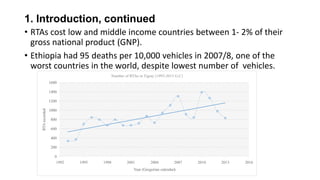
• Ethiopia had 95 deaths per 10,000 vehicles in 2007/8, one of the
worst countries in the world, despite lowest number of vehicles.
Number of RTAs in Tigray (1993-2013 G.C)
1600
1400

RTA recorded

1200
1000
800
600
400

200
0
1992

1995

1998

2001

2004

2007

Year (Gregorian calendar)

2010

2013

2016
Introduction, continued
• Causes are attributed to driver, pedestrians, vehicles condition and
road environment.

1.1. Statement of the problem
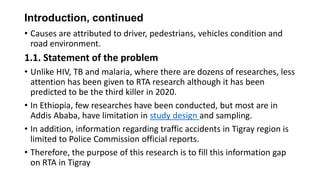
• Unlike HIV, TB and malaria, where there are dozens of researches, less
attention has been given to RTA research although it has been
predicted to be the third killer in 2020.
• In Ethiopia, few researches have been conducted, but most are in
Addis Ababa, have limitation in study design and sampling.
• In addition, information regarding traffic accidents in Tigray region is
limited to Police Commission official reports.
• Therefore, the purpose of this research is to fill this information gap
on RTA in Tigray
1.2. Significance of the study
• The information obtained from this study;
• will help policy makers to develop countermeasures that could reduce the
number and severity of road traffic accidents.
• can also be used by the road safety authorities for planning and evaluating
road safety measures.

2. Objective
• General objective:
• To determine prevalence and factors associated with road traffic accident in
Mekelle Town, Northern Ethiopia.

• Specific objectives:
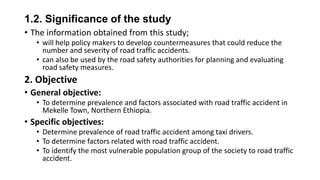
• Determine prevalence of road traffic accident among taxi drivers.
• To determine factors related with road traffic accident.
• To identify the most vulnerable population group of the society to road traffic
accident.
3. Methodology
3.1. Study design: Cross sectional study design will be used
3.2. Study area and time: The study would be conducted in Mekelle
Town, from January to March 2014.
3.3. Sample size determination
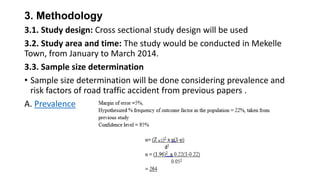
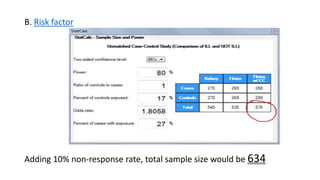
• Sample size determination will be done considering prevalence and
risk factors of road traffic accident from previous papers .
A. Prevalence
B. Risk factor

Adding 10% non-response rate, total sample size would be 634
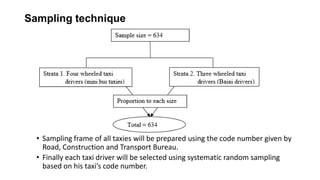
Sampling technique

• Sampling frame of all taxies will be prepared using the code number given by
Road, Construction and Transport Bureau.
• Finally each taxi driver will be selected using systematic random sampling
based on his taxi’s code number.
3.4. Variables
Independent variables:
• Factors related to taxi drivers; like over speed driving, drunk
driving and socio-demographic characteristics.
• Factors related to vehicle; high service year of vehicle, vehicle
ownership.
• Pedestrians related factors; like failure to respects traffic rule, e.g.
left hand-rule, zebra crossing.
• Environmental conditions like road condition, rain, night driving.
Dependent variable/outcome: An event of road traffic accident
3.5 Data collection and quality control
• Questionnaire will be designed based on the country’s traffic statistics
format , with few modification, which focuses on four major factors
(on the driver, vehicle, pedestrian and road environment).
• For administering the interview, six trained information technology
professional data collectors and one supervisor will participate.
• One day training will be prearranged to data collectors and supervisor.
• The questionnaire will be first pre tested on 5% or 30 taxi drivers.
• Taxi drivers will not be stopped while driving, instead they will be
approached at refueling stations and at their waiting places.
• Data will be entered by the principal investigator and will be cleaned
before analysis.
3.6. Operational definition
• Driver: Persons in control of vehicles other than pedal cycles and two-wheeled
motor vehicles.
• Passengers: Occupants of vehicles, other than the person in control, including
extra seat/pillion passengers.
• Pedestrians: People walking or riding or pushing bicycles on the street or
footway.
• Road: Every public road system: state, regional or local road, or city Street.
• Road traffic accident: A collision between vehicles; between vehicles and
pedestrians; between vehicles and animals; or between vehicles and fixed
obstacle.
• Road users: Pedestrians and vehicle users which include all occupants (i.e. driver
or rider and passengers).
• Taxi: a vehicle, whose driver is paid to transport passengers and their light
commodities, typically for short distances.
• Vehicle: A machine that is used to carry people or goods from one place to
another, it could be bicycle, motor cycle or three and above wheeled machine.
3.7 Data processing/analysis
• The data will be entered into EPI Info version 7 analyzed using SPSS
version 20.
• Data cleaning will be performed for correcting errors.
• Frequencies, proportions and summary statistics will be used to
describe the study population in relation to relevant variables.
• Bivariate and multivariate logistic regression analysis will be carried
out to distinguish the effect of independent variables on the
dependent.
• 95% CI and odds ratio will be computed and variables having p-value
less than 0.05 in the multivariate logistic regression model will be
considered as significantly associated with the dependent variable.
3.8. Ethical clearance
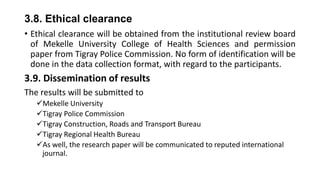
• Ethical clearance will be obtained from the institutional review board
of Mekelle University College of Health Sciences and permission
paper from Tigray Police Commission. No form of identification will be
done in the data collection format, with regard to the participants.

3.9. Dissemination of results
The results will be submitted to
Mekelle University
Tigray Police Commission
Tigray Construction, Roads and Transport Bureau
Tigray Regional Health Bureau
As well, the research paper will be communicated to reputed international
journal.
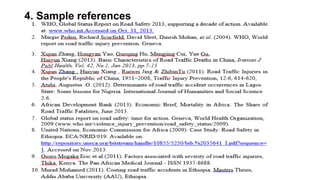
4. Sample references
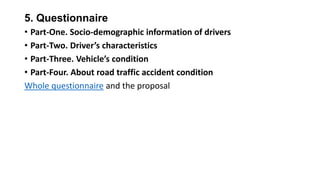
5. Questionnaire
• Part-One. Socio-demographic information of drivers
• Part-Two. Driver’s characteristics
• Part-Three. Vehicle’s condition
• Part-Four. About road traffic accident condition
Whole questionnaire and the proposal
THANKS!!

Road traffic accident defence presentation

  • 1.
    MEKELLE UNIVERSITY COLLEGE OFHEALTH SCIENCES DEPARTMENT OF PUBLIC HEALTH Prevalence and factors associated with road traffic accident in Mekelle Town, Northern Ethiopia. By: Nigus G.medhin Assefa (B. Pharm, MPH RH fellow) Advisors: Dr. Lalit Ingale ( MSc, PhD) Ashenafi Shumey (BSc, MPH) January, 2014
  • 2.
    Contents • Introduction • Objectives •Method • Study design • Study area and time • Sample size determination • Variables • Data collection • Operational definition • Data analysis • Ethical clearance • Dissemination and utilization of results • Sample references • Questionnaire
  • 3.
    1. Introduction • Roadtraffic accident is the current serious public health problem, especially to middle and low-income countries. • Approximately 1.24 million people die every year on the world’s roads and 20 to 50 million people sustain nonfatal injuries. • Over 90% of traffic accidents occur in low-income and middle-income countries, which have only 48% of worlds vehicles. • In Africa, deaths due to road traffic accidents are highest among the most economically active population aged 15-59 years and it constitute 25% of all injury-related deaths. • The increased rate of fatal road traffic accident is duet to increased motorization.
  • 4.
    1. Introduction, continued •RTAs cost low and middle income countries between 1- 2% of their gross national product (GNP). • Ethiopia had 95 deaths per 10,000 vehicles in 2007/8, one of the worst countries in the world, despite lowest number of vehicles. Number of RTAs in Tigray (1993-2013 G.C) 1600 1400 RTA recorded 1200 1000 800 600 400 200 0 1992 1995 1998 2001 2004 2007 Year (Gregorian calendar) 2010 2013 2016
  • 5.
    Introduction, continued • Causesare attributed to driver, pedestrians, vehicles condition and road environment. 1.1. Statement of the problem • Unlike HIV, TB and malaria, where there are dozens of researches, less attention has been given to RTA research although it has been predicted to be the third killer in 2020. • In Ethiopia, few researches have been conducted, but most are in Addis Ababa, have limitation in study design and sampling. • In addition, information regarding traffic accidents in Tigray region is limited to Police Commission official reports. • Therefore, the purpose of this research is to fill this information gap on RTA in Tigray
  • 6.
    1.2. Significance ofthe study • The information obtained from this study; • will help policy makers to develop countermeasures that could reduce the number and severity of road traffic accidents. • can also be used by the road safety authorities for planning and evaluating road safety measures. 2. Objective • General objective: • To determine prevalence and factors associated with road traffic accident in Mekelle Town, Northern Ethiopia. • Specific objectives: • Determine prevalence of road traffic accident among taxi drivers. • To determine factors related with road traffic accident. • To identify the most vulnerable population group of the society to road traffic accident.
  • 7.
    3. Methodology 3.1. Studydesign: Cross sectional study design will be used 3.2. Study area and time: The study would be conducted in Mekelle Town, from January to March 2014. 3.3. Sample size determination • Sample size determination will be done considering prevalence and risk factors of road traffic accident from previous papers . A. Prevalence
  • 8.
    B. Risk factor Adding10% non-response rate, total sample size would be 634
  • 9.
    Sampling technique • Samplingframe of all taxies will be prepared using the code number given by Road, Construction and Transport Bureau. • Finally each taxi driver will be selected using systematic random sampling based on his taxi’s code number.
  • 10.
    3.4. Variables Independent variables: •Factors related to taxi drivers; like over speed driving, drunk driving and socio-demographic characteristics. • Factors related to vehicle; high service year of vehicle, vehicle ownership. • Pedestrians related factors; like failure to respects traffic rule, e.g. left hand-rule, zebra crossing. • Environmental conditions like road condition, rain, night driving. Dependent variable/outcome: An event of road traffic accident
  • 11.
    3.5 Data collectionand quality control • Questionnaire will be designed based on the country’s traffic statistics format , with few modification, which focuses on four major factors (on the driver, vehicle, pedestrian and road environment). • For administering the interview, six trained information technology professional data collectors and one supervisor will participate. • One day training will be prearranged to data collectors and supervisor. • The questionnaire will be first pre tested on 5% or 30 taxi drivers. • Taxi drivers will not be stopped while driving, instead they will be approached at refueling stations and at their waiting places. • Data will be entered by the principal investigator and will be cleaned before analysis.
  • 12.
    3.6. Operational definition •Driver: Persons in control of vehicles other than pedal cycles and two-wheeled motor vehicles. • Passengers: Occupants of vehicles, other than the person in control, including extra seat/pillion passengers. • Pedestrians: People walking or riding or pushing bicycles on the street or footway. • Road: Every public road system: state, regional or local road, or city Street. • Road traffic accident: A collision between vehicles; between vehicles and pedestrians; between vehicles and animals; or between vehicles and fixed obstacle. • Road users: Pedestrians and vehicle users which include all occupants (i.e. driver or rider and passengers). • Taxi: a vehicle, whose driver is paid to transport passengers and their light commodities, typically for short distances. • Vehicle: A machine that is used to carry people or goods from one place to another, it could be bicycle, motor cycle or three and above wheeled machine.
  • 13.
    3.7 Data processing/analysis •The data will be entered into EPI Info version 7 analyzed using SPSS version 20. • Data cleaning will be performed for correcting errors. • Frequencies, proportions and summary statistics will be used to describe the study population in relation to relevant variables. • Bivariate and multivariate logistic regression analysis will be carried out to distinguish the effect of independent variables on the dependent. • 95% CI and odds ratio will be computed and variables having p-value less than 0.05 in the multivariate logistic regression model will be considered as significantly associated with the dependent variable.
  • 14.
    3.8. Ethical clearance •Ethical clearance will be obtained from the institutional review board of Mekelle University College of Health Sciences and permission paper from Tigray Police Commission. No form of identification will be done in the data collection format, with regard to the participants. 3.9. Dissemination of results The results will be submitted to Mekelle University Tigray Police Commission Tigray Construction, Roads and Transport Bureau Tigray Regional Health Bureau As well, the research paper will be communicated to reputed international journal.
  • 15.
  • 16.
    5. Questionnaire • Part-One.Socio-demographic information of drivers • Part-Two. Driver’s characteristics • Part-Three. Vehicle’s condition • Part-Four. About road traffic accident condition Whole questionnaire and the proposal
  • 17.