José Luis Pérez Talavera
VALORIZA AGUA
fuenteagria@gmail.com
SUBJECTS
 To detect false biofouling
 Is there a link between biofouling and bacterial
content?
 Biofouling and bacterial stress
 Plant shut down risk
FALSE BIOFOULING
 Very frequent mistake among operators ,confounding
inorganic with organic fouling.
 Case study nº 1: Aluminium fouling
 Case study nº 2: Iron fouling
Case study nº1: Aluminium
 City water B.W.R.O. Plant with severe fouling
problems . (Weekly C.I.P.)
 All chemical companies and R.O. experts diagnosed as
biofouling, recommending to switch to cellulose
acetate membranes.
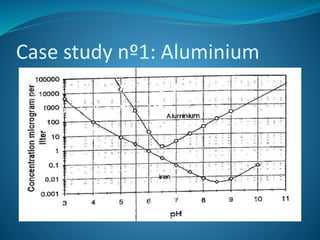
 We discovered the aluminum fouling ,produced by a
ph reduction from 8.5 to 6.5 (Just the minimum
solubility point of aluminium).
 Problem solved once ph was further reduced to 5.5
Case study nº1: Aluminium
Case study nº 2: Iron
 Open intake S.W.R.O. Plant with severe fouling .
 Based on bad biological quality of feed water.
 We discovered the origin of the problem : A very high
iron dosage of 20 p.p.m. as Cl3Fe
 They determined the dosage according jar test.
 Jar tests are not suitable for R.O. Plants.
 Problem solved once the dosage was decreased to 0.5
p.p.m.
Case study nº 2: Iron
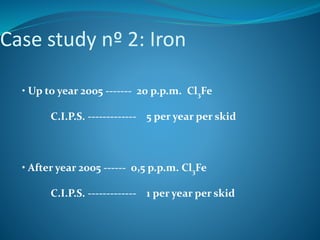
• Up to year 2005 ------- 20 p.p.m. Cl3Fe
C.I.P.S. ------------- 5 per year per skid
• After year 2005 ------ 0,5 p.p.m. Cl3Fe
C.I.P.S. ------------- 1 per year per skid
FALSE TOPIC: Link between severity
of biofouling and bacterial content.
FALSE TOPIC: Link between severity
of biofouling and bacterial content.
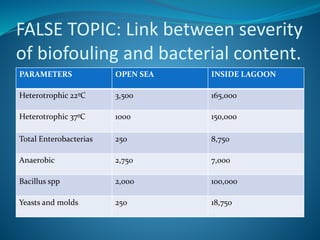
PARAMETERS OPEN SEA INSIDE LAGOON
Heterotrophic 22ºC 3,500 165,000
Heterotrophic 37ºC 1000 150,000
Total Enterobacterias 250 8,750
Anaerobic 2,750 7,000
Bacillus spp 2,000 100,000
Yeasts and molds 250 18,750
FALSE TOPIC: Link between severity
of biofouling and bacterial content.
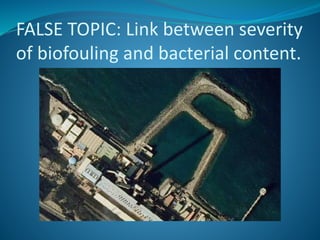
 In spite of the fact of the big difference in the bacterial
content between the lagoon and the open sea, the
S.W.R.O. Plant performed very well.
 C.I.P. only once a year or even longer.
 Trick: No attack to the bacterias.
EPS-TEP and Biofouling
 It has being determined that Exo Polymeric
Substances (EPS), mainly Polysaccharides, including
natural Transparent Exopolymer Particles (TEP), are
responsible for the biofouling of the membranes. (R.O.
and M.F./U.F.)
 Bacterias, per se, are not responsible, unless have
being forced to produce EPS.
 Number of bacterias is not important.
EPS-TEP and Biofouling
 Bacteria produce EPS when they are stressed by a big
change in their environment.
 The biggest the attack, the more the production of EPS
 Oxidants are the biggest producers of EPS.
 Ph change affects in a minor degree.
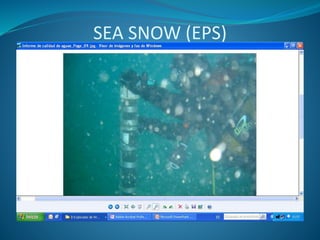
SEA SNOW (EPS)
CHLORINATION-DECHLORINATION
 In the early times, membrane makers forced to
operators, the use of chlorine.
 Plants did not perform well.
 C.I.P.s were very frequent, almost once a month.
CHLORINATION-DECHLORINATION
 The questions we made were:
 Why there in not biofouling in the sand of the
beaches?
 Why the big formation of biofilm after the injection of
SBS?
 Could be the chlorination the origin of the problem?
CHLORINATION-DECHLORINATION
 CASE STUDY Nº 3
 S.W.R.O. Plant (Open intake)
 Heavy biofouling, required C.I.P. every month.
CHLORINATION-DECHLORINATION
 In the eighties, we decided to eliminate the
chlorination, in order to improve the operation.
 The membrane maker was against and cancelled the
warranty, but we went ahead.
 The decision we took, was a success
CHLORINATION-DECHLORINATION
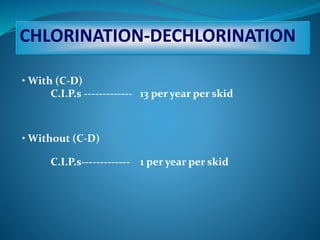
• With (C-D)
C.I.P.s ------------- 13 per year per skid
• Without (C-D)
C.I.P.s------------- 1 per year per skid
CHLORINATION-DECHLORINATION
 CASE STUDY Nº 4
 B.W.R.O. Plant fed with city water
 Feed water is chlorinated
CHLORINATION-DECHLORINATION
 Ultra pure water plant
 Pre-treatment based on U.F. membranes.
 Heavy biofouling film after the SBS injection point.
 No way of solving the problem.
CHLORINATION-DECHLORINATION
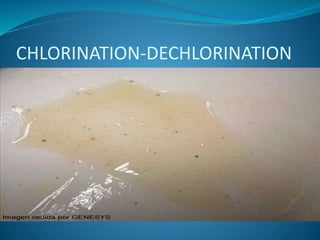
 The inspection of the pipe in the area of the SBS
injection, showed a bright and clean surface before
the injection point and a thick film of biofouling after
it.
 Plant continues changing membranes every 6 months.
CHLORINATION-DECHLORINATION
PH CHANGE
 Case study nº 5
 SWRO Plant with acid addition to ph 7
 CIP frequency was once every 10 – 11 months
 After removing the acid, got a little improvement ,
switching to 11-12 months.
OPERATION RULES
 If you do not bother the bacterias, they don’t hurt you
 The less chemicals you add, the better operation you
get.
 All the Plants I have operated, have no chemicals
addition or only anti scalants.
ANTI SCALANTS
 Anti scalants are another source of fouling.
 Blend of organic and biofouling obtained.
 Phosphonates are the best, but not all the brands.
 It’s necessary to perform pilots in order to choose the
best one.
 There are big differences among brands.
 Acrilates and Maleates not recommended.

SHUT DOWN CONSERVATION
 Plant shutdown is a dangerous period.
 Many ways of conservation are used
 SBS solution as preserving method, is the most
popular.
 I found terrible effects sometimes, due to the
formation of heavy film of anaerobic bacteria.
SHUT DOWN CONSERVATION
Another method use a safe biocide as thiazoline.
The method I use with a great result, is keeping a small
flow of feed water running constantly or with short
breaks.
 Avoiding the stagnant water, no biofouling is formed.
SHUT DOWN CONSERVATION
 This method has a lot of other benefits:
 Fouling: avoiding its formation in sand and cartridge
filters, as well as pipes.
 Mechanical: keep high pressure pumps running. (No
need of turning shaft by hand regularly).

R.o. plants biofouling an overview

  • 1.
    José Luis PérezTalavera VALORIZA AGUA fuenteagria@gmail.com
  • 2.
    SUBJECTS  To detectfalse biofouling  Is there a link between biofouling and bacterial content?  Biofouling and bacterial stress  Plant shut down risk
  • 3.
    FALSE BIOFOULING  Veryfrequent mistake among operators ,confounding inorganic with organic fouling.  Case study nº 1: Aluminium fouling  Case study nº 2: Iron fouling
  • 4.
    Case study nº1:Aluminium  City water B.W.R.O. Plant with severe fouling problems . (Weekly C.I.P.)  All chemical companies and R.O. experts diagnosed as biofouling, recommending to switch to cellulose acetate membranes.  We discovered the aluminum fouling ,produced by a ph reduction from 8.5 to 6.5 (Just the minimum solubility point of aluminium).  Problem solved once ph was further reduced to 5.5
  • 5.
  • 6.
    Case study nº2: Iron  Open intake S.W.R.O. Plant with severe fouling .  Based on bad biological quality of feed water.  We discovered the origin of the problem : A very high iron dosage of 20 p.p.m. as Cl3Fe  They determined the dosage according jar test.  Jar tests are not suitable for R.O. Plants.  Problem solved once the dosage was decreased to 0.5 p.p.m.
  • 7.
    Case study nº2: Iron • Up to year 2005 ------- 20 p.p.m. Cl3Fe C.I.P.S. ------------- 5 per year per skid • After year 2005 ------ 0,5 p.p.m. Cl3Fe C.I.P.S. ------------- 1 per year per skid
  • 8.
    FALSE TOPIC: Linkbetween severity of biofouling and bacterial content.
  • 9.
    FALSE TOPIC: Linkbetween severity of biofouling and bacterial content. PARAMETERS OPEN SEA INSIDE LAGOON Heterotrophic 22ºC 3,500 165,000 Heterotrophic 37ºC 1000 150,000 Total Enterobacterias 250 8,750 Anaerobic 2,750 7,000 Bacillus spp 2,000 100,000 Yeasts and molds 250 18,750
  • 10.
    FALSE TOPIC: Linkbetween severity of biofouling and bacterial content.  In spite of the fact of the big difference in the bacterial content between the lagoon and the open sea, the S.W.R.O. Plant performed very well.  C.I.P. only once a year or even longer.  Trick: No attack to the bacterias.
  • 11.
    EPS-TEP and Biofouling It has being determined that Exo Polymeric Substances (EPS), mainly Polysaccharides, including natural Transparent Exopolymer Particles (TEP), are responsible for the biofouling of the membranes. (R.O. and M.F./U.F.)  Bacterias, per se, are not responsible, unless have being forced to produce EPS.  Number of bacterias is not important.
  • 12.
    EPS-TEP and Biofouling Bacteria produce EPS when they are stressed by a big change in their environment.  The biggest the attack, the more the production of EPS  Oxidants are the biggest producers of EPS.  Ph change affects in a minor degree.
  • 13.
  • 14.
    CHLORINATION-DECHLORINATION  In theearly times, membrane makers forced to operators, the use of chlorine.  Plants did not perform well.  C.I.P.s were very frequent, almost once a month.
  • 15.
    CHLORINATION-DECHLORINATION  The questionswe made were:  Why there in not biofouling in the sand of the beaches?  Why the big formation of biofilm after the injection of SBS?  Could be the chlorination the origin of the problem?
  • 16.
    CHLORINATION-DECHLORINATION  CASE STUDYNº 3  S.W.R.O. Plant (Open intake)  Heavy biofouling, required C.I.P. every month.
  • 17.
  • 18.
    CHLORINATION-DECHLORINATION  In theeighties, we decided to eliminate the chlorination, in order to improve the operation.  The membrane maker was against and cancelled the warranty, but we went ahead.  The decision we took, was a success
  • 19.
    CHLORINATION-DECHLORINATION • With (C-D) C.I.P.s------------- 13 per year per skid • Without (C-D) C.I.P.s------------- 1 per year per skid
  • 20.
    CHLORINATION-DECHLORINATION  CASE STUDYNº 4  B.W.R.O. Plant fed with city water  Feed water is chlorinated
  • 21.
    CHLORINATION-DECHLORINATION  Ultra purewater plant  Pre-treatment based on U.F. membranes.  Heavy biofouling film after the SBS injection point.  No way of solving the problem.
  • 22.
    CHLORINATION-DECHLORINATION  The inspectionof the pipe in the area of the SBS injection, showed a bright and clean surface before the injection point and a thick film of biofouling after it.  Plant continues changing membranes every 6 months.
  • 23.
  • 24.
    PH CHANGE  Casestudy nº 5  SWRO Plant with acid addition to ph 7  CIP frequency was once every 10 – 11 months  After removing the acid, got a little improvement , switching to 11-12 months.
  • 25.
    OPERATION RULES  Ifyou do not bother the bacterias, they don’t hurt you  The less chemicals you add, the better operation you get.  All the Plants I have operated, have no chemicals addition or only anti scalants.
  • 26.
    ANTI SCALANTS  Antiscalants are another source of fouling.  Blend of organic and biofouling obtained.  Phosphonates are the best, but not all the brands.  It’s necessary to perform pilots in order to choose the best one.  There are big differences among brands.  Acrilates and Maleates not recommended. 
  • 27.
    SHUT DOWN CONSERVATION Plant shutdown is a dangerous period.  Many ways of conservation are used  SBS solution as preserving method, is the most popular.  I found terrible effects sometimes, due to the formation of heavy film of anaerobic bacteria.
  • 28.
    SHUT DOWN CONSERVATION Anothermethod use a safe biocide as thiazoline. The method I use with a great result, is keeping a small flow of feed water running constantly or with short breaks.  Avoiding the stagnant water, no biofouling is formed.
  • 29.
    SHUT DOWN CONSERVATION This method has a lot of other benefits:  Fouling: avoiding its formation in sand and cartridge filters, as well as pipes.  Mechanical: keep high pressure pumps running. (No need of turning shaft by hand regularly).