AHMAD FAUZI ISMAIL, PhD., FASc., CEng., FIChemE.
Zulhairun Abdul Karim, PhD
Advanced Membrane Technology Research Centre (AMTEC) [HICoE]
Universiti Teknologi Malaysia (UTM), Malaysia
3rd International Conference on Engineering, Technology and Industrial Application (ICETIA 2016), 6-8 Dec., 2016, Surakarta, Indonesia
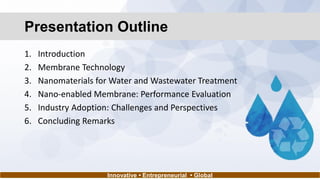
Presentation Outline
1. Introduction
2. Membrane Technology
3. Nanomaterials for Water and Wastewater Treatment
4. Nano-enabled Membrane: Performance Evaluation
5. Industry Adoption: Challenges and Perspectives
6. Concluding Remarks
Innovative • Entrepreneurial • Global
Global Water
Crisis:
H2O QUICK
FACTS
Innovative • Entrepreneurial • GlobalInnovative • Entrepreneurial • Global
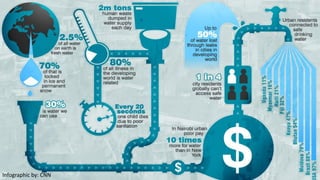
Do you know that…
• Water scarcity will be one of the defining features of
the 21st century.
• The U.N. predicts that by 2025 two thirds of the
world's population will suffer water shortages.
• Compared to today, five times as much land is likely to
be under “extreme drought” by 2050.
• By 2050, 1 in 5 developing countries will face water
shortages.
Sources: United Nation’s Food and Agriculture Organization; World Health Organization; UNICEF, 2015
Innovative • Entrepreneurial • Global
Do you know that…
Sources: United Nation’s Food and Agriculture Organization; World Health Organization; UNICEF, 2015
Innovative • Entrepreneurial • GlobalInfographic by: CNN
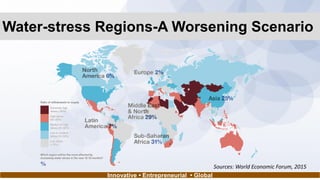
Water-stress Regions-A Worsening Scenario
Innovative • Entrepreneurial • Global
Sources: World Economic Forum, 2015
Factors Leading to Water Crisis
Innovative • Entrepreneurial • Global
Climate and Geography
Poor Water Infrastructure
and Sanitary
Water Pollutions
Engineering Solutions:
Wastewater Treatment
Desalination
Innovative • Entrepreneurial • Global
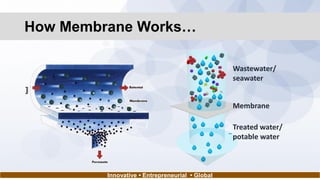
How Membrane Works…
Innovative • Entrepreneurial • Global
Membrane
Wastewater/
seawater
Treated water/
potable water
How Membrane Works…
Innovative • Entrepreneurial • Global
Osmotically Driven
Membrane Processes
Pressure Driven
Membrane Processes
Multidisciplinary in Membrane Technology
Fundamental sciences
studies involving:
Material selection
Dope formulation
Manufacturing Processes
involving:
Membrane fabrication
System/Equipment design
Material Science studies:
Membrane characterization
Membrane properties
fine-tuning
Separation Processes involving:
Molecular transport mechanism
Mass transport control
Innovative • Entrepreneurial • Global
Membrane and Membrane Modules
Membrane element: Flat sheet & Hollow fiber
Membrane module: Membrane integrated unit
Membrane System: Consist of membrane
modules, tubings, pumps, valves and etc
Innovative • Entrepreneurial • Global
Synthesis
Material
Characterizati
on
Membrane
Fabrication
Module
Preparation
System
Design and
Testing
Field Test &
commerciali
zation
Methodology in Membrane Science
and Technology
Innovative • Entrepreneurial • Global
The Next Big Thing:
Engineered Nanomaterials
Innovative • Entrepreneurial • Global
• Nanomaterials are typically defined as materials smaller
than 100 nm in at least one dimension.
• At this scale, materials often possess novel size-
dependent properties different from their large
counterparts.
• Water and wastewater treatment utilize the scalable size-
dependent properties of nanomaterials which relate to:
• High specific surface area and sorption capacity
• High selectivity and reactivity
• Fast transport
• Antimicrobial
Classes of Nanomaterials
Innovative • Entrepreneurial • Global
a) Clusters (0D)
Examples: TiO2, Al2O3, ZrO2,
SiO2, ZnO, Ag
b) Nanotubes/rods (1D)
Examples: SWCNTs, MWCNTs,
titania nanotube, boron
nitride nanotubes
c) Films/ exfoliated (2D)
Examples: grahene, graphene
oxide, clay silicate,
boron nitride nanosheet
Examples: zeolite, metal
organic framework
d) Polycrystal (3D)
How Does Nanotechnology Help?
• Recent advances in nanotechnology offer leapfrogging
opportunities to develop next-generation water supply
systems.
• The highly efficient, modular, and multifunctional
processes enabled by nanotechnology-provide high
performance, affordable and sustainable solutions.
• Less reliance on large infrastructures.
• New treatment capabilities that allow economic utilization
of unconventional water sources to expand the water
supply.
Innovative • Entrepreneurial • Global
Membrane Enhanced with
Emerging Nanomaterials
Innovative • Entrepreneurial • Global
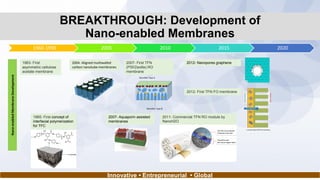
BREAKTHROUGH: Development of
Nano-enabled Membranes
Innovative • Entrepreneurial • Global
1960-1990 2005 2010 2015 2020
Nano-enabledMembraneDevelopment
2007- First TFN
(PSf/Zeolite) RO
membrane
1963- First
asymmetric cellulose
acetate membrane
2011- Commercial TFN RO module by
NanoH2O
1965- First concept of
interfacial polymerization
for TFC
2004- Aligned multiwalled
carbon nanotube membranes
2007- Aquaporin assisted
membranes
2012- First TFN FO membrane
2012- Nanopores graphene
PES/Fe–Mn binary oxide UF Membrane
for Arsenic Adsorption
Innovative • Entrepreneurial • Global
D. Ocin´ski et al. Chemical Engineering Journal 294 (2016) 210–221
uals containing iron and manganese oxides for
water – Characterization of physicochemical
tion studies
kowicz-Sobala a
, Piotr Mazur b
, Jerzy Raczyk c
, El _zbieta Kociołek-Balawejder a
University of Economics, ul. Komandorska 118/120, 53-345 Wrocław, Poland
Wrocław, Pl. Maxa Borna 9, 50-204 Wrocław, Poland
of Wrocław, Pl. Uniwersytecki 1, 50-137 Wrocław, Poland
g r a p h i c a l a b s t r a c t
a b s t r a c t
Water treatment residuals (WTRs), generated as a by-product during the deironing and demanganization
process of infiltration water, were characterized and examined as arsenate and arsenite sorbent. The raw
material consisted mainly of iron and manganese oxides with the ratio of Fe:Mn of 5:1. The adsorbent
was also characterized by BET surface area measurement, X-ray diffraction (XRD), SEM EDS microscopy
and X-ray photoelectron spectroscopy (XPS). The results showed that WTRs had a high surface area
(120 m2
g 1
) and were mainly amorphous, with small fractions of crystalline quartz and feroxyhyte.
The maximum sorption capacities determined by means of the Langmuir isotherm equation w ere
132 mg As(III) g 1
and 77 mg As(V) g 1
. The higher arsenite uptake may be attributed to the creation
of new adsorption sites at the solid surface as a result of As(III) oxidation. The XPSconfirmed that arsenite
was oxidized prior to adsorption, which was accompanied by release of Mn2+
cations followed by their
adsorption on the sorbent surface. The effectiveness of arsenate removal decreased w ith the increase
of pH, with a noticeable drop above pHpzc of the sorbent, whereas arsenite adsorption was almost con-
stant at acidic and neutral pH. A slight decrease was observed only above pH = 10 due to repulsion
Iron-Manganese binary oxide- powerful adsorbent for Arsenic
Impregnating FMBO particles into porous host matrix
(membrane) tackle the following limitations:
-Cannot be used directly in fixed-bed or any flow-through
systems- experience excessive pressure drops due to the fine
particles.
-Additional post-treatment process is required after adsorption
process to separate the fine particles from treated water.
As(III) adsorption kinetics and change
of As(III) concentration in aqueous
solution indicated very fast reaction in
the first 2 hours.
Fine particle size of the FMBO offered
many active sites for the adsorbption
As(III) from the bulk solution.
Initial conc=20 ppm
pH =7.5
After desorption
and readsorption,
the performance
of PES/FBMO was
recovered by 85%
A.F. Ismail et al. Separation and Purification Technology 118 (2013) 64–72
TiO2/PVDF for Photocatalytic
Degradation of Nonylphenol
Innovative • Entrepreneurial • Global
Schematic diagram of photodegradation apparatus.
Dual-layer hollow fibre membranes before
and after the UVA irradiation.
The hollow fiber turned yellowish after the
reaction indicates that he light is scattered
by the anatase TiO2 nanoparticles for the
photodegradation to take place.
SEM/EDX
characterization
evidenced the
distribution of TiO2
nanoparticles
throughout the
dual-layer hollow
fiber matrix.
PLC chromatogram of
nonylphenol and its
intermediate. Initial conditions:
100 ppm of NP, 0.2 ratio of
TiO2/PVDF, 36 W of UVA.
The disappearance of peak
nonylphenol (2) has proven the
degradation of the compound.
Phenol peak
nonylphenol peak
A.F. Ismail et al. / Reactive and Functional Polymers 99 (2016) 80–87
TFN NF Membrane Incorporated
with GO for Desalination
Innovative • Entrepreneurial • Global
Synthesized GO is single flake form in nature. The sp2 hybridization
state of carbon in graphene changed into sp3 hybridization state in
GO, resulting in the disruption of the original planar structure of
graphene into a wrinkled structured in GO
TFN Formation
Polyamide thin film
GO incorporated into PSf membrane
• 0.3wt% GO incorporated TFN showed high rejection towards multivalent salts i.e. Na2SO4
rejection: 95.2% and MgSO4 rejection 91.1%.
• GO nanosheets has potential to overcome trade-off effect encountered by typical TFC
membrane i.e. increasing both membrane water permeability and salt rejection.
• The improvements were due to unique characteristics of GO nanosheets, i.e. highly charged
and hydrophilic surfaces.
Innovative • Entrepreneurial • Global
Thin Film Nanocomposite FO
membrane for Desalination
Polyamide TFN with PSf–TiO2 nanocomposite substrate
• The hydrophilicity and porosity of the PSf– TiO2 nanocomposite substrate was improved upon addition
of TiO2.
• TFN prepared from PSf substrate embedded with 0.5 wt% TiO2 was found to be the best performing FO
membrane for water desalination process owing to its high water permeability and low reverse solute
flux, without compromising rejection
• The increase in water permeability can be attributed to decrease in structural parameter which resulted
in decreased internal concentration polarization (ICP).
A.F. Ismail et al. / Chemical Engineering Journal 237 (2014) 70–80
Innovative • Entrepreneurial • Global
C.S. Ong, W.J. Lau, P.S. Goh, A.F. Ismail et al Desalination 353 (2014) 48–56
A laboratory-scale submerged membrane photocatalytic reactor (sMPR) exhibited remarkably
improved performances in degrading synthetic cutting oil wastewater and producing
permeate of high quality at relatively low operating cost.
FEED with
different
concentration
of cutting oil
PERMEATE
with clear
solution that
comply
discharge
standard
Photocatalytic Membrane for
Oily Wastewater Treatment
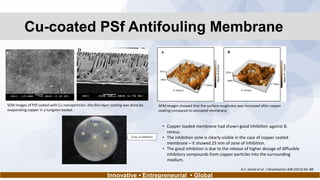
Cu-coated PSf Antifouling Membrane
Innovative • Entrepreneurial • Global
SEM images of PSf coated with Cu nanoparticles- the thin layer coating was done by
evaporating copper in a tungsten basket.
AFM images showed that the surface roughness was increased after copper
coating compared to uncoated membrane
• Copper loaded membrane had shown good inhibition against B.
cereus.
• The inhibition zone is clearly visible in the case of copper coated
membrane – it showed 23 mm of zone of inhibition.
• The good inhibition is due to the release of higher dosage of diffusible
inhibitory compounds from copper particles into the surrounding
medium.
A.F. Ismail et al. / Desalination 308 (2013) 82–88
INDUSTRY ADOPTION:
Challenges and
Opportunities
Challenges
• Up-scaling and retrofitting
• Uncertainties in market penetration
• Inappropriate risk and safety evaluation
• Trigger emerging environmental issues
associated with nanomaterials
Opportunities
• Heightened water treatment performance
• Long term economic prosperity
• Continuous sustainable development
• New industry revenue
Commercialization of Nano-enabled
Water and Wastewater treatment
Innovative • Entrepreneurial • Global
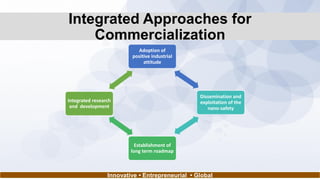
Integrated Approaches for
Commercialization
Adoption of
positive industrial
attitude
Dissemination and
exploitation of the
nano-safety
Establishment of
long term roadmap
Integrated research
and development
Innovative • Entrepreneurial • Global
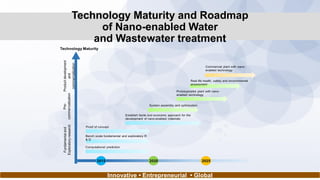
Technology Maturity and Roadmap
of Nano-enabled Water
and Wastewater treatment
Innovative • Entrepreneurial • Global
Concluding Remarks
• Desalination and wastewater treatments are promising approaches to tackle
alarming water shortage issues.
• The advancement of nanotechnology offer tremendous opportunities to heighten
the performance of current existing technology for desalination and wastewater
treatments.
• Nano-enabled membrane is an emerging material which holds potential to move
from laboratory to industry.
• The key drivers for commercialization of this technology need to be identified in
order to expedite the industry adoption in near future.
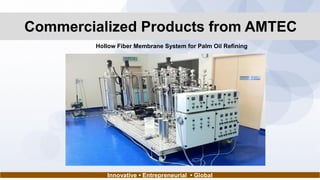
Commercialized Products from AMTEC
Innovative • Entrepreneurial • Global
UF/RO Membrane System for Clean Water production-Disaster relieve
Innovative • Entrepreneurial • Global
Hollow Fiber Membrane System for Palm Oil Refining
Commercialized Products from AMTEC
Flood Relief at Pekan, Pahang
January 2015
MEDIA HIGHLIGHT ON FLOOD
RELIEF AT PEKAN PAHANG
RO SYSTEM AT KG. SINARUT,
RANAU, SABAH
August 2015
MEDIA HIGHLIGHT ON RANAU PROJECT
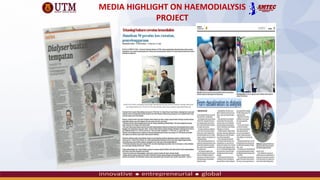
MEDIA HIGHLIGHT ON HAEMODIALYSIS
PROJECT
Acknowledgement
 Members and students of AMTEC, UTM
 Universiti Teknologi Malaysia
 Ministry of Higher Education Malaysia
 Ministry of Science, Technology and Innovation Malaysia
Innovative • Entrepreneurial • Global
Thank You
A. F. Ismail {Fauzi}
afauzi@utm.my or
fauzi.ismail@gmail.com
http://www.utm.my/dvcri/
http://www.utm.my/amtec

A.F. Ismail (presentation)

  • 1.
    AHMAD FAUZI ISMAIL,PhD., FASc., CEng., FIChemE. Zulhairun Abdul Karim, PhD Advanced Membrane Technology Research Centre (AMTEC) [HICoE] Universiti Teknologi Malaysia (UTM), Malaysia 3rd International Conference on Engineering, Technology and Industrial Application (ICETIA 2016), 6-8 Dec., 2016, Surakarta, Indonesia
  • 2.
    Presentation Outline 1. Introduction 2.Membrane Technology 3. Nanomaterials for Water and Wastewater Treatment 4. Nano-enabled Membrane: Performance Evaluation 5. Industry Adoption: Challenges and Perspectives 6. Concluding Remarks Innovative • Entrepreneurial • Global
  • 3.
    Global Water Crisis: H2O QUICK FACTS Innovative• Entrepreneurial • GlobalInnovative • Entrepreneurial • Global
  • 4.
    Do you knowthat… • Water scarcity will be one of the defining features of the 21st century. • The U.N. predicts that by 2025 two thirds of the world's population will suffer water shortages. • Compared to today, five times as much land is likely to be under “extreme drought” by 2050. • By 2050, 1 in 5 developing countries will face water shortages. Sources: United Nation’s Food and Agriculture Organization; World Health Organization; UNICEF, 2015 Innovative • Entrepreneurial • Global
  • 5.
    Do you knowthat… Sources: United Nation’s Food and Agriculture Organization; World Health Organization; UNICEF, 2015 Innovative • Entrepreneurial • GlobalInfographic by: CNN
  • 6.
    Water-stress Regions-A WorseningScenario Innovative • Entrepreneurial • Global Sources: World Economic Forum, 2015
  • 7.
    Factors Leading toWater Crisis Innovative • Entrepreneurial • Global Climate and Geography Poor Water Infrastructure and Sanitary Water Pollutions
  • 8.
  • 9.
  • 10.
    How Membrane Works… Innovative• Entrepreneurial • Global Membrane Wastewater/ seawater Treated water/ potable water
  • 11.
    How Membrane Works… Innovative• Entrepreneurial • Global Osmotically Driven Membrane Processes Pressure Driven Membrane Processes
  • 12.
    Multidisciplinary in MembraneTechnology Fundamental sciences studies involving: Material selection Dope formulation Manufacturing Processes involving: Membrane fabrication System/Equipment design Material Science studies: Membrane characterization Membrane properties fine-tuning Separation Processes involving: Molecular transport mechanism Mass transport control Innovative • Entrepreneurial • Global
  • 13.
    Membrane and MembraneModules Membrane element: Flat sheet & Hollow fiber Membrane module: Membrane integrated unit Membrane System: Consist of membrane modules, tubings, pumps, valves and etc Innovative • Entrepreneurial • Global
  • 14.
    Synthesis Material Characterizati on Membrane Fabrication Module Preparation System Design and Testing Field Test& commerciali zation Methodology in Membrane Science and Technology Innovative • Entrepreneurial • Global
  • 16.
    The Next BigThing: Engineered Nanomaterials Innovative • Entrepreneurial • Global • Nanomaterials are typically defined as materials smaller than 100 nm in at least one dimension. • At this scale, materials often possess novel size- dependent properties different from their large counterparts. • Water and wastewater treatment utilize the scalable size- dependent properties of nanomaterials which relate to: • High specific surface area and sorption capacity • High selectivity and reactivity • Fast transport • Antimicrobial
  • 17.
    Classes of Nanomaterials Innovative• Entrepreneurial • Global a) Clusters (0D) Examples: TiO2, Al2O3, ZrO2, SiO2, ZnO, Ag b) Nanotubes/rods (1D) Examples: SWCNTs, MWCNTs, titania nanotube, boron nitride nanotubes c) Films/ exfoliated (2D) Examples: grahene, graphene oxide, clay silicate, boron nitride nanosheet Examples: zeolite, metal organic framework d) Polycrystal (3D)
  • 18.
    How Does NanotechnologyHelp? • Recent advances in nanotechnology offer leapfrogging opportunities to develop next-generation water supply systems. • The highly efficient, modular, and multifunctional processes enabled by nanotechnology-provide high performance, affordable and sustainable solutions. • Less reliance on large infrastructures. • New treatment capabilities that allow economic utilization of unconventional water sources to expand the water supply. Innovative • Entrepreneurial • Global
  • 19.
    Membrane Enhanced with EmergingNanomaterials Innovative • Entrepreneurial • Global
  • 20.
    BREAKTHROUGH: Development of Nano-enabledMembranes Innovative • Entrepreneurial • Global 1960-1990 2005 2010 2015 2020 Nano-enabledMembraneDevelopment 2007- First TFN (PSf/Zeolite) RO membrane 1963- First asymmetric cellulose acetate membrane 2011- Commercial TFN RO module by NanoH2O 1965- First concept of interfacial polymerization for TFC 2004- Aligned multiwalled carbon nanotube membranes 2007- Aquaporin assisted membranes 2012- First TFN FO membrane 2012- Nanopores graphene
  • 22.
    PES/Fe–Mn binary oxideUF Membrane for Arsenic Adsorption Innovative • Entrepreneurial • Global D. Ocin´ski et al. Chemical Engineering Journal 294 (2016) 210–221 uals containing iron and manganese oxides for water – Characterization of physicochemical tion studies kowicz-Sobala a , Piotr Mazur b , Jerzy Raczyk c , El _zbieta Kociołek-Balawejder a University of Economics, ul. Komandorska 118/120, 53-345 Wrocław, Poland Wrocław, Pl. Maxa Borna 9, 50-204 Wrocław, Poland of Wrocław, Pl. Uniwersytecki 1, 50-137 Wrocław, Poland g r a p h i c a l a b s t r a c t a b s t r a c t Water treatment residuals (WTRs), generated as a by-product during the deironing and demanganization process of infiltration water, were characterized and examined as arsenate and arsenite sorbent. The raw material consisted mainly of iron and manganese oxides with the ratio of Fe:Mn of 5:1. The adsorbent was also characterized by BET surface area measurement, X-ray diffraction (XRD), SEM EDS microscopy and X-ray photoelectron spectroscopy (XPS). The results showed that WTRs had a high surface area (120 m2 g 1 ) and were mainly amorphous, with small fractions of crystalline quartz and feroxyhyte. The maximum sorption capacities determined by means of the Langmuir isotherm equation w ere 132 mg As(III) g 1 and 77 mg As(V) g 1 . The higher arsenite uptake may be attributed to the creation of new adsorption sites at the solid surface as a result of As(III) oxidation. The XPSconfirmed that arsenite was oxidized prior to adsorption, which was accompanied by release of Mn2+ cations followed by their adsorption on the sorbent surface. The effectiveness of arsenate removal decreased w ith the increase of pH, with a noticeable drop above pHpzc of the sorbent, whereas arsenite adsorption was almost con- stant at acidic and neutral pH. A slight decrease was observed only above pH = 10 due to repulsion Iron-Manganese binary oxide- powerful adsorbent for Arsenic Impregnating FMBO particles into porous host matrix (membrane) tackle the following limitations: -Cannot be used directly in fixed-bed or any flow-through systems- experience excessive pressure drops due to the fine particles. -Additional post-treatment process is required after adsorption process to separate the fine particles from treated water. As(III) adsorption kinetics and change of As(III) concentration in aqueous solution indicated very fast reaction in the first 2 hours. Fine particle size of the FMBO offered many active sites for the adsorbption As(III) from the bulk solution. Initial conc=20 ppm pH =7.5 After desorption and readsorption, the performance of PES/FBMO was recovered by 85% A.F. Ismail et al. Separation and Purification Technology 118 (2013) 64–72
  • 23.
    TiO2/PVDF for Photocatalytic Degradationof Nonylphenol Innovative • Entrepreneurial • Global Schematic diagram of photodegradation apparatus. Dual-layer hollow fibre membranes before and after the UVA irradiation. The hollow fiber turned yellowish after the reaction indicates that he light is scattered by the anatase TiO2 nanoparticles for the photodegradation to take place. SEM/EDX characterization evidenced the distribution of TiO2 nanoparticles throughout the dual-layer hollow fiber matrix. PLC chromatogram of nonylphenol and its intermediate. Initial conditions: 100 ppm of NP, 0.2 ratio of TiO2/PVDF, 36 W of UVA. The disappearance of peak nonylphenol (2) has proven the degradation of the compound. Phenol peak nonylphenol peak A.F. Ismail et al. / Reactive and Functional Polymers 99 (2016) 80–87
  • 24.
    TFN NF MembraneIncorporated with GO for Desalination Innovative • Entrepreneurial • Global Synthesized GO is single flake form in nature. The sp2 hybridization state of carbon in graphene changed into sp3 hybridization state in GO, resulting in the disruption of the original planar structure of graphene into a wrinkled structured in GO TFN Formation Polyamide thin film GO incorporated into PSf membrane • 0.3wt% GO incorporated TFN showed high rejection towards multivalent salts i.e. Na2SO4 rejection: 95.2% and MgSO4 rejection 91.1%. • GO nanosheets has potential to overcome trade-off effect encountered by typical TFC membrane i.e. increasing both membrane water permeability and salt rejection. • The improvements were due to unique characteristics of GO nanosheets, i.e. highly charged and hydrophilic surfaces.
  • 25.
    Innovative • Entrepreneurial• Global Thin Film Nanocomposite FO membrane for Desalination Polyamide TFN with PSf–TiO2 nanocomposite substrate • The hydrophilicity and porosity of the PSf– TiO2 nanocomposite substrate was improved upon addition of TiO2. • TFN prepared from PSf substrate embedded with 0.5 wt% TiO2 was found to be the best performing FO membrane for water desalination process owing to its high water permeability and low reverse solute flux, without compromising rejection • The increase in water permeability can be attributed to decrease in structural parameter which resulted in decreased internal concentration polarization (ICP). A.F. Ismail et al. / Chemical Engineering Journal 237 (2014) 70–80
  • 26.
    Innovative • Entrepreneurial• Global C.S. Ong, W.J. Lau, P.S. Goh, A.F. Ismail et al Desalination 353 (2014) 48–56 A laboratory-scale submerged membrane photocatalytic reactor (sMPR) exhibited remarkably improved performances in degrading synthetic cutting oil wastewater and producing permeate of high quality at relatively low operating cost. FEED with different concentration of cutting oil PERMEATE with clear solution that comply discharge standard Photocatalytic Membrane for Oily Wastewater Treatment
  • 27.
    Cu-coated PSf AntifoulingMembrane Innovative • Entrepreneurial • Global SEM images of PSf coated with Cu nanoparticles- the thin layer coating was done by evaporating copper in a tungsten basket. AFM images showed that the surface roughness was increased after copper coating compared to uncoated membrane • Copper loaded membrane had shown good inhibition against B. cereus. • The inhibition zone is clearly visible in the case of copper coated membrane – it showed 23 mm of zone of inhibition. • The good inhibition is due to the release of higher dosage of diffusible inhibitory compounds from copper particles into the surrounding medium. A.F. Ismail et al. / Desalination 308 (2013) 82–88
  • 28.
  • 29.
    Challenges • Up-scaling andretrofitting • Uncertainties in market penetration • Inappropriate risk and safety evaluation • Trigger emerging environmental issues associated with nanomaterials Opportunities • Heightened water treatment performance • Long term economic prosperity • Continuous sustainable development • New industry revenue Commercialization of Nano-enabled Water and Wastewater treatment Innovative • Entrepreneurial • Global
  • 30.
    Integrated Approaches for Commercialization Adoptionof positive industrial attitude Dissemination and exploitation of the nano-safety Establishment of long term roadmap Integrated research and development Innovative • Entrepreneurial • Global
  • 31.
    Technology Maturity andRoadmap of Nano-enabled Water and Wastewater treatment Innovative • Entrepreneurial • Global
  • 32.
    Concluding Remarks • Desalinationand wastewater treatments are promising approaches to tackle alarming water shortage issues. • The advancement of nanotechnology offer tremendous opportunities to heighten the performance of current existing technology for desalination and wastewater treatments. • Nano-enabled membrane is an emerging material which holds potential to move from laboratory to industry. • The key drivers for commercialization of this technology need to be identified in order to expedite the industry adoption in near future.
  • 33.
    Commercialized Products fromAMTEC Innovative • Entrepreneurial • Global UF/RO Membrane System for Clean Water production-Disaster relieve
  • 34.
    Innovative • Entrepreneurial• Global Hollow Fiber Membrane System for Palm Oil Refining Commercialized Products from AMTEC
  • 35.
    Flood Relief atPekan, Pahang January 2015
  • 36.
    MEDIA HIGHLIGHT ONFLOOD RELIEF AT PEKAN PAHANG
  • 37.
    RO SYSTEM ATKG. SINARUT, RANAU, SABAH August 2015
  • 38.
    MEDIA HIGHLIGHT ONRANAU PROJECT
  • 39.
    MEDIA HIGHLIGHT ONHAEMODIALYSIS PROJECT
  • 40.
    Acknowledgement  Members andstudents of AMTEC, UTM  Universiti Teknologi Malaysia  Ministry of Higher Education Malaysia  Ministry of Science, Technology and Innovation Malaysia Innovative • Entrepreneurial • Global
  • 41.
    Thank You A. F.Ismail {Fauzi} afauzi@utm.my or fauzi.ismail@gmail.com http://www.utm.my/dvcri/ http://www.utm.my/amtec