Meeting of the Markets
 Building connections between
      producers and eaters

       October 15, 2012

       By Mike Callicrate
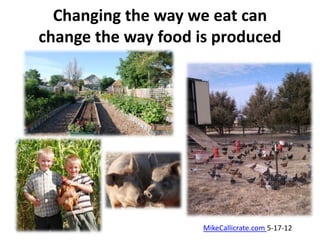
Changing the way we eat can
change the way food is produced


                     MikeCallicrate.com 5-17-12
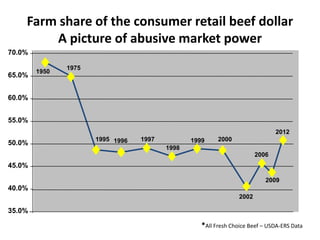
Farm share of the consumer retail beef dollar
        A picture of abusive market power
70.0%

               1975
        1950
65.0%


60.0%


55.0%
                                                                                 2012
                      1995 1996   1997          1999       2000
50.0%
                                         1998
                                                                          2006
45.0%

                                                                             2009
40.0%
                                                                   2002

35.0%
          1    2      3     4      5      6      7          8         9

                                                     *All Fresh Choice Beef – USDA-ERS Data
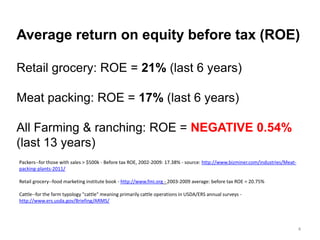
Average return on equity before tax (ROE)

Retail grocery: ROE = 21% (last 6 years)

Meat packing: ROE = 17% (last 6 years)

All Farming & ranching: ROE = NEGATIVE 0.54%
(last 13 years)
Packers--for those with sales > $500k - Before tax ROE, 2002-2009: 17.38% - source: http://www.bizminer.com/industries/Meat-
packing-plants-2011/

Retail grocery--food marketing institute book - http://www.fmi.org - 2003-2009 average: before tax ROE = 20.75%

Cattle--for the farm typology "cattle" meaning primarily cattle operations in USDA/ERS annual surveys -
http://www.ers.usda.gov/Briefing/ARMS/


                                                                                                                               4
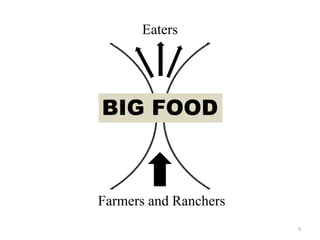
Eaters


BIG FOOD


Farmers and Ranchers
                       5
BIG FOOD - Where the takers reside
– the big corporations, the CEOs, the
bureaucrats, the politicians, the brokers,
the middlemen, agents and certifiers.

They create nothing. They produce no
wealth. They extract, exploit, abuse and
enslave. They mine our soils and pollute.
They make us sick. They operate above
the law.
Vincent C. Vickers, Governor of the Bank
of England in 1910, described them as
“drones of the national beehive.”

“They live and are dependent upon the
honey that others collect. Like the
unemployed, they are supported at the
cost of the nation.”
He said, “If productive industry could cut
out the intervening profit of the
middleman and trade direct with the
individual consumers of their products,
there would follow an immediate
demand throughout the country for a
much greater production, necessitating
an increased employment of labour and
therefore an eventual reduction of
taxation.”
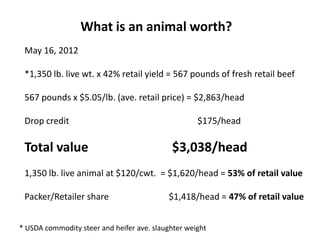
What is an animal worth?
 May 16, 2012

 *1,350 lb. live wt. x 42% retail yield = 567 pounds of fresh retail beef

 567 pounds x $5.05/lb. (ave. retail price) = $2,863/head

 Drop credit                                        $175/head

 Total value                                $3,038/head
 1,350 lb. live animal at $120/cwt. = $1,620/head = 53% of retail value

 Packer/Retailer share                     $1,418/head = 47% of retail value


* USDA commodity steer and heifer ave. slaughter weight
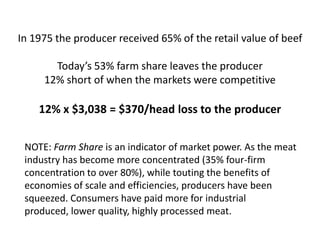
In 1975 the producer received 65% of the retail value of beef

       Today’s 53% farm share leaves the producer
     12% short of when the markets were competitive

    12% x $3,038 = $370/head loss to the producer


 NOTE: Farm Share is an indicator of market power. As the meat
 industry has become more concentrated (35% four-firm
 concentration to over 80%), while touting the benefits of
 economies of scale and efficiencies, producers have been
 squeezed. Consumers have paid more for industrial
 produced, lower quality, highly processed meat.
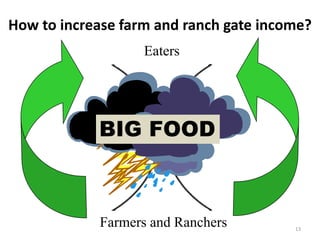
How to increase farm and ranch gate income?
                   Eaters


            BIG FOOD


            Farmers and Ranchers        13
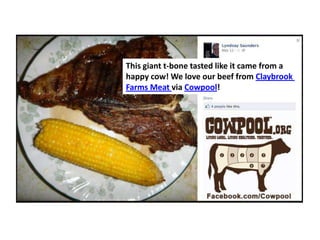
This giant t-bone tasted like it came from a
happy cow! We love our beef from Claybrook
Farms Meat via Cowpool!
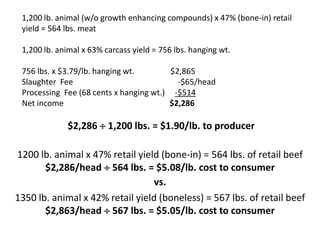
1,200 lb. animal (w/o growth enhancing compounds) x 47% (bone-in) retail
 yield = 564 lbs. meat

 1,200 lb. animal x 63% carcass yield = 756 lbs. hanging wt.

 756 lbs. x $3.79/lb. hanging wt.        $2,865
 Slaughter Fee                             -$65/head
 Processing Fee (68 cents x hanging wt.) -$514
 Net income                             $2,286

             $2,286  1,200 lbs. = $1.90/lb. to producer

1200 lb. animal x 47% retail yield (bone-in) = 564 lbs. of retail beef
       $2,286/head  564 lbs. = $5.08/lb. cost to consumer
                                  vs.
1350 lb. animal x 42% retail yield (boneless) = 567 lbs. of retail beef
       $2,863/head  567 lbs. = $5.05/lb. cost to consumer
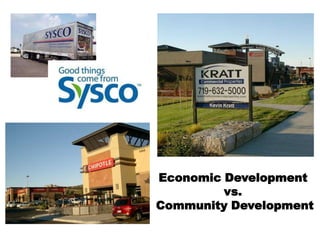
Economic Development
         vs.
Community Development
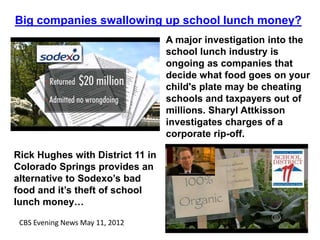
Big companies swallowing up school lunch money?
                                  A major investigation into the
                                  school lunch industry is
                                  ongoing as companies that
                                  decide what food goes on your
                                  child's plate may be cheating
                                  schools and taxpayers out of
                                  millions. Sharyl Attkisson
                                  investigates charges of a
                                  corporate rip-off.

Rick Hughes with District 11 in
Colorado Springs provides an
alternative to Sodexo’s bad
food and it’s theft of school
lunch money…

 CBS Evening News May 11, 2012
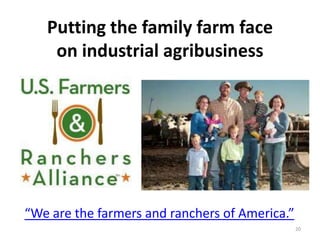
Putting the family farm face
    on industrial agribusiness


“We are the farmers and ranchers of America.”
                                                20
Cargill, Safeway Go Locavore in Colorado


September 13, 2012 - FORT MORGAN, Colo.—Cargill
and Safeway have announced a collaboration that
will bring “Colorado Proud” beef products to Safeway
stores throughout Colorado as part of the retailer’s
Rancher’s Reserve Tender Beef line.
                                                       21
Tyson launches unique new audit
program for on-farm animal treatment


10/12/12 - Tyson Foods, Inc. has launched a
company-wide auditing program to monitor the
treatment of animals by the 12,000 livestock and
poultry farmers that supply the company.
                                                   22
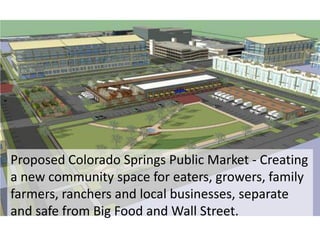
Proposed Colorado Springs Public Market - Creating
a new community space for eaters, growers, family
farmers, ranchers and local businesses, separate
and safe from Big Food and Wall Street.

Rocky Mountain Farmers Union and HSUS's Meeting of the Markets

  • 1.
    Meeting of theMarkets Building connections between producers and eaters October 15, 2012 By Mike Callicrate
  • 2.
    Changing the waywe eat can change the way food is produced MikeCallicrate.com 5-17-12
  • 3.
    Farm share ofthe consumer retail beef dollar A picture of abusive market power 70.0% 1975 1950 65.0% 60.0% 55.0% 2012 1995 1996 1997 1999 2000 50.0% 1998 2006 45.0% 2009 40.0% 2002 35.0% 1 2 3 4 5 6 7 8 9 *All Fresh Choice Beef – USDA-ERS Data
  • 4.
    Average return onequity before tax (ROE) Retail grocery: ROE = 21% (last 6 years) Meat packing: ROE = 17% (last 6 years) All Farming & ranching: ROE = NEGATIVE 0.54% (last 13 years) Packers--for those with sales > $500k - Before tax ROE, 2002-2009: 17.38% - source: http://www.bizminer.com/industries/Meat- packing-plants-2011/ Retail grocery--food marketing institute book - http://www.fmi.org - 2003-2009 average: before tax ROE = 20.75% Cattle--for the farm typology "cattle" meaning primarily cattle operations in USDA/ERS annual surveys - http://www.ers.usda.gov/Briefing/ARMS/ 4
  • 5.
  • 6.
    BIG FOOD -Where the takers reside – the big corporations, the CEOs, the bureaucrats, the politicians, the brokers, the middlemen, agents and certifiers. They create nothing. They produce no wealth. They extract, exploit, abuse and enslave. They mine our soils and pollute. They make us sick. They operate above the law.
  • 7.
    Vincent C. Vickers,Governor of the Bank of England in 1910, described them as “drones of the national beehive.” “They live and are dependent upon the honey that others collect. Like the unemployed, they are supported at the cost of the nation.”
  • 8.
    He said, “Ifproductive industry could cut out the intervening profit of the middleman and trade direct with the individual consumers of their products, there would follow an immediate demand throughout the country for a much greater production, necessitating an increased employment of labour and therefore an eventual reduction of taxation.”
  • 9.
    What is ananimal worth? May 16, 2012 *1,350 lb. live wt. x 42% retail yield = 567 pounds of fresh retail beef 567 pounds x $5.05/lb. (ave. retail price) = $2,863/head Drop credit $175/head Total value $3,038/head 1,350 lb. live animal at $120/cwt. = $1,620/head = 53% of retail value Packer/Retailer share $1,418/head = 47% of retail value * USDA commodity steer and heifer ave. slaughter weight
  • 10.
    In 1975 theproducer received 65% of the retail value of beef Today’s 53% farm share leaves the producer 12% short of when the markets were competitive 12% x $3,038 = $370/head loss to the producer NOTE: Farm Share is an indicator of market power. As the meat industry has become more concentrated (35% four-firm concentration to over 80%), while touting the benefits of economies of scale and efficiencies, producers have been squeezed. Consumers have paid more for industrial produced, lower quality, highly processed meat.
  • 11.
    How to increasefarm and ranch gate income? Eaters BIG FOOD Farmers and Ranchers 13
  • 12.
    This giant t-bonetasted like it came from a happy cow! We love our beef from Claybrook Farms Meat via Cowpool!
  • 13.
    1,200 lb. animal(w/o growth enhancing compounds) x 47% (bone-in) retail yield = 564 lbs. meat 1,200 lb. animal x 63% carcass yield = 756 lbs. hanging wt. 756 lbs. x $3.79/lb. hanging wt. $2,865 Slaughter Fee -$65/head Processing Fee (68 cents x hanging wt.) -$514 Net income $2,286 $2,286  1,200 lbs. = $1.90/lb. to producer 1200 lb. animal x 47% retail yield (bone-in) = 564 lbs. of retail beef $2,286/head  564 lbs. = $5.08/lb. cost to consumer vs. 1350 lb. animal x 42% retail yield (boneless) = 567 lbs. of retail beef $2,863/head  567 lbs. = $5.05/lb. cost to consumer
  • 16.
    Economic Development vs. Community Development
  • 17.
    Big companies swallowingup school lunch money? A major investigation into the school lunch industry is ongoing as companies that decide what food goes on your child's plate may be cheating schools and taxpayers out of millions. Sharyl Attkisson investigates charges of a corporate rip-off. Rick Hughes with District 11 in Colorado Springs provides an alternative to Sodexo’s bad food and it’s theft of school lunch money… CBS Evening News May 11, 2012
  • 18.
    Putting the familyfarm face on industrial agribusiness “We are the farmers and ranchers of America.” 20
  • 19.
    Cargill, Safeway GoLocavore in Colorado September 13, 2012 - FORT MORGAN, Colo.—Cargill and Safeway have announced a collaboration that will bring “Colorado Proud” beef products to Safeway stores throughout Colorado as part of the retailer’s Rancher’s Reserve Tender Beef line. 21
  • 20.
    Tyson launches uniquenew audit program for on-farm animal treatment 10/12/12 - Tyson Foods, Inc. has launched a company-wide auditing program to monitor the treatment of animals by the 12,000 livestock and poultry farmers that supply the company. 22
  • 22.
    Proposed Colorado SpringsPublic Market - Creating a new community space for eaters, growers, family farmers, ranchers and local businesses, separate and safe from Big Food and Wall Street.