Brenda L. Boetel Extension Livestock Marketing Specialist University of Wisconsin-River Falls
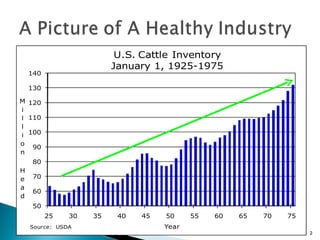
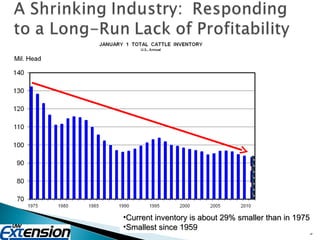
Current inventory is about 29% smaller than in 1975 Smallest since 1959
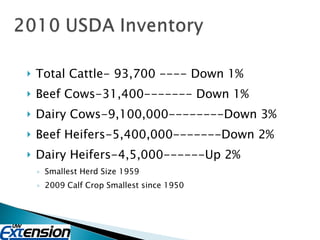
Total Cattle- 93,700 ---- Down 1% Beef Cows-31,400------- Down 1% Dairy Cows-9,100,000--------Down 3% Beef Heifers-5,400,000-------Down 2% Dairy Heifers-4,5,000------Up 2% Smallest Herd Size 1959 2009 Calf Crop Smallest since 1950
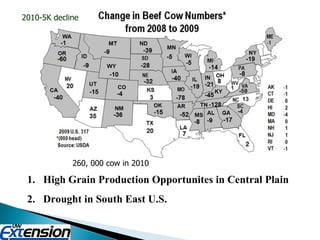
High Grain Production Opportunites in Central Plain Drought in South East U.S. 2010-5K decline 260, 000 cow in 2010
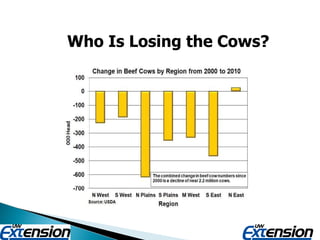
Who Is Losing the Cows?
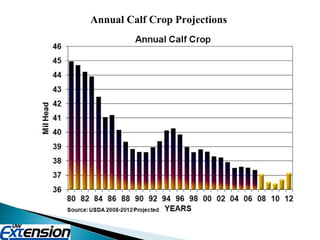
Annual Calf Crop Projections
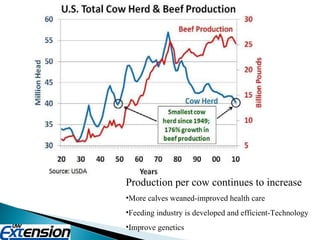
Production per cow continues to increase More calves weaned-improved health care Feeding industry is developed and efficient-Technology Improve genetics
Demand Exchange rate  Alternative meats Consumer income Byproduct Value Supply Recent prices and returns Cow slaughter and inventory Weights and beef production Past Prices and Seasonality Outlook
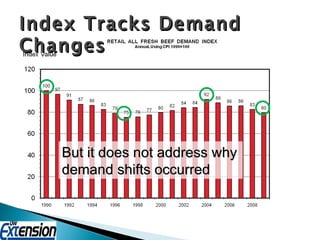
Index Tracks Demand Changes But it does not address why demand shifts occurred
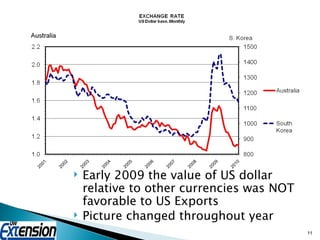
Early 2009 the value of US dollar relative to other currencies was NOT favorable to US Exports Picture changed throughout year
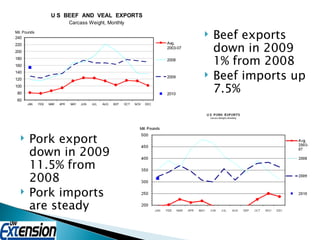
Pork export down in 2009 11.5% from 2008 Pork imports are steady Beef exports down in 2009 1% from 2008 Beef imports up 7.5%
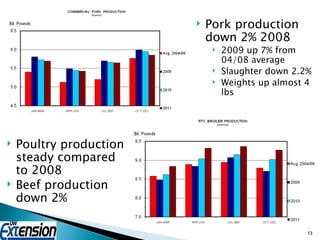
Pork production down 2% 2008 2009 up 7% from 04/08 average Slaughter down 2.2% Weights up almost 4 lbs Poultry production steady compared to 2008 Beef production down 2%
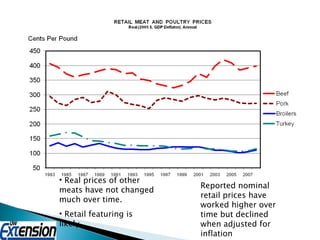
Real prices of other meats have not changed much over time.  Retail featuring is likely. Reported nominal retail prices have worked higher over time but declined when adjusted for inflation
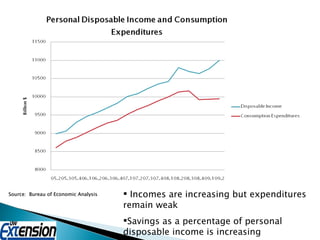
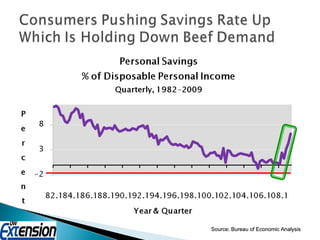
Incomes are increasing but expenditures remain weak Savings as a percentage of personal disposable income is increasing Source:  Bureau of Economic Analysis
Source: Bureau of Economic Analysis
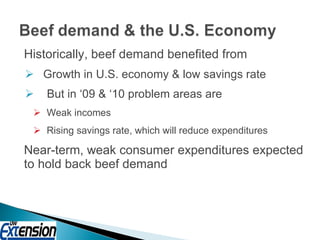
Historically, beef demand benefited from Growth in U.S. economy & low savings rate But in ‘09 & ‘10 problem areas are Weak incomes Rising savings rate, which will reduce expenditures Near-term, weak consumer expenditures expected to hold back beef demand
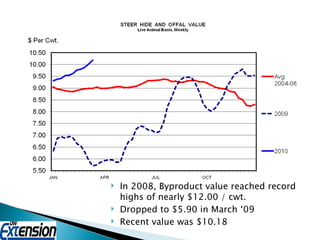
In 2008, Byproduct value reached record highs of nearly $12.00 / cwt. Dropped to $5.90 in March ‘09 Recent value was $10.18
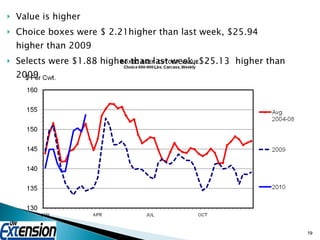
Value is higher Choice boxes were $ 2.21higher than last week, $25.94 higher than 2009 Selects were $1.88 higher than last week, $25.13  higher than 2009
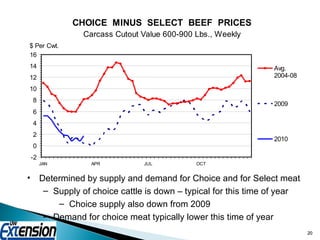
Determined by supply and demand for Choice and for Select meat Supply of choice cattle is down – typical for this time of year Choice supply also down from 2009 Demand for choice meat typically lower this time of year
Beef is more affected than any other protein by the economic situation Look for continued weak domestic demand International demand will depend on alternative protein production, value of the dollar, trade restrictions
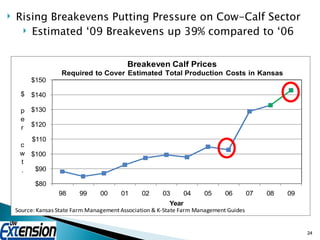
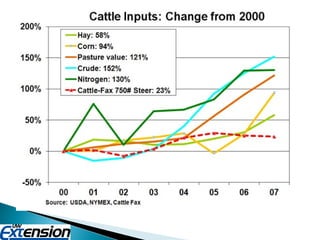
Cow-Calf Production costs rising rapidly Up almost 30% from 2005  Feed costs have helped drive up production costs Record high hay prices are coming down Rising breakevens putting pressure on cow-calf sector Estimated ‘09 breakevens up 39% compared to 2006
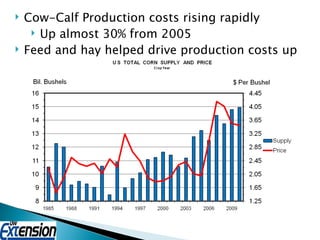
Cow-Calf Production costs rising rapidly Up almost 30% from 2005 Feed and hay helped drive production costs up
Rising Breakevens Putting Pressure on Cow-Calf Sector Estimated ‘09 Breakevens up 39% compared to ‘06
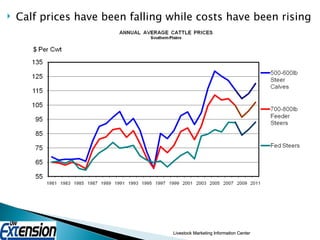
Livestock Marketing Information Center Calf prices have been falling while costs have been rising
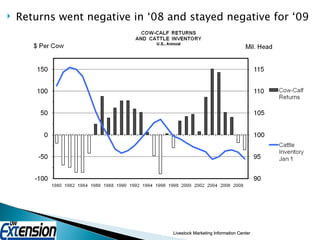
Livestock Marketing Information Center Returns went negative in ‘08 and stayed negative for ‘09
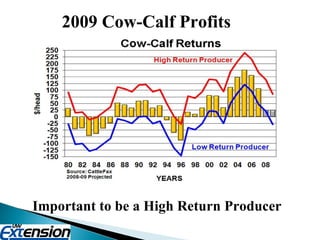
Important to be a High Return Producer 2009 Cow-Calf Profits
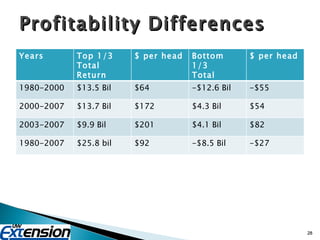
Profitability Differences Years Top 1/3 Total Return $ per head Bottom 1/3 Total Return $ per head 1980-2000 $13.5 Bil $64 -$12.6 Bil -$55 2000-2007 $13.7 Bil $172 $4.3 Bil $54 2003-2007 $9.9 Bil $201 $4.1 Bil $82 1980-2007 $25.8 bil $92 -$8.5 Bil -$27
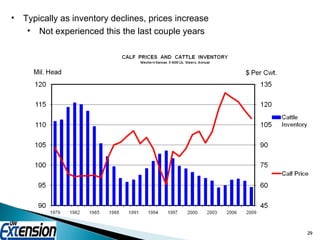
Typically as inventory declines, prices increase Not experienced this the last couple years
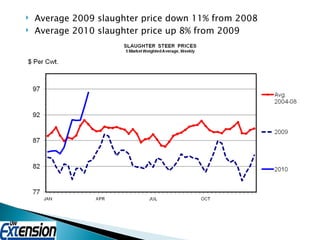
Average 2009 slaughter price down 11% from 2008 Average 2010 slaughter price up 8% from 2009
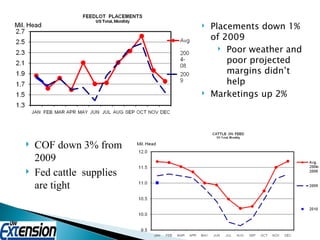
COF down 3% from 2009 Fed cattle  supplies are tight Placements down 1% of 2009 Poor weather and poor projected margins didn’t help Marketings up 2%
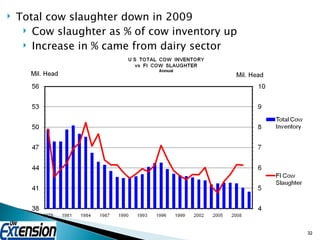
Total cow slaughter down in 2009 Cow slaughter as % of cow inventory up Increase in % came from dairy sector
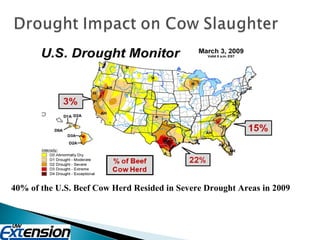
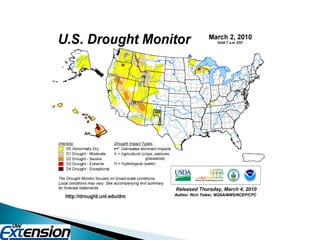
40% of the U.S. Beef Cow Herd Resided in Severe Drought Areas in 2009
 
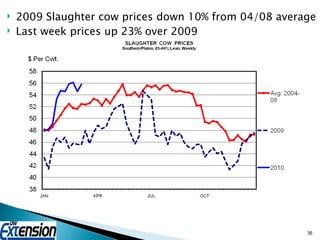
2009 Slaughter cow prices down 10% from 04/08 average Last week prices up 23% over 2009
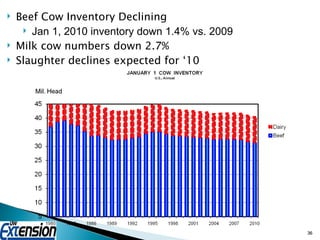
Beef Cow Inventory Declining Jan 1, 2010 inventory down 1.4% vs. 2009 Milk cow numbers down 2.7% Slaughter declines expected for ‘10
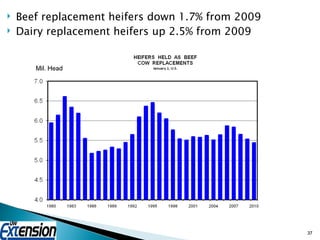
Beef replacement heifers down 1.7% from 2009 Dairy replacement heifers up 2.5% from 2009
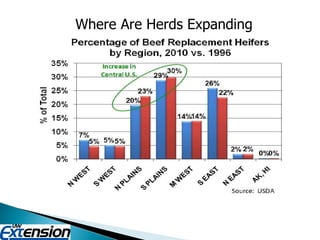
Where Are Herds Expanding
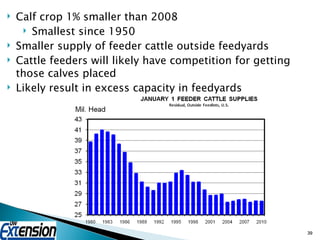
Calf crop 1% smaller than 2008 Smallest since 1950 Smaller supply of feeder cattle outside feedyards Cattle feeders will likely have competition for getting those calves placed Likely result in excess capacity in feedyards
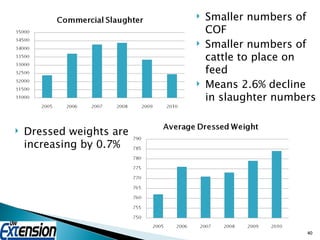
Smaller numbers of COF Smaller numbers of cattle to place on feed Means 2.6% decline in slaughter numbers Dressed weights are increasing by 0.7%
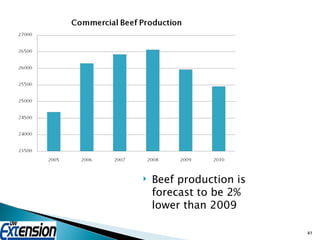
Beef production is forecast to be 2% lower than 2009
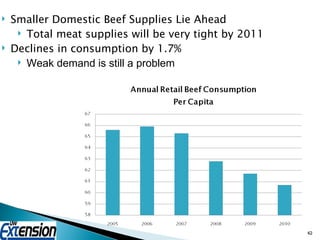
Smaller Domestic Beef Supplies Lie Ahead Total meat supplies will be very tight by 2011 Declines in consumption by 1.7% Weak demand is still a problem
Smaller cattle supplies have supported calf and feeder cattle prices Lower corn prices have supported prices, particularly calf prices Weak domestic but improving international demand Higher byproduct prices
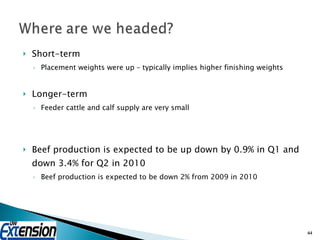
Short-term Placement weights were up – typically implies higher finishing weights Longer-term Feeder cattle and calf supply are very small Beef production is expected to be up down by 0.9% in Q1 and down 3.4% for Q2 in 2010 Beef production is expected to be down 2% from 2009 in 2010
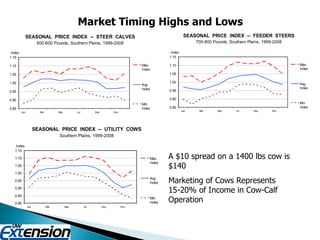
Market Timing Highs and Lows A $10 spread on a 1400 lbs cow is $140  Marketing of Cows Represents 15-20% of Income in Cow-Calf Operation
 
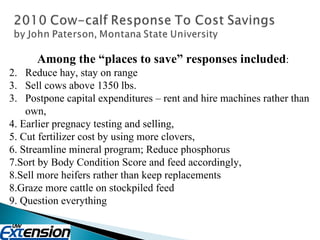
Among the “places to save” responses included : Reduce hay, stay on range Sell cows above 1350 lbs. 3.  Postpone capital expenditures – rent and hire machines rather than own,  4. Earlier pregnacy testing and selling,  5. Cut fertilizer cost by using more clovers, 6. Streamline mineral program; Reduce phosphorus  7.Sort by Body Condition Score and feed accordingly,  8.Sell more heifers rather than keep replacements  8.Graze more cattle on stockpiled feed  9. Question everything
Where did these producers think were the places  to  spend money in their operations this year? Responses included : Protein, mineral and vaccines,  Testing and monitoring – PI calves, soils, feedstuffs and range  Continuing education  Spend time and money on maintenance and extend life expectancy of equipment  Animal ID  Keep good ranch help  Pasture renovation  In synthesizing the responses, Paterson says he thinks the top five important places to cut costs are :  Cut hay waste  Feed more crop residue such as straw  Weigh and sort cows  Body condition score and sort the herd  Supplement wisely based on forage analysis
The five places Paterson believes are worthy to spend this year include: 1. Mineral supplementation, specifically phosphorus, copper, zinc and selenium, 2. Forage analysis 3. Preg testing 4. Implants/ionophores 5. Herd biosecurity He concludes: It will be important for producers to balance rations, remember that health and nutrition go together, use straw in rations, price supplements based on both nutrient and non-nutrient costs, and know the weight of your cows
Below average annual cow costs Lower than average calf breakeven prices Lower feed cost Lower interest expenses  (less debt) Lower general operating expenses Higher averaging weaning weights Higher conception rates More pound weaned per cow exposed High quality bulls with strong genetics Preventative herd health plans High quality pastures  (maintain nutritional requirements of the cow)
Live cattle (IA-MN market) Q1 2010 $86-88 Q2 2010 $87-90 Q3 2010 $83-87 Q4 2010 $86-89 Feeder Cattle 700-800# Southern Plains Q1 2010 $99-101 Q2 2010 $100-103 Q3 2010 $102-108 Q4 2010 $99-107 Feeder Cattle 500-600# Southern Plains Q1 2010 $115-117 Q2 2010 $117-121 Q3 2010 $117-123 Q4 2010 $109-118
Cattle Inventories Have Flattened Corn Prices are Affecting Production Costs Beef Prices Are Moving Up Heifer Retention is lower by 2% Higher Feeder Calf Prices Expected Profitable Situation For Cow-calf Producers and feedlot owners Cattle Slaughter Weights Will Go Up Price Increases Tied to Asian Export Markets Reopening but Premium Market Competitive Meat Prices will go UP as inventory declines
Any Questions? [email_address] Graphs:  LMIC –  www.lmic.info Data: LMIC, USDA-NASS

2010 Cow Calf Outlook

  • 1.
    Brenda L. BoetelExtension Livestock Marketing Specialist University of Wisconsin-River Falls
  • 3.
    Current inventory isabout 29% smaller than in 1975 Smallest since 1959
  • 4.
    Total Cattle- 93,700---- Down 1% Beef Cows-31,400------- Down 1% Dairy Cows-9,100,000--------Down 3% Beef Heifers-5,400,000-------Down 2% Dairy Heifers-4,5,000------Up 2% Smallest Herd Size 1959 2009 Calf Crop Smallest since 1950
  • 5.
    High Grain ProductionOpportunites in Central Plain Drought in South East U.S. 2010-5K decline 260, 000 cow in 2010
  • 6.
    Who Is Losingthe Cows?
  • 7.
    Annual Calf CropProjections
  • 8.
    Production per cowcontinues to increase More calves weaned-improved health care Feeding industry is developed and efficient-Technology Improve genetics
  • 9.
    Demand Exchange rate Alternative meats Consumer income Byproduct Value Supply Recent prices and returns Cow slaughter and inventory Weights and beef production Past Prices and Seasonality Outlook
  • 10.
    Index Tracks DemandChanges But it does not address why demand shifts occurred
  • 11.
    Early 2009 thevalue of US dollar relative to other currencies was NOT favorable to US Exports Picture changed throughout year
  • 12.
    Pork export downin 2009 11.5% from 2008 Pork imports are steady Beef exports down in 2009 1% from 2008 Beef imports up 7.5%
  • 13.
    Pork production down2% 2008 2009 up 7% from 04/08 average Slaughter down 2.2% Weights up almost 4 lbs Poultry production steady compared to 2008 Beef production down 2%
  • 14.
    Real prices ofother meats have not changed much over time. Retail featuring is likely. Reported nominal retail prices have worked higher over time but declined when adjusted for inflation
  • 15.
    Incomes are increasingbut expenditures remain weak Savings as a percentage of personal disposable income is increasing Source: Bureau of Economic Analysis
  • 16.
    Source: Bureau ofEconomic Analysis
  • 17.
    Historically, beef demandbenefited from Growth in U.S. economy & low savings rate But in ‘09 & ‘10 problem areas are Weak incomes Rising savings rate, which will reduce expenditures Near-term, weak consumer expenditures expected to hold back beef demand
  • 18.
    In 2008, Byproductvalue reached record highs of nearly $12.00 / cwt. Dropped to $5.90 in March ‘09 Recent value was $10.18
  • 19.
    Value is higherChoice boxes were $ 2.21higher than last week, $25.94 higher than 2009 Selects were $1.88 higher than last week, $25.13 higher than 2009
  • 20.
    Determined by supplyand demand for Choice and for Select meat Supply of choice cattle is down – typical for this time of year Choice supply also down from 2009 Demand for choice meat typically lower this time of year
  • 21.
    Beef is moreaffected than any other protein by the economic situation Look for continued weak domestic demand International demand will depend on alternative protein production, value of the dollar, trade restrictions
  • 22.
    Cow-Calf Production costsrising rapidly Up almost 30% from 2005 Feed costs have helped drive up production costs Record high hay prices are coming down Rising breakevens putting pressure on cow-calf sector Estimated ‘09 breakevens up 39% compared to 2006
  • 23.
    Cow-Calf Production costsrising rapidly Up almost 30% from 2005 Feed and hay helped drive production costs up
  • 24.
    Rising Breakevens PuttingPressure on Cow-Calf Sector Estimated ‘09 Breakevens up 39% compared to ‘06
  • 25.
    Livestock Marketing InformationCenter Calf prices have been falling while costs have been rising
  • 26.
    Livestock Marketing InformationCenter Returns went negative in ‘08 and stayed negative for ‘09
  • 27.
    Important to bea High Return Producer 2009 Cow-Calf Profits
  • 28.
    Profitability Differences YearsTop 1/3 Total Return $ per head Bottom 1/3 Total Return $ per head 1980-2000 $13.5 Bil $64 -$12.6 Bil -$55 2000-2007 $13.7 Bil $172 $4.3 Bil $54 2003-2007 $9.9 Bil $201 $4.1 Bil $82 1980-2007 $25.8 bil $92 -$8.5 Bil -$27
  • 29.
    Typically as inventorydeclines, prices increase Not experienced this the last couple years
  • 30.
    Average 2009 slaughterprice down 11% from 2008 Average 2010 slaughter price up 8% from 2009
  • 31.
    COF down 3%from 2009 Fed cattle supplies are tight Placements down 1% of 2009 Poor weather and poor projected margins didn’t help Marketings up 2%
  • 32.
    Total cow slaughterdown in 2009 Cow slaughter as % of cow inventory up Increase in % came from dairy sector
  • 33.
    40% of theU.S. Beef Cow Herd Resided in Severe Drought Areas in 2009
  • 34.
  • 35.
    2009 Slaughter cowprices down 10% from 04/08 average Last week prices up 23% over 2009
  • 36.
    Beef Cow InventoryDeclining Jan 1, 2010 inventory down 1.4% vs. 2009 Milk cow numbers down 2.7% Slaughter declines expected for ‘10
  • 37.
    Beef replacement heifersdown 1.7% from 2009 Dairy replacement heifers up 2.5% from 2009
  • 38.
    Where Are HerdsExpanding
  • 39.
    Calf crop 1%smaller than 2008 Smallest since 1950 Smaller supply of feeder cattle outside feedyards Cattle feeders will likely have competition for getting those calves placed Likely result in excess capacity in feedyards
  • 40.
    Smaller numbers ofCOF Smaller numbers of cattle to place on feed Means 2.6% decline in slaughter numbers Dressed weights are increasing by 0.7%
  • 41.
    Beef production isforecast to be 2% lower than 2009
  • 42.
    Smaller Domestic BeefSupplies Lie Ahead Total meat supplies will be very tight by 2011 Declines in consumption by 1.7% Weak demand is still a problem
  • 43.
    Smaller cattle supplieshave supported calf and feeder cattle prices Lower corn prices have supported prices, particularly calf prices Weak domestic but improving international demand Higher byproduct prices
  • 44.
    Short-term Placement weightswere up – typically implies higher finishing weights Longer-term Feeder cattle and calf supply are very small Beef production is expected to be up down by 0.9% in Q1 and down 3.4% for Q2 in 2010 Beef production is expected to be down 2% from 2009 in 2010
  • 45.
    Market Timing Highsand Lows A $10 spread on a 1400 lbs cow is $140 Marketing of Cows Represents 15-20% of Income in Cow-Calf Operation
  • 46.
  • 47.
    Among the “placesto save” responses included : Reduce hay, stay on range Sell cows above 1350 lbs. 3. Postpone capital expenditures – rent and hire machines rather than own, 4. Earlier pregnacy testing and selling, 5. Cut fertilizer cost by using more clovers, 6. Streamline mineral program; Reduce phosphorus 7.Sort by Body Condition Score and feed accordingly, 8.Sell more heifers rather than keep replacements 8.Graze more cattle on stockpiled feed 9. Question everything
  • 48.
    Where did theseproducers think were the places to spend money in their operations this year? Responses included : Protein, mineral and vaccines, Testing and monitoring – PI calves, soils, feedstuffs and range Continuing education Spend time and money on maintenance and extend life expectancy of equipment Animal ID Keep good ranch help Pasture renovation In synthesizing the responses, Paterson says he thinks the top five important places to cut costs are : Cut hay waste Feed more crop residue such as straw Weigh and sort cows Body condition score and sort the herd Supplement wisely based on forage analysis
  • 49.
    The five placesPaterson believes are worthy to spend this year include: 1. Mineral supplementation, specifically phosphorus, copper, zinc and selenium, 2. Forage analysis 3. Preg testing 4. Implants/ionophores 5. Herd biosecurity He concludes: It will be important for producers to balance rations, remember that health and nutrition go together, use straw in rations, price supplements based on both nutrient and non-nutrient costs, and know the weight of your cows
  • 50.
    Below average annualcow costs Lower than average calf breakeven prices Lower feed cost Lower interest expenses (less debt) Lower general operating expenses Higher averaging weaning weights Higher conception rates More pound weaned per cow exposed High quality bulls with strong genetics Preventative herd health plans High quality pastures (maintain nutritional requirements of the cow)
  • 51.
    Live cattle (IA-MNmarket) Q1 2010 $86-88 Q2 2010 $87-90 Q3 2010 $83-87 Q4 2010 $86-89 Feeder Cattle 700-800# Southern Plains Q1 2010 $99-101 Q2 2010 $100-103 Q3 2010 $102-108 Q4 2010 $99-107 Feeder Cattle 500-600# Southern Plains Q1 2010 $115-117 Q2 2010 $117-121 Q3 2010 $117-123 Q4 2010 $109-118
  • 52.
    Cattle Inventories HaveFlattened Corn Prices are Affecting Production Costs Beef Prices Are Moving Up Heifer Retention is lower by 2% Higher Feeder Calf Prices Expected Profitable Situation For Cow-calf Producers and feedlot owners Cattle Slaughter Weights Will Go Up Price Increases Tied to Asian Export Markets Reopening but Premium Market Competitive Meat Prices will go UP as inventory declines
  • 53.
    Any Questions? [email_address]Graphs: LMIC – www.lmic.info Data: LMIC, USDA-NASS

Editor's Notes

  • #12 As slowdown in the global economy eases, the pruchasing power of foreign buyers should recover and be supportive to meat exports With lower US dollar though imports such as oil cost more. The increase in dollar limited imports of feeder and slaughter animals from Canada. (currently US dollar about 16% lower than last year)
  • #14 Pork production is up 1% or so this year as heavier hogs have compensated for larger decline in slaughter numbers. Slaughter is down
  • #19 The international market drives the byproduct value.  Last summer, high oil and feedstuff prices drove byproduct values to record highs, however as the economy collapsed so did the prices for those items. Byproduct values did improve this summer in response to tighter cattle supplies and gains in the domestic and global economies; however, those gains were short li Last year, as reported by USDA-AMS, the steer byproduct value skyrocketed to record highs reaching a near $12.00 per cwt. on a live steer basis in July 2008.  Since then the byproduct value has generally declined, falling to a monthly low of $5.90 per cwt. in March of this year.  During the second and third quarters, the byproduct value modestly strengthened averaging over $9.00 per cwt. in August and September.  However, the byproduct value was still 22 percent or $2.00 to $3.00 per cwt. lower than the respective months last year.  During the first nine months of 2009, the byproduct value averaged slightly over $7.19 per cwt., about $4.00 less than in 2008.  In October, the byproduct value has continued to slip, falling to $8.00 per cwt. by mid-October vs. over $10.00 per cwt. for the corresponding week in 2008, with the monthly average estimated to be in the low $8.00 per cwt. range.ved as byproduct values have softened recently.
  • #20 Supplies are at or near highs Price gains will be easier to achieve as supplies decrease
  • #21 Spread will not widen to typical $10 - $12 range as the supply is too great. Slaughter weights typically decline through the end of the year and slaughter numbers also decline as the year progresses.