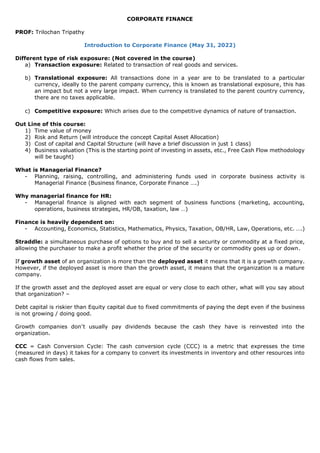
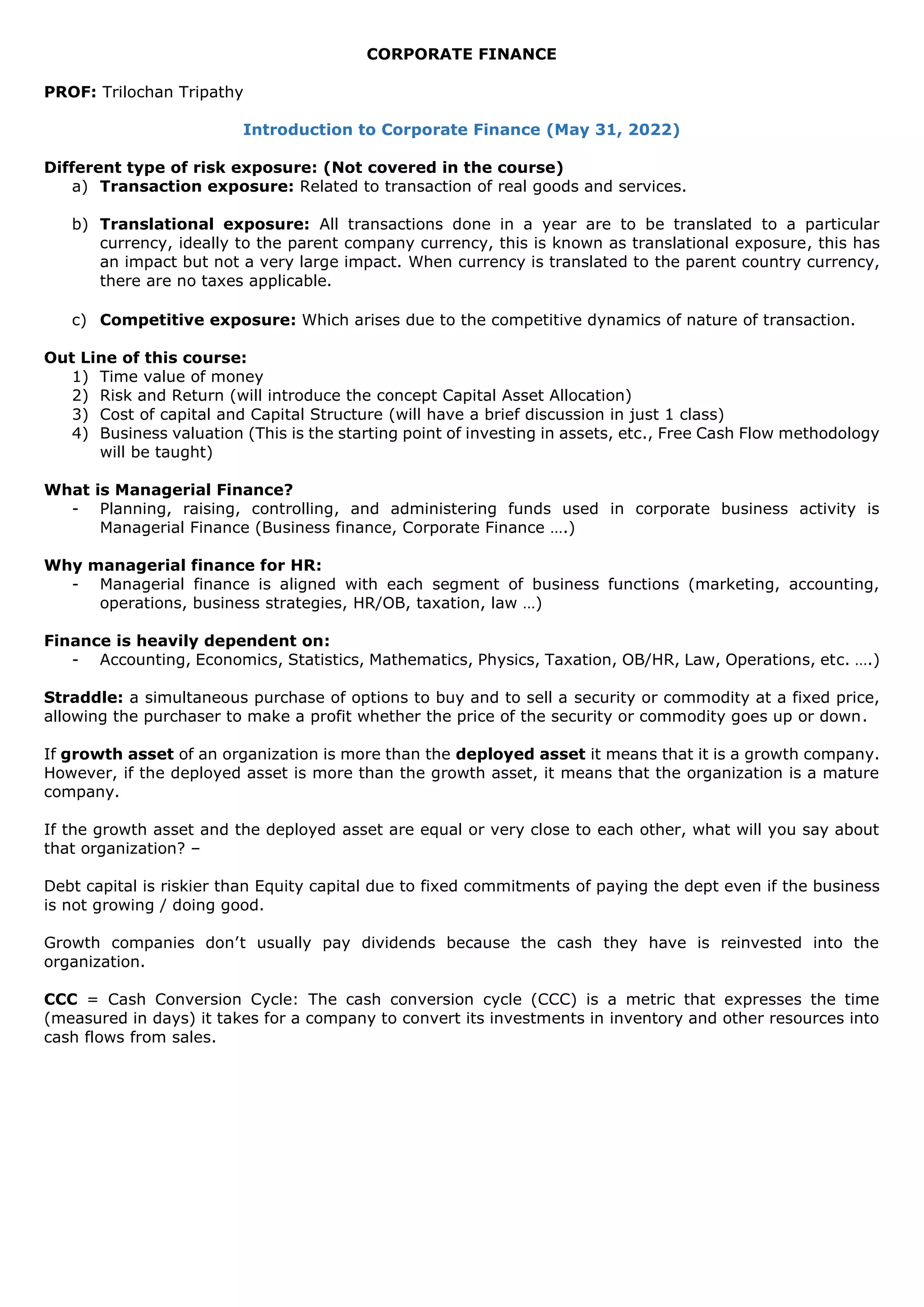
CORPORATE FINANCE
PROF: Trilochan Tripathy
Introduction to Corporate Finance (May 31, 2022)
Different type of risk exposure: (Not covered in the course)
a) Transaction exposure: Related to transaction of real goods and services.
b) Translational exposure: All transactions done in a year are to be translated to a particular
currency, ideally to the parent company currency, this is known as translational exposure, this has
an impact but not a very large impact. When currency is translated to the parent country currency,
there are no taxes applicable.
c) Competitive exposure: Which arises due to the competitive dynamics of nature of transaction.
Out Line of this course:
1) Time value of money
2) Risk and Return (will introduce the concept Capital Asset Allocation)
3) Cost of capital and Capital Structure (will have a brief discussion in just 1 class)
4) Business valuation (This is the starting point of investing in assets, etc., Free Cash Flow methodology
will be taught)
What is Managerial Finance?
- Planning, raising, controlling, and administering funds used in corporate business activity is
Managerial Finance (Business finance, Corporate Finance ….)
Why managerial finance for HR:
- Managerial finance is aligned with each segment of business functions (marketing, accounting,
operations, business strategies, HR/OB, taxation, law …)
Finance is heavily dependent on:
- Accounting, Economics, Statistics, Mathematics, Physics, Taxation, OB/HR, Law, Operations, etc. ….)
Straddle: a simultaneous purchase of options to buy and to sell a security or commodity at a fixed price,
allowing the purchaser to make a profit whether the price of the security or commodity goes up or down.
If growth asset of an organization is more than the deployed asset it means that it is a growth company.
However, if the deployed asset is more than the growth asset, it means that the organization is a mature
company.
If the growth asset and the deployed asset are equal or very close to each other, what will you say about
that organization? –
Debt capital is riskier than Equity capital due to fixed commitments of paying the dept even if the business
is not growing / doing good.
Growth companies don’t usually pay dividends because the cash they have is reinvested into the
organization.
CCC = Cash Conversion Cycle: The cash conversion cycle (CCC) is a metric that expresses the time
(measured in days) it takes for a company to convert its investments in inventory and other resources into
cash flows from sales.
TIME VALUE OF MONEY
Money has time value because if I invest money today in future it may give positive return if the interest
rate remains positive.
Inflation and rate of interest go hand in hand, if inflation is positive rate of interest will be high and vice-
versa.
Financial Values:
- Present value of Money: = PV = Future Value / [1+r]r
Future value of Money = FV = PV x [1+i]n
For the PV function to work in XL sheet, the PV must be the same, for the NPV function to work in XL sheet,
the PV must be different.
RISK & RETURN: A PRACTICE PERSPECTIVE (June 1, 2022)
While making an investment, we think of risk & return.
Risk – Return Tradeoff: Higher the risk, higher the return and vice-versa.
Beta Measure – Beta is a measure of a stock's volatility in relation to the overall market. By definition, the
market, such as the S&P 500 Index, has a beta of 1.0, and individual stocks are ranked according to how
much they deviate from the market. A stock that swings more than the market over time has a beta above
1.0. For example, a stock with a beta of 0.8 would be expected to return 80% as much as the overall
market. A stock with a beta of 1.2 would move 20% more than the overall market.
Co-Variance: Covariance measures the directional relationship between the returns on two assets. A
positive covariance means that asset returns move together while a negative covariance means they move
inversely.
Risk & Return Fundamentals:
Return:
- Loss or gain experienced from an investment over a period of time Rt = [Pt – Pt-1] / Pt-1 x 100 =
Return, this is called “Discrete Return”
- Holding Period Return: Dividend / Income + Discreet Return
- Dividend % + Discreet Return % = Holding Period Return %
- Capital Gain = Subtract your basis (what you paid) from the realized amount (how much you sold it
for) to determine the difference, and if you want a percentage value, multiply by 100
Price of stock today is 100 and tomorrow it has gone up 120
Pt = Today’s value of the stock
Pt-1 = Yesterday’s value of the stock
Risk:
- Chance of financial loss
- Variability of returns associated with a given asset
- The uncertainty of the returns associated with a given asset
- Standard deviation is a total risk measure
- Beta is a systematic risk measure
Measurement of Risk:
- Standard Deviation
- Variance
- Beta
- Covariance
- Correlation
Gold and Equity are inversely affected to each other. Whenever the market falls gold rises and vice-versa.
Gold and Equity have a negative correlation.
Annualizing Return
- From monthly return to annualized return:
- Annual gross return = [1+Rm]^12-1
- Rm here = monthly return
- Nominal return is the return computed before inflation, post computing inflation the return got is
known as Real / Net return
▪ Leverage Theory: The good news and bad news having the same impact will reduce the stock price
faster than increase it for good news
▪ Systematic Risk cannot be diversified – called as Market Risk, means imposed by the market
▪ Non-systematic Risk can be diversified – Risk taken at an individual / organizational level
▪ Total Risk can be measured by standard deviation
▪ Beta measures the market risk which is the Systematic Risk
CAPM Model (Capital Asset Pricing Model)
E(ri) = rf + [Beta i x (E(rm) – rf)]
- Rl = Alpha + Beta (Rm – Rf)
- Beta = Systematic Risk = Covariance (Rm,Ri) / Variance (Rm). Variance divided by another variance
will always be 1 – but for the MARKET only, for an individual security it will give some figure.
- Rm = Market Return (Also known as Market Average Return) = Rm, also known as Index Return
- Ri = Individual Return
- Rf = Risk free rate (there are no assets which are risk free), Treasury Bond Yield
- Difference between Rm and Rf is known as How much return the market is offering over and above
the risk, also known as Market Risk Premium
- Beta x Difference between Rm and Rf is known as How much return the market is offering over and
above the risk. = Market Risk associated return this is also known as Risk Premium associated with
that security.
- Square of Standard Deviation = Variance
The adjusted closing price amends a stock's closing price to reflect that stock's value after accounting
for any corporate actions. The closing price is the raw price, which is just the cash value of the last
transacted price before the market closes.

Class Notes.pdf

  • 1.
    CORPORATE FINANCE PROF: TrilochanTripathy Introduction to Corporate Finance (May 31, 2022) Different type of risk exposure: (Not covered in the course) a) Transaction exposure: Related to transaction of real goods and services. b) Translational exposure: All transactions done in a year are to be translated to a particular currency, ideally to the parent company currency, this is known as translational exposure, this has an impact but not a very large impact. When currency is translated to the parent country currency, there are no taxes applicable. c) Competitive exposure: Which arises due to the competitive dynamics of nature of transaction. Out Line of this course: 1) Time value of money 2) Risk and Return (will introduce the concept Capital Asset Allocation) 3) Cost of capital and Capital Structure (will have a brief discussion in just 1 class) 4) Business valuation (This is the starting point of investing in assets, etc., Free Cash Flow methodology will be taught) What is Managerial Finance? - Planning, raising, controlling, and administering funds used in corporate business activity is Managerial Finance (Business finance, Corporate Finance ….) Why managerial finance for HR: - Managerial finance is aligned with each segment of business functions (marketing, accounting, operations, business strategies, HR/OB, taxation, law …) Finance is heavily dependent on: - Accounting, Economics, Statistics, Mathematics, Physics, Taxation, OB/HR, Law, Operations, etc. ….) Straddle: a simultaneous purchase of options to buy and to sell a security or commodity at a fixed price, allowing the purchaser to make a profit whether the price of the security or commodity goes up or down. If growth asset of an organization is more than the deployed asset it means that it is a growth company. However, if the deployed asset is more than the growth asset, it means that the organization is a mature company. If the growth asset and the deployed asset are equal or very close to each other, what will you say about that organization? – Debt capital is riskier than Equity capital due to fixed commitments of paying the dept even if the business is not growing / doing good. Growth companies don’t usually pay dividends because the cash they have is reinvested into the organization. CCC = Cash Conversion Cycle: The cash conversion cycle (CCC) is a metric that expresses the time (measured in days) it takes for a company to convert its investments in inventory and other resources into cash flows from sales.
  • 2.
    TIME VALUE OFMONEY Money has time value because if I invest money today in future it may give positive return if the interest rate remains positive. Inflation and rate of interest go hand in hand, if inflation is positive rate of interest will be high and vice- versa. Financial Values: - Present value of Money: = PV = Future Value / [1+r]r Future value of Money = FV = PV x [1+i]n For the PV function to work in XL sheet, the PV must be the same, for the NPV function to work in XL sheet, the PV must be different. RISK & RETURN: A PRACTICE PERSPECTIVE (June 1, 2022) While making an investment, we think of risk & return. Risk – Return Tradeoff: Higher the risk, higher the return and vice-versa. Beta Measure – Beta is a measure of a stock's volatility in relation to the overall market. By definition, the market, such as the S&P 500 Index, has a beta of 1.0, and individual stocks are ranked according to how much they deviate from the market. A stock that swings more than the market over time has a beta above 1.0. For example, a stock with a beta of 0.8 would be expected to return 80% as much as the overall market. A stock with a beta of 1.2 would move 20% more than the overall market. Co-Variance: Covariance measures the directional relationship between the returns on two assets. A positive covariance means that asset returns move together while a negative covariance means they move inversely. Risk & Return Fundamentals: Return: - Loss or gain experienced from an investment over a period of time Rt = [Pt – Pt-1] / Pt-1 x 100 = Return, this is called “Discrete Return” - Holding Period Return: Dividend / Income + Discreet Return - Dividend % + Discreet Return % = Holding Period Return % - Capital Gain = Subtract your basis (what you paid) from the realized amount (how much you sold it for) to determine the difference, and if you want a percentage value, multiply by 100 Price of stock today is 100 and tomorrow it has gone up 120 Pt = Today’s value of the stock Pt-1 = Yesterday’s value of the stock Risk: - Chance of financial loss - Variability of returns associated with a given asset - The uncertainty of the returns associated with a given asset - Standard deviation is a total risk measure - Beta is a systematic risk measure Measurement of Risk: - Standard Deviation - Variance - Beta - Covariance - Correlation
  • 3.
    Gold and Equityare inversely affected to each other. Whenever the market falls gold rises and vice-versa. Gold and Equity have a negative correlation. Annualizing Return - From monthly return to annualized return: - Annual gross return = [1+Rm]^12-1 - Rm here = monthly return - Nominal return is the return computed before inflation, post computing inflation the return got is known as Real / Net return ▪ Leverage Theory: The good news and bad news having the same impact will reduce the stock price faster than increase it for good news ▪ Systematic Risk cannot be diversified – called as Market Risk, means imposed by the market ▪ Non-systematic Risk can be diversified – Risk taken at an individual / organizational level ▪ Total Risk can be measured by standard deviation ▪ Beta measures the market risk which is the Systematic Risk CAPM Model (Capital Asset Pricing Model) E(ri) = rf + [Beta i x (E(rm) – rf)] - Rl = Alpha + Beta (Rm – Rf) - Beta = Systematic Risk = Covariance (Rm,Ri) / Variance (Rm). Variance divided by another variance will always be 1 – but for the MARKET only, for an individual security it will give some figure. - Rm = Market Return (Also known as Market Average Return) = Rm, also known as Index Return - Ri = Individual Return - Rf = Risk free rate (there are no assets which are risk free), Treasury Bond Yield - Difference between Rm and Rf is known as How much return the market is offering over and above the risk, also known as Market Risk Premium - Beta x Difference between Rm and Rf is known as How much return the market is offering over and above the risk. = Market Risk associated return this is also known as Risk Premium associated with that security. - Square of Standard Deviation = Variance The adjusted closing price amends a stock's closing price to reflect that stock's value after accounting for any corporate actions. The closing price is the raw price, which is just the cash value of the last transacted price before the market closes.