Risk -Meaning
Probability of loss?
Magnitude of loss?
Probability of underperforming target?
Types of Risk
 Systematic Risk
 Unsystematic Risk
Systematic Risk
 Non-Diversifiable, Inherent, cannot be
avoided
 Interest-Rate Risk
 Inflation-Rate Risk
 Political Risk
 Market Risk
 Natural Calamities
 War situations
Interest Rate Risk
 Refers to the uncertainty of future market
values and the size of the future income
due to fluctuations in interest Rates
 Investing with borrowed funds becomes
less attractive due to rapid fluctuations
 Low yield bonds and debentures become
less attractive at the prevailing rates in
case of rising rates.
Inflation Rate Risk
 Inflation rate changes represent a risk to both the lender
and the borrower
 Loss of purchasing power due to which real gains from
the investment are much less than the monetary gains
 The real yield from the bonds is much lower than the
nominal interest rate, declining yield affects the market
price of the bonds
 In response to this, many governments have issued real
return bonds (also known as inflation indexed, in which
the principle value and coupon rises each year with the
rate of inflation, with the result that the interest rate on
the bond is a real interest rate.
Example
 For example, if somebody lends Rs.1000 for a
year at 10 percent, and receives Rs.1100 back
at the end of the year, this represents a 10
percent increase in his purchasing power if
prices for the average goods and services that
he buys are unchanged from what they were at
the beginning of the year. However, if the prices
of the food, clothing, housing, and other things
that he wishes to purchase have increased 20
percent over this period, he has in fact suffered
a real loss of about 10 percent in his purchasing
power
Market Risk
 Market risk is an outcome of changes in
investors perceptions and expectations
 Investors react to tangible and Intangible
events
 Threat of War, assassination of politician
etc-Herd instinct-trigger mechanism
Non Systematic Risk
 Diversifiable and thereby reduced or
eliminated
 It is that portion of the total risk which is
unique or particular to a specific class of
industry or a company in particular and
does not effect the markets in general
 Performance of a company, Mergers,
industry specific announcements
Non Systematic Risk
 Business Risk
 Financial Risk
Business Risk
 Internal Business Risk- Variability in
operating efficiency
 External Business Risk- Result of
operating conditions imposed upon the
firm by circumstances beyond its control-
government policies can affect revenues
Financial Risk
 It is associated with the way in which the
companies finance its activities
 It is related to the capital structure
decisions and Financial Leverage
 A heavy debt financing increases the
financial leverage thereby affecting the
common shareholders.
 A firm which has no debt content in its
capital structure has no financial risk.
Standard Deviation and Variance
 Measures the extent of deviation of returns
from the average value of return
 The square of standard deviation is called
variance
 Computation of Standard deviation and
Variance can be Historical[ Ex-post] or
Expected –[Ex-ante]
Return
Welcome
Meaning
 We invest to get return
 Includes current income and capital gains
on the same
 Thus return is the actual income received
plus any changes in market price usually
expressed as a percent of the opening
market price
1
Basic Statistical Computations-
Recap
Mean
Standard Deviation and Variance
Covariance
Correlation Coefficient
2
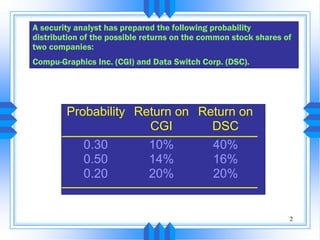
A security analyst has prepared the following probability
distribution of the possible returns on the common stock shares of
two companies:
Compu-Graphics Inc. (CGI) and Data Switch Corp. (DSC).
Probability Return on
CGI
Return on
DSC
0.30
0.50
0.20
10%
14%
20%
40%
16%
20%
3
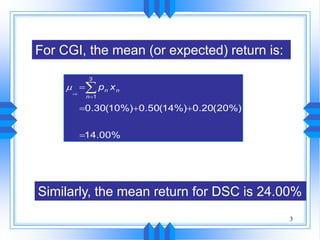
The MeanFor CGI, the mean (or expected) return is:
%00.14
%)20(20.0%)14(50.0%)10(30.0
3
1


n
nn xp
CGI

Similarly, the mean return for DSC is 24.00%
4
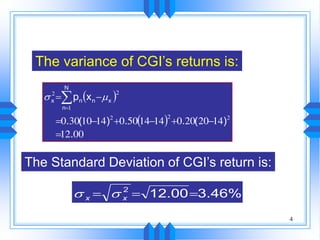
The variance of CGI’s returns is:
 
 
0012
142020014145001410300 222
1
22
.
)(..)(.
xp
N
n
xnnx




The Standard Deviation of CGI’s return is:
%46.300.122
 xx 
5
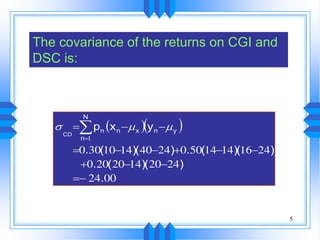
The covariance of the returns on CGI and
DSC is:
  
0024
24201420200
2416141450024401410300
1
.
)()(.
)()(.)()(.
yxp ynxn
N
n
n
CD





6
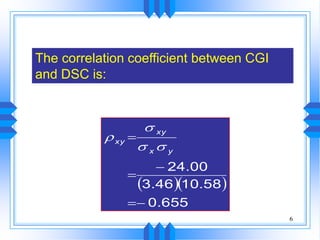
The correlation coefficient between CGI
and DSC is:
  
655.0
58.1046.3
00.24




yx
xy
xy



7
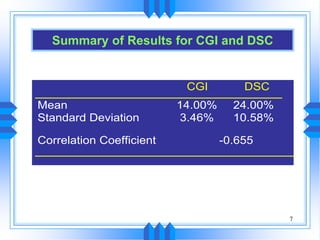
Summary of Results for CGI and DSC
CGI DSC
Mean
Standard Deviation
14.00%
3.46%
24.00%
10.58%
Correlation Coefficient -0.655
8
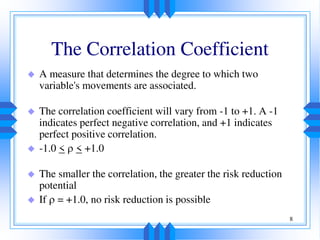
The Correlation Coefficient
 A measure that determines the degree to which two
variable's movements are associated.
 The correlation coefficient will vary from -1 to +1. A -1
indicates perfect negative correlation, and +1 indicates
perfect positive correlation.
 -1.0 <  < +1.0
 The smaller the correlation, the greater the risk reduction
potential
 If  = +1.0, no risk reduction is possible
Beta
Beta
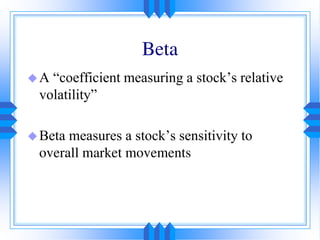
A “coefficient measuring a stock’s relative
volatility”
Beta measures a stock’s sensitivity to
overall market movements
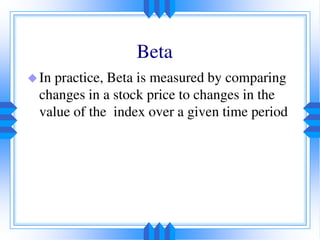
In practice, Beta is measured by comparing
changes in a stock price to changes in the
value of the index over a given time period
Beta
A Generic Example
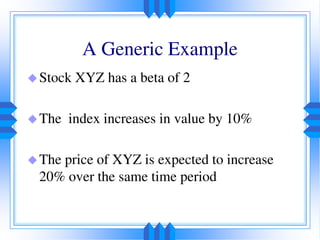
Stock XYZ has a beta of 2
The index increases in value by 10%
The price of XYZ is expected to increase
20% over the same time period
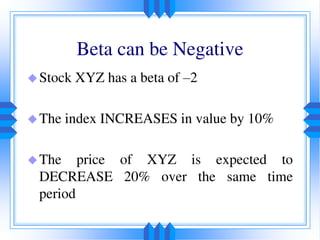
Beta can be Negative
Stock XYZ has a beta of –2
The index INCREASES in value by 10%
The price of XYZ is expected to
DECREASE 20% over the same time
period
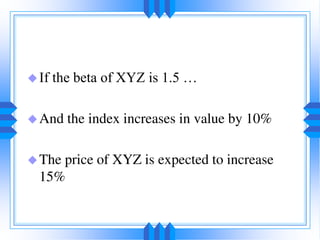
If the beta of XYZ is 1.5 …
And the index increases in value by 10%
The price of XYZ is expected to increase
15%
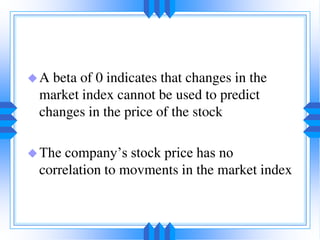
A beta of 0 indicates that changes in the
market index cannot be used to predict
changes in the price of the stock
The company’s stock price has no
correlation to movments in the market index
Beta and Risk
Beta is a measure of volatility
Volatility is associated with risk
If beta is a measure of risk, then investors
who hold stocks with higher betas should
expect a higher return for taking on that risk
How to Calculate Beta
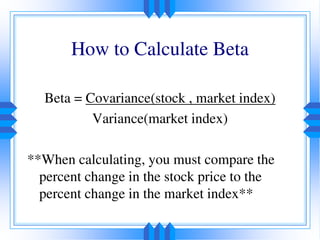
Beta = Covariance(stock , market index)
Variance(market index)
**When calculating, you must compare the
percent change in the stock price to the
percent change in the market index**
How to Calculate Beta
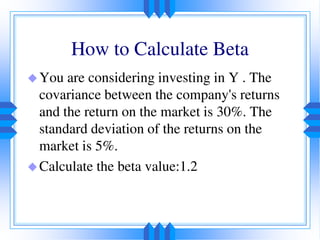
You are considering investing in Y . The
covariance between the company's returns
and the return on the market is 30%. The
standard deviation of the returns on the
market is 5%.
Calculate the beta value:1.2
Fundamental analysis is a method of
evaluating a security or asset by attempting to
measure its intrinsic value by examining
related economic, financial and other
qualitative and quantitative factors.
Fundamental analysts attempt to study
everything that can affect the security's value,
including macroeconomic factors (like the
overall economy and industry conditions) and
individually specific factors.
The fundamental approach is based on an in-
depth and all-around study of the underlying
forces of the economy, conducted to provide
data that can be used to forecast future prices
and market developments.
Fundamental analysis can be composed of
many different aspects: the analysis of the
economy as the whole, the analysis of an
industry or that of an individual company.
A combination of the data is used to establish
the true current value of the underlying asset,
to determine whether they are over- or under-
valued and to predict the future value of the
underlying asset based on this information.
As far as short-term trading is
concerned, fundamental analysis
cannot be used as a "tactical", short-
term decision-making method.
It helps an investor obtain information about
the overall state of the market, attractiveness
and state of a specific security as compared to
other securities, However, when and how to
react to the information, derived through
fundamental analysis, is determined using
technical analysis.
Though the basic approach is the same while
doing fundamental analysis, the various
factors that affect the value of the underlying
asset keep changing depending upon the class
and nature of the asset under focus.
For example weather may not play a major
factor while analysing the value of the share of
a company, which is in the business of
Information technology.
Thus it is important for an analyst to identify
the factors that are likely to affect the value of
the underlying asset and then resort to the
study of the said factors.
Fundamental Analysis thus involves 3 steps
 Economic analysis
 Industry analysis
 Company analysis
Economic Analysis
 The performance of a company depends much on the
performance of the economy if the economy is BOOM, the
industries and companies in general said to be prosperous.
On the other hand, if the economy is in RECESSION, the
performance of companies will be generally poor.
 Investors are interested in studying those economic
varieties, which affect the performance of the company in
which they proposed to invest. An analyzed of those
economic variable would give an idea about future
corporate earnings and the payment of dividends and
interest to investors.
Classes of Macro economic
policies
 Fiscal policy – Government spending , stimulates the
demand for goods.
 Monetary policy – Manipulation of money supply in
an economy.
Techniques for Economic
forecasting
(1) GNP
(2) SAVINGS AND INVESTMENT
(3) INFLATION
(4) AGRICULTURE
(5) RATES OF INTEREST
(6) GOVT. REVENUE, EXPENDITURE & DEFICITS
(7) INFRASTRUCTURE
(8) MONSOON
(9) POLITICAL STABILITY
GNP
GNP represents the aggregate value of goods and
services produced in the economy. It reflects the over
all performance of the economy. The growth rate of
GNP indicates the growth rate of the economy the
higher the rate of growth of GNP, the more favorable is
it for the stock market and vice versa
Inflation
Inflation has considerate impact on the performance of
companies. Higher rates of inflation upset business
plans and erode purchasing power in the hands of
consumers. This will result in lower demand for
products. Thus high rates of inflation in an economy
are likely to affect the performance of companies
adversely. However industries and companies prosper
during periods of low inflation. Hence an investor has
to evaluate the inflation rates prevailing in the
economy currently as well as the trend of inflation
likely to prevail in the future.
Agriculture
 Agriculture forms a major part of the Indian economy.
Some companies are using agricultural raw material as
inputs and some others are supplying inputs to
agriculture. Such companies are directly affected by
changes in agricultural production. Hence, the
increase/decrease in agricultural production has a
significant bearing on the industrial production and
corporate performance
Rate of interest
The cost and availability of credit for companies are
determined by the rates of interest prevalent in an
economy. A low interest rate stimulates investment by
making credit available easily and cheaply. As a result
cost of finance for companies decreases which assures
higher profitability. On the other hand, higher
interest rates result in higher cost of production, which
may lead to lower profitability and lower demand.
Hence an investor has to consider the interest rates
prevailing in the economy and evaluate their impact
on the performance and profitability of the companies.
GOVT. REVENUE, EXPENDITURE & DEFICITS
Government is the largest investor and spender of
money. So the trends in government revenue
expenditure deficits have a significant impact on the
performance of industries and companies. So the
investor has to evaluate these carefully to assess their
impact on his investments.
Infrastructure
 The development of an economy very much on the
availability of infrastructure. It includes electricity,
roads and railways, communication channels etc. The
availability of infrastructural facilities affects the
performance of companies. Thus an investor should
assess the status of infrastructural facilities available in
the economy before finalizing his investment avenues.
Monsoon
 The Indian economy is essentially an agrarian
economy and agriculture forms a very important sector
of the Indian economy. But the performance of
agriculture to a very great extent depends upon the
monsoon. The adequacy of the monsoon ensures the
success of the agricultural activities in India and vice
versa. Hence the progress and adequacy of the
monsoon becomes a matter of great concern for an
investor in India.
Political Stability
 A stable political environment is necessary for steady
and balanced growth. No industry or company can
grow and prosper in the midst of political turmoil.
Such long term economic policies are needed for
industrial growth. Such stable policies can be framed
only by stable political systems.
Industry Analysis
Industry analysis indicates to an investor whether the
industry is a growth industry or not. It gives an
investor a choice of the industry in which the
investments should be made.
Industry analysis refers to an evaluation of the
relative strength and weakness of particular industries
which can be divided in to three parts, viz.,
1. Life cycle of an industry
2. Characteristics of an industry
3. Profit potential of an industry
Life Cycle
a) Pioneering Stage: Technology and product are newly
introduced.
(b) Expansion stage: Those companies which reached first stage
grow further and becomes stronger.
(c) Stagnation Stage: In this stage the growth of the industries
Stabilizes. Sales increases at slower rate.
(d) Decay stage-The industry becomes obsolete and gradually
ceases to exist.
Characteristics of Industry
Analysis
Past sales and earning performance
Attitude of government towards that industry
Labor Conditions
Competitive Conditions
Raw material
Characteristics of Industry
Analysis
 Management
 Future Prospects-demand and markets
Company Analysis
It involves a close investigative scrutiny of the
companies financial and non financial aspects with a
view to identifying its strength, weaknesses and future
business prospects.
Company Analysis
 Competitive Edge-Market Share , Growth of sales ,
stability of sales
 Capital Structure
 Management
 Operating Efficiency-Efficient use of fixed assets
 Financial Performance-Balance Sheet ,P and L
account,Ratio
 Historic price of stock
 P/E Ratio

Fm unit-2-part-1 (1)

  • 1.
    Risk -Meaning Probability ofloss? Magnitude of loss? Probability of underperforming target?
  • 2.
    Types of Risk Systematic Risk  Unsystematic Risk
  • 3.
    Systematic Risk  Non-Diversifiable,Inherent, cannot be avoided  Interest-Rate Risk  Inflation-Rate Risk  Political Risk  Market Risk  Natural Calamities  War situations
  • 4.
    Interest Rate Risk Refers to the uncertainty of future market values and the size of the future income due to fluctuations in interest Rates  Investing with borrowed funds becomes less attractive due to rapid fluctuations  Low yield bonds and debentures become less attractive at the prevailing rates in case of rising rates.
  • 5.
    Inflation Rate Risk Inflation rate changes represent a risk to both the lender and the borrower  Loss of purchasing power due to which real gains from the investment are much less than the monetary gains  The real yield from the bonds is much lower than the nominal interest rate, declining yield affects the market price of the bonds  In response to this, many governments have issued real return bonds (also known as inflation indexed, in which the principle value and coupon rises each year with the rate of inflation, with the result that the interest rate on the bond is a real interest rate.
  • 6.
    Example  For example,if somebody lends Rs.1000 for a year at 10 percent, and receives Rs.1100 back at the end of the year, this represents a 10 percent increase in his purchasing power if prices for the average goods and services that he buys are unchanged from what they were at the beginning of the year. However, if the prices of the food, clothing, housing, and other things that he wishes to purchase have increased 20 percent over this period, he has in fact suffered a real loss of about 10 percent in his purchasing power
  • 7.
    Market Risk  Marketrisk is an outcome of changes in investors perceptions and expectations  Investors react to tangible and Intangible events  Threat of War, assassination of politician etc-Herd instinct-trigger mechanism
  • 8.
    Non Systematic Risk Diversifiable and thereby reduced or eliminated  It is that portion of the total risk which is unique or particular to a specific class of industry or a company in particular and does not effect the markets in general  Performance of a company, Mergers, industry specific announcements
  • 9.
    Non Systematic Risk Business Risk  Financial Risk
  • 10.
    Business Risk  InternalBusiness Risk- Variability in operating efficiency  External Business Risk- Result of operating conditions imposed upon the firm by circumstances beyond its control- government policies can affect revenues
  • 11.
    Financial Risk  Itis associated with the way in which the companies finance its activities  It is related to the capital structure decisions and Financial Leverage  A heavy debt financing increases the financial leverage thereby affecting the common shareholders.  A firm which has no debt content in its capital structure has no financial risk.
  • 12.
    Standard Deviation andVariance  Measures the extent of deviation of returns from the average value of return  The square of standard deviation is called variance  Computation of Standard deviation and Variance can be Historical[ Ex-post] or Expected –[Ex-ante]
  • 13.
  • 14.
    Meaning  We investto get return  Includes current income and capital gains on the same  Thus return is the actual income received plus any changes in market price usually expressed as a percent of the opening market price
  • 15.
    1 Basic Statistical Computations- Recap Mean StandardDeviation and Variance Covariance Correlation Coefficient
  • 16.
    2 A security analysthas prepared the following probability distribution of the possible returns on the common stock shares of two companies: Compu-Graphics Inc. (CGI) and Data Switch Corp. (DSC). Probability Return on CGI Return on DSC 0.30 0.50 0.20 10% 14% 20% 40% 16% 20%
  • 17.
    3 The MeanFor CGI,the mean (or expected) return is: %00.14 %)20(20.0%)14(50.0%)10(30.0 3 1   n nn xp CGI  Similarly, the mean return for DSC is 24.00%
  • 18.
    4 The variance ofCGI’s returns is:     0012 142020014145001410300 222 1 22 . )(..)(. xp N n xnnx     The Standard Deviation of CGI’s return is: %46.300.122  xx 
  • 19.
    5 The covariance ofthe returns on CGI and DSC is:    0024 24201420200 2416141450024401410300 1 . )()(. )()(.)()(. yxp ynxn N n n CD     
  • 20.
    6 The correlation coefficientbetween CGI and DSC is:    655.0 58.1046.3 00.24     yx xy xy   
  • 21.
    7 Summary of Resultsfor CGI and DSC CGI DSC Mean Standard Deviation 14.00% 3.46% 24.00% 10.58% Correlation Coefficient -0.655
  • 22.
    8 The Correlation Coefficient A measure that determines the degree to which two variable's movements are associated.  The correlation coefficient will vary from -1 to +1. A -1 indicates perfect negative correlation, and +1 indicates perfect positive correlation.  -1.0 <  < +1.0  The smaller the correlation, the greater the risk reduction potential  If  = +1.0, no risk reduction is possible
  • 23.
  • 24.
    Beta A “coefficient measuringa stock’s relative volatility” Beta measures a stock’s sensitivity to overall market movements
  • 25.
    In practice, Betais measured by comparing changes in a stock price to changes in the value of the index over a given time period Beta
  • 26.
    A Generic Example StockXYZ has a beta of 2 The index increases in value by 10% The price of XYZ is expected to increase 20% over the same time period
  • 27.
    Beta can beNegative Stock XYZ has a beta of –2 The index INCREASES in value by 10% The price of XYZ is expected to DECREASE 20% over the same time period
  • 28.
    If the betaof XYZ is 1.5 … And the index increases in value by 10% The price of XYZ is expected to increase 15%
  • 29.
    A beta of0 indicates that changes in the market index cannot be used to predict changes in the price of the stock The company’s stock price has no correlation to movments in the market index
  • 30.
    Beta and Risk Betais a measure of volatility Volatility is associated with risk
  • 31.
    If beta isa measure of risk, then investors who hold stocks with higher betas should expect a higher return for taking on that risk
  • 32.
    How to CalculateBeta Beta = Covariance(stock , market index) Variance(market index) **When calculating, you must compare the percent change in the stock price to the percent change in the market index**
  • 33.
    How to CalculateBeta You are considering investing in Y . The covariance between the company's returns and the return on the market is 30%. The standard deviation of the returns on the market is 5%. Calculate the beta value:1.2
  • 35.
    Fundamental analysis isa method of evaluating a security or asset by attempting to measure its intrinsic value by examining related economic, financial and other qualitative and quantitative factors.
  • 36.
    Fundamental analysts attemptto study everything that can affect the security's value, including macroeconomic factors (like the overall economy and industry conditions) and individually specific factors.
  • 37.
    The fundamental approachis based on an in- depth and all-around study of the underlying forces of the economy, conducted to provide data that can be used to forecast future prices and market developments.
  • 38.
    Fundamental analysis canbe composed of many different aspects: the analysis of the economy as the whole, the analysis of an industry or that of an individual company.
  • 39.
    A combination ofthe data is used to establish the true current value of the underlying asset, to determine whether they are over- or under- valued and to predict the future value of the underlying asset based on this information.
  • 40.
    As far asshort-term trading is concerned, fundamental analysis cannot be used as a "tactical", short- term decision-making method.
  • 41.
    It helps aninvestor obtain information about the overall state of the market, attractiveness and state of a specific security as compared to other securities, However, when and how to react to the information, derived through fundamental analysis, is determined using technical analysis.
  • 42.
    Though the basicapproach is the same while doing fundamental analysis, the various factors that affect the value of the underlying asset keep changing depending upon the class and nature of the asset under focus.
  • 43.
    For example weathermay not play a major factor while analysing the value of the share of a company, which is in the business of Information technology.
  • 44.
    Thus it isimportant for an analyst to identify the factors that are likely to affect the value of the underlying asset and then resort to the study of the said factors.
  • 45.
    Fundamental Analysis thusinvolves 3 steps  Economic analysis  Industry analysis  Company analysis
  • 46.
    Economic Analysis  Theperformance of a company depends much on the performance of the economy if the economy is BOOM, the industries and companies in general said to be prosperous. On the other hand, if the economy is in RECESSION, the performance of companies will be generally poor.  Investors are interested in studying those economic varieties, which affect the performance of the company in which they proposed to invest. An analyzed of those economic variable would give an idea about future corporate earnings and the payment of dividends and interest to investors.
  • 47.
    Classes of Macroeconomic policies  Fiscal policy – Government spending , stimulates the demand for goods.  Monetary policy – Manipulation of money supply in an economy.
  • 48.
    Techniques for Economic forecasting (1)GNP (2) SAVINGS AND INVESTMENT (3) INFLATION (4) AGRICULTURE (5) RATES OF INTEREST (6) GOVT. REVENUE, EXPENDITURE & DEFICITS (7) INFRASTRUCTURE (8) MONSOON (9) POLITICAL STABILITY
  • 49.
    GNP GNP represents theaggregate value of goods and services produced in the economy. It reflects the over all performance of the economy. The growth rate of GNP indicates the growth rate of the economy the higher the rate of growth of GNP, the more favorable is it for the stock market and vice versa
  • 50.
    Inflation Inflation has considerateimpact on the performance of companies. Higher rates of inflation upset business plans and erode purchasing power in the hands of consumers. This will result in lower demand for products. Thus high rates of inflation in an economy are likely to affect the performance of companies adversely. However industries and companies prosper during periods of low inflation. Hence an investor has to evaluate the inflation rates prevailing in the economy currently as well as the trend of inflation likely to prevail in the future.
  • 51.
    Agriculture  Agriculture formsa major part of the Indian economy. Some companies are using agricultural raw material as inputs and some others are supplying inputs to agriculture. Such companies are directly affected by changes in agricultural production. Hence, the increase/decrease in agricultural production has a significant bearing on the industrial production and corporate performance
  • 52.
    Rate of interest Thecost and availability of credit for companies are determined by the rates of interest prevalent in an economy. A low interest rate stimulates investment by making credit available easily and cheaply. As a result cost of finance for companies decreases which assures higher profitability. On the other hand, higher interest rates result in higher cost of production, which may lead to lower profitability and lower demand. Hence an investor has to consider the interest rates prevailing in the economy and evaluate their impact on the performance and profitability of the companies.
  • 53.
    GOVT. REVENUE, EXPENDITURE& DEFICITS Government is the largest investor and spender of money. So the trends in government revenue expenditure deficits have a significant impact on the performance of industries and companies. So the investor has to evaluate these carefully to assess their impact on his investments.
  • 54.
    Infrastructure  The developmentof an economy very much on the availability of infrastructure. It includes electricity, roads and railways, communication channels etc. The availability of infrastructural facilities affects the performance of companies. Thus an investor should assess the status of infrastructural facilities available in the economy before finalizing his investment avenues.
  • 55.
    Monsoon  The Indianeconomy is essentially an agrarian economy and agriculture forms a very important sector of the Indian economy. But the performance of agriculture to a very great extent depends upon the monsoon. The adequacy of the monsoon ensures the success of the agricultural activities in India and vice versa. Hence the progress and adequacy of the monsoon becomes a matter of great concern for an investor in India.
  • 56.
    Political Stability  Astable political environment is necessary for steady and balanced growth. No industry or company can grow and prosper in the midst of political turmoil. Such long term economic policies are needed for industrial growth. Such stable policies can be framed only by stable political systems.
  • 57.
    Industry Analysis Industry analysisindicates to an investor whether the industry is a growth industry or not. It gives an investor a choice of the industry in which the investments should be made. Industry analysis refers to an evaluation of the relative strength and weakness of particular industries which can be divided in to three parts, viz., 1. Life cycle of an industry 2. Characteristics of an industry 3. Profit potential of an industry
  • 58.
    Life Cycle a) PioneeringStage: Technology and product are newly introduced. (b) Expansion stage: Those companies which reached first stage grow further and becomes stronger. (c) Stagnation Stage: In this stage the growth of the industries Stabilizes. Sales increases at slower rate. (d) Decay stage-The industry becomes obsolete and gradually ceases to exist.
  • 59.
    Characteristics of Industry Analysis Pastsales and earning performance Attitude of government towards that industry Labor Conditions Competitive Conditions Raw material
  • 60.
    Characteristics of Industry Analysis Management  Future Prospects-demand and markets
  • 61.
    Company Analysis It involvesa close investigative scrutiny of the companies financial and non financial aspects with a view to identifying its strength, weaknesses and future business prospects.
  • 62.
    Company Analysis  CompetitiveEdge-Market Share , Growth of sales , stability of sales  Capital Structure  Management  Operating Efficiency-Efficient use of fixed assets  Financial Performance-Balance Sheet ,P and L account,Ratio  Historic price of stock  P/E Ratio