RIVERS - LIVELIHOOD
For
Class V EVS
PPT by
M PADMA LALITHA SHARADA
The Godavari, a river
Let us find out the source of the river Godavari and
about the people living on its banks.
The river Godavari, originates its journey from the hills of
Brahmagiri of the Western Ghats at Triambakeshwar, in the
district of Nasik in Maharashtra.
It enters our state at Basar in Adilabad district.
To reach our state it travels1465 kms.
In our Telangana state it flows through the districts
of Adilabad, Karimnagar, Warangal, Khamman and
in A.P. East Godavari and West Godavari.
Its flow, separates the districts of Adilabad and
Karimnagar and also East and West Godavari of
Andhra Pradesh.
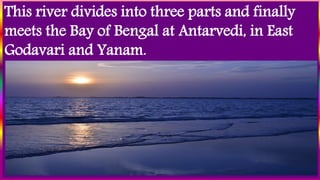
This river divides into three parts and finally
meets the Bay of Bengal at Antarvedi, in East
Godavari and Yanam.
Fishermen
Many people make a living by catching fish in the
Godavari. They use boats and catch a variety of
fishes, crabs, lobsters employing nets.
Fishing needs skill and hard work. They use
different kinds of boats for fishing.
The river is the source of livelihood for the fishermen.
They lead their lives by fishing. They make money for their
families by catching and marketing the fish.
To catch the fish, they use conventional boats
and also the motor boats.
Traditional Boat
Motor Boat
During floods, they lose the boats and their nets
get damaged.
We are able to include the nutritious fishes in
our diet due to these efforts of these fishermen.
Do you know
Its scientific name is Hilsa ilisha. Its a salt water
fish. For breeding, it migrates to fresh water.
In the months of august-september, the water
in the river Godavari turns red due to floods.
During this time, these fish travel 1200 km in
the ocean and enter the Godavari districts to
lay eggs.
Again, in the next two months, the young ones
swim back to the ocean.
Thus, when they swim to the river, they are
caught in the nets.
They have a huge demand in the market, the
big fish is sold for up to two thousand rupees.
The researches prove that these fish are rich in
omega 2 fatty acids and are good for health.
Water transport
The river Godavari is not only providing livelihood to
the fishermen but it also is a tourist spot for travellers.
Many take pleasure riding on ferries from Rajamhundry to
Bhadrachalam between the Papikondalu hills. Our state
tourism department is operating the launches for tourists.
Godavari River between
Papi Kondalu
Dams – crops
The first dam built on the river Godavari is at
Gangapur. It supplies drinking water to the cities of
Nasik and Triambakeshwar.
Gangapur Dam at Nasik
The other projects on it are Jayakawadi. Sri
Ram Sagar, Dhavaleshwaram.
Sriram Sagar Project
These provide water for irrigation to lakhs of
acres both in Maharastra and A.P.
Sir Arthur Cotton barrage at
Dhavaleshwaram
Jayakwadi Dam Paithan at
Aurangabad
The projects are not only used for irrigation and for providing
drinking water to towns but also for preventing floods and for
the production of electricity.
With the Devadula Ethipothala Programme in Warangal we
are trying to supply water to Warangal, Karimnagar, and
Nalgonda Districts.
Devadula Ethipothala
Programme
Maharashtra and Andhra Pradesh grow crops
like sugar cane, paddy, cotton, tobacco, chilly
and fruit orchards using the Godavari waters.
The land where the Godavari river meets the
ocean is very fertile. In this delta land, paddy
and coconut are grown.
Konaseema, in the East Godavari district is in
this delta and is an extremely beautiful place.
On the other hand, many people become homeless and the
lakhs of acres of land is lost with the construction of the big
dams and projects. Government tries its best to rehabilitate
these uprooted people.
Do you know?
The expanded area of the Godavari river and its irrigated
area is 3,12,812 sq.km. This is 1/10th of the Indian sub
continent land. This area is more than that of the countries
like England and Ireland put together.
Rivers – civilisation
It is observed that from ancient times the humans have been living at the
banks of the rivers. They grow crops and develop settlements.
This development is natural, as it provides water for drinking
and irrigation.
They become the natural resources for progress and
livelihood. Many ancient cities and villages were
located near the rivers. In these places, the people got
developed culturally and socially.
Most of the human civilization, in the world, started near the
rivers. The archeological excavations have revealed many
buildings constructed along the rivers.
The land along the Godavari is the centre for spirituality and
culture. Kumbha Mela is celebrated at Nasik.
Triambakeswar is among the twelve important
jyothirlingas of lord Shiva. Paithan was the
kingdom of the Satavahanas.
Triambakeswara
Temple in
Maharashtra
Jain Tirth, Paithan
Aurangabad
In Nanded, the famous Sachkhand Gurudwara is
located. The famous Saraswati temple, is located at
Basar in Telangana.
SHRI SACHKHAND GURUDWARA
Basara Temple
Basara Gnana Saraswati Temple
Out of Saraswati Temples in India,one is in Kashmir
and the second is Basara Gnana Saraswati temple.
It was built on the bank of river Godavari in Adilabad district of
Telangana State during the period of Chalukyas. It is 205km
away from Hyderabad and 35 km away from Nizamabad district.
The important celebrations in the temple are Vasantha
Panchami, Maha Shiva Rathri, Devi nava Rathrulu,
Vyasa Purnima, and Aksharabyasa.
The Goddes is worshiped as mother of education.
Nirmal is famous for toys.
The temples like Laxmi Narasimha Swamy at Dharmapuri, Rama
temple at Bhadrachalam and Goutamishwara at Manthani are
the centres of religious importance.
Dharmapuri Temple
Bhadrachalam Temple on
the bank of Godavari River
Once in every 12 years, Pushkar mela is organised on the bank
of the river Godavari. It lasts for 12 days. It is considered to be
auspicious to take a dip in Godavari water during that time.
Industries – pollution
Many industries depend on the waters of the Godavari. We
are able to produce 2,600 megawatts of electricity through
the Thermal Power station at Ramagudam.
The NTPC power plant at Ramagundam
Paper mills are located at Bhadrachalam, Thermal
power station is located at Kothagudem and natural
gas power centre is at Vijjeshwaram.
Vijjeswaram Gas Thermal
Power Station Kovvur
Kothagudem
Thermal power station
Paper mill at
Bhadrachalam
Nanded and Aurangabad have also developed
industrially.
industrial conveyor belt
in Aurangabad
Industry Shed. Videocon Narmada Glass
Factory, Aurangabad
Manufacturer of GC Sheets
& Roofing Sheets by Malpani
Industries, Nanded
Textile
Industry
in Nanded
But, the wastes from the industries and the power stations are released
into the river. This is causing damage to the water and to the living
organisms and polluting the river water.
The sewage water from villages and cities on the banks of the
river Godavari is discharged into the river. This results in the
pollution of the river and the water becomes unsuitable for
drinking.
The people who visit the rivers also cause the
water pollution by throwing plastic bottles and
covers in to the river.
This leads to the excess growth of the water plant called
Eichhornia which reduces the dissolved oxygen leading
to the death of the water organisms, animals and plants.
Drought, floods
During scanty rains, there is very little flow in the river Godavari. With
this the water level in the reservoirs comes down.
These type of drought condition leads the farmers
and their families to adverse situations and losses.
When there is heavey rainfall, floods occur. The
floods inundate the land near the river. The crops
and the yield get swept into the water.
When the water bodies like river and canals overflow then
all the possible means of transport like the road, rail and
water are disturbed. Human deaths also, may occur.
Due to floods lot of water is lost to the ocean. Embankments
have been built to avoid flood water from river & canals. These
embankments saved hundreds of villages from flood water.
SHARADA

Rivers - livelihood

  • 1.
    RIVERS - LIVELIHOOD For ClassV EVS PPT by M PADMA LALITHA SHARADA
  • 2.
    The Godavari, ariver Let us find out the source of the river Godavari and about the people living on its banks.
  • 3.
    The river Godavari,originates its journey from the hills of Brahmagiri of the Western Ghats at Triambakeshwar, in the district of Nasik in Maharashtra.
  • 4.
    It enters ourstate at Basar in Adilabad district. To reach our state it travels1465 kms.
  • 5.
    In our Telanganastate it flows through the districts of Adilabad, Karimnagar, Warangal, Khamman and in A.P. East Godavari and West Godavari.
  • 6.
    Its flow, separatesthe districts of Adilabad and Karimnagar and also East and West Godavari of Andhra Pradesh.
  • 7.
    This river dividesinto three parts and finally meets the Bay of Bengal at Antarvedi, in East Godavari and Yanam.
  • 8.
    Fishermen Many people makea living by catching fish in the Godavari. They use boats and catch a variety of fishes, crabs, lobsters employing nets.
  • 9.
    Fishing needs skilland hard work. They use different kinds of boats for fishing.
  • 10.
    The river isthe source of livelihood for the fishermen. They lead their lives by fishing. They make money for their families by catching and marketing the fish.
  • 11.
    To catch thefish, they use conventional boats and also the motor boats. Traditional Boat Motor Boat
  • 12.
    During floods, theylose the boats and their nets get damaged.
  • 13.
    We are ableto include the nutritious fishes in our diet due to these efforts of these fishermen.
  • 14.
    Do you know Itsscientific name is Hilsa ilisha. Its a salt water fish. For breeding, it migrates to fresh water.
  • 15.
    In the monthsof august-september, the water in the river Godavari turns red due to floods.
  • 16.
    During this time,these fish travel 1200 km in the ocean and enter the Godavari districts to lay eggs.
  • 17.
    Again, in thenext two months, the young ones swim back to the ocean.
  • 18.
    Thus, when theyswim to the river, they are caught in the nets.
  • 19.
    They have ahuge demand in the market, the big fish is sold for up to two thousand rupees.
  • 20.
    The researches provethat these fish are rich in omega 2 fatty acids and are good for health.
  • 21.
    Water transport The riverGodavari is not only providing livelihood to the fishermen but it also is a tourist spot for travellers.
  • 22.
    Many take pleasureriding on ferries from Rajamhundry to Bhadrachalam between the Papikondalu hills. Our state tourism department is operating the launches for tourists. Godavari River between Papi Kondalu
  • 23.
    Dams – crops Thefirst dam built on the river Godavari is at Gangapur. It supplies drinking water to the cities of Nasik and Triambakeshwar. Gangapur Dam at Nasik
  • 24.
    The other projectson it are Jayakawadi. Sri Ram Sagar, Dhavaleshwaram. Sriram Sagar Project
  • 25.
    These provide waterfor irrigation to lakhs of acres both in Maharastra and A.P. Sir Arthur Cotton barrage at Dhavaleshwaram Jayakwadi Dam Paithan at Aurangabad
  • 26.
    The projects arenot only used for irrigation and for providing drinking water to towns but also for preventing floods and for the production of electricity.
  • 27.
    With the DevadulaEthipothala Programme in Warangal we are trying to supply water to Warangal, Karimnagar, and Nalgonda Districts. Devadula Ethipothala Programme
  • 28.
    Maharashtra and AndhraPradesh grow crops like sugar cane, paddy, cotton, tobacco, chilly and fruit orchards using the Godavari waters.
  • 29.
    The land wherethe Godavari river meets the ocean is very fertile. In this delta land, paddy and coconut are grown.
  • 30.
    Konaseema, in theEast Godavari district is in this delta and is an extremely beautiful place.
  • 31.
    On the otherhand, many people become homeless and the lakhs of acres of land is lost with the construction of the big dams and projects. Government tries its best to rehabilitate these uprooted people.
  • 32.
    Do you know? Theexpanded area of the Godavari river and its irrigated area is 3,12,812 sq.km. This is 1/10th of the Indian sub continent land. This area is more than that of the countries like England and Ireland put together.
  • 33.
    Rivers – civilisation Itis observed that from ancient times the humans have been living at the banks of the rivers. They grow crops and develop settlements. This development is natural, as it provides water for drinking and irrigation.
  • 34.
    They become thenatural resources for progress and livelihood. Many ancient cities and villages were located near the rivers. In these places, the people got developed culturally and socially.
  • 35.
    Most of thehuman civilization, in the world, started near the rivers. The archeological excavations have revealed many buildings constructed along the rivers.
  • 36.
    The land alongthe Godavari is the centre for spirituality and culture. Kumbha Mela is celebrated at Nasik.
  • 37.
    Triambakeswar is amongthe twelve important jyothirlingas of lord Shiva. Paithan was the kingdom of the Satavahanas. Triambakeswara Temple in Maharashtra Jain Tirth, Paithan Aurangabad
  • 38.
    In Nanded, thefamous Sachkhand Gurudwara is located. The famous Saraswati temple, is located at Basar in Telangana. SHRI SACHKHAND GURUDWARA Basara Temple
  • 39.
    Basara Gnana SaraswatiTemple Out of Saraswati Temples in India,one is in Kashmir and the second is Basara Gnana Saraswati temple.
  • 40.
    It was builton the bank of river Godavari in Adilabad district of Telangana State during the period of Chalukyas. It is 205km away from Hyderabad and 35 km away from Nizamabad district.
  • 41.
    The important celebrationsin the temple are Vasantha Panchami, Maha Shiva Rathri, Devi nava Rathrulu, Vyasa Purnima, and Aksharabyasa.
  • 42.
    The Goddes isworshiped as mother of education.
  • 43.
  • 44.
    The temples likeLaxmi Narasimha Swamy at Dharmapuri, Rama temple at Bhadrachalam and Goutamishwara at Manthani are the centres of religious importance. Dharmapuri Temple Bhadrachalam Temple on the bank of Godavari River
  • 45.
    Once in every12 years, Pushkar mela is organised on the bank of the river Godavari. It lasts for 12 days. It is considered to be auspicious to take a dip in Godavari water during that time.
  • 46.
    Industries – pollution Manyindustries depend on the waters of the Godavari. We are able to produce 2,600 megawatts of electricity through the Thermal Power station at Ramagudam. The NTPC power plant at Ramagundam
  • 47.
    Paper mills arelocated at Bhadrachalam, Thermal power station is located at Kothagudem and natural gas power centre is at Vijjeshwaram. Vijjeswaram Gas Thermal Power Station Kovvur Kothagudem Thermal power station Paper mill at Bhadrachalam
  • 48.
    Nanded and Aurangabadhave also developed industrially. industrial conveyor belt in Aurangabad Industry Shed. Videocon Narmada Glass Factory, Aurangabad Manufacturer of GC Sheets & Roofing Sheets by Malpani Industries, Nanded Textile Industry in Nanded
  • 49.
    But, the wastesfrom the industries and the power stations are released into the river. This is causing damage to the water and to the living organisms and polluting the river water.
  • 50.
    The sewage waterfrom villages and cities on the banks of the river Godavari is discharged into the river. This results in the pollution of the river and the water becomes unsuitable for drinking.
  • 51.
    The people whovisit the rivers also cause the water pollution by throwing plastic bottles and covers in to the river.
  • 52.
    This leads tothe excess growth of the water plant called Eichhornia which reduces the dissolved oxygen leading to the death of the water organisms, animals and plants.
  • 53.
    Drought, floods During scantyrains, there is very little flow in the river Godavari. With this the water level in the reservoirs comes down.
  • 54.
    These type ofdrought condition leads the farmers and their families to adverse situations and losses.
  • 55.
    When there isheavey rainfall, floods occur. The floods inundate the land near the river. The crops and the yield get swept into the water.
  • 56.
    When the waterbodies like river and canals overflow then all the possible means of transport like the road, rail and water are disturbed. Human deaths also, may occur.
  • 57.
    Due to floodslot of water is lost to the ocean. Embankments have been built to avoid flood water from river & canals. These embankments saved hundreds of villages from flood water.
  • 58.