RIVER VALLEY
CIVILIZATIONS
Lec2
QUESTIONS TO KEEP IN
MIND:
How did geography impact the
first civilizations?
How did changes in the
Neolithic Revolution lead to the
development of River Valley
Civilizations?
KEY VOCABULARY
 Civilization – form of culture in which some
people live in cities and have complex social
institutions, use some form of writing, and are
skilled in science, art, and technology
 Empire – group of territories or nations ruled by
a single ruler or government
 Theocracy – government headed by religious
leaders or a leader regarded as a god
 Polytheistic – belief in many gods
 Monotheistic – belief in only one god
THE RISE OF CIVILIZATION
Arose in 4 separate river valleys
around 3500 B.C.
Fertile soil, mild climate, waterway for
transportation, water for crops &
drinking
Provided for abundant crops and food
surpluses
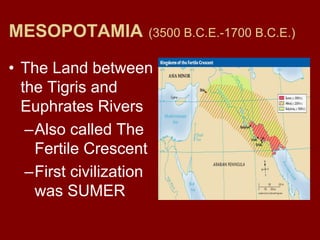
MESOPOTAMIA (3500 B.C.E.-1700 B.C.E.)
• The Land between
the Tigris and
Euphrates Rivers
–Also called The
Fertile Crescent
–First civilization
was SUMER
GOVERNMENT
• City-states
• Each had its own ruler (also head of
religion – theocracy)
• Were eventually united under
single rulers
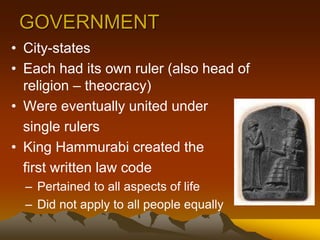
• King Hammurabi created the
first written law code
– Pertained to all aspects of life
– Did not apply to all people equally
ECONOMY
• Farming – basis for economy
– Grew grains, vegetables, dates, flax
– Domesticated sheep, goats, cows, oxen, and
donkeys
• Evidence shows they traded with other
civilizations
– Merchants
– artisans
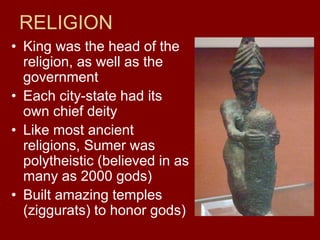
RELIGION
• King was the head of the
religion, as well as the
government
• Each city-state had its
own chief deity
• Like most ancient
religions, Sumer was
polytheistic (believed in as
many as 2000 gods)
• Built amazing temples
(ziggurats) to honor gods)
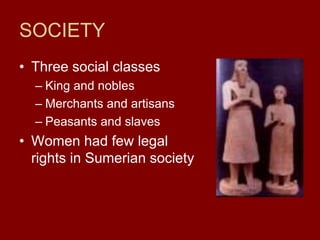
SOCIETY
• Three social classes
– King and nobles
– Merchants and artisans
– Peasants and slaves
• Women had few legal
rights in Sumerian society
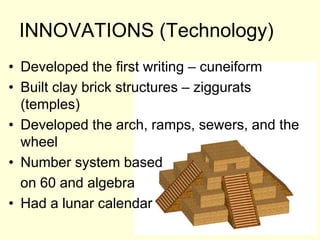
INNOVATIONS (Technology)
• Developed the first writing – cuneiform
• Built clay brick structures – ziggurats
(temples)
• Developed the arch, ramps, sewers, and the
wheel
• Number system based
on 60 and algebra
• Had a lunar calendar
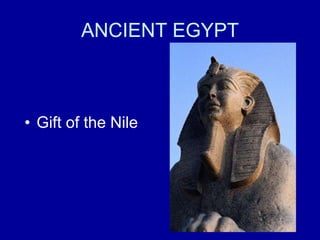
ANCIENT EGYPT
• Gift of the Nile
GEOGRAPHY
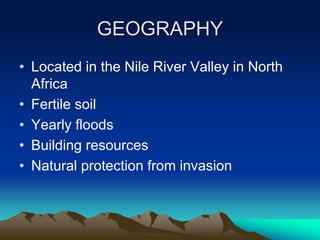
• Located in the Nile River Valley in North
Africa
• Fertile soil
• Yearly floods
• Building resources
• Natural protection from invasion
POLITICS
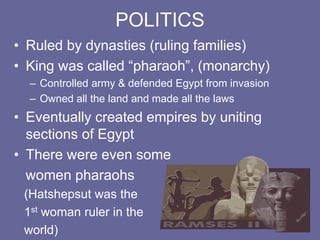
• Ruled by dynasties (ruling families)
• King was called “pharaoh”, (monarchy)
– Controlled army & defended Egypt from invasion
– Owned all the land and made all the laws
• Eventually created empires by uniting
sections of Egypt
• There were even some
women pharaohs
(Hatshepsut was the
1st woman ruler in the
world)
ECONOMY
 The pharaoh controlled the economy
 Nearly everyone was involved in
agriculture
 Some were merchants and craftsmen
 Trade was prominent throughout the
kingdom and with other civilizations
RELIGION
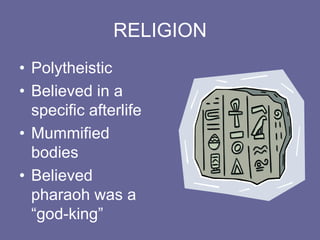
• Polytheistic
• Believed in a
specific afterlife
• Mummified
bodies
• Believed
pharaoh was a
“god-king”
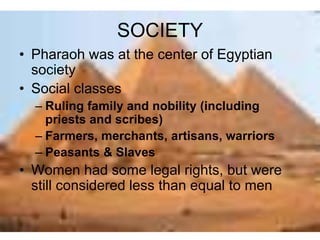
SOCIETY
• Pharaoh was at the center of Egyptian
society
• Social classes
– Ruling family and nobility (including
priests and scribes)
– Farmers, merchants, artisans, warriors
– Peasants & Slaves
• Women had some legal rights, but were
still considered less than equal to men
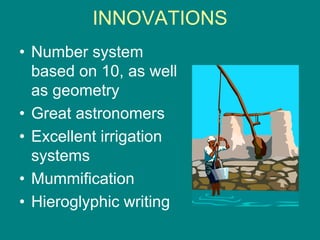
INNOVATIONS
• Number system
based on 10, as well
as geometry
• Great astronomers
• Excellent irrigation
systems
• Mummification
• Hieroglyphic writing
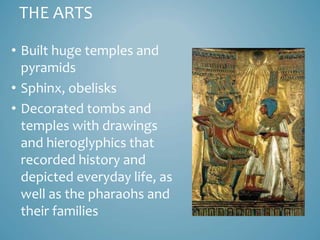
• Built huge temples and
pyramids
• Sphinx, obelisks
• Decorated tombs and
temples with drawings
and hieroglyphics that
recorded history and
depicted everyday life, as
well as the pharaohs and
their families
THE ARTS
INDUS RIVER VALLEY
The Harappan Civilization
GEOGRAPHY
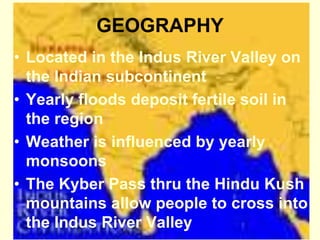
• Located in the Indus River Valley on
the Indian subcontinent
• Yearly floods deposit fertile soil in
the region
• Weather is influenced by yearly
monsoons
• The Kyber Pass thru the Hindu Kush
mountains allow people to cross into
the Indus River Valley
POLITICAL STRUCTURE
• The center of government was the citadel
• The Harappan’s had a strong and well-
organized central government
• We are unsure of the exact political
structure
• There were “twin” capitals at Harappa and
Mohenjo-Daro
• Eventually, the Arayans took control
ECONOMY
 People who lived in the towns and cities were
mostly merchants and craftsmen
 People who lived in areas outside the cities were
farmers and herders
 The Harappans invented the first system of
weights and measures for trade
 They traded as far away as ancient Sumer
where they imported textiles and food in
exchange for copper, lumber, precious stones,
cotton, and luxury goods
RELIGION
 Polytheistic
 Originally, probably an animistic religion
 Rulers probably ruled by divine right
 Eventually developed the Hindu religion
when the Arayans brought their ideas
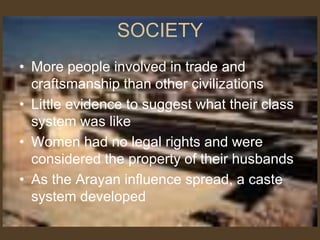
SOCIETY
• More people involved in trade and
craftsmanship than other civilizations
• Little evidence to suggest what their class
system was like
• Women had no legal rights and were
considered the property of their husbands
• As the Arayan influence spread, a caste
system developed
INNOVATIONS
• Well-planned cities (streets at 90o
angles)
• Sewer systems and garbage bins
• Private and public baths
• Kilns for baking bricks
• Public wells provided water
• Written language (mostly
pictographic)
[The Arayans brought the Sanskrit
language when they took over]
THE END OF HARAPPAN
CIVILIZATION
 No one really knows what happened
to the Harappans
 Theories
– Natural disaster (earthquake, floods)
destroyed the cities and the people
migrated to other areas
– They were conquered by other people
– They moved from the region for some
other reason
THE ARYANS
• Nomadic people from the Caspian and Black
Sea region
• Patriarchal tribes of herders
• Did not associate with the natives of India which
they conquered
• Did not build large cities or permanent
settlements
• Influenced modern social structure and religion
of India
CHINA
GEOGRAPHY
 Located in the Huang He River Valley
– Also called the Yellow River (silt
yellowish color)
– Also called China’s Sorrow (devastating
floods)
– Contained by a system of dikes
 Relatively isolated
– Surrounded by mountains, desert, and
water
– Little influence from other civilizations
POLITICAL STRUCTURE
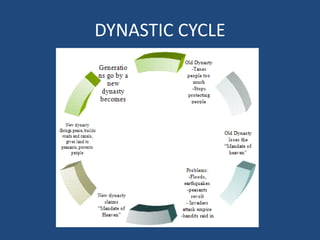
• Known for its dynastic cycle (see diagram)
• The first known dynasty was the Shang
– Built China’s first cities
– Established a capital at Anyang
• Emperors were military leaders who ruled
with the help of powerful nobles
• Principle of government was the Mandate
of Heaven (gods approval of the emperor)
• When an emperor lost “Mandate of
Heaven” there was an uprising and often a
new dynasty would take control
DYNASTIC CYCLE
ECONOMY
• Based on agriculture
• Used mostly barter system of trade
• Though skilled at many crafts, trade
was discouraged outside the empire
RELIGION
• Polytheistic (animistic)
• Believed in ancestor worship (think Mulan)
• Shang emperors also served as high
priests and often offered sacrifices to their
royal ancestors
SOCIETY
• Social structure was based on agricultural
society
• Three social classes
– Emperor/Royal Family/Nobility
– Warriors
– Farmers/merchants/craftsmen
• Family was key social unit
• Women had no legal rights
• Arranged marriages
• Extended families lived together
INNOVATIONS
• Skilled metal workers
• Weapons made of bronze
• Bronze ceremonial vessels
• Silk
• Mirrors
• Fireworks/gunpowder (later
dynasties)
The Arts
Unique architecture
Decorated pottery
Pictographic writing (5000
characters)
OTHER ANCIENT
PEOPLES
The Phoenicians
• Seafaring people along the eastern
Mediterranean coast
• Traded a number of goods with other
people
• Purple dye
• Cedar lumber
• glass
• Established colonies throughout the
Mediterranean
• Developed an alphabet of 22 characters
The Hebrews (Israelites) 1200 B.C.E.
• Mostly nomadic herders
• Influenced both Mesopotamia and Egypt
due to its geographic location near the
eastern Mediterranean
• Developed the first monotheistic religion
• Ten Commandments
• Forefathers, Abraham and Moses entered
into covenants with God (Yahweh)

RIVER VALLEY CIVILIZATIONS.ppt

  • 1.
  • 2.
    QUESTIONS TO KEEPIN MIND: How did geography impact the first civilizations? How did changes in the Neolithic Revolution lead to the development of River Valley Civilizations?
  • 3.
    KEY VOCABULARY  Civilization– form of culture in which some people live in cities and have complex social institutions, use some form of writing, and are skilled in science, art, and technology  Empire – group of territories or nations ruled by a single ruler or government  Theocracy – government headed by religious leaders or a leader regarded as a god  Polytheistic – belief in many gods  Monotheistic – belief in only one god
  • 4.
    THE RISE OFCIVILIZATION Arose in 4 separate river valleys around 3500 B.C. Fertile soil, mild climate, waterway for transportation, water for crops & drinking Provided for abundant crops and food surpluses
  • 5.
    MESOPOTAMIA (3500 B.C.E.-1700B.C.E.) • The Land between the Tigris and Euphrates Rivers –Also called The Fertile Crescent –First civilization was SUMER
  • 6.
    GOVERNMENT • City-states • Eachhad its own ruler (also head of religion – theocracy) • Were eventually united under single rulers • King Hammurabi created the first written law code – Pertained to all aspects of life – Did not apply to all people equally
  • 7.
    ECONOMY • Farming –basis for economy – Grew grains, vegetables, dates, flax – Domesticated sheep, goats, cows, oxen, and donkeys • Evidence shows they traded with other civilizations – Merchants – artisans
  • 8.
    RELIGION • King wasthe head of the religion, as well as the government • Each city-state had its own chief deity • Like most ancient religions, Sumer was polytheistic (believed in as many as 2000 gods) • Built amazing temples (ziggurats) to honor gods)
  • 9.
    SOCIETY • Three socialclasses – King and nobles – Merchants and artisans – Peasants and slaves • Women had few legal rights in Sumerian society
  • 10.
    INNOVATIONS (Technology) • Developedthe first writing – cuneiform • Built clay brick structures – ziggurats (temples) • Developed the arch, ramps, sewers, and the wheel • Number system based on 60 and algebra • Had a lunar calendar
  • 11.
  • 12.
    GEOGRAPHY • Located inthe Nile River Valley in North Africa • Fertile soil • Yearly floods • Building resources • Natural protection from invasion
  • 13.
    POLITICS • Ruled bydynasties (ruling families) • King was called “pharaoh”, (monarchy) – Controlled army & defended Egypt from invasion – Owned all the land and made all the laws • Eventually created empires by uniting sections of Egypt • There were even some women pharaohs (Hatshepsut was the 1st woman ruler in the world)
  • 14.
    ECONOMY  The pharaohcontrolled the economy  Nearly everyone was involved in agriculture  Some were merchants and craftsmen  Trade was prominent throughout the kingdom and with other civilizations
  • 15.
    RELIGION • Polytheistic • Believedin a specific afterlife • Mummified bodies • Believed pharaoh was a “god-king”
  • 16.
    SOCIETY • Pharaoh wasat the center of Egyptian society • Social classes – Ruling family and nobility (including priests and scribes) – Farmers, merchants, artisans, warriors – Peasants & Slaves • Women had some legal rights, but were still considered less than equal to men
  • 17.
    INNOVATIONS • Number system basedon 10, as well as geometry • Great astronomers • Excellent irrigation systems • Mummification • Hieroglyphic writing
  • 18.
    • Built hugetemples and pyramids • Sphinx, obelisks • Decorated tombs and temples with drawings and hieroglyphics that recorded history and depicted everyday life, as well as the pharaohs and their families THE ARTS
  • 19.
    INDUS RIVER VALLEY TheHarappan Civilization
  • 20.
    GEOGRAPHY • Located inthe Indus River Valley on the Indian subcontinent • Yearly floods deposit fertile soil in the region • Weather is influenced by yearly monsoons • The Kyber Pass thru the Hindu Kush mountains allow people to cross into the Indus River Valley
  • 21.
    POLITICAL STRUCTURE • Thecenter of government was the citadel • The Harappan’s had a strong and well- organized central government • We are unsure of the exact political structure • There were “twin” capitals at Harappa and Mohenjo-Daro • Eventually, the Arayans took control
  • 22.
    ECONOMY  People wholived in the towns and cities were mostly merchants and craftsmen  People who lived in areas outside the cities were farmers and herders  The Harappans invented the first system of weights and measures for trade  They traded as far away as ancient Sumer where they imported textiles and food in exchange for copper, lumber, precious stones, cotton, and luxury goods
  • 23.
    RELIGION  Polytheistic  Originally,probably an animistic religion  Rulers probably ruled by divine right  Eventually developed the Hindu religion when the Arayans brought their ideas
  • 24.
    SOCIETY • More peopleinvolved in trade and craftsmanship than other civilizations • Little evidence to suggest what their class system was like • Women had no legal rights and were considered the property of their husbands • As the Arayan influence spread, a caste system developed
  • 25.
    INNOVATIONS • Well-planned cities(streets at 90o angles) • Sewer systems and garbage bins • Private and public baths • Kilns for baking bricks • Public wells provided water • Written language (mostly pictographic) [The Arayans brought the Sanskrit language when they took over]
  • 26.
    THE END OFHARAPPAN CIVILIZATION  No one really knows what happened to the Harappans  Theories – Natural disaster (earthquake, floods) destroyed the cities and the people migrated to other areas – They were conquered by other people – They moved from the region for some other reason
  • 27.
    THE ARYANS • Nomadicpeople from the Caspian and Black Sea region • Patriarchal tribes of herders • Did not associate with the natives of India which they conquered • Did not build large cities or permanent settlements • Influenced modern social structure and religion of India
  • 28.
  • 29.
    GEOGRAPHY  Located inthe Huang He River Valley – Also called the Yellow River (silt yellowish color) – Also called China’s Sorrow (devastating floods) – Contained by a system of dikes  Relatively isolated – Surrounded by mountains, desert, and water – Little influence from other civilizations
  • 30.
    POLITICAL STRUCTURE • Knownfor its dynastic cycle (see diagram) • The first known dynasty was the Shang – Built China’s first cities – Established a capital at Anyang • Emperors were military leaders who ruled with the help of powerful nobles • Principle of government was the Mandate of Heaven (gods approval of the emperor) • When an emperor lost “Mandate of Heaven” there was an uprising and often a new dynasty would take control
  • 31.
  • 32.
    ECONOMY • Based onagriculture • Used mostly barter system of trade • Though skilled at many crafts, trade was discouraged outside the empire
  • 33.
    RELIGION • Polytheistic (animistic) •Believed in ancestor worship (think Mulan) • Shang emperors also served as high priests and often offered sacrifices to their royal ancestors
  • 34.
    SOCIETY • Social structurewas based on agricultural society • Three social classes – Emperor/Royal Family/Nobility – Warriors – Farmers/merchants/craftsmen • Family was key social unit • Women had no legal rights • Arranged marriages • Extended families lived together
  • 35.
    INNOVATIONS • Skilled metalworkers • Weapons made of bronze • Bronze ceremonial vessels • Silk • Mirrors • Fireworks/gunpowder (later dynasties)
  • 36.
    The Arts Unique architecture Decoratedpottery Pictographic writing (5000 characters)
  • 37.
  • 38.
    The Phoenicians • Seafaringpeople along the eastern Mediterranean coast • Traded a number of goods with other people • Purple dye • Cedar lumber • glass • Established colonies throughout the Mediterranean • Developed an alphabet of 22 characters
  • 39.
    The Hebrews (Israelites)1200 B.C.E. • Mostly nomadic herders • Influenced both Mesopotamia and Egypt due to its geographic location near the eastern Mediterranean • Developed the first monotheistic religion • Ten Commandments • Forefathers, Abraham and Moses entered into covenants with God (Yahweh)