Newer Oral Anticoagulants
by
D r. MOUSA EL SHAMLY
professor of Chest Diseases
Al-Azhar University
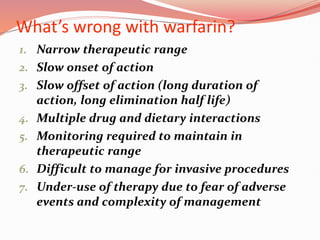
What’s wrong with warfarin?
1. Narrow therapeutic range
2. Slow onset of action
3. Slow offset of action (long duration of
action, long elimination half life)
4. Multiple drug and dietary interactions
5. Monitoring required to maintain in
therapeutic range
6. Difficult to manage for invasive procedures
7. Under-use of therapy due to fear of adverse
events and complexity of management
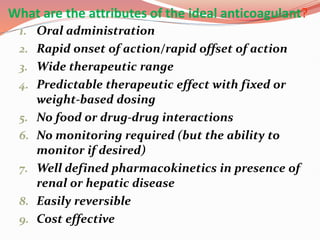
What are the attributes of the ideal anticoagulant?
1. Oral administration
2. Rapid onset of action/rapid offset of action
3. Wide therapeutic range
4. Predictable therapeutic effect with fixed or
weight-based dosing
5. No food or drug-drug interactions
6. No monitoring required (but the ability to
monitor if desired)
7. Well defined pharmacokinetics in presence of
renal or hepatic disease
8. Easily reversible
9. Cost effective
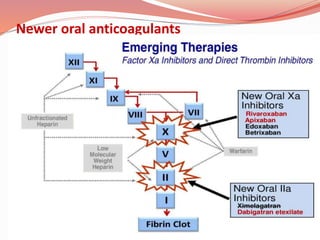
Newer oral anticoagulants
Classification
Direct thrombin (IIa) inhibitor
 Dabigatran (Pradaxa)
Factor Xa inhibitors
 Rivaroxaban (Xarelto)
 Apixaban
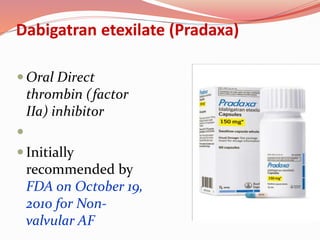
Dabigatran etexilate (Pradaxa)
 Oral Direct
thrombin (factor
IIa) inhibitor

 Initially
recommended by
FDA on October 19,
2010 for Non-
valvular AF
Mechanism of Action
Dabigatran is competitive, direct
thrombin inhibitors. Both free and
clot-bound thrombin, and thrombin-
induced platelet aggregation are
inhibited by the active moieties.
Minimal metabolism of dabigatran by
CYP3A4 enzymes is clinically
insignificant
No dose modification required in
hepatic impairment
Pharmacodynamics
Dabigatran prolongs
- aptt which targets intrinsic pathway of coagulation.
- Thrombin clotting time (TT), which directly
assesses the activity of thrombin in a plasma sample
- Has relatively little effect on the prothrombin
time and INR, which targets the extrinsic
coagulation pathway.
A dilute thrombin time assay
(Hemoclot test, Hyphen Biomed, France)
has been certified in Europe since late 2010
for the quantitative determination of
dabigatran plasma levels. It can be
calibrated with dabigatran standards.
INDICATIONS AND USAGE
 Reduction of Risk of Stroke and Systemic
Embolism in Non-valvular Atrial Fibrillation
 Treatment of Deep Venous Thrombosis and
Pulmonary Embolism
Pradaxa is indicated for the treatment of deep venous
thrombosis and pulmonary embolism in patients who
have been treated with a parenteral anticoagulant for
5-10 days.
 Reduction in the Risk of Recurrence of Deep
Venous Thrombosis and Pulmonary Embolism
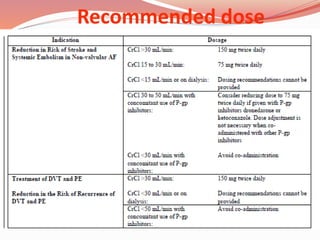
Recommended dose
SOME SPECIAL POINTS TO
MENTION….
If a dose of PRADAXA is not taken at the
scheduled time, the dose should be taken
as soon as possible on the same day; the
missed dose should be skipped if it cannot
be taken at least 6 hours before the next
scheduled dose. The dose of PRADAXA
should not be doubled to make up for a
missed dose.
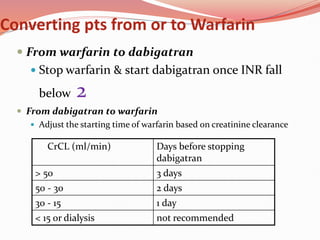
Converting pts from or to Warfarin
 From warfarin to dabigatran
 Stop warfarin & start dabigatran once INR fall
below 2
 From dabigatran to warfarin
 Adjust the starting time of warfarin based on creatinine clearance
CrCL (ml/min) Days before stopping
dabigatran
> 50 3 days
50 - 30 2 days
30 - 15 1 day
< 15 or dialysis not recommended
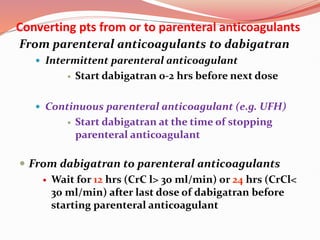
Converting pts from or to parenteral anticoagulants
From parenteral anticoagulants to dabigatran
 Intermittent parenteral anticoagulant
 Start dabigatran 0-2 hrs before next dose
 Continuous parenteral anticoagulant (e.g. UFH)
 Start dabigatran at the time of stopping
parenteral anticoagulant
 From dabigatran to parenteral anticoagulants
 Wait for 12 hrs (CrC l> 30 ml/min) or 24 hrs (CrCl<
30 ml/min) after last dose of dabigatran before
starting parenteral anticoagulant
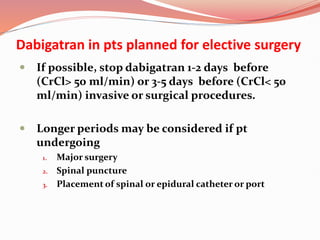
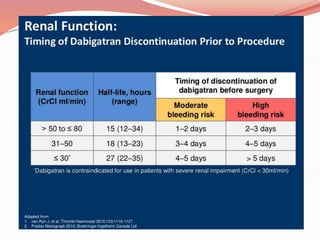
Dabigatran in pts planned for elective surgery
 If possible, stop dabigatran 1-2 days before
(CrCl> 50 ml/min) or 3-5 days before (CrCl< 50
ml/min) invasive or surgical procedures.
 Longer periods may be considered if pt
undergoing
1. Major surgery
2. Spinal puncture
3. Placement of spinal or epidural catheter or port
Dabigatran in pts planned for emergency surgery
 Because specific antidote is not available, options
are
 Either have to wait until the anticoagulant effect
has spontaneously diminished
Or
 Undergo their procedure with the knowledge that
they have a increased risk of bleeding
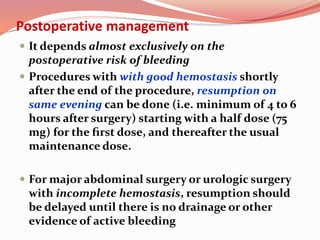
Postoperative management
 It depends almost exclusively on the
postoperative risk of bleeding
 Procedures with with good hemostasis shortly
after the end of the procedure, resumption on
same evening can be done (i.e. minimum of 4 to 6
hours after surgery) starting with a half dose (75
mg) for the first dose, and thereafter the usual
maintenance dose.
 For major abdominal surgery or urologic surgery
with incomplete hemostasis, resumption should
be delayed until there is no drainage or other
evidence of active bleeding
Antidote
 Specific agent not available
 Though limited data, following agents may be used
 Activated prothrombin complex concentrate
 Recombinant factor VIIa
 Concentrate of coagulant factors II, IX and X
 Hemodialysis (because only 35% of dabigatran is
bound to plasma proteins)
Protamine sulfate and Vit-K are not helpful
Adverse effects
 Bleeding – increases with age
 GI events
 Dyspepsia (12%)
 Abdominal pain
 Gastritis including GERD, esophagitis, erosive
gastritis, gastric hemorrhage and GI ulcers
 Hypersensitivity reaction (<0.1%)
 An unexplained increase in acute myocardial
infarction in the dabigatran group versus warfarin
(~0.2% increased risk for a AMI re-ly trial)
Contraindication
“Recently the FDA added a contraindication to the dabigatran
label against using the drug in patients with mechanical heart
valves” [12/19/2012 - Drug Safety Communication - FDA]
Based on
A clinical trial in Europe (the RE-ALIGN trial) was recently
stopped because dabigatran (Pradaxa) users were more likely to
experience strokes, heart attacks, and blood clots forming on the
mechanical heart valves than those were on warfarin. There was
also more bleeding after valve surgery in the Pradaxa users than
in the warfarin users.
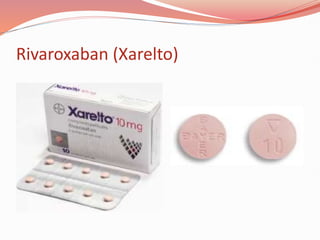
Rivaroxaban (Xarelto)
 Direct factor Xa inhibitor
 Half life: 7 - 9 hours
 Peak plasma concentration 0.5 – 3 hours after
administration
 Have excellent bio-availability of 80-100%
 2/3rd of rivaroxaban is metabolized by CYP3A4
system in liver
 1/3rd of rivaroxaban excreted unchanged in
urine while ½ of the metabolized excreted
renally while other half via fecal route.
 To reduce the risk of DVTs and PEs in patients
undergoing knee or hip replacement surgery
(Jul 1, 2011)
 For prevention of thromboembolism and
stroke in patients with nonvalvular atrial
fibrillation (Nov 4, 2011 )
 Treatment of deep vein thrombosis (DVT) and
pulmonary embolism (PE), as well as to reduce
the risk of recurrent DVT and PE (Nov 2, 2012)
Rivaroxaban: FDA Approval
(First approved in July 1st, 2011)
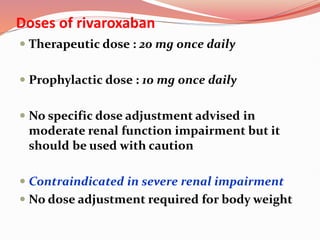
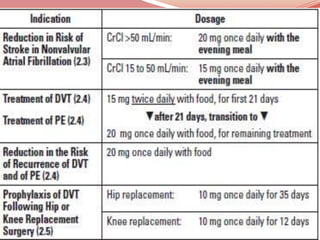
Doses of rivaroxaban
 Therapeutic dose : 20 mg once daily
 Prophylactic dose : 10 mg once daily
 No specific dose adjustment advised in
moderate renal function impairment but it
should be used with caution
 Contraindicated in severe renal impairment
 No dose adjustment required for body weight
Antidote
 Like dabigatran, no specific antidote is available
 Unlike dabigatran, rivaroxaban is not dialyzable
because of a high degree of albumin binding in
plasma (92%-95%)
 Some effects are reversed by a 4- factor
prothrombin complex concentrate PCC (dose of 50
IU/kg) in case of acute major hospital or clinic
bleeding, clinical data are still lacking
Rivaroxaban: drug interactions
 CYP3A4 system realated
 Inhibitors : Ketoconazole, ritonavir,
clarithromycin, erythromycin (increase
rivaroxaban levels 30-100%)
 Inducers : Rifampicin (decrease rivaroxaban levels
50%)
 P glycoprotein mediated
 Inhibitors : amiodarone, verapamil &
clarithromycin (increases rivaroxaban level)
 Inducer : rifampin, (decreases rivaroxaban level)
So caution is advised but no dose adjustment are
advised
Apixaban (Eliquis)
 Direct factor Xa inhibitor
 Half life – 8 to 11 hours
 Peak plasma concentration 1 – 3 hours after
administration
 Have excellent bio-availability of 66%
 Metabolized in liver
 25 % of apixaban is renally excreted, so no dose
adjustment are required in renal failure pts
 75% excreted by fecal route
 To reduce the risk of stroke and dangerous
blood clots (systemic embolism) in patients
with atrial fibrillation that is not caused by a
heart valve problem (Dec 28, 2012 )
FDA recommendation
(FDA first approved on Dec. 28, 2012)
Recommended Dose
Reduction of Risk of Stroke and Systemic Embolism in
Patients with Nonvalvular Atrial Fibrillation
The recommended dose of ELIQUIS for most
patients is 5 mg taken orally twice daily.
The recommended dose is 2.5 mg twice daily in
patients with any 2 of the following characteristics:
• age ≥80 years
• body weight ≤60 kg
• serum creatinine ≥1.5 mg/dL
Prophylaxis of Deep Vein Thrombosis Following Hip
or Knee Replacement Surgery
The recommended dose is 2.5 mg taken orally twice daily.
The initial dose should be taken 12 to 24 hours after
surgery.
• In patients undergoing hip replacement surgery, the
recommended duration of treatment is 35 days.
• In patients undergoing knee replacement surgery, the
recommended duration of treatment is 12 days.
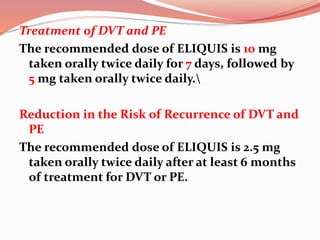
Treatment of DVT and PE
The recommended dose of ELIQUIS is 10 mg
taken orally twice daily for 7 days, followed by
5 mg taken orally twice daily.
Reduction in the Risk of Recurrence of DVT and
PE
The recommended dose of ELIQUIS is 2.5 mg
taken orally twice daily after at least 6 months
of treatment for DVT or PE.
Pts best treated with warfarin are…
1. Good level of control with warfarin
2. Renal failure pts
3. Mechanical heart valve replacement
pts
4. Gastrointestinal disease pts & elderly
pts
5. Poor compliance pts
6. Drug cost
3. Mechanical heart valve replacement pts
Why ?
 These new drugs have not been evaluated in
patients with mechanical heart valve
prosthesis
 And also
“ Recently the FDA added a
contraindication to the dabigatran label
against using the drug in patients with
mechanical heart valves”
[12/19/2012 - Drug Safety
Communication - FDA]
4. Gastrointestinal disease pts & elderly pts
Why ?
 Lower GI bleeding is significantly increased with dabigatran
compared with warfarin (probably because of low
bioavailability, which results in high concentrations of
active drug in the feces)
 Treatment with rivaroxaban was also associated with a
significant increase of the risk for gastrointestinal bleeding
 Hence, patients with intestinal angiodysplasia,
inflammatory bowel disease, or diverticulosis, or those
with a history of other forms of GI bleeding may experience
a deterioration on treatment with dabigatran or
rivaroxaban
Pts best treated with newer anticoagulants are…
1. Unexplained poor warfarin control
2. Poor level of control because of
unavoidable drug-drug interaction
3. New patients on anticoagulation
therapy for AF
oralanticoagulantspp 2.pptx

oralanticoagulantspp 2.pptx

  • 1.
    Newer Oral Anticoagulants by Dr. MOUSA EL SHAMLY professor of Chest Diseases Al-Azhar University
  • 2.
    What’s wrong withwarfarin? 1. Narrow therapeutic range 2. Slow onset of action 3. Slow offset of action (long duration of action, long elimination half life) 4. Multiple drug and dietary interactions 5. Monitoring required to maintain in therapeutic range 6. Difficult to manage for invasive procedures 7. Under-use of therapy due to fear of adverse events and complexity of management
  • 3.
    What are theattributes of the ideal anticoagulant? 1. Oral administration 2. Rapid onset of action/rapid offset of action 3. Wide therapeutic range 4. Predictable therapeutic effect with fixed or weight-based dosing 5. No food or drug-drug interactions 6. No monitoring required (but the ability to monitor if desired) 7. Well defined pharmacokinetics in presence of renal or hepatic disease 8. Easily reversible 9. Cost effective
  • 4.
  • 5.
    Classification Direct thrombin (IIa)inhibitor  Dabigatran (Pradaxa) Factor Xa inhibitors  Rivaroxaban (Xarelto)  Apixaban
  • 6.
    Dabigatran etexilate (Pradaxa) Oral Direct thrombin (factor IIa) inhibitor   Initially recommended by FDA on October 19, 2010 for Non- valvular AF
  • 7.
    Mechanism of Action Dabigatranis competitive, direct thrombin inhibitors. Both free and clot-bound thrombin, and thrombin- induced platelet aggregation are inhibited by the active moieties.
  • 8.
    Minimal metabolism ofdabigatran by CYP3A4 enzymes is clinically insignificant No dose modification required in hepatic impairment
  • 9.
    Pharmacodynamics Dabigatran prolongs - apttwhich targets intrinsic pathway of coagulation. - Thrombin clotting time (TT), which directly assesses the activity of thrombin in a plasma sample - Has relatively little effect on the prothrombin time and INR, which targets the extrinsic coagulation pathway.
  • 10.
    A dilute thrombintime assay (Hemoclot test, Hyphen Biomed, France) has been certified in Europe since late 2010 for the quantitative determination of dabigatran plasma levels. It can be calibrated with dabigatran standards.
  • 11.
    INDICATIONS AND USAGE Reduction of Risk of Stroke and Systemic Embolism in Non-valvular Atrial Fibrillation  Treatment of Deep Venous Thrombosis and Pulmonary Embolism Pradaxa is indicated for the treatment of deep venous thrombosis and pulmonary embolism in patients who have been treated with a parenteral anticoagulant for 5-10 days.  Reduction in the Risk of Recurrence of Deep Venous Thrombosis and Pulmonary Embolism
  • 12.
  • 13.
    SOME SPECIAL POINTSTO MENTION….
  • 14.
    If a doseof PRADAXA is not taken at the scheduled time, the dose should be taken as soon as possible on the same day; the missed dose should be skipped if it cannot be taken at least 6 hours before the next scheduled dose. The dose of PRADAXA should not be doubled to make up for a missed dose.
  • 15.
    Converting pts fromor to Warfarin  From warfarin to dabigatran  Stop warfarin & start dabigatran once INR fall below 2  From dabigatran to warfarin  Adjust the starting time of warfarin based on creatinine clearance CrCL (ml/min) Days before stopping dabigatran > 50 3 days 50 - 30 2 days 30 - 15 1 day < 15 or dialysis not recommended
  • 16.
    Converting pts fromor to parenteral anticoagulants From parenteral anticoagulants to dabigatran  Intermittent parenteral anticoagulant  Start dabigatran 0-2 hrs before next dose  Continuous parenteral anticoagulant (e.g. UFH)  Start dabigatran at the time of stopping parenteral anticoagulant  From dabigatran to parenteral anticoagulants  Wait for 12 hrs (CrC l> 30 ml/min) or 24 hrs (CrCl< 30 ml/min) after last dose of dabigatran before starting parenteral anticoagulant
  • 17.
    Dabigatran in ptsplanned for elective surgery  If possible, stop dabigatran 1-2 days before (CrCl> 50 ml/min) or 3-5 days before (CrCl< 50 ml/min) invasive or surgical procedures.  Longer periods may be considered if pt undergoing 1. Major surgery 2. Spinal puncture 3. Placement of spinal or epidural catheter or port
  • 18.
    Dabigatran in ptsplanned for emergency surgery  Because specific antidote is not available, options are  Either have to wait until the anticoagulant effect has spontaneously diminished Or  Undergo their procedure with the knowledge that they have a increased risk of bleeding
  • 19.
    Postoperative management  Itdepends almost exclusively on the postoperative risk of bleeding  Procedures with with good hemostasis shortly after the end of the procedure, resumption on same evening can be done (i.e. minimum of 4 to 6 hours after surgery) starting with a half dose (75 mg) for the first dose, and thereafter the usual maintenance dose.  For major abdominal surgery or urologic surgery with incomplete hemostasis, resumption should be delayed until there is no drainage or other evidence of active bleeding
  • 21.
    Antidote  Specific agentnot available  Though limited data, following agents may be used  Activated prothrombin complex concentrate  Recombinant factor VIIa  Concentrate of coagulant factors II, IX and X  Hemodialysis (because only 35% of dabigatran is bound to plasma proteins) Protamine sulfate and Vit-K are not helpful
  • 22.
    Adverse effects  Bleeding– increases with age  GI events  Dyspepsia (12%)  Abdominal pain  Gastritis including GERD, esophagitis, erosive gastritis, gastric hemorrhage and GI ulcers  Hypersensitivity reaction (<0.1%)  An unexplained increase in acute myocardial infarction in the dabigatran group versus warfarin (~0.2% increased risk for a AMI re-ly trial)
  • 23.
    Contraindication “Recently the FDAadded a contraindication to the dabigatran label against using the drug in patients with mechanical heart valves” [12/19/2012 - Drug Safety Communication - FDA] Based on A clinical trial in Europe (the RE-ALIGN trial) was recently stopped because dabigatran (Pradaxa) users were more likely to experience strokes, heart attacks, and blood clots forming on the mechanical heart valves than those were on warfarin. There was also more bleeding after valve surgery in the Pradaxa users than in the warfarin users.
  • 24.
  • 25.
    Rivaroxaban (Xarelto)  Directfactor Xa inhibitor  Half life: 7 - 9 hours  Peak plasma concentration 0.5 – 3 hours after administration  Have excellent bio-availability of 80-100%  2/3rd of rivaroxaban is metabolized by CYP3A4 system in liver  1/3rd of rivaroxaban excreted unchanged in urine while ½ of the metabolized excreted renally while other half via fecal route.
  • 26.
     To reducethe risk of DVTs and PEs in patients undergoing knee or hip replacement surgery (Jul 1, 2011)  For prevention of thromboembolism and stroke in patients with nonvalvular atrial fibrillation (Nov 4, 2011 )  Treatment of deep vein thrombosis (DVT) and pulmonary embolism (PE), as well as to reduce the risk of recurrent DVT and PE (Nov 2, 2012) Rivaroxaban: FDA Approval (First approved in July 1st, 2011)
  • 27.
    Doses of rivaroxaban Therapeutic dose : 20 mg once daily  Prophylactic dose : 10 mg once daily  No specific dose adjustment advised in moderate renal function impairment but it should be used with caution  Contraindicated in severe renal impairment  No dose adjustment required for body weight
  • 29.
    Antidote  Like dabigatran,no specific antidote is available  Unlike dabigatran, rivaroxaban is not dialyzable because of a high degree of albumin binding in plasma (92%-95%)  Some effects are reversed by a 4- factor prothrombin complex concentrate PCC (dose of 50 IU/kg) in case of acute major hospital or clinic bleeding, clinical data are still lacking
  • 30.
    Rivaroxaban: drug interactions CYP3A4 system realated  Inhibitors : Ketoconazole, ritonavir, clarithromycin, erythromycin (increase rivaroxaban levels 30-100%)  Inducers : Rifampicin (decrease rivaroxaban levels 50%)  P glycoprotein mediated  Inhibitors : amiodarone, verapamil & clarithromycin (increases rivaroxaban level)  Inducer : rifampin, (decreases rivaroxaban level) So caution is advised but no dose adjustment are advised
  • 31.
    Apixaban (Eliquis)  Directfactor Xa inhibitor  Half life – 8 to 11 hours  Peak plasma concentration 1 – 3 hours after administration  Have excellent bio-availability of 66%  Metabolized in liver  25 % of apixaban is renally excreted, so no dose adjustment are required in renal failure pts  75% excreted by fecal route
  • 32.
     To reducethe risk of stroke and dangerous blood clots (systemic embolism) in patients with atrial fibrillation that is not caused by a heart valve problem (Dec 28, 2012 ) FDA recommendation (FDA first approved on Dec. 28, 2012)
  • 33.
    Recommended Dose Reduction ofRisk of Stroke and Systemic Embolism in Patients with Nonvalvular Atrial Fibrillation The recommended dose of ELIQUIS for most patients is 5 mg taken orally twice daily. The recommended dose is 2.5 mg twice daily in patients with any 2 of the following characteristics: • age ≥80 years • body weight ≤60 kg • serum creatinine ≥1.5 mg/dL
  • 34.
    Prophylaxis of DeepVein Thrombosis Following Hip or Knee Replacement Surgery The recommended dose is 2.5 mg taken orally twice daily. The initial dose should be taken 12 to 24 hours after surgery. • In patients undergoing hip replacement surgery, the recommended duration of treatment is 35 days. • In patients undergoing knee replacement surgery, the recommended duration of treatment is 12 days.
  • 35.
    Treatment of DVTand PE The recommended dose of ELIQUIS is 10 mg taken orally twice daily for 7 days, followed by 5 mg taken orally twice daily. Reduction in the Risk of Recurrence of DVT and PE The recommended dose of ELIQUIS is 2.5 mg taken orally twice daily after at least 6 months of treatment for DVT or PE.
  • 37.
    Pts best treatedwith warfarin are… 1. Good level of control with warfarin 2. Renal failure pts 3. Mechanical heart valve replacement pts 4. Gastrointestinal disease pts & elderly pts 5. Poor compliance pts 6. Drug cost
  • 38.
    3. Mechanical heartvalve replacement pts Why ?  These new drugs have not been evaluated in patients with mechanical heart valve prosthesis  And also “ Recently the FDA added a contraindication to the dabigatran label against using the drug in patients with mechanical heart valves” [12/19/2012 - Drug Safety Communication - FDA]
  • 39.
    4. Gastrointestinal diseasepts & elderly pts Why ?  Lower GI bleeding is significantly increased with dabigatran compared with warfarin (probably because of low bioavailability, which results in high concentrations of active drug in the feces)  Treatment with rivaroxaban was also associated with a significant increase of the risk for gastrointestinal bleeding  Hence, patients with intestinal angiodysplasia, inflammatory bowel disease, or diverticulosis, or those with a history of other forms of GI bleeding may experience a deterioration on treatment with dabigatran or rivaroxaban
  • 40.
    Pts best treatedwith newer anticoagulants are… 1. Unexplained poor warfarin control 2. Poor level of control because of unavoidable drug-drug interaction 3. New patients on anticoagulation therapy for AF