RISK WITH HVAC
SYSTEM AND
MITIGATION PLAN
Presented by:
AKSHAY MEHTA
INTRODUCTION
• Heating, Ventilating, and Air Conditioning (HVAC) relates to systems
that perform processes designed to regulate the air conditions within
hospital for the comfort and safety to the patients, visitors and staff.
• HVAC systems condition and move air to desired areas of an indoor
environment to create and maintain desirable temperature, humidity,
ventilation and air purity.
• HVAC system is a key component of facility safety and infection
control.
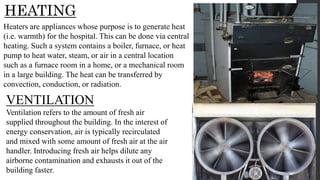
HEATING
Heaters are appliances whose purpose is to generate heat
(i.e. warmth) for the hospital. This can be done via central
heating. Such a system contains a boiler, furnace, or heat
pump to heat water, steam, or air in a central location
such as a furnace room in a home, or a mechanical room
in a large building. The heat can be transferred by
convection, conduction, or radiation.
VENTILATION
Ventilation refers to the amount of fresh air
supplied throughout the building. In the interest of
energy conservation, air is typically recirculated
and mixed with some amount of fresh air at the air
handler. Introducing fresh air helps dilute any
airborne contamination and exhausts it out of the
building faster.
AIR CONDITIONING
• An air conditioning system provides cooling and humidity control for
all parts of hospital.
• Air conditioned hospitals often have sealed windows, because open
windows would work against the system intended to maintain constant
indoor air conditions.
• In a hospital, the needs of the room might change constantly as
different patients come and go. With powerful air conditioning
system, we can perform constant adjustment to ensure that the
environment is precisely tailored to the needs of recovering patients.
Association of HAI and HVAC:
Some of the ways that potentially
infectious microorganisms can be spread
in a health care environment include
• sneezes and coughs
• inhalation
• Contact
• deposition in surgical site or open
wound
• water mist
• insect bite.
HVAC systems can impact HAIs by
affecting
• dilution (by ventilation)
• air quality (by filtration)
• exposure time (by air change and
pressure differential)
• temperature
• humidity
• organism viability (by ultraviolet [UV]
treatment)
• airflow patterns.
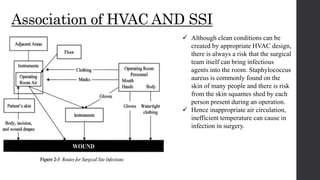
Association of HVAC AND SSI
 Although clean conditions can be
created by appropriate HVAC design,
there is always a risk that the surgical
team itself can bring infectious
agents into the room. Staphylococcus
aureus is commonly found on the
skin of many people and there is risk
from the skin squames shed by each
person present during an operation.
 Hence inappropriate air circulation,
inefficient temperature can cause in
infection in surgery.
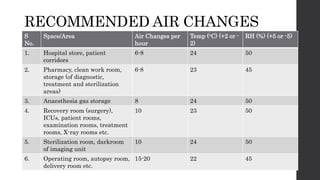
RECOMMENDED AIR CHANGES
S
No.
Space/Area Air Changes per
hour
Temp (oC) (+2 or -
2)
RH (%) (+5 or -5)
1. Hospital store, patient
corridors
6-8 24 50
2. Pharmacy, clean work room,
storage (of diagnostic,
treatment and sterilization
areas)
6-8 23 45
3. Anaesthesia gas storage 8 24 50
4. Recovery room (surgery),
ICUs, patient rooms,
examination rooms, treatment
rooms, X-ray rooms etc.
10 23 50
5. Sterilization room, darkroom
of imaging unit
10 24 50
6. Operating room, autopsy room,
delivery room etc.
15-20 22 45
HVAC AND AIRBORNE INFECTION ISOLATION
ROOMS
RISKS INVOLVED:
• The major infection risk both to the hospital staff and patients and is often due to
the old age and poor condition of the HVAC systems. Air tightness of new isolation
rooms is better than old isolation rooms. However, several leakages such as
unsealed cables and tubes, windows, door frames and surroundings, wall sockets,
switches and old seals have been found in new isolation rooms, all of which reduce
the rooms’ air tightness.
• Adding insult to injury, hospital employees have also mistakenly open the isolation
room windows and thus help the spread infectious diseases.
MITIGATION PLAN
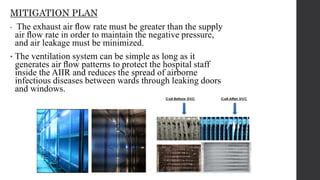
• The exhaust air flow rate must be greater than the supply
air flow rate in order to maintain the negative pressure,
and air leakage must be minimized.
• The ventilation system can be simple as long as it
generates air flow patterns to protect the hospital staff
inside the AIIR and reduces the spread of airborne
infectious diseases between wards through leaking doors
and windows.
HVAC AND OPERATING ROOMS
RISKS INVOLVED:
• Commonly encountered HVAC problems in the OTs include insufficient indoor air
exchange, poor control on indoor thermal conditions, bad space ergonomics that
influence the ventilation system operation, poor maintenance of technical
installations, understaffed technical departments and inefficient HVAC systems.
• Allergies and respiratory illnesses are associated with high humidity and mould
growth, particularly for asthma and rhinitis.
MITIGATION PLAN
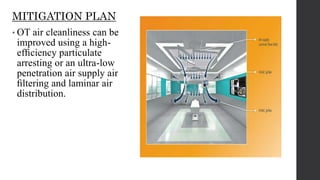
• OT air cleanliness can be
improved using a high-
efficiency particulate
arresting or an ultra-low
penetration air supply air
filtering and laminar air
distribution.
HVAC AND INTENSIVE CARE UNIT
• RISKS INVOLVED:
• Severely ill patients in ICUs frequently require invasive devices, which may
increase the risk of airway infections. The incidence of these infections is
especially high in the ICU.
• Also, the probability of cross-infection among patients increases with the use of
an HVAC system or from contacts between patients and health-care personnel.
MITIGATION PLAN:
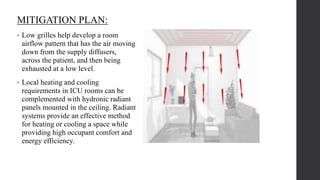
• Low grilles help develop a room
airflow pattern that has the air moving
down from the supply diffusers,
across the patient, and then being
exhausted at a low level.
• Local heating and cooling
requirements in ICU rooms can be
complemented with hydronic radiant
panels mounted in the ceiling. Radiant
systems provide an effective method
for heating or cooling a space while
providing high occupant comfort and
energy efficiency.
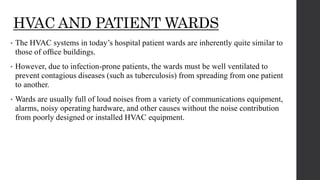
HVAC AND PATIENT WARDS
• The HVAC systems in today’s hospital patient wards are inherently quite similar to
those of office buildings.
• However, due to infection-prone patients, the wards must be well ventilated to
prevent contagious diseases (such as tuberculosis) from spreading from one patient
to another.
• Wards are usually full of loud noises from a variety of communications equipment,
alarms, noisy operating hardware, and other causes without the noise contribution
from poorly designed or installed HVAC equipment.
MITIGATION PLAN:
• Patient wards are occupied and thus in use
throughout the entire day. The patient ward air is
usually supplied using ceiling or corridor wall
blasting with mixing ventilation.
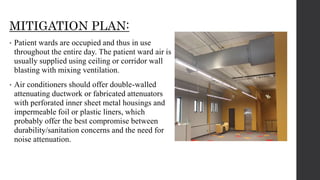
• Air conditioners should offer double-walled
attenuating ductwork or fabricated attenuators
with perforated inner sheet metal housings and
impermeable foil or plastic liners, which
probably offer the best compromise between
durability/sanitation concerns and the need for
noise attenuation.
HVAC AND LABORATORIES
• Laboratories frequently suffer from poor ventilation and the HVAC systems
in laboratories are in poor condition, creating occupational safety hazards.
• Ventilation determines the degree of exposure to harmful emissions. Less
ventilation equals higher levels of exposure and potential danger from
chemicals and contaminants.
• The hazardous air should be recirculated as it poses threat to professionals.
MITIGATION PLAN
• Hospital laboratories require efficient
IAQ control. Local exhaust ventilation is
being used in laboratories to prevent
indoor air contaminants from spreading.
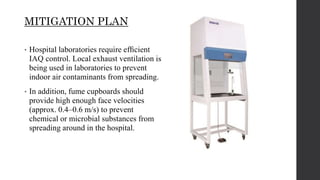
• In addition, fume cupboards should
provide high enough face velocities
(approx. 0.4–0.6 m/s) to prevent
chemical or microbial substances from
spreading around in the hospital.
HVAC AND EMERGENCY DEPARTMENT
RISKS
• The emergency department is generally the point of entry to a hospital for
undiagnosed patients, some of whom may be carriers of dangerous infectious
diseases like tuberculosis.
• Infectious patients are also a concern in the event of a pandemic in the
community. During a pandemic, the emergency department will be a primary
point of contact between infected patients and the hospital.
MITIGATION
PLAN
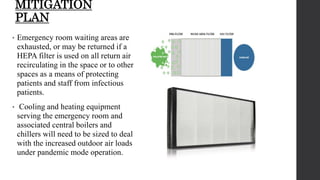
• Emergency room waiting areas are
exhausted, or may be returned if a
HEPA filter is used on all return air
recirculating in the space or to other
spaces as a means of protecting
patients and staff from infectious
patients.
• Cooling and heating equipment
serving the emergency room and
associated central boilers and
chillers will need to be sized to deal
with the increased outdoor air loads
under pandemic mode operation.
THANK YOU

Risk with hvac system and mitigation plan

  • 1.
    RISK WITH HVAC SYSTEMAND MITIGATION PLAN Presented by: AKSHAY MEHTA
  • 2.
    INTRODUCTION • Heating, Ventilating,and Air Conditioning (HVAC) relates to systems that perform processes designed to regulate the air conditions within hospital for the comfort and safety to the patients, visitors and staff. • HVAC systems condition and move air to desired areas of an indoor environment to create and maintain desirable temperature, humidity, ventilation and air purity. • HVAC system is a key component of facility safety and infection control.
  • 3.
    HEATING Heaters are applianceswhose purpose is to generate heat (i.e. warmth) for the hospital. This can be done via central heating. Such a system contains a boiler, furnace, or heat pump to heat water, steam, or air in a central location such as a furnace room in a home, or a mechanical room in a large building. The heat can be transferred by convection, conduction, or radiation. VENTILATION Ventilation refers to the amount of fresh air supplied throughout the building. In the interest of energy conservation, air is typically recirculated and mixed with some amount of fresh air at the air handler. Introducing fresh air helps dilute any airborne contamination and exhausts it out of the building faster.
  • 4.
    AIR CONDITIONING • Anair conditioning system provides cooling and humidity control for all parts of hospital. • Air conditioned hospitals often have sealed windows, because open windows would work against the system intended to maintain constant indoor air conditions. • In a hospital, the needs of the room might change constantly as different patients come and go. With powerful air conditioning system, we can perform constant adjustment to ensure that the environment is precisely tailored to the needs of recovering patients.
  • 5.
    Association of HAIand HVAC: Some of the ways that potentially infectious microorganisms can be spread in a health care environment include • sneezes and coughs • inhalation • Contact • deposition in surgical site or open wound • water mist • insect bite. HVAC systems can impact HAIs by affecting • dilution (by ventilation) • air quality (by filtration) • exposure time (by air change and pressure differential) • temperature • humidity • organism viability (by ultraviolet [UV] treatment) • airflow patterns.
  • 6.
    Association of HVACAND SSI  Although clean conditions can be created by appropriate HVAC design, there is always a risk that the surgical team itself can bring infectious agents into the room. Staphylococcus aureus is commonly found on the skin of many people and there is risk from the skin squames shed by each person present during an operation.  Hence inappropriate air circulation, inefficient temperature can cause in infection in surgery.
  • 7.
    RECOMMENDED AIR CHANGES S No. Space/AreaAir Changes per hour Temp (oC) (+2 or - 2) RH (%) (+5 or -5) 1. Hospital store, patient corridors 6-8 24 50 2. Pharmacy, clean work room, storage (of diagnostic, treatment and sterilization areas) 6-8 23 45 3. Anaesthesia gas storage 8 24 50 4. Recovery room (surgery), ICUs, patient rooms, examination rooms, treatment rooms, X-ray rooms etc. 10 23 50 5. Sterilization room, darkroom of imaging unit 10 24 50 6. Operating room, autopsy room, delivery room etc. 15-20 22 45
  • 8.
    HVAC AND AIRBORNEINFECTION ISOLATION ROOMS RISKS INVOLVED: • The major infection risk both to the hospital staff and patients and is often due to the old age and poor condition of the HVAC systems. Air tightness of new isolation rooms is better than old isolation rooms. However, several leakages such as unsealed cables and tubes, windows, door frames and surroundings, wall sockets, switches and old seals have been found in new isolation rooms, all of which reduce the rooms’ air tightness. • Adding insult to injury, hospital employees have also mistakenly open the isolation room windows and thus help the spread infectious diseases.
  • 9.
    MITIGATION PLAN • Theexhaust air flow rate must be greater than the supply air flow rate in order to maintain the negative pressure, and air leakage must be minimized. • The ventilation system can be simple as long as it generates air flow patterns to protect the hospital staff inside the AIIR and reduces the spread of airborne infectious diseases between wards through leaking doors and windows.
  • 10.
    HVAC AND OPERATINGROOMS RISKS INVOLVED: • Commonly encountered HVAC problems in the OTs include insufficient indoor air exchange, poor control on indoor thermal conditions, bad space ergonomics that influence the ventilation system operation, poor maintenance of technical installations, understaffed technical departments and inefficient HVAC systems. • Allergies and respiratory illnesses are associated with high humidity and mould growth, particularly for asthma and rhinitis.
  • 11.
    MITIGATION PLAN • OTair cleanliness can be improved using a high- efficiency particulate arresting or an ultra-low penetration air supply air filtering and laminar air distribution.
  • 12.
    HVAC AND INTENSIVECARE UNIT • RISKS INVOLVED: • Severely ill patients in ICUs frequently require invasive devices, which may increase the risk of airway infections. The incidence of these infections is especially high in the ICU. • Also, the probability of cross-infection among patients increases with the use of an HVAC system or from contacts between patients and health-care personnel.
  • 13.
    MITIGATION PLAN: • Lowgrilles help develop a room airflow pattern that has the air moving down from the supply diffusers, across the patient, and then being exhausted at a low level. • Local heating and cooling requirements in ICU rooms can be complemented with hydronic radiant panels mounted in the ceiling. Radiant systems provide an effective method for heating or cooling a space while providing high occupant comfort and energy efficiency.
  • 14.
    HVAC AND PATIENTWARDS • The HVAC systems in today’s hospital patient wards are inherently quite similar to those of office buildings. • However, due to infection-prone patients, the wards must be well ventilated to prevent contagious diseases (such as tuberculosis) from spreading from one patient to another. • Wards are usually full of loud noises from a variety of communications equipment, alarms, noisy operating hardware, and other causes without the noise contribution from poorly designed or installed HVAC equipment.
  • 15.
    MITIGATION PLAN: • Patientwards are occupied and thus in use throughout the entire day. The patient ward air is usually supplied using ceiling or corridor wall blasting with mixing ventilation. • Air conditioners should offer double-walled attenuating ductwork or fabricated attenuators with perforated inner sheet metal housings and impermeable foil or plastic liners, which probably offer the best compromise between durability/sanitation concerns and the need for noise attenuation.
  • 16.
    HVAC AND LABORATORIES •Laboratories frequently suffer from poor ventilation and the HVAC systems in laboratories are in poor condition, creating occupational safety hazards. • Ventilation determines the degree of exposure to harmful emissions. Less ventilation equals higher levels of exposure and potential danger from chemicals and contaminants. • The hazardous air should be recirculated as it poses threat to professionals.
  • 17.
    MITIGATION PLAN • Hospitallaboratories require efficient IAQ control. Local exhaust ventilation is being used in laboratories to prevent indoor air contaminants from spreading. • In addition, fume cupboards should provide high enough face velocities (approx. 0.4–0.6 m/s) to prevent chemical or microbial substances from spreading around in the hospital.
  • 18.
    HVAC AND EMERGENCYDEPARTMENT RISKS • The emergency department is generally the point of entry to a hospital for undiagnosed patients, some of whom may be carriers of dangerous infectious diseases like tuberculosis. • Infectious patients are also a concern in the event of a pandemic in the community. During a pandemic, the emergency department will be a primary point of contact between infected patients and the hospital.
  • 19.
    MITIGATION PLAN • Emergency roomwaiting areas are exhausted, or may be returned if a HEPA filter is used on all return air recirculating in the space or to other spaces as a means of protecting patients and staff from infectious patients. • Cooling and heating equipment serving the emergency room and associated central boilers and chillers will need to be sized to deal with the increased outdoor air loads under pandemic mode operation.
  • 20.