Revenue Risk Management
The Future of Revenue Assurance
Exploiting risk management techniques to
accelerate Revenue Assurance maturity
January 2014
Copyright © 2008-2014 Revenue Risk Management Solutions Limited 1
Introduction
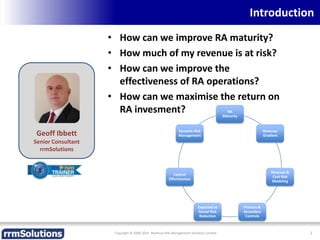
• How can we improve RA maturity?
• How much of my revenue is at risk?
• How can we improve the
effectiveness of RA operations?
• How can we maximise the return on
RA invesment?
Copyright © 2008-2014 Revenue Risk Management Solutions Limited 2
Geoff Ibbett
Senior Consultant
rrmSolutions
RA
Maturity
Revenue
Gradient
Revenue &
Cost Risk
Modeling
Primary &
Secondary
Controls
Expected vs
Actual Risk
Reduction
Control
Effectiveness
Dynamic Risk
Management
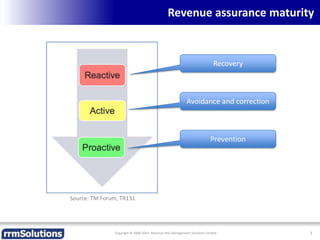
Revenue assurance maturity
Copyright © 2008-2014 Revenue Risk Management Solutions Limited 3
Source: TM Forum, TR131
Recovery
Avoidance and correction
Prevention
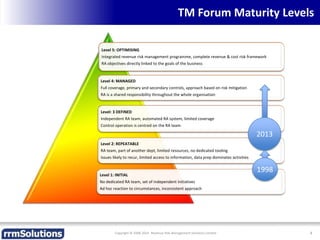
TM Forum Maturity Levels
Copyright © 2008-2014 Revenue Risk Management Solutions Limited 4
Level 5: OPTIMISING
Integrated revenue risk management programme, complete revenue & cost risk framework
RA objectives directly linked to the goals of the business
Level 4: MANAGED
Full coverage, primary and secondary controls, approach based on risk mitigation
RA is a shared responsibility throughout the whole organisation
Level: 3 DEFINED
Independent RA team, automated RA system, limited coverage
Control operation is centred on the RA team
Level 2: REPEATABLE
RA team, part of another dept, limited resources, no dedicated tooling
Issues likely to recur, limited access to information, data prep dominates activities
Level 1: INITIAL
No dedicated RA team, set of independent initiatives
Ad hoc reaction to circumstances, inconsistent approach
2013
1998
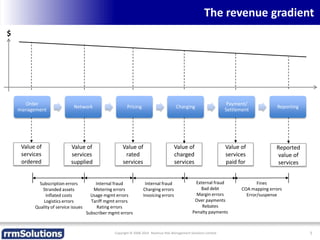
The revenue gradient
Copyright © 2008-2014 Revenue Risk Management Solutions Limited 5
Order
management
Network Pricing Charging
Payment/
Settlement
Reporting
$
Value of
services
ordered
Value of
services
supplied
Value of
rated
services
Value of
charged
services
Value of
services
paid for
Reported
value of
services
Fines
COA mapping errors
Error/suspense
External fraud
Bad debt
Margin errors
Over payments
Rebates
Penalty payments
Internal fraud
Charging errors
Invoicing errors
Internal fraud
Metering errors
Usage mgmt errors
Tariff mgmt errors
Rating errors
Subscriber mgmt errors
Subscription errors
Stranded assets
Inflated costs
Logistics errors
Quality of service issues
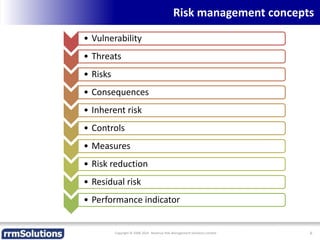
Risk management concepts
Copyright © 2008-2014 Revenue Risk Management Solutions Limited 6
• Vulnerability
• Threats
• Risks
• Consequences
• Inherent risk
• Controls
• Measures
• Risk reduction
• Residual risk
• Performance indicator
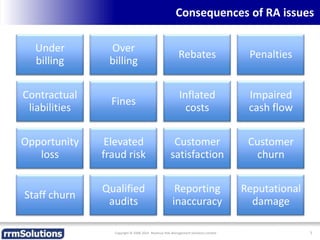
Consequences of RA issues
Copyright © 2008-2014 Revenue Risk Management Solutions Limited 7
Under
billing
Over
billing
Rebates Penalties
Contractual
liabilities
Fines
Inflated
costs
Impaired
cash flow
Opportunity
loss
Elevated
fraud risk
Customer
satisfaction
Customer
churn
Staff churn
Qualified
audits
Reporting
inaccuracy
Reputational
damage
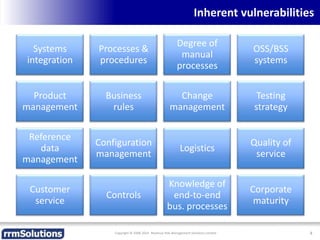
Inherent vulnerabilities
Copyright © 2008-2014 Revenue Risk Management Solutions Limited 8
Systems
integration
Processes &
procedures
Degree of
manual
processes
OSS/BSS
systems
Product
management
Business
rules
Change
management
Testing
strategy
Reference
data
management
Configuration
management
Logistics
Quality of
service
Customer
service
Controls
Knowledge of
end-to-end
bus. processes
Corporate
maturity
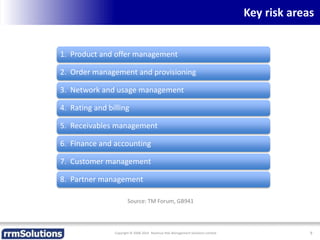
Key risk areas
Copyright © 2008-2014 Revenue Risk Management Solutions Limited 9
Source: TM Forum, GB941
1. Product and offer management
2. Order management and provisioning
3. Network and usage management
4. Rating and billing
5. Receivables management
6. Finance and accounting
7. Customer management
8. Partner management
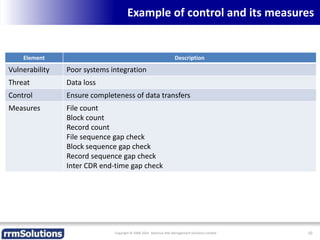
Example of control and its measures
Copyright © 2008-2014 Revenue Risk Management Solutions Limited 10
Element Description
Vulnerability Poor systems integration
Threat Data loss
Control Ensure completeness of data transfers
Measures File count
Block count
Record count
File sequence gap check
Block sequence gap check
Record sequence gap check
Inter CDR end-time gap check
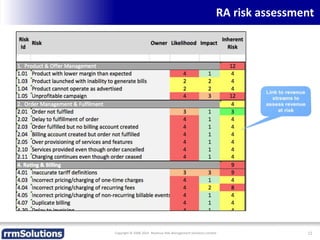
RA risk assessment
Copyright © 2008-2014 Revenue Risk Management Solutions Limited 11
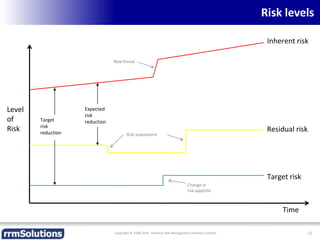
Risk levels
Copyright © 2008-2014 Revenue Risk Management Solutions Limited 12
Time
Level
of
Risk
Inherent risk
Target risk
Residual risk
Expected
risk
reductionTarget
risk
reduction Risk assessment
New threat
Change in
risk appetite
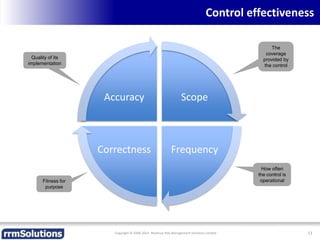
Control effectiveness
Scope
FrequencyCorrectness
Accuracy
Copyright © 2008-2014 Revenue Risk Management Solutions Limited 13
The
coverage
provided by
the control
How often
the control is
operationalFitness for
purpose
Quality of its
implementation
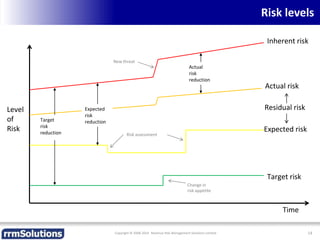
Risk levels
Copyright © 2008-2014 Revenue Risk Management Solutions Limited 14
Time
Level
of
Risk
Inherent risk
Expected risk
Actual risk
Expected
risk
reduction
Actual
risk
reduction
Risk assessment
New threat
Target risk
Change in
risk appetite
Target
risk
reduction
Residual risk
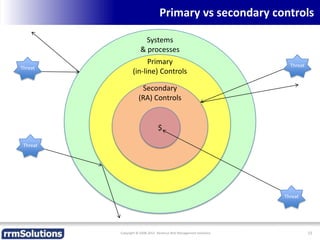
Systems
& processes
Primary
(in-line) Controls
Secondary
(RA) Controls
Primary vs secondary controls
Copyright © 2008-2012 Revenue Risk Management Solutions 15
$
Threat Threat
Threat
Threat
Primary vs secondary controls
Copyright © 2008-2014 Revenue Risk Management Solutions Limited 16
Order
management
Network Pricing Charging
Payment/
Settlement
Reporting
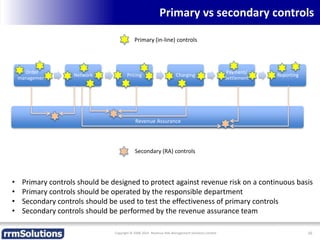
Primary (in-line) controls
Secondary (RA) controls
Revenue Assurance
• Primary controls should be designed to protect against revenue risk on a continuous basis
• Primary controls should be operated by the responsible department
• Secondary controls should be used to test the effectiveness of primary controls
• Secondary controls should be performed by the revenue assurance team
Dynamic risk management
Copyright © 2008-2014 Revenue Risk Management Solutions Limited 17
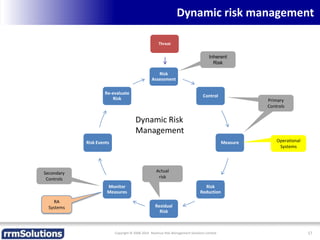
Risk
Assessment
Control
Measure
Risk
Reduction
Residual
Risk
Monitor
Measures
Risk Events
Re-evaluate
Risk
Threat
Inherent
Risk
Primary
Controls
Expected
risk
Actual
risk
Dynamic Risk
Management
RA
Systems
Operational
Systems
Primary
Controls
Secondary
Controls
Business benefits
Copyright © 2008-2014 Revenue Risk Management Solutions Limited 18
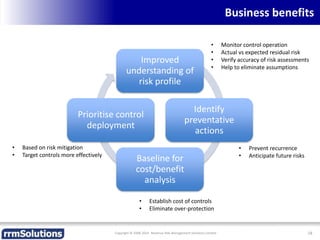
Improved
understanding of
risk profile
Identify
preventative
actions
Baseline for
cost/benefit
analysis
Prioritise control
deployment
• Monitor control operation
• Actual vs expected residual risk
• Verify accuracy of risk assessments
• Help to eliminate assumptions
• Prevent recurrence
• Anticipate future risks
• Establish cost of controls
• Eliminate over-protection
• Based on risk mitigation
• Target controls more effectively
Summary
Copyright © 2008-2014 Revenue Risk Management Solutions Limited 19
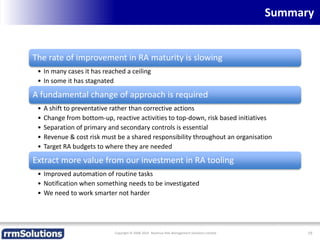
The rate of improvement in RA maturity is slowing
• In many cases it has reached a ceiling
• In some it has stagnated
A fundamental change of approach is required
• A shift to preventative rather than corrective actions
• Change from bottom-up, reactive activities to top-down, risk based initiatives
• Separation of primary and secondary controls is essential
• Revenue & cost risk must be a shared responsibility throughout an organisation
• Target RA budgets to where they are needed
Extract more value from our investment in RA tooling
• Improved automation of routine tasks
• Notification when something needs to be investigated
• We need to work smarter not harder
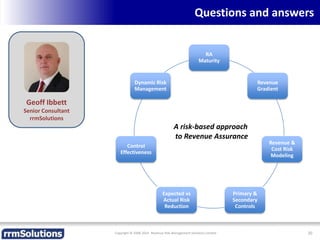
Questions and answers
Copyright © 2008-2014 Revenue Risk Management Solutions Limited 20
Geoff Ibbett
Senior Consultant
rrmSolutions
RA
Maturity
Revenue
Gradient
Revenue &
Cost Risk
Modeling
Primary &
Secondary
Controls
Expected vs
Actual Risk
Reduction
Control
Effectiveness
Dynamic Risk
Management
A risk-based approach
to Revenue Assurance

Risk Based Approach to RA

  • 1.
    Revenue Risk Management TheFuture of Revenue Assurance Exploiting risk management techniques to accelerate Revenue Assurance maturity January 2014 Copyright © 2008-2014 Revenue Risk Management Solutions Limited 1
  • 2.
    Introduction • How canwe improve RA maturity? • How much of my revenue is at risk? • How can we improve the effectiveness of RA operations? • How can we maximise the return on RA invesment? Copyright © 2008-2014 Revenue Risk Management Solutions Limited 2 Geoff Ibbett Senior Consultant rrmSolutions RA Maturity Revenue Gradient Revenue & Cost Risk Modeling Primary & Secondary Controls Expected vs Actual Risk Reduction Control Effectiveness Dynamic Risk Management
  • 3.
    Revenue assurance maturity Copyright© 2008-2014 Revenue Risk Management Solutions Limited 3 Source: TM Forum, TR131 Recovery Avoidance and correction Prevention
  • 4.
    TM Forum MaturityLevels Copyright © 2008-2014 Revenue Risk Management Solutions Limited 4 Level 5: OPTIMISING Integrated revenue risk management programme, complete revenue & cost risk framework RA objectives directly linked to the goals of the business Level 4: MANAGED Full coverage, primary and secondary controls, approach based on risk mitigation RA is a shared responsibility throughout the whole organisation Level: 3 DEFINED Independent RA team, automated RA system, limited coverage Control operation is centred on the RA team Level 2: REPEATABLE RA team, part of another dept, limited resources, no dedicated tooling Issues likely to recur, limited access to information, data prep dominates activities Level 1: INITIAL No dedicated RA team, set of independent initiatives Ad hoc reaction to circumstances, inconsistent approach 2013 1998
  • 5.
    The revenue gradient Copyright© 2008-2014 Revenue Risk Management Solutions Limited 5 Order management Network Pricing Charging Payment/ Settlement Reporting $ Value of services ordered Value of services supplied Value of rated services Value of charged services Value of services paid for Reported value of services Fines COA mapping errors Error/suspense External fraud Bad debt Margin errors Over payments Rebates Penalty payments Internal fraud Charging errors Invoicing errors Internal fraud Metering errors Usage mgmt errors Tariff mgmt errors Rating errors Subscriber mgmt errors Subscription errors Stranded assets Inflated costs Logistics errors Quality of service issues
  • 6.
    Risk management concepts Copyright© 2008-2014 Revenue Risk Management Solutions Limited 6 • Vulnerability • Threats • Risks • Consequences • Inherent risk • Controls • Measures • Risk reduction • Residual risk • Performance indicator
  • 7.
    Consequences of RAissues Copyright © 2008-2014 Revenue Risk Management Solutions Limited 7 Under billing Over billing Rebates Penalties Contractual liabilities Fines Inflated costs Impaired cash flow Opportunity loss Elevated fraud risk Customer satisfaction Customer churn Staff churn Qualified audits Reporting inaccuracy Reputational damage
  • 8.
    Inherent vulnerabilities Copyright ©2008-2014 Revenue Risk Management Solutions Limited 8 Systems integration Processes & procedures Degree of manual processes OSS/BSS systems Product management Business rules Change management Testing strategy Reference data management Configuration management Logistics Quality of service Customer service Controls Knowledge of end-to-end bus. processes Corporate maturity
  • 9.
    Key risk areas Copyright© 2008-2014 Revenue Risk Management Solutions Limited 9 Source: TM Forum, GB941 1. Product and offer management 2. Order management and provisioning 3. Network and usage management 4. Rating and billing 5. Receivables management 6. Finance and accounting 7. Customer management 8. Partner management
  • 10.
    Example of controland its measures Copyright © 2008-2014 Revenue Risk Management Solutions Limited 10 Element Description Vulnerability Poor systems integration Threat Data loss Control Ensure completeness of data transfers Measures File count Block count Record count File sequence gap check Block sequence gap check Record sequence gap check Inter CDR end-time gap check
  • 11.
    RA risk assessment Copyright© 2008-2014 Revenue Risk Management Solutions Limited 11
  • 12.
    Risk levels Copyright ©2008-2014 Revenue Risk Management Solutions Limited 12 Time Level of Risk Inherent risk Target risk Residual risk Expected risk reductionTarget risk reduction Risk assessment New threat Change in risk appetite
  • 13.
    Control effectiveness Scope FrequencyCorrectness Accuracy Copyright ©2008-2014 Revenue Risk Management Solutions Limited 13 The coverage provided by the control How often the control is operationalFitness for purpose Quality of its implementation
  • 14.
    Risk levels Copyright ©2008-2014 Revenue Risk Management Solutions Limited 14 Time Level of Risk Inherent risk Expected risk Actual risk Expected risk reduction Actual risk reduction Risk assessment New threat Target risk Change in risk appetite Target risk reduction Residual risk
  • 15.
    Systems & processes Primary (in-line) Controls Secondary (RA)Controls Primary vs secondary controls Copyright © 2008-2012 Revenue Risk Management Solutions 15 $ Threat Threat Threat Threat
  • 16.
    Primary vs secondarycontrols Copyright © 2008-2014 Revenue Risk Management Solutions Limited 16 Order management Network Pricing Charging Payment/ Settlement Reporting Primary (in-line) controls Secondary (RA) controls Revenue Assurance • Primary controls should be designed to protect against revenue risk on a continuous basis • Primary controls should be operated by the responsible department • Secondary controls should be used to test the effectiveness of primary controls • Secondary controls should be performed by the revenue assurance team
  • 17.
    Dynamic risk management Copyright© 2008-2014 Revenue Risk Management Solutions Limited 17 Risk Assessment Control Measure Risk Reduction Residual Risk Monitor Measures Risk Events Re-evaluate Risk Threat Inherent Risk Primary Controls Expected risk Actual risk Dynamic Risk Management RA Systems Operational Systems Primary Controls Secondary Controls
  • 18.
    Business benefits Copyright ©2008-2014 Revenue Risk Management Solutions Limited 18 Improved understanding of risk profile Identify preventative actions Baseline for cost/benefit analysis Prioritise control deployment • Monitor control operation • Actual vs expected residual risk • Verify accuracy of risk assessments • Help to eliminate assumptions • Prevent recurrence • Anticipate future risks • Establish cost of controls • Eliminate over-protection • Based on risk mitigation • Target controls more effectively
  • 19.
    Summary Copyright © 2008-2014Revenue Risk Management Solutions Limited 19 The rate of improvement in RA maturity is slowing • In many cases it has reached a ceiling • In some it has stagnated A fundamental change of approach is required • A shift to preventative rather than corrective actions • Change from bottom-up, reactive activities to top-down, risk based initiatives • Separation of primary and secondary controls is essential • Revenue & cost risk must be a shared responsibility throughout an organisation • Target RA budgets to where they are needed Extract more value from our investment in RA tooling • Improved automation of routine tasks • Notification when something needs to be investigated • We need to work smarter not harder
  • 20.
    Questions and answers Copyright© 2008-2014 Revenue Risk Management Solutions Limited 20 Geoff Ibbett Senior Consultant rrmSolutions RA Maturity Revenue Gradient Revenue & Cost Risk Modeling Primary & Secondary Controls Expected vs Actual Risk Reduction Control Effectiveness Dynamic Risk Management A risk-based approach to Revenue Assurance