The Hygiene Hypothesis   By Shawn Pichette
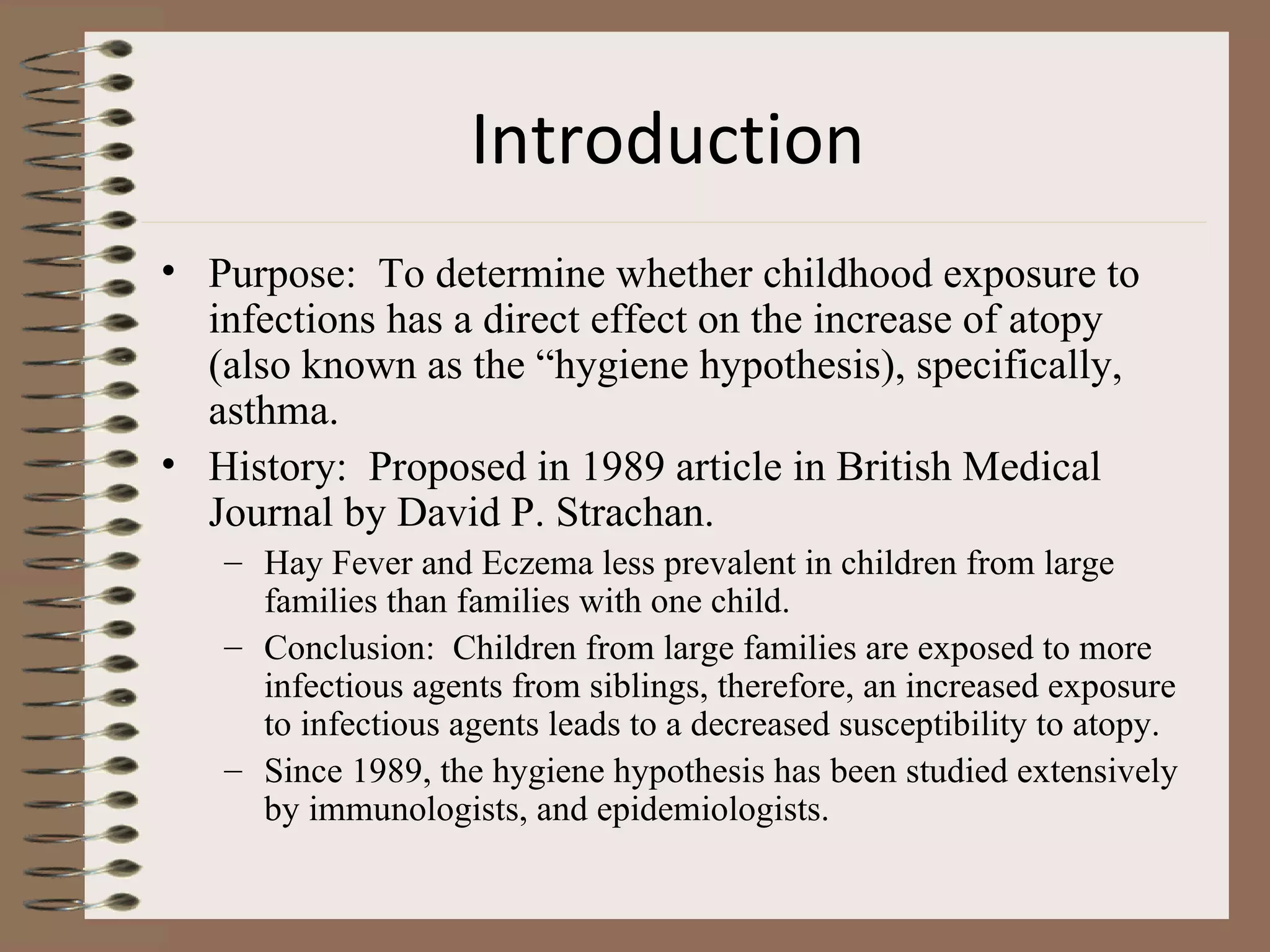
Introduction   Purpose:  To determine whether childhood exposure to infections has a direct effect on the increase of atopy (also known as the “hygiene hypothesis), specifically, asthma.   History:  Proposed in 1989 article in British Medical Journal by David P. Strachan. Hay Fever and Eczema less prevalent in children from large families than families with one child. Conclusion:  Children from large families are exposed to more infectious agents from siblings, therefore, an increased exposure to infectious agents leads to a decreased susceptibility to atopy. Since 1989, the hygiene hypothesis has been studied extensively by immunologists, and epidemiologists.
Hazard Identification Atopy:  A type I hypersensitive or allergic reaction for which there is a genetic predisposition…  Hay fever and asthma are two of the most commonly inherited allergies…  As with all type I hypersensitivity reactions, IgE is the primary antibody involved . Asthma:  A disease caused by increased responsiveness of the tracheobronchial tree to various stimuli, which results in episodic narrowing and inflammation of the airways. Infection:  A disease caused by microorganisms, especially those that release toxins of invade body tissues. (All definitions were taken from Taber’s Cyclopedic Medical Dictionary)
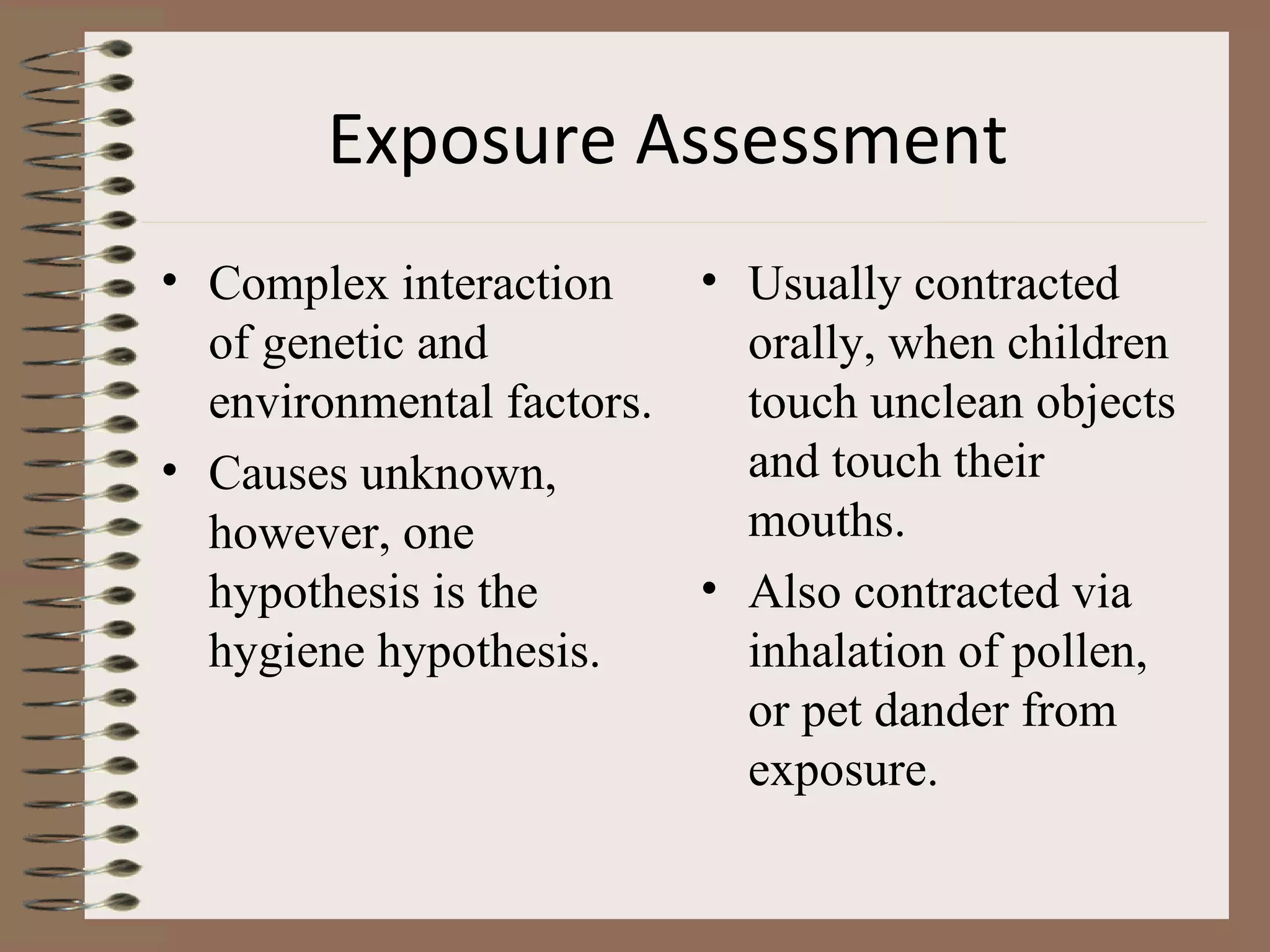
Exposure Assessment   Complex interaction of genetic and environmental factors. Causes unknown, however, one hypothesis is the hygiene hypothesis. Usually contracted orally, when children touch unclean objects and touch their mouths. Also contracted via inhalation of pollen, or pet dander from exposure.
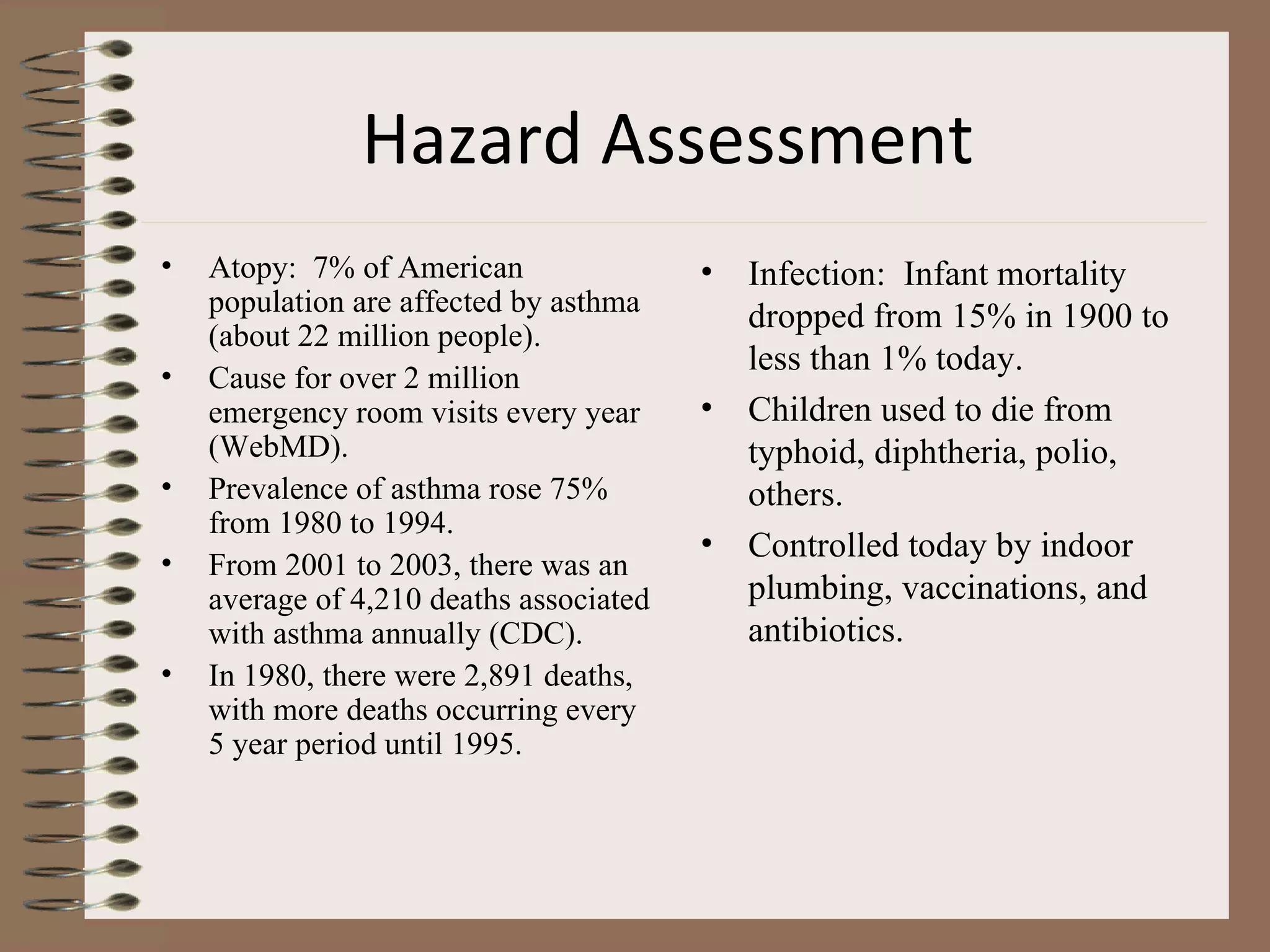
Hazard Assessment   Atopy:  7% of American population are affected by asthma (about 22 million people). Cause for over 2 million emergency room visits every year (WebMD). Prevalence of asthma rose 75% from 1980 to 1994. From 2001 to 2003, there was an average of 4,210 deaths associated with asthma annually (CDC). In 1980, there were 2,891 deaths, with more deaths occurring every 5 year period until 1995. Infection:  Infant mortality dropped from 15% in 1900 to less than 1% today. Children used to die from typhoid, diphtheria, polio, others. Controlled today by indoor plumbing, vaccinations, and antibiotics.
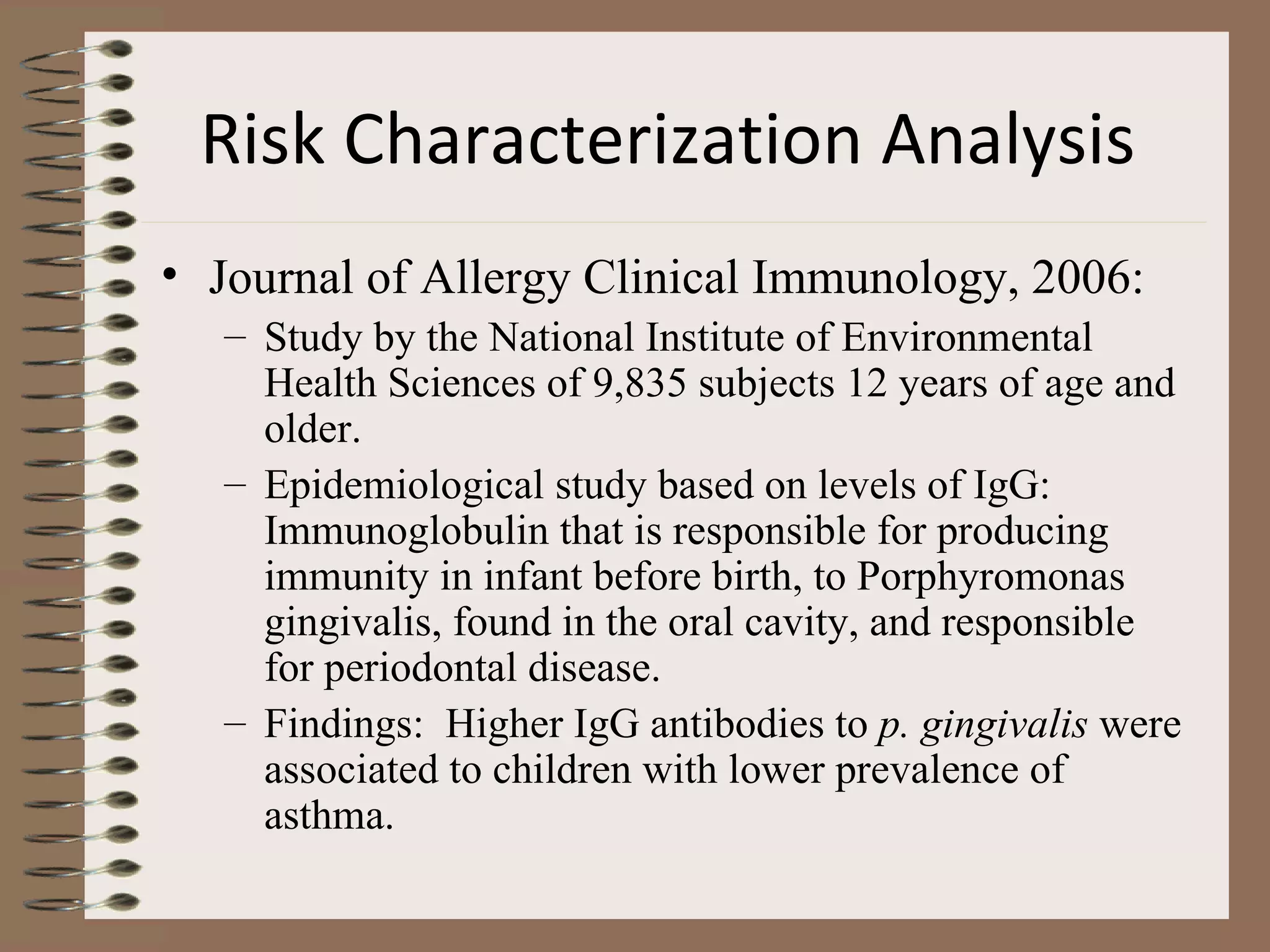
Risk Characterization Analysis   Journal of Allergy Clinical Immunology, 2006: Study by the National Institute of Environmental Health Sciences of 9,835 subjects 12 years of age and older. Epidemiological study based on levels of IgG:  Immunoglobulin that is responsible for producing immunity in infant before birth, to Porphyromonas gingivalis, found in the oral cavity, and responsible for periodontal disease. Findings:  Higher IgG antibodies to  p. gingivalis  were associated to children with lower prevalence of asthma.
Risk Characterization Analysis Continued Journal of Epidemiological Community Health 2004: Study by the Centre for Public Health Research in New Zealand of 1,584 children notified to public health services between ages 0 and 4, and 2,539 children from the general public. No major distinction between two groups for wheezing (23.5% to 24.3%, respectively), or major site of infection. There was a correlation between children who used antibiotics and asthma (odds ratio:  1.78).
Conclusion   Hill’s Criteria Strength – Medium Consistency – Medium Specificity – Medium/High Temporality – Medium/High Biological Gradient – Unknown Plausibility – Medium Coherence – Medium/High Experiment – No Available Human Experiment Analogy – Genetic Causes Should Also Be Considered Conclusion:  Since there is an overall medium association, and because both childhood infection and atopy are serious, moderation between germs and sterility should be practiced.

Risk Assessment The Hygiene Hypothesis

  • 1.
    The Hygiene Hypothesis By Shawn Pichette
  • 2.
    Introduction Purpose:  To determine whether childhood exposure to infections has a direct effect on the increase of atopy (also known as the “hygiene hypothesis), specifically, asthma. History: Proposed in 1989 article in British Medical Journal by David P. Strachan. Hay Fever and Eczema less prevalent in children from large families than families with one child. Conclusion: Children from large families are exposed to more infectious agents from siblings, therefore, an increased exposure to infectious agents leads to a decreased susceptibility to atopy. Since 1989, the hygiene hypothesis has been studied extensively by immunologists, and epidemiologists.
  • 3.
    Hazard Identification Atopy: A type I hypersensitive or allergic reaction for which there is a genetic predisposition…  Hay fever and asthma are two of the most commonly inherited allergies…  As with all type I hypersensitivity reactions, IgE is the primary antibody involved . Asthma: A disease caused by increased responsiveness of the tracheobronchial tree to various stimuli, which results in episodic narrowing and inflammation of the airways. Infection: A disease caused by microorganisms, especially those that release toxins of invade body tissues. (All definitions were taken from Taber’s Cyclopedic Medical Dictionary)
  • 4.
    Exposure Assessment Complex interaction of genetic and environmental factors. Causes unknown, however, one hypothesis is the hygiene hypothesis. Usually contracted orally, when children touch unclean objects and touch their mouths. Also contracted via inhalation of pollen, or pet dander from exposure.
  • 5.
    Hazard Assessment Atopy: 7% of American population are affected by asthma (about 22 million people). Cause for over 2 million emergency room visits every year (WebMD). Prevalence of asthma rose 75% from 1980 to 1994. From 2001 to 2003, there was an average of 4,210 deaths associated with asthma annually (CDC). In 1980, there were 2,891 deaths, with more deaths occurring every 5 year period until 1995. Infection: Infant mortality dropped from 15% in 1900 to less than 1% today. Children used to die from typhoid, diphtheria, polio, others. Controlled today by indoor plumbing, vaccinations, and antibiotics.
  • 6.
    Risk Characterization Analysis Journal of Allergy Clinical Immunology, 2006: Study by the National Institute of Environmental Health Sciences of 9,835 subjects 12 years of age and older. Epidemiological study based on levels of IgG: Immunoglobulin that is responsible for producing immunity in infant before birth, to Porphyromonas gingivalis, found in the oral cavity, and responsible for periodontal disease. Findings: Higher IgG antibodies to p. gingivalis were associated to children with lower prevalence of asthma.
  • 7.
    Risk Characterization AnalysisContinued Journal of Epidemiological Community Health 2004: Study by the Centre for Public Health Research in New Zealand of 1,584 children notified to public health services between ages 0 and 4, and 2,539 children from the general public. No major distinction between two groups for wheezing (23.5% to 24.3%, respectively), or major site of infection. There was a correlation between children who used antibiotics and asthma (odds ratio: 1.78).
  • 8.
    Conclusion Hill’s Criteria Strength – Medium Consistency – Medium Specificity – Medium/High Temporality – Medium/High Biological Gradient – Unknown Plausibility – Medium Coherence – Medium/High Experiment – No Available Human Experiment Analogy – Genetic Causes Should Also Be Considered Conclusion: Since there is an overall medium association, and because both childhood infection and atopy are serious, moderation between germs and sterility should be practiced.