Regional

Innovation
Scoreboard
2014
Enterprise
and Industry
Legal notice:
The views expressed in this report, as well as the information included in it, do not necessarily reflect the
opinion or position of the European Commission and in no way commit the institution.

Europe Direct is a service to help you find answers
to your questions about the European Union
Freephone number (*):
00 800 6 7 8 9 10 11
(*) Certain mobile telephone operators do not allow access to 00 800 numbers or these calls may be billed.

This report was prepared by:
Hugo Hollanders & Nordine Es-Sadki,
Maastricht University (Maastricht Economic and Social Research Institute
on Innovation and Technology – MERIT).
Bianca Buligescu,
Maastricht University (Maastricht Economic and Social Research Institute on
Innovation and Technology – MERIT) (Annex 5)
Lorena Rivera Leon, Elina Griniece & Laura Roman,
Technopolis Group (Chapter 4 and corresponding Annex)

Coordinated and guided by:
Bonifacio Garcia Porras, Head of Unit, and Tomasz Jerzyniak
Directorate-General for Enterprise and Industry
Directorate B – sustainable Growth and EU 2020
Unit B3 – Innovation Policy for Growth

Acknowledgements:
The authors are grateful to all Member States which have made available regional data from their Community Innovation
Survey. Without these data, the construction of a Regional Innovation Scoreboard would not have been possible. We also
thank our colleague René Wintjes (MERIT) for his ideas for improving the RIS measurement methodology. All maps in this
report have been created by MERIT with Region Map Generator (http://www.cciyy.com/).

More information on the European Union is available on the Internet (http://europa.eu)
Cataloguing data can be found at the end of this publication.
Cover picture: iStock_000010807364Large © AVTG
© European Union, 2014
Reproduction is authorised provided the source is acknowledged.
Printed in Belgium
PRINTED ON CHLORINE FREE PAPER
Regional Innovation
Scoreboard 2014
TABLE OF CONTENTS
4

EXECUTIVE SUMMARY

6

1.

INTRODUCTION

8

2.

RIS INDICATORS, REGIONS AND DATA AVAILABILITY

8

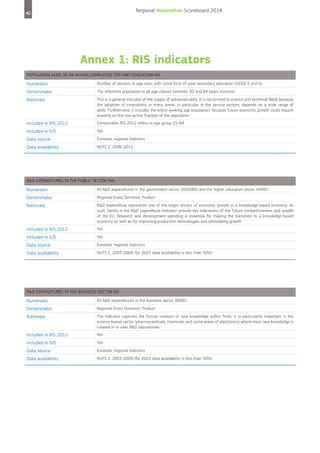
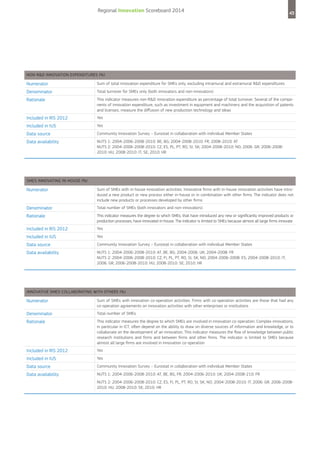
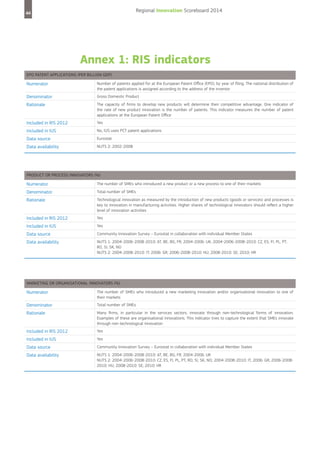
2.1 Indicators

10

2.2 Regional coverage

12

2.3 Regional data availability

14

3.

REGIONAL INNOVATION PERFORMANCE

14

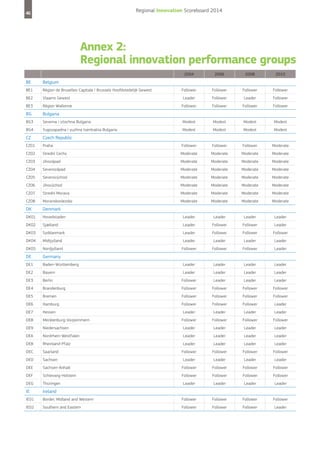
3.1 Regional performance groups

18

3.2 Performance changes over time

21

3.3 Barriers and drivers to regional innovation

24

4.

REGIONAL RESEARCH AND INNOVATION POTENTIAL THROUGH EU FUNDING

24

4.1 Introduction

24

4.2 EU funding instruments for increasing regional research and innovation capacity

27

4.3 Indicators and data availability

29

4.4 Regional absorption and leverage of EU funding

36

4.5 Conclusions

37

5.

RIS METHODOLOGY

37

5.1 Missing data: imputations

40

5.2 Composite indicators

41

5.3 Group membership

42

ANNEX 1:

RIS indicators

46

ANNEX 2:

Regional innovation performance groups

52

ANNEX 3:

Performance maps per indicator

63

ANNEX 4:

RIS normalised database

72

ANNEX 5:

Use/absorption of EU funding and regional innovation performance

74

ANNEX 6:

Regional Systems of Innovation
Regional Innovation Scoreboard 2014

4

Executive summary
This 6th edition of the Regional Innovation Scoreboard
(RIS) provides a comparative assessment of innovation
performance across 190 regions of the European Union,
Norway and Switzerland. The RIS accompanies the
Innovation Union Scoreboard (IUS) which benchmarks
innovation performance at the level of Member States.

have been published in 2002, 2003, 2006, 2009 and
2012. The RIS 2014 provides both an update of the
RIS 2012 but also introduces some changes in the
measurement methodology.

Where the IUS provides an annual benchmark of
Member States’ innovation performance, regional
innovation benchmarks are less frequent and less
detailed due to a general lack of innovation data at
the regional level. The Regional Innovation Scoreboard
addresses this gap and provides statistical facts on
regions’ innovation performance. Previous RIS reports

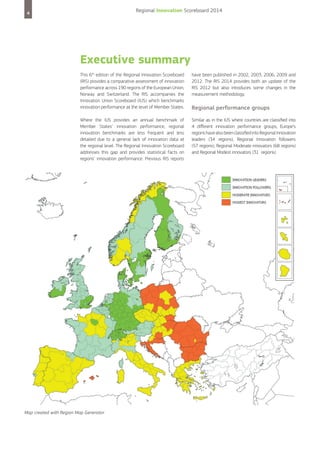
Similar as in the IUS where countries are classified into
4 different innovation performance groups, Europe’s
regions have also been classified into Regional Innovation
leaders (34 regions), Regional Innovation followers
(57 regions), Regional Moderate innovators (68 regions)
and Regional Modest innovators (31 regions).

Map created with Region Map Generator

Regional performance groups
Regional Innovation Scoreboard 2014

The most innovative regions are typically
in the most innovative countries
Despite the fact that there is variation in regional
performance within countries, regional performance
groups do match the corresponding IUS country
performance groups quite well. Most of the regional
innovation leaders and innovation followers are located
in the IUS Innovation leaders and followers and most
of the regional moderate and modest innovators are
located in the IUS Moderate and Modest innovators.
However, 14 countries have regions in two performance
groups and four Member states, France, Portugal,
Slovakia and Spain, have regions in 3 different regional
performance groups, which indicate more pronounced
innovation performance differences within countries.
Only Austria, Belgium, Bulgaria, Czech Republic,
Greece and Switzerland show a relatively homogenous
innovation performance as all regions in those countries
are in the same performance group.
All the EU regional innovation leaders (27 regions) are
located in only eight EU Member States: Denmark,
Germany, Finland, France, Ireland, Netherlands, Sweden
and United Kingdom. This indicates that innovation
excellence is concentrated in relatively few areas in
Europe.

For most regions innovation has improved
over time
An analysis over the seven-year period 2004-2010
shows that innovation performance has improved for
most regions (155 out of 190). For more than half of
the regions (106) innovation has grown even more than
the average of the EU. At the same time innovation
performance worsened for 35 regions scattered across
15 countries. For 4 regions performance even declined
at a very sharp rate of more than -10% on average
per year.

Drivers of regional innovation
Additional analyses have explored the impact of
potential drivers of regional innovation. Regions where
people have a more positive attitude to new things
and ideas (European Social Survey) have favourable
conditions for both entrepreneurship and innovation.
Regions with a well-developed system of public
financial support for innovation with high shares of
innovating companies receiving some form of public

financial support are also more innovative than regions
where fewer firms benefit from such support. With a
lack of finance being one of the most important barriers
to innovation this result shows in regions with a lack of
private funding policies providing public funding can be
successful in promoting innovation.

Regional research and innovation potential
through EU funding
The analysis of the use of EU funding for research
and innovation in the last programming period 20072013 distinguishes among 5 typologies of regions:
Framework Programme leading absorbers (15.85%);
Structural Funds (SFs) leading users targeting research
and technological activities (3.66%); Structural
Funds leading users prioritising services for business
innovation and commercialisation (6.10%); Users of SF
for both types of RTDI priorities with similar mediumto-high amounts of SF committed to projects targeting
both of the above fields (3.66%); and regions with low
use of Structural Funds, which make up the majority of
regions included in the analysis (71%).
To understand the extent to which the EU funding is
reflected in the innovation performance of the recipient
regions, a cross-analysis of the region’s absorption
of EU funding and their results in the framework of
the RIS 2014 was performed. The analysis shows
that, while there are several regions that can be
classified as pockets of excellence in terms of their
FP participation and regional innovation capacity,
only a few of the regions that are using EU funds for
business innovation more intensely are above average
innovation performers. The greatest majority of the EU
regions in the analysed sample are low absorbers of
FP funding and SFs and exhibit moderate to modest
levels of innovation. These findings point to the fact
that the “regional innovation paradox” continues to be a
dominant feature of the European regional innovation
landscape that calls for more policy attention in the
future programming period.

RIS methodology
The RIS 2014 replicates the IUS methodology used
at national level to measure performance of the EU
regional systems of innovation distinguishing between
Enablers, Firm activities and Outputs. The RIS 2014
uses data for 11 of the 25 indicators used in the IUS
for 190 regions across Europe (22 EU member states
together with Norway and Switzerland).

5
6

Regional Innovation Scoreboard 2014

1. Introduction
The Regional Innovation Scoreboard is a regional
extension of the Innovation Union Scoreboard. The
Innovation Union Scoreboard (IUS) gives a comparative
assessment of the innovation performance at the
country level of the EU Member States and other
European countries. Innovation performance is
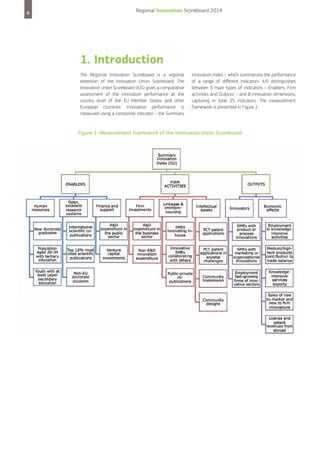
measured using a composite indicator – the Summary

Innovation Index – which summarizes the performance
of a range of different indicators. IUS distinguishes
between 3 main types of indicators – Enablers, Firm
activities and Outputs – and 8 innovation dimensions,
capturing in total 25 indicators. The measurement
framework is presented in Figure 1.

Figure 1: Measurement framework of the Innovation Union Scoreboard
Regional Innovation Scoreboard 2014

Innovation also plays an important role at the regional
level as regions are important engines of economic
development. Economic literature has identified three
stylized facts: 1) innovation is not uniformly distributed
across regions, 2) innovation tends to be spatially
concentrated over time and 3) even regions with
similar innovation capacity have different economic
growth patterns. Regional Systems of Innovation (RSI)
have become the focus of many academic studies and
policy reports.1 Attempts to monitor RSIs and region’s
innovation performance are severely hindered by a lack
of regional innovation data.
The Regional Innovation Scoreboard (RIS) addresses
this gap and provides statistical facts on regions’
innovation performance. Following the revision of
the European Innovation Scoreboard (EIS) into the
Innovation Union Scoreboard in 2010, the RIS 2012
provided both an update of earlier RIS reports and it
resembled the revised IUS measurement framework
at the regional level. Regions were ranked in four
groups of regions showing different levels of regional
innovation performance. The RIS 2014 provides both
an update of the RIS 2012 but also introduces some
changes in the measurement methodology. First, the
imputation techniques for estimating missing data
have been modified with the aim to standardize
the imputation techniques and make them more
transparent. Secondly, group membership is not, as
in the RIS 2012, determined by a statistical cluster
analysis, but by applying the same method as used
in the IUS by grouping regions based on their relative
performance to the EU.

1

Section 2 discusses the availability of regional data, the
indicators that are used for and the regions which are
included in the RIS 2014. Section 3 presents results for
the Regional Innovation Index and group membership
in four distinct regional innovation performance
groups. Section 3 also discusses performance trends
over time. Section 4 provides a separate analysis
on the relationship between the use of two main EU
funding instruments and innovation performance:
the 7th Framework Programme for Research and
Technological Development (FP7) and the Structural
Funds (SF). The results show that the “regional
innovation paradox” continues, i.e. that the majority
of regions receiving large amounts of FP and SF
funds are less innovative. Section 5 discusses the full
methodology for calculating the Regional Innovation
Index and for imputing missing data.
The years used in the titles of the previous RIS reports
refer to the years in which the individual editions were
published, i.e. RIS 2012, RIS 2009 and RIS 2006. These
dates do not refer to the reference years for data
collection as the timeliness of regional data is lagging
several years behind the date of publication of the RIS
report. For the RIS 2014 most recent data are referring
to 2012 for 1 indicator, 2011 for 1 indicator, 2010 for
8 indicators and 2008 for 1 indicator. A reference to
the most recent performance year in this report should
thus be interpreted as referring to the year 2010. The
seven-year period used in the growth analyses refers
to 2004-2010.

Annex 6 provides a more detailed discussion of Regional Systems of Innovation.

7
Regional Innovation Scoreboard 2014

8

2. RIS indicators, regions and
data availability
This chapter discusses the indicators used in the Regional Innovation Scoreboard 2014, the regional
coverage and regional data availability.

2.1 Indicators
Regional innovation performance ideally should be
measured using regional data for the same indicators
used in the Innovation Union Scoreboard (IUS), which
measures innovation performance at the country level.
However, for many indicators used in the IUS regional
data are not available either because these data are
not collected at the regional level for all countries or
because they are not collected at all.
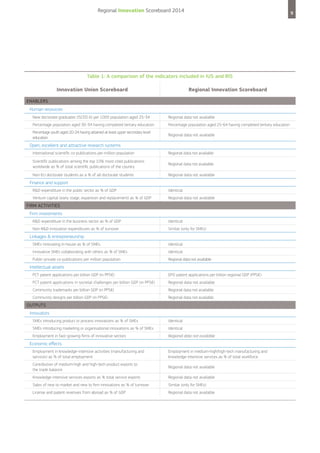
The Regional Innovation Scoreboard (RIS) is therefore
limited to using regional data for 11 of the 25 indicators
used in the IUS (Table 1). For several indicators slightly
different definitions have been used as regional data
would not be available if the definitions would be
the same as in the IUS. For the 2 indicators using
data from the Community Innovation Survey (CIS) –
Non-R&D innovation expenditures and Sales share
of new to market and new to firm innovations – the
data refer to SMEs only and not to all companies.2

2

For the indicator measuring attainment in tertiary
level education detailed regional data for the age
group between 25 and 34 years of age are not
available and instead the indicator uses data for
the broader age group between 25 and 64 years of
age. For the indicator on PCT patent applications no
regional data are available and instead regional data
on EPO patent applications are used. For the indicator
on employment in knowledge-intensive activities no
regional data are available and instead employment
in medium-high and high-tech manufacturing and
knowledge-intensive services is used. Compared to the
RIS 2012 one indicator is no longer used as for publicprivate co-publications no new data have become
available. The indicators are explained in more detail
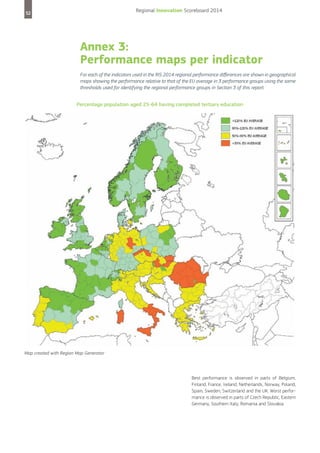
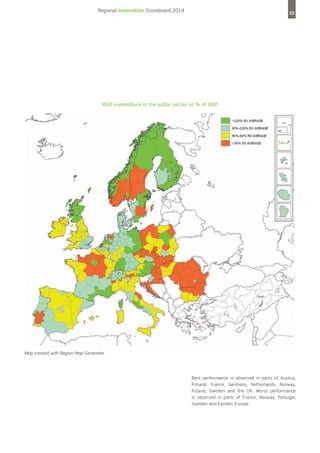
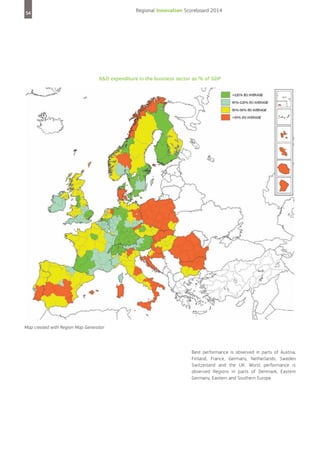
in Annex 1 and Annex 3 shows performance maps for
each of the indicators. Section 2.3 presents a more
detailed discussion of the availability of regional data
for the indicators used in the RIS.

Regional CIS data are not publicly available and have been made explicitly available for the Regional Innovation Scoreboard by national statistical offices. The
CIS assigns the innovation activities of multi-establishment enterprises to the region where the head office is located. There is a risk that regions without head
offices score lower on the CIS indicators as some of the activities in these regions are assigned to those regions with head offices. In order to minimize this risk
the regional CIS data excludes large firms (who are more likely to have multiple establishments in different regions) and focuses on SMEs only. More details are
available in the RIS 2014 Methodology report.
Regional Innovation Scoreboard 2014

9

Table 1: A comparison of the indicators included in IUS and RIS
Innovation Union Scoreboard

Regional Innovation Scoreboard

Enablers
Human resources
New doctorate graduates (ISCED 6) per 1000 population aged 25-34

Regional data not available

Percentage population aged 30-34 having completed tertiary education

Percentage population aged 25-64 having completed tertiary education

Percentage youth aged 20-24 having attained at least upper secondary level
education

Regional data not available

Open, excellent and attractive research systems
International scientific co-publications per million population

Regional data not available

Scientific publications among the top 10% most cited publications
worldwide as % of total scientific publications of the country

Regional data not available

Non-EU doctorate students as a % of all doctorate students

Regional data not available

Finance and support
R&D expenditure in the public sector as % of GDP

Identical

Venture capital (early stage, expansion and replacement) as % of GDP

Regional data not available

FIRM ACTIVITIES
Firm investments
R&D expenditure in the business sector as % of GDP

Identical

Non-R&D innovation expenditures as % of turnover

Similar (only for SMEs)

Linkages & entrepreneurship
SMEs innovating in-house as % of SMEs

Identical

Innovative SMEs collaborating with others as % of SMEs

Identical

Public-private co-publications per million population

Regional data not available

Intellectual assets
PCT patent applications per billion GDP (in PPS€)

EPO patent applications per billion regional GDP (PPS€)

PCT patent applications in societal challenges per billion GDP (in PPS€)

Regional data not available

Community trademarks per billion GDP (in PPS€)

Regional data not available

Community designs per billion GDP (in PPS€)

Regional data not available

OUTPUTS
Innovators
SMEs introducing product or process innovations as % of SMEs

Identical

SMEs introducing marketing or organisational innovations as % of SMEs

Identical

Employment in fast-growing firms of innovative sectors

Regional data not available

Economic effects
Employment in knowledge-intensive activities (manufacturing and
services) as % of total employment

Employment in medium-high/high-tech manufacturing and
knowledge-intensive services as % of total workforce

Contribution of medium-high and high-tech product exports to
the trade balance

Regional data not available

Knowledge-intensive services exports as % total service exports

Regional data not available

Sales of new to market and new to firm innovations as % of turnover

Similar (only for SMEs)

License and patent revenues from abroad as % of GDP

Regional data not available
10

Regional Innovation Scoreboard 2014

2.2 Regional coverage
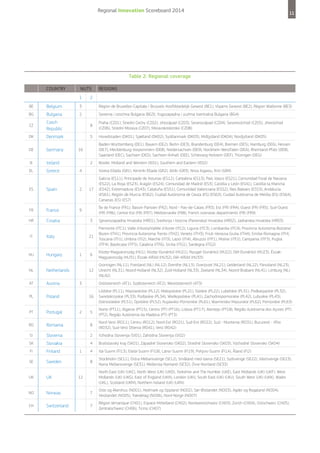
The RIS covers 190 regions for 22 EU Member States as
well as Norway and Switzerland at different NUTS levels.
The NUTS classification (Nomenclature of territorial
units for statistics) is a hierarchical system for dividing
up the economic territory of the EU and it distinguishes
between 3 different levels: NUTS 1 captures major socioeconomic regions, NUTS 2 captures basic regions for the
application of regional policies and NUTS 3 captures
small regions for specific diagnoses.3

3

Depending on differences in regional data availability
the RIS covers 55 NUTS 1 level regions and 135
NUTS 2 level regions (Table 2). The EU Member
States Cyprus, Estonia, Latvia, Lithuania, Luxembourg
and Malta have not been included as the regional
administrative level as such does not exist in these
countries (NUTS 1 and NUTS 2 levels are identical
with the country territory).

The current NUTS 2010 classification is valid from 1 January 2012 until 31 December 2014 and lists 97 regions at NUTS 1, 270 regions at NUTS 2 and 1294
regions at NUTS 3 level.
Regional Innovation Scoreboard 2014

11

Table 2: Regional coverage
Country

NUTS
1

Regions

2

BE

Belgium

3

Région de Bruxelles-Capitale / Brussels Hoofdstedelijk Gewest (BE1), Vlaams Gewest (BE2), Région Wallonne (BE3)

BG

Bulgaria

2

Severna i iztochna Bulgaria (BG3), Yugozapadna i yuzhna tsentralna Bulgaria (BG4)

CZ

Czech
Republic

8

DK

Denmark

5

DE

Germany

IE

Ireland

EL

Greece

2

Voreia Ellada (GR1), Kentriki Ellada (GR2), Attiki (GR3), Nisia Aigaiou, Kriti (GR4)
Galicia (ES11), Principado de Asturias (ES12), Cantabria (ES13), País Vasco (ES21), Comunidad Foral de Navarra
(ES22), La Rioja (ES23), Aragón (ES24), Comunidad de Madrid (ES3), Castilla y León (ES41), Castilla-la Mancha
(ES42), Extremadura (ES43), Cataluña (ES51), Comunidad Valenciana (ES52), Illes Balears (ES53), Andalucía
(ES61), Región de Murcia (ES62), Ciudad Autónoma de Ceuta (ES) (ES63), Ciudad Autónoma de Melilla (ES) (ES64),
Canarias (ES) (ES7)

2

FR

France

9

HR

Croatia

NL

Austria

PL

Portugal

RO

1

Sjeverozapadna Hrvatska (HR01), Sredisnja i Istocna (Panonska) Hrvatska (HR02), Jadranska Hrvatska (HR03)
Piemonte (ITC1), Valle d'Aosta/Vallée d'Aoste (ITC2), Liguria (ITC3), Lombardia (ITC4), Provincia Autonoma Bolzano/
Bozen (ITH1), Provincia Autonoma Trento (ITH2), Veneto (ITH3), Friuli-Venezia Giulia (ITH4), Emilia-Romagna (ITH),
Toscana (ITI1), Umbria (ITI2), Marche (ITI3), Lazio (ITI4), Abruzzo (ITF1), Molise (ITF2), Campania (ITF3), Puglia
(ITF4), Basilicata (ITF5), Calabria (ITF6), Sicilia (ITG1), Sardegna (ITG2)

6

Közép-Magyarország (HU1), Közép-Dunántúl (HU21), Nyugat-Dunántúl (HU22), Dél-Dunántúl (HU23), ÉszakMagyarország (HU31), Észak-Alföld (HU32), Dél-Alföld (HU33)

12

Poland

PT

Île de France (FR1), Bassin Parisien (FR2), Nord - Pas-de-Calais (FR3), Est (FR) (FR4), Ouest (FR) (FR5), Sud-Ouest
(FR) (FR6), Centre-Est (FR) (FR7), Méditerranée (FR8), French overseas departments (FR) (FR9)

21

Netherlands

AT

17

3

Italy

Hungary

Border, Midland and Western (IE01), Southern and Eastern (IE02)

4

Spain

HU

Hovedstaden (DK01), Sjælland (DK02), Syddanmark (DK03), Midtjylland (DK04), Nordjylland (DK05)
Baden-Württemberg (DE1), Bayern (DE2), Berlin (DE3), Brandenburg (DE4), Bremen (DE5), Hamburg (DE6), Hessen
(DE7), Mecklenburg-Vorpommern (DE8), Niedersachsen (DE9), Nordrhein-Westfalen (DEA), Rheinland-Pfalz (DEB),
Saarland (DEC), Sachsen (DED), Sachsen-Anhalt (DEE), Schleswig-Holstein (DEF), Thüringen (DEG)

16

ES

IT

Praha (CZ01), Strední Cechy (CZ02), Jihozápad (CZ03), Severozápad (CZ04), Severovýchod (CZ05), Jihovýchod
(CZ06), Strední Morava (CZ07), Moravskoslezsko (CZ08)

Groningen (NL11), Friesland (NL) (NL12), Drenthe (NL13), Overijssel (NL21), Gelderland (NL22), Flevoland (NL23),
Utrecht (NL31), Noord-Holland (NL32), Zuid-Holland (NL33), Zeeland (NL34), Noord-Brabant (NL41), Limburg (NL)
(NL42)

3

Ostösterreich (AT1), Südösterreich (AT2), Westösterreich (AT3)
16

Lódzkie (PL11), Mazowieckie (PL12), Malopolskie (PL21), Slaskie (PL22), Lubelskie (PL31), Podkarpackie (PL32),
Swietokrzyskie (PL33), Podlaskie (PL34), Wielkopolskie (PL41), Zachodniopomorskie (PL42), Lubuskie (PL43),
Dolnoslaskie (PL51), Opolskie (PL52), Kujawsko-Pomorskie (PL61), Warminsko-Mazurskie (PL62), Pomorskie (PL63)

5

Norte (PT11), Algarve (PT15), Centro (PT) (PT16), Lisboa (PT17), Alentejo (PT18), Região Autónoma dos Açores (PT)
(PT2), Região Autónoma da Madeira (PT) (PT3)

Romania

8

Nord-Vest (RO11), Centru (RO12), Nord-Est (RO21), Sud-Est (RO22), Sud - Muntenia (RO31), Bucuresti - Ilfov
(RO32), Sud-Vest Oltenia (RO41), Vest (RO42)

SI

Slovenia

2

Vzhodna Slovenija (SI01), Zahodna Slovenija (SI02)

SK

Slovakia

FI

Finland

SE

Sweden

UK

UK

NO

Norway

7

Oslo og Akershus (NO01), Hedmark og Oppland (NO02), Sør-Østlandet (NO03), Agder og Rogaland (NO04),
Vestlandet (NO05), Trøndelag (NO06), Nord-Norge (NO07)

CH

Switzerland

7

Région lémanique (CH01), Espace Mittelland (CH02), Nordwestschweiz (CH03), Zürich (CH04), Ostschweiz (CH05),
Zentralschweiz (CH06), Ticino (CH07)

2

4

Bratislavský kraj (SK01), Západné Slovensko (SK02), Stredné Slovensko (SK03), Východné Slovensko (SK04)

4

Itä-Suomi (FI13), Etelä-Suomi (FI18), Länsi-Suomi (FI19), Pohjois-Suomi (FI1A), Åland (FI2)

8

1

Stockholm (SE11), Östra Mellansverige (SE12), Småland med öarna (SE21), Sydsverige (SE22), Västsverige (SE23),
Norra Mellansverige (SE31), Mellersta Norrland (SE32), Övre Norrland (SE33)
North East (UK) (UKC), North West (UK) (UKD), Yorkshire and The Humber (UKE), East Midlands (UK) (UKF), West
Midlands (UK) (UKG), East of England (UKH), London (UKI), South East (UK) (UKJ), South West (UK) (UKK), Wales
(UKL), Scotland (UKM), Northern Ireland (UK) (UKN)

12
12

Regional Innovation Scoreboard 2014

2.3 Regional data availability
Regional innovation data for 5 indicators are directly
available from Eurostat. For the share of population
aged 25-64 having completed tertiary education, R&D
expenditures in the public and business sector, EPO
patent applications and employment in medium-high/
high-tech manufacturing and knowledge-intensive
services regional data can be extracted from Eurostat’s
online regional database.4 For the 6 indicators using
Community Innovation Survey (CIS) data however
regional data are not directly available from Eurostat
and a special data request had to be made to obtain
regional CIS data.
Regional CIS data request
To collect regional CIS data, in 2012 data requests
were made by Eurostat to most Member States
excluding those countries for which NUTS 1 and
NUTS 2 levels are identical with the country territory
or countries for which national CIS samples are too
small to allow them to deliver reliable regional level
data (e.g. Germany). In august 2013, Eurostat shared
regional CIS 2010 data with the project team for 17
countries (Austria, Belgium, Bulgaria, Croatia, Czech
Republic, Finland, France, Hungary, Italy, Norway,
Poland, Portugal, Romania, Slovakia, Slovenia, Spain
and Sweden) for the following indicators:

•	 Non-R&D innovation expenditure
•	 SMEs innovating in-house
•	 Innovative SMEs collaborating with others
•	 Product or process innovators
•	 Marketing or organisational innovators
•	 Sales of new-to-market and new-to-firm innovations
	
•	 Reduced labour costs being of high importance for
	
developing product or process innovations

•	 Any public financial support for innovation activities
	
from either local government, national government
or the European Union.

4

http://epp.eurostat.ec.europa.eu/portal/page/portal/region_cities/regional_statistics/data/database

The last 2 indicators are not included in the RIS for different
reasons. The indicator measuring reduced labour costs was
part of an indicator on resource efficiency used in the RIS
2009 but the indicator was no longer used in the RIS 2012
as the indicator on resource efficiency was removed from
the list of indicators used in IUS. The resource efficiency
indicator combined two indicators, the indicator on reduced
labour costs and an indicator on reduced use of materials
and energy. The latter was not included anymore in the CIS
2010 and was replaced by the indicator measuring public
financial support. For this indicator no regional data from
earlier CIS surveys are available and the indicator has
therefore not been included in the current RIS.
Timeliness of regional data
The timeliness of regional data is lagging several years
behind the date of publication of the RIS report. For the
RIS 2014 most recent data are referring to 2012 for
1 indicator (tertiary education), 2011 for 1 indicator
(employment in medium-high/high-tech manufacturing
and knowledge-intensive services), 2010 for 8 indicators
(all 6 indicators using CIS data and both indicators public
and private R&D expenditures) and 2008 for 1 indicator
(EPO patents). Following the availability of regional data
for 4 waves of the CIS (CIS 2004, CIS 2006, CIS 2008 and
CIS 2010), the RIS will present regional innovation results
for 4 reference years: 2004, 2006, 2008 and 2010.
Data availability by indicator and country
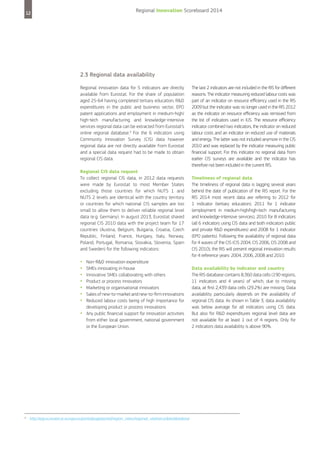
The RIS database contains 8,360 data cells (190 regions,
11 indicators and 4 years) of which, due to missing
data, at first 2,439 data cells (29.2%) are missing. Data
availability particularly depends on the availability of
regional CIS data. As shown in Table 3, data availability
was below average for all indicators using CIS data.
But also for R&D expenditures regional level data are
not available for at least 1 out of 4 regions. Only for
2 indicators data availability is above 90%.
Regional Innovation Scoreboard 2014

13

Table 3: Data availability by indicator
DATA AVAILABILITy
Population having completed tertiary education

94.9%

Employment in medium-high/high-tech manufacturing and knowledge-intensive services

91.8%

EPO patent applications

87.6%

R&D expenditure in the business sector

75.1%

R&D expenditure in the public sector

71.8%

All indicators

70.8%

Product or process innovators (CIS)

64.5%

Innovative SMEs collaborating with others (CIS)

64.2%

Marketing or organisational innovators (CIS)

63.3%

SMEs innovating in-house (CIS)

60.9%

Non-R&D innovation expenditure (CIS)

55.3%

Sales of new-to-market and new-to-firm innovations (CIS)

49.6%

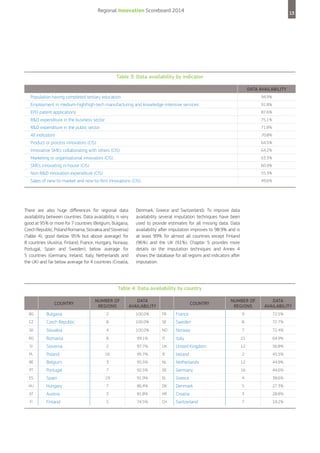
There are also huge differences for regional data
availability between countries. Data availability is very
good at 95% or more for 7 countries (Belgium, Bulgaria,
Czech Republic, Poland Romania, Slovakia and Slovenia)
(Table 4), good (below 95% but above average) for
8 countries (Austria, Finland, France, Hungary, Norway,
Portugal, Spain and Sweden), below average for
5 countries (Germany, Ireland, Italy, Netherlands and
the UK) and far below average for 4 countries (Croatia,

Denmark, Greece and Switzerland). To improve data
availability several imputation techniques have been
used to provide estimates for all missing data. Data
availability after imputation improves to 98.9% and is
at least 99% for almost all countries except Finland
(96%) and the UK (91%). Chapter 5 provides more
details on the imputation techniques and Annex 4
shows the database for all regions and indicators after
imputation.

Table 4: Data availability by country
COUNTRy

NUMBER OF
REGIONS

DATA
AVAILABILITy

COUNTRy

NUMBER OF
REGIONS

DATA
AVAILABILITy

BG

Bulgaria

2

100.0%

FR

France

9

72.5%

CZ

Czech Republic

8

100.0%

SE

Sweden

8

72.7%

SK

Slovakia

4

100.0%

NO

Norway

7

72.4%

RO

Romania

8

99.1%

IT

Italy

21

64.9%

SI

Slovenia

2

97.7%

UK

United Kingdom

12

56.8%

PL

Poland

16

95.7%

IE

Ireland

2

45.5%

BE

Belgium

3

95.5%

NL

Netherlands

12

44.9%

PT

Portugal

7

92.5%

DE

Germany

16

44.6%

ES

Spain

19

91.9%

EL

Greece

4

38.6%

HU

Hungary

7

86.4%

DK

Denmark

5

27.3%

AT

Austria

3

81.8%

HR

Croatia

3

28.8%

FI

Finland

5

74.5%

CH

Switzerland

7

18.2%
Regional Innovation Scoreboard 2014

14

3. Regional innovation performance
3.1 Regional performance groups
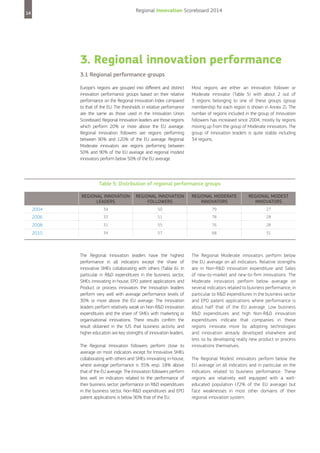
Europe’s regions are grouped into different and distinct
innovation performance groups based on their relative
performance on the Regional Innovation Index compared
to that of the EU. The thresholds in relative performance
are the same as those used in the Innovation Union
Scoreboard. Regional Innovation leaders are those regions
which perform 20% or more above the EU average.
Regional Innovation followers are regions performing
between 90% and 120% of the EU average. Regional
Moderate innovators are regions performing between
50% and 90% of the EU average and regional modest
innovators perform below 50% of the EU average.

Most regions are either an Innovation follower or
Moderate innovator (Table 5) with about 2 out of
3 regions belonging to one of these groups (group
membership for each region is shown in Annex 2). The
number of regions included in the group of Innovation
followers has increased since 2004, mostly by regions
moving up from the group of Moderate innovators. The
group of Innovation leaders is quite stable including
34 regions.

Table 5: Distribution of regional performance groups
REGIONAL INNOVATION
LEADERS

REGIONAL INNOVATION
FOLLOWERS

REGIONAL MODERATE
INNOVATORS

REGIONAL MODEST
INNOVATORS

2004

34

50

79

27

2006

33

51

78

28

2008

31

55

76

28

2010

34

57

68

31

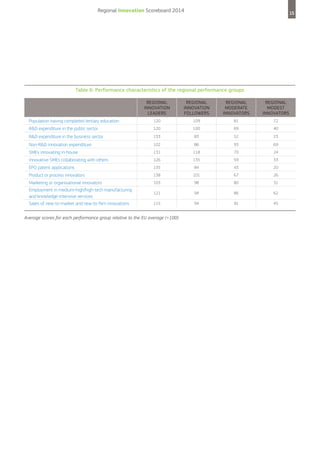
The Regional Innovation leaders have the highest
performance in all indicators except the share of
innovative SMEs collaborating with others (Table 6). In
particular in R&D expenditures in the business sector,
SMEs innovating in-house, EPO patent applications and
Product or process innovators the Innovation leaders
perform very well with average performance levels of
30% or more above the EU average. The Innovation
leaders perform relatively weak on Non-R&D innovation
expenditures and the share of SMEs with marketing or
organisational innovations. There results confirm the
result obtained in the IUS that business activity and
higher education are key strengths of Innovation leaders.
The Regional Innovation followers perform close to
average on most indicators except for Innovative SMEs
collaborating with others and SMEs innovating in-house,
where average performance is 35% resp. 18% above
that of the EU average. The Innovation followers perform
less well on indicators related to the performance of
their business sector: performance on R&D expenditures
in the business sector, Non-R&D expenditures and EPO
patent applications is below 90% that of the EU.

The Regional Moderate innovators perform below
the EU average on all indicators. Relative strengths
are in Non-R&D innovation expenditure and Sales
of new-to-market and new-to-firm innovations. The
Moderate innovators perform below average on
several indicators related to business performance, in
particular to R&D expenditures in the business sector
and EPO patent applications where performance is
about half that of the EU average. Low business
R&D expenditures and high Non-R&D innovation
expenditures indicate that companies in these
regions innovate more by adopting technologies
and innovation already developed elsewhere and
less so by developing really new product or process
innovations themselves.
The Regional Modest innovators perform below the
EU average on all indicators and in particular on the
indicators related to business performance. These
regions are relatively well equipped with a welleducated population (72% of the EU average) but
face weaknesses in most other domains of their
regional innovation system.
Regional Innovation Scoreboard 2014

15

Table 6: Performance characteristics of the regional performance groups
Regional
Innovation
leaders

Regional
Innovation
followers

Regional
Moderate
innovators

Regional
Modest
innovators

Population having completed tertiary education

120

109

81

72

R&D expenditure in the public sector

120

100

69

40

R&D expenditure in the business sector

133

83

52

23

Non-R&D innovation expenditure

102

86

93

69

SMEs innovating in-house

131

118

70

24

Innovative SMEs collaborating with others

126

135

59

33

EPO patent applications

135

84

43

20

Product or process innovators

138

101

67

26

Marketing or organisational innovators
Employment in medium-high/high-tech manufacturing
and knowledge-intensive services
Sales of new-to-market and new-to-firm innovations

103

98

80

31

121

94

86

62

115

94

91

45

Average scores for each performance group relative to the EU average (=100)
Regional Innovation Scoreboard 2014

16

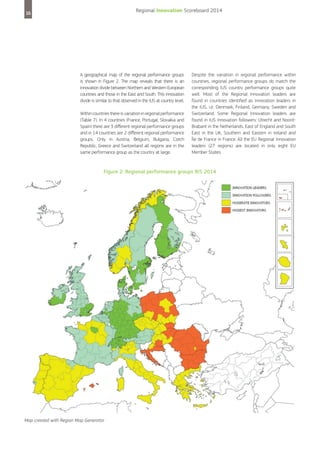
A geographical map of the regional performance groups
is shown in Figure 2. The map reveals that there is an
innovation divide between Northern and Western European
countries and those in the East and South. This innovation
divide is similar to that observed in the IUS at country level.
Within countries there is variation in regional performance
(Table 7). In 4 countries (France, Portugal, Slovakia and
Spain) there are 3 different regional performance groups
and in 14 countries are 2 different regional performance
groups. Only in Austria, Belgium, Bulgaria, Czech
Republic, Greece and Switzerland all regions are in the
same performance group as the country at large.

Despite the variation in regional performance within
countries, regional performance groups do match the
corresponding IUS country performance groups quite
well. Most of the Regional Innovation leaders are
found in countries identified as Innovation leaders in
the IUS, i.e. Denmark, Finland, Germany, Sweden and
Switzerland. Some Regional Innovation leaders are
found in IUS Innovation followers: Utrecht and NoordBrabant in the Netherlands, East of England and South
East in the UK, Southern and Eastern in Ireland and
Île de France in France. All the EU Regional Innovation
leaders (27 regions) are located in only eight EU
Member States.

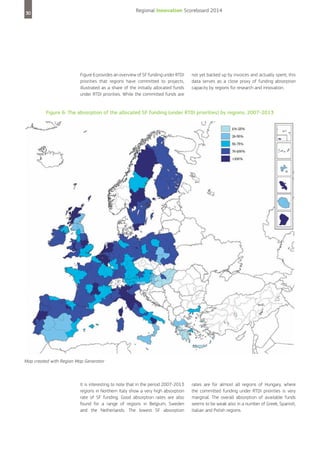
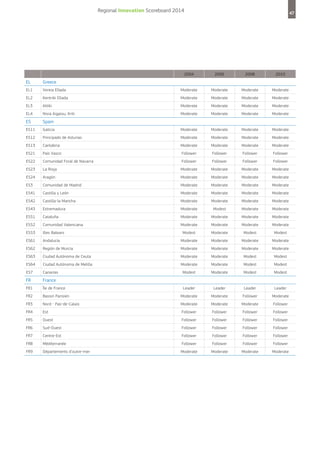
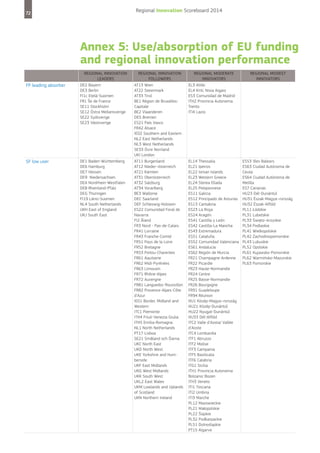
Figure 2: Regional performance groups RIS 2014

Map created with Region Map Generator
Regional Innovation Scoreboard 2014

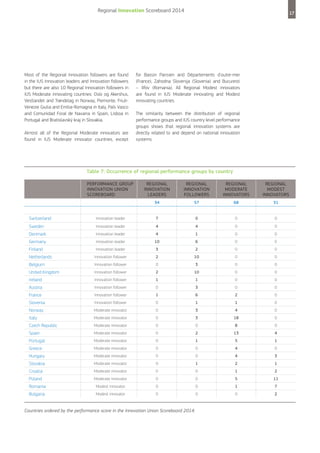
Most of the Regional Innovation followers are found
in the IUS Innovation leaders and Innovation followers
but there are also 10 Regional Innovation followers in
IUS Moderate innovating countries: Oslo og Akershus,
Vestlandet and Trøndelag in Norway, Piemonte, FriuliVenezie Giulia and Emilia-Romagna in Italy, País Vasco
and Comunidad Foral de Navarra in Spain, Lisboa in
Portugal and Bratislavský kraj in Slovakia.
Almost all of the Regional Moderate innovators are
found in IUS Moderate innovator countries, except

17

for Bassin Parisien and Départements d'outre-mer
(France), Zahodna Slovenija (Slovenia) and Bucuresti
– Ilfov (Romania). All Regional Modest innovators
are found in IUS Moderate innovating and Modest
innovating countries.
The similarity between the distribution of regional
performance groups and IUS country level performance
groups shows that regional innovation systems are
directly related to and depend on national innovation
systems.

Table 7: Occurrence of regional performance groups by country
PERFORMANCE GROUP
INNOVATION UNION
SCOREBOARD

REGIONAL
INNOVATION
LEADERS

REGIONAL
INNOVATION
FOLLOWERS

REGIONAL
MODERATE
INNOVATORS

REGIONAL
MODEST
INNOVATORS

34

57

68

31

Switzerland

Innovation leader

7

0

0

0

Sweden

Innovation leader

4

4

0

0

Denmark

Innovation leader

4

1

0

0

Germany

Innovation leader

10

6

0

0

Finland

Innovation leader

3

2

0

0

Netherlands

Innovation follower

2

10

0

0

Belgium

Innovation follower

0

3

0

0

United Kingdom

Innovation follower

2

10

0

0

Ireland

Innovation follower

1

1

0

0

Austria

Innovation follower

0

3

0

0

France

Innovation follower

1

6

2

0

Slovenia

Innovation follower

0

1

1

0

Norway

Moderate innovator

0

3

4

0

Italy

Moderate innovator

0

3

18

0

Czech Republic

Moderate innovator

0

0

8

0

Spain

Moderate innovator

0

2

13

4

Portugal

Moderate innovator

0

1

5

1

Greece

Moderate innovator

0

0

4

0

Hungary

Moderate innovator

0

0

4

3

Slovakia

Moderate innovator

0

1

2

1

Croatia

Moderate innovator

0

0

1

2

Poland

Moderate innovator

0

0

5

11

Romania

Modest innovator

0

0

1

7

Bulgaria

Modest innovator

0

0

0

2

Countries ordered by the performance score in the Innovation Union Scoreboard 2014.
Regional Innovation Scoreboard 2014

18

3.2 Performance changes over time
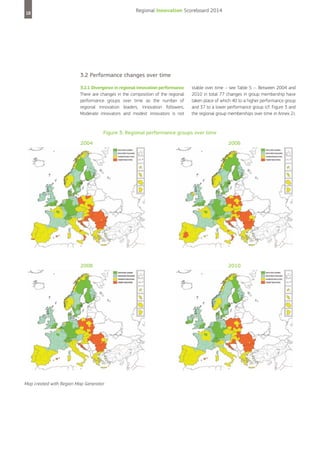
3.2.1 Divergence in regional innovation performance
There are changes in the composition of the regional
performance groups over time as the number of
regional Innovation leaders, Innovation followers,
Moderate innovators and modest innovators is not

stable over time – see Table 5 –. Between 2004 and
2010 in total 77 changes in group membership have
taken place of which 40 to a higher performance group
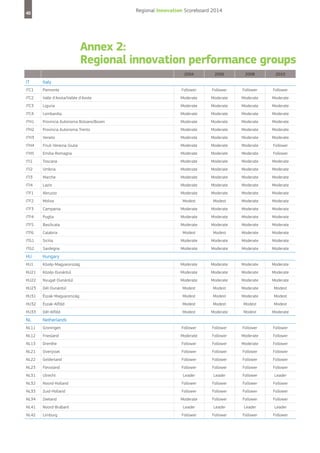
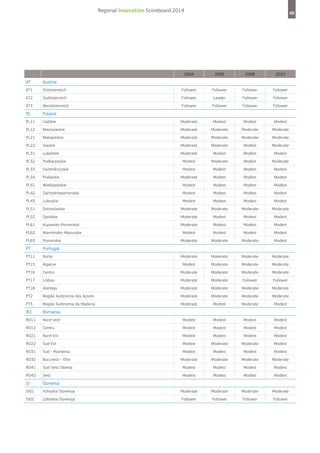
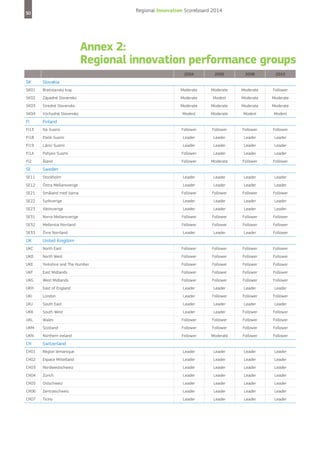
and 37 to a lower performance group (cf. Figure 3 and
the regional group memberships over time in Annex 2).

Figure 3: Regional performance groups over time
2004

2006

2008

2010

Map created with Region Map Generator
Regional Innovation Scoreboard 2014

Most changes in performance groups took place in
a limited number of regions. Five regions changed
performance group 3 times5 and 17 regions changed
performance group twice6. None of these regions
managed to consistently improve their performance.
Regions either moved down to a lower performance
group and then moved up again or they moved up to a
higher performance group and then moved down again.

19

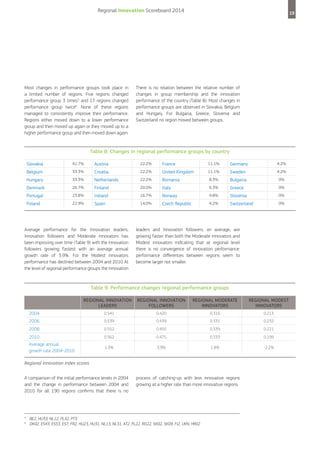
There is no relation between the relative number of
changes in group membership and the innovation
performance of the country (Table 8). Most changes in
performance groups are observed in Slovakia, Belgium
and Hungary. For Bulgaria, Greece, Slovenia and
Switzerland no region moved between groups.

Table 8: Changes in regional performance groups by country
Slovakia

41.7%

Austria

22.2%

France

11.1%

Germany

4.2%

Belgium

33.3%

Croatia

22.2%

United Kingdom

11.1%

Sweden

4.2%

Hungary

33.3%

Netherlands

22.2%

Romania

8.3%

Bulgaria

0%

Denmark

26.7%

Finland

20.0%

Italy

6.3%

Greece

0%

Portugal

23.8%

Ireland

16.7%

Norway

4.8%

Slovenia

0%

Poland

22.9%

Spain

14.0%

Czech Republic

4.2%

Switzerland

0%

Average performance for the Innovation leaders,
Innovation followers and Moderate innovators has
been improving over time (Table 9) with the Innovation
followers growing fastest with an average annual
growth rate of 3.9%. For the Modest innovators
performance has declined between 2004 and 2010 At
the level of regional performance groups the Innovation

leaders and Innovation followers, on average, are
growing faster than both the Moderate innovators and
Modest innovators indicating that at regional level
there is no convergence of innovation performance:
performance differences between regions seem to
become larger not smaller.

Table 9: Performance changes regional performance groups
REGIONAL INNOVATION
LEADERS

REGIONAL INNOVATION
FOLLOWERS

REGIONAL MODERATE
INNOVATORS

REGIONAL MODEST
INNOVATORS

2004

0.541

0.420

0.316

0.213

2006

0.539

0.439

0.331

0.232

2008

0.552

0.450

0.339

0.221

2010
Average annual
growth rate 2004-2010

0.562

0.475

0.333

0.199

1.3%

3.9%

1.8%

-2.2%

Regional Innovation Index scores
A comparison of the initial performance levels in 2004
and the change in performance between 2004 and
2010 for all 190 regions confirms that there is no

5
6

process of catching-up with less innovative regions
growing at a higher rate than more innovative regions.

BE2, HU33, NL12, PL32, PT3
DK02, ES43, ES53, ES7, FR2, HU23, HU31, NL13, NL31, AT2, PL22, RO22, SK02, SK04, FI2, UKN, HR02
Regional Innovation Scoreboard 2014

20

3.2.2 Individual performance changes
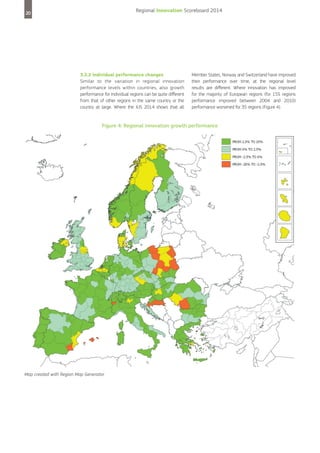
Similar to the variation in regional innovation
performance levels within countries, also growth
performance for individual regions can be quite different
from that of other regions in the same country or the
country at large. Where the IUS 2014 shows that all

Member States, Norway and Switzerland have improved
their performance over time, at the regional level
results are different. Where innovation has improved
for the majority of European regions (for 155 regions
performance improved between 2004 and 2010)
performance worsened for 35 regions (Figure 4).

Figure 4: Regional innovation growth performance

Map created with Region Map Generator
Regional Innovation Scoreboard 2014

In 14 countries for at least one region innovation has
become worse. Average annual growth has been
strongly negative (below -2.5%) for 14 regions of
which 7 Polish regions, 4 Spanish regions and 1 region
in Croatia, Italy and Romania (see Figure 5). Growth
has been below -10% in Ciudad Autónoma de Ceuta
(ES), Ciudad Autónoma de Melilla (ES), Podlaskie (PL)
and Kujawsko-Pomorskie (PL). Less negative growth
between -2.5 and 0% is observed for 21 regions of
which 3 regions in Poland, 2 regions in Czech Republic,
Denmark, Norway, Sweden and the UK and 1 region
in Belgium, France, Greece, Hungary, Italy, Portugal,
Romania and Spain.

21

Positive growth between 0% and 2.5%, the average for
the EU, is observed for 49 regions of which 9 regions
in the UK, 6 in Germany, 4 in Czech Republic, Italy and
Sweden and 3 in Finland, France, Poland, Spain and
Sweden.
The majority of regions, 106 in total, have grown at a
higher rate than the EU average. At least one region in
every country has grown at a higher rate than the EU
average and all regions in Austria, Ireland, Netherlands
and Switzerland have grown at a higher rate than the
EU average.

3.3 Barriers and drivers to regional innovation
This section makes a comparison between regional
indicators either measuring framework conditions for
regional innovation or the impact of innovation on
economic performance and the Regional Innovation
Index. This comparison is fruitful as more indicators
become available at the regional level that might have
an influence on the innovation performance of specific
regions.
Educational attainment, ICT infrastructure, the availability of finance, an environment conducive to new
innovative activities and strong clusters are some of
the potential drivers of business innovation. First a brief
discussion of these indicators and the rationale for
considering them is provided. The full definitions and
data availability of these indicators can be found in the
RIS 2014 Methodology Report. Secondly a correlation
analysis is carried out to find empirical evidence for
the existence of a possible relationship between these
indicators and regional innovation performance.
Indicators used in the analysis
Educational attainment is already partly covered in
the RIS but the indicator on tertiary education only
captures formal training but not the training people
received after completing their formal education. The
indicator Participation in life-long learning per
100 population aged 25-64 captures this aspect of
educational attainment. The rationale for including this

7
8

indicator is that a central characteristic of a knowledge
economy is continual technical development and
innovation. Individuals need to continually learn new
ideas and skills or to participate in life-long learning. All
types of learning are valuable, since it prepares people
for “learning to learn”. The ability to learn can then be
applied to new tasks with social and economic benefits.
Broadband access is a proxy for the existence of a
well-developed ICT infrastructure. Although in many EU
regions broadband access is widely spread variation in
the levels across regions is still high. Therefore realising
Europe's full e-potential depends on creating the
conditions for electronic commerce and the Internet to
flourish across all EU regions. This indicator captures
the relative use of this e-potential by the number of
households that have access to broadband.
It is important to improve the framework conditions for
innovation. The 2006 Aho Group Report on "Creating
an Innovative Europe” recommended “the need for
Europe to provide an innovation friendly market for its
businesses”.7 Rather than stressing innovation inputs
such as R&D, the report stresses innovation demand
and the myriad of socio-cultural factors that encourage
innovation. Social attitudes towards innovation can be
defined as consumers’ receptiveness to try and adopt
innovative products and services.8 Attitudes towards
innovation captures positive attitudes to people’s

http://ec.europa.eu/invest-in-research/action/2006_ahogroup_en.htm
Buligescu, B., Hollanders, H. and Saebi, T. (2012), “Social attitudes to innovation and entrepreneurship”. PRO INNO Europe: INNO Grips II report, Brussels: European
Commission, DG Enterprise and Industry (http://ec.europa.eu/enterprise/policies/innovation/files/proinno/innovation-intelligence-study-4_en.pdf).
22

Regional Innovation Scoreboard 2014

receptiveness to new innovations. The indicator
measures the share of people who either think it is very
important “to think new ideas and be creative” or “to try
new and different things”.9 One can for instance argue
that a region with a population that finds it important
to be creative and to start up business is a favourable
environment for knowledge creation. This favourable
condition should then positively influence the regional
innovation performance.
Companies innovate in collaboration with other
private and public partners. The proximity of strong
collaboration partners can benefit companies’
innovation performance. Proximity and interaction of
partners is captured by clusters. A cluster can be defined
at the geographic concentration of interconnected
businesses, suppliers and associated institutions.
The relative presence of clusters is measured by an
indicator on Employment in strong clusters, which
is measured by looking at employment in 2-star and
3-star clusters as defined by the European Cluster
Observatory.10 The 2-star and 3-star cluster regions are
more specialised in a specific industry than the overall
economy across all regions. According to the Cluster
Observatory, this is likely to be an indication that this
region attracts economic activity leading to (stronger)
spill-over effects and linkages.11
Companies face a range of diverse factors preventing
them to innovate or hindering their innovation activities.
Results from the CIS 2010 show that for 22% of all
companies12 the lack of finance from sources outside
the company was a highly important factor hampering
innovation activities. Finance from outside the company
can include finance from private and public sources.
The availability of public financial support could thus
help companies to innovate and it is measured by
the Share of innovators receiving any type of
public funding. For constructing the indicator regional
CIS 2010 data is used on the share of innovating
companies responding positively to the question if

9
10

11

12
13

the company received any public financial support13
for innovation activities from either local or regional
authorities, central government or the European Union.
As data are available for only 82 regions, additional
data have been estimated using the CIS imputation
technique also used for estimating missing CIS data in
the RIS.
Linkages between possible drivers to innovation
and innovation performance
Correlation analysis is used to analyse the link between
these indicators and the RIS regional performance
indexes. The correlation analysis is conducted by
constructing variables that combine data for four
periods in time, using, for each indicator, the most recent
data available and data which are 2, 4 and 6 years
less recent. With 190 regions included for every time
period, a maximum of 760 observations are possible to
calculate correlations. This maximum is only obtained
in the correlation analysis for Participation in life-long
learning as for the other indicators data is missing and
for the Share of Share of innovators receiving any type
of public funding data are available for one period only.
Results from the correlation analysis are shown in Table
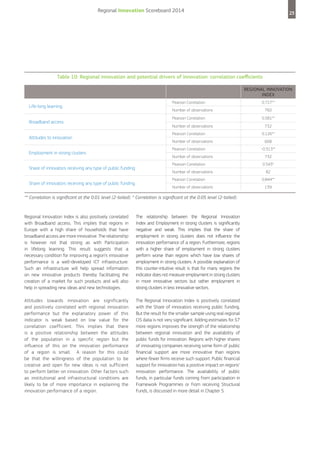
10. The Regional Innovation Index is positively and
significantly correlated with the indicator Participation
in life-long learning. This implies that regions with
a higher share of population that participates in
continuous training and learning activities are more
innovative. If the population in a specific region has a
high share of people investing in their human capital
by continuously learning and developing technical
skills then this will eventually lead to new applications,
spillovers, attracting investments and setting examples
for future generations. All these factors are influential
for the business environment and the innovative
performance of a region. The results thus show that
it is important to continuously upgrade skills after the
completion of formal education.

Data are taken from the European Social Survey. The RIS 2014 Methodology report provides more details.
The European Cluster Observatory assigns 0, 1, 2 or 3 stars depending 1) if employment reaches a sufficient share of total European employment, 2) if a region
is more specialised in a specific cluster category than the overall economy across all regions, 3) if a cluster accounts for a larger share of a region's overall
employment. Full details about the methodology used by the European Cluster Observatory are available at http://www.clusterobservatory.eu/index.html
The Regional Competitiveness Report 2013 uses a similar indicator on the share of employees in strong clusters among high-tech clusters to measure regions
innovation performance (http://ec.europa.eu/regional_policy/sources/docgener/studies/pdf/6th_report/rci_2013_report_final.pdf).
Both innovating companies (23%) and non-innovating companies (21%) equally report that the lack of external sources of finance is hampering their innovation activities.
Financial support can include tax credits or deductions, grants, subsidised loans, and loan guarantees. Research and other innovation activities conducted entirely
for the public sector under contract are excluded.
Regional Innovation Scoreboard 2014

23

Table 10: Regional innovation and potential drivers of innovation: correlation coefficients
REGIONAL INNOVATION
INDEx
Life-long learning
Broadband access
Attitudes to innovation
Employment in strong clusters
Share of innovators receiving any type of public funding

Pearson Correlation
Number of observations
Pearson Correlation
Number of observations
Pearson Correlation
Number of observations
Pearson Correlation
Number of observations
Pearson Correlation
Number of observations
Pearson Correlation
Number of observations

** Correlation is significant at the 0.01 level (2-tailed). * Correlation is significant at the 0.05 level (2-tailed).

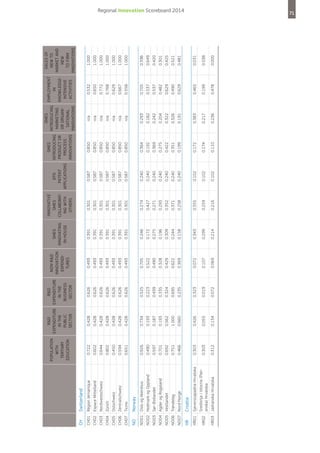
Regional Innovation Index is also positively correlated
with Broadband access. This implies that regions in
Europe with a high share of households that have
broadband access are more innovative. The relationship
is however not that strong as with Participation
in lifelong learning. This result suggests that a
necessary condition for improving a region’s innovative
performance is a well-developed ICT infrastructure.
Such an infrastructure will help spread information
on new innovative products thereby facilitating the
creation of a market for such products and will also
help in spreading new ideas and new technologies.

The relationship between the Regional Innovation
Index and Employment in strong clusters is significantly
negative and weak. This implies that the share of
employment in strong clusters does not influence the
innovation performance of a region. Furthermore, regions
with a higher share of employment in strong clusters
perform worse than regions which have low shares of
employment in strong clusters. A possible explanation of
this counter-intuitive result is that for many regions the
indicator does not measure employment in strong clusters
in more innovative sectors but rather employment in
strong clusters in less innovative sectors.

Attitudes towards innovation are significantly
and positively correlated with regional innovation
performance but the explanatory power of this
indicator is weak based on low value for the
correlation coefficient. This implies that there
is a positive relationship between the attitudes
of the population in a specific region but the
influence of this on the innovation performance
of a region is small. A reason for this could
be that the willingness of the population to be
creative and open for new ideas is not sufficient
to perform better on innovation. Other factors such
as institutional and infrastructural conditions are
likely to be of more importance in explaining the
innovation performance of a region.

The Regional Innovation Index is positively correlated
with the Share of innovators receiving public funding.
But the result for the smaller sample using real regional
CIS data is not very significant. Adding estimates for 57
more regions improves the strength of the relationship
between regional innovation and the availability of
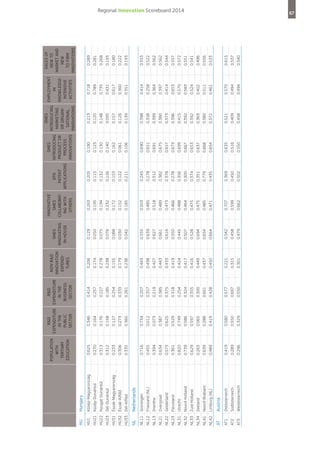
public funds for innovation. Regions with higher shares
of innovating companies receiving some form of public
financial support are more innovative than regions
where fewer firms receive such support. Public financial
support for innovation has a positive impact on regions’
innovation performance. The availability of public
funds, in particular funds coming from participation in
Framework Programmes or from receiving Structural
Funds, is discussed in more detail in Chapter 5.

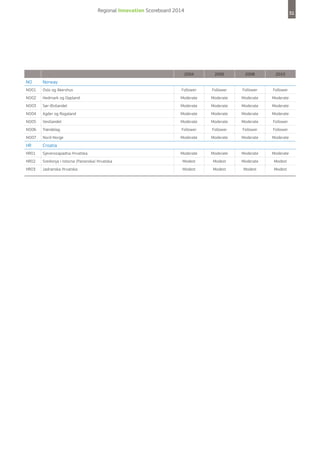
0.727**
760
0.581**
732
0.126**
668
-0.313**
732
0.543*
82
0.844**
139
Regional Innovation Scoreboard 2014

24

4. Regional research and innovation
potential through EU funding
4.1 Introduction
This chapter aims to provide evidence to contribute
to a better understanding of the relationship between
EU funding instruments such as the Structural Funds
(SFs) and the Framework Programme for Research
and Technological Development (FP7) and regions’
innovation performance.
Firstly, the chapter presents a categorisation of
regions based on their extent of using and leveraging
SFs to invest in the fields of research, technological
development and innovation (RTDI) and of their
participation in FP7. This provides the landscape of
how European regions have been benefitting from EU
support in this specific domain. The chapter also gives
an overview of the absorption capacity of regions
regarding the use of SFs with the most updated
available data on committed projects by the end of
2012.
Secondly, this chapter analyses the extent to which the
absorption of EU funds is reflected in regions’ innovation
performance. The analysis will focus on identifying
whether regional investments in RTDI measures are

matched by regions’ innovation performance. In other
words, are regions with high public investments in RTDI
more likely to be innovation leaders? Or are regions
with low capacity to leverage funds for innovation also
lagging behind in terms of innovation performance?
Similar to the analysis performed in the RIS 2012,
this chapter aims to contribute to investigating the
variety of forms that the “regional innovation paradox”
takes in Europe, or the idea that lagging regions with
greater needs for support are prone to low absorption
of European funds and lack prioritisation of available
resources towards support for innovation.
Section 4.2 presents an overview of the instruments
provided at European level in support of regional
research and innovation activities. Section 4.3 gives
an overview of the data used and presents the cluster
analysis and cross-analysis methodologies. Section 4.4
describes the groups of EU regions based on their use
of EU funds, and the results achieved when intersecting
the regions’ type of absorption of EU funds with their
innovation performance. Section 4.5 concludes.

4.2 EU funding instruments for increasing regional research and innovation capacity
4.2.1 Structural Funds
Innovation is at the heart of Europe 2020 policy
objectives, yet there are significant differences in
research and innovation capacity among the regions of
Europe. The Structural Funds (SFs) are an instrument
of the EU’s cohesion policy that aim to counterbalance
these disparities by investing especially in those
regions that lag behind in performance. For this reason
the EU cohesion policy introduced two types of regional
funding objectives. The SF Convergence objective
(CON) covers the regions that have GDP per capita
below 75% of the EU average and aim to accelerate
the economic development in these regions. The

14
15
16

http://ec.europa.eu/regional_policy/
Funding for selected projects (either already spent or earmarked for spending).
Croatia is excluded in this calculation to enable better comparability between the periods.

Regional Competitiveness and Employment objective
(RCE) comprises all other regions above this threshold
and seek to reinforce competitiveness, employment
and attractiveness of these regions14.
In the period 2000-2006 the SF investment in research
and innovation reached €17.9 billion or 10% of the
total SF budget. The committed SF funding15 under
RTDI priorities in the EU27 for the period 2007-2013
amounted to €42.6 billion, constituting 16.3% of all
available funds16. It is important to point out that
Convergence regions increased their share of research
and innovation in SF budgets on average by 12%
Regional Innovation Scoreboard 2014

compared to about 8% for RCE regions between both
periods17. Taking into account the fact that in absolute
figures the largest amount of funding has been allocated
to Convergence regions, SFs can be regarded as a major
financial input to narrow the innovation gap between
advanced and less developed regions.
While the SF is part of the EU budget, the spending of
this funding is based on the system of shared responsibility between regions, national governments and

25

the European Commission. The funds are channelled
through Operational Programmes (OPs) that cover
the policy priorities selected by respective countries
and/or regions.18 Depending on the country’s specific
administrative structure and the degree of centralisation
of regional policy-mak ing, the OPs can be formulated at the level of NUTS 1 or NUTS 2 regions, or also
at country level. Table 11 summarises the territorial
coverage of Operational Programmes 2007-2013 in
all EU Member States.19

Table 11: Territorial coverage of Operational Programmes in EU Member States
LEVEL

COUNTRIES

NUTS 1

Belgium, Germany, Greece20, Netherlands, United Kingdom

NUTS 2

Austria, Spain, Finland, France, Hungary, Ireland, Italy, Poland, Portugal, Sweden

Country level (OPs organised by policy
priorities not specific regions)

Bulgaria, Croatia, Czech Republic, Denmark, Romania, Slovakia

Country level (the countries are not split in regions)

Estonia, Cyprus, Latvia, Lithuania, Malta, Slovenia

Source: Technopolis Group based on the DG REGIO Data Warehouse

17
18

19

20

Regional Innovation Scoreboard 2012
The OPs are prepared by the EU Member States and negotiated with and ultimately validated by the European Commission. The implementation of OPs is done
by the Management Authorities of each Member State and their respective regions. The Commission is involved in the monitoring and quality control of funds
management, alongside the country concerned.
In cases where there are particular pockets of less developed regions encompassed within more advanced NUTS 1 regions, several countries have opted for
tailored OPs to address specific challenges of such Cohesion regions. For instance, Germany has established a separate OP for the NUTS 2 region Lüneburg (DE93)
focusing on improvement of infrastructure. Similar rationales have been applied to the Belgian region Hainaut (BE32) and two UK regions – Cornwall and the Isles
of Scilly (UKK3) and Lowlands and Uplands of Scotland (UKM6).
OPs of Greece do not follow a strict territorial logic. There are five OPs for these combinations of regions: 1) Attiki (EL3); 2) E Kriti, Nisia Aigaio (EL4); 3) Anatoliki
Makedonia, Thraki (EL11); 4) Thessalia, Sterea Ellada, Ipeiros (EL14+EL24+EL21); 5) Western Greece, Peloponnese, Ionian Islands (EL23+EL25+EL22)
26

Regional Innovation Scoreboard 2014

To provide an indication on countries’ prioritisation
of spending for RTDI priorities in their OPs, Figure 5
presents a comparison of the shares of the EU SFs
that have been initially earmarked for supporting
RTDI. In the period 2007-2013. EU15 countries have
allocated significantly larger shares of SFs to research
and innovation. On average the share for EU15
countries is around 27%, while for EU12 countries it

is approximately 15%. Both EU15 and EU12 countries
have put policy importance on stimulating research
and technological activities allocating respectively
around 16% and 10% of the total SF budget. EU15
countries have earmarked on average 11% of SFs for
services for business innovation and commercialisation,
however EU12 countries allocated only some 5% of the
available funding to this policy priority.

Figure 5: Share of Structural Funds initially allocated under RTDI priorities, 2007-2013

• Blue: EU15 countries (dark: research and technological activities; light: services for business innovation and
commercialisation)
• Orange: EU12 countries (dark: research and technological activities; light: services for business innovation and
commercialisation)
Source: Technopolis Group based on the DG REGIO Data Warehouse
Regional Innovation Scoreboard 2014

4.2.2 Framework Programme for Research and
Technological Development
The Framework Programme for Research and
Technological Development (FP) is another EU
intervention that provides significant funding for
research and innovation, but differs in its nature. If
SFs favour the emergence of the knowledge economy
and aim to foster socio-economic cohesion, the FP
is based on organisations bidding for competitive
funding based on criteria of excellence. For this reason
it is usually the case that innovation leaders are also
the best performers in attracting FP funds.
Since the individual regions’ participation in the
Framework Programme is conditioned by the location
of research infrastructures within their boundaries,
the data analysis of FP funds attracted by the
regions needs to be considered with care. Centralised

27

research systems with wide networks of national
research institutes, for example, the French National
Centre for Scientific Research (CNRS) or the Spanish
National Research Council (CSIC), will attribute the
FP participation results to the region where the legal
residence of the public research institute network
in seated. This creates the so-called “headquarters
effect”, significantly boosting the FP performance of
large capital regions. It must be taken into account
that FP participation is also very much determined by
temporal path dependence. For example, it is known
that FP6 projects have led to increased co-publication
activity between project partners21. This implies that
strong visibility in FP6 could have led to more solid
integration of participants in excellent European
research networks ultimately improving also their
results in FP7 competitive bids.

4.3 Indicators and data availability
4.3.1 Data availability and data sources
There are two main data sources used in this analysis:
1) Structural Funds data was obtained from the data
warehouse of the Directorate General for Regional
Policy of the European Commission. Different from
the data used in the RIS 2012, in this edition the SF
data was organised per Operational Programme.
Another difference is that the data used concerns
committed funding, namely funds earmarked
for selected projects that are not yet backed-up
with invoices, but will most likely become actual
expenditures once the programming period is
closed.
2) Framework Programme data was obtained from
the External Common Research Data Warehouse
E-CORDA of the Directorate General Research
and Innovation of the European Commission. The
database cut-off date is June 2013.

21
22

23

Based on the data availability only at Operational
Programme level, the database for the analysis was
constructed of the OPs with data at NUTS 1 and 2
levels, and does not include information on regions in
countries where the OPs are managed at national level
only. In total the analysis comprises 164 regions22.
There are 58 regions under Convergence objective and
104 RCE objective regions that represent respectively
35% and 63% of all regions analysed. The structure
of Greek Operational Programmes does not follow a
strict territorial rationale. Therefore, Greek regions are
grouped into NUTS 1 regions, one separate NUTS 2
region and a mix of NUTS 2 regions23.
To link the expenditure of EU funding in regions with
regional innovation performance, the analysis makes use
of the results of the assessment of regional innovation
performance presented in Section 3 of this report.

AVEDAS AG, NetPact (2009), Structuring Effects of Community Research – The Impact of the Framework Programme on RTD on Network Formation
Due to the recent administratively territorial reform carried out in Finland in 2013, the results do not disaggregate the region Helsinki-Uusimaa (FI1B) that has been
detached from the former region Etelä-Suomi (FI18). In this analysis the results of Helsinki-Uusimaa (FI1B) are displayed within the new administrative region
Etelä-Suomi (FI1C).
Cf. footnote 21
Regional Innovation Scoreboard 2014

28

4.3.2 Indicators
As in the RIS 2012, the analysis is based on a composite
thematic categorisation of the fields of SF intervention
for the period 2007-2013. The figures under the specific
expenditure categories reflect funding committed to
selected projects. The amounts registered for each field
of investment are self-reported by the regions, which
might create some unobserved bias and thus diminish
the validity of the data analysis. In order to compare
the use of SF under RTDI priorities across regions in the
EU, the values of the funds are reported at a per capita
level for each region and annualised.
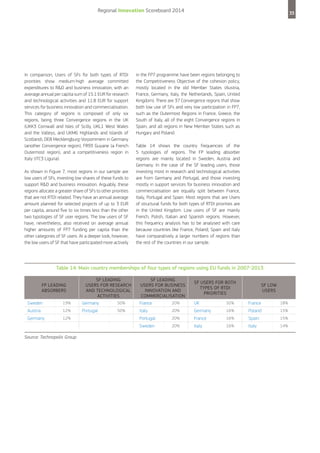
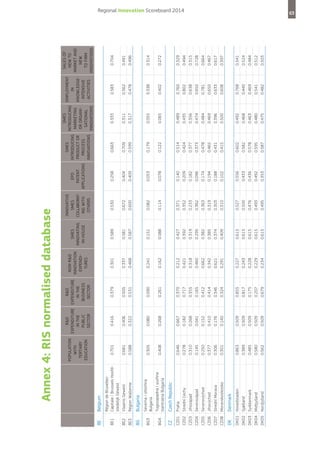
The relevant thematic categories of investment priorities
established by DG REGIO for the Structural Funds were
summed into two main indicators that reflect the amount
of regional support in two core areas:
1) Research and technological activities: portrays the use of funds in support of improving the
infrastructure, technological basis and RTDI capacity
of the regional players which have an impact on both
the public and private sectors’ performance;
2) Support services for business innovation
and commercialisation: concerns the fields
of investments that are directly targeting the
enhancement of innovation outputs in enterprises
(mainly advisory services, technology transfer
and training measures aimed at enterprises).
This indicator includes also the field of assistance
to SMEs for the promotion of environmentally
friendly products and production processes.

The Framework Programme funds were analysed based
on quantifying four major indicators for the participation
of the regions in competitive research and technology
development. The indicators were chosen to highlight in
particular the strength of the private sector’s participation
in the programme by considering the following dimensions:
1) The total amount of subsidies received by
the regional actors per year (per capita) indicates
the absorptive capacity of the region in attracting
FP funds;
2) The leverage (per capita), or the difference
between the total cost of the projects and the
total subsidies received in the region for the FP
projects undertaken, which shows the power of
the regional research actors to raise additional
funds from further public or private sources to
support competitive research;
3) The number of participations from the
private sector (per thousand inhabitants) is
linked to the amount of private enterprises engaged
in FP projects in the region. It shows the strength of
the business sector as a research actor;
4) Percentage of SME participation in private
sector shows the share of SMEs in the total
number of FP participations from the private sector.
This indicator gives a hint about the vibrancy of the
business innovation environment in the region.
Table 12 shows the categories of SF expenditures that
are included in each indicator, based on the definitions
of DG REGIO and the selected FP indicators.

Table 12: Categories of EU funds expenditure under RTDI priorities in the period 2007-2013
INDICATOR

STRUCTURAL FUNDS 2007-2013
01: R&TD activities in research centres

Research and technological activities

02: R&TD infrastructure and centres of competence in a specific technology
04: Assistance to R&TD, particularly in SMEs (including access to R&TD services in research centres)
07: Investment in firms directly linked to research and innovation
03: Technology transfer and improvement of cooperation networks

Services for business innovation and
commercialisation

09: Other measures to stimulate research and innovation and entrepreneurship in SMEs
05: Advanced support services for firms and groups of firms
06: Assistance to SMEs for the promotion of environmentally-friendly products and production processes
14: Services and applications for SMEs (e-commerce, education and training, networking, etc.)
Total amount of subsidies received (per capita)

FP7 indicators

Leverage (per capita)
Number of participations from the private sector (per thousand inhabitants)
Percentage of SME participation in private sector

Source: Technopolis Group
Regional Innovation Scoreboard 2014

4.3.3 Methodology
This year’s methodology differs from that used in the
RIS 2012. Given that the current programming period
of SFs is still running, it was not possible to provide
an analysis based on expenditures and instead data on
committed funds to projects have been used. Because
the current most updated data on SFs is structurally
different to data on expenditures for the programming
period 2000-2006, it is not possible to provide a crosstime comparison between both programming periods.24
A factor analysis was first performed on all variables
in order to find factors among observed variables and
group variables with similar characteristics together.
The factor analysis revealed that SFs data variables
and FP data variables are structurally different.

29

A cluster analysis was then performed to group
information on the use of EU funds in regions based
on their similarity on the different sub-indicators
presented in section 4.3.2.25 Hierarchical clustering
was chosen as the method to cluster SFs data26
and based on the characterisations of the different
clusters a total of 4 clusters for grouping SFs data
was obtained.
A similar clustering method was tested for obtaining
typologies related to the use and leverage of FP funding
in regions. However, the results were not satisfactory as
a consequence, we have applied a similar methodology
of that used in chapter 3, identifying FP leading
absorbers as those regions that perform at least 120%
of the sample average.

4.4 Regional absorption and leverage of EU funding
4.4.1 Regional absorption rate of SF funding
for RTDI
For the purpose of this chapter, we define the absorption
rate as the share of committed Structural Funds that
are allocated to specific projects under RTDI priorities.
The absorption rate has been linked to the capacity
to use funds in support of RTDI, which is considered
crucial for ensuring that the EU funding is making the
greatest effect on economic and social cohesion. It has
been recognised as an important concern in relation to
the implementation of cohesion policy. Many Member

24
25

26
27

States have experienced difficulties in the absorption
of SFs in the initial years after the accession to the
EU. The causes of these difficulties in taking up EU
funding include shortage of resources to co-finance
projects, lack of long-term strategic vision from the
policy-makers, low administrative capacity to manage
funds in terms of insufficient human resources
and skills, weak inter-institutional cooperation and
underdeveloped public-private partnerships27. While
there are many interrelated factors that account for
regions’ ability to absorb EU funding, a major part of
them relates back to the quality of governance.

However, the RIS 2012 presents good evidence of the characteristics and funding performance of EU regions in the programming period 2000-2006.
In order to perform the analysis and to avoid results being influenced by scores of regions over-performing, the dataset has been normalised for outlier’s scores
with the next best values.
The chosen cluster method was between-group linkage. The interval measures are computed using Squared Euclidean distance.
E.g. Zaman, G. and Georgescu, G. (2009) Structural Fund Absorption: A New Challenge For Romania?. Journal for Economic Forecasting, Institute for Economic
Forecasting, 6(1), 136-154
Regional Innovation Scoreboard 2014

30

Figure 6 provides an overview of SF funding under RTDI
priorities that regions have committed to projects,
illustrated as a share of the initially allocated funds
under RTDI priorities. While the committed funds are

not yet backed up by invoices and actually spent, this
data serves as a close proxy of funding absorption
capacity by regions for research and innovation.

Figure 6: The absorption of the allocated SF funding (under RTDI priorities) by regions, 2007-2013

Map created with Region Map Generator

It is interesting to note that in the period 2007-2013
regions in Northern Italy show a very high absorption
rate of SF funding. Good absorption rates are also
found for a range of regions in Belgium, Sweden
and the Netherlands. The lowest SF absorption

rates are for almost all regions of Hungary, where
the committed funding under RTDI priorities is very
marginal. The overall absorption of available funds
seems to be weak also in a number of Greek, Spanish,
Italian and Polish regions.
Regional Innovation Scoreboard 2014

4.4.2 Findings from the cluster analysis
Following the cluster analysis results of SFs funding
and the analysis of FP based on relative regional
performance to that of the average, there are five main
typologies of regions in terms of the use of EU funding
for research and innovation in the period 2007-2013.
The five typologies identified are:
1) FP leading absorbers, regions with medium-high
to very high participation in the FP7 programme
(above 120% of the regional average in our sample);
2) SF leading users with high use of SF for
research and technological activities;
3) SF leading users with high use of SF for

support services for business innovation
and commercialisation;
4) Users of SF for all types of RTDI priorities
with medium-to-high use of SF for both research
and technological activities and services for
business innovation and commercialisation;
5) SF low users with low rates of use of SF under
research, technological development and innovation
priorities.
The detailed cluster membership of each of the
164 regions can be found in Annex 5. The map in
Figure 7 below gives an overview of the localisation of
the different typologies of regions.

Figure 7: Map of EU funding typology in EU regions

Map created with Region Map Generator

31
Regional Innovation Scoreboard 2014

32

Over the period 2007-2013, the five groups of 164
regions include a majority of low users of Structural
Funds (116 regions or 70.7% of total). There were only
six regions that were Users of SF for both types of RTDI
priorities (3.6% of regions), and 16 leading SF users
of both types (i.e. high focus of SFs on research and
technological activities and support services for business
innovation and commercialisation) (9.7% of total). Over
90% of the 26 regions that are leading FP absorbers are
low users of Structural Funds (with an average annual
committed expenditure of 3 EUR per capita). Only two
of the leading regions in FP participation also show a
high use of Structural Funds, in particular targeting
services for business innovation and commercialisation
(the Greek region of Attiki and the Swedish region Övre
Norrland). These two regions were also identified as FP
leading absorbers in the RIS 2012.
The SF leading users have the highest shares of these
funds directed towards investments to research and
business innovation. They can be classified into two subcategories: those SF leading users that invest most

in improving their research and technological
activities (on average 23.9 EUR per capita annually),
and those leading user regions that prioritise ‘softer’
measures targeting support services for business
innovation and commercialisation (on average
24.7 EUR per capita per year) (see Table 13 below). It
is interesting to note that the regions with the highest
investments in research and technological activities are
Convergence regions, 3 of them located in the Eastern
part of Germany (Brandenburg, Sachsen, SachsenAnhalt) and 3 in Portugal (Norte, Centro and Alentejo).
The regions with the highest investments in support
services for business innovation and commercialisation
are scattered across the Mediterranean part of Europe
and the Nordic countries, and split between the
Convergence and Competitiveness Objective of the
Cohesion Policy: Anatoloki Makedonia, Thraki (EL11)
in Greece, Sardegna (ITG2) and Puglia (ITF4) in Italy,
Autonomous Region of Açores (PT20) in Portugal, two
Outermost regions in France (Martinique and Corse
FR83), and the regions of Norra Mellansverige (SE31)
and Mellersta Norrland (SE32) in Sweden.

Table 13: Number of regions and average characteristics of EU funds used / leveraged for the five typologies of regions

FP LEADING
ABSORBERS
Funding programme
SFs PP 2007-2013
(funds committed to
projects selected):
Euros/annual/per
capita (Dec 2012)

No. regions
Research and
technological activities
Support services for
business innovation and
commercialisation
Total amount of subsidies
received (per capita)
Leverage (per capita)

FP7 (June 2013)

Number of participations
from the private sector
(per thousand inhabitants)
Percentage of SME participation in private sector

Source: Technopolis Group

SF LEADING
USERS FOR
RESEARCH
AND TECHNOL.
ACTIVITIES

SF LEADING
USERS FOR BUSINESS INNOVATION
AND COMMERCIALISATION

SF USERS
FOR BOTH
RTDI
PRIORITIES

SF LOW
USERS

26

6

10

6

116

2.4

23.9

7.1

15.1

2.9

3.7

4.7

24.7

11.8

2.7

106.9

14.3

8.0

15.2

17.3

35.5

5.2

2.9

4.8

6.1

0.08

0.02

0.01

0.03

0.02

62%

71%

47%

99%

69%
Regional Innovation Scoreboard 2014

In comparison, Users of SFs for both types of RTDI
priorities show medium-high average committed
expenditures to R&D and business innovation, with an
average annual per capita sum of 15.1 EUR for research
and technological activities and 11.8 EUR for support
services for business innovation and commercialisation.
This category of regions is composed of only six
regions, being three Convergence regions in the UK
(UKK3 Cornwall and Isles of Scilly, UKL1 West Wales
and the Valleys, and UKM6 Highlands and Islands of
Scotland), DE8 Mecklengburg-Vorpommern in Germany
(another Convergence region), FR93 Guyane (a French
Outermost region), and a competitiveness region in
Italy (ITC3 Liguria).
As shown in Figure 7, most regions in our sample are
low users of SFs, investing low shares of these funds to
support R&D and business innovation. Arguably, these
regions allocate a greater share of SFs to other priorities
that are not RTDI related. They have an annual average
amount planned for selected projects of up to 3 EUR
per capita, around five to six times less than the other
two typologies of SF user regions. The low users of SF
have, nevertheless, also received on average annual
higher amounts of FP7 funding per capita than the
other categories of SF users. At a deeper look, however,
the low users of SF that have participated more actively

33

in the FP7 programme have been regions belonging to
the Competitiveness Objective of the cohesion policy,
mostly located in the old Member States (Austria,
France, Germany, Italy, the Netherlands, Spain, United
Kingdom). There are 37 Convergence regions that show
both low use of SFs and very low participation in FP7,
such as the Outermost Regions in France, Greece, the
South of Italy, all of the eight Convergence regions in
Spain, and all regions in New Member States such as
Hungary and Poland.
Table 14 shows the country frequencies of the
5 typologies of regions. The FP leading absorber
regions are mainly located in Sweden, Austria and
Germany. In the case of the SF leading users, those
investing most in research and technological activities
are from Germany and Portugal, and those investing
mostly in support services for business innovation and
commercialisation are equally split between France,
Italy, Portugal and Spain. Most regions that are Users
of structural funds for both types of RTDI priorities are
in the United Kingdom. Low users of SF are mainly
French, Polish, Italian and Spanish regions. However,
this frequency analysis has to be analysed with care
because countries like France, Poland, Spain and Italy
have comparatively a larger numbers of regions than
the rest of the countries in our sample.

Table 14: Main country memberships of four types of regions using EU funds in 2007-2013

Sweden

19%

SF LEADING
USERS FOR RESEARCH
AND TECHNOLOGICAL
ACTIVITIES
50%
Germany

Austria

12%

Portugal

Germany

12%

Source: Technopolis Group

50%

SF LEADING
USERS FOR BUSINESS
INNOVATION AND
COMMERCIALISATION
20%
France

UK

50%

France

18%

Italy

20%

Germany

16%

Poland

15%

Portugal

20%

France

16%

Spain

15%

Sweden

FP LEADING
ABSORBERS

20%

Italy

16%

Italy

14%

SF USERS FOR BOTH
TyPES OF RTDI
PRIORITIES

SF LOW
USERS
Regional Innovation Scoreboard 2014

34

4.4.3 Matching leverage and absorption capacity
to innovation performance
While the landscape of the regional absorption of
EU funds for RTDI helps to identify how the regions
are making use of EU support, this section aims to
understand to what extent the absorption of EU funds
is reflected in the regional innovation performance of
the regions. We perform a cross analysis between the

different categories of regional use of EU funds and the
regions’ levels of innovation performance as discussed
in Chapter 3. We use the same classification of
innovation performance as the RIS: leaders, followers,
moderate and modest innovators. The cross analysis
results show 20 different groups of regions (see
Table 15 below and Annex 5 for the detailed overview
of the results).

Table 15: Use of EU funding and innovation performance in 20 groups of regions
RIS INNOVATION PERFORMANCE GROUPS 2014

Leader

Moderate

Modest

FP leading absorber

13

5

0

SF leading user research
and technological activities

1

2

3

0

SF leading user business innovation and commercialisation

0

3

5

1

SF user for both types of
RTDI priorities

0

2

2

0

SF low user

Typologies use of
EU funding period
2007-2013

Follower

8

11

40

45

18

Source: Technopolis Group
Note: the analysis does not contain five regions that were not classified for innovation performance in the RIS: BE32 Hainaut, DE93
Lüneburg, FI1D Pohjois- ja Itä-Suomi, UKK3 Cornwall and the Isles of Scilly and UKM6 Lowlands and Uplands of Scotland.
The regions making high use of SFs for research and
technological activities, as well as the Users of SF for
both types of RTDI priorities show a comparatively
even distribution of their innovation performance
between followers and moderate innovators. The only
leading region with regards to its use of SF for research
and technological activities exhibiting high innovation
performance is the German region Saxony (DED). In the
case of the leading SF users for services for business
innovation and commercialisation, the majority of
the regions are moderate innovators, located in the
Mediterranean regions, while there are a few follower
Swedish regions. A modest innovating region investing
high amounts in business innovation is the Portuguese
Autonomous Region of Madeira (PT3).
Different than in the RIS 2012, where the FP leading
absorbers were rather evenly split between the
leader and follower innovator categories, there
are discrepancies in the distribution of innovation
performance in the groups of FP leading absorber
regions. 30.8% of the FP leading absorbers are
innovation leaders, whereas 50% of them are followers
and 19.2% are moderate innovators.

The low users of SF show an interesting distribution of
performance among regions, with 55% of the regions
categorised as moderate (40%) or modest (15%) innovators,
and around 45% of the low SF user regions falling in the
follower (35%) or leading innovator (9%) categories. There is
a striking North-South and West-East division in the regions
that are low absorbers of SF, signalling the fact that the
55% of low users of SF that show moderate and modest
innovation performance are not prioritising measures to
boost their innovation performance, but may be focusing
their spending on other types of support, risking to continue
to lag behind better performing regions:

•	 63% of the leading innovators but low SF users are
represented by German regions, followed by British,
Dutch and Finnish regions. Moreover, follower
innovators and low SF absorbers are 30% from
France, 22.5% from the UK and 15% from Austria.

•	 The modest innovators and low SF users are mostly

regions in Poland, Hungary and Spain, while the
moderate innovators and low SF users are from Italy
(28%), Spain (26%), France (17%), Greece (13%),
Poland (11%) and Hungary (9%).
Regional Innovation Scoreboard 2014

4.4.4 Regional research and innovation potential
through EU funding: discussion
The analysis of the regions’ use of EU funding under
RTDI priorities and the relationship with their innovation
performance shows striking features of the European
regional innovation landscape, confirming the trends
identified in the RIS 2012 report.
Most FP leading absorbers show good to very good
performance in regional innovation. In these regions,
EU funds seem to have a complementary role in the
regional innovation system. The use of EU funding is
high and medium-to-high in a relatively low number of
FP leading absorber regions, which partly also exhibit
innovation potential that is higher than average.
Nevertheless, a higher share of the regions investing
larger amounts in support for business innovation
are moderate innovators. This might show a partial
disconnection between the regions’ innovation support
policies and the actual needs of innovators.
Regions absorbing low amounts of SF for business
innovation make up the largest share of EU regions
(71%). More than half of the low SF users are moderate
or modest innovators, located in Mediterranean regions
or in the Eastern European countries. This finding
points to the fact that the lack of regions’ prioritisation
of investments in innovation is reflected in their low
innovation performance.
Our results confirm that the “regional innovation
paradox”28 is at work in Europe, whereby less innovative
regions with greater needs for investments in
innovation and in solutions to structural problems have
lower absorption capacity than performing regions, and
invest lower amounts of resources into supporting RTDI
activities. According to recent research in the field29,
these regions risk to remain locked in the “middleincome trap”, in case the regions do not implement
solutions to restore their competitive advantage and
to improve the quality of governance and the structural
problems that they are facing.
There are several further trends that need to be highlighted
to better understand the context in which the regional

28

29

30

31
32

33

35

innovation paradox takes place in Europe. Beyond the
trends of globalisation, and diminishing competitiveness
of EU regions, the complexity of the multi-levelgovernance schemes in place for implementing European
policies and particularly the funding programmes of
the cohesion policy. While the Framework Programme
funds are awarded on a competitive basis to research
actors, the process of awarding of Structural Funds is
subject to the Member States’ varieties of governance
arrangements for implementing policies for (regional)
development (ranging from decentralised city, county- or
regional-level planning to national level steering), which
ultimately influences the success of the cohesion policy.
Recent scholar contributions suggest that there is a gap
in implementing development policy thinking at national
level.30 The placed-based approach to development has
been receiving wide recognition starting with the 2009
World Bank report on the role of economic geography to
local development31 and the 2009 Barca report for the
European Commission on reforming the cohesion policy.32
Both reports emphasise the role of taking the interactions
of economic geography and local and regional institutions
into account, and of capitalising on the knowledge of local
and external actors by engaging them in participatory
processes when delivering development policies. It is
argued that these approaches have been integrated
into the future cohesion policy 2014-2020, but some of
the national and regional implementation mechanisms
of development and innovation policies have remained
unchanged in EU Member States, based on rather
spatially-blind and top-down approaches.
In addition, a similar statement can be made regarding
the policy thinking in the field of regional innovation
systems. The different ways of understanding
innovation in the Member States is reflected in the type
of governance mechanisms in the field of innovation
promotion: while some governments have transferred
competencies to regions or local governments to better
foster a thriving environment for innovators, others have
preferred to maintain the top-down, linear approach
to RTDI support.33 This can be also recognised in the
way Operational Programmes have been designed, as
discussed in section 4.3. Some Member States have

See Oughton, C., Landabaso, M., Morgan, K. (2002): “The Regional Innovation Paradox: Innovation Policy and Industrial Policy” in Journal of Technology Transfer,
27, 97-100 pp.
Reid, A., Muscio, A., R ivera-Leon, L. (forthcoming): “An empirical test of the Regional Innovation Paradox: can smart specialisation overcome the paradox in the
central and eastern European countries?”.
Eichengreen, B., Park, D., Shin, K. (2013). Growth Slowdowns Redux: New Evidence on the Middle-Income Trap. NBER Working Paper No. 18673.
See Barca, F., McCann,P, Rodriguez-Pose, A. (2012): “The case for regional development intervention: place-based versus place-neutral approaches”, in Journal of Regional
Science, vol. 52, no. 1, pp. 134-152.
World Bank, (2009): “World Development Report 2009: Reshaping Economic Geography”, Washington DC: World Bank.
Barca, F. (2009): “An Agenda for a Reformed Cohesion Policy: A Place-Based Approach to Meeting European Union Challenges and Expectations”, Independent Report, prepared
at the request of the European Commissioner for Regional Policy, European Commission, Brussels.
Riche, M. (2010): “Regional Innovation Governance”, in Regional Focus, no. 2, 2010 DG Regional Policy, Brussels.
Regional Innovation Scoreboard 2014

36

tailored the OPs based on the territorial boundaries of
NUTS 2 or NUTS 1 regions, or also taking into account
the socio-economic profile of distinct territories (e.g. the
UK has a specific ERDF Operational Programme covering
the NUTS 2 Convergence region Cornwall and Isles of
Scilly and a different one covering the NUTS 1 region
South West England where the NUTS 2 region belongs).
On the other hand, many Member States, particularly in

Eastern Europe, have left the design of the Operational
Programmes for the national level (see Figure 7). While
there is no prescribed recipe for managing (regional)
innovation systems, the variance in implementing
innovation policies and development policies in the
EU, coupled with the quality of governance in several
Member States can be considered further challenges
to exiting the trap of the regional innovation paradox.

4.5 Conclusions
The analysis of the use of EU funding in the
programming period 2007-2013 shows that there
are 5 typologies of regions: Framework Programme
leading absorbers (15.85%); Structural Funds (SFs)
leading users targeting research and technological
activities (3.66%); Structural Funds leading users
prioritising services for business innovation and
commercialisation (6.10%); Users of Structural
Funds for both types of RTDI priorities, with similar
medium-to-high amounts of SF committed to projects
targeting both types of priorities (3.66%); and regions
with low use of Structural Funds, which make up the
majority of regions in our sample (71%).
This chapter also illustrated the low absorption capacity
of several European regions by analysing the changes
in initial allocations for business innovation support
within the SF Operational Programmes and the latest
data covering the amounts committed to projects in
the field of business innovation. It is striking that in
countries such as Greece, Hungary, Italy, Spain and
Poland, a large part of the regions resorted to awarding
less funding to innovation than initially foreseen,
shifting priorities during the course of the economic
crisis away from promoting innovation.
The absorption of FP funds shows that it is regions with
low use of SFs that are the most prominent participants
in the FP programme. This can be considered an evidence
of the complementarities of the two programmes in
these particular regions. However, there is a relatively
low share of regions that are making medium-tohigh use of SFs for business innovation. The majority
of the regions that made use of low amounts of SFs
are generally Convergence regions, located in the New
Member States or in the Mediterranean countries

most struck by the economic crisis. This shows that, in
spite of the structural problems encountered and the
diminishing competitiveness of EU regions, they have
not been prioritising innovation through EU funds as a
means to tackle these issues.
In order to understand to what extent EU funding is
reflected in the innovation performance of the recipient
regions, a cross-analysis of the region’s absorption of
EU funding and their regional innovation performance
was performed. The analysis shows that, while there
are several regions that can be classified as pockets
of excellence in terms of participation in the FP
programme and in regional innovation, only few of the
regions that are using EU funds for business innovation
more intensely are follower innovating regions, and
only one is a leading innovator. The majority of EU
regions in the analysed sample are low absorbers of
EU FP funds and SFs and exhibit moderate to modest
levels of innovation.
Taking into account their low use of SF in comparison
to other leading regions in the EU and the moderate
to modest innovation potential, the analysis points to
the fact that the regional innovation paradox continues
to be a feature of the European regional innovation
landscape, which needs to be tackled with more
care in the future programming period. The different
approaches to development policy thinking in terms
of place-based versus spatially-blind policies in the
EU Member States, and the varieties of governance
arrangements towards fostering (regional or national)
innovation systems are further challenges that need to
be taken into account as factors influencing the success
of European funding and ultimately the innovation
performance of regions.
Regional Innovation Scoreboard 2014

5. RIS methodology
5.1 Missing data: imputations
For 190 regions, 4 years (corresponding to having
regional data for 4 waves of the CIS) and 11 indicators,
full data availability would require data for 8,360 data
cells. But data availability is not very good with 29.2%
of data not being available. For several indicators, in
particular the indicators using CIS data, regional data
is missing for a number of years or even for the entire
period considered. Ideally, for calculating composite
indicators data should be available for all indicators,
although some degree of missing data is acceptable
(e.g. in the IUS for several countries data availability
is below 100%). To increase data availability, a CIS
regionalization technique has been used for the
indicators using CIS data followed by a set of imputation
techniques for the remaining missing CIS data and the
indicators not using CIS data.
5.1.1 CIS regionalization technique
If CIS data are missing for all regions but the aggregate
for the country is available, a CIS “regionalization”
technique will be used using country and regional level
data on employment and number of firms at the 2-digit
industry level assuming that industry intensities at the
country level also hold at the regional level.
We explain the method for regionalizing the CIS data
by using the share of firms with product innovations as
an example:

•	 Step 1: Calculate for each country Y the share of
•	
•	
•	
•	
•	

firms with product innovations for each industry I
using the CIS 2010 country level data: PI_Y_I
Step 2a: Identify the employment share of industry
I for region R: EMPL_R_I
Step 3a: Calculate the estimate for the share
of firms with product innovations by multiplying
EMPL_R_I with PI_Y_I: PI_EMPL_R_I
Step 2b: Identify the share of local units
(enterprises) of industry I for region R: ENTR_R_I
Step 3b: Calculate the estimate for the share
of firms with product innovations by multiplying
ENTR_R_I with PI_Y_I: PI_ENTR_R_I
Step 4: Calculate the average of PI_EMPL_R_I and
PI_ENTR_R_I as the estimate for the regional share
of product innovators: PI_R_I

The same method can be applied for all indicators
using CIS data. The RIS Methodology report includes
an example for an unnamed region for the share of
product and process innovators using CIS 2010 data.

5.1.2 General imputation techniques
The following techniques will be applied in the order as
shown below.

•	 At the country level, if data for both the previous
	

and following year are available first the average of
both years will be used
, then
that of the previous year
and finally that
, where C denotes
of the following year
the country, T the current year, T-1 the previous year
and T+1 the following year. If data are not available
for the previous and following year missing data will
not be imputed.

•	 I	f

regional data are available for the previous
year the ratio between the corresponding NUTS
level and that at a higher aggregate level (NUTS1
for NUTS2 regions, country level for NUTS1
regions) for the previous year is multiplied with
the current value at the higher aggregate level:
, where R denotes the
region, C the country (as the higher aggregate level),
T the current year and T-1 the previous year.

•	 I	f regional data for the previous year is not available,

the same procedure as in step 2 will be used but
using the ratio between the corresponding NUTS
level and that at a higher aggregate level (NUTS1
for NUTS2 regions, country level for NUTS1 regions)
for the following year:
,
where R denotes the region, C the country (as the
higher aggregate level), T the current year and T+1
the following year.

•	 I	f there are no regional data for both the previous

and following year, the higher level aggregate
((NUTS1 for NUTS2 regions, country level for NUTS1
regions)), first that for the current year, and, if not
available, that for the previous year otherwise that
for the following year:
or
or
, where R denotes the region, C the
country (as the higher aggregate level), t the current
year, T-1 the previous year and T+1 the following year.

•	 I	f there are no regional and no country level data

available for the current, previous and following
year, missing data will not be imputed.

The RIS Methodology report provides examples for
steps 3 and 4.

37
Regional Innovation Scoreboard 2014

38

5.1.3 Quality assessment of CIS estimates
The quality of regional estimates can be assessed
by comparing the regional CIS 2010 estimates with
real regional CIS 2010 data for 87 to 127 regions
as made available by Member States and Norway.
The regional estimates are of relatively good quality
for those indicators measured as a share of all
SMEs (with correlation coefficients above 90%), in

particular innovative SMEs collaborating with others,
product and/or process innovators and marketing
and/or organizational innovators. The estimates
are of lower quality for both indicators measured
as a share of turnover (with correlation coefficients
below 70%), i.e. non-R&D innovation expenditures
and sales due to new-to-market and new-to-firm
products.

Table 16: Correlation coefficients between real and estimated regional CIS 2010 data
CORRELATION COEFFICIENT

NUMBER OF REGIONS

Non-R&D innovation expenditure

0.617*

SMEs innovating in-house

0.812*

87

Innovative SMEs collaborating with others

0.919*

126

Product or process innovators

0.915*

127

Marketing or organisational innovators

0.903*

127

Sales of new-to-market and new-to-firm innovations

0.688*

101

125

* Correlation significant at 1%

5.1.4 Summary of data imputations per country
and indicator
Of the different imputation steps, the one used most
frequently at the regional level is step 2 (11.4%),
followed by steps 3 (6.6%), 5 (5.1%) and 4 (5.0%).
After applying the imputation techniques outlined
above data availability has increased from 70.8%
to 98.9% reducing the share of missing data to only
1.1% (cf. Annex 4 in the RIS Methodology report for full
details on the different imputation techniques used in
every region). Annex 4 provides the full database for all
regions and indicators after imputation.

Tables 17 and 18 provide details on the relative
share of imputations per country and indicator. For
most countries data availability after imputation is
100% except for Spain and France (99.0%), Finland
(96.4%) and the UK (90.9%). For most indicators
data imputations have raised data availability to
99% or more, except for EPO patent applications,
Marketing or organisational innovators and Non-R&D
innovation expenditure due to a lack of data at the
country level.

Table 17: Data availability per country after imputation
COUNTRy/COUNTRIES

DATA AVAILABILITy

Austria, Belgium, Bulgaria, Croatia, Czech Republic, Denmark, Germany, Greece, Hungary, Ireland, Italy,
Netherlands, Norway, Poland, Portugal, Romania, Slovakia, Slovenia, Sweden, Switzerland
Spain

99.0%

France

99.0%

Finland

96.4%

United Kingdom

90.9%

100%
Regional Innovation Scoreboard 2014

39

Table 18: Data availability per indicator after imputations
Indicator

Data availability

Population having completed tertiary education

100%

R&D expenditure in the public sector

100%

R&D expenditure in the business sector

100%

SMEs innovating in-house

100%

Innovative SMEs collaborating with others

100%

Product or process innovators

100%

Sales of new-to-market and new-to-firm innovations

100%

Employment in medium-high/high-tech manufacturing and knowledge-intensive services

99.5%

EPO patents

97.9%

Marketing or organisational innovators

96.3%

Non-R&D innovation expenditure

93.7%
Regional Innovation Scoreboard 2014

40

5.2 Composite indicators
5.2.1 Normalising data
Ideally for calculating composite indicators the
individual indicators should follow a normal
distribution. Most of the indicators are fractional
indicators with values between 0% and 100% and
most of these follow a normal distribution. Some
indicators are unbound indicators, where values are
not limited to an upper threshold. These indicators
can have skewed data distributions (where most
regions show low performance levels and a few
regions show exceptionally high performance levels).
For all indicators data have been transformed using a
square root transformation with power N if the degree
of skewness of the raw data exceeds 1 such that the

skewness of the transformed data is below 1. This
transformation will be applied after the imputation of
missing data.
Table 19 summarizes the degree of skewness before
and after the transformation and the power N used
in the transformation. The data are then normalized
using the min-max procedure. The transformed score
is first subtracted with the minimum score observed
for all regions across all four yearly observations
and then divided by the difference between the
maximum and minimum scores observed for all
regions across all four yearly observations. The
maximum normalised score is equal to 1 and the
minimum normalised score is equal to 0.

Table 19: Degree of skewness and transformation
DEGREE OF
SKEWNESS BEFORE
TRANSFORMATION

POWER USED IN
TRANSFORMATION

DEGREE OF
SKEWNESS AFTER
TRANSFORMATION

Population having completed tertiary education

0.154

1

--

R&D expenditure in the public sector

1.058

0.75

0.563

R&D expenditure in the business sector

1.727

0.5

0.676

Non-R&D innovation expenditure

2.525

0.5

0.610

SMEs innovating in-house

0.130

1

--

Innovative SMEs collaborating with others

0.843

1

--

EPO patents

2.130

0.5

0.759

Product or process innovators

0.360

1

--

Marketing or organisational innovators
Employment in medium-high/high-tech manufacturing
+ knowledge-intensive services
Sales of new-to-market and new-to-firm innovations

0.723

1

--

-0.091

1

--

1.824

0.5

0.610

5.2.2 Regional Innovation Index
Average innovation performance is measured using
composite indicators. The Regional Innovation Index is
calculated as the unweighted average of the normalised
scores of the 11 indicators.
A comparison of the Regional Innovation Index at the
country level with the Summary Innovation Index in the
Innovation Union Scoreboard shows that, due to using a
more restricted set of indicators in the RIS, countries’ relative
to the EU performance in the RIS is different than that in
the Innovation Union Scoreboard. The following correction is
therefore applied to the composite indicator scores:

1) Calculate the ratio of the IUS Summary Innovation
Index at country level with that of the EU: IUS_
index_CTR / IUS_index_EU
2) Calculate the ratio of the RIS innovation index at
country level with that of the EU: RIS_index_CTR
/ RIS_index_EU
3) Calculate the correction factor by dividing the
ratios 1) and 2)
These country correction factors are then multiplied
with the Regional Innovation Index for each region in
the correspond country.
Regional Innovation Scoreboard 2014

5.3 Group membership
Where group membership in the RIS 2012 was
determined using hierarchical clustering, the RIS
2014 adopts the classification scheme used in the
Innovation Union Scoreboard:

•	 Innovation
•	

leaders are those regions with a
relative performance of 20% or more above that
of the EU27;
Innovation followers are those regions with a
relative performance less than 20% above but
more than 10% below that of the EU27;

•	 Moderate
•	

innovators are those regions with a
relative performance less than 10% below but
more than 50% below that of the EU27;
Modest innovators are those regions with a
relative performance of 50% or less that of the
EU27.

This classification scheme is more transparent and
identical to that used in the IUS and provides more
consistent results over time.

41
Regional Innovation Scoreboard 2014

42

Annex 1: RIS indicators
Population aged 30-34 having completed tertiary education (%)

Numerator

Number of persons in age class with some form of post-secondary education (ISCED 5 and 6)

Denominator

The reference population is all age classes between 30 and 34 years inclusive

Rationale

This is a general indicator of the supply of advanced skills. It is not limited to science and technical fields because
the adoption of innovations in many areas, in particular in the service sectors, depends on a wide range of
skills. Furthermore, it includes the entire working age population, because future economic growth could require
drawing on the non-active fraction of the population

Included in RIS 2012

Comparable, RIS 2012 refers to age group 25-64

Included in IUS

Yes

Data source

Eurostat, regional statistics

Data availability

NUTS 2, 2006-2012

R&D expenditures in the public sector (%)

Numerator

All R&D expenditures in the government sector (GOVERD) and the higher education sector (HERD)

Denominator

Regional Gross Domestic Product

Rationale

R&D expenditure represents one of the major drivers of economic growth in a knowledge-based economy. As
such, trends in the R&D expenditure indicator provide key indications of the future competitiveness and wealth
of the EU. Research and development spending is essential for making the transition to a knowledge-based
economy as well as for improving production technologies and stimulating growth

Included in RIS 2012

Yes

Included in IUS

Yes

Data source

Eurostat, regional statistics

Data availability

NUTS 2, 2003-2009 (for 2010 data availability is less than 50%)

R&D expenditures in the business sector (%)

Numerator

All R&D expenditures in the business sector (BERD)

Denominator

Regional Gross Domestic Product

Rationale

The indicator captures the formal creation of new knowledge within firms. It is particularly important in the
science-based sector (pharmaceuticals, chemicals and some areas of electronics) where most new knowledge is
created in or near R&D laboratories

Included in RIS 2012

Yes

Included in IUS

Yes

Data source

Eurostat, regional statistics

Data availability

NUTS 2, 2003-2009 (for 2010 data availability is less than 50%)
Regional Innovation Scoreboard 2014

43

Non-R&D innovation expenditures (%)

Numerator

Sum of total innovation expenditure for SMEs only, excluding intramural and extramural R&D expenditures

Denominator

Total turnover for SMEs only (both innovators and non-innovators)

Rationale

This indicator measures non-R&D innovation expenditure as percentage of total turnover. Several of the components of innovation expenditure, such as investment in equipment and machinery and the acquisition of patents
and licenses, measure the diffusion of new production technology and ideas

Included in RIS 2012

Yes

Included in IUS

Yes

Data source

Community Innovation Survey – Eurostat in collaboration with individual Member States

Data availability

NUTS 1: 2004-2006-2008-2010: BE, BG; 2004-2008-2010: FR; 2008-2010: AT
NUTS 2: 2004-2006-2008-2010: CZ, ES, PL, PT, RO, SI, SK; 2004-2008-2010: NO; 2006: GR; 2006-20082010: HU; 2008-2010: IT, SE; 2010: HR

SMEs innovating in-house (%)

Numerator

Sum of SMEs with in-house innovation activities. Innovative firms with in-house innovation activities have introduced a new product or new process either in-house or in combination with other firms. The indicator does not
include new products or processes developed by other firms

Denominator

Total number of SMEs (both innovators and non-innovators).

Rationale

This indicator measures the degree to which SMEs, that have introduced any new or significantly improved products or
production processes, have innovated in-house. The indicator is limited to SMEs because almost all large firms innovate

Included in RIS 2012

Yes

Included in IUS

Yes

Data source

Community Innovation Survey – Eurostat in collaboration with individual Member States

Data availability

NUTS 1: 2004-2006-2008-2010: AT, BE, BG; 2004-2006: UK; 2004-2008: FR
NUTS 2: 2004-2006-2008-2010: CZ, FI, PL, PT, RO, SI, SK, NO; 2004-2006-2008: ES; 2004-2008-2010: IT;
2006: GR; 2006-2008-2010: HU; 2008-2010: SE; 2010: HR

Innovative SMEs collaborating with others (%)

Numerator

Sum of SMEs with innovation co-operation activities. Firms with co-operation activities are those that had any
co-operation agreements on innovation activities with other enterprises or institutions

Denominator

Total number of SMEs

Rationale

This indicator measures the degree to which SMEs are involved in innovation co-operation. Complex innovations,
in particular in ICT, often depend on the ability to draw on diverse sources of information and knowledge, or to
collaborate on the development of an innovation. This indicator measures the flow of knowledge between public
research institutions and firms and between firms and other firms. The indicator is limited to SMEs because
almost all large firms are involved in innovation co-operation

Included in RIS 2012

Yes

Included in IUS

Yes

Data source

Community Innovation Survey – Eurostat in collaboration with individual Member States

Data availability

NUTS 1: 2004-2006-2008-2010: AT, BE, BG, FR; 2004-2006-2010: UK; 2004-2008-210: FR
NUTS 2: 2004-2006-2008-2010: CZ, ES, FI, PL, PT, RO, SI, SK, NO; 2004-2008-2010: IT; 2006: GR; 2006-20082010: HU; 2008-2010: SE; 2010: HR
Regional Innovation Scoreboard 2014

44

Annex 1: RIS indicators
EPO patent applications (per billion GDP)

Numerator

Number of patents applied for at the European Patent Office (EPO), by year of filing. The national distribution of
the patent applications is assigned according to the address of the inventor

Denominator

Gross Domestic Product

Rationale

The capacity of firms to develop new products will determine their competitive advantage. One indicator of
the rate of new product innovation is the number of patents. This indicator measures the number of patent
applications at the European Patent Office

Included in RIS 2012

Yes

Included in IUS

No, IUS uses PCT patent applications

Data source

Eurostat

Data availability

NUTS 2: 2002-2008

Product or process innovators (%)

Numerator

The number of SMEs who introduced a new product or a new process to one of their markets

Denominator

Total number of SMEs

Rationale

Technological innovation as measured by the introduction of new products (goods or services) and processes is
key to innovation in manufacturing activities. Higher shares of technological innovators should reflect a higher
level of innovation activities

Included in RIS 2012

Yes

Included in IUS

Yes

Data source

Community Innovation Survey – Eurostat in collaboration with individual Member States

Data availability

NUTS 1: 2004-2006-2008-2010: AT, BE, BG, FR; 2004-2006: UK; 2004-2006-2008-2010: CZ, ES, FI, PL, PT,
RO, SI, SK, NO
NUTS 2: 2004-2008-2010: IT; 2006: GR; 2006-2008-2010: HU; 2008-2010: SE; 2010: HR

Marketing or organisational innovators (%)

Numerator

The number of SMEs who introduced a new marketing innovation and/or organisational innovation to one of
their markets

Denominator

Total number of SMEs

Rationale

Many firms, in particular in the services sectors, innovate through non-technological forms of innovation.
Examples of these are organisational innovations. This indicator tries to capture the extent that SMEs innovate
through non-technological innovation

Included in RIS 2012

Yes

Included in IUS

Yes

Data source

Community Innovation Survey – Eurostat in collaboration with individual Member States

Data availability

NUTS 1: 2004-2006-2008-2010: AT, BE, BG, FR; 2004-2006: UK
NUTS 2: 2004-2006-2008-2010: CZ, ES, FI, PL, PT, RO, SI, SK, NO; 2004-2008-2010: IT; 2006: GR; 2006-20082010: HU; 2008-2010: SE; 2010: HR
Regional Innovation Scoreboard 2014

45

Employment in medium-high/high-tech manufacturing and knowledge-intensive services (%)

Numerator

Number of employed persons in the medium-high and high-tech manufacturing sectors include chemicals
(NACE24), machinery (NACE29), office equipment (NACE30), electrical equipment (NACE31), telecommunications
and related equipment (NACE32), precision instruments (NACE33), automobiles (NACE34) and aerospace and
other transport (NACE35). Number of employed persons in the knowledge-intensive services sectors include
water transport (NACE 61), air transport (NACE 62), post and telecommunications (NACE64), financial intermediation (NACE 65), insurance and pension funding (NACE 66), activities auxiliary to financial intermediation (NACE
67), real estate activities (NACE 70), renting of machinery and equipment (NACE 71), computer and related
activities (NACE72), research and development (NACE73) and other business activities (NACE 74)

Denominator

Total workforce including all manufacturing and service sectors

Rationale

The share of employment in high technology manufacturing sectors is an indicator of the manufacturing economy
that is based on continual innovation through creative, inventive activity. The use of total employment gives a
better indicator than using the share of manufacturing employment alone, since the latter will be affected by the
hollowing out of manufacturing in some countries.
Knowledge-intensive services provide services directly to consumers, such as telecommunications, and provide
inputs to the innovative activities of other firms in all sectors of the economy. The latter can increase productivity
throughout the economy and support the diffusion of a range of innovations, in particular those based on ICT

Included in RIS 2012

Yes

Included in IUS

No (IUS uses indicator on employment in knowledge-intensive activities for which regional data are not available)

Data source

Eurostat

Data availability

NUTS 2: 2000-2011, break in time series between 2007 and 2008 due to revision of NACE classification

Sales of new-to-market and new-to-firm innovations (%)

Numerator

Sum of total turnover of new or significantly improved products for SMEs only

Denominator

Total turnover for SMEs only (both innovators and non-innovators)

Rationale

This indicator measures the turnover of new or significantly improved products to the firm as a percentage of
total turnover. These products are not new to the market. Sales of new to the firm but not new to the market
products are a proxy of the use or implementation of elsewhere already introduced products (or technologies).
This indicator is a proxy for the degree of diffusion of state-of-the-art technologies

Included in RIS 2012

Yes

Included in IUS

No, merged with indicator on sales of new-to-firm products

Data source

Community Innovation Survey – Eurostat in collaboration with individual Member States

Data availability

NUTS 1: 2004-2006-2008-2010: BE, BG; 2004-2008-2010: FR; 2008-2010: AT
NUTS 2: 2004-2006-2008-2010: CZ, ES, PL, RO, SI, SK, NO; 2006: GR; 2006-2008-2010: HU, PT; 2008-2010:
SE; 2010: HR
Regional Innovation Scoreboard 2014

46

Annex 2:
Regional innovation performance groups
2004

2006

2008

2010

Follower

Follower

Follower

Follower

Vlaams Gewest

Leader

Follower

Leader

Follower

Région Wallonne

Follower

Follower

Follower

Follower

Severna i iztochna Bulgaria

Modest

Modest

Modest

Modest

Yugozapadna i yuzhna tsentralna Bulgaria

Modest

Modest

Modest

Modest

Follower

Follower

Moderate

Moderate

Moderate

Moderate

Moderate

Moderate

Moderate

Moderate

Moderate

Moderate

Moderate

Moderate

Moderate

Moderate

Moderate

Jihovýchod

Moderate

Moderate

Moderate

Moderate

Strední Morava

Moderate

Moderate

Moderate

Moderate

Moderate

Moderate

Moderate

Moderate

Leader

BE

Belgium

BE1

Région de Bruxelles-Capitale / Brussels Hoofdstedelijk Gewest

BE2
BE3

BG

Bulgaria

BG3
BG4

CZ

Czech Republic

CZ01

Praha

Follower

CZ02

Strední Cechy

Moderate

CZ03

Jihozápad

Moderate

CZ04

Severozápad

CZ05

Severovýchod

CZ06
CZ07
CZ08

Moravskoslezsko

DK

Denmark

DK01

Hovedstaden

Leader

Leader

Leader

DK02

Sjælland

Leader

Follower

Follower

Leader

DK03

Syddanmark

Leader

Follower

Follower

Follower

DK04

Midtjylland

Leader

Leader

Leader

Leader

Follower

Follower

Follower

Leader

Leader

Leader

Leader

Leader

DK05

Nordjylland

DE

Germany

DE1

Baden-Württemberg

DE2

Bayern

Leader

Leader

Leader

Leader

DE3

Berlin

Follower

Leader

Leader

Leader

DE4

Brandenburg

Follower

Follower

Follower

Follower

DE5

Bremen

Follower

Follower

Follower

Follower

DE6

Hamburg

Follower

Follower

Follower

Leader

DE7

Hessen

Leader

Leader

Leader

Leader

DE8

Mecklenburg-Vorpommern

Follower

Follower

Follower

Follower

DE9

Niedersachsen

Leader

Leader

Leader

Leader

DEA

Nordrhein-Westfalen

Leader

Leader

Leader

Leader

DEB

Rheinland-Pfalz

Leader

Leader

Leader

Leader

DEC

Saarland

Follower

Follower

Follower

Follower

DED

Sachsen

Leader

Leader

Leader

Leader

DEE

Sachsen-Anhalt

Follower

Follower

Follower

Follower

DEF

Schleswig-Holstein

Follower

Follower

Follower

Follower

DEG

Thüringen

Leader

Leader

Leader

Leader

IE

Ireland

IE01

Border, Midland and Western

Follower

Follower

Follower

Follower

IE02

Southern and Eastern

Follower

Follower

Follower

Leader
Regional Innovation Scoreboard 2014

47

2004

2006

2008

2010

Voreia Ellada

Moderate

Moderate

Moderate

Moderate

EL2

Kentriki Ellada

Moderate

Moderate

Moderate

Moderate

EL3

Attiki

Moderate

Moderate

Moderate

Moderate

EL4

Nisia Aigaiou, Kriti

Moderate

Moderate

Moderate

Moderate

EL

Greece

EL1

ES

Spain

ES11

Galicia

Moderate

Moderate

Moderate

Moderate

ES12

Principado de Asturias

Moderate

Moderate

Moderate

Moderate

ES13

Cantabria

Moderate

Moderate

Moderate

Moderate

ES21

País Vasco

Follower

Follower

Follower

Follower

ES22

Comunidad Foral de Navarra

Follower

Follower

Follower

Follower

ES23

La Rioja

Moderate

Moderate

Moderate

Moderate

ES24

Aragón

Moderate

Moderate

Moderate

Moderate

ES3

Comunidad de Madrid

Moderate

Moderate

Moderate

Moderate

ES41

Castilla y León

Moderate

Moderate

Moderate

Moderate

ES42

Castilla-la Mancha

Moderate

Moderate

Moderate

Moderate

ES43

Extremadura

Moderate

Modest

Moderate

Moderate

ES51

Cataluña

Moderate

Moderate

Moderate

Moderate

ES52

Comunidad Valenciana

Moderate

Moderate

Moderate

Moderate

ES53

Illes Balears

Modest

Moderate

Modest

Modest

ES61

Andalucía

Moderate

Moderate

Moderate

Moderate

ES62

Región de Murcia

Moderate

Moderate

Moderate

Moderate

ES63

Ciudad Autónoma de Ceuta

Moderate

Moderate

Modest

Modest

ES64

Ciudad Autónoma de Melilla

Moderate

Moderate

Modest

Modest

Modest

Moderate

Modest

Modest

Leader

Leader

Leader

Leader

ES7

Canarias

FR

France

FR1

Île de France

FR2

Bassin Parisien

Moderate

Moderate

Follower

Moderate

FR3

Nord - Pas-de-Calais

Moderate

Moderate

Moderate

Follower

FR4

Est

Follower

Follower

Follower

Follower

FR5

Ouest

Follower

Follower

Follower

Follower

FR6

Sud-Ouest

Follower

Follower

Follower

Follower

FR7

Centre-Est

Follower

Follower

Follower

Follower

FR8

Méditerranée

Follower

Follower

Follower

Follower

FR9

Départements d'outre-mer

Moderate

Moderate

Moderate

Moderate
Regional Innovation Scoreboard 2014

48

Annex 2:
Regional innovation performance groups
2004

2006

2008

2010

Piemonte

Follower

Follower

Follower

Follower

ITC2

Valle d'Aosta/Vallée d'Aoste

Moderate

Moderate

Moderate

Moderate

ITC3

Liguria

Moderate

Moderate

Moderate

Moderate

ITC4

Lombardia

Moderate

Moderate

Moderate

Moderate

ITH1

Provincia Autonoma Bolzano/Bozen

Moderate

Moderate

Moderate

Moderate

ITH2

Provincia Autonoma Trento

Moderate

Moderate

Moderate

Moderate

ITH3

Veneto

Moderate

Moderate

Moderate

Moderate

ITH4

Friuli-Venezia Giulia

Moderate

Moderate

Moderate

Follower

ITH5

Emilia-Romagna

Moderate

Moderate

Moderate

Follower

ITI1

Toscana

Moderate

Moderate

Moderate

Moderate

ITI2

Umbria

Moderate

Moderate

Moderate

Moderate

ITI3

Marche

Moderate

Moderate

Moderate

Moderate

ITI4

Lazio

Moderate

Moderate

Moderate

Moderate

ITF1

Abruzzo

Moderate

Moderate

Moderate

Moderate

ITF2

Molise

Modest

Modest

Moderate

Moderate

ITF3

Campania

Moderate

Moderate

Moderate

Moderate

ITF4

Puglia

Moderate

Moderate

Moderate

Moderate

ITF5

Basilicata

Moderate

Moderate

Moderate

Moderate

ITF6

Calabria

Modest

Modest

Moderate

Moderate

ITG1

Sicilia

Moderate

Moderate

Moderate

Moderate

Moderate

Moderate

Moderate

Moderate

IT

Italy

ITC1

ITG2

Sardegna

HU

Hungary

HU1

Közép-Magyarország

Moderate

Moderate

Moderate

Moderate

HU21

Közép-Dunántúl

Moderate

Moderate

Moderate

Moderate

HU22

Nyugat-Dunántúl

Moderate

Moderate

Moderate

Moderate

HU23

Dél-Dunántúl

Modest

Modest

Moderate

Modest

HU31

Észak-Magyarország

Modest

Modest

Moderate

Modest

HU32

Észak-Alföld

Modest

Modest

Modest

Modest

HU33

Dél-Alföld

Modest

Moderate

Modest

Moderate

NL

Netherlands

NL11

Groningen

Follower

Follower

Follower

Follower

NL12

Friesland

Moderate

Follower

Moderate

Follower

NL13

Drenthe

Follower

Follower

Moderate

Follower

NL21

Overijssel

Follower

Follower

Follower

Follower

NL22

Gelderland

Follower

Follower

Follower

Follower

NL23

Flevoland

Follower

Follower

Follower

Follower

NL31

Utrecht

Leader

Leader

Follower

Leader

NL32

Noord-Holland

Follower

Follower

Follower

Follower

NL33

Zuid-Holland

Follower

Follower

Follower

Follower

NL34

Zeeland

Moderate

Follower

Follower

Follower

NL41

Noord-Brabant

Leader

Leader

Leader

Leader

NL42

Limburg

Follower

Follower

Follower

Follower
Regional Innovation Scoreboard 2014

49

2004

2006

2008

2010

Ostösterreich

Follower

Follower

Follower

Follower

AT2

Südösterreich

Follower

Leader

Follower

Follower

AT3

Westösterreich

Follower

Follower

Follower

Follower

PL

Poland

PL11

Lódzkie

Moderate

Modest

Modest

Modest

PL12

Mazowieckie

Moderate

Moderate

Moderate

Moderate

PL21

Malopolskie

Moderate

Moderate

Moderate

Moderate

PL22

Slaskie

Moderate

Moderate

Modest

Moderate

PL31

Lubelskie

Moderate

Modest

Modest

Modest

PL32

Podkarpackie

Modest

Moderate

Modest

Moderate

PL33

Swietokrzyskie

PL34

Podlaskie

PL41

AT

Austria

AT1

Modest

Modest

Modest

Modest

Moderate

Modest

Modest

Modest

Wielkopolskie

Modest

Modest

Modest

Modest

PL42

Zachodniopomorskie

Modest

Modest

Modest

Modest

PL43

Lubuskie

Modest

Modest

Modest

Modest

PL51

Dolnoslaskie

Moderate

Moderate

Moderate

Moderate

PL52

Opolskie

Moderate

Modest

Modest

Modest

PL61

Kujawsko-Pomorskie

Moderate

Modest

Modest

Modest

PL62

Warminsko-Mazurskie

Modest

Modest

Modest

Modest

PL63

Pomorskie

Moderate

Moderate

Moderate

Modest

Moderate

Moderate

Moderate

Moderate

PT

Portugal

PT11

Norte

PT15

Algarve

Modest

Moderate

Moderate

Moderate

PT16

Centro

Moderate

Moderate

Moderate

Moderate

PT17

Lisboa

Moderate

Moderate

Follower

Follower

PT18

Alentejo

Moderate

Moderate

Moderate

Moderate

PT2

Região Autónoma dos Açores

Moderate

Moderate

Moderate

Moderate

PT3

Região Autónoma da Madeira

Moderate

Modest

Moderate

Modest

RO

Romania

RO11

Nord-Vest

Modest

Modest

Modest

Modest

RO12

Centru

Modest

Modest

Modest

Modest

RO21

Nord-Est

Modest

Modest

Modest

Modest

RO22

Sud-Est

Modest

Moderate

Moderate

Modest

RO31

Sud - Muntenia

Modest

Modest

Modest

Modest

RO32

Bucuresti - Ilfov

Moderate

Moderate

Moderate

Moderate

RO41

Sud-Vest Oltenia

Modest

Modest

Modest

Modest

Modest

Modest

Modest

Modest

RO42

Vest

SI

Slovenia

SI01

Vzhodna Slovenija

Moderate

Moderate

Moderate

Moderate

SI02

Zahodna Slovenija

Follower

Follower

Follower

Follower
Regional Innovation Scoreboard 2014

50

Annex 2:
Regional innovation performance groups
2004

2006

2008

2010

Bratislavský kraj

Moderate

Moderate

Moderate

Follower

SK02

Západné Slovensko

Moderate

Modest

Moderate

Moderate

SK03

Stredné Slovensko

Moderate

Moderate

Moderate

Moderate

SK04

Východné Slovensko

Modest

Moderate

Modest

Modest

Follower

Follower

Follower

Follower

Leader

Leader

Leader

Leader

SK

Slovakia

SK01

FI

Finland

FI13

Itä-Suomi

FI18

Etelä-Suomi

FI19

Länsi-Suomi

Leader

Leader

Leader

Leader

FI1A

Pohjois-Suomi

Follower

Leader

Leader

Leader

FI2

Åland

Follower

Moderate

Follower

Follower

SE

Sweden

SE11

Stockholm

Leader

Leader

Leader

Leader

SE12

Östra Mellansverige

Leader

Leader

Leader

Leader

SE21

Småland med öarna

Follower

Follower

Follower

Follower

SE22

Sydsverige

Leader

Leader

Leader

Leader

SE23

Västsverige

Leader

Leader

Leader

Leader

SE31

Norra Mellansverige

Follower

Follower

Follower

Follower

SE32

Mellersta Norrland

Follower

Follower

Follower

Follower

SE33

Övre Norrland

Leader

Leader

Leader

Follower

UK

United Kingdom

UKC

North East

Follower

Follower

Follower

Follower

UKD

North West

Follower

Follower

Follower

Follower

UKE

Yorkshire and The Humber

Follower

Follower

Follower

Follower

UKF

East Midlands

Follower

Follower

Follower

Follower

UKG

West Midlands

Follower

Follower

Follower

Follower

UKH

East of England

Leader

Leader

Leader

Leader

UKI

London

Leader

Follower

Follower

Follower

UKJ

South East

Leader

Leader

Leader

Leader

UKK

South West

Leader

Leader

Follower

Follower

UKL

Wales

Follower

Follower

Follower

Follower

UKM

Scotland

Follower

Follower

Follower

Follower

UKN

Northern Ireland

Follower

Moderate

Follower

Follower

CH

Switzerland

CH01

Région lémanique

Leader

Leader

Leader

Leader

CH02

Espace Mittelland

Leader

Leader

Leader

Leader

CH03

Nordwestschweiz

Leader

Leader

Leader

Leader

CH04

Zürich

Leader

Leader

Leader

Leader

CH05

Ostschweiz

Leader

Leader

Leader

Leader

CH06

Zentralschweiz

Leader

Leader

Leader

Leader

CH07

Ticino

Leader

Leader

Leader

Leader
Regional Innovation Scoreboard 2014

51

2004

2006

2008

2010

Oslo og Akershus

Follower

Follower

Follower

Follower

NO02

Hedmark og Oppland

Moderate

Moderate

Moderate

Moderate

NO03

Sør-Østlandet

Moderate

Moderate

Moderate

Moderate

NO04

Agder og Rogaland

Moderate

Moderate

Moderate

Moderate

NO05

Vestlandet

Moderate

Moderate

Moderate

Follower

NO06

Trøndelag

Follower

Follower

Follower

Follower

NO07

Nord-Norge

Moderate

Moderate

Moderate

Moderate

Moderate

Moderate

Moderate

Moderate

NO

Norway

NO01

HR

Croatia

HR01

Sjeverozapadna Hrvatska

HR02

Sredisnja i Istocna (Panonska) Hrvatska

Modest

Modest

Moderate

Modest

HR03

Jadranska Hrvatska

Modest

Modest

Modest

Modest
Regional Innovation Scoreboard 2014

52

Annex 3:
Performance maps per indicator
For each of the indicators used in the RIS 2014 regional performance differences are shown in geographical
maps showing the performance relative to that of the EU average in 3 performance groups using the same
thresholds used for identifying the regional performance groups in Section 3 of this report.

Percentage population aged 25-64 having completed tertiary education

Map created with Region Map Generator

Best performance is observed in parts of Belgium,
Finland, France, Ireland, Netherlands, Norway, Poland,
Spain, Sweden, Switzerland and the UK. Worst performance is observed in parts of Czech Republic, Eastern
Germany, Southern Italy, Romania and Slovakia.
Regional Innovation Scoreboard 2014

53

R&D expenditure in the public sector as % of GDP

Map created with Region Map Generator

Best performance is observed in parts of Austria,
Finland, France, Germany, Netherlands, Norway,
Poland, Sweden and the UK. Worst performance
is observed in parts of France, Norway, Portugal,
Sweden and Eastern Europe.
Regional Innovation Scoreboard 2014

54

R&D expenditure in the business sector as % of GDP

Map created with Region Map Generator

Best performance is observed in parts of Austria,
Finland, France, Germany, Netherlands, Sweden
Switzerland and the UK. Worst performance is
observed Regions in parts of Denmark, Eastern
Germany, Eastern and Southern Europe.
Regional Innovation Scoreboard 2014

55

Non-R&D innovation expenditures as % of turnover

Map created with Region Map Generator

Best performance is observed in parts of Belgium,
Czech Republic, Finland, France, Greece, Netherlands,
Norway, Poland, Sweden and Switzerland. Worst
performance is observed in parts of Bulgaria,
Croatia, Hungary and Romania. For the UK data are
not available.
56

Regional Innovation Scoreboard 2014

SMEs innovating in-house as % of SMEs

Map created with Region Map Generator

Best performance is observed in Belgium, Ireland,
Netherlands and Sweden and partly in Finland,
Italy, Portugal and the UK. Worst performance is
observed in Bulgaria, Poland, Romania and Slovakia
and partly in Norway and Spain.
Regional Innovation Scoreboard 2014

57

Innovative SMEs collaborating with others as % of SMEs

Map created with Region Map Generator

Best performance is observed in Austria, Belgium,
Denmark, Finland, Greece, Netherland and the
UK and partly in Finland and Germany. Worst
performance is observed in Bulgaria, Poland and
Romania and partly in Hungary, Italy and Spain.
Regional Innovation Scoreboard 2014

58

EPO patent applications per billion regional GDP (PPS€)

Map created with Region Map Generator

Best performance is observed in Austria, Germany
and Switzerland and partly in Denmark, Finland,
France, Netherlands and Sweden. Worst performance
is observed in Eastern and Southern Europe.
Regional Innovation Scoreboard 2014

59

SMEs introducing product or process innovations as % of SMEs

Map created with Region Map Generator

Best performance is observed in Germany, Ireland,
Netherland and Switzerland and partly in Belgium
and Portugal. Worst performance is observed in
Bulgaria, Croatia, Poland, Romania and the UK and
partly in Norway and Spain.
Regional Innovation Scoreboard 2014

60

SMEs introducing marketing or organisational innovations as % of SMEs

Map created with Region Map Generator

Best performance is observed in Germany, Greece
and Ireland partly in Belgium and Italy and Portugal.
Worst performance is observed in Bulgaria, Croatia,
Poland and Romania and partly in Norway and Spain.
Regional Innovation Scoreboard 2014

61

Employment in medium-high/high-tech manufacturing and knowledge-intensive services as % of total workforce

Map created with Region Map Generator

Best performance is observed in parts of Czech
Republic, Finland, Germany, Hungary, Italy and the
UK. Worst performance is observed in Greece and
parts Poland, Portugal and Romania.
Regional Innovation Scoreboard 2014

62

Sales of new to market and new to firm innovations as % of turnover

Map created with Region Map Generator

Best performance is observed in Switzerland and
parts of Czech Republic, Greece, Norway and Spain.
Worst performance is observed in parts of Croatia,
Hungary, Poland and Sweden.
Czech Republic

Praha
Strední Cechy
Jihozápad
Severozápad
Severovýchod
Jihovýchod
Strední Morava
Moravskoslezsko

Denmark

Hovedstaden
Sjælland
Syddanmark
Midtjylland
Nordjylland

CZ01
CZ02
CZ03
CZ04
CZ05
CZ06
CZ07
CZ08

DK

DK01
DK02
DK03
DK04
DK05

Severna i iztochna
Bulgaria
Yugozapadna i yuzhna
tsentralna Bulgaria

Bulgaria

Région de BruxellesCapitale / Brussels Hoofdstedelijk Gewest
Vlaams Gewest
Région Wallonne

Belgium

CZ

BG4

BG3

BG

BE2
BE3

BE1

BE

0.863
0.389
0.485
0.580
0.562

0.646
0.278
0.310
0.145
0.250
0.377
0.306
0.301

0.408

0.305

0.681
0.588

0.701

Population
with
tertiary
education

0.509
0.509
0.509
0.509
0.509

0.667
0.182
0.268
0.041
0.152
0.410
0.176
0.140

0.268

0.080

0.406
0.322

0.416

0.855
0.817
0.175
0.207
0.679

0.370
0.717
0.355
0.165
0.412
0.414
0.346
0.324

0.261

0.090

0.505
0.531

0.379

R&D
R&D
expenditure expenditure
in the
in the
public
business
sector
sector

0.227
0.243
0.228
0.229
0.234

0.212
0.421
0.318
0.460
0.662
0.342
0.621
0.291

0.162

0.241

0.337
0.468

0.301

Non-R&D
innovation
expenditures

0.615
0.615
0.615
0.615
0.615

0.427
0.392
0.319
0.295
0.382
0.385
0.374
0.409

0.088

0.151

0.581
0.587

0.589

SMEs
innovating
in-house

0.527
0.500
0.476
0.493
0.495

0.371
0.352
0.233
0.362
0.363
0.319
0.303
0.310

0.114

0.082

0.672
0.600

0.530

0.556
0.433
0.436
0.492
0.353

0.140
0.209
0.182
0.096
0.174
0.194
0.188
0.102

0.078

0.053

0.404
0.409

0.258

0.602
0.582
0.578
0.595
0.587

0.514
0.424
0.377
0.373
0.478
0.465
0.431
0.415

0.122

0.179

0.709
0.599

0.663

0.492
0.468
0.463
0.480
0.475

0.489
0.435
0.356
0.474
0.484
0.469
0.396
0.500

0.065

0.055

0.311
0.317

0.333

0.768
0.440
0.469
0.541
0.482

0.760
0.802
0.638
0.650
0.781
0.650
0.633
0.608

0.402

0.338

0.562
0.478

0.583

0.541
0.524
0.484
0.512
0.503

0.329
0.494
0.315
0.728
0.664
0.467
0.617
0.397

0.272

0.314

0.491
0.496

0.704

SMEs
Sales of
Innovative
SMEs
Employment
introducing
new to
SMES
EPO
introducing
in
marketing
market and
Collaboratpatent
product or
knowledgeor organinew
ing with
applications
process
intensive
sational
to firm
others
innovations
activities
innovations
innovations

Annex 4: RIS normalised database

Regional Innovation Scoreboard 2014
63
Ireland

DE9
DEA
DEB
DEC
DED
DEE
DEF
DEG

IE

Greece

Voreia Ellada
Kentriki Ellada
Attiki
Nisia Aigaiou, Kriti

EL

EL1
EL2
EL3
EL4

IE02

IE01

Border, Midland and
Western
Southern and Eastern

Baden-Württemberg
Bayern
Berlin
Brandenburg
Bremen
Hamburg
Hessen
Mecklenburg-Vorpommern
Niedersachsen
Nordrhein-Westfalen
Rheinland-Pfalz
Saarland
Sachsen
Sachsen-Anhalt
Schleswig-Holstein
Thüringen

DE1
DE2
DE3
DE4
DE5
DE6
DE7

DE8

Germany

DE

0.375
0.301
0.583
0.326

0.814

0.685

0.359
0.377
0.417
0.366
0.483
0.242
0.333
0.405

0.268

0.529
0.527
0.644
0.299
0.457
0.559
0.503

Population
with
tertiary
education

n/a
n/a
n/a
n/a

0.360

0.313

0.496
0.441
0.332
0.432
0.742
0.500
0.405
0.586

0.629

0.529
0.410
0.919
0.562
0.782
0.517
0.365

n/a
n/a
n/a
n/a

0.450

0.487

0.575
0.467
0.524
0.291
0.467
0.264
0.312
0.434

0.309

0.861
0.675
0.507
0.235
0.414
0.467
0.674

R&D
R&D
expenditure expenditure
in the
in the
public
business
sector
sector

0.456
0.472
0.335
0.814

0.335

0.331

0.331
0.338
0.335
0.349
0.342
0.338
0.332
0.346

0.351

0.338
0.346
0.341
0.337
0.316
0.316
0.333

Non-R&D
innovation
expenditures

0.459
0.429
0.477
0.566

0.579

0.579

0.671
0.679
0.696
0.693
0.674
0.646
0.655
0.693

0.593

0.750
0.734
0.693
0.635
0.580
0.641
0.702

SMEs
innovating
in-house

0.461
0.638
0.371
0.476

0.457

0.423

0.428
0.437
0.460
0.447
0.449
0.438
0.415
0.462

0.366

0.500
0.486
0.458
0.417
0.339
0.401
0.451

0.071
0.055
0.106
0.112

0.229

0.331

0.483
0.513
0.592
0.374
0.389
0.243
0.451
0.457

0.271

0.717
0.653
0.506
0.417
0.258
0.378
0.501

0.459
0.499
0.548
0.653

0.803

0.767

0.929
0.943
0.955
0.951
0.936
0.914
0.930
0.955

0.865

1.000
0.988
0.950
0.904
0.860
0.917
0.959

0.601
0.636
0.542
0.647

0.666

0.590

0.749
0.759
0.761
0.745
0.749
0.730
0.760
0.750

0.715

0.778
0.778
0.775
0.733
0.726
0.768
0.777

0.246
0.212
0.545
0.351

0.646

0.507

0.558
0.642
0.692
0.404
0.646
0.397
0.499
0.604

0.381

1.000
0.848
0.697
0.520
0.625
0.735
0.760

0.926
0.519
0.766
0.500

0.508

0.503

0.549
0.530
0.536
0.571
0.548
0.507
0.511
0.565

0.482

0.603
0.587
0.541
0.515
0.462
0.497
0.545

SMEs
Sales of
Innovative
SMEs
Employment
introducing
new to
EPO
introducing
in
SMES
marketing
market and
patent
product or
knowledgeCollaborator organinew
ing with
applications
process
intensive
sational
to firm
others
innovations
activities
innovations
innovations

Annex 4: RIS normalised database

64

Regional Innovation Scoreboard 2014
France

Île de France
Bassin Parisien
Nord - Pas-de-Calais
Est (FR)
Ouest (FR)
Sud-Ouest (FR)
Centre-Est (FR)
Méditerranée
Départements d'outremer (FR)

ES11
ES12
ES13
ES21

FR

FR1
FR2
FR3
FR4
FR5
FR6
FR7
FR8

FR9

ES7

ES64

ES63

ES23
ES24
ES3
ES41
ES42
ES43
ES51
ES52
ES53
ES61
ES62

ES22

Spain

Galicia
Principado de Asturias
Cantabria
País Vasco
Comunidad Foral de
Navarra
La Rioja
Aragón
Comunidad de Madrid
Castilla y León
Castilla-la Mancha
Extremadura
Cataluña
Comunidad Valenciana
Illes Balears
Andalucía
Región de Murcia
Ciudad Autónoma de
Ceuta (ES)
Ciudad Autónoma de
Melilla (ES)
Canarias (ES)

ES

0.651

0.800
0.557
0.623
0.543
0.620
0.709
0.653
0.555

0.457

0.250

0.281

0.648
0.697
0.753
0.655
0.469
0.485
0.620
0.562
0.454
0.438
0.329

0.765

0.630
0.771
0.676
0.968

Population
with
tertiary
education

0.426

0.541
0.146
0.252
0.379
0.294
0.435
0.462
0.584

0.313

0.114

0.073

0.327
0.308
0.500
0.317
0.221
0.405
0.410
0.374
0.242
0.436
0.336

0.365

0.317
0.365
0.462
0.313

0.027

0.606
0.420
0.259
0.446
0.382
0.599
0.563
0.430

0.119

0.006

0.028

0.294
0.324
0.445
0.312
0.235
0.149
0.405
0.261
0.072
0.261
0.235

0.507

0.257
0.264
0.246
0.525

R&D
R&D
expenditure expenditure
in the
in the
public
business
sector
sector

0.373

0.160
0.353
0.439
0.477
0.366
0.378
0.318
0.334

0.271

0.049

0.049

0.148
0.220
0.151
0.267
0.270
0.255
0.182
0.177
0.055
0.244
0.379

0.158

0.198
0.199
0.212
0.137

Non-R&D
innovation
expenditures

0.253

0.463
0.395
0.409
0.371
0.426
0.446
0.465
0.395

0.132

0.064

0.064

0.307
0.342
0.278
0.275
0.214
0.168
0.349
0.249
0.153
0.213
0.204

0.489

0.227
0.253
0.258
0.404

SMEs
innovating
in-house

0.169

0.437
0.315
0.341
0.310
0.336
0.356
0.380
0.302

0.104

0.231

0.231

0.305
0.244
0.155
0.196
0.081
0.164
0.177
0.185
0.048
0.102
0.091

0.316

0.290
0.191
0.223
0.365

0.058

0.438
0.339
0.240
0.405
0.333
0.346
0.539
0.341

0.079

n/a

n/a

0.112
0.217
0.202
0.119
0.102
0.043
0.258
0.162
0.080
0.099
0.109

0.309

0.118
0.168
0.145
0.242

0.269

0.456
0.354
0.325
0.379
0.437
0.403
0.448
0.329

0.208

0.222

0.222

0.498
0.370
0.287
0.312
0.291
0.239
0.371
0.277
0.197
0.229
0.341

0.536

0.328
0.303
0.402
0.422

0.540

0.532
0.409
0.450
0.451
0.445
0.504
0.460
0.503

0.113

0.057

0.057

0.238
0.278
0.297
0.194
0.211
0.145
0.328
0.240
0.128
0.174
0.232

0.295

0.200
0.108
0.158
0.208

n/a

0.836
0.444
0.376
0.532
0.381
0.469
0.549
0.414

0.204

0.305

0.305

0.313
0.604
0.794
0.381
0.263
0.208
0.646
0.360
0.360
0.317
0.225

0.549

0.343
0.301
0.393
0.654

0.250

0.463
0.341
0.485
0.411
0.401
0.459
0.411
0.399

0.318

0.085

0.085

0.638
0.716
0.437
0.698
0.605
0.358
0.480
0.518
0.090
0.558
0.414

0.657

0.503
0.743
0.486
0.615

SMEs
Sales of
Innovative
SMEs
Employment
introducing
new to
SMES
EPO
introducing
in
marketing
market and
Collaboratpatent
product or
knowledgeor organinew
ing with
applications
process
intensive
sational
to firm
others
innovations
activities
innovations
innovations

Regional Innovation Scoreboard 2014
65
Piemonte
Valle d'Aosta/Vallée
d'Aoste
Liguria
Lombardia
Provincia Autonoma
Bolzano/Bozen
Provincia Autonoma
Trento
Veneto
Friuli-Venezia Giulia
Emilia-Romagna
Toscana
Umbria
Marche
Lazio
Abruzzo
Molise
Campania
Puglia
Basilicata
Calabria
Sicilia
Sardegna

ITC1

ITH3
ITH4
ITH5
ITI1
ITI2
ITI3
ITI4
ITF1
ITF2
ITF3
ITF4
ITF5
ITF6
ITG1
ITG2

ITH2

ITH1

ITC3
ITC4

ITC2

Italy

IT

0.263
0.292
0.389
0.291
0.335
0.280
0.326
0.278
0.306
0.179
0.210
0.257
0.212
0.179
0.161

0.352

0.278

0.370
0.296

0.268

0.277

Population
with
tertiary
education

0.235
0.379
0.297
0.433
0.379
0.184
0.668
0.327
0.288
0.428
0.346
0.336
0.273
0.351
0.369

0.477

0.148

0.360
0.268

0.121

0.273

0.237
0.342
0.389
0.270
0.170
0.232
0.304
0.243
0.052
0.271
0.160
0.138
0.039
0.180
0.062

0.189

0.217

0.385
0.398

0.261

0.503

R&D
R&D
expenditure expenditure
in the
in the
public
business
sector
sector

0.418
0.412
0.355
0.311
0.284
0.323
0.195
0.388
0.198
0.372
0.324
0.232
0.413
0.321
0.367

0.191

0.444

0.282
0.311

0.350

0.387

Non-R&D
innovation
expenditures

0.582
0.733
0.574
0.445
0.319
0.412
0.353
0.509
0.253
0.416
0.214
0.241
0.431
0.338
0.302

0.447

0.505

0.359
0.565

0.272

0.664

SMEs
innovating
in-house

0.095
0.292
0.126
0.107
0.074
0.056
0.076
0.127
0.128
0.065
0.048
0.258
0.169
0.107
0.143

0.208

0.117

0.133
0.180

0.100

0.248

0.353
0.383
0.399
0.296
0.236
0.289
0.197
0.206
0.042
0.181
0.160
0.144
0.081
0.123
0.139

0.219

0.327

0.300
0.356

0.198

0.381

0.579
0.705
0.609
0.474
0.349
0.412
0.359
0.577
0.248
0.449
0.254
0.241
0.416
0.356
0.312

0.517

0.551

0.360
0.588

0.321

0.651

0.531
0.644
0.523
0.405
0.462
0.457
0.411
0.419
0.305
0.465
0.369
0.223
0.408
0.463
0.390

0.489

0.610

0.345
0.523

0.572

0.486

0.558
0.541
0.663
0.469
0.465
0.494
0.646
0.478
0.393
0.456
0.376
0.410
0.288
0.309
0.275

0.440

0.263

0.541
0.777

0.570

0.768

0.541
0.546
0.552
0.523
0.524
0.506
0.506
0.523
0.524
0.506
0.506
0.508
0.508
0.503
0.498

0.515

0.501

0.514
0.543

0.508

0.544

SMEs
Sales of
Innovative
SMEs
Employment
introducing
new to
EPO
introducing
in
SMES
marketing
market and
patent
product or
knowledgeCollaborator organinew
ing with
applications
process
intensive
sational
to firm
others
innovations
activities
innovations
innovations

Annex 4: RIS normalised database

66

Regional Innovation Scoreboard 2014
Hungary

Közép-Magyarország
Közép-Dunántúl
Nyugat-Dunántúl
Dél-Dunántúl
Észak-Magyarország
Észak-Alföld
Dél-Alföld

Netherlands

Groningen
Friesland (NL)
Drenthe
Overijssel
Gelderland
Flevoland
Utrecht
Noord-Holland
Zuid-Holland
Zeeland
Noord-Brabant
Limburg (NL)

Austria

Ostösterreich
Südösterreich
Westösterreich

HU

HU1
HU21
HU22
HU23
HU31
HU32
HU33

NL

NL11
NL12
NL13
NL21
NL22
NL23
NL31
NL32
NL33
NL34
NL41
NL42

AT

AT1
AT2
AT3

0.419
0.289
0.296

0.716
0.455
0.394
0.634
0.573
0.361
0.820
0.739
0.629
0.263
0.639
0.489

0.625
0.270
0.313
0.312
0.233
0.306
0.335

Population
with
tertiary
education

0.580
0.550
0.329

0.734
0.012
0.073
0.387
0.625
0.529
0.749
0.586
0.597
0.065
0.288
0.419

0.346
0.164
0.176
0.158
0.127
0.273
0.360

0.577
0.697
0.550

0.207
0.357
0.219
0.385
0.375
0.318
0.254
0.324
0.355
0.300
0.601
0.428

0.414
0.257
0.227
0.185
0.254
0.333
0.261

R&D
R&D
expenditure expenditure
in the
in the
public
business
sector
sector

0.221
0.315
0.301

0.443
0.438
0.427
0.443
0.433
0.419
0.424
0.417
0.416
0.449
0.437
0.450

0.206
0.174
0.278
0.238
0.155
0.179
0.238

Non-R&D
innovation
expenditures

0.542
0.458
0.479

0.555
0.639
0.627
0.661
0.616
0.550
0.445
0.507
0.528
0.694
0.654
0.664

0.129
0.050
0.075
0.076
0.088
0.030
0.042

SMEs
innovating
in-house

0.707
0.599
0.662

0.503
0.485
0.518
0.489
0.473
0.466
0.488
0.464
0.475
0.475
0.485
0.471

0.263
0.195
0.194
0.232
0.172
0.152
0.185

0.369
0.450
0.502

0.245
0.278
0.312
0.382
0.378
0.278
0.356
0.300
0.374
0.351
0.779
0.435

0.205
0.115
0.132
0.126
0.153
0.122
0.211

0.635
0.516
0.550

0.690
0.651
0.691
0.675
0.657
0.673
0.699
0.667
0.653
0.637
0.668
0.654

0.190
0.123
0.130
0.140
0.162
0.061
0.106

0.521
0.409
0.458

0.398
0.358
0.399
0.380
0.373
0.396
0.415
0.392
0.392
0.369
0.380
0.372

0.213
0.120
0.148
0.095
0.157
0.126
0.139

0.570
0.494
0.494

0.414
0.258
0.364
0.397
0.414
0.653
0.570
0.583
0.524
0.402
0.511
0.461

0.718
0.789
0.735
0.431
0.617
0.360
0.351

0.615
0.537
0.540

0.553
0.522
0.562
0.562
0.544
0.557
0.572
0.551
0.541
0.496
0.556
0.533

0.289
0.281
0.268
0.193
0.180
0.222
0.193

SMEs
Sales of
Innovative
SMEs
Employment
introducing
new to
SMES
EPO
introducing
in
marketing
market and
Collaboratpatent
product or
knowledgeor organinew
ing with
applications
process
intensive
sational
to firm
others
innovations
activities
innovations
innovations

Regional Innovation Scoreboard 2014
67
Lódzkie
Mazowieckie
Malopolskie
Slaskie
Lubelskie
Podkarpackie
Swietokrzyskie
Podlaskie
Wielkopolskie
Zachodniopomorskie
Lubuskie
Dolnoslaskie
Opolskie
Kujawsko-Pomorskie
Warminsko-Mazurskie
Pomorskie

Portugal

Norte
Algarve
Centro (PT)
Lisboa
Alentejo
Região Autónoma dos
Açores (PT)
Região Autónoma da
Madeira (PT)

PL11
PL12
PL21
PL22
PL31
PL32
PL33
PL34
PL41
PL42
PL43
PL51
PL52
PL61
PL62
PL63

PT

PT11
PT15
PT16
PT17
PT18

PT3

PT2

Poland

PL

0.361

0.364

0.391
0.287
0.287
0.448
0.271

0.571
0.727
0.587
0.601
0.576
0.518
0.576
0.641
0.511
0.478
0.440
0.524
0.440
0.494
0.396
0.587

Population
with
tertiary
education

0.199

0.226

0.449
0.252
0.449
0.590
0.199

0.322
0.533
0.462
0.215
0.346
0.278
0.204
0.182
0.293
0.182
0.065
0.226
0.087
0.176
0.252
0.210

0.039

0.052

0.341
0.072
0.274
0.456
0.143

0.112
0.227
0.170
0.132
0.098
0.294
0.149
0.072
0.119
0.072
0.072
0.155
0.025
0.081
0.072
0.211

R&D
R&D
expenditure expenditure
in the
in the
public
business
sector
sector

0.293

0.261

0.431
0.194
0.503
0.244
0.387

0.265
0.243
0.255
0.410
0.317
0.349
0.329
0.219
0.303
0.535
0.360
0.358
0.357
0.335
0.421
0.303

Non-R&D
innovation
expenditures

0.403

0.607

0.468
0.412
0.669
0.678
0.604

0.047
0.088
0.088
0.113
0.086
0.128
0.073
0.047
0.081
0.075
0.065
0.082
0.131
0.086
0.082
0.069

SMEs
innovating
in-house

0.126

0.121

0.145
0.156
0.364
0.399
0.277

0.112
0.135
0.119
0.146
0.134
0.161
0.087
0.116
0.132
0.102
0.104
0.148
0.158
0.091
0.116
0.114

0.059

0.055

0.145
0.097
0.123
0.111
0.073

0.139
0.094
0.147
0.088
0.167
0.095
0.072
0.043
0.098
0.080
0.080
0.095
0.113
0.110
0.047
0.092

0.447

0.687

0.554
0.484
0.706
0.744
0.666

0.077
0.128
0.118
0.149
0.121
0.167
0.115
0.088
0.118
0.114
0.101
0.114
0.165
0.109
0.134
0.109

0.327

0.790

0.441
0.492
0.586
0.754
0.533

0.078
0.163
0.135
0.139
0.095
0.129
0.082
0.034
0.101
0.117
0.077
0.129
0.117
0.093
0.077
0.124

0.326

0.326

0.296
0.334
0.216
0.532
0.202

0.385
0.528
0.381
0.520
0.204
0.343
0.183
0.199
0.376
0.372
0.376
0.604
0.343
0.322
0.204
0.507

0.198

0.161

0.487
0.444
0.475
0.626
0.397

0.223
0.300
0.325
0.241
0.127
0.262
0.265
0.071
0.241
0.156
0.191
0.379
0.341
0.149
0.224
0.173

SMEs
Sales of
Innovative
SMEs
Employment
introducing
new to
EPO
introducing
in
SMES
marketing
market and
patent
product or
knowledgeCollaborator organinew
ing with
applications
process
intensive
sational
to firm
others
innovations
activities
innovations
innovations

Annex 4: RIS normalised database

68

Regional Innovation Scoreboard 2014
Slovenia

Vzhodna Slovenija
Zahodna Slovenija

Slovakia

RO11
RO12
RO21
RO22
RO31
RO32
RO41
RO42

SI

SI01
SI02

SK

Finland

Itä-Suomi
Etelä-Suomi
Länsi-Suomi
Pohjois-Suomi
Åland

FI

FI13
FI18
FI19
FI1A
FI2

SK01 Bratislavský kraj
SK02 Západné Slovensko
SK03 Stredné Slovensko
SK04 Východné Slovensko

Romania

Nord-Vest
Centru
Nord-Est
Sud-Est
Sud - Muntenia
Bucuresti - Ilfov
Sud-Vest Oltenia
Vest

RO

0.636
0.739
0.632
0.592
0.690

0.716
0.210
0.277
0.249

0.517
0.636

0.231
0.226
0.215
0.186
0.179
0.676
0.208
0.243

Population
with
tertiary
education

0.541
0.644
0.500
0.649
0.000

0.441
0.094
0.158
0.210

0.127
0.554

0.164
0.073
0.152
0.073
0.012
0.414
0.108
0.140

0.316
0.696
0.761
0.958
0.138

0.231
0.219
0.138
0.155

0.467
0.537

0.105
0.105
0.081
0.081
0.227
0.235
0.039
0.039

R&D
R&D
expenditure expenditure
in the
in the
public
business
sector
sector

0.278
0.258
0.420
0.595
0.188

0.327
0.355
0.442
0.313

0.372
0.280

0.173
0.238
0.267
0.380
0.237
0.137
0.099
0.179

Non-R&D
innovation
expenditures

0.564
0.555
0.522
0.498
0.680

0.391
0.212
0.331
0.184

0.375
0.354

0.105
0.065
0.133
0.220
0.111
0.069
0.032
0.000

SMEs
innovating
in-house

0.651
0.526
0.512
0.582
0.311

0.308
0.271
0.297
0.159

0.458
0.497

0.065
0.055
0.122
0.098
0.064
0.161
0.020
0.013

n/a
0.526
0.494
n/a
0.119

0.133
0.053
0.019
0.114

0.261
0.320

0.041
0.021
0.042
0.009
0.021
0.078
0.025
0.077

0.632
0.582
0.570
0.530
0.639

0.428
0.277
0.370
0.213

0.443
0.418

0.099
0.062
0.125
0.207
0.105
0.065
0.030
0.000

0.418
0.454
0.329
0.429
0.594

0.393
0.178
0.217
0.156

0.370
0.423

0.167
0.111
0.403
0.217
0.199
0.255
0.260
0.044

0.381
0.713
0.587
0.448
0.612

0.869
0.705
0.545
0.490

0.617
0.671

0.225
0.305
0.090
0.221
0.440
0.604
0.221
0.697

0.456
0.469
0.517
0.449
0.487

0.674
0.579
0.529
0.235

0.472
0.366

0.416
0.499
0.389
0.386
0.565
0.300
0.337
0.218

SMEs
Sales of
Innovative
SMEs
Employment
introducing
new to
SMES
EPO
introducing
in
marketing
market and
Collaboratpatent
product or
knowledgeor organinew
ing with
applications
process
intensive
sational
to firm
others
innovations
activities
innovations
innovations

Regional Innovation Scoreboard 2014
69
Stockholm
Östra Mellansverige
Småland med öarna
Sydsverige
Västsverige
Norra Mellansverige
Mellersta Norrland
Övre Norrland

United Kingdom

North East (UK)
North West (UK)
Yorkshire and The
Humber
East Midlands (UK)
West Midlands (UK)
East of England
London
South East (UK)
South West (UK)
Wales
Scotland
Northern Ireland (UK)

SE11
SE12
SE21
SE22
SE23
SE31
SE32
SE33

UK

UKC
UKD

UKF
UKG
UKH
UKI
UKJ
UKK
UKL
UKM
UKN

UKE

Sweden

SE

0.566
0.515
0.615
1.000
0.713
0.704
0.606
0.814
0.560

0.648

0.564
0.609

0.876
0.708
0.545
0.729
0.722
0.555
0.534
0.643

Population
with
tertiary
education

0.309
0.223
0.474
0.401
0.447
0.363
0.373
0.548
0.344

0.334

0.314
0.339

0.562
0.807
0.187
0.613
0.504
0.199
0.204
0.936

0.452
0.391
0.812
0.238
0.564
0.485
0.283
0.280
0.299

0.266

0.355
0.569

0.732
0.732
0.434
0.811
0.797
0.373
0.312
0.333

R&D
R&D
expenditure expenditure
in the
in the
public
business
sector
sector

n/a
n/a
n/a
n/a
n/a
n/a
n/a
n/a
n/a

n/a

n/a
n/a

0.367
0.489
0.415
0.461
0.380
0.435
0.334
0.275

Non-R&D
innovation
expenditures

0.527
0.500
0.557
0.342
0.481
0.499
0.503
0.416
0.287

0.419

0.463
0.488

0.991
0.825
0.727
0.792
0.749
0.736
0.815
0.691

SMEs
innovating
in-house

0.814
0.835
0.851
0.798
0.868
0.825
0.810
0.755
0.808

0.807

0.853
0.820

0.568
0.616
0.593
0.611
0.515
0.559
0.711
0.437

0.338
0.270
0.397
0.189
0.397
0.340
0.231
0.277
0.211

0.264

0.312
0.279

0.601
0.609
0.374
0.664
0.500
0.364
0.320
0.369

0.243
0.248
0.253
0.260
0.269
0.251
0.243
0.231
0.236

0.240

0.250
0.245

0.754
0.611
0.604
0.630
0.568
0.586
0.558
0.498

0.308
0.264
0.347
0.188
0.366
0.300
0.293
0.327
0.201

0.263

0.321
0.257

0.579
0.430
0.492
0.419
0.461
0.353
0.465
0.347

0.524
0.562
0.596
0.823
0.701
0.549
0.427
0.444
0.368

0.406

0.448
0.528

0.971
0.654
0.549
0.676
0.747
0.435
0.532
0.473

0.423
0.463
0.448
0.463
0.471
0.444
0.427
0.408
0.414

0.418

0.465
0.437

0.255
0.375
0.269
0.323
0.254
0.235
0.278
0.255

SMEs
Sales of
Innovative
SMEs
Employment
introducing
new to
EPO
introducing
in
SMES
marketing
market and
patent
product or
knowledgeCollaborator organinew
ing with
applications
process
intensive
sational
to firm
others
innovations
activities
innovations
innovations

Annex 4: RIS normalised database

70

Regional Innovation Scoreboard 2014
Norway

Oslo og Akershus
Hedmark og Oppland
Sør-Østlandet
Agder og Rogaland
Vestlandet
Trøndelag
Nord-Norge

Croatia

CH01
CH02
CH03
CH04
CH05
CH06
CH07

NO

NO01
NO02
NO03
NO04
NO05
NO06
NO07

HR

HR01 Sjeverozapadna Hrvatska
Sredisnja i Istocna (PanHR02
onska) Hrvatska
HR03 Jadranska Hrvatska

Switzerland

Région lémanique
Espace Mittelland
Nordwestschweiz
Zürich
Ostschweiz
Zentralschweiz
Ticino

CH

0.426

0.734
0.193
0.187
0.193
0.562
1.000
0.660

0.428
0.428
0.428
0.428
0.428
0.428
0.428

0.055

0.134

0.303

0.312

0.072

0.019

0.323

0.525
0.223
0.439
0.335
0.324
0.695
0.235

0.626
0.626
0.626
0.626
0.626
0.626
0.626

R&D
R&D
expenditure expenditure
in the
in the
public
business
sector
sector

0.303

0.926
0.490
0.597
0.701
0.692
0.751
0.466

0.722
0.602
0.644
0.802
0.450
0.594
0.651

Population
with
tertiary
education

0.069

0.107

0.072

0.705
0.522
0.490
0.328
0.429
0.622
0.369

0.493
0.493
0.493
0.493
0.493
0.493
0.493

Non-R&D
innovation
expenditures

0.214

0.299

0.343

0.246
0.172
0.275
0.196
0.309
0.244
0.158

0.391
0.391
0.391
0.391
0.391
0.391
0.391

SMEs
innovating
in-house

0.216

0.259

0.355

0.274
0.427
0.271
0.293
0.352
0.371
0.258

0.301
0.301
0.301
0.301
0.301
0.301
0.301

0.102

0.102

0.102

0.240
0.240
0.240
0.240
0.240
0.240
0.240

0.587
0.587
0.587
0.587
0.587
0.587
0.587

0.110

0.174

0.172

0.364
0.192
0.369
0.275
0.422
0.351
0.199

0.850
0.850
0.850
0.850
0.850
0.850
0.850

0.236

0.217

0.383

0.293
0.182
0.242
0.204
0.322
0.326
0.191

n/a
n/a
n/a
n/a
n/a
n/a
n/a

0.478

0.199

0.465

0.705
0.537
0.537
0.482
0.629
0.490
0.629

0.532
0.650
0.772
0.768
0.629
0.667
0.558

0.000

0.038

0.031

0.396
0.649
0.420
0.301
0.425
0.521
0.481

1.000
1.000
1.000
1.000
1.000
1.000
1.000

SMEs
Sales of
Innovative
SMEs
Employment
introducing
new to
SMES
EPO
introducing
in
marketing
market and
Collaboratpatent
product or
knowledgeor organinew
ing with
applications
process
intensive
sational
to firm
others
innovations
activities
innovations
innovations

Regional Innovation Scoreboard 2014
71
Regional Innovation Scoreboard 2014

72

Annex 5: Use/absorption of EU funding
and regional innovation performance
FP leading absorber

SF low user

Regional Innovation
leaders
DE2 Bayern
DE3 Berlin
FI1c Etelä-Suomen
FR1 Île de France
SE11 Stockholm
SE12 Östra Mellansverige
SE22 Sydsverige
SE23 Västsverige

DE1 Baden-Württemberg
DE6 Hamburg
DE7 Hessen
DE9 Niedersachsen
DEA Nordrhein-Westfalen
DEB Rheinland-Pfalz
DEG Thüringen
FI19 Länsi-Suomen
NL4 South Netherlands
UKH East of England
UKJ South East

Regional Innovation
followers
AT13 Wien
AT22 Steiermark
AT33 Tirol
BE1 Région de BruxellesCapitale
BE2 Vlaanderen
DE5 Bremen
ES21 País Vasco
FR42 Alsace
IE02 Southern and Eastern
NL2 East Netherlands
NL3 West Netherlands
SE33 Övre Norrland
UKI London
AT11 Burgenland
AT12 Nieder¬österreich
AT21 Kärnten
AT31 Oberösterreich
AT32 Salzburg
AT34 Vorarlberg
BE3 Wallonie
DEC Saarland
DEF Schleswig-Holstein
ES22 Comunidad Foral de
Navarra
FI2 Åland
FR3 Nord - Pas-de-Calais
FR41 Lorraine
FR43 Franche-Comté
FR51 Pays de la Loire
FR52 Bretagne
FR53 Poitou-Charentes
FR61 Aquitaine
FR62 Midi-Pyrénées
FR63 Limousin
FR71 Rhône-Alpes
FR72 Auvergne
FR81 Languedoc-Roussillon
FR82 Provence-Alpes-Côte
d'Azur
IE01 Border, Midland and
Western
ITC1 Piemonte
ITH4 Friuli-Venezia Giulia
ITH5 Emilia-Romagna
NL1 North Netherlands
PT17 Lisboa
SE21 Småland och Öarna
UKC North East
UKD North West
UKE Yorkshire and Humberside
UKF East Midlands
UKG West Midlands
UKK South West
UKL2 East Wales
UKM Lowlands and Uplands
of Scotland
UKN Northern Ireland

Regional Moderate
innovators
EL3 Attiki
EL4 Kriti, Nisia Aigaio
ES3 Comunidad de Madrid
ITH2 Provincia Autonoma
Trento
ITI4 Lazio

EL14 Thessalia
EL21 Ipeiros
EL22 Ionian Islands
EL23 Western Greece
EL24 Sterea Ellada
EL25 Peloponnese
ES11 Galicia
ES12 Principado de Asturias
ES13 Cantabria
ES23 La Rioja
ES24 Aragón
ES41 Castilla y León
ES42 Castilla-La Mancha
ES43 Extremadura
ES51 Cataluña
ES52 Comunidad Valenciana
ES61 Andalucía
ES62 Región de Murcia
FR21 Champagne-Ardenne
FR22 Picardie
FR23 Haute-Normandie
FR24 Centre
FR25 Basse-Normandie
FR26 Bourgogne
FR91 Guadeloupe
FR94 Réunion
HU1 Közép-Magya¬rország
HU21 Közép-Dunántúl
HU22 Nyugat-Dunántúl
HU33 Dél-Alföld
ITC2 Valle d'Aosta/ Vallée
d'Aoste
ITC4 Lombardia
ITF1 Abruzzo
ITF2 Molise
ITF3 Campania
ITF5 Basilicata
ITF6 Calabria
ITG1 Sicilia
ITH1 Provincia Autonoma
Bolzano/ Bozen
ITH3 Veneto
ITI1 Toscana
ITI2 Umbria
ITI3 Marche
PL12 Mazowieckie
PL21 Małopolskie
PL22 Śląskie
PL32 Podkarpackie
PL51 Dolnośląskie
PT15 Algarve

Regional Modest
innovators

ES53 Illes Balears
ES63 Ciudad Autónoma de
Ceuta
ES64 Ciudad Autónoma de
Melilla
ES7 Canarias
HU23 Dél-Dunántúl
HU31 Észak-Magya¬rország
HU32 Észak-Alföld
PL11 Łódzkie
PL31 Lubelskie
PL33 Święto¬krzyskie
PL34 Podlaskie
PL41 Wielkopolskie
PL42 Zachodniopomorskie
PL43 Lubuskie
PL52 Opolskie
PL61 Kujawsko-Pomorskie
PL62 Warmińsko-Mazurskie
PL63 Pomorskie
Regional Innovation Scoreboard 2014

Regional Innovation
followers
DE4 Brandenburg
DEE Sachsen-Anhalt

Regional Moderate
innovators
PT11 Norte
PT16 Centro (P)
PT18 Alentejo

SF leading
user in support to services
for business innovation
and commercialisation

FR83 Corse
SE31 Norra Mellansverige
SE32 Mellersta Norrland

EL11 Anatoliki Makedonia,
Thraki
FR92 Martinique
ITF4 Puglia
ITG2 Sardegna
PL2 Região Autónoma dos
Açores

SF user for both types of
RTDI priorities

DE8 MecklenburgVorpommern

FR93 Guyane

SF leading user in
support to research and
technological activities

Regional Innovation
leaders
DED Sachsen

73

Regional Modest
innovators

PT3 Região Autónoma da
Madeira
74

Regional Innovation Scoreboard 2014

Annex 6:
Regional Systems of Innovation
The main aim of this Annex is to provide a better understanding of the importance of regions and
the related concept of Regional Systems of Innovation (RSI).

Why regions are important
A rich body of literature has been developing over the
last 20 years emphasizing the role of Regional Systems
of Innovation in augmenting the competitiveness and
regional performance. The general consensus in the
literature today is that the driving force behind longterm economic growth is science, technology and
innovation and long-term differences in growth across
countries and regions can be explained by differences in
knowledge, productivity and technology (Soete 2011).
Over the last decade it has become increasingly
accepted in economic literature and amongst policy
makers that competitiveness and innovation are
primarily determined at the regional and local
levels (OECD 2001, 2007, Doloreux and Parto 2004).
Political processes of decentralizing the governance of
innovation policy and devolution have led to an increase
in policy making competences and responsibilities of
regions (Magro and Wilson, 2013).

Despite globalization trends and free movement of
capital and labor, there is an increased importance of
regions as knowledge production, exploitation and the
process of accumulation of knowledge remains locally
embedded and spatially concentrated. “Differences in
knowledge absorption, creation and diffusion capacities
across regional innovation systems tend to persist over
time, both between and within countries.”(OECD 2011).
The literature has emphasized three stylized facts:
1) innovative activity is not uniformly or randomly
distributed across the geographical landscape, 2) the
tendency towards spatial concentration has become
more marked over time despite a wide spread of
information and communication technologies and
increased globalization and 3) even regions with similar
innovative capacity tend to have very different growth
patterns (Kourtit et al. 2011, Asheim and Gertler 2006).

Regional Systems of Innovation
The Regional System of Innovation (RSI) concept
is highly popular mainly due to the emergence of
identifiable regional clusters of industrial activity,
more policy making competences and responsibilities
assigned to regions, policies advanced by the EU for
regional development such as the European Cohesion
Policy as well as globalization and increased societal
challenges that constitute major issues on the political
agendas of the regions (McCann and Ortega-Argilés
2013, OECD 2001, 2007).
There is no common standard definition of RSIs.
However, there is agreement in the literature that a
system of innovation is made of components which
are actors (organizations and institutions) and the
linkages or relationships between actors (Edquist 2005,
Asheim et al. 2013). Braczyk et al. (1998) and Cooke et
al. (1992) proposed the RSI concept to examine how
governance, institutionalized learning, and culture may

impact innovation at the regional level. The system
of innovation approach focuses on the fact that firms
do not innovate in isolation but rather in collaboration
and interdependence with other organizations such as
other enterprises, universities and government research
institutes (Edquist 2005). The key explanatory factors
are “the combinations of institutions involved - and
their interactions - , which determine the processes of
accumulation of capital and technology” and create
growth (Uyarra 2010). There is a clear link between
the national system of innovation definitions and the
RSI as can be seen from boxes 2.1 and 2.2. Lundvall
(1992) argues that ‘‘the structure of production’’ and
‘‘the institutional set-up’’ are the two most important
dimensions that ‘‘jointly define a system of innovation”.
Tödtling and Trippl (2005) add a policy dimension to
existing sub-systems and show the linkages and flows
between sub-systems via knowledge diffusion of
innovation.
Regional Innovation Scoreboard 2014

Box 2.1 Innovation Systems Definitions

“ .. the network of institutions in the public and private sectors
.
whose activities and interactions initiate, import, modify and
diffuse new technologies.” (Freeman, 1987)

75

Box 2.2 Regional System of Innovation Definitions

“ ... a collective order based on microconstitutional regulation
conditioned by trust, reliability, exchange and cooperative
interaction” (Cooke, Gomez Uranga, Etxebarria, 1997)

[I contains] “... subsystems of generation and exploitation of
t
“ .. the elements and relationships which interact in the
.
knowledge that interact with other regional, national and global
production, diffusion and use of new, and economically useful,
systems for the commercialization of new knowledge”
knowledge ... and are either located within or rooted inside the
(Cooke et al. , 2004)
borders of a nation state.”
“  he structure of production’’ and ‘‘the institutional set-up’’ are
T
the two most important dimensions that ‘‘jointly define a system
of innovation’’ (Lundvall 1992)
“ .. a set of institutions whose interactions determine the
.
innovative performance ... of national firms.” (Nelson, 1993)

“ ... a set of interacting private and public interests, formal
institutions and other organizations that function according to
organizational and institutional arrangements and relationships
conducive to the generation, use and dissemination of
knowledge” (Doloraux, 2004)

“ .. the national institutions, their incentive structures and
.
their competencies, that determine the rate and direction of
technological learning (or the volume and composition of change
generating activities) in a country.” (Patel and Pavitt, 1994)

“ ... the institutional infrastructure supporting innovation within
the production structure of a region” (Asheim and Gertler, 2005)
“[It compRSIes] two subsystems of actors: …1) the regional
production structure or knowledge exploitation subsystem
(mainly firms, often displaying clustering tendencies) 2) the
regional supportive infrastructure or knowledge generation
“ .. that set of distinct institutions which jointly and individually
.
subsystem. …These two subsystems are systematically engaged
contribute to the development and diffusion of new technologies
in interactive learning in an informal institutional context
and which provides the framework within which governments
(i.e. norms, trust and routines).
form and implement policies to influence the innovation process.
This dynamic and complex interaction constitutes what is
As such it is a system of interconnected institutions to create,
commonly labeled systems of innovation [where] systems are
store and transfer the knowledge, skills and artefacts which
understood as interaction networks.” (Asheim, Coenen, 2006)
define new technologies.” (Metcalfe, 1995)
“ .. all important economic, social political, organizational,
.
institutional and other factors that influence the development,
diffusion and use of innovations.” (Edquist, 1997, Edquist 2005)


RSI can be defined as the “.. wider setting of organisations and
institutions affecting and supporting learning and innovation in a
region” (Asheim, 2009)
76

Regional Innovation Scoreboard 2014

Although a system is normally considered to have
a function, this was not addressed in a systematic
manner in the early work on systems of innovation and
in the theoretical conceptualization (Edquist 2005).
Applied research attempted to define either functions
or activities of RSIs and to measure and describe RSIs.
According to Edquist (2005) a system of innovation
has a main function to develop, diffuse and use
innovations. Activities in systems of innovations are
those factors that influence the development, diffusion
and use of innovations or in other words the factors or
determinants influencing the function (Edquist 2005).
The measurement of RSI can take a linear approach by
identifying a structure of the innovation system such
as inputs, throughputs and outputs (the approach
adopted in the Regional Innovation Scoreboard)
or a dynamic approach by focusing on functions of
the system such as knowledge creation, absorptive
capacity, governance capacity, diffusion capacity,
demand, social filters, economies of agglomeration,
RD expenditure and accessibility of regions (Hajek et
al. 2013, Navarro et al. 2009, Wintjes and Hollanders
2010). The functional approach has been introduced
in order to capture the dynamics of the system of
innovation (Hekkert et al. 2007).
The innovation system boundaries may be defined
in three ways: spatially/geographically, sectorally
and in terms of system activities and functions
(Edquist, 2005). Whether the unit of analysis should
be national, sectoral or regional depends mainly on

the research questions and the source of variation
one seeks to explain. RSIs establish relationships
with extra-regional actors, networks and institutions
and there is a role for geographical proximity in
generating spill-overs (Asheim et al. 2013, Tödtling
and Trippl 2005). Therefore Tödtling and Trippl (2005)
and Asheim and Gertler (2006) emphasized that RSIs
are linked with national systems of innovation, supranational systems of innovation and other RSIs.
However, certain lack of clarity remains in relation
to defining the elements and the dynamics of RSIs.
This lack of clarity comes from the fact that the
concept of RSI is influenced by a number of theories
and approaches, and authors aimed to keep the
concept open and flexible for interpretation (Uyarra
2010, Edquist 2005). Amongst all the theories and
frameworks, the RSI literature is closely linked to the
national system of innovation framework and as such
it takes stock of both the benefits and the caveats of
this approach (Freeman 1987, Edquist 1997, 2005,
Lundvall 1992). The RSI framework has been criticized
on lack of precision, clarity and rigour, conceptual
diffuseness in determining the factors playing a role
in the innovation system and the factors to leave out
and relative absence of well-established empirical
regularities (Edquist 2005, Doloreux and Parto 2004).
Another important criticism of RSI is that the literature
has been too focused on discussing successful cases
of regional performance and that failures and regional
decline has not been adequately captured.

Why does location matter? What explains differences in regional performance?
For the first question several explanations are proposed
in the literature: regional differences in the availability
and the quality of local inputs: for example regions
have different knowledge bases (Asheim and Gertler
2006); locations differ with regard to the ‘quality’ or the
‘efficiency’ of regional innovation systems (RSI), leading
to different levels of innovative output even if the inputs
are identical in quantitative as well as in qualitative
terms (Fritsch and Slavtchev 2011); tacit knowledge is
difficult to exchange over long distances and therefore is
context specific and spatially sticky (Asheim and Gertler
2006, Krugman and Venables 1996); agglomeration of
firms in close proximity minimizes transaction costs
and leads to positive externalities.

For the second research question, several theories
have been proposed to explain why some regions
achieve significantly higher growth rates than others:
theories emphasizing the role of initial conditions,
theories emphasizing the potential for innovation
and knowledge spillovers and theories focusing on
the composition of economic activity (Porter 1990,
Glaeser et al. 1992, Barro and Sala-i-Martin 1995,
Fujita, Krugman and Venables 1999, Delgado,
Porter and Stern 2011). Rees (1979) proposed that
technology was the prime driver in regional economic
development and follow-up work showed how
technology is related to agglomeration economies
in regional economic development. Porter (1990)
Regional Innovation Scoreboard 2014

advanced the thesis that co-location by firms increase
efficiency by reducing supply-chain firm costs,
more access to talent and more start-up activity,
innovation and productivity. More generic conditions
for growth such as good infrastructure and education
are insufficient for growth (Cooke et al. 2011). Rees
(2001) emphasized that technology based theories of
regional economic development need to incorporate
the role of entrepreneurship and leadership that can

lead to the growth of new industrial regions and to
the regeneration of older ones. Some theorists argued
that it is not only economic factors but also values and
cultural factors that have an impact such as social
capital and trust in developing collaborative networks
among firms, knowledge sharing and in having access
to venture capital and creating a powerful RD and
entrepreneurial business climate.

77
Regional Innovation Scoreboard 2014

78

References
Asheim, B. (2009), Guest Editorial: Introduction to the
Creative Class in European City Regions, Economic
Geography, Clark University, Vol. 85(4), pages 355-362.

Delgado, M., Porter, M.E., Stern, S. (2011), Clusters,
Convergence, and Economic Performance, Census
Working Paper.

Asheim, B., Bugge, M., Coenen, L., Herstad, S. (2013),
What does Evolutionary Economic Geography Bring
to the Table? Reconceptualising Regional Innovation
Systems. CIRCLE Working Paper no. 2013/05, Circle,
Lund University.

Doloreux, D. (2004), Regional Innovation Systems in
Canada: A Comparative Study, Regional Studies, Vol.
38, pp.479-492.

Asheim, B., Coenen, L. (2006), Contextualising Regional
Innovation Systems in a Globalising Learning Economy:
On Knowledge Bases and Institutional Frameworks, The
Journal of Technology Transfer, Springer, Vol. 31(1), pp.
163-173.
Asheim, B., Gertler, M.S. (2006), The geography of
innovation. Regional innovation systems, in Fagerberg
Jan, Mowery, David C., Nelson Richard R. (Eds.) The
Oxford Handbook of Innovation, pp. 291-317, Oxford
University Press, Oxford.
Barro, R., Sala-i-Martin, X. (1995), Economic growth,
McGraw-Hill.
Braczyk, H.-J., Cooke, P., Heidenreich, M. (Eds.) (1998),
Regional Innovation Systems. University College
London Press, London.
Cooke, P. (1992), Regional innovation systems: competitive regulation in the new Europe, GeoForum, issue
23, pp. 365-382.
Cooke, P., Asheim, B.T., Boschma, R., Martin, R., Schwartz,
D., Tődtling F. (2011), Introduction to the Handbook of
Regional Innovation and Growth, in Cooke, P., Asheim,
B.T., Boschma, R., Martin, R., Schwartz, D., Tődtling F.
(eds.), Handbook of Regional Innovation and Growth,
Edward Elgar Publishing Limited, Cheltenham, United
Kingdom, pp. 1-26.
Cooke, P., Gomez Uranga, M., Etxebarria, G. (1997), Regional
innovation systems: Institutional and organisational
dimensions, Research Policy, Elsevier, Vol. 26(4-5), pp.
475-491.
Cooke, P., Heidenreich. M., Braczyk, H.J. (eds.) (2004),
Regional Innovation Systems, 2nd edition London:
Routledge.

Doloreux, D., Parto S. (2004), Regional innovation systems: a critical review, MERIT Working Paper.
Edquist, C. (ed.) (1997), Systems of innovation:
Technologies, institutions and organizations, London,
Pinter Publishers.
Edquist, C. (2005), Systems of Innovation: Perspectives
and Challenges, in Fagerberg, J., Mowery, D. and Nelson,
R.R. (eds.), The Oxford Handbook of Innovation, Norfolk,
Oxford University Press.
Freeman, C. (1987), Technology policy and economic
performance: Lessons from Japan, London, Pinter
Publishers.
Fritsch, M., Slavtchev, V. (2011), Determinants of the
Efficiency of Regional Innovation Systems, Regional
Studies, Vol. 45, issue 7, pp. 905–918.
Fujita, M., Krugman, P., Venables, A.J. (2001), The
Spatial Economy: Cities, Regions, and International
Trade, MIT Press.
Glaeser, E.L., Kallal, H.D., Scheinkman, J.A. Shleifer,
A. (1992), Growth in Cities, The Journal of Political
Economy, Vol. 100(6), pp. 1126-1152.
Hajek, P., Henriques, R., Hajkova, V. (2013), Visualising
components of regional innovation systems using selforganized maps - Evidence from European Regions,
Technological Forecasting and Social Change.
Hekkert, M.P., Suurs, R.A.A., Negro, S.O., Kuhlmann,
S., Smits, R.E.H.M. (2007), Functions of innovation
systems: A new approach for analysing technological
change, Technological Forecasting  Social Change,
Vol. 74, pp. 413-432.
Regional Innovation Scoreboard 2014

Kourtit, K., Nijkamp, P., Stough, R. (eds.) (2011), Drivers
of Innovation, Entrepreneurship and Regional Dynamics,
Berlin: Springer-Verlag.
Krugman, P., Venables, A.J. (1996), Integration, specialization, and adjustment, European Economic Review,
Elsevier, Vol. 40(3-5), pp. 959-967.

Porter, M.E. (1990), The competitive advantage of the
nations, New York: The Free Press.
Rees, J. (1979), State Technology Programs and
Industry Experience in the USA, Review of Urban and
Regional Development Studies, Vol. 3, pp. 39–59.

Lundvall, B.-Å. (ed.) (1992), National Innovation Systems: Towards a Theory of Innovation and Interactive
Learning, London, Pinter Publishers.

Rees, J. (2001), Technology and Regional Development:
Theory Revisited. In: Johansson, B., Karlsson, Ch.,
Stough, R.R. (Eds.): Theories of Endogenous Regional
Growth, Springer-Verlag, Heidelberg, pp. 94–110.

McCann, P., Ortega-Argilés, R. (2013), Smart Specialization, Regional Growth and Applications to European
Union Cohesion Policy, Regional Studies.

Soete, L. (2011), Regions and innovation policies: the
way forward, in Regions and Innovation Policy, OECD
Reviews of Regional Innovation, OECD Publishing.

Magro, E., Wilson, J.R. (2013), Complex innovation
policy systems: Towards an evaluation mix, Research
Policy, Vol 42, issue 9, pp. 1647-1656.

Tödtling, F., Trippl, M. (2005) One size fits all?: Towards
a differentiated regional innovation policy approach,
Research Policy, Vol. 34(8), pp. 1203-1219.

Metcalfe, S. (1995), The Economic Foundations of
Technology Policy: Equilibrium and Evolutionary
Perspectives, in Stoneman. P. (ed.), Handbook of the
Economics of Innovation and Technological Change,
Blackwell Publishers, Oxford (UK)/Cambridge (US).

Uyarra, E. (2010), What is evolutionary about “regional
systems of innovation?. Implications for regional
policy, Journal of Evolutionary Econonmy, vol. 20,
pp.115–137.

Navarro, M., Gibaja, J.J., Bilbao-Osorio, B., Aguado
R. (2009), Patterns of innovation in EU-25 regions: a
typology and policy recommendations, Environment
and Planning C: Government and Policy, Vol. 27, issue
5, pp. 815-840.
Nelson, R.R. (ed.) (1993), National Innovation Systems:
A Comparative Analysis, Oxford, Oxford University Press.
OECD (2001), Devolution and Globalisation.
Implications for local decision-makers. Paris: OECD.
OECD (2007), Globalisation and Regional Patterns of
innovation in EU-25 regions: a typology and policy
recommendations Economies. Paris: OECD.
OECD (2011), Regions and Innovation Policy, OECD
Reviews of Regional Innovation, OECD Publishing.
Patel, P., Pavitt, K. (1994), The Nature and Economic
Importance of National Innovation Systems, STI Review,
No. 14, OECD, Paris.

Wintjes, R., Hollanders, H. (2010), The regional impact of
technological change in 2020, Report for the Directorate
General Regional Policy, European Commission.

79
European Commission
Regional Innovation Scoreboard 2014
2014 – 79 pp – 210 x 297 mm
ISSN 2315-2117
ISBN 978-92-79-34592-0
doi: 10.2769/88893

How to obtain EU publications
Free publications:
•	 via EU Bookshop (http://bookshop.europa.eu);
a
•	  t the European Union’s representations or delegations. You can obtain their contact
details on the Internet (http://ec.europa.eu) or by sending a fax to +352 2929-42758.
Free publications:
•	 via EU Bookshop (http://bookshop.europa.eu).
Priced subscriptions (e.g. annual series of the Official Journal of the European Union
and reports of cases before the Court of Justice of the European Union):
v
•	  ia one of the sales agents of the Publications Office of the European Union
(http://publications.europa.eu/others/agents/index_en.htm).

Enterprise  Industry Magazine
The Enterprise  Industry online magazine (http://ec.europa.eu/enterprise/magazine) covers issues
related to SMEs, innovation, entrepreneurship, the single market for goods, competitiveness and
environmental protection, industrial policies across a wide range of sectors, and more.
The printed edition of the magazine is published three times a year. You can subscribe online
(http://ec.europa.eu/enterprise/magazine/print-edition/subscription/index_en.htm)
to receive it - in English, French, German or Italian - free of charge by post.
NB-BC-14-001-EN-C

Regional Innovation Scoreboard 2014

ISSN 2315-2117
ISBN 978-92-79-34592-0
doi: 10.2769/88893

Ris 2014 en

  • 1.
  • 2.
    Legal notice: The viewsexpressed in this report, as well as the information included in it, do not necessarily reflect the opinion or position of the European Commission and in no way commit the institution. Europe Direct is a service to help you find answers to your questions about the European Union Freephone number (*): 00 800 6 7 8 9 10 11 (*) Certain mobile telephone operators do not allow access to 00 800 numbers or these calls may be billed. This report was prepared by: Hugo Hollanders & Nordine Es-Sadki, Maastricht University (Maastricht Economic and Social Research Institute on Innovation and Technology – MERIT). Bianca Buligescu, Maastricht University (Maastricht Economic and Social Research Institute on Innovation and Technology – MERIT) (Annex 5) Lorena Rivera Leon, Elina Griniece & Laura Roman, Technopolis Group (Chapter 4 and corresponding Annex) Coordinated and guided by: Bonifacio Garcia Porras, Head of Unit, and Tomasz Jerzyniak Directorate-General for Enterprise and Industry Directorate B – sustainable Growth and EU 2020 Unit B3 – Innovation Policy for Growth Acknowledgements: The authors are grateful to all Member States which have made available regional data from their Community Innovation Survey. Without these data, the construction of a Regional Innovation Scoreboard would not have been possible. We also thank our colleague René Wintjes (MERIT) for his ideas for improving the RIS measurement methodology. All maps in this report have been created by MERIT with Region Map Generator (http://www.cciyy.com/). More information on the European Union is available on the Internet (http://europa.eu) Cataloguing data can be found at the end of this publication. Cover picture: iStock_000010807364Large © AVTG © European Union, 2014 Reproduction is authorised provided the source is acknowledged. Printed in Belgium PRINTED ON CHLORINE FREE PAPER
  • 3.
  • 5.
    TABLE OF CONTENTS 4 EXECUTIVESUMMARY 6 1. INTRODUCTION 8 2. RIS INDICATORS, REGIONS AND DATA AVAILABILITY 8 2.1 Indicators 10 2.2 Regional coverage 12 2.3 Regional data availability 14 3. REGIONAL INNOVATION PERFORMANCE 14 3.1 Regional performance groups 18 3.2 Performance changes over time 21 3.3 Barriers and drivers to regional innovation 24 4. REGIONAL RESEARCH AND INNOVATION POTENTIAL THROUGH EU FUNDING 24 4.1 Introduction 24 4.2 EU funding instruments for increasing regional research and innovation capacity 27 4.3 Indicators and data availability 29 4.4 Regional absorption and leverage of EU funding 36 4.5 Conclusions 37 5. RIS METHODOLOGY 37 5.1 Missing data: imputations 40 5.2 Composite indicators 41 5.3 Group membership 42 ANNEX 1: RIS indicators 46 ANNEX 2: Regional innovation performance groups 52 ANNEX 3: Performance maps per indicator 63 ANNEX 4: RIS normalised database 72 ANNEX 5: Use/absorption of EU funding and regional innovation performance 74 ANNEX 6: Regional Systems of Innovation
  • 6.
    Regional Innovation Scoreboard2014 4 Executive summary This 6th edition of the Regional Innovation Scoreboard (RIS) provides a comparative assessment of innovation performance across 190 regions of the European Union, Norway and Switzerland. The RIS accompanies the Innovation Union Scoreboard (IUS) which benchmarks innovation performance at the level of Member States. have been published in 2002, 2003, 2006, 2009 and 2012. The RIS 2014 provides both an update of the RIS 2012 but also introduces some changes in the measurement methodology. Where the IUS provides an annual benchmark of Member States’ innovation performance, regional innovation benchmarks are less frequent and less detailed due to a general lack of innovation data at the regional level. The Regional Innovation Scoreboard addresses this gap and provides statistical facts on regions’ innovation performance. Previous RIS reports Similar as in the IUS where countries are classified into 4 different innovation performance groups, Europe’s regions have also been classified into Regional Innovation leaders (34 regions), Regional Innovation followers (57 regions), Regional Moderate innovators (68 regions) and Regional Modest innovators (31 regions). Map created with Region Map Generator Regional performance groups
  • 7.
    Regional Innovation Scoreboard2014 The most innovative regions are typically in the most innovative countries Despite the fact that there is variation in regional performance within countries, regional performance groups do match the corresponding IUS country performance groups quite well. Most of the regional innovation leaders and innovation followers are located in the IUS Innovation leaders and followers and most of the regional moderate and modest innovators are located in the IUS Moderate and Modest innovators. However, 14 countries have regions in two performance groups and four Member states, France, Portugal, Slovakia and Spain, have regions in 3 different regional performance groups, which indicate more pronounced innovation performance differences within countries. Only Austria, Belgium, Bulgaria, Czech Republic, Greece and Switzerland show a relatively homogenous innovation performance as all regions in those countries are in the same performance group. All the EU regional innovation leaders (27 regions) are located in only eight EU Member States: Denmark, Germany, Finland, France, Ireland, Netherlands, Sweden and United Kingdom. This indicates that innovation excellence is concentrated in relatively few areas in Europe. For most regions innovation has improved over time An analysis over the seven-year period 2004-2010 shows that innovation performance has improved for most regions (155 out of 190). For more than half of the regions (106) innovation has grown even more than the average of the EU. At the same time innovation performance worsened for 35 regions scattered across 15 countries. For 4 regions performance even declined at a very sharp rate of more than -10% on average per year. Drivers of regional innovation Additional analyses have explored the impact of potential drivers of regional innovation. Regions where people have a more positive attitude to new things and ideas (European Social Survey) have favourable conditions for both entrepreneurship and innovation. Regions with a well-developed system of public financial support for innovation with high shares of innovating companies receiving some form of public financial support are also more innovative than regions where fewer firms benefit from such support. With a lack of finance being one of the most important barriers to innovation this result shows in regions with a lack of private funding policies providing public funding can be successful in promoting innovation. Regional research and innovation potential through EU funding The analysis of the use of EU funding for research and innovation in the last programming period 20072013 distinguishes among 5 typologies of regions: Framework Programme leading absorbers (15.85%); Structural Funds (SFs) leading users targeting research and technological activities (3.66%); Structural Funds leading users prioritising services for business innovation and commercialisation (6.10%); Users of SF for both types of RTDI priorities with similar mediumto-high amounts of SF committed to projects targeting both of the above fields (3.66%); and regions with low use of Structural Funds, which make up the majority of regions included in the analysis (71%). To understand the extent to which the EU funding is reflected in the innovation performance of the recipient regions, a cross-analysis of the region’s absorption of EU funding and their results in the framework of the RIS 2014 was performed. The analysis shows that, while there are several regions that can be classified as pockets of excellence in terms of their FP participation and regional innovation capacity, only a few of the regions that are using EU funds for business innovation more intensely are above average innovation performers. The greatest majority of the EU regions in the analysed sample are low absorbers of FP funding and SFs and exhibit moderate to modest levels of innovation. These findings point to the fact that the “regional innovation paradox” continues to be a dominant feature of the European regional innovation landscape that calls for more policy attention in the future programming period. RIS methodology The RIS 2014 replicates the IUS methodology used at national level to measure performance of the EU regional systems of innovation distinguishing between Enablers, Firm activities and Outputs. The RIS 2014 uses data for 11 of the 25 indicators used in the IUS for 190 regions across Europe (22 EU member states together with Norway and Switzerland). 5
  • 8.
    6 Regional Innovation Scoreboard2014 1. Introduction The Regional Innovation Scoreboard is a regional extension of the Innovation Union Scoreboard. The Innovation Union Scoreboard (IUS) gives a comparative assessment of the innovation performance at the country level of the EU Member States and other European countries. Innovation performance is measured using a composite indicator – the Summary Innovation Index – which summarizes the performance of a range of different indicators. IUS distinguishes between 3 main types of indicators – Enablers, Firm activities and Outputs – and 8 innovation dimensions, capturing in total 25 indicators. The measurement framework is presented in Figure 1. Figure 1: Measurement framework of the Innovation Union Scoreboard
  • 9.
    Regional Innovation Scoreboard2014 Innovation also plays an important role at the regional level as regions are important engines of economic development. Economic literature has identified three stylized facts: 1) innovation is not uniformly distributed across regions, 2) innovation tends to be spatially concentrated over time and 3) even regions with similar innovation capacity have different economic growth patterns. Regional Systems of Innovation (RSI) have become the focus of many academic studies and policy reports.1 Attempts to monitor RSIs and region’s innovation performance are severely hindered by a lack of regional innovation data. The Regional Innovation Scoreboard (RIS) addresses this gap and provides statistical facts on regions’ innovation performance. Following the revision of the European Innovation Scoreboard (EIS) into the Innovation Union Scoreboard in 2010, the RIS 2012 provided both an update of earlier RIS reports and it resembled the revised IUS measurement framework at the regional level. Regions were ranked in four groups of regions showing different levels of regional innovation performance. The RIS 2014 provides both an update of the RIS 2012 but also introduces some changes in the measurement methodology. First, the imputation techniques for estimating missing data have been modified with the aim to standardize the imputation techniques and make them more transparent. Secondly, group membership is not, as in the RIS 2012, determined by a statistical cluster analysis, but by applying the same method as used in the IUS by grouping regions based on their relative performance to the EU. 1 Section 2 discusses the availability of regional data, the indicators that are used for and the regions which are included in the RIS 2014. Section 3 presents results for the Regional Innovation Index and group membership in four distinct regional innovation performance groups. Section 3 also discusses performance trends over time. Section 4 provides a separate analysis on the relationship between the use of two main EU funding instruments and innovation performance: the 7th Framework Programme for Research and Technological Development (FP7) and the Structural Funds (SF). The results show that the “regional innovation paradox” continues, i.e. that the majority of regions receiving large amounts of FP and SF funds are less innovative. Section 5 discusses the full methodology for calculating the Regional Innovation Index and for imputing missing data. The years used in the titles of the previous RIS reports refer to the years in which the individual editions were published, i.e. RIS 2012, RIS 2009 and RIS 2006. These dates do not refer to the reference years for data collection as the timeliness of regional data is lagging several years behind the date of publication of the RIS report. For the RIS 2014 most recent data are referring to 2012 for 1 indicator, 2011 for 1 indicator, 2010 for 8 indicators and 2008 for 1 indicator. A reference to the most recent performance year in this report should thus be interpreted as referring to the year 2010. The seven-year period used in the growth analyses refers to 2004-2010. Annex 6 provides a more detailed discussion of Regional Systems of Innovation. 7
  • 10.
    Regional Innovation Scoreboard2014 8 2. RIS indicators, regions and data availability This chapter discusses the indicators used in the Regional Innovation Scoreboard 2014, the regional coverage and regional data availability. 2.1 Indicators Regional innovation performance ideally should be measured using regional data for the same indicators used in the Innovation Union Scoreboard (IUS), which measures innovation performance at the country level. However, for many indicators used in the IUS regional data are not available either because these data are not collected at the regional level for all countries or because they are not collected at all. The Regional Innovation Scoreboard (RIS) is therefore limited to using regional data for 11 of the 25 indicators used in the IUS (Table 1). For several indicators slightly different definitions have been used as regional data would not be available if the definitions would be the same as in the IUS. For the 2 indicators using data from the Community Innovation Survey (CIS) – Non-R&D innovation expenditures and Sales share of new to market and new to firm innovations – the data refer to SMEs only and not to all companies.2 2 For the indicator measuring attainment in tertiary level education detailed regional data for the age group between 25 and 34 years of age are not available and instead the indicator uses data for the broader age group between 25 and 64 years of age. For the indicator on PCT patent applications no regional data are available and instead regional data on EPO patent applications are used. For the indicator on employment in knowledge-intensive activities no regional data are available and instead employment in medium-high and high-tech manufacturing and knowledge-intensive services is used. Compared to the RIS 2012 one indicator is no longer used as for publicprivate co-publications no new data have become available. The indicators are explained in more detail in Annex 1 and Annex 3 shows performance maps for each of the indicators. Section 2.3 presents a more detailed discussion of the availability of regional data for the indicators used in the RIS. Regional CIS data are not publicly available and have been made explicitly available for the Regional Innovation Scoreboard by national statistical offices. The CIS assigns the innovation activities of multi-establishment enterprises to the region where the head office is located. There is a risk that regions without head offices score lower on the CIS indicators as some of the activities in these regions are assigned to those regions with head offices. In order to minimize this risk the regional CIS data excludes large firms (who are more likely to have multiple establishments in different regions) and focuses on SMEs only. More details are available in the RIS 2014 Methodology report.
  • 11.
    Regional Innovation Scoreboard2014 9 Table 1: A comparison of the indicators included in IUS and RIS Innovation Union Scoreboard Regional Innovation Scoreboard Enablers Human resources New doctorate graduates (ISCED 6) per 1000 population aged 25-34 Regional data not available Percentage population aged 30-34 having completed tertiary education Percentage population aged 25-64 having completed tertiary education Percentage youth aged 20-24 having attained at least upper secondary level education Regional data not available Open, excellent and attractive research systems International scientific co-publications per million population Regional data not available Scientific publications among the top 10% most cited publications worldwide as % of total scientific publications of the country Regional data not available Non-EU doctorate students as a % of all doctorate students Regional data not available Finance and support R&D expenditure in the public sector as % of GDP Identical Venture capital (early stage, expansion and replacement) as % of GDP Regional data not available FIRM ACTIVITIES Firm investments R&D expenditure in the business sector as % of GDP Identical Non-R&D innovation expenditures as % of turnover Similar (only for SMEs) Linkages & entrepreneurship SMEs innovating in-house as % of SMEs Identical Innovative SMEs collaborating with others as % of SMEs Identical Public-private co-publications per million population Regional data not available Intellectual assets PCT patent applications per billion GDP (in PPS€) EPO patent applications per billion regional GDP (PPS€) PCT patent applications in societal challenges per billion GDP (in PPS€) Regional data not available Community trademarks per billion GDP (in PPS€) Regional data not available Community designs per billion GDP (in PPS€) Regional data not available OUTPUTS Innovators SMEs introducing product or process innovations as % of SMEs Identical SMEs introducing marketing or organisational innovations as % of SMEs Identical Employment in fast-growing firms of innovative sectors Regional data not available Economic effects Employment in knowledge-intensive activities (manufacturing and services) as % of total employment Employment in medium-high/high-tech manufacturing and knowledge-intensive services as % of total workforce Contribution of medium-high and high-tech product exports to the trade balance Regional data not available Knowledge-intensive services exports as % total service exports Regional data not available Sales of new to market and new to firm innovations as % of turnover Similar (only for SMEs) License and patent revenues from abroad as % of GDP Regional data not available
  • 12.
    10 Regional Innovation Scoreboard2014 2.2 Regional coverage The RIS covers 190 regions for 22 EU Member States as well as Norway and Switzerland at different NUTS levels. The NUTS classification (Nomenclature of territorial units for statistics) is a hierarchical system for dividing up the economic territory of the EU and it distinguishes between 3 different levels: NUTS 1 captures major socioeconomic regions, NUTS 2 captures basic regions for the application of regional policies and NUTS 3 captures small regions for specific diagnoses.3 3 Depending on differences in regional data availability the RIS covers 55 NUTS 1 level regions and 135 NUTS 2 level regions (Table 2). The EU Member States Cyprus, Estonia, Latvia, Lithuania, Luxembourg and Malta have not been included as the regional administrative level as such does not exist in these countries (NUTS 1 and NUTS 2 levels are identical with the country territory). The current NUTS 2010 classification is valid from 1 January 2012 until 31 December 2014 and lists 97 regions at NUTS 1, 270 regions at NUTS 2 and 1294 regions at NUTS 3 level.
  • 13.
    Regional Innovation Scoreboard2014 11 Table 2: Regional coverage Country NUTS 1 Regions 2 BE Belgium 3 Région de Bruxelles-Capitale / Brussels Hoofdstedelijk Gewest (BE1), Vlaams Gewest (BE2), Région Wallonne (BE3) BG Bulgaria 2 Severna i iztochna Bulgaria (BG3), Yugozapadna i yuzhna tsentralna Bulgaria (BG4) CZ Czech Republic 8 DK Denmark 5 DE Germany IE Ireland EL Greece 2 Voreia Ellada (GR1), Kentriki Ellada (GR2), Attiki (GR3), Nisia Aigaiou, Kriti (GR4) Galicia (ES11), Principado de Asturias (ES12), Cantabria (ES13), País Vasco (ES21), Comunidad Foral de Navarra (ES22), La Rioja (ES23), Aragón (ES24), Comunidad de Madrid (ES3), Castilla y León (ES41), Castilla-la Mancha (ES42), Extremadura (ES43), Cataluña (ES51), Comunidad Valenciana (ES52), Illes Balears (ES53), Andalucía (ES61), Región de Murcia (ES62), Ciudad Autónoma de Ceuta (ES) (ES63), Ciudad Autónoma de Melilla (ES) (ES64), Canarias (ES) (ES7) 2 FR France 9 HR Croatia NL Austria PL Portugal RO 1 Sjeverozapadna Hrvatska (HR01), Sredisnja i Istocna (Panonska) Hrvatska (HR02), Jadranska Hrvatska (HR03) Piemonte (ITC1), Valle d'Aosta/Vallée d'Aoste (ITC2), Liguria (ITC3), Lombardia (ITC4), Provincia Autonoma Bolzano/ Bozen (ITH1), Provincia Autonoma Trento (ITH2), Veneto (ITH3), Friuli-Venezia Giulia (ITH4), Emilia-Romagna (ITH), Toscana (ITI1), Umbria (ITI2), Marche (ITI3), Lazio (ITI4), Abruzzo (ITF1), Molise (ITF2), Campania (ITF3), Puglia (ITF4), Basilicata (ITF5), Calabria (ITF6), Sicilia (ITG1), Sardegna (ITG2) 6 Közép-Magyarország (HU1), Közép-Dunántúl (HU21), Nyugat-Dunántúl (HU22), Dél-Dunántúl (HU23), ÉszakMagyarország (HU31), Észak-Alföld (HU32), Dél-Alföld (HU33) 12 Poland PT Île de France (FR1), Bassin Parisien (FR2), Nord - Pas-de-Calais (FR3), Est (FR) (FR4), Ouest (FR) (FR5), Sud-Ouest (FR) (FR6), Centre-Est (FR) (FR7), Méditerranée (FR8), French overseas departments (FR) (FR9) 21 Netherlands AT 17 3 Italy Hungary Border, Midland and Western (IE01), Southern and Eastern (IE02) 4 Spain HU Hovedstaden (DK01), Sjælland (DK02), Syddanmark (DK03), Midtjylland (DK04), Nordjylland (DK05) Baden-Württemberg (DE1), Bayern (DE2), Berlin (DE3), Brandenburg (DE4), Bremen (DE5), Hamburg (DE6), Hessen (DE7), Mecklenburg-Vorpommern (DE8), Niedersachsen (DE9), Nordrhein-Westfalen (DEA), Rheinland-Pfalz (DEB), Saarland (DEC), Sachsen (DED), Sachsen-Anhalt (DEE), Schleswig-Holstein (DEF), Thüringen (DEG) 16 ES IT Praha (CZ01), Strední Cechy (CZ02), Jihozápad (CZ03), Severozápad (CZ04), Severovýchod (CZ05), Jihovýchod (CZ06), Strední Morava (CZ07), Moravskoslezsko (CZ08) Groningen (NL11), Friesland (NL) (NL12), Drenthe (NL13), Overijssel (NL21), Gelderland (NL22), Flevoland (NL23), Utrecht (NL31), Noord-Holland (NL32), Zuid-Holland (NL33), Zeeland (NL34), Noord-Brabant (NL41), Limburg (NL) (NL42) 3 Ostösterreich (AT1), Südösterreich (AT2), Westösterreich (AT3) 16 Lódzkie (PL11), Mazowieckie (PL12), Malopolskie (PL21), Slaskie (PL22), Lubelskie (PL31), Podkarpackie (PL32), Swietokrzyskie (PL33), Podlaskie (PL34), Wielkopolskie (PL41), Zachodniopomorskie (PL42), Lubuskie (PL43), Dolnoslaskie (PL51), Opolskie (PL52), Kujawsko-Pomorskie (PL61), Warminsko-Mazurskie (PL62), Pomorskie (PL63) 5 Norte (PT11), Algarve (PT15), Centro (PT) (PT16), Lisboa (PT17), Alentejo (PT18), Região Autónoma dos Açores (PT) (PT2), Região Autónoma da Madeira (PT) (PT3) Romania 8 Nord-Vest (RO11), Centru (RO12), Nord-Est (RO21), Sud-Est (RO22), Sud - Muntenia (RO31), Bucuresti - Ilfov (RO32), Sud-Vest Oltenia (RO41), Vest (RO42) SI Slovenia 2 Vzhodna Slovenija (SI01), Zahodna Slovenija (SI02) SK Slovakia FI Finland SE Sweden UK UK NO Norway 7 Oslo og Akershus (NO01), Hedmark og Oppland (NO02), Sør-Østlandet (NO03), Agder og Rogaland (NO04), Vestlandet (NO05), Trøndelag (NO06), Nord-Norge (NO07) CH Switzerland 7 Région lémanique (CH01), Espace Mittelland (CH02), Nordwestschweiz (CH03), Zürich (CH04), Ostschweiz (CH05), Zentralschweiz (CH06), Ticino (CH07) 2 4 Bratislavský kraj (SK01), Západné Slovensko (SK02), Stredné Slovensko (SK03), Východné Slovensko (SK04) 4 Itä-Suomi (FI13), Etelä-Suomi (FI18), Länsi-Suomi (FI19), Pohjois-Suomi (FI1A), Åland (FI2) 8 1 Stockholm (SE11), Östra Mellansverige (SE12), Småland med öarna (SE21), Sydsverige (SE22), Västsverige (SE23), Norra Mellansverige (SE31), Mellersta Norrland (SE32), Övre Norrland (SE33) North East (UK) (UKC), North West (UK) (UKD), Yorkshire and The Humber (UKE), East Midlands (UK) (UKF), West Midlands (UK) (UKG), East of England (UKH), London (UKI), South East (UK) (UKJ), South West (UK) (UKK), Wales (UKL), Scotland (UKM), Northern Ireland (UK) (UKN) 12
  • 14.
    12 Regional Innovation Scoreboard2014 2.3 Regional data availability Regional innovation data for 5 indicators are directly available from Eurostat. For the share of population aged 25-64 having completed tertiary education, R&D expenditures in the public and business sector, EPO patent applications and employment in medium-high/ high-tech manufacturing and knowledge-intensive services regional data can be extracted from Eurostat’s online regional database.4 For the 6 indicators using Community Innovation Survey (CIS) data however regional data are not directly available from Eurostat and a special data request had to be made to obtain regional CIS data. Regional CIS data request To collect regional CIS data, in 2012 data requests were made by Eurostat to most Member States excluding those countries for which NUTS 1 and NUTS 2 levels are identical with the country territory or countries for which national CIS samples are too small to allow them to deliver reliable regional level data (e.g. Germany). In august 2013, Eurostat shared regional CIS 2010 data with the project team for 17 countries (Austria, Belgium, Bulgaria, Croatia, Czech Republic, Finland, France, Hungary, Italy, Norway, Poland, Portugal, Romania, Slovakia, Slovenia, Spain and Sweden) for the following indicators: • Non-R&D innovation expenditure • SMEs innovating in-house • Innovative SMEs collaborating with others • Product or process innovators • Marketing or organisational innovators • Sales of new-to-market and new-to-firm innovations • Reduced labour costs being of high importance for developing product or process innovations • Any public financial support for innovation activities from either local government, national government or the European Union. 4 http://epp.eurostat.ec.europa.eu/portal/page/portal/region_cities/regional_statistics/data/database The last 2 indicators are not included in the RIS for different reasons. The indicator measuring reduced labour costs was part of an indicator on resource efficiency used in the RIS 2009 but the indicator was no longer used in the RIS 2012 as the indicator on resource efficiency was removed from the list of indicators used in IUS. The resource efficiency indicator combined two indicators, the indicator on reduced labour costs and an indicator on reduced use of materials and energy. The latter was not included anymore in the CIS 2010 and was replaced by the indicator measuring public financial support. For this indicator no regional data from earlier CIS surveys are available and the indicator has therefore not been included in the current RIS. Timeliness of regional data The timeliness of regional data is lagging several years behind the date of publication of the RIS report. For the RIS 2014 most recent data are referring to 2012 for 1 indicator (tertiary education), 2011 for 1 indicator (employment in medium-high/high-tech manufacturing and knowledge-intensive services), 2010 for 8 indicators (all 6 indicators using CIS data and both indicators public and private R&D expenditures) and 2008 for 1 indicator (EPO patents). Following the availability of regional data for 4 waves of the CIS (CIS 2004, CIS 2006, CIS 2008 and CIS 2010), the RIS will present regional innovation results for 4 reference years: 2004, 2006, 2008 and 2010. Data availability by indicator and country The RIS database contains 8,360 data cells (190 regions, 11 indicators and 4 years) of which, due to missing data, at first 2,439 data cells (29.2%) are missing. Data availability particularly depends on the availability of regional CIS data. As shown in Table 3, data availability was below average for all indicators using CIS data. But also for R&D expenditures regional level data are not available for at least 1 out of 4 regions. Only for 2 indicators data availability is above 90%.
  • 15.
    Regional Innovation Scoreboard2014 13 Table 3: Data availability by indicator DATA AVAILABILITy Population having completed tertiary education 94.9% Employment in medium-high/high-tech manufacturing and knowledge-intensive services 91.8% EPO patent applications 87.6% R&D expenditure in the business sector 75.1% R&D expenditure in the public sector 71.8% All indicators 70.8% Product or process innovators (CIS) 64.5% Innovative SMEs collaborating with others (CIS) 64.2% Marketing or organisational innovators (CIS) 63.3% SMEs innovating in-house (CIS) 60.9% Non-R&D innovation expenditure (CIS) 55.3% Sales of new-to-market and new-to-firm innovations (CIS) 49.6% There are also huge differences for regional data availability between countries. Data availability is very good at 95% or more for 7 countries (Belgium, Bulgaria, Czech Republic, Poland Romania, Slovakia and Slovenia) (Table 4), good (below 95% but above average) for 8 countries (Austria, Finland, France, Hungary, Norway, Portugal, Spain and Sweden), below average for 5 countries (Germany, Ireland, Italy, Netherlands and the UK) and far below average for 4 countries (Croatia, Denmark, Greece and Switzerland). To improve data availability several imputation techniques have been used to provide estimates for all missing data. Data availability after imputation improves to 98.9% and is at least 99% for almost all countries except Finland (96%) and the UK (91%). Chapter 5 provides more details on the imputation techniques and Annex 4 shows the database for all regions and indicators after imputation. Table 4: Data availability by country COUNTRy NUMBER OF REGIONS DATA AVAILABILITy COUNTRy NUMBER OF REGIONS DATA AVAILABILITy BG Bulgaria 2 100.0% FR France 9 72.5% CZ Czech Republic 8 100.0% SE Sweden 8 72.7% SK Slovakia 4 100.0% NO Norway 7 72.4% RO Romania 8 99.1% IT Italy 21 64.9% SI Slovenia 2 97.7% UK United Kingdom 12 56.8% PL Poland 16 95.7% IE Ireland 2 45.5% BE Belgium 3 95.5% NL Netherlands 12 44.9% PT Portugal 7 92.5% DE Germany 16 44.6% ES Spain 19 91.9% EL Greece 4 38.6% HU Hungary 7 86.4% DK Denmark 5 27.3% AT Austria 3 81.8% HR Croatia 3 28.8% FI Finland 5 74.5% CH Switzerland 7 18.2%
  • 16.
    Regional Innovation Scoreboard2014 14 3. Regional innovation performance 3.1 Regional performance groups Europe’s regions are grouped into different and distinct innovation performance groups based on their relative performance on the Regional Innovation Index compared to that of the EU. The thresholds in relative performance are the same as those used in the Innovation Union Scoreboard. Regional Innovation leaders are those regions which perform 20% or more above the EU average. Regional Innovation followers are regions performing between 90% and 120% of the EU average. Regional Moderate innovators are regions performing between 50% and 90% of the EU average and regional modest innovators perform below 50% of the EU average. Most regions are either an Innovation follower or Moderate innovator (Table 5) with about 2 out of 3 regions belonging to one of these groups (group membership for each region is shown in Annex 2). The number of regions included in the group of Innovation followers has increased since 2004, mostly by regions moving up from the group of Moderate innovators. The group of Innovation leaders is quite stable including 34 regions. Table 5: Distribution of regional performance groups REGIONAL INNOVATION LEADERS REGIONAL INNOVATION FOLLOWERS REGIONAL MODERATE INNOVATORS REGIONAL MODEST INNOVATORS 2004 34 50 79 27 2006 33 51 78 28 2008 31 55 76 28 2010 34 57 68 31 The Regional Innovation leaders have the highest performance in all indicators except the share of innovative SMEs collaborating with others (Table 6). In particular in R&D expenditures in the business sector, SMEs innovating in-house, EPO patent applications and Product or process innovators the Innovation leaders perform very well with average performance levels of 30% or more above the EU average. The Innovation leaders perform relatively weak on Non-R&D innovation expenditures and the share of SMEs with marketing or organisational innovations. There results confirm the result obtained in the IUS that business activity and higher education are key strengths of Innovation leaders. The Regional Innovation followers perform close to average on most indicators except for Innovative SMEs collaborating with others and SMEs innovating in-house, where average performance is 35% resp. 18% above that of the EU average. The Innovation followers perform less well on indicators related to the performance of their business sector: performance on R&D expenditures in the business sector, Non-R&D expenditures and EPO patent applications is below 90% that of the EU. The Regional Moderate innovators perform below the EU average on all indicators. Relative strengths are in Non-R&D innovation expenditure and Sales of new-to-market and new-to-firm innovations. The Moderate innovators perform below average on several indicators related to business performance, in particular to R&D expenditures in the business sector and EPO patent applications where performance is about half that of the EU average. Low business R&D expenditures and high Non-R&D innovation expenditures indicate that companies in these regions innovate more by adopting technologies and innovation already developed elsewhere and less so by developing really new product or process innovations themselves. The Regional Modest innovators perform below the EU average on all indicators and in particular on the indicators related to business performance. These regions are relatively well equipped with a welleducated population (72% of the EU average) but face weaknesses in most other domains of their regional innovation system.
  • 17.
    Regional Innovation Scoreboard2014 15 Table 6: Performance characteristics of the regional performance groups Regional Innovation leaders Regional Innovation followers Regional Moderate innovators Regional Modest innovators Population having completed tertiary education 120 109 81 72 R&D expenditure in the public sector 120 100 69 40 R&D expenditure in the business sector 133 83 52 23 Non-R&D innovation expenditure 102 86 93 69 SMEs innovating in-house 131 118 70 24 Innovative SMEs collaborating with others 126 135 59 33 EPO patent applications 135 84 43 20 Product or process innovators 138 101 67 26 Marketing or organisational innovators Employment in medium-high/high-tech manufacturing and knowledge-intensive services Sales of new-to-market and new-to-firm innovations 103 98 80 31 121 94 86 62 115 94 91 45 Average scores for each performance group relative to the EU average (=100)
  • 18.
    Regional Innovation Scoreboard2014 16 A geographical map of the regional performance groups is shown in Figure 2. The map reveals that there is an innovation divide between Northern and Western European countries and those in the East and South. This innovation divide is similar to that observed in the IUS at country level. Within countries there is variation in regional performance (Table 7). In 4 countries (France, Portugal, Slovakia and Spain) there are 3 different regional performance groups and in 14 countries are 2 different regional performance groups. Only in Austria, Belgium, Bulgaria, Czech Republic, Greece and Switzerland all regions are in the same performance group as the country at large. Despite the variation in regional performance within countries, regional performance groups do match the corresponding IUS country performance groups quite well. Most of the Regional Innovation leaders are found in countries identified as Innovation leaders in the IUS, i.e. Denmark, Finland, Germany, Sweden and Switzerland. Some Regional Innovation leaders are found in IUS Innovation followers: Utrecht and NoordBrabant in the Netherlands, East of England and South East in the UK, Southern and Eastern in Ireland and Île de France in France. All the EU Regional Innovation leaders (27 regions) are located in only eight EU Member States. Figure 2: Regional performance groups RIS 2014 Map created with Region Map Generator
  • 19.
    Regional Innovation Scoreboard2014 Most of the Regional Innovation followers are found in the IUS Innovation leaders and Innovation followers but there are also 10 Regional Innovation followers in IUS Moderate innovating countries: Oslo og Akershus, Vestlandet and Trøndelag in Norway, Piemonte, FriuliVenezie Giulia and Emilia-Romagna in Italy, País Vasco and Comunidad Foral de Navarra in Spain, Lisboa in Portugal and Bratislavský kraj in Slovakia. Almost all of the Regional Moderate innovators are found in IUS Moderate innovator countries, except 17 for Bassin Parisien and Départements d'outre-mer (France), Zahodna Slovenija (Slovenia) and Bucuresti – Ilfov (Romania). All Regional Modest innovators are found in IUS Moderate innovating and Modest innovating countries. The similarity between the distribution of regional performance groups and IUS country level performance groups shows that regional innovation systems are directly related to and depend on national innovation systems. Table 7: Occurrence of regional performance groups by country PERFORMANCE GROUP INNOVATION UNION SCOREBOARD REGIONAL INNOVATION LEADERS REGIONAL INNOVATION FOLLOWERS REGIONAL MODERATE INNOVATORS REGIONAL MODEST INNOVATORS 34 57 68 31 Switzerland Innovation leader 7 0 0 0 Sweden Innovation leader 4 4 0 0 Denmark Innovation leader 4 1 0 0 Germany Innovation leader 10 6 0 0 Finland Innovation leader 3 2 0 0 Netherlands Innovation follower 2 10 0 0 Belgium Innovation follower 0 3 0 0 United Kingdom Innovation follower 2 10 0 0 Ireland Innovation follower 1 1 0 0 Austria Innovation follower 0 3 0 0 France Innovation follower 1 6 2 0 Slovenia Innovation follower 0 1 1 0 Norway Moderate innovator 0 3 4 0 Italy Moderate innovator 0 3 18 0 Czech Republic Moderate innovator 0 0 8 0 Spain Moderate innovator 0 2 13 4 Portugal Moderate innovator 0 1 5 1 Greece Moderate innovator 0 0 4 0 Hungary Moderate innovator 0 0 4 3 Slovakia Moderate innovator 0 1 2 1 Croatia Moderate innovator 0 0 1 2 Poland Moderate innovator 0 0 5 11 Romania Modest innovator 0 0 1 7 Bulgaria Modest innovator 0 0 0 2 Countries ordered by the performance score in the Innovation Union Scoreboard 2014.
  • 20.
    Regional Innovation Scoreboard2014 18 3.2 Performance changes over time 3.2.1 Divergence in regional innovation performance There are changes in the composition of the regional performance groups over time as the number of regional Innovation leaders, Innovation followers, Moderate innovators and modest innovators is not stable over time – see Table 5 –. Between 2004 and 2010 in total 77 changes in group membership have taken place of which 40 to a higher performance group and 37 to a lower performance group (cf. Figure 3 and the regional group memberships over time in Annex 2). Figure 3: Regional performance groups over time 2004 2006 2008 2010 Map created with Region Map Generator
  • 21.
    Regional Innovation Scoreboard2014 Most changes in performance groups took place in a limited number of regions. Five regions changed performance group 3 times5 and 17 regions changed performance group twice6. None of these regions managed to consistently improve their performance. Regions either moved down to a lower performance group and then moved up again or they moved up to a higher performance group and then moved down again. 19 There is no relation between the relative number of changes in group membership and the innovation performance of the country (Table 8). Most changes in performance groups are observed in Slovakia, Belgium and Hungary. For Bulgaria, Greece, Slovenia and Switzerland no region moved between groups. Table 8: Changes in regional performance groups by country Slovakia 41.7% Austria 22.2% France 11.1% Germany 4.2% Belgium 33.3% Croatia 22.2% United Kingdom 11.1% Sweden 4.2% Hungary 33.3% Netherlands 22.2% Romania 8.3% Bulgaria 0% Denmark 26.7% Finland 20.0% Italy 6.3% Greece 0% Portugal 23.8% Ireland 16.7% Norway 4.8% Slovenia 0% Poland 22.9% Spain 14.0% Czech Republic 4.2% Switzerland 0% Average performance for the Innovation leaders, Innovation followers and Moderate innovators has been improving over time (Table 9) with the Innovation followers growing fastest with an average annual growth rate of 3.9%. For the Modest innovators performance has declined between 2004 and 2010 At the level of regional performance groups the Innovation leaders and Innovation followers, on average, are growing faster than both the Moderate innovators and Modest innovators indicating that at regional level there is no convergence of innovation performance: performance differences between regions seem to become larger not smaller. Table 9: Performance changes regional performance groups REGIONAL INNOVATION LEADERS REGIONAL INNOVATION FOLLOWERS REGIONAL MODERATE INNOVATORS REGIONAL MODEST INNOVATORS 2004 0.541 0.420 0.316 0.213 2006 0.539 0.439 0.331 0.232 2008 0.552 0.450 0.339 0.221 2010 Average annual growth rate 2004-2010 0.562 0.475 0.333 0.199 1.3% 3.9% 1.8% -2.2% Regional Innovation Index scores A comparison of the initial performance levels in 2004 and the change in performance between 2004 and 2010 for all 190 regions confirms that there is no 5 6 process of catching-up with less innovative regions growing at a higher rate than more innovative regions. BE2, HU33, NL12, PL32, PT3 DK02, ES43, ES53, ES7, FR2, HU23, HU31, NL13, NL31, AT2, PL22, RO22, SK02, SK04, FI2, UKN, HR02
  • 22.
    Regional Innovation Scoreboard2014 20 3.2.2 Individual performance changes Similar to the variation in regional innovation performance levels within countries, also growth performance for individual regions can be quite different from that of other regions in the same country or the country at large. Where the IUS 2014 shows that all Member States, Norway and Switzerland have improved their performance over time, at the regional level results are different. Where innovation has improved for the majority of European regions (for 155 regions performance improved between 2004 and 2010) performance worsened for 35 regions (Figure 4). Figure 4: Regional innovation growth performance Map created with Region Map Generator
  • 23.
    Regional Innovation Scoreboard2014 In 14 countries for at least one region innovation has become worse. Average annual growth has been strongly negative (below -2.5%) for 14 regions of which 7 Polish regions, 4 Spanish regions and 1 region in Croatia, Italy and Romania (see Figure 5). Growth has been below -10% in Ciudad Autónoma de Ceuta (ES), Ciudad Autónoma de Melilla (ES), Podlaskie (PL) and Kujawsko-Pomorskie (PL). Less negative growth between -2.5 and 0% is observed for 21 regions of which 3 regions in Poland, 2 regions in Czech Republic, Denmark, Norway, Sweden and the UK and 1 region in Belgium, France, Greece, Hungary, Italy, Portugal, Romania and Spain. 21 Positive growth between 0% and 2.5%, the average for the EU, is observed for 49 regions of which 9 regions in the UK, 6 in Germany, 4 in Czech Republic, Italy and Sweden and 3 in Finland, France, Poland, Spain and Sweden. The majority of regions, 106 in total, have grown at a higher rate than the EU average. At least one region in every country has grown at a higher rate than the EU average and all regions in Austria, Ireland, Netherlands and Switzerland have grown at a higher rate than the EU average. 3.3 Barriers and drivers to regional innovation This section makes a comparison between regional indicators either measuring framework conditions for regional innovation or the impact of innovation on economic performance and the Regional Innovation Index. This comparison is fruitful as more indicators become available at the regional level that might have an influence on the innovation performance of specific regions. Educational attainment, ICT infrastructure, the availability of finance, an environment conducive to new innovative activities and strong clusters are some of the potential drivers of business innovation. First a brief discussion of these indicators and the rationale for considering them is provided. The full definitions and data availability of these indicators can be found in the RIS 2014 Methodology Report. Secondly a correlation analysis is carried out to find empirical evidence for the existence of a possible relationship between these indicators and regional innovation performance. Indicators used in the analysis Educational attainment is already partly covered in the RIS but the indicator on tertiary education only captures formal training but not the training people received after completing their formal education. The indicator Participation in life-long learning per 100 population aged 25-64 captures this aspect of educational attainment. The rationale for including this 7 8 indicator is that a central characteristic of a knowledge economy is continual technical development and innovation. Individuals need to continually learn new ideas and skills or to participate in life-long learning. All types of learning are valuable, since it prepares people for “learning to learn”. The ability to learn can then be applied to new tasks with social and economic benefits. Broadband access is a proxy for the existence of a well-developed ICT infrastructure. Although in many EU regions broadband access is widely spread variation in the levels across regions is still high. Therefore realising Europe's full e-potential depends on creating the conditions for electronic commerce and the Internet to flourish across all EU regions. This indicator captures the relative use of this e-potential by the number of households that have access to broadband. It is important to improve the framework conditions for innovation. The 2006 Aho Group Report on "Creating an Innovative Europe” recommended “the need for Europe to provide an innovation friendly market for its businesses”.7 Rather than stressing innovation inputs such as R&D, the report stresses innovation demand and the myriad of socio-cultural factors that encourage innovation. Social attitudes towards innovation can be defined as consumers’ receptiveness to try and adopt innovative products and services.8 Attitudes towards innovation captures positive attitudes to people’s http://ec.europa.eu/invest-in-research/action/2006_ahogroup_en.htm Buligescu, B., Hollanders, H. and Saebi, T. (2012), “Social attitudes to innovation and entrepreneurship”. PRO INNO Europe: INNO Grips II report, Brussels: European Commission, DG Enterprise and Industry (http://ec.europa.eu/enterprise/policies/innovation/files/proinno/innovation-intelligence-study-4_en.pdf).
  • 24.
    22 Regional Innovation Scoreboard2014 receptiveness to new innovations. The indicator measures the share of people who either think it is very important “to think new ideas and be creative” or “to try new and different things”.9 One can for instance argue that a region with a population that finds it important to be creative and to start up business is a favourable environment for knowledge creation. This favourable condition should then positively influence the regional innovation performance. Companies innovate in collaboration with other private and public partners. The proximity of strong collaboration partners can benefit companies’ innovation performance. Proximity and interaction of partners is captured by clusters. A cluster can be defined at the geographic concentration of interconnected businesses, suppliers and associated institutions. The relative presence of clusters is measured by an indicator on Employment in strong clusters, which is measured by looking at employment in 2-star and 3-star clusters as defined by the European Cluster Observatory.10 The 2-star and 3-star cluster regions are more specialised in a specific industry than the overall economy across all regions. According to the Cluster Observatory, this is likely to be an indication that this region attracts economic activity leading to (stronger) spill-over effects and linkages.11 Companies face a range of diverse factors preventing them to innovate or hindering their innovation activities. Results from the CIS 2010 show that for 22% of all companies12 the lack of finance from sources outside the company was a highly important factor hampering innovation activities. Finance from outside the company can include finance from private and public sources. The availability of public financial support could thus help companies to innovate and it is measured by the Share of innovators receiving any type of public funding. For constructing the indicator regional CIS 2010 data is used on the share of innovating companies responding positively to the question if 9 10 11 12 13 the company received any public financial support13 for innovation activities from either local or regional authorities, central government or the European Union. As data are available for only 82 regions, additional data have been estimated using the CIS imputation technique also used for estimating missing CIS data in the RIS. Linkages between possible drivers to innovation and innovation performance Correlation analysis is used to analyse the link between these indicators and the RIS regional performance indexes. The correlation analysis is conducted by constructing variables that combine data for four periods in time, using, for each indicator, the most recent data available and data which are 2, 4 and 6 years less recent. With 190 regions included for every time period, a maximum of 760 observations are possible to calculate correlations. This maximum is only obtained in the correlation analysis for Participation in life-long learning as for the other indicators data is missing and for the Share of Share of innovators receiving any type of public funding data are available for one period only. Results from the correlation analysis are shown in Table 10. The Regional Innovation Index is positively and significantly correlated with the indicator Participation in life-long learning. This implies that regions with a higher share of population that participates in continuous training and learning activities are more innovative. If the population in a specific region has a high share of people investing in their human capital by continuously learning and developing technical skills then this will eventually lead to new applications, spillovers, attracting investments and setting examples for future generations. All these factors are influential for the business environment and the innovative performance of a region. The results thus show that it is important to continuously upgrade skills after the completion of formal education. Data are taken from the European Social Survey. The RIS 2014 Methodology report provides more details. The European Cluster Observatory assigns 0, 1, 2 or 3 stars depending 1) if employment reaches a sufficient share of total European employment, 2) if a region is more specialised in a specific cluster category than the overall economy across all regions, 3) if a cluster accounts for a larger share of a region's overall employment. Full details about the methodology used by the European Cluster Observatory are available at http://www.clusterobservatory.eu/index.html The Regional Competitiveness Report 2013 uses a similar indicator on the share of employees in strong clusters among high-tech clusters to measure regions innovation performance (http://ec.europa.eu/regional_policy/sources/docgener/studies/pdf/6th_report/rci_2013_report_final.pdf). Both innovating companies (23%) and non-innovating companies (21%) equally report that the lack of external sources of finance is hampering their innovation activities. Financial support can include tax credits or deductions, grants, subsidised loans, and loan guarantees. Research and other innovation activities conducted entirely for the public sector under contract are excluded.
  • 25.
    Regional Innovation Scoreboard2014 23 Table 10: Regional innovation and potential drivers of innovation: correlation coefficients REGIONAL INNOVATION INDEx Life-long learning Broadband access Attitudes to innovation Employment in strong clusters Share of innovators receiving any type of public funding Share of innovators receiving any type of public funding Pearson Correlation Number of observations Pearson Correlation Number of observations Pearson Correlation Number of observations Pearson Correlation Number of observations Pearson Correlation Number of observations Pearson Correlation Number of observations ** Correlation is significant at the 0.01 level (2-tailed). * Correlation is significant at the 0.05 level (2-tailed). Regional Innovation Index is also positively correlated with Broadband access. This implies that regions in Europe with a high share of households that have broadband access are more innovative. The relationship is however not that strong as with Participation in lifelong learning. This result suggests that a necessary condition for improving a region’s innovative performance is a well-developed ICT infrastructure. Such an infrastructure will help spread information on new innovative products thereby facilitating the creation of a market for such products and will also help in spreading new ideas and new technologies. The relationship between the Regional Innovation Index and Employment in strong clusters is significantly negative and weak. This implies that the share of employment in strong clusters does not influence the innovation performance of a region. Furthermore, regions with a higher share of employment in strong clusters perform worse than regions which have low shares of employment in strong clusters. A possible explanation of this counter-intuitive result is that for many regions the indicator does not measure employment in strong clusters in more innovative sectors but rather employment in strong clusters in less innovative sectors. Attitudes towards innovation are significantly and positively correlated with regional innovation performance but the explanatory power of this indicator is weak based on low value for the correlation coefficient. This implies that there is a positive relationship between the attitudes of the population in a specific region but the influence of this on the innovation performance of a region is small. A reason for this could be that the willingness of the population to be creative and open for new ideas is not sufficient to perform better on innovation. Other factors such as institutional and infrastructural conditions are likely to be of more importance in explaining the innovation performance of a region. The Regional Innovation Index is positively correlated with the Share of innovators receiving public funding. But the result for the smaller sample using real regional CIS data is not very significant. Adding estimates for 57 more regions improves the strength of the relationship between regional innovation and the availability of public funds for innovation. Regions with higher shares of innovating companies receiving some form of public financial support are more innovative than regions where fewer firms receive such support. Public financial support for innovation has a positive impact on regions’ innovation performance. The availability of public funds, in particular funds coming from participation in Framework Programmes or from receiving Structural Funds, is discussed in more detail in Chapter 5. 0.727** 760 0.581** 732 0.126** 668 -0.313** 732 0.543* 82 0.844** 139
  • 26.
    Regional Innovation Scoreboard2014 24 4. Regional research and innovation potential through EU funding 4.1 Introduction This chapter aims to provide evidence to contribute to a better understanding of the relationship between EU funding instruments such as the Structural Funds (SFs) and the Framework Programme for Research and Technological Development (FP7) and regions’ innovation performance. Firstly, the chapter presents a categorisation of regions based on their extent of using and leveraging SFs to invest in the fields of research, technological development and innovation (RTDI) and of their participation in FP7. This provides the landscape of how European regions have been benefitting from EU support in this specific domain. The chapter also gives an overview of the absorption capacity of regions regarding the use of SFs with the most updated available data on committed projects by the end of 2012. Secondly, this chapter analyses the extent to which the absorption of EU funds is reflected in regions’ innovation performance. The analysis will focus on identifying whether regional investments in RTDI measures are matched by regions’ innovation performance. In other words, are regions with high public investments in RTDI more likely to be innovation leaders? Or are regions with low capacity to leverage funds for innovation also lagging behind in terms of innovation performance? Similar to the analysis performed in the RIS 2012, this chapter aims to contribute to investigating the variety of forms that the “regional innovation paradox” takes in Europe, or the idea that lagging regions with greater needs for support are prone to low absorption of European funds and lack prioritisation of available resources towards support for innovation. Section 4.2 presents an overview of the instruments provided at European level in support of regional research and innovation activities. Section 4.3 gives an overview of the data used and presents the cluster analysis and cross-analysis methodologies. Section 4.4 describes the groups of EU regions based on their use of EU funds, and the results achieved when intersecting the regions’ type of absorption of EU funds with their innovation performance. Section 4.5 concludes. 4.2 EU funding instruments for increasing regional research and innovation capacity 4.2.1 Structural Funds Innovation is at the heart of Europe 2020 policy objectives, yet there are significant differences in research and innovation capacity among the regions of Europe. The Structural Funds (SFs) are an instrument of the EU’s cohesion policy that aim to counterbalance these disparities by investing especially in those regions that lag behind in performance. For this reason the EU cohesion policy introduced two types of regional funding objectives. The SF Convergence objective (CON) covers the regions that have GDP per capita below 75% of the EU average and aim to accelerate the economic development in these regions. The 14 15 16 http://ec.europa.eu/regional_policy/ Funding for selected projects (either already spent or earmarked for spending). Croatia is excluded in this calculation to enable better comparability between the periods. Regional Competitiveness and Employment objective (RCE) comprises all other regions above this threshold and seek to reinforce competitiveness, employment and attractiveness of these regions14. In the period 2000-2006 the SF investment in research and innovation reached €17.9 billion or 10% of the total SF budget. The committed SF funding15 under RTDI priorities in the EU27 for the period 2007-2013 amounted to €42.6 billion, constituting 16.3% of all available funds16. It is important to point out that Convergence regions increased their share of research and innovation in SF budgets on average by 12%
  • 27.
    Regional Innovation Scoreboard2014 compared to about 8% for RCE regions between both periods17. Taking into account the fact that in absolute figures the largest amount of funding has been allocated to Convergence regions, SFs can be regarded as a major financial input to narrow the innovation gap between advanced and less developed regions. While the SF is part of the EU budget, the spending of this funding is based on the system of shared responsibility between regions, national governments and 25 the European Commission. The funds are channelled through Operational Programmes (OPs) that cover the policy priorities selected by respective countries and/or regions.18 Depending on the country’s specific administrative structure and the degree of centralisation of regional policy-mak ing, the OPs can be formulated at the level of NUTS 1 or NUTS 2 regions, or also at country level. Table 11 summarises the territorial coverage of Operational Programmes 2007-2013 in all EU Member States.19 Table 11: Territorial coverage of Operational Programmes in EU Member States LEVEL COUNTRIES NUTS 1 Belgium, Germany, Greece20, Netherlands, United Kingdom NUTS 2 Austria, Spain, Finland, France, Hungary, Ireland, Italy, Poland, Portugal, Sweden Country level (OPs organised by policy priorities not specific regions) Bulgaria, Croatia, Czech Republic, Denmark, Romania, Slovakia Country level (the countries are not split in regions) Estonia, Cyprus, Latvia, Lithuania, Malta, Slovenia Source: Technopolis Group based on the DG REGIO Data Warehouse 17 18 19 20 Regional Innovation Scoreboard 2012 The OPs are prepared by the EU Member States and negotiated with and ultimately validated by the European Commission. The implementation of OPs is done by the Management Authorities of each Member State and their respective regions. The Commission is involved in the monitoring and quality control of funds management, alongside the country concerned. In cases where there are particular pockets of less developed regions encompassed within more advanced NUTS 1 regions, several countries have opted for tailored OPs to address specific challenges of such Cohesion regions. For instance, Germany has established a separate OP for the NUTS 2 region Lüneburg (DE93) focusing on improvement of infrastructure. Similar rationales have been applied to the Belgian region Hainaut (BE32) and two UK regions – Cornwall and the Isles of Scilly (UKK3) and Lowlands and Uplands of Scotland (UKM6). OPs of Greece do not follow a strict territorial logic. There are five OPs for these combinations of regions: 1) Attiki (EL3); 2) E Kriti, Nisia Aigaio (EL4); 3) Anatoliki Makedonia, Thraki (EL11); 4) Thessalia, Sterea Ellada, Ipeiros (EL14+EL24+EL21); 5) Western Greece, Peloponnese, Ionian Islands (EL23+EL25+EL22)
  • 28.
    26 Regional Innovation Scoreboard2014 To provide an indication on countries’ prioritisation of spending for RTDI priorities in their OPs, Figure 5 presents a comparison of the shares of the EU SFs that have been initially earmarked for supporting RTDI. In the period 2007-2013. EU15 countries have allocated significantly larger shares of SFs to research and innovation. On average the share for EU15 countries is around 27%, while for EU12 countries it is approximately 15%. Both EU15 and EU12 countries have put policy importance on stimulating research and technological activities allocating respectively around 16% and 10% of the total SF budget. EU15 countries have earmarked on average 11% of SFs for services for business innovation and commercialisation, however EU12 countries allocated only some 5% of the available funding to this policy priority. Figure 5: Share of Structural Funds initially allocated under RTDI priorities, 2007-2013 • Blue: EU15 countries (dark: research and technological activities; light: services for business innovation and commercialisation) • Orange: EU12 countries (dark: research and technological activities; light: services for business innovation and commercialisation) Source: Technopolis Group based on the DG REGIO Data Warehouse
  • 29.
    Regional Innovation Scoreboard2014 4.2.2 Framework Programme for Research and Technological Development The Framework Programme for Research and Technological Development (FP) is another EU intervention that provides significant funding for research and innovation, but differs in its nature. If SFs favour the emergence of the knowledge economy and aim to foster socio-economic cohesion, the FP is based on organisations bidding for competitive funding based on criteria of excellence. For this reason it is usually the case that innovation leaders are also the best performers in attracting FP funds. Since the individual regions’ participation in the Framework Programme is conditioned by the location of research infrastructures within their boundaries, the data analysis of FP funds attracted by the regions needs to be considered with care. Centralised 27 research systems with wide networks of national research institutes, for example, the French National Centre for Scientific Research (CNRS) or the Spanish National Research Council (CSIC), will attribute the FP participation results to the region where the legal residence of the public research institute network in seated. This creates the so-called “headquarters effect”, significantly boosting the FP performance of large capital regions. It must be taken into account that FP participation is also very much determined by temporal path dependence. For example, it is known that FP6 projects have led to increased co-publication activity between project partners21. This implies that strong visibility in FP6 could have led to more solid integration of participants in excellent European research networks ultimately improving also their results in FP7 competitive bids. 4.3 Indicators and data availability 4.3.1 Data availability and data sources There are two main data sources used in this analysis: 1) Structural Funds data was obtained from the data warehouse of the Directorate General for Regional Policy of the European Commission. Different from the data used in the RIS 2012, in this edition the SF data was organised per Operational Programme. Another difference is that the data used concerns committed funding, namely funds earmarked for selected projects that are not yet backed-up with invoices, but will most likely become actual expenditures once the programming period is closed. 2) Framework Programme data was obtained from the External Common Research Data Warehouse E-CORDA of the Directorate General Research and Innovation of the European Commission. The database cut-off date is June 2013. 21 22 23 Based on the data availability only at Operational Programme level, the database for the analysis was constructed of the OPs with data at NUTS 1 and 2 levels, and does not include information on regions in countries where the OPs are managed at national level only. In total the analysis comprises 164 regions22. There are 58 regions under Convergence objective and 104 RCE objective regions that represent respectively 35% and 63% of all regions analysed. The structure of Greek Operational Programmes does not follow a strict territorial rationale. Therefore, Greek regions are grouped into NUTS 1 regions, one separate NUTS 2 region and a mix of NUTS 2 regions23. To link the expenditure of EU funding in regions with regional innovation performance, the analysis makes use of the results of the assessment of regional innovation performance presented in Section 3 of this report. AVEDAS AG, NetPact (2009), Structuring Effects of Community Research – The Impact of the Framework Programme on RTD on Network Formation Due to the recent administratively territorial reform carried out in Finland in 2013, the results do not disaggregate the region Helsinki-Uusimaa (FI1B) that has been detached from the former region Etelä-Suomi (FI18). In this analysis the results of Helsinki-Uusimaa (FI1B) are displayed within the new administrative region Etelä-Suomi (FI1C). Cf. footnote 21
  • 30.
    Regional Innovation Scoreboard2014 28 4.3.2 Indicators As in the RIS 2012, the analysis is based on a composite thematic categorisation of the fields of SF intervention for the period 2007-2013. The figures under the specific expenditure categories reflect funding committed to selected projects. The amounts registered for each field of investment are self-reported by the regions, which might create some unobserved bias and thus diminish the validity of the data analysis. In order to compare the use of SF under RTDI priorities across regions in the EU, the values of the funds are reported at a per capita level for each region and annualised. The relevant thematic categories of investment priorities established by DG REGIO for the Structural Funds were summed into two main indicators that reflect the amount of regional support in two core areas: 1) Research and technological activities: portrays the use of funds in support of improving the infrastructure, technological basis and RTDI capacity of the regional players which have an impact on both the public and private sectors’ performance; 2) Support services for business innovation and commercialisation: concerns the fields of investments that are directly targeting the enhancement of innovation outputs in enterprises (mainly advisory services, technology transfer and training measures aimed at enterprises). This indicator includes also the field of assistance to SMEs for the promotion of environmentally friendly products and production processes. The Framework Programme funds were analysed based on quantifying four major indicators for the participation of the regions in competitive research and technology development. The indicators were chosen to highlight in particular the strength of the private sector’s participation in the programme by considering the following dimensions: 1) The total amount of subsidies received by the regional actors per year (per capita) indicates the absorptive capacity of the region in attracting FP funds; 2) The leverage (per capita), or the difference between the total cost of the projects and the total subsidies received in the region for the FP projects undertaken, which shows the power of the regional research actors to raise additional funds from further public or private sources to support competitive research; 3) The number of participations from the private sector (per thousand inhabitants) is linked to the amount of private enterprises engaged in FP projects in the region. It shows the strength of the business sector as a research actor; 4) Percentage of SME participation in private sector shows the share of SMEs in the total number of FP participations from the private sector. This indicator gives a hint about the vibrancy of the business innovation environment in the region. Table 12 shows the categories of SF expenditures that are included in each indicator, based on the definitions of DG REGIO and the selected FP indicators. Table 12: Categories of EU funds expenditure under RTDI priorities in the period 2007-2013 INDICATOR STRUCTURAL FUNDS 2007-2013 01: R&TD activities in research centres Research and technological activities 02: R&TD infrastructure and centres of competence in a specific technology 04: Assistance to R&TD, particularly in SMEs (including access to R&TD services in research centres) 07: Investment in firms directly linked to research and innovation 03: Technology transfer and improvement of cooperation networks Services for business innovation and commercialisation 09: Other measures to stimulate research and innovation and entrepreneurship in SMEs 05: Advanced support services for firms and groups of firms 06: Assistance to SMEs for the promotion of environmentally-friendly products and production processes 14: Services and applications for SMEs (e-commerce, education and training, networking, etc.) Total amount of subsidies received (per capita) FP7 indicators Leverage (per capita) Number of participations from the private sector (per thousand inhabitants) Percentage of SME participation in private sector Source: Technopolis Group
  • 31.
    Regional Innovation Scoreboard2014 4.3.3 Methodology This year’s methodology differs from that used in the RIS 2012. Given that the current programming period of SFs is still running, it was not possible to provide an analysis based on expenditures and instead data on committed funds to projects have been used. Because the current most updated data on SFs is structurally different to data on expenditures for the programming period 2000-2006, it is not possible to provide a crosstime comparison between both programming periods.24 A factor analysis was first performed on all variables in order to find factors among observed variables and group variables with similar characteristics together. The factor analysis revealed that SFs data variables and FP data variables are structurally different. 29 A cluster analysis was then performed to group information on the use of EU funds in regions based on their similarity on the different sub-indicators presented in section 4.3.2.25 Hierarchical clustering was chosen as the method to cluster SFs data26 and based on the characterisations of the different clusters a total of 4 clusters for grouping SFs data was obtained. A similar clustering method was tested for obtaining typologies related to the use and leverage of FP funding in regions. However, the results were not satisfactory as a consequence, we have applied a similar methodology of that used in chapter 3, identifying FP leading absorbers as those regions that perform at least 120% of the sample average. 4.4 Regional absorption and leverage of EU funding 4.4.1 Regional absorption rate of SF funding for RTDI For the purpose of this chapter, we define the absorption rate as the share of committed Structural Funds that are allocated to specific projects under RTDI priorities. The absorption rate has been linked to the capacity to use funds in support of RTDI, which is considered crucial for ensuring that the EU funding is making the greatest effect on economic and social cohesion. It has been recognised as an important concern in relation to the implementation of cohesion policy. Many Member 24 25 26 27 States have experienced difficulties in the absorption of SFs in the initial years after the accession to the EU. The causes of these difficulties in taking up EU funding include shortage of resources to co-finance projects, lack of long-term strategic vision from the policy-makers, low administrative capacity to manage funds in terms of insufficient human resources and skills, weak inter-institutional cooperation and underdeveloped public-private partnerships27. While there are many interrelated factors that account for regions’ ability to absorb EU funding, a major part of them relates back to the quality of governance. However, the RIS 2012 presents good evidence of the characteristics and funding performance of EU regions in the programming period 2000-2006. In order to perform the analysis and to avoid results being influenced by scores of regions over-performing, the dataset has been normalised for outlier’s scores with the next best values. The chosen cluster method was between-group linkage. The interval measures are computed using Squared Euclidean distance. E.g. Zaman, G. and Georgescu, G. (2009) Structural Fund Absorption: A New Challenge For Romania?. Journal for Economic Forecasting, Institute for Economic Forecasting, 6(1), 136-154
  • 32.
    Regional Innovation Scoreboard2014 30 Figure 6 provides an overview of SF funding under RTDI priorities that regions have committed to projects, illustrated as a share of the initially allocated funds under RTDI priorities. While the committed funds are not yet backed up by invoices and actually spent, this data serves as a close proxy of funding absorption capacity by regions for research and innovation. Figure 6: The absorption of the allocated SF funding (under RTDI priorities) by regions, 2007-2013 Map created with Region Map Generator It is interesting to note that in the period 2007-2013 regions in Northern Italy show a very high absorption rate of SF funding. Good absorption rates are also found for a range of regions in Belgium, Sweden and the Netherlands. The lowest SF absorption rates are for almost all regions of Hungary, where the committed funding under RTDI priorities is very marginal. The overall absorption of available funds seems to be weak also in a number of Greek, Spanish, Italian and Polish regions.
  • 33.
    Regional Innovation Scoreboard2014 4.4.2 Findings from the cluster analysis Following the cluster analysis results of SFs funding and the analysis of FP based on relative regional performance to that of the average, there are five main typologies of regions in terms of the use of EU funding for research and innovation in the period 2007-2013. The five typologies identified are: 1) FP leading absorbers, regions with medium-high to very high participation in the FP7 programme (above 120% of the regional average in our sample); 2) SF leading users with high use of SF for research and technological activities; 3) SF leading users with high use of SF for support services for business innovation and commercialisation; 4) Users of SF for all types of RTDI priorities with medium-to-high use of SF for both research and technological activities and services for business innovation and commercialisation; 5) SF low users with low rates of use of SF under research, technological development and innovation priorities. The detailed cluster membership of each of the 164 regions can be found in Annex 5. The map in Figure 7 below gives an overview of the localisation of the different typologies of regions. Figure 7: Map of EU funding typology in EU regions Map created with Region Map Generator 31
  • 34.
    Regional Innovation Scoreboard2014 32 Over the period 2007-2013, the five groups of 164 regions include a majority of low users of Structural Funds (116 regions or 70.7% of total). There were only six regions that were Users of SF for both types of RTDI priorities (3.6% of regions), and 16 leading SF users of both types (i.e. high focus of SFs on research and technological activities and support services for business innovation and commercialisation) (9.7% of total). Over 90% of the 26 regions that are leading FP absorbers are low users of Structural Funds (with an average annual committed expenditure of 3 EUR per capita). Only two of the leading regions in FP participation also show a high use of Structural Funds, in particular targeting services for business innovation and commercialisation (the Greek region of Attiki and the Swedish region Övre Norrland). These two regions were also identified as FP leading absorbers in the RIS 2012. The SF leading users have the highest shares of these funds directed towards investments to research and business innovation. They can be classified into two subcategories: those SF leading users that invest most in improving their research and technological activities (on average 23.9 EUR per capita annually), and those leading user regions that prioritise ‘softer’ measures targeting support services for business innovation and commercialisation (on average 24.7 EUR per capita per year) (see Table 13 below). It is interesting to note that the regions with the highest investments in research and technological activities are Convergence regions, 3 of them located in the Eastern part of Germany (Brandenburg, Sachsen, SachsenAnhalt) and 3 in Portugal (Norte, Centro and Alentejo). The regions with the highest investments in support services for business innovation and commercialisation are scattered across the Mediterranean part of Europe and the Nordic countries, and split between the Convergence and Competitiveness Objective of the Cohesion Policy: Anatoloki Makedonia, Thraki (EL11) in Greece, Sardegna (ITG2) and Puglia (ITF4) in Italy, Autonomous Region of Açores (PT20) in Portugal, two Outermost regions in France (Martinique and Corse FR83), and the regions of Norra Mellansverige (SE31) and Mellersta Norrland (SE32) in Sweden. Table 13: Number of regions and average characteristics of EU funds used / leveraged for the five typologies of regions FP LEADING ABSORBERS Funding programme SFs PP 2007-2013 (funds committed to projects selected): Euros/annual/per capita (Dec 2012) No. regions Research and technological activities Support services for business innovation and commercialisation Total amount of subsidies received (per capita) Leverage (per capita) FP7 (June 2013) Number of participations from the private sector (per thousand inhabitants) Percentage of SME participation in private sector Source: Technopolis Group SF LEADING USERS FOR RESEARCH AND TECHNOL. ACTIVITIES SF LEADING USERS FOR BUSINESS INNOVATION AND COMMERCIALISATION SF USERS FOR BOTH RTDI PRIORITIES SF LOW USERS 26 6 10 6 116 2.4 23.9 7.1 15.1 2.9 3.7 4.7 24.7 11.8 2.7 106.9 14.3 8.0 15.2 17.3 35.5 5.2 2.9 4.8 6.1 0.08 0.02 0.01 0.03 0.02 62% 71% 47% 99% 69%
  • 35.
    Regional Innovation Scoreboard2014 In comparison, Users of SFs for both types of RTDI priorities show medium-high average committed expenditures to R&D and business innovation, with an average annual per capita sum of 15.1 EUR for research and technological activities and 11.8 EUR for support services for business innovation and commercialisation. This category of regions is composed of only six regions, being three Convergence regions in the UK (UKK3 Cornwall and Isles of Scilly, UKL1 West Wales and the Valleys, and UKM6 Highlands and Islands of Scotland), DE8 Mecklengburg-Vorpommern in Germany (another Convergence region), FR93 Guyane (a French Outermost region), and a competitiveness region in Italy (ITC3 Liguria). As shown in Figure 7, most regions in our sample are low users of SFs, investing low shares of these funds to support R&D and business innovation. Arguably, these regions allocate a greater share of SFs to other priorities that are not RTDI related. They have an annual average amount planned for selected projects of up to 3 EUR per capita, around five to six times less than the other two typologies of SF user regions. The low users of SF have, nevertheless, also received on average annual higher amounts of FP7 funding per capita than the other categories of SF users. At a deeper look, however, the low users of SF that have participated more actively 33 in the FP7 programme have been regions belonging to the Competitiveness Objective of the cohesion policy, mostly located in the old Member States (Austria, France, Germany, Italy, the Netherlands, Spain, United Kingdom). There are 37 Convergence regions that show both low use of SFs and very low participation in FP7, such as the Outermost Regions in France, Greece, the South of Italy, all of the eight Convergence regions in Spain, and all regions in New Member States such as Hungary and Poland. Table 14 shows the country frequencies of the 5 typologies of regions. The FP leading absorber regions are mainly located in Sweden, Austria and Germany. In the case of the SF leading users, those investing most in research and technological activities are from Germany and Portugal, and those investing mostly in support services for business innovation and commercialisation are equally split between France, Italy, Portugal and Spain. Most regions that are Users of structural funds for both types of RTDI priorities are in the United Kingdom. Low users of SF are mainly French, Polish, Italian and Spanish regions. However, this frequency analysis has to be analysed with care because countries like France, Poland, Spain and Italy have comparatively a larger numbers of regions than the rest of the countries in our sample. Table 14: Main country memberships of four types of regions using EU funds in 2007-2013 Sweden 19% SF LEADING USERS FOR RESEARCH AND TECHNOLOGICAL ACTIVITIES 50% Germany Austria 12% Portugal Germany 12% Source: Technopolis Group 50% SF LEADING USERS FOR BUSINESS INNOVATION AND COMMERCIALISATION 20% France UK 50% France 18% Italy 20% Germany 16% Poland 15% Portugal 20% France 16% Spain 15% Sweden FP LEADING ABSORBERS 20% Italy 16% Italy 14% SF USERS FOR BOTH TyPES OF RTDI PRIORITIES SF LOW USERS
  • 36.
    Regional Innovation Scoreboard2014 34 4.4.3 Matching leverage and absorption capacity to innovation performance While the landscape of the regional absorption of EU funds for RTDI helps to identify how the regions are making use of EU support, this section aims to understand to what extent the absorption of EU funds is reflected in the regional innovation performance of the regions. We perform a cross analysis between the different categories of regional use of EU funds and the regions’ levels of innovation performance as discussed in Chapter 3. We use the same classification of innovation performance as the RIS: leaders, followers, moderate and modest innovators. The cross analysis results show 20 different groups of regions (see Table 15 below and Annex 5 for the detailed overview of the results). Table 15: Use of EU funding and innovation performance in 20 groups of regions RIS INNOVATION PERFORMANCE GROUPS 2014 Leader Moderate Modest FP leading absorber 13 5 0 SF leading user research and technological activities 1 2 3 0 SF leading user business innovation and commercialisation 0 3 5 1 SF user for both types of RTDI priorities 0 2 2 0 SF low user Typologies use of EU funding period 2007-2013 Follower 8 11 40 45 18 Source: Technopolis Group Note: the analysis does not contain five regions that were not classified for innovation performance in the RIS: BE32 Hainaut, DE93 Lüneburg, FI1D Pohjois- ja Itä-Suomi, UKK3 Cornwall and the Isles of Scilly and UKM6 Lowlands and Uplands of Scotland. The regions making high use of SFs for research and technological activities, as well as the Users of SF for both types of RTDI priorities show a comparatively even distribution of their innovation performance between followers and moderate innovators. The only leading region with regards to its use of SF for research and technological activities exhibiting high innovation performance is the German region Saxony (DED). In the case of the leading SF users for services for business innovation and commercialisation, the majority of the regions are moderate innovators, located in the Mediterranean regions, while there are a few follower Swedish regions. A modest innovating region investing high amounts in business innovation is the Portuguese Autonomous Region of Madeira (PT3). Different than in the RIS 2012, where the FP leading absorbers were rather evenly split between the leader and follower innovator categories, there are discrepancies in the distribution of innovation performance in the groups of FP leading absorber regions. 30.8% of the FP leading absorbers are innovation leaders, whereas 50% of them are followers and 19.2% are moderate innovators. The low users of SF show an interesting distribution of performance among regions, with 55% of the regions categorised as moderate (40%) or modest (15%) innovators, and around 45% of the low SF user regions falling in the follower (35%) or leading innovator (9%) categories. There is a striking North-South and West-East division in the regions that are low absorbers of SF, signalling the fact that the 55% of low users of SF that show moderate and modest innovation performance are not prioritising measures to boost their innovation performance, but may be focusing their spending on other types of support, risking to continue to lag behind better performing regions: • 63% of the leading innovators but low SF users are represented by German regions, followed by British, Dutch and Finnish regions. Moreover, follower innovators and low SF absorbers are 30% from France, 22.5% from the UK and 15% from Austria. • The modest innovators and low SF users are mostly regions in Poland, Hungary and Spain, while the moderate innovators and low SF users are from Italy (28%), Spain (26%), France (17%), Greece (13%), Poland (11%) and Hungary (9%).
  • 37.
    Regional Innovation Scoreboard2014 4.4.4 Regional research and innovation potential through EU funding: discussion The analysis of the regions’ use of EU funding under RTDI priorities and the relationship with their innovation performance shows striking features of the European regional innovation landscape, confirming the trends identified in the RIS 2012 report. Most FP leading absorbers show good to very good performance in regional innovation. In these regions, EU funds seem to have a complementary role in the regional innovation system. The use of EU funding is high and medium-to-high in a relatively low number of FP leading absorber regions, which partly also exhibit innovation potential that is higher than average. Nevertheless, a higher share of the regions investing larger amounts in support for business innovation are moderate innovators. This might show a partial disconnection between the regions’ innovation support policies and the actual needs of innovators. Regions absorbing low amounts of SF for business innovation make up the largest share of EU regions (71%). More than half of the low SF users are moderate or modest innovators, located in Mediterranean regions or in the Eastern European countries. This finding points to the fact that the lack of regions’ prioritisation of investments in innovation is reflected in their low innovation performance. Our results confirm that the “regional innovation paradox”28 is at work in Europe, whereby less innovative regions with greater needs for investments in innovation and in solutions to structural problems have lower absorption capacity than performing regions, and invest lower amounts of resources into supporting RTDI activities. According to recent research in the field29, these regions risk to remain locked in the “middleincome trap”, in case the regions do not implement solutions to restore their competitive advantage and to improve the quality of governance and the structural problems that they are facing. There are several further trends that need to be highlighted to better understand the context in which the regional 28 29 30 31 32 33 35 innovation paradox takes place in Europe. Beyond the trends of globalisation, and diminishing competitiveness of EU regions, the complexity of the multi-levelgovernance schemes in place for implementing European policies and particularly the funding programmes of the cohesion policy. While the Framework Programme funds are awarded on a competitive basis to research actors, the process of awarding of Structural Funds is subject to the Member States’ varieties of governance arrangements for implementing policies for (regional) development (ranging from decentralised city, county- or regional-level planning to national level steering), which ultimately influences the success of the cohesion policy. Recent scholar contributions suggest that there is a gap in implementing development policy thinking at national level.30 The placed-based approach to development has been receiving wide recognition starting with the 2009 World Bank report on the role of economic geography to local development31 and the 2009 Barca report for the European Commission on reforming the cohesion policy.32 Both reports emphasise the role of taking the interactions of economic geography and local and regional institutions into account, and of capitalising on the knowledge of local and external actors by engaging them in participatory processes when delivering development policies. It is argued that these approaches have been integrated into the future cohesion policy 2014-2020, but some of the national and regional implementation mechanisms of development and innovation policies have remained unchanged in EU Member States, based on rather spatially-blind and top-down approaches. In addition, a similar statement can be made regarding the policy thinking in the field of regional innovation systems. The different ways of understanding innovation in the Member States is reflected in the type of governance mechanisms in the field of innovation promotion: while some governments have transferred competencies to regions or local governments to better foster a thriving environment for innovators, others have preferred to maintain the top-down, linear approach to RTDI support.33 This can be also recognised in the way Operational Programmes have been designed, as discussed in section 4.3. Some Member States have See Oughton, C., Landabaso, M., Morgan, K. (2002): “The Regional Innovation Paradox: Innovation Policy and Industrial Policy” in Journal of Technology Transfer, 27, 97-100 pp. Reid, A., Muscio, A., R ivera-Leon, L. (forthcoming): “An empirical test of the Regional Innovation Paradox: can smart specialisation overcome the paradox in the central and eastern European countries?”. Eichengreen, B., Park, D., Shin, K. (2013). Growth Slowdowns Redux: New Evidence on the Middle-Income Trap. NBER Working Paper No. 18673. See Barca, F., McCann,P, Rodriguez-Pose, A. (2012): “The case for regional development intervention: place-based versus place-neutral approaches”, in Journal of Regional Science, vol. 52, no. 1, pp. 134-152. World Bank, (2009): “World Development Report 2009: Reshaping Economic Geography”, Washington DC: World Bank. Barca, F. (2009): “An Agenda for a Reformed Cohesion Policy: A Place-Based Approach to Meeting European Union Challenges and Expectations”, Independent Report, prepared at the request of the European Commissioner for Regional Policy, European Commission, Brussels. Riche, M. (2010): “Regional Innovation Governance”, in Regional Focus, no. 2, 2010 DG Regional Policy, Brussels.
  • 38.
    Regional Innovation Scoreboard2014 36 tailored the OPs based on the territorial boundaries of NUTS 2 or NUTS 1 regions, or also taking into account the socio-economic profile of distinct territories (e.g. the UK has a specific ERDF Operational Programme covering the NUTS 2 Convergence region Cornwall and Isles of Scilly and a different one covering the NUTS 1 region South West England where the NUTS 2 region belongs). On the other hand, many Member States, particularly in Eastern Europe, have left the design of the Operational Programmes for the national level (see Figure 7). While there is no prescribed recipe for managing (regional) innovation systems, the variance in implementing innovation policies and development policies in the EU, coupled with the quality of governance in several Member States can be considered further challenges to exiting the trap of the regional innovation paradox. 4.5 Conclusions The analysis of the use of EU funding in the programming period 2007-2013 shows that there are 5 typologies of regions: Framework Programme leading absorbers (15.85%); Structural Funds (SFs) leading users targeting research and technological activities (3.66%); Structural Funds leading users prioritising services for business innovation and commercialisation (6.10%); Users of Structural Funds for both types of RTDI priorities, with similar medium-to-high amounts of SF committed to projects targeting both types of priorities (3.66%); and regions with low use of Structural Funds, which make up the majority of regions in our sample (71%). This chapter also illustrated the low absorption capacity of several European regions by analysing the changes in initial allocations for business innovation support within the SF Operational Programmes and the latest data covering the amounts committed to projects in the field of business innovation. It is striking that in countries such as Greece, Hungary, Italy, Spain and Poland, a large part of the regions resorted to awarding less funding to innovation than initially foreseen, shifting priorities during the course of the economic crisis away from promoting innovation. The absorption of FP funds shows that it is regions with low use of SFs that are the most prominent participants in the FP programme. This can be considered an evidence of the complementarities of the two programmes in these particular regions. However, there is a relatively low share of regions that are making medium-tohigh use of SFs for business innovation. The majority of the regions that made use of low amounts of SFs are generally Convergence regions, located in the New Member States or in the Mediterranean countries most struck by the economic crisis. This shows that, in spite of the structural problems encountered and the diminishing competitiveness of EU regions, they have not been prioritising innovation through EU funds as a means to tackle these issues. In order to understand to what extent EU funding is reflected in the innovation performance of the recipient regions, a cross-analysis of the region’s absorption of EU funding and their regional innovation performance was performed. The analysis shows that, while there are several regions that can be classified as pockets of excellence in terms of participation in the FP programme and in regional innovation, only few of the regions that are using EU funds for business innovation more intensely are follower innovating regions, and only one is a leading innovator. The majority of EU regions in the analysed sample are low absorbers of EU FP funds and SFs and exhibit moderate to modest levels of innovation. Taking into account their low use of SF in comparison to other leading regions in the EU and the moderate to modest innovation potential, the analysis points to the fact that the regional innovation paradox continues to be a feature of the European regional innovation landscape, which needs to be tackled with more care in the future programming period. The different approaches to development policy thinking in terms of place-based versus spatially-blind policies in the EU Member States, and the varieties of governance arrangements towards fostering (regional or national) innovation systems are further challenges that need to be taken into account as factors influencing the success of European funding and ultimately the innovation performance of regions.
  • 39.
    Regional Innovation Scoreboard2014 5. RIS methodology 5.1 Missing data: imputations For 190 regions, 4 years (corresponding to having regional data for 4 waves of the CIS) and 11 indicators, full data availability would require data for 8,360 data cells. But data availability is not very good with 29.2% of data not being available. For several indicators, in particular the indicators using CIS data, regional data is missing for a number of years or even for the entire period considered. Ideally, for calculating composite indicators data should be available for all indicators, although some degree of missing data is acceptable (e.g. in the IUS for several countries data availability is below 100%). To increase data availability, a CIS regionalization technique has been used for the indicators using CIS data followed by a set of imputation techniques for the remaining missing CIS data and the indicators not using CIS data. 5.1.1 CIS regionalization technique If CIS data are missing for all regions but the aggregate for the country is available, a CIS “regionalization” technique will be used using country and regional level data on employment and number of firms at the 2-digit industry level assuming that industry intensities at the country level also hold at the regional level. We explain the method for regionalizing the CIS data by using the share of firms with product innovations as an example: • Step 1: Calculate for each country Y the share of • • • • • firms with product innovations for each industry I using the CIS 2010 country level data: PI_Y_I Step 2a: Identify the employment share of industry I for region R: EMPL_R_I Step 3a: Calculate the estimate for the share of firms with product innovations by multiplying EMPL_R_I with PI_Y_I: PI_EMPL_R_I Step 2b: Identify the share of local units (enterprises) of industry I for region R: ENTR_R_I Step 3b: Calculate the estimate for the share of firms with product innovations by multiplying ENTR_R_I with PI_Y_I: PI_ENTR_R_I Step 4: Calculate the average of PI_EMPL_R_I and PI_ENTR_R_I as the estimate for the regional share of product innovators: PI_R_I The same method can be applied for all indicators using CIS data. The RIS Methodology report includes an example for an unnamed region for the share of product and process innovators using CIS 2010 data. 5.1.2 General imputation techniques The following techniques will be applied in the order as shown below. • At the country level, if data for both the previous and following year are available first the average of both years will be used , then that of the previous year and finally that , where C denotes of the following year the country, T the current year, T-1 the previous year and T+1 the following year. If data are not available for the previous and following year missing data will not be imputed. • I f regional data are available for the previous year the ratio between the corresponding NUTS level and that at a higher aggregate level (NUTS1 for NUTS2 regions, country level for NUTS1 regions) for the previous year is multiplied with the current value at the higher aggregate level: , where R denotes the region, C the country (as the higher aggregate level), T the current year and T-1 the previous year. • I f regional data for the previous year is not available, the same procedure as in step 2 will be used but using the ratio between the corresponding NUTS level and that at a higher aggregate level (NUTS1 for NUTS2 regions, country level for NUTS1 regions) for the following year: , where R denotes the region, C the country (as the higher aggregate level), T the current year and T+1 the following year. • I f there are no regional data for both the previous and following year, the higher level aggregate ((NUTS1 for NUTS2 regions, country level for NUTS1 regions)), first that for the current year, and, if not available, that for the previous year otherwise that for the following year: or or , where R denotes the region, C the country (as the higher aggregate level), t the current year, T-1 the previous year and T+1 the following year. • I f there are no regional and no country level data available for the current, previous and following year, missing data will not be imputed. The RIS Methodology report provides examples for steps 3 and 4. 37
  • 40.
    Regional Innovation Scoreboard2014 38 5.1.3 Quality assessment of CIS estimates The quality of regional estimates can be assessed by comparing the regional CIS 2010 estimates with real regional CIS 2010 data for 87 to 127 regions as made available by Member States and Norway. The regional estimates are of relatively good quality for those indicators measured as a share of all SMEs (with correlation coefficients above 90%), in particular innovative SMEs collaborating with others, product and/or process innovators and marketing and/or organizational innovators. The estimates are of lower quality for both indicators measured as a share of turnover (with correlation coefficients below 70%), i.e. non-R&D innovation expenditures and sales due to new-to-market and new-to-firm products. Table 16: Correlation coefficients between real and estimated regional CIS 2010 data CORRELATION COEFFICIENT NUMBER OF REGIONS Non-R&D innovation expenditure 0.617* SMEs innovating in-house 0.812* 87 Innovative SMEs collaborating with others 0.919* 126 Product or process innovators 0.915* 127 Marketing or organisational innovators 0.903* 127 Sales of new-to-market and new-to-firm innovations 0.688* 101 125 * Correlation significant at 1% 5.1.4 Summary of data imputations per country and indicator Of the different imputation steps, the one used most frequently at the regional level is step 2 (11.4%), followed by steps 3 (6.6%), 5 (5.1%) and 4 (5.0%). After applying the imputation techniques outlined above data availability has increased from 70.8% to 98.9% reducing the share of missing data to only 1.1% (cf. Annex 4 in the RIS Methodology report for full details on the different imputation techniques used in every region). Annex 4 provides the full database for all regions and indicators after imputation. Tables 17 and 18 provide details on the relative share of imputations per country and indicator. For most countries data availability after imputation is 100% except for Spain and France (99.0%), Finland (96.4%) and the UK (90.9%). For most indicators data imputations have raised data availability to 99% or more, except for EPO patent applications, Marketing or organisational innovators and Non-R&D innovation expenditure due to a lack of data at the country level. Table 17: Data availability per country after imputation COUNTRy/COUNTRIES DATA AVAILABILITy Austria, Belgium, Bulgaria, Croatia, Czech Republic, Denmark, Germany, Greece, Hungary, Ireland, Italy, Netherlands, Norway, Poland, Portugal, Romania, Slovakia, Slovenia, Sweden, Switzerland Spain 99.0% France 99.0% Finland 96.4% United Kingdom 90.9% 100%
  • 41.
    Regional Innovation Scoreboard2014 39 Table 18: Data availability per indicator after imputations Indicator Data availability Population having completed tertiary education 100% R&D expenditure in the public sector 100% R&D expenditure in the business sector 100% SMEs innovating in-house 100% Innovative SMEs collaborating with others 100% Product or process innovators 100% Sales of new-to-market and new-to-firm innovations 100% Employment in medium-high/high-tech manufacturing and knowledge-intensive services 99.5% EPO patents 97.9% Marketing or organisational innovators 96.3% Non-R&D innovation expenditure 93.7%
  • 42.
    Regional Innovation Scoreboard2014 40 5.2 Composite indicators 5.2.1 Normalising data Ideally for calculating composite indicators the individual indicators should follow a normal distribution. Most of the indicators are fractional indicators with values between 0% and 100% and most of these follow a normal distribution. Some indicators are unbound indicators, where values are not limited to an upper threshold. These indicators can have skewed data distributions (where most regions show low performance levels and a few regions show exceptionally high performance levels). For all indicators data have been transformed using a square root transformation with power N if the degree of skewness of the raw data exceeds 1 such that the skewness of the transformed data is below 1. This transformation will be applied after the imputation of missing data. Table 19 summarizes the degree of skewness before and after the transformation and the power N used in the transformation. The data are then normalized using the min-max procedure. The transformed score is first subtracted with the minimum score observed for all regions across all four yearly observations and then divided by the difference between the maximum and minimum scores observed for all regions across all four yearly observations. The maximum normalised score is equal to 1 and the minimum normalised score is equal to 0. Table 19: Degree of skewness and transformation DEGREE OF SKEWNESS BEFORE TRANSFORMATION POWER USED IN TRANSFORMATION DEGREE OF SKEWNESS AFTER TRANSFORMATION Population having completed tertiary education 0.154 1 -- R&D expenditure in the public sector 1.058 0.75 0.563 R&D expenditure in the business sector 1.727 0.5 0.676 Non-R&D innovation expenditure 2.525 0.5 0.610 SMEs innovating in-house 0.130 1 -- Innovative SMEs collaborating with others 0.843 1 -- EPO patents 2.130 0.5 0.759 Product or process innovators 0.360 1 -- Marketing or organisational innovators Employment in medium-high/high-tech manufacturing + knowledge-intensive services Sales of new-to-market and new-to-firm innovations 0.723 1 -- -0.091 1 -- 1.824 0.5 0.610 5.2.2 Regional Innovation Index Average innovation performance is measured using composite indicators. The Regional Innovation Index is calculated as the unweighted average of the normalised scores of the 11 indicators. A comparison of the Regional Innovation Index at the country level with the Summary Innovation Index in the Innovation Union Scoreboard shows that, due to using a more restricted set of indicators in the RIS, countries’ relative to the EU performance in the RIS is different than that in the Innovation Union Scoreboard. The following correction is therefore applied to the composite indicator scores: 1) Calculate the ratio of the IUS Summary Innovation Index at country level with that of the EU: IUS_ index_CTR / IUS_index_EU 2) Calculate the ratio of the RIS innovation index at country level with that of the EU: RIS_index_CTR / RIS_index_EU 3) Calculate the correction factor by dividing the ratios 1) and 2) These country correction factors are then multiplied with the Regional Innovation Index for each region in the correspond country.
  • 43.
    Regional Innovation Scoreboard2014 5.3 Group membership Where group membership in the RIS 2012 was determined using hierarchical clustering, the RIS 2014 adopts the classification scheme used in the Innovation Union Scoreboard: • Innovation • leaders are those regions with a relative performance of 20% or more above that of the EU27; Innovation followers are those regions with a relative performance less than 20% above but more than 10% below that of the EU27; • Moderate • innovators are those regions with a relative performance less than 10% below but more than 50% below that of the EU27; Modest innovators are those regions with a relative performance of 50% or less that of the EU27. This classification scheme is more transparent and identical to that used in the IUS and provides more consistent results over time. 41
  • 44.
    Regional Innovation Scoreboard2014 42 Annex 1: RIS indicators Population aged 30-34 having completed tertiary education (%) Numerator Number of persons in age class with some form of post-secondary education (ISCED 5 and 6) Denominator The reference population is all age classes between 30 and 34 years inclusive Rationale This is a general indicator of the supply of advanced skills. It is not limited to science and technical fields because the adoption of innovations in many areas, in particular in the service sectors, depends on a wide range of skills. Furthermore, it includes the entire working age population, because future economic growth could require drawing on the non-active fraction of the population Included in RIS 2012 Comparable, RIS 2012 refers to age group 25-64 Included in IUS Yes Data source Eurostat, regional statistics Data availability NUTS 2, 2006-2012 R&D expenditures in the public sector (%) Numerator All R&D expenditures in the government sector (GOVERD) and the higher education sector (HERD) Denominator Regional Gross Domestic Product Rationale R&D expenditure represents one of the major drivers of economic growth in a knowledge-based economy. As such, trends in the R&D expenditure indicator provide key indications of the future competitiveness and wealth of the EU. Research and development spending is essential for making the transition to a knowledge-based economy as well as for improving production technologies and stimulating growth Included in RIS 2012 Yes Included in IUS Yes Data source Eurostat, regional statistics Data availability NUTS 2, 2003-2009 (for 2010 data availability is less than 50%) R&D expenditures in the business sector (%) Numerator All R&D expenditures in the business sector (BERD) Denominator Regional Gross Domestic Product Rationale The indicator captures the formal creation of new knowledge within firms. It is particularly important in the science-based sector (pharmaceuticals, chemicals and some areas of electronics) where most new knowledge is created in or near R&D laboratories Included in RIS 2012 Yes Included in IUS Yes Data source Eurostat, regional statistics Data availability NUTS 2, 2003-2009 (for 2010 data availability is less than 50%)
  • 45.
    Regional Innovation Scoreboard2014 43 Non-R&D innovation expenditures (%) Numerator Sum of total innovation expenditure for SMEs only, excluding intramural and extramural R&D expenditures Denominator Total turnover for SMEs only (both innovators and non-innovators) Rationale This indicator measures non-R&D innovation expenditure as percentage of total turnover. Several of the components of innovation expenditure, such as investment in equipment and machinery and the acquisition of patents and licenses, measure the diffusion of new production technology and ideas Included in RIS 2012 Yes Included in IUS Yes Data source Community Innovation Survey – Eurostat in collaboration with individual Member States Data availability NUTS 1: 2004-2006-2008-2010: BE, BG; 2004-2008-2010: FR; 2008-2010: AT NUTS 2: 2004-2006-2008-2010: CZ, ES, PL, PT, RO, SI, SK; 2004-2008-2010: NO; 2006: GR; 2006-20082010: HU; 2008-2010: IT, SE; 2010: HR SMEs innovating in-house (%) Numerator Sum of SMEs with in-house innovation activities. Innovative firms with in-house innovation activities have introduced a new product or new process either in-house or in combination with other firms. The indicator does not include new products or processes developed by other firms Denominator Total number of SMEs (both innovators and non-innovators). Rationale This indicator measures the degree to which SMEs, that have introduced any new or significantly improved products or production processes, have innovated in-house. The indicator is limited to SMEs because almost all large firms innovate Included in RIS 2012 Yes Included in IUS Yes Data source Community Innovation Survey – Eurostat in collaboration with individual Member States Data availability NUTS 1: 2004-2006-2008-2010: AT, BE, BG; 2004-2006: UK; 2004-2008: FR NUTS 2: 2004-2006-2008-2010: CZ, FI, PL, PT, RO, SI, SK, NO; 2004-2006-2008: ES; 2004-2008-2010: IT; 2006: GR; 2006-2008-2010: HU; 2008-2010: SE; 2010: HR Innovative SMEs collaborating with others (%) Numerator Sum of SMEs with innovation co-operation activities. Firms with co-operation activities are those that had any co-operation agreements on innovation activities with other enterprises or institutions Denominator Total number of SMEs Rationale This indicator measures the degree to which SMEs are involved in innovation co-operation. Complex innovations, in particular in ICT, often depend on the ability to draw on diverse sources of information and knowledge, or to collaborate on the development of an innovation. This indicator measures the flow of knowledge between public research institutions and firms and between firms and other firms. The indicator is limited to SMEs because almost all large firms are involved in innovation co-operation Included in RIS 2012 Yes Included in IUS Yes Data source Community Innovation Survey – Eurostat in collaboration with individual Member States Data availability NUTS 1: 2004-2006-2008-2010: AT, BE, BG, FR; 2004-2006-2010: UK; 2004-2008-210: FR NUTS 2: 2004-2006-2008-2010: CZ, ES, FI, PL, PT, RO, SI, SK, NO; 2004-2008-2010: IT; 2006: GR; 2006-20082010: HU; 2008-2010: SE; 2010: HR
  • 46.
    Regional Innovation Scoreboard2014 44 Annex 1: RIS indicators EPO patent applications (per billion GDP) Numerator Number of patents applied for at the European Patent Office (EPO), by year of filing. The national distribution of the patent applications is assigned according to the address of the inventor Denominator Gross Domestic Product Rationale The capacity of firms to develop new products will determine their competitive advantage. One indicator of the rate of new product innovation is the number of patents. This indicator measures the number of patent applications at the European Patent Office Included in RIS 2012 Yes Included in IUS No, IUS uses PCT patent applications Data source Eurostat Data availability NUTS 2: 2002-2008 Product or process innovators (%) Numerator The number of SMEs who introduced a new product or a new process to one of their markets Denominator Total number of SMEs Rationale Technological innovation as measured by the introduction of new products (goods or services) and processes is key to innovation in manufacturing activities. Higher shares of technological innovators should reflect a higher level of innovation activities Included in RIS 2012 Yes Included in IUS Yes Data source Community Innovation Survey – Eurostat in collaboration with individual Member States Data availability NUTS 1: 2004-2006-2008-2010: AT, BE, BG, FR; 2004-2006: UK; 2004-2006-2008-2010: CZ, ES, FI, PL, PT, RO, SI, SK, NO NUTS 2: 2004-2008-2010: IT; 2006: GR; 2006-2008-2010: HU; 2008-2010: SE; 2010: HR Marketing or organisational innovators (%) Numerator The number of SMEs who introduced a new marketing innovation and/or organisational innovation to one of their markets Denominator Total number of SMEs Rationale Many firms, in particular in the services sectors, innovate through non-technological forms of innovation. Examples of these are organisational innovations. This indicator tries to capture the extent that SMEs innovate through non-technological innovation Included in RIS 2012 Yes Included in IUS Yes Data source Community Innovation Survey – Eurostat in collaboration with individual Member States Data availability NUTS 1: 2004-2006-2008-2010: AT, BE, BG, FR; 2004-2006: UK NUTS 2: 2004-2006-2008-2010: CZ, ES, FI, PL, PT, RO, SI, SK, NO; 2004-2008-2010: IT; 2006: GR; 2006-20082010: HU; 2008-2010: SE; 2010: HR
  • 47.
    Regional Innovation Scoreboard2014 45 Employment in medium-high/high-tech manufacturing and knowledge-intensive services (%) Numerator Number of employed persons in the medium-high and high-tech manufacturing sectors include chemicals (NACE24), machinery (NACE29), office equipment (NACE30), electrical equipment (NACE31), telecommunications and related equipment (NACE32), precision instruments (NACE33), automobiles (NACE34) and aerospace and other transport (NACE35). Number of employed persons in the knowledge-intensive services sectors include water transport (NACE 61), air transport (NACE 62), post and telecommunications (NACE64), financial intermediation (NACE 65), insurance and pension funding (NACE 66), activities auxiliary to financial intermediation (NACE 67), real estate activities (NACE 70), renting of machinery and equipment (NACE 71), computer and related activities (NACE72), research and development (NACE73) and other business activities (NACE 74) Denominator Total workforce including all manufacturing and service sectors Rationale The share of employment in high technology manufacturing sectors is an indicator of the manufacturing economy that is based on continual innovation through creative, inventive activity. The use of total employment gives a better indicator than using the share of manufacturing employment alone, since the latter will be affected by the hollowing out of manufacturing in some countries. Knowledge-intensive services provide services directly to consumers, such as telecommunications, and provide inputs to the innovative activities of other firms in all sectors of the economy. The latter can increase productivity throughout the economy and support the diffusion of a range of innovations, in particular those based on ICT Included in RIS 2012 Yes Included in IUS No (IUS uses indicator on employment in knowledge-intensive activities for which regional data are not available) Data source Eurostat Data availability NUTS 2: 2000-2011, break in time series between 2007 and 2008 due to revision of NACE classification Sales of new-to-market and new-to-firm innovations (%) Numerator Sum of total turnover of new or significantly improved products for SMEs only Denominator Total turnover for SMEs only (both innovators and non-innovators) Rationale This indicator measures the turnover of new or significantly improved products to the firm as a percentage of total turnover. These products are not new to the market. Sales of new to the firm but not new to the market products are a proxy of the use or implementation of elsewhere already introduced products (or technologies). This indicator is a proxy for the degree of diffusion of state-of-the-art technologies Included in RIS 2012 Yes Included in IUS No, merged with indicator on sales of new-to-firm products Data source Community Innovation Survey – Eurostat in collaboration with individual Member States Data availability NUTS 1: 2004-2006-2008-2010: BE, BG; 2004-2008-2010: FR; 2008-2010: AT NUTS 2: 2004-2006-2008-2010: CZ, ES, PL, RO, SI, SK, NO; 2006: GR; 2006-2008-2010: HU, PT; 2008-2010: SE; 2010: HR
  • 48.
    Regional Innovation Scoreboard2014 46 Annex 2: Regional innovation performance groups 2004 2006 2008 2010 Follower Follower Follower Follower Vlaams Gewest Leader Follower Leader Follower Région Wallonne Follower Follower Follower Follower Severna i iztochna Bulgaria Modest Modest Modest Modest Yugozapadna i yuzhna tsentralna Bulgaria Modest Modest Modest Modest Follower Follower Moderate Moderate Moderate Moderate Moderate Moderate Moderate Moderate Moderate Moderate Moderate Moderate Moderate Moderate Moderate Jihovýchod Moderate Moderate Moderate Moderate Strední Morava Moderate Moderate Moderate Moderate Moderate Moderate Moderate Moderate Leader BE Belgium BE1 Région de Bruxelles-Capitale / Brussels Hoofdstedelijk Gewest BE2 BE3 BG Bulgaria BG3 BG4 CZ Czech Republic CZ01 Praha Follower CZ02 Strední Cechy Moderate CZ03 Jihozápad Moderate CZ04 Severozápad CZ05 Severovýchod CZ06 CZ07 CZ08 Moravskoslezsko DK Denmark DK01 Hovedstaden Leader Leader Leader DK02 Sjælland Leader Follower Follower Leader DK03 Syddanmark Leader Follower Follower Follower DK04 Midtjylland Leader Leader Leader Leader Follower Follower Follower Leader Leader Leader Leader Leader DK05 Nordjylland DE Germany DE1 Baden-Württemberg DE2 Bayern Leader Leader Leader Leader DE3 Berlin Follower Leader Leader Leader DE4 Brandenburg Follower Follower Follower Follower DE5 Bremen Follower Follower Follower Follower DE6 Hamburg Follower Follower Follower Leader DE7 Hessen Leader Leader Leader Leader DE8 Mecklenburg-Vorpommern Follower Follower Follower Follower DE9 Niedersachsen Leader Leader Leader Leader DEA Nordrhein-Westfalen Leader Leader Leader Leader DEB Rheinland-Pfalz Leader Leader Leader Leader DEC Saarland Follower Follower Follower Follower DED Sachsen Leader Leader Leader Leader DEE Sachsen-Anhalt Follower Follower Follower Follower DEF Schleswig-Holstein Follower Follower Follower Follower DEG Thüringen Leader Leader Leader Leader IE Ireland IE01 Border, Midland and Western Follower Follower Follower Follower IE02 Southern and Eastern Follower Follower Follower Leader
  • 49.
    Regional Innovation Scoreboard2014 47 2004 2006 2008 2010 Voreia Ellada Moderate Moderate Moderate Moderate EL2 Kentriki Ellada Moderate Moderate Moderate Moderate EL3 Attiki Moderate Moderate Moderate Moderate EL4 Nisia Aigaiou, Kriti Moderate Moderate Moderate Moderate EL Greece EL1 ES Spain ES11 Galicia Moderate Moderate Moderate Moderate ES12 Principado de Asturias Moderate Moderate Moderate Moderate ES13 Cantabria Moderate Moderate Moderate Moderate ES21 País Vasco Follower Follower Follower Follower ES22 Comunidad Foral de Navarra Follower Follower Follower Follower ES23 La Rioja Moderate Moderate Moderate Moderate ES24 Aragón Moderate Moderate Moderate Moderate ES3 Comunidad de Madrid Moderate Moderate Moderate Moderate ES41 Castilla y León Moderate Moderate Moderate Moderate ES42 Castilla-la Mancha Moderate Moderate Moderate Moderate ES43 Extremadura Moderate Modest Moderate Moderate ES51 Cataluña Moderate Moderate Moderate Moderate ES52 Comunidad Valenciana Moderate Moderate Moderate Moderate ES53 Illes Balears Modest Moderate Modest Modest ES61 Andalucía Moderate Moderate Moderate Moderate ES62 Región de Murcia Moderate Moderate Moderate Moderate ES63 Ciudad Autónoma de Ceuta Moderate Moderate Modest Modest ES64 Ciudad Autónoma de Melilla Moderate Moderate Modest Modest Modest Moderate Modest Modest Leader Leader Leader Leader ES7 Canarias FR France FR1 Île de France FR2 Bassin Parisien Moderate Moderate Follower Moderate FR3 Nord - Pas-de-Calais Moderate Moderate Moderate Follower FR4 Est Follower Follower Follower Follower FR5 Ouest Follower Follower Follower Follower FR6 Sud-Ouest Follower Follower Follower Follower FR7 Centre-Est Follower Follower Follower Follower FR8 Méditerranée Follower Follower Follower Follower FR9 Départements d'outre-mer Moderate Moderate Moderate Moderate
  • 50.
    Regional Innovation Scoreboard2014 48 Annex 2: Regional innovation performance groups 2004 2006 2008 2010 Piemonte Follower Follower Follower Follower ITC2 Valle d'Aosta/Vallée d'Aoste Moderate Moderate Moderate Moderate ITC3 Liguria Moderate Moderate Moderate Moderate ITC4 Lombardia Moderate Moderate Moderate Moderate ITH1 Provincia Autonoma Bolzano/Bozen Moderate Moderate Moderate Moderate ITH2 Provincia Autonoma Trento Moderate Moderate Moderate Moderate ITH3 Veneto Moderate Moderate Moderate Moderate ITH4 Friuli-Venezia Giulia Moderate Moderate Moderate Follower ITH5 Emilia-Romagna Moderate Moderate Moderate Follower ITI1 Toscana Moderate Moderate Moderate Moderate ITI2 Umbria Moderate Moderate Moderate Moderate ITI3 Marche Moderate Moderate Moderate Moderate ITI4 Lazio Moderate Moderate Moderate Moderate ITF1 Abruzzo Moderate Moderate Moderate Moderate ITF2 Molise Modest Modest Moderate Moderate ITF3 Campania Moderate Moderate Moderate Moderate ITF4 Puglia Moderate Moderate Moderate Moderate ITF5 Basilicata Moderate Moderate Moderate Moderate ITF6 Calabria Modest Modest Moderate Moderate ITG1 Sicilia Moderate Moderate Moderate Moderate Moderate Moderate Moderate Moderate IT Italy ITC1 ITG2 Sardegna HU Hungary HU1 Közép-Magyarország Moderate Moderate Moderate Moderate HU21 Közép-Dunántúl Moderate Moderate Moderate Moderate HU22 Nyugat-Dunántúl Moderate Moderate Moderate Moderate HU23 Dél-Dunántúl Modest Modest Moderate Modest HU31 Észak-Magyarország Modest Modest Moderate Modest HU32 Észak-Alföld Modest Modest Modest Modest HU33 Dél-Alföld Modest Moderate Modest Moderate NL Netherlands NL11 Groningen Follower Follower Follower Follower NL12 Friesland Moderate Follower Moderate Follower NL13 Drenthe Follower Follower Moderate Follower NL21 Overijssel Follower Follower Follower Follower NL22 Gelderland Follower Follower Follower Follower NL23 Flevoland Follower Follower Follower Follower NL31 Utrecht Leader Leader Follower Leader NL32 Noord-Holland Follower Follower Follower Follower NL33 Zuid-Holland Follower Follower Follower Follower NL34 Zeeland Moderate Follower Follower Follower NL41 Noord-Brabant Leader Leader Leader Leader NL42 Limburg Follower Follower Follower Follower
  • 51.
    Regional Innovation Scoreboard2014 49 2004 2006 2008 2010 Ostösterreich Follower Follower Follower Follower AT2 Südösterreich Follower Leader Follower Follower AT3 Westösterreich Follower Follower Follower Follower PL Poland PL11 Lódzkie Moderate Modest Modest Modest PL12 Mazowieckie Moderate Moderate Moderate Moderate PL21 Malopolskie Moderate Moderate Moderate Moderate PL22 Slaskie Moderate Moderate Modest Moderate PL31 Lubelskie Moderate Modest Modest Modest PL32 Podkarpackie Modest Moderate Modest Moderate PL33 Swietokrzyskie PL34 Podlaskie PL41 AT Austria AT1 Modest Modest Modest Modest Moderate Modest Modest Modest Wielkopolskie Modest Modest Modest Modest PL42 Zachodniopomorskie Modest Modest Modest Modest PL43 Lubuskie Modest Modest Modest Modest PL51 Dolnoslaskie Moderate Moderate Moderate Moderate PL52 Opolskie Moderate Modest Modest Modest PL61 Kujawsko-Pomorskie Moderate Modest Modest Modest PL62 Warminsko-Mazurskie Modest Modest Modest Modest PL63 Pomorskie Moderate Moderate Moderate Modest Moderate Moderate Moderate Moderate PT Portugal PT11 Norte PT15 Algarve Modest Moderate Moderate Moderate PT16 Centro Moderate Moderate Moderate Moderate PT17 Lisboa Moderate Moderate Follower Follower PT18 Alentejo Moderate Moderate Moderate Moderate PT2 Região Autónoma dos Açores Moderate Moderate Moderate Moderate PT3 Região Autónoma da Madeira Moderate Modest Moderate Modest RO Romania RO11 Nord-Vest Modest Modest Modest Modest RO12 Centru Modest Modest Modest Modest RO21 Nord-Est Modest Modest Modest Modest RO22 Sud-Est Modest Moderate Moderate Modest RO31 Sud - Muntenia Modest Modest Modest Modest RO32 Bucuresti - Ilfov Moderate Moderate Moderate Moderate RO41 Sud-Vest Oltenia Modest Modest Modest Modest Modest Modest Modest Modest RO42 Vest SI Slovenia SI01 Vzhodna Slovenija Moderate Moderate Moderate Moderate SI02 Zahodna Slovenija Follower Follower Follower Follower
  • 52.
    Regional Innovation Scoreboard2014 50 Annex 2: Regional innovation performance groups 2004 2006 2008 2010 Bratislavský kraj Moderate Moderate Moderate Follower SK02 Západné Slovensko Moderate Modest Moderate Moderate SK03 Stredné Slovensko Moderate Moderate Moderate Moderate SK04 Východné Slovensko Modest Moderate Modest Modest Follower Follower Follower Follower Leader Leader Leader Leader SK Slovakia SK01 FI Finland FI13 Itä-Suomi FI18 Etelä-Suomi FI19 Länsi-Suomi Leader Leader Leader Leader FI1A Pohjois-Suomi Follower Leader Leader Leader FI2 Åland Follower Moderate Follower Follower SE Sweden SE11 Stockholm Leader Leader Leader Leader SE12 Östra Mellansverige Leader Leader Leader Leader SE21 Småland med öarna Follower Follower Follower Follower SE22 Sydsverige Leader Leader Leader Leader SE23 Västsverige Leader Leader Leader Leader SE31 Norra Mellansverige Follower Follower Follower Follower SE32 Mellersta Norrland Follower Follower Follower Follower SE33 Övre Norrland Leader Leader Leader Follower UK United Kingdom UKC North East Follower Follower Follower Follower UKD North West Follower Follower Follower Follower UKE Yorkshire and The Humber Follower Follower Follower Follower UKF East Midlands Follower Follower Follower Follower UKG West Midlands Follower Follower Follower Follower UKH East of England Leader Leader Leader Leader UKI London Leader Follower Follower Follower UKJ South East Leader Leader Leader Leader UKK South West Leader Leader Follower Follower UKL Wales Follower Follower Follower Follower UKM Scotland Follower Follower Follower Follower UKN Northern Ireland Follower Moderate Follower Follower CH Switzerland CH01 Région lémanique Leader Leader Leader Leader CH02 Espace Mittelland Leader Leader Leader Leader CH03 Nordwestschweiz Leader Leader Leader Leader CH04 Zürich Leader Leader Leader Leader CH05 Ostschweiz Leader Leader Leader Leader CH06 Zentralschweiz Leader Leader Leader Leader CH07 Ticino Leader Leader Leader Leader
  • 53.
    Regional Innovation Scoreboard2014 51 2004 2006 2008 2010 Oslo og Akershus Follower Follower Follower Follower NO02 Hedmark og Oppland Moderate Moderate Moderate Moderate NO03 Sør-Østlandet Moderate Moderate Moderate Moderate NO04 Agder og Rogaland Moderate Moderate Moderate Moderate NO05 Vestlandet Moderate Moderate Moderate Follower NO06 Trøndelag Follower Follower Follower Follower NO07 Nord-Norge Moderate Moderate Moderate Moderate Moderate Moderate Moderate Moderate NO Norway NO01 HR Croatia HR01 Sjeverozapadna Hrvatska HR02 Sredisnja i Istocna (Panonska) Hrvatska Modest Modest Moderate Modest HR03 Jadranska Hrvatska Modest Modest Modest Modest
  • 54.
    Regional Innovation Scoreboard2014 52 Annex 3: Performance maps per indicator For each of the indicators used in the RIS 2014 regional performance differences are shown in geographical maps showing the performance relative to that of the EU average in 3 performance groups using the same thresholds used for identifying the regional performance groups in Section 3 of this report. Percentage population aged 25-64 having completed tertiary education Map created with Region Map Generator Best performance is observed in parts of Belgium, Finland, France, Ireland, Netherlands, Norway, Poland, Spain, Sweden, Switzerland and the UK. Worst performance is observed in parts of Czech Republic, Eastern Germany, Southern Italy, Romania and Slovakia.
  • 55.
    Regional Innovation Scoreboard2014 53 R&D expenditure in the public sector as % of GDP Map created with Region Map Generator Best performance is observed in parts of Austria, Finland, France, Germany, Netherlands, Norway, Poland, Sweden and the UK. Worst performance is observed in parts of France, Norway, Portugal, Sweden and Eastern Europe.
  • 56.
    Regional Innovation Scoreboard2014 54 R&D expenditure in the business sector as % of GDP Map created with Region Map Generator Best performance is observed in parts of Austria, Finland, France, Germany, Netherlands, Sweden Switzerland and the UK. Worst performance is observed Regions in parts of Denmark, Eastern Germany, Eastern and Southern Europe.
  • 57.
    Regional Innovation Scoreboard2014 55 Non-R&D innovation expenditures as % of turnover Map created with Region Map Generator Best performance is observed in parts of Belgium, Czech Republic, Finland, France, Greece, Netherlands, Norway, Poland, Sweden and Switzerland. Worst performance is observed in parts of Bulgaria, Croatia, Hungary and Romania. For the UK data are not available.
  • 58.
    56 Regional Innovation Scoreboard2014 SMEs innovating in-house as % of SMEs Map created with Region Map Generator Best performance is observed in Belgium, Ireland, Netherlands and Sweden and partly in Finland, Italy, Portugal and the UK. Worst performance is observed in Bulgaria, Poland, Romania and Slovakia and partly in Norway and Spain.
  • 59.
    Regional Innovation Scoreboard2014 57 Innovative SMEs collaborating with others as % of SMEs Map created with Region Map Generator Best performance is observed in Austria, Belgium, Denmark, Finland, Greece, Netherland and the UK and partly in Finland and Germany. Worst performance is observed in Bulgaria, Poland and Romania and partly in Hungary, Italy and Spain.
  • 60.
    Regional Innovation Scoreboard2014 58 EPO patent applications per billion regional GDP (PPS€) Map created with Region Map Generator Best performance is observed in Austria, Germany and Switzerland and partly in Denmark, Finland, France, Netherlands and Sweden. Worst performance is observed in Eastern and Southern Europe.
  • 61.
    Regional Innovation Scoreboard2014 59 SMEs introducing product or process innovations as % of SMEs Map created with Region Map Generator Best performance is observed in Germany, Ireland, Netherland and Switzerland and partly in Belgium and Portugal. Worst performance is observed in Bulgaria, Croatia, Poland, Romania and the UK and partly in Norway and Spain.
  • 62.
    Regional Innovation Scoreboard2014 60 SMEs introducing marketing or organisational innovations as % of SMEs Map created with Region Map Generator Best performance is observed in Germany, Greece and Ireland partly in Belgium and Italy and Portugal. Worst performance is observed in Bulgaria, Croatia, Poland and Romania and partly in Norway and Spain.
  • 63.
    Regional Innovation Scoreboard2014 61 Employment in medium-high/high-tech manufacturing and knowledge-intensive services as % of total workforce Map created with Region Map Generator Best performance is observed in parts of Czech Republic, Finland, Germany, Hungary, Italy and the UK. Worst performance is observed in Greece and parts Poland, Portugal and Romania.
  • 64.
    Regional Innovation Scoreboard2014 62 Sales of new to market and new to firm innovations as % of turnover Map created with Region Map Generator Best performance is observed in Switzerland and parts of Czech Republic, Greece, Norway and Spain. Worst performance is observed in parts of Croatia, Hungary, Poland and Sweden.
  • 65.
    Czech Republic Praha Strední Cechy Jihozápad Severozápad Severovýchod Jihovýchod StredníMorava Moravskoslezsko Denmark Hovedstaden Sjælland Syddanmark Midtjylland Nordjylland CZ01 CZ02 CZ03 CZ04 CZ05 CZ06 CZ07 CZ08 DK DK01 DK02 DK03 DK04 DK05 Severna i iztochna Bulgaria Yugozapadna i yuzhna tsentralna Bulgaria Bulgaria Région de BruxellesCapitale / Brussels Hoofdstedelijk Gewest Vlaams Gewest Région Wallonne Belgium CZ BG4 BG3 BG BE2 BE3 BE1 BE 0.863 0.389 0.485 0.580 0.562 0.646 0.278 0.310 0.145 0.250 0.377 0.306 0.301 0.408 0.305 0.681 0.588 0.701 Population with tertiary education 0.509 0.509 0.509 0.509 0.509 0.667 0.182 0.268 0.041 0.152 0.410 0.176 0.140 0.268 0.080 0.406 0.322 0.416 0.855 0.817 0.175 0.207 0.679 0.370 0.717 0.355 0.165 0.412 0.414 0.346 0.324 0.261 0.090 0.505 0.531 0.379 R&D R&D expenditure expenditure in the in the public business sector sector 0.227 0.243 0.228 0.229 0.234 0.212 0.421 0.318 0.460 0.662 0.342 0.621 0.291 0.162 0.241 0.337 0.468 0.301 Non-R&D innovation expenditures 0.615 0.615 0.615 0.615 0.615 0.427 0.392 0.319 0.295 0.382 0.385 0.374 0.409 0.088 0.151 0.581 0.587 0.589 SMEs innovating in-house 0.527 0.500 0.476 0.493 0.495 0.371 0.352 0.233 0.362 0.363 0.319 0.303 0.310 0.114 0.082 0.672 0.600 0.530 0.556 0.433 0.436 0.492 0.353 0.140 0.209 0.182 0.096 0.174 0.194 0.188 0.102 0.078 0.053 0.404 0.409 0.258 0.602 0.582 0.578 0.595 0.587 0.514 0.424 0.377 0.373 0.478 0.465 0.431 0.415 0.122 0.179 0.709 0.599 0.663 0.492 0.468 0.463 0.480 0.475 0.489 0.435 0.356 0.474 0.484 0.469 0.396 0.500 0.065 0.055 0.311 0.317 0.333 0.768 0.440 0.469 0.541 0.482 0.760 0.802 0.638 0.650 0.781 0.650 0.633 0.608 0.402 0.338 0.562 0.478 0.583 0.541 0.524 0.484 0.512 0.503 0.329 0.494 0.315 0.728 0.664 0.467 0.617 0.397 0.272 0.314 0.491 0.496 0.704 SMEs Sales of Innovative SMEs Employment introducing new to SMES EPO introducing in marketing market and Collaboratpatent product or knowledgeor organinew ing with applications process intensive sational to firm others innovations activities innovations innovations Annex 4: RIS normalised database Regional Innovation Scoreboard 2014 63
  • 66.
    Ireland DE9 DEA DEB DEC DED DEE DEF DEG IE Greece Voreia Ellada Kentriki Ellada Attiki NisiaAigaiou, Kriti EL EL1 EL2 EL3 EL4 IE02 IE01 Border, Midland and Western Southern and Eastern Baden-Württemberg Bayern Berlin Brandenburg Bremen Hamburg Hessen Mecklenburg-Vorpommern Niedersachsen Nordrhein-Westfalen Rheinland-Pfalz Saarland Sachsen Sachsen-Anhalt Schleswig-Holstein Thüringen DE1 DE2 DE3 DE4 DE5 DE6 DE7 DE8 Germany DE 0.375 0.301 0.583 0.326 0.814 0.685 0.359 0.377 0.417 0.366 0.483 0.242 0.333 0.405 0.268 0.529 0.527 0.644 0.299 0.457 0.559 0.503 Population with tertiary education n/a n/a n/a n/a 0.360 0.313 0.496 0.441 0.332 0.432 0.742 0.500 0.405 0.586 0.629 0.529 0.410 0.919 0.562 0.782 0.517 0.365 n/a n/a n/a n/a 0.450 0.487 0.575 0.467 0.524 0.291 0.467 0.264 0.312 0.434 0.309 0.861 0.675 0.507 0.235 0.414 0.467 0.674 R&D R&D expenditure expenditure in the in the public business sector sector 0.456 0.472 0.335 0.814 0.335 0.331 0.331 0.338 0.335 0.349 0.342 0.338 0.332 0.346 0.351 0.338 0.346 0.341 0.337 0.316 0.316 0.333 Non-R&D innovation expenditures 0.459 0.429 0.477 0.566 0.579 0.579 0.671 0.679 0.696 0.693 0.674 0.646 0.655 0.693 0.593 0.750 0.734 0.693 0.635 0.580 0.641 0.702 SMEs innovating in-house 0.461 0.638 0.371 0.476 0.457 0.423 0.428 0.437 0.460 0.447 0.449 0.438 0.415 0.462 0.366 0.500 0.486 0.458 0.417 0.339 0.401 0.451 0.071 0.055 0.106 0.112 0.229 0.331 0.483 0.513 0.592 0.374 0.389 0.243 0.451 0.457 0.271 0.717 0.653 0.506 0.417 0.258 0.378 0.501 0.459 0.499 0.548 0.653 0.803 0.767 0.929 0.943 0.955 0.951 0.936 0.914 0.930 0.955 0.865 1.000 0.988 0.950 0.904 0.860 0.917 0.959 0.601 0.636 0.542 0.647 0.666 0.590 0.749 0.759 0.761 0.745 0.749 0.730 0.760 0.750 0.715 0.778 0.778 0.775 0.733 0.726 0.768 0.777 0.246 0.212 0.545 0.351 0.646 0.507 0.558 0.642 0.692 0.404 0.646 0.397 0.499 0.604 0.381 1.000 0.848 0.697 0.520 0.625 0.735 0.760 0.926 0.519 0.766 0.500 0.508 0.503 0.549 0.530 0.536 0.571 0.548 0.507 0.511 0.565 0.482 0.603 0.587 0.541 0.515 0.462 0.497 0.545 SMEs Sales of Innovative SMEs Employment introducing new to EPO introducing in SMES marketing market and patent product or knowledgeCollaborator organinew ing with applications process intensive sational to firm others innovations activities innovations innovations Annex 4: RIS normalised database 64 Regional Innovation Scoreboard 2014
  • 67.
    France Île de France BassinParisien Nord - Pas-de-Calais Est (FR) Ouest (FR) Sud-Ouest (FR) Centre-Est (FR) Méditerranée Départements d'outremer (FR) ES11 ES12 ES13 ES21 FR FR1 FR2 FR3 FR4 FR5 FR6 FR7 FR8 FR9 ES7 ES64 ES63 ES23 ES24 ES3 ES41 ES42 ES43 ES51 ES52 ES53 ES61 ES62 ES22 Spain Galicia Principado de Asturias Cantabria País Vasco Comunidad Foral de Navarra La Rioja Aragón Comunidad de Madrid Castilla y León Castilla-la Mancha Extremadura Cataluña Comunidad Valenciana Illes Balears Andalucía Región de Murcia Ciudad Autónoma de Ceuta (ES) Ciudad Autónoma de Melilla (ES) Canarias (ES) ES 0.651 0.800 0.557 0.623 0.543 0.620 0.709 0.653 0.555 0.457 0.250 0.281 0.648 0.697 0.753 0.655 0.469 0.485 0.620 0.562 0.454 0.438 0.329 0.765 0.630 0.771 0.676 0.968 Population with tertiary education 0.426 0.541 0.146 0.252 0.379 0.294 0.435 0.462 0.584 0.313 0.114 0.073 0.327 0.308 0.500 0.317 0.221 0.405 0.410 0.374 0.242 0.436 0.336 0.365 0.317 0.365 0.462 0.313 0.027 0.606 0.420 0.259 0.446 0.382 0.599 0.563 0.430 0.119 0.006 0.028 0.294 0.324 0.445 0.312 0.235 0.149 0.405 0.261 0.072 0.261 0.235 0.507 0.257 0.264 0.246 0.525 R&D R&D expenditure expenditure in the in the public business sector sector 0.373 0.160 0.353 0.439 0.477 0.366 0.378 0.318 0.334 0.271 0.049 0.049 0.148 0.220 0.151 0.267 0.270 0.255 0.182 0.177 0.055 0.244 0.379 0.158 0.198 0.199 0.212 0.137 Non-R&D innovation expenditures 0.253 0.463 0.395 0.409 0.371 0.426 0.446 0.465 0.395 0.132 0.064 0.064 0.307 0.342 0.278 0.275 0.214 0.168 0.349 0.249 0.153 0.213 0.204 0.489 0.227 0.253 0.258 0.404 SMEs innovating in-house 0.169 0.437 0.315 0.341 0.310 0.336 0.356 0.380 0.302 0.104 0.231 0.231 0.305 0.244 0.155 0.196 0.081 0.164 0.177 0.185 0.048 0.102 0.091 0.316 0.290 0.191 0.223 0.365 0.058 0.438 0.339 0.240 0.405 0.333 0.346 0.539 0.341 0.079 n/a n/a 0.112 0.217 0.202 0.119 0.102 0.043 0.258 0.162 0.080 0.099 0.109 0.309 0.118 0.168 0.145 0.242 0.269 0.456 0.354 0.325 0.379 0.437 0.403 0.448 0.329 0.208 0.222 0.222 0.498 0.370 0.287 0.312 0.291 0.239 0.371 0.277 0.197 0.229 0.341 0.536 0.328 0.303 0.402 0.422 0.540 0.532 0.409 0.450 0.451 0.445 0.504 0.460 0.503 0.113 0.057 0.057 0.238 0.278 0.297 0.194 0.211 0.145 0.328 0.240 0.128 0.174 0.232 0.295 0.200 0.108 0.158 0.208 n/a 0.836 0.444 0.376 0.532 0.381 0.469 0.549 0.414 0.204 0.305 0.305 0.313 0.604 0.794 0.381 0.263 0.208 0.646 0.360 0.360 0.317 0.225 0.549 0.343 0.301 0.393 0.654 0.250 0.463 0.341 0.485 0.411 0.401 0.459 0.411 0.399 0.318 0.085 0.085 0.638 0.716 0.437 0.698 0.605 0.358 0.480 0.518 0.090 0.558 0.414 0.657 0.503 0.743 0.486 0.615 SMEs Sales of Innovative SMEs Employment introducing new to SMES EPO introducing in marketing market and Collaboratpatent product or knowledgeor organinew ing with applications process intensive sational to firm others innovations activities innovations innovations Regional Innovation Scoreboard 2014 65
  • 68.
    Piemonte Valle d'Aosta/Vallée d'Aoste Liguria Lombardia Provincia Autonoma Bolzano/Bozen ProvinciaAutonoma Trento Veneto Friuli-Venezia Giulia Emilia-Romagna Toscana Umbria Marche Lazio Abruzzo Molise Campania Puglia Basilicata Calabria Sicilia Sardegna ITC1 ITH3 ITH4 ITH5 ITI1 ITI2 ITI3 ITI4 ITF1 ITF2 ITF3 ITF4 ITF5 ITF6 ITG1 ITG2 ITH2 ITH1 ITC3 ITC4 ITC2 Italy IT 0.263 0.292 0.389 0.291 0.335 0.280 0.326 0.278 0.306 0.179 0.210 0.257 0.212 0.179 0.161 0.352 0.278 0.370 0.296 0.268 0.277 Population with tertiary education 0.235 0.379 0.297 0.433 0.379 0.184 0.668 0.327 0.288 0.428 0.346 0.336 0.273 0.351 0.369 0.477 0.148 0.360 0.268 0.121 0.273 0.237 0.342 0.389 0.270 0.170 0.232 0.304 0.243 0.052 0.271 0.160 0.138 0.039 0.180 0.062 0.189 0.217 0.385 0.398 0.261 0.503 R&D R&D expenditure expenditure in the in the public business sector sector 0.418 0.412 0.355 0.311 0.284 0.323 0.195 0.388 0.198 0.372 0.324 0.232 0.413 0.321 0.367 0.191 0.444 0.282 0.311 0.350 0.387 Non-R&D innovation expenditures 0.582 0.733 0.574 0.445 0.319 0.412 0.353 0.509 0.253 0.416 0.214 0.241 0.431 0.338 0.302 0.447 0.505 0.359 0.565 0.272 0.664 SMEs innovating in-house 0.095 0.292 0.126 0.107 0.074 0.056 0.076 0.127 0.128 0.065 0.048 0.258 0.169 0.107 0.143 0.208 0.117 0.133 0.180 0.100 0.248 0.353 0.383 0.399 0.296 0.236 0.289 0.197 0.206 0.042 0.181 0.160 0.144 0.081 0.123 0.139 0.219 0.327 0.300 0.356 0.198 0.381 0.579 0.705 0.609 0.474 0.349 0.412 0.359 0.577 0.248 0.449 0.254 0.241 0.416 0.356 0.312 0.517 0.551 0.360 0.588 0.321 0.651 0.531 0.644 0.523 0.405 0.462 0.457 0.411 0.419 0.305 0.465 0.369 0.223 0.408 0.463 0.390 0.489 0.610 0.345 0.523 0.572 0.486 0.558 0.541 0.663 0.469 0.465 0.494 0.646 0.478 0.393 0.456 0.376 0.410 0.288 0.309 0.275 0.440 0.263 0.541 0.777 0.570 0.768 0.541 0.546 0.552 0.523 0.524 0.506 0.506 0.523 0.524 0.506 0.506 0.508 0.508 0.503 0.498 0.515 0.501 0.514 0.543 0.508 0.544 SMEs Sales of Innovative SMEs Employment introducing new to EPO introducing in SMES marketing market and patent product or knowledgeCollaborator organinew ing with applications process intensive sational to firm others innovations activities innovations innovations Annex 4: RIS normalised database 66 Regional Innovation Scoreboard 2014
  • 69.
    Hungary Közép-Magyarország Közép-Dunántúl Nyugat-Dunántúl Dél-Dunántúl Észak-Magyarország Észak-Alföld Dél-Alföld Netherlands Groningen Friesland (NL) Drenthe Overijssel Gelderland Flevoland Utrecht Noord-Holland Zuid-Holland Zeeland Noord-Brabant Limburg (NL) Austria Ostösterreich Südösterreich Westösterreich HU HU1 HU21 HU22 HU23 HU31 HU32 HU33 NL NL11 NL12 NL13 NL21 NL22 NL23 NL31 NL32 NL33 NL34 NL41 NL42 AT AT1 AT2 AT3 0.419 0.289 0.296 0.716 0.455 0.394 0.634 0.573 0.361 0.820 0.739 0.629 0.263 0.639 0.489 0.625 0.270 0.313 0.312 0.233 0.306 0.335 Population with tertiary education 0.580 0.550 0.329 0.734 0.012 0.073 0.387 0.625 0.529 0.749 0.586 0.597 0.065 0.288 0.419 0.346 0.164 0.176 0.158 0.127 0.273 0.360 0.577 0.697 0.550 0.207 0.357 0.219 0.385 0.375 0.318 0.254 0.324 0.355 0.300 0.601 0.428 0.414 0.257 0.227 0.185 0.254 0.333 0.261 R&D R&D expenditureexpenditure in the in the public business sector sector 0.221 0.315 0.301 0.443 0.438 0.427 0.443 0.433 0.419 0.424 0.417 0.416 0.449 0.437 0.450 0.206 0.174 0.278 0.238 0.155 0.179 0.238 Non-R&D innovation expenditures 0.542 0.458 0.479 0.555 0.639 0.627 0.661 0.616 0.550 0.445 0.507 0.528 0.694 0.654 0.664 0.129 0.050 0.075 0.076 0.088 0.030 0.042 SMEs innovating in-house 0.707 0.599 0.662 0.503 0.485 0.518 0.489 0.473 0.466 0.488 0.464 0.475 0.475 0.485 0.471 0.263 0.195 0.194 0.232 0.172 0.152 0.185 0.369 0.450 0.502 0.245 0.278 0.312 0.382 0.378 0.278 0.356 0.300 0.374 0.351 0.779 0.435 0.205 0.115 0.132 0.126 0.153 0.122 0.211 0.635 0.516 0.550 0.690 0.651 0.691 0.675 0.657 0.673 0.699 0.667 0.653 0.637 0.668 0.654 0.190 0.123 0.130 0.140 0.162 0.061 0.106 0.521 0.409 0.458 0.398 0.358 0.399 0.380 0.373 0.396 0.415 0.392 0.392 0.369 0.380 0.372 0.213 0.120 0.148 0.095 0.157 0.126 0.139 0.570 0.494 0.494 0.414 0.258 0.364 0.397 0.414 0.653 0.570 0.583 0.524 0.402 0.511 0.461 0.718 0.789 0.735 0.431 0.617 0.360 0.351 0.615 0.537 0.540 0.553 0.522 0.562 0.562 0.544 0.557 0.572 0.551 0.541 0.496 0.556 0.533 0.289 0.281 0.268 0.193 0.180 0.222 0.193 SMEs Sales of Innovative SMEs Employment introducing new to SMES EPO introducing in marketing market and Collaboratpatent product or knowledgeor organinew ing with applications process intensive sational to firm others innovations activities innovations innovations Regional Innovation Scoreboard 2014 67
  • 70.
    Lódzkie Mazowieckie Malopolskie Slaskie Lubelskie Podkarpackie Swietokrzyskie Podlaskie Wielkopolskie Zachodniopomorskie Lubuskie Dolnoslaskie Opolskie Kujawsko-Pomorskie Warminsko-Mazurskie Pomorskie Portugal Norte Algarve Centro (PT) Lisboa Alentejo Região Autónomados Açores (PT) Região Autónoma da Madeira (PT) PL11 PL12 PL21 PL22 PL31 PL32 PL33 PL34 PL41 PL42 PL43 PL51 PL52 PL61 PL62 PL63 PT PT11 PT15 PT16 PT17 PT18 PT3 PT2 Poland PL 0.361 0.364 0.391 0.287 0.287 0.448 0.271 0.571 0.727 0.587 0.601 0.576 0.518 0.576 0.641 0.511 0.478 0.440 0.524 0.440 0.494 0.396 0.587 Population with tertiary education 0.199 0.226 0.449 0.252 0.449 0.590 0.199 0.322 0.533 0.462 0.215 0.346 0.278 0.204 0.182 0.293 0.182 0.065 0.226 0.087 0.176 0.252 0.210 0.039 0.052 0.341 0.072 0.274 0.456 0.143 0.112 0.227 0.170 0.132 0.098 0.294 0.149 0.072 0.119 0.072 0.072 0.155 0.025 0.081 0.072 0.211 R&D R&D expenditure expenditure in the in the public business sector sector 0.293 0.261 0.431 0.194 0.503 0.244 0.387 0.265 0.243 0.255 0.410 0.317 0.349 0.329 0.219 0.303 0.535 0.360 0.358 0.357 0.335 0.421 0.303 Non-R&D innovation expenditures 0.403 0.607 0.468 0.412 0.669 0.678 0.604 0.047 0.088 0.088 0.113 0.086 0.128 0.073 0.047 0.081 0.075 0.065 0.082 0.131 0.086 0.082 0.069 SMEs innovating in-house 0.126 0.121 0.145 0.156 0.364 0.399 0.277 0.112 0.135 0.119 0.146 0.134 0.161 0.087 0.116 0.132 0.102 0.104 0.148 0.158 0.091 0.116 0.114 0.059 0.055 0.145 0.097 0.123 0.111 0.073 0.139 0.094 0.147 0.088 0.167 0.095 0.072 0.043 0.098 0.080 0.080 0.095 0.113 0.110 0.047 0.092 0.447 0.687 0.554 0.484 0.706 0.744 0.666 0.077 0.128 0.118 0.149 0.121 0.167 0.115 0.088 0.118 0.114 0.101 0.114 0.165 0.109 0.134 0.109 0.327 0.790 0.441 0.492 0.586 0.754 0.533 0.078 0.163 0.135 0.139 0.095 0.129 0.082 0.034 0.101 0.117 0.077 0.129 0.117 0.093 0.077 0.124 0.326 0.326 0.296 0.334 0.216 0.532 0.202 0.385 0.528 0.381 0.520 0.204 0.343 0.183 0.199 0.376 0.372 0.376 0.604 0.343 0.322 0.204 0.507 0.198 0.161 0.487 0.444 0.475 0.626 0.397 0.223 0.300 0.325 0.241 0.127 0.262 0.265 0.071 0.241 0.156 0.191 0.379 0.341 0.149 0.224 0.173 SMEs Sales of Innovative SMEs Employment introducing new to EPO introducing in SMES marketing market and patent product or knowledgeCollaborator organinew ing with applications process intensive sational to firm others innovations activities innovations innovations Annex 4: RIS normalised database 68 Regional Innovation Scoreboard 2014
  • 71.
    Slovenia Vzhodna Slovenija Zahodna Slovenija Slovakia RO11 RO12 RO21 RO22 RO31 RO32 RO41 RO42 SI SI01 SI02 SK Finland Itä-Suomi Etelä-Suomi Länsi-Suomi Pohjois-Suomi Åland FI FI13 FI18 FI19 FI1A FI2 SK01Bratislavský kraj SK02 Západné Slovensko SK03 Stredné Slovensko SK04 Východné Slovensko Romania Nord-Vest Centru Nord-Est Sud-Est Sud - Muntenia Bucuresti - Ilfov Sud-Vest Oltenia Vest RO 0.636 0.739 0.632 0.592 0.690 0.716 0.210 0.277 0.249 0.517 0.636 0.231 0.226 0.215 0.186 0.179 0.676 0.208 0.243 Population with tertiary education 0.541 0.644 0.500 0.649 0.000 0.441 0.094 0.158 0.210 0.127 0.554 0.164 0.073 0.152 0.073 0.012 0.414 0.108 0.140 0.316 0.696 0.761 0.958 0.138 0.231 0.219 0.138 0.155 0.467 0.537 0.105 0.105 0.081 0.081 0.227 0.235 0.039 0.039 R&D R&D expenditure expenditure in the in the public business sector sector 0.278 0.258 0.420 0.595 0.188 0.327 0.355 0.442 0.313 0.372 0.280 0.173 0.238 0.267 0.380 0.237 0.137 0.099 0.179 Non-R&D innovation expenditures 0.564 0.555 0.522 0.498 0.680 0.391 0.212 0.331 0.184 0.375 0.354 0.105 0.065 0.133 0.220 0.111 0.069 0.032 0.000 SMEs innovating in-house 0.651 0.526 0.512 0.582 0.311 0.308 0.271 0.297 0.159 0.458 0.497 0.065 0.055 0.122 0.098 0.064 0.161 0.020 0.013 n/a 0.526 0.494 n/a 0.119 0.133 0.053 0.019 0.114 0.261 0.320 0.041 0.021 0.042 0.009 0.021 0.078 0.025 0.077 0.632 0.582 0.570 0.530 0.639 0.428 0.277 0.370 0.213 0.443 0.418 0.099 0.062 0.125 0.207 0.105 0.065 0.030 0.000 0.418 0.454 0.329 0.429 0.594 0.393 0.178 0.217 0.156 0.370 0.423 0.167 0.111 0.403 0.217 0.199 0.255 0.260 0.044 0.381 0.713 0.587 0.448 0.612 0.869 0.705 0.545 0.490 0.617 0.671 0.225 0.305 0.090 0.221 0.440 0.604 0.221 0.697 0.456 0.469 0.517 0.449 0.487 0.674 0.579 0.529 0.235 0.472 0.366 0.416 0.499 0.389 0.386 0.565 0.300 0.337 0.218 SMEs Sales of Innovative SMEs Employment introducing new to SMES EPO introducing in marketing market and Collaboratpatent product or knowledgeor organinew ing with applications process intensive sational to firm others innovations activities innovations innovations Regional Innovation Scoreboard 2014 69
  • 72.
    Stockholm Östra Mellansverige Småland medöarna Sydsverige Västsverige Norra Mellansverige Mellersta Norrland Övre Norrland United Kingdom North East (UK) North West (UK) Yorkshire and The Humber East Midlands (UK) West Midlands (UK) East of England London South East (UK) South West (UK) Wales Scotland Northern Ireland (UK) SE11 SE12 SE21 SE22 SE23 SE31 SE32 SE33 UK UKC UKD UKF UKG UKH UKI UKJ UKK UKL UKM UKN UKE Sweden SE 0.566 0.515 0.615 1.000 0.713 0.704 0.606 0.814 0.560 0.648 0.564 0.609 0.876 0.708 0.545 0.729 0.722 0.555 0.534 0.643 Population with tertiary education 0.309 0.223 0.474 0.401 0.447 0.363 0.373 0.548 0.344 0.334 0.314 0.339 0.562 0.807 0.187 0.613 0.504 0.199 0.204 0.936 0.452 0.391 0.812 0.238 0.564 0.485 0.283 0.280 0.299 0.266 0.355 0.569 0.732 0.732 0.434 0.811 0.797 0.373 0.312 0.333 R&D R&D expenditure expenditure in the in the public business sector sector n/a n/a n/a n/a n/a n/a n/a n/a n/a n/a n/a n/a 0.367 0.489 0.415 0.461 0.380 0.435 0.334 0.275 Non-R&D innovation expenditures 0.527 0.500 0.557 0.342 0.481 0.499 0.503 0.416 0.287 0.419 0.463 0.488 0.991 0.825 0.727 0.792 0.749 0.736 0.815 0.691 SMEs innovating in-house 0.814 0.835 0.851 0.798 0.868 0.825 0.810 0.755 0.808 0.807 0.853 0.820 0.568 0.616 0.593 0.611 0.515 0.559 0.711 0.437 0.338 0.270 0.397 0.189 0.397 0.340 0.231 0.277 0.211 0.264 0.312 0.279 0.601 0.609 0.374 0.664 0.500 0.364 0.320 0.369 0.243 0.248 0.253 0.260 0.269 0.251 0.243 0.231 0.236 0.240 0.250 0.245 0.754 0.611 0.604 0.630 0.568 0.586 0.558 0.498 0.308 0.264 0.347 0.188 0.366 0.300 0.293 0.327 0.201 0.263 0.321 0.257 0.579 0.430 0.492 0.419 0.461 0.353 0.465 0.347 0.524 0.562 0.596 0.823 0.701 0.549 0.427 0.444 0.368 0.406 0.448 0.528 0.971 0.654 0.549 0.676 0.747 0.435 0.532 0.473 0.423 0.463 0.448 0.463 0.471 0.444 0.427 0.408 0.414 0.418 0.465 0.437 0.255 0.375 0.269 0.323 0.254 0.235 0.278 0.255 SMEs Sales of Innovative SMEs Employment introducing new to EPO introducing in SMES marketing market and patent product or knowledgeCollaborator organinew ing with applications process intensive sational to firm others innovations activities innovations innovations Annex 4: RIS normalised database 70 Regional Innovation Scoreboard 2014
  • 73.
    Norway Oslo og Akershus Hedmarkog Oppland Sør-Østlandet Agder og Rogaland Vestlandet Trøndelag Nord-Norge Croatia CH01 CH02 CH03 CH04 CH05 CH06 CH07 NO NO01 NO02 NO03 NO04 NO05 NO06 NO07 HR HR01 Sjeverozapadna Hrvatska Sredisnja i Istocna (PanHR02 onska) Hrvatska HR03 Jadranska Hrvatska Switzerland Région lémanique Espace Mittelland Nordwestschweiz Zürich Ostschweiz Zentralschweiz Ticino CH 0.426 0.734 0.193 0.187 0.193 0.562 1.000 0.660 0.428 0.428 0.428 0.428 0.428 0.428 0.428 0.055 0.134 0.303 0.312 0.072 0.019 0.323 0.525 0.223 0.439 0.335 0.324 0.695 0.235 0.626 0.626 0.626 0.626 0.626 0.626 0.626 R&D R&D expenditure expenditure in the in the public business sector sector 0.303 0.926 0.490 0.597 0.701 0.692 0.751 0.466 0.722 0.602 0.644 0.802 0.450 0.594 0.651 Population with tertiary education 0.069 0.107 0.072 0.705 0.522 0.490 0.328 0.429 0.622 0.369 0.493 0.493 0.493 0.493 0.493 0.493 0.493 Non-R&D innovation expenditures 0.214 0.299 0.343 0.246 0.172 0.275 0.196 0.309 0.244 0.158 0.391 0.391 0.391 0.391 0.391 0.391 0.391 SMEs innovating in-house 0.216 0.259 0.355 0.274 0.427 0.271 0.293 0.352 0.371 0.258 0.301 0.301 0.301 0.301 0.301 0.301 0.301 0.102 0.102 0.102 0.240 0.240 0.240 0.240 0.240 0.240 0.240 0.587 0.587 0.587 0.587 0.587 0.587 0.587 0.110 0.174 0.172 0.364 0.192 0.369 0.275 0.422 0.351 0.199 0.850 0.850 0.850 0.850 0.850 0.850 0.850 0.236 0.217 0.383 0.293 0.182 0.242 0.204 0.322 0.326 0.191 n/a n/a n/a n/a n/a n/a n/a 0.478 0.199 0.465 0.705 0.537 0.537 0.482 0.629 0.490 0.629 0.532 0.650 0.772 0.768 0.629 0.667 0.558 0.000 0.038 0.031 0.396 0.649 0.420 0.301 0.425 0.521 0.481 1.000 1.000 1.000 1.000 1.000 1.000 1.000 SMEs Sales of Innovative SMEs Employment introducing new to SMES EPO introducing in marketing market and Collaboratpatent product or knowledgeor organinew ing with applications process intensive sational to firm others innovations activities innovations innovations Regional Innovation Scoreboard 2014 71
  • 74.
    Regional Innovation Scoreboard2014 72 Annex 5: Use/absorption of EU funding and regional innovation performance FP leading absorber SF low user Regional Innovation leaders DE2 Bayern DE3 Berlin FI1c Etelä-Suomen FR1 Île de France SE11 Stockholm SE12 Östra Mellansverige SE22 Sydsverige SE23 Västsverige DE1 Baden-Württemberg DE6 Hamburg DE7 Hessen DE9 Niedersachsen DEA Nordrhein-Westfalen DEB Rheinland-Pfalz DEG Thüringen FI19 Länsi-Suomen NL4 South Netherlands UKH East of England UKJ South East Regional Innovation followers AT13 Wien AT22 Steiermark AT33 Tirol BE1 Région de BruxellesCapitale BE2 Vlaanderen DE5 Bremen ES21 País Vasco FR42 Alsace IE02 Southern and Eastern NL2 East Netherlands NL3 West Netherlands SE33 Övre Norrland UKI London AT11 Burgenland AT12 Nieder¬österreich AT21 Kärnten AT31 Oberösterreich AT32 Salzburg AT34 Vorarlberg BE3 Wallonie DEC Saarland DEF Schleswig-Holstein ES22 Comunidad Foral de Navarra FI2 Åland FR3 Nord - Pas-de-Calais FR41 Lorraine FR43 Franche-Comté FR51 Pays de la Loire FR52 Bretagne FR53 Poitou-Charentes FR61 Aquitaine FR62 Midi-Pyrénées FR63 Limousin FR71 Rhône-Alpes FR72 Auvergne FR81 Languedoc-Roussillon FR82 Provence-Alpes-Côte d'Azur IE01 Border, Midland and Western ITC1 Piemonte ITH4 Friuli-Venezia Giulia ITH5 Emilia-Romagna NL1 North Netherlands PT17 Lisboa SE21 Småland och Öarna UKC North East UKD North West UKE Yorkshire and Humberside UKF East Midlands UKG West Midlands UKK South West UKL2 East Wales UKM Lowlands and Uplands of Scotland UKN Northern Ireland Regional Moderate innovators EL3 Attiki EL4 Kriti, Nisia Aigaio ES3 Comunidad de Madrid ITH2 Provincia Autonoma Trento ITI4 Lazio EL14 Thessalia EL21 Ipeiros EL22 Ionian Islands EL23 Western Greece EL24 Sterea Ellada EL25 Peloponnese ES11 Galicia ES12 Principado de Asturias ES13 Cantabria ES23 La Rioja ES24 Aragón ES41 Castilla y León ES42 Castilla-La Mancha ES43 Extremadura ES51 Cataluña ES52 Comunidad Valenciana ES61 Andalucía ES62 Región de Murcia FR21 Champagne-Ardenne FR22 Picardie FR23 Haute-Normandie FR24 Centre FR25 Basse-Normandie FR26 Bourgogne FR91 Guadeloupe FR94 Réunion HU1 Közép-Magya¬rország HU21 Közép-Dunántúl HU22 Nyugat-Dunántúl HU33 Dél-Alföld ITC2 Valle d'Aosta/ Vallée d'Aoste ITC4 Lombardia ITF1 Abruzzo ITF2 Molise ITF3 Campania ITF5 Basilicata ITF6 Calabria ITG1 Sicilia ITH1 Provincia Autonoma Bolzano/ Bozen ITH3 Veneto ITI1 Toscana ITI2 Umbria ITI3 Marche PL12 Mazowieckie PL21 Małopolskie PL22 Śląskie PL32 Podkarpackie PL51 Dolnośląskie PT15 Algarve Regional Modest innovators ES53 Illes Balears ES63 Ciudad Autónoma de Ceuta ES64 Ciudad Autónoma de Melilla ES7 Canarias HU23 Dél-Dunántúl HU31 Észak-Magya¬rország HU32 Észak-Alföld PL11 Łódzkie PL31 Lubelskie PL33 Święto¬krzyskie PL34 Podlaskie PL41 Wielkopolskie PL42 Zachodniopomorskie PL43 Lubuskie PL52 Opolskie PL61 Kujawsko-Pomorskie PL62 Warmińsko-Mazurskie PL63 Pomorskie
  • 75.
    Regional Innovation Scoreboard2014 Regional Innovation followers DE4 Brandenburg DEE Sachsen-Anhalt Regional Moderate innovators PT11 Norte PT16 Centro (P) PT18 Alentejo SF leading user in support to services for business innovation and commercialisation FR83 Corse SE31 Norra Mellansverige SE32 Mellersta Norrland EL11 Anatoliki Makedonia, Thraki FR92 Martinique ITF4 Puglia ITG2 Sardegna PL2 Região Autónoma dos Açores SF user for both types of RTDI priorities DE8 MecklenburgVorpommern FR93 Guyane SF leading user in support to research and technological activities Regional Innovation leaders DED Sachsen 73 Regional Modest innovators PT3 Região Autónoma da Madeira
  • 76.
    74 Regional Innovation Scoreboard2014 Annex 6: Regional Systems of Innovation The main aim of this Annex is to provide a better understanding of the importance of regions and the related concept of Regional Systems of Innovation (RSI). Why regions are important A rich body of literature has been developing over the last 20 years emphasizing the role of Regional Systems of Innovation in augmenting the competitiveness and regional performance. The general consensus in the literature today is that the driving force behind longterm economic growth is science, technology and innovation and long-term differences in growth across countries and regions can be explained by differences in knowledge, productivity and technology (Soete 2011). Over the last decade it has become increasingly accepted in economic literature and amongst policy makers that competitiveness and innovation are primarily determined at the regional and local levels (OECD 2001, 2007, Doloreux and Parto 2004). Political processes of decentralizing the governance of innovation policy and devolution have led to an increase in policy making competences and responsibilities of regions (Magro and Wilson, 2013). Despite globalization trends and free movement of capital and labor, there is an increased importance of regions as knowledge production, exploitation and the process of accumulation of knowledge remains locally embedded and spatially concentrated. “Differences in knowledge absorption, creation and diffusion capacities across regional innovation systems tend to persist over time, both between and within countries.”(OECD 2011). The literature has emphasized three stylized facts: 1) innovative activity is not uniformly or randomly distributed across the geographical landscape, 2) the tendency towards spatial concentration has become more marked over time despite a wide spread of information and communication technologies and increased globalization and 3) even regions with similar innovative capacity tend to have very different growth patterns (Kourtit et al. 2011, Asheim and Gertler 2006). Regional Systems of Innovation The Regional System of Innovation (RSI) concept is highly popular mainly due to the emergence of identifiable regional clusters of industrial activity, more policy making competences and responsibilities assigned to regions, policies advanced by the EU for regional development such as the European Cohesion Policy as well as globalization and increased societal challenges that constitute major issues on the political agendas of the regions (McCann and Ortega-Argilés 2013, OECD 2001, 2007). There is no common standard definition of RSIs. However, there is agreement in the literature that a system of innovation is made of components which are actors (organizations and institutions) and the linkages or relationships between actors (Edquist 2005, Asheim et al. 2013). Braczyk et al. (1998) and Cooke et al. (1992) proposed the RSI concept to examine how governance, institutionalized learning, and culture may impact innovation at the regional level. The system of innovation approach focuses on the fact that firms do not innovate in isolation but rather in collaboration and interdependence with other organizations such as other enterprises, universities and government research institutes (Edquist 2005). The key explanatory factors are “the combinations of institutions involved - and their interactions - , which determine the processes of accumulation of capital and technology” and create growth (Uyarra 2010). There is a clear link between the national system of innovation definitions and the RSI as can be seen from boxes 2.1 and 2.2. Lundvall (1992) argues that ‘‘the structure of production’’ and ‘‘the institutional set-up’’ are the two most important dimensions that ‘‘jointly define a system of innovation”. Tödtling and Trippl (2005) add a policy dimension to existing sub-systems and show the linkages and flows between sub-systems via knowledge diffusion of innovation.
  • 77.
    Regional Innovation Scoreboard2014 Box 2.1 Innovation Systems Definitions “ .. the network of institutions in the public and private sectors . whose activities and interactions initiate, import, modify and diffuse new technologies.” (Freeman, 1987) 75 Box 2.2 Regional System of Innovation Definitions “ ... a collective order based on microconstitutional regulation conditioned by trust, reliability, exchange and cooperative interaction” (Cooke, Gomez Uranga, Etxebarria, 1997) [I contains] “... subsystems of generation and exploitation of t “ .. the elements and relationships which interact in the . knowledge that interact with other regional, national and global production, diffusion and use of new, and economically useful, systems for the commercialization of new knowledge” knowledge ... and are either located within or rooted inside the (Cooke et al. , 2004) borders of a nation state.” “ he structure of production’’ and ‘‘the institutional set-up’’ are T the two most important dimensions that ‘‘jointly define a system of innovation’’ (Lundvall 1992) “ .. a set of institutions whose interactions determine the . innovative performance ... of national firms.” (Nelson, 1993) “ ... a set of interacting private and public interests, formal institutions and other organizations that function according to organizational and institutional arrangements and relationships conducive to the generation, use and dissemination of knowledge” (Doloraux, 2004) “ .. the national institutions, their incentive structures and . their competencies, that determine the rate and direction of technological learning (or the volume and composition of change generating activities) in a country.” (Patel and Pavitt, 1994) “ ... the institutional infrastructure supporting innovation within the production structure of a region” (Asheim and Gertler, 2005) “[It compRSIes] two subsystems of actors: …1) the regional production structure or knowledge exploitation subsystem (mainly firms, often displaying clustering tendencies) 2) the regional supportive infrastructure or knowledge generation “ .. that set of distinct institutions which jointly and individually . subsystem. …These two subsystems are systematically engaged contribute to the development and diffusion of new technologies in interactive learning in an informal institutional context and which provides the framework within which governments (i.e. norms, trust and routines). form and implement policies to influence the innovation process. This dynamic and complex interaction constitutes what is As such it is a system of interconnected institutions to create, commonly labeled systems of innovation [where] systems are store and transfer the knowledge, skills and artefacts which understood as interaction networks.” (Asheim, Coenen, 2006) define new technologies.” (Metcalfe, 1995) “ .. all important economic, social political, organizational, . institutional and other factors that influence the development, diffusion and use of innovations.” (Edquist, 1997, Edquist 2005) RSI can be defined as the “.. wider setting of organisations and institutions affecting and supporting learning and innovation in a region” (Asheim, 2009)
  • 78.
    76 Regional Innovation Scoreboard2014 Although a system is normally considered to have a function, this was not addressed in a systematic manner in the early work on systems of innovation and in the theoretical conceptualization (Edquist 2005). Applied research attempted to define either functions or activities of RSIs and to measure and describe RSIs. According to Edquist (2005) a system of innovation has a main function to develop, diffuse and use innovations. Activities in systems of innovations are those factors that influence the development, diffusion and use of innovations or in other words the factors or determinants influencing the function (Edquist 2005). The measurement of RSI can take a linear approach by identifying a structure of the innovation system such as inputs, throughputs and outputs (the approach adopted in the Regional Innovation Scoreboard) or a dynamic approach by focusing on functions of the system such as knowledge creation, absorptive capacity, governance capacity, diffusion capacity, demand, social filters, economies of agglomeration, RD expenditure and accessibility of regions (Hajek et al. 2013, Navarro et al. 2009, Wintjes and Hollanders 2010). The functional approach has been introduced in order to capture the dynamics of the system of innovation (Hekkert et al. 2007). The innovation system boundaries may be defined in three ways: spatially/geographically, sectorally and in terms of system activities and functions (Edquist, 2005). Whether the unit of analysis should be national, sectoral or regional depends mainly on the research questions and the source of variation one seeks to explain. RSIs establish relationships with extra-regional actors, networks and institutions and there is a role for geographical proximity in generating spill-overs (Asheim et al. 2013, Tödtling and Trippl 2005). Therefore Tödtling and Trippl (2005) and Asheim and Gertler (2006) emphasized that RSIs are linked with national systems of innovation, supranational systems of innovation and other RSIs. However, certain lack of clarity remains in relation to defining the elements and the dynamics of RSIs. This lack of clarity comes from the fact that the concept of RSI is influenced by a number of theories and approaches, and authors aimed to keep the concept open and flexible for interpretation (Uyarra 2010, Edquist 2005). Amongst all the theories and frameworks, the RSI literature is closely linked to the national system of innovation framework and as such it takes stock of both the benefits and the caveats of this approach (Freeman 1987, Edquist 1997, 2005, Lundvall 1992). The RSI framework has been criticized on lack of precision, clarity and rigour, conceptual diffuseness in determining the factors playing a role in the innovation system and the factors to leave out and relative absence of well-established empirical regularities (Edquist 2005, Doloreux and Parto 2004). Another important criticism of RSI is that the literature has been too focused on discussing successful cases of regional performance and that failures and regional decline has not been adequately captured. Why does location matter? What explains differences in regional performance? For the first question several explanations are proposed in the literature: regional differences in the availability and the quality of local inputs: for example regions have different knowledge bases (Asheim and Gertler 2006); locations differ with regard to the ‘quality’ or the ‘efficiency’ of regional innovation systems (RSI), leading to different levels of innovative output even if the inputs are identical in quantitative as well as in qualitative terms (Fritsch and Slavtchev 2011); tacit knowledge is difficult to exchange over long distances and therefore is context specific and spatially sticky (Asheim and Gertler 2006, Krugman and Venables 1996); agglomeration of firms in close proximity minimizes transaction costs and leads to positive externalities. For the second research question, several theories have been proposed to explain why some regions achieve significantly higher growth rates than others: theories emphasizing the role of initial conditions, theories emphasizing the potential for innovation and knowledge spillovers and theories focusing on the composition of economic activity (Porter 1990, Glaeser et al. 1992, Barro and Sala-i-Martin 1995, Fujita, Krugman and Venables 1999, Delgado, Porter and Stern 2011). Rees (1979) proposed that technology was the prime driver in regional economic development and follow-up work showed how technology is related to agglomeration economies in regional economic development. Porter (1990)
  • 79.
    Regional Innovation Scoreboard2014 advanced the thesis that co-location by firms increase efficiency by reducing supply-chain firm costs, more access to talent and more start-up activity, innovation and productivity. More generic conditions for growth such as good infrastructure and education are insufficient for growth (Cooke et al. 2011). Rees (2001) emphasized that technology based theories of regional economic development need to incorporate the role of entrepreneurship and leadership that can lead to the growth of new industrial regions and to the regeneration of older ones. Some theorists argued that it is not only economic factors but also values and cultural factors that have an impact such as social capital and trust in developing collaborative networks among firms, knowledge sharing and in having access to venture capital and creating a powerful RD and entrepreneurial business climate. 77
  • 80.
    Regional Innovation Scoreboard2014 78 References Asheim, B. (2009), Guest Editorial: Introduction to the Creative Class in European City Regions, Economic Geography, Clark University, Vol. 85(4), pages 355-362. Delgado, M., Porter, M.E., Stern, S. (2011), Clusters, Convergence, and Economic Performance, Census Working Paper. Asheim, B., Bugge, M., Coenen, L., Herstad, S. (2013), What does Evolutionary Economic Geography Bring to the Table? Reconceptualising Regional Innovation Systems. CIRCLE Working Paper no. 2013/05, Circle, Lund University. Doloreux, D. (2004), Regional Innovation Systems in Canada: A Comparative Study, Regional Studies, Vol. 38, pp.479-492. Asheim, B., Coenen, L. (2006), Contextualising Regional Innovation Systems in a Globalising Learning Economy: On Knowledge Bases and Institutional Frameworks, The Journal of Technology Transfer, Springer, Vol. 31(1), pp. 163-173. Asheim, B., Gertler, M.S. (2006), The geography of innovation. Regional innovation systems, in Fagerberg Jan, Mowery, David C., Nelson Richard R. (Eds.) The Oxford Handbook of Innovation, pp. 291-317, Oxford University Press, Oxford. Barro, R., Sala-i-Martin, X. (1995), Economic growth, McGraw-Hill. Braczyk, H.-J., Cooke, P., Heidenreich, M. (Eds.) (1998), Regional Innovation Systems. University College London Press, London. Cooke, P. (1992), Regional innovation systems: competitive regulation in the new Europe, GeoForum, issue 23, pp. 365-382. Cooke, P., Asheim, B.T., Boschma, R., Martin, R., Schwartz, D., Tődtling F. (2011), Introduction to the Handbook of Regional Innovation and Growth, in Cooke, P., Asheim, B.T., Boschma, R., Martin, R., Schwartz, D., Tődtling F. (eds.), Handbook of Regional Innovation and Growth, Edward Elgar Publishing Limited, Cheltenham, United Kingdom, pp. 1-26. Cooke, P., Gomez Uranga, M., Etxebarria, G. (1997), Regional innovation systems: Institutional and organisational dimensions, Research Policy, Elsevier, Vol. 26(4-5), pp. 475-491. Cooke, P., Heidenreich. M., Braczyk, H.J. (eds.) (2004), Regional Innovation Systems, 2nd edition London: Routledge. Doloreux, D., Parto S. (2004), Regional innovation systems: a critical review, MERIT Working Paper. Edquist, C. (ed.) (1997), Systems of innovation: Technologies, institutions and organizations, London, Pinter Publishers. Edquist, C. (2005), Systems of Innovation: Perspectives and Challenges, in Fagerberg, J., Mowery, D. and Nelson, R.R. (eds.), The Oxford Handbook of Innovation, Norfolk, Oxford University Press. Freeman, C. (1987), Technology policy and economic performance: Lessons from Japan, London, Pinter Publishers. Fritsch, M., Slavtchev, V. (2011), Determinants of the Efficiency of Regional Innovation Systems, Regional Studies, Vol. 45, issue 7, pp. 905–918. Fujita, M., Krugman, P., Venables, A.J. (2001), The Spatial Economy: Cities, Regions, and International Trade, MIT Press. Glaeser, E.L., Kallal, H.D., Scheinkman, J.A. Shleifer, A. (1992), Growth in Cities, The Journal of Political Economy, Vol. 100(6), pp. 1126-1152. Hajek, P., Henriques, R., Hajkova, V. (2013), Visualising components of regional innovation systems using selforganized maps - Evidence from European Regions, Technological Forecasting and Social Change. Hekkert, M.P., Suurs, R.A.A., Negro, S.O., Kuhlmann, S., Smits, R.E.H.M. (2007), Functions of innovation systems: A new approach for analysing technological change, Technological Forecasting Social Change, Vol. 74, pp. 413-432.
  • 81.
    Regional Innovation Scoreboard2014 Kourtit, K., Nijkamp, P., Stough, R. (eds.) (2011), Drivers of Innovation, Entrepreneurship and Regional Dynamics, Berlin: Springer-Verlag. Krugman, P., Venables, A.J. (1996), Integration, specialization, and adjustment, European Economic Review, Elsevier, Vol. 40(3-5), pp. 959-967. Porter, M.E. (1990), The competitive advantage of the nations, New York: The Free Press. Rees, J. (1979), State Technology Programs and Industry Experience in the USA, Review of Urban and Regional Development Studies, Vol. 3, pp. 39–59. Lundvall, B.-Å. (ed.) (1992), National Innovation Systems: Towards a Theory of Innovation and Interactive Learning, London, Pinter Publishers. Rees, J. (2001), Technology and Regional Development: Theory Revisited. In: Johansson, B., Karlsson, Ch., Stough, R.R. (Eds.): Theories of Endogenous Regional Growth, Springer-Verlag, Heidelberg, pp. 94–110. McCann, P., Ortega-Argilés, R. (2013), Smart Specialization, Regional Growth and Applications to European Union Cohesion Policy, Regional Studies. Soete, L. (2011), Regions and innovation policies: the way forward, in Regions and Innovation Policy, OECD Reviews of Regional Innovation, OECD Publishing. Magro, E., Wilson, J.R. (2013), Complex innovation policy systems: Towards an evaluation mix, Research Policy, Vol 42, issue 9, pp. 1647-1656. Tödtling, F., Trippl, M. (2005) One size fits all?: Towards a differentiated regional innovation policy approach, Research Policy, Vol. 34(8), pp. 1203-1219. Metcalfe, S. (1995), The Economic Foundations of Technology Policy: Equilibrium and Evolutionary Perspectives, in Stoneman. P. (ed.), Handbook of the Economics of Innovation and Technological Change, Blackwell Publishers, Oxford (UK)/Cambridge (US). Uyarra, E. (2010), What is evolutionary about “regional systems of innovation?. Implications for regional policy, Journal of Evolutionary Econonmy, vol. 20, pp.115–137. Navarro, M., Gibaja, J.J., Bilbao-Osorio, B., Aguado R. (2009), Patterns of innovation in EU-25 regions: a typology and policy recommendations, Environment and Planning C: Government and Policy, Vol. 27, issue 5, pp. 815-840. Nelson, R.R. (ed.) (1993), National Innovation Systems: A Comparative Analysis, Oxford, Oxford University Press. OECD (2001), Devolution and Globalisation. Implications for local decision-makers. Paris: OECD. OECD (2007), Globalisation and Regional Patterns of innovation in EU-25 regions: a typology and policy recommendations Economies. Paris: OECD. OECD (2011), Regions and Innovation Policy, OECD Reviews of Regional Innovation, OECD Publishing. Patel, P., Pavitt, K. (1994), The Nature and Economic Importance of National Innovation Systems, STI Review, No. 14, OECD, Paris. Wintjes, R., Hollanders, H. (2010), The regional impact of technological change in 2020, Report for the Directorate General Regional Policy, European Commission. 79
  • 83.
    European Commission Regional InnovationScoreboard 2014 2014 – 79 pp – 210 x 297 mm ISSN 2315-2117 ISBN 978-92-79-34592-0 doi: 10.2769/88893 How to obtain EU publications Free publications: • via EU Bookshop (http://bookshop.europa.eu); a • t the European Union’s representations or delegations. You can obtain their contact details on the Internet (http://ec.europa.eu) or by sending a fax to +352 2929-42758. Free publications: • via EU Bookshop (http://bookshop.europa.eu). Priced subscriptions (e.g. annual series of the Official Journal of the European Union and reports of cases before the Court of Justice of the European Union): v • ia one of the sales agents of the Publications Office of the European Union (http://publications.europa.eu/others/agents/index_en.htm). Enterprise Industry Magazine The Enterprise Industry online magazine (http://ec.europa.eu/enterprise/magazine) covers issues related to SMEs, innovation, entrepreneurship, the single market for goods, competitiveness and environmental protection, industrial policies across a wide range of sectors, and more. The printed edition of the magazine is published three times a year. You can subscribe online (http://ec.europa.eu/enterprise/magazine/print-edition/subscription/index_en.htm) to receive it - in English, French, German or Italian - free of charge by post.
  • 84.
    NB-BC-14-001-EN-C Regional Innovation Scoreboard2014 ISSN 2315-2117 ISBN 978-92-79-34592-0 doi: 10.2769/88893