www.merit.unu.edu
Written by Teressa Juzwiak, Elaine
McGregor and Melissa Siegel,
UNU-MERIT.
© United Nations University 2014
ISBN 978-92-808-5002-4 
ISSN 1813-5706
Licensed under the Creative
Commons Deed“Attribution-
NonCommercial-NoDerivs 2.5”
The views expressed in this
publication are those of the authors
and do not necessarily reflect the
views of United Nations University.
Migrant and Refugee
Integration in Global Cities:
The Role of Cities and
Businesses
Migration is a local reality. According to Singer
(2012)“while we often think of immigrants as moving from one coun-
try to another, really they arrive from a particular place and settle in a particu-
lar community, usually a metropolitan area”, forming multi-ethnic communities
(p9). It is primarily in cities that migrants and non-migrants interact, be it
through working, studying, living, playing or raising their families.
This brief provides a synopsis of a research project designed as result of a
partnership between The Hague Process on Refugees and Migration (THP)
and UNU-MERIT and its School of Governance. The main aim of the proj-
ect was to ascertain how businesses and governments in global cities are con-
tributing to the integration of migrant and refugee populations, either through
outreach, specialized programmes, the provision of services, or targeted fund-
ing of non-governmental organizations (NGOs); and to what extent these
contributions can be deepened or expanded.
The research involved the study of eight cities worldwide representing a
diversity of immigration experiences: Auckland (New Zealand), Buenos Aires
(Argentina), Chicago (USA), Kuala Lumpur (Malaysia), Lisbon (Portugal),
Nairobi (Kenya), Rotterdam (The Netherlands), and São Paulo (Brazil). A
total of 56 interviews with a broad range of stakeholders were conducted.
By looking at integration from the perspective of public-private partner-
ships between city level governments and businesses, this research blazes a trail
and presents a number of important findings that can be of value to the policy
community.
number 1, 2014
Overview
This policy brief considers how
businesses and governments in global
cities contribute to the integration
of migrant and refugee populations,
either through outreach, specialized
programmes, the provision of
services, or targeted funding of
non-governmental organizations
(NGOs); and to what extent these
contributions can be deepened or
expanded.The research involved
the study of eight cities around the
world representing a diversity of
immigration experiences:Auckland
(New Zealand), Buenos Aires
(Argentina), Chicago (USA), Kuala
Lumpur (Malaysia), Lisbon (Portugal),
Nairobi (Kenya), Rotterdam (The
Netherlands), and São Paulo (Brazil).
2	 Policy Brief
www.unu.edu
Key Definitions
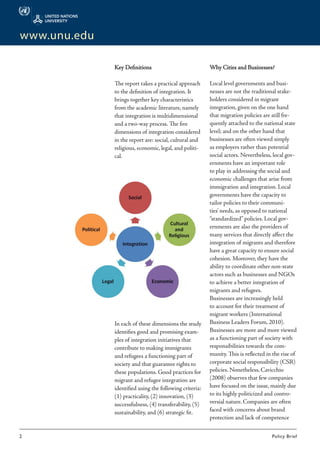
The report takes a practical approach
to the definition of integration. It
brings together key characteristics
from the academic literature, namely
that integration is multidimensional
and a two-way process. The five
dimensions of integration considered
in the report are: social, cultural and
religious, economic, legal, and politi-
cal.
In each of these dimensions the study
identifies good and promising exam-
ples of integration initiatives that
contribute to making immigrants
and refugees a functioning part of
society and that guarantee rights to
these populations. Good practices for
migrant and refugee integration are
identified using the following criteria:
(1) practicality, (2) innovation, (3)
successfulness, (4) transferability, (5)
sustainability, and (6) strategic fit.
Why Cities and Businesses?
Local level governments and busi-
nesses are not the traditional stake-
holders considered in migrant
integration, given on the one hand
that migration policies are still fre-
quently attached to the national state
level; and on the other hand that
businesses are often viewed simply
as employers rather than potential
social actors. Nevertheless, local gov-
ernments have an important role
to play in addressing the social and
economic challenges that arise from
immigration and integration. Local
governments have the capacity to
tailor policies to their communi-
ties’ needs, as opposed to national
“standardized” policies. Local gov-
ernments are also the providers of
many services that directly affect the
integration of migrants and therefore
have a great capacity to ensure social
cohesion. Moreover, they have the
ability to coordinate other non-state
actors such as businesses and NGOs
to achieve a better integration of
migrants and refugees.
Businesses are increasingly held
to account for their treatment of
migrant workers (International
Business Leaders Forum, 2010).
Businesses are more and more viewed
as a functioning part of society with
responsibilities towards the com-
munity. This is reflected in the rise of
corporate social responsibility (CSR)
policies. Nonetheless, Cavicchio
(2008) observes that few companies
have focused on the issue, mainly due
to its highly politicized and contro-
versial nature. Companies are often
faced with concerns about brand
protection and lack of competence
Migrant and Refugee Integration in Global Cities
www.merit.unu.edu
on the topic, as well as difficulty in
allocating specific funds to this issue,
among so many others of social rel-
evance (Cavicchio, 2008). Beyond
CSR however businesses have other
reasons to be interested in the inte-
gration of migrants and refugees.
Among the reasons that make migra-
tion a topic of direct interest to
businesses is the fact that diversity
can lead to a stronger workforce,
where individuals can share and
learn from each other (Koser, 2013).
Additionally, migration is believed
to enhance global competitiveness
and allows companies to address
labour shortages and specific skills
needs. Migration also represents an
expanded consumer base and often
creates new market opportunities for
businesses to thrive in (Cavicchio,
2008). According to Koser (2013),
not only are better integrated
migrants more successful due to
higher motivation and productivity,
but they also display higher loyalty
towards their employer, which results
in less turnover and absenteeism.
Furthermore, a diverse workplace has
been shown to boost competitiveness
and innovation among employees
(Koser, 2013).
Why Public-Private Partnerships?
Public-private partnerships represent
an important tool through which cit-
ies can improve migrant and refugee
integration policies. According to the
IOM (2006),“partnerships between
the private sector and governments
are instrumental in identifying chal-
lenges and solutions in the economic
and labour dimensions of migra-
tion” (p. 2). Private sector entities
may also contribute to cities through
knowledge of the local labour market,
recruitment decisions and in devis-
ing educational and vocational train-
ing policies tailored to labour market
needs (IOM, 2008). Furthermore,
businesses are important sources of
funding, and may also bring evalua-
tion and monitoring techniques from
the private to the public sector. The
contribution of businesses can allow
cities to better monitor and coordi-
nate activities for migrant and refu-
gee integration, which serve both the
interests of businesses and migrants
themselves.
Case Selection
Cities find themselves in different
stages of development and commit-
ment regarding the management of
migration. This is also reflected in the
number of stakeholders involved or
interested in migration issues, as well
as the resources a city has or is will-
ing to allocate to address such issues.
The cities selected for study repre-
sented cities with different immigra-
tion histories and policy frameworks.
They are also cities less represented
by current work examining good
practices for the integration of
migrants and refugees. Additionally,
all of the cities in this study can be
considered global cities, where the
“expansion of corporate headquarters
and international finance and related
commercial activities” (OECD, 1998,
p. 8) has led to the emergence of
numerous job opportunities in all
wage levels and a constantly changing
population (Penninx, 2005).
About the Authors
Teressa Juzwiak is a Research
Assistant at UNU-MERIT and
its School of Governance.
She has worked on several
projects, including the Evaluation
of the ILO’s Programme on
International Labour Migration,
The Hague Process on Refugees
and Migration (THP) Project on
Migrant and Refugee Integration
in Global Cities:The role of
Cities and Businesses, and is also
involved in the Migration and
Health research stream.
Elaine McGregor is a Researcher
at UNU-MERIT and its School
of Governance. Since joining the
school she has been involved in
a number of migration-related
research projects. Her main
research interest lies in the area
of migration and development,
with a focus on transnational
activities including remittances,
transnational associations and
knowledge-sharing across
borders.
Dr. Melissa Siegel works as
an Associate Professor and
Head of Migration Studies at
UNU-MERIT and its School
of Governance. She manages
several migration research
projects and coordinates the
Migration Studies Specialization
and Migration Management
Diploma Programme, while
also lecturing and supervising
students. She has worked on or
led projects for governments,
international organizations and
NGOs including the Dutch
Ministries of Finance, Foreign
Affairs and Social Affairs, the
ILO, IOM and UNHCR.
4	 Policy Brief
www.unu.edu
Key Findings
The research uncovered a number of
interesting findings linked to migrant
and refugee integration:
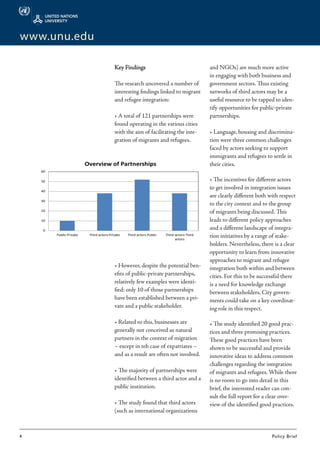
• A total of 121 partnerships were
found operating in the various cities
with the aim of facilitating the inte-
gration of migrants and refugees.
• However, despite the potential ben-
efits of public-private partnerships,
relatively few examples were identi-
fied: only 10 of those partnerships
have been established between a pri-
vate and a public stakeholder.
• Related to this, businesses are
generally not conceived as natural
partners in the context of migration
– except in teh case of expatriates –
and as a result are often not involved.
• The majority of partnerships were
identified between a third actor and a
public institution.
• The study found that third actors
(such as international organizations
and NGOs) are much more active
in engaging with both business and
government sectors. Thus existing
networks of third actors may be a
useful resource to be tapped to iden-
tify opportunities for public-private
partnerships.
• Language, housing and discrimina-
tion were three common challenges
faced by actors seeking to support
immigrants and refugees to settle in
their cities.
• The incentives for different actors
to get involved in integration issues
are clearly different both with respect
to the city context and to the group
of migrants being discussed. This
leads to different policy approaches
and a different landscape of integra-
tion initiatives by a range of stake-
holders. Nevertheless, there is a clear
opportunity to learn from innovative
approaches to migrant and refugee
integration both within and between
cities. For this to be successful there
is a need for knowledge exchange
between stakeholders. City govern-
ments could take on a key coordinat-
ing role in this respect.
• The study identified 20 good prac-
tices and three promising practices.
These good practices have been
shown to be successful and provide
innovative ideas to address common
challenges regarding the integration
of migrants and refugees. While there
is no room to go into detail in this
brief, the interested reader can con-
sult the full report for a clear over-
view of the identified good practices.
Migrant and Refugee Integration in Global Cities
www.merit.unu.edu
• The good and promising practices
identified in this study contribute to
a growing database to address inte-
gration challenges of migrants and
refugee groups. As the framework
of this study suggests, local govern-
ments, businesses and other local
stakeholders should engage in knowl-
edge-sharing not only at city level
but also between cities. Presenting
similar experiences and accomplished
solutions can help other cities tackle
their identified challenges in more
effective ways.
Recommendations
Based on the study’s findings some
clear recommendations emerge:
1. Establish networks and fora
to share experiences and identify
potential partners both within and
between cities. Rather than applying
predefined notions of what a partner-
ship looks like we should acknowl-
edge that collaborations between
different stakeholders often occur
in an ad hoc and unofficial manner;
ignoring them could undermine the
potential identification of successful
and transferable practices. Within
cities there is often a lack of under-
standing of what other key actors are
doing. By sharing this knowledge and
experience, opportunities for partner-
ships can be identified, promoting
the transfer of good practices within
and between cities.
2. Learn each other’s language: inte-
gration and migration are“loaded”
terms which vary according to the
frame of reference of each city and
stakeholder. The practical reality
uncovered here is that the portfolio
of services that businesses and cit-
ies provide to their residents and
employees often functions as inte-
gration support without specifically
being labelled as such. A reframing
of the conversation would help to
engage the relevant stakeholders. By
broadening our vocabulary we can
better communicate with each other
and identify new and improved ways
of managing issues linked to urban
development.
6	 Policy Brief
www.unu.edu
3. Acknowledge diversity while rec-
ognizing commonality: There was
clear variation in the services for dif-
ferent migrant groups (e.g. expats,
refugees) in the practices identified
by the study. For example, a highly
skilled migrant has more to gain from
improved policies for the recognition
of qualifications which can support
their labour market integration. Low
skilled migrants, however, are more
likely to be interested in legal sup-
port for cases in which passports or
wages are withheld by their employer,
particularly where their status in
the country is tied exclusively to
their employment contract.Yet most
people share common needs when
moving to a new city: regularize
their legal status, find housing, access
health care, find schools for their
children and so forth. Thus, lessons
can also be learnt by better under-
standing the range of services already
being provided within a city to iden-
tify areas where good practices could
be replicated for other groups within
the city.
Concluding Remarks
Ultimately, cities should be more
involved in the field of migrant and
refugee integration. It is in cities that
migrants carry out their daily lives
and have interactions that enable the
creation of social connections with
the community. Not only should
more cities around the world be
included in the implementation of
local level integration policies, cities
should also be actively encouraged
to seek out partnership opportuni-
ties with local businesses and to tap
the existing network of interventions
that offer good and promising ideas
for supporting migrants to succeed.
Further research currently being
carried out on this topic is already
taking into consideration the impor-
tance of city level initiatives for the
well-being of all citizens, including
migrants and refugees. Such is the
case for the IOM’s forthcoming 2015
World Migration Report and for the
Joint Migration and Development
Initiative (JMDI), both of which
aim to strengthen the contribution of
migration and development by rein-
forcing the local dimension.
“Ultimately, cities should be more involved
in the field of migrant and refugee integration...”
Migrant and Refugee Integration in Global Cities
www.merit.unu.edu
References
Cavicchio, C. (2008). Council perspectives; Immigration and corporate philanthropy. Retrieved from http://www.
conference-board.org/pdf_free/councils/ImmigrationReport.pdf
International Business Leaders Forum. (2010). Business and migration: From risk to opportunity. Retrieved from
http://c.ymcdn.com/sites/www.gbsnonline.org/resource/collection/C6833BC0-02C0-42E2-8804-5FAB1D3B217B/
BusinessAndMigration.pdf
IOM. (2006). International dialogue on migration 2006: Partnerships in migration - engaging business and civil
society (No. MC/INF/283). Retrieved from http://www.iom.int/jahia/webdav/site/myjahiasite/shared/shared/
mainsite/policy_and_research/policy_documents/MC-INF-283.pdf
IOM. (2008). Migrants and the host society: Partnerships for success (Vol. 11). Geneva: International Organization
for Migration. Retrieved from http://publications.iom.int/bookstore/free/IDM_11_EN.pdf
Koser, K. (2013).The Business Case for Migration. Retrieved January, 2014, from: http://www.gcsp.ch/Resources-
Publications/Publications/Staff-Publications/Working-Papers/The-Business-Case-for-Migration
OECD. (1998). Immigrants, Integration and Cities: Exploring the links. Retrieved from http://www.
keepeek.com/Digital-Asset-Management/oecd/social-issues-migration-health/immigrants-integration-and-
cities_9789264162952-en
Penninx, R. (2005). Integration of migrants: Economic, social, cultural and political dimensions. In The new
demographic regime: Population challenges and policy responses (pp. 137–152).
Singer, A. (2012). Migration and the Metropolis. Practice to Policy. Lessons from Local Leadership on Immigrant
Integration. Maytree Foundation., 9–10.
8	 Policy Brief
www.unu.edu
UNU-MERIT is the United Nations University - Maastricht Economic
and social Research institute on Innovation andTechnology.The institute
explores the social, political and economic factors that drive technological
innovation, with a particular focus on creation, diffusion and access to
knowledge. Following the integration of the Maastricht Graduate School
of Governance in December 2010, UNU-MERIT now covers all aspects of
governance in domestic and global organizations, from risk assessment
to policy analysis, design and evaluation. In its enlarged form UNU-MERIT
functions as a unique research and training institute for around 100
PhD fellows, and as a UN think tank addressing a broad range of policy
questions on science, innovation and democratic governance. UNU-
MERIT is located at, and works in close collaboration with,
Maastricht University in the Netherlands.
UNU—MaastrichtEconomicand
socialResearchandtraining
instituteonInnovationand
Technology
KeizerKarelplein19
6211TCMaastricht
I N S I D E :
Policy Brief
“Migrant
and Refugee
Integration in
Global Cities”
Exploring how businesses
and governments in
global cities contribute to
the integration of migrant
and refugee populations.
www.merit.unu.edu

Migrant and Refugee Integration in Global Cities: The Role of Cities and Businesses,

  • 1.
    www.merit.unu.edu Written by TeressaJuzwiak, Elaine McGregor and Melissa Siegel, UNU-MERIT. © United Nations University 2014 ISBN 978-92-808-5002-4  ISSN 1813-5706 Licensed under the Creative Commons Deed“Attribution- NonCommercial-NoDerivs 2.5” The views expressed in this publication are those of the authors and do not necessarily reflect the views of United Nations University. Migrant and Refugee Integration in Global Cities: The Role of Cities and Businesses Migration is a local reality. According to Singer (2012)“while we often think of immigrants as moving from one coun- try to another, really they arrive from a particular place and settle in a particu- lar community, usually a metropolitan area”, forming multi-ethnic communities (p9). It is primarily in cities that migrants and non-migrants interact, be it through working, studying, living, playing or raising their families. This brief provides a synopsis of a research project designed as result of a partnership between The Hague Process on Refugees and Migration (THP) and UNU-MERIT and its School of Governance. The main aim of the proj- ect was to ascertain how businesses and governments in global cities are con- tributing to the integration of migrant and refugee populations, either through outreach, specialized programmes, the provision of services, or targeted fund- ing of non-governmental organizations (NGOs); and to what extent these contributions can be deepened or expanded. The research involved the study of eight cities worldwide representing a diversity of immigration experiences: Auckland (New Zealand), Buenos Aires (Argentina), Chicago (USA), Kuala Lumpur (Malaysia), Lisbon (Portugal), Nairobi (Kenya), Rotterdam (The Netherlands), and São Paulo (Brazil). A total of 56 interviews with a broad range of stakeholders were conducted. By looking at integration from the perspective of public-private partner- ships between city level governments and businesses, this research blazes a trail and presents a number of important findings that can be of value to the policy community. number 1, 2014 Overview This policy brief considers how businesses and governments in global cities contribute to the integration of migrant and refugee populations, either through outreach, specialized programmes, the provision of services, or targeted funding of non-governmental organizations (NGOs); and to what extent these contributions can be deepened or expanded.The research involved the study of eight cities around the world representing a diversity of immigration experiences:Auckland (New Zealand), Buenos Aires (Argentina), Chicago (USA), Kuala Lumpur (Malaysia), Lisbon (Portugal), Nairobi (Kenya), Rotterdam (The Netherlands), and São Paulo (Brazil).
  • 2.
    2 Policy Brief www.unu.edu KeyDefinitions The report takes a practical approach to the definition of integration. It brings together key characteristics from the academic literature, namely that integration is multidimensional and a two-way process. The five dimensions of integration considered in the report are: social, cultural and religious, economic, legal, and politi- cal. In each of these dimensions the study identifies good and promising exam- ples of integration initiatives that contribute to making immigrants and refugees a functioning part of society and that guarantee rights to these populations. Good practices for migrant and refugee integration are identified using the following criteria: (1) practicality, (2) innovation, (3) successfulness, (4) transferability, (5) sustainability, and (6) strategic fit. Why Cities and Businesses? Local level governments and busi- nesses are not the traditional stake- holders considered in migrant integration, given on the one hand that migration policies are still fre- quently attached to the national state level; and on the other hand that businesses are often viewed simply as employers rather than potential social actors. Nevertheless, local gov- ernments have an important role to play in addressing the social and economic challenges that arise from immigration and integration. Local governments have the capacity to tailor policies to their communi- ties’ needs, as opposed to national “standardized” policies. Local gov- ernments are also the providers of many services that directly affect the integration of migrants and therefore have a great capacity to ensure social cohesion. Moreover, they have the ability to coordinate other non-state actors such as businesses and NGOs to achieve a better integration of migrants and refugees. Businesses are increasingly held to account for their treatment of migrant workers (International Business Leaders Forum, 2010). Businesses are more and more viewed as a functioning part of society with responsibilities towards the com- munity. This is reflected in the rise of corporate social responsibility (CSR) policies. Nonetheless, Cavicchio (2008) observes that few companies have focused on the issue, mainly due to its highly politicized and contro- versial nature. Companies are often faced with concerns about brand protection and lack of competence
  • 3.
    Migrant and RefugeeIntegration in Global Cities www.merit.unu.edu on the topic, as well as difficulty in allocating specific funds to this issue, among so many others of social rel- evance (Cavicchio, 2008). Beyond CSR however businesses have other reasons to be interested in the inte- gration of migrants and refugees. Among the reasons that make migra- tion a topic of direct interest to businesses is the fact that diversity can lead to a stronger workforce, where individuals can share and learn from each other (Koser, 2013). Additionally, migration is believed to enhance global competitiveness and allows companies to address labour shortages and specific skills needs. Migration also represents an expanded consumer base and often creates new market opportunities for businesses to thrive in (Cavicchio, 2008). According to Koser (2013), not only are better integrated migrants more successful due to higher motivation and productivity, but they also display higher loyalty towards their employer, which results in less turnover and absenteeism. Furthermore, a diverse workplace has been shown to boost competitiveness and innovation among employees (Koser, 2013). Why Public-Private Partnerships? Public-private partnerships represent an important tool through which cit- ies can improve migrant and refugee integration policies. According to the IOM (2006),“partnerships between the private sector and governments are instrumental in identifying chal- lenges and solutions in the economic and labour dimensions of migra- tion” (p. 2). Private sector entities may also contribute to cities through knowledge of the local labour market, recruitment decisions and in devis- ing educational and vocational train- ing policies tailored to labour market needs (IOM, 2008). Furthermore, businesses are important sources of funding, and may also bring evalua- tion and monitoring techniques from the private to the public sector. The contribution of businesses can allow cities to better monitor and coordi- nate activities for migrant and refu- gee integration, which serve both the interests of businesses and migrants themselves. Case Selection Cities find themselves in different stages of development and commit- ment regarding the management of migration. This is also reflected in the number of stakeholders involved or interested in migration issues, as well as the resources a city has or is will- ing to allocate to address such issues. The cities selected for study repre- sented cities with different immigra- tion histories and policy frameworks. They are also cities less represented by current work examining good practices for the integration of migrants and refugees. Additionally, all of the cities in this study can be considered global cities, where the “expansion of corporate headquarters and international finance and related commercial activities” (OECD, 1998, p. 8) has led to the emergence of numerous job opportunities in all wage levels and a constantly changing population (Penninx, 2005). About the Authors Teressa Juzwiak is a Research Assistant at UNU-MERIT and its School of Governance. She has worked on several projects, including the Evaluation of the ILO’s Programme on International Labour Migration, The Hague Process on Refugees and Migration (THP) Project on Migrant and Refugee Integration in Global Cities:The role of Cities and Businesses, and is also involved in the Migration and Health research stream. Elaine McGregor is a Researcher at UNU-MERIT and its School of Governance. Since joining the school she has been involved in a number of migration-related research projects. Her main research interest lies in the area of migration and development, with a focus on transnational activities including remittances, transnational associations and knowledge-sharing across borders. Dr. Melissa Siegel works as an Associate Professor and Head of Migration Studies at UNU-MERIT and its School of Governance. She manages several migration research projects and coordinates the Migration Studies Specialization and Migration Management Diploma Programme, while also lecturing and supervising students. She has worked on or led projects for governments, international organizations and NGOs including the Dutch Ministries of Finance, Foreign Affairs and Social Affairs, the ILO, IOM and UNHCR.
  • 4.
    4 Policy Brief www.unu.edu KeyFindings The research uncovered a number of interesting findings linked to migrant and refugee integration: • A total of 121 partnerships were found operating in the various cities with the aim of facilitating the inte- gration of migrants and refugees. • However, despite the potential ben- efits of public-private partnerships, relatively few examples were identi- fied: only 10 of those partnerships have been established between a pri- vate and a public stakeholder. • Related to this, businesses are generally not conceived as natural partners in the context of migration – except in teh case of expatriates – and as a result are often not involved. • The majority of partnerships were identified between a third actor and a public institution. • The study found that third actors (such as international organizations and NGOs) are much more active in engaging with both business and government sectors. Thus existing networks of third actors may be a useful resource to be tapped to iden- tify opportunities for public-private partnerships. • Language, housing and discrimina- tion were three common challenges faced by actors seeking to support immigrants and refugees to settle in their cities. • The incentives for different actors to get involved in integration issues are clearly different both with respect to the city context and to the group of migrants being discussed. This leads to different policy approaches and a different landscape of integra- tion initiatives by a range of stake- holders. Nevertheless, there is a clear opportunity to learn from innovative approaches to migrant and refugee integration both within and between cities. For this to be successful there is a need for knowledge exchange between stakeholders. City govern- ments could take on a key coordinat- ing role in this respect. • The study identified 20 good prac- tices and three promising practices. These good practices have been shown to be successful and provide innovative ideas to address common challenges regarding the integration of migrants and refugees. While there is no room to go into detail in this brief, the interested reader can con- sult the full report for a clear over- view of the identified good practices.
  • 5.
    Migrant and RefugeeIntegration in Global Cities www.merit.unu.edu • The good and promising practices identified in this study contribute to a growing database to address inte- gration challenges of migrants and refugee groups. As the framework of this study suggests, local govern- ments, businesses and other local stakeholders should engage in knowl- edge-sharing not only at city level but also between cities. Presenting similar experiences and accomplished solutions can help other cities tackle their identified challenges in more effective ways. Recommendations Based on the study’s findings some clear recommendations emerge: 1. Establish networks and fora to share experiences and identify potential partners both within and between cities. Rather than applying predefined notions of what a partner- ship looks like we should acknowl- edge that collaborations between different stakeholders often occur in an ad hoc and unofficial manner; ignoring them could undermine the potential identification of successful and transferable practices. Within cities there is often a lack of under- standing of what other key actors are doing. By sharing this knowledge and experience, opportunities for partner- ships can be identified, promoting the transfer of good practices within and between cities. 2. Learn each other’s language: inte- gration and migration are“loaded” terms which vary according to the frame of reference of each city and stakeholder. The practical reality uncovered here is that the portfolio of services that businesses and cit- ies provide to their residents and employees often functions as inte- gration support without specifically being labelled as such. A reframing of the conversation would help to engage the relevant stakeholders. By broadening our vocabulary we can better communicate with each other and identify new and improved ways of managing issues linked to urban development.
  • 6.
    6 Policy Brief www.unu.edu 3.Acknowledge diversity while rec- ognizing commonality: There was clear variation in the services for dif- ferent migrant groups (e.g. expats, refugees) in the practices identified by the study. For example, a highly skilled migrant has more to gain from improved policies for the recognition of qualifications which can support their labour market integration. Low skilled migrants, however, are more likely to be interested in legal sup- port for cases in which passports or wages are withheld by their employer, particularly where their status in the country is tied exclusively to their employment contract.Yet most people share common needs when moving to a new city: regularize their legal status, find housing, access health care, find schools for their children and so forth. Thus, lessons can also be learnt by better under- standing the range of services already being provided within a city to iden- tify areas where good practices could be replicated for other groups within the city. Concluding Remarks Ultimately, cities should be more involved in the field of migrant and refugee integration. It is in cities that migrants carry out their daily lives and have interactions that enable the creation of social connections with the community. Not only should more cities around the world be included in the implementation of local level integration policies, cities should also be actively encouraged to seek out partnership opportuni- ties with local businesses and to tap the existing network of interventions that offer good and promising ideas for supporting migrants to succeed. Further research currently being carried out on this topic is already taking into consideration the impor- tance of city level initiatives for the well-being of all citizens, including migrants and refugees. Such is the case for the IOM’s forthcoming 2015 World Migration Report and for the Joint Migration and Development Initiative (JMDI), both of which aim to strengthen the contribution of migration and development by rein- forcing the local dimension. “Ultimately, cities should be more involved in the field of migrant and refugee integration...”
  • 7.
    Migrant and RefugeeIntegration in Global Cities www.merit.unu.edu References Cavicchio, C. (2008). Council perspectives; Immigration and corporate philanthropy. Retrieved from http://www. conference-board.org/pdf_free/councils/ImmigrationReport.pdf International Business Leaders Forum. (2010). Business and migration: From risk to opportunity. Retrieved from http://c.ymcdn.com/sites/www.gbsnonline.org/resource/collection/C6833BC0-02C0-42E2-8804-5FAB1D3B217B/ BusinessAndMigration.pdf IOM. (2006). International dialogue on migration 2006: Partnerships in migration - engaging business and civil society (No. MC/INF/283). Retrieved from http://www.iom.int/jahia/webdav/site/myjahiasite/shared/shared/ mainsite/policy_and_research/policy_documents/MC-INF-283.pdf IOM. (2008). Migrants and the host society: Partnerships for success (Vol. 11). Geneva: International Organization for Migration. Retrieved from http://publications.iom.int/bookstore/free/IDM_11_EN.pdf Koser, K. (2013).The Business Case for Migration. Retrieved January, 2014, from: http://www.gcsp.ch/Resources- Publications/Publications/Staff-Publications/Working-Papers/The-Business-Case-for-Migration OECD. (1998). Immigrants, Integration and Cities: Exploring the links. Retrieved from http://www. keepeek.com/Digital-Asset-Management/oecd/social-issues-migration-health/immigrants-integration-and- cities_9789264162952-en Penninx, R. (2005). Integration of migrants: Economic, social, cultural and political dimensions. In The new demographic regime: Population challenges and policy responses (pp. 137–152). Singer, A. (2012). Migration and the Metropolis. Practice to Policy. Lessons from Local Leadership on Immigrant Integration. Maytree Foundation., 9–10.
  • 8.
    8 Policy Brief www.unu.edu UNU-MERITis the United Nations University - Maastricht Economic and social Research institute on Innovation andTechnology.The institute explores the social, political and economic factors that drive technological innovation, with a particular focus on creation, diffusion and access to knowledge. Following the integration of the Maastricht Graduate School of Governance in December 2010, UNU-MERIT now covers all aspects of governance in domestic and global organizations, from risk assessment to policy analysis, design and evaluation. In its enlarged form UNU-MERIT functions as a unique research and training institute for around 100 PhD fellows, and as a UN think tank addressing a broad range of policy questions on science, innovation and democratic governance. UNU- MERIT is located at, and works in close collaboration with, Maastricht University in the Netherlands. UNU—MaastrichtEconomicand socialResearchandtraining instituteonInnovationand Technology KeizerKarelplein19 6211TCMaastricht I N S I D E : Policy Brief “Migrant and Refugee Integration in Global Cities” Exploring how businesses and governments in global cities contribute to the integration of migrant and refugee populations. www.merit.unu.edu