The Effectiveness of Regional, National
and EU Support for Innovation
in the UK and Spain
Bettina Becker, ERC and Aston Business School
Stephen Roper, ERC and Warwick Business School
Jim Love, ERC and Warwick Business School
ERC Research Paper No. 52, 2017
• Innovation and R&D increase growth and productivity at the
firm, industry and country level (supported by large body of work)
• Social and private benefits (e.g. Mohnen, 1996; Ceh, 2009)
• Classic public goods problem means innovative firms are
unable to appropriate the full value of these benefits
• Hence market failure justification for corrective public
interventions (e.g. Arrow, 1962; Rigby & Ramlogan, 2013)
• UK: Government Green Paper on Industrial Strategy (January
2017)
Why support innovation?
• Labour market: Innovation in modern production processes
can lead to greater inequality in opportunity and earnings
(‘Second Machine Age’ by Brynjlofsson & McAfee)
• Support allocation mechanisms: Public innovation support,
especially at national level, is often awarded through
competitions
→ tends to reward the best projects and best firms
→ may increase gap in firms’ competitiveness and
productivity (OECD, 2015; Czarnitzki & Ebersberger, 2010)
• ‘Distribution sensitive innovation policies’ could include
regional support targeted at under-developed regions (Zehavi &
Breznitz, 2017)
Though is innovation necessarily ‘a good
thing’?
1. Examine simultaneously the effects of firms’ receipt of policy
support from regional, national and EU sources
2. Consider policy effects at both the extensive and intensive
margin, i.e. % of innovating firms and % of innovative sales
3. Provide insights into the innovation policy effects of two very
different innovation support regimes: UK & Spain
4. Consider sample of innovators & non-innovators, thus
avoiding selection bias; innovators-only as robustness check
Contribution
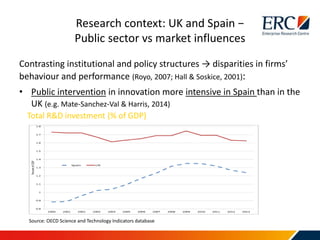
Contrasting institutional and policy structures → disparities in firms’
behaviour and performance (Royo, 2007; Hall & Soskice, 2001):
• Public intervention in innovation more intensive in Spain than in the
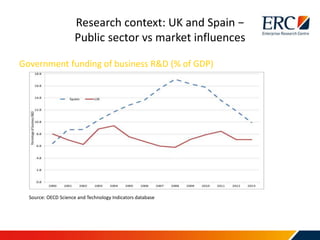
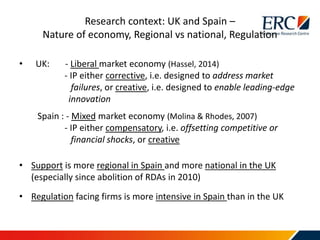
UK (e.g. Mate-Sanchez-Val & Harris, 2014)
Total R&D investment (% of GDP)
Source: OECD Science and Technology Indicators database
Research context: UK and Spain −
Public sector vs market influences
Business investment in R&D (% of GDP)
Source: OECD Science and Technology Indicators database
Research context: UK and Spain
Public sector vs market influences
Government funding of business R&D (% of GDP)
Source: OECD Science and Technology Indicators database
Research context: UK and Spain −
Public sector vs market influences
• UK: - Liberal market economy (Hassel, 2014)
- IP either corrective, i.e. designed to address market
failures, or creative, i.e. designed to enable leading-edge
innovation
Spain : - Mixed market economy (Molina & Rhodes, 2007)
- IP either compensatory, i.e. offsetting competitive or
financial shocks, or creative
• Support is more regional in Spain and more national in the UK
(especially since abolition of RDAs in 2010)
• Regulation facing firms is more intensive in Spain than in the UK
Research context: UK and Spain –
Nature of economy, Regional vs national, Regulation
• UK and Spain contributions to EU Community Innovation
Survey: UKIS and PITEC
• UKIS conducted every two years, PITEC annually, each with 3-
year reference period
• Both apply the definitions and type of questions defined in
the OECD Oslo Manual (2005)
• Sample period (panel, matching waves): 2004-2012
• Over 35,000 company returns in the UK and over 52,000 in
Spain
Data
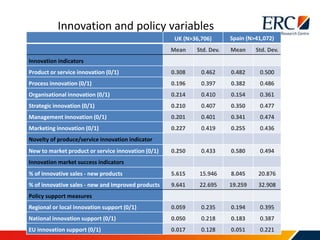
Innovation and policy variables
UK (N>36,706) Spain (N>41,072)
Mean Std. Dev. Mean Std. Dev.
Innovation indicators
Product or service innovation (0/1) 0.308 0.462 0.482 0.500
Process innovation (0/1) 0.196 0.397 0.382 0.486
Organisational innovation (0/1) 0.214 0.410 0.154 0.361
Strategic innovation (0/1) 0.210 0.407 0.350 0.477
Management innovation (0/1) 0.201 0.401 0.341 0.474
Marketing innovation (0/1) 0.227 0.419 0.255 0.436
Novelty of produce/service innovation indicator
New to market product or service innovation (0/1) 0.250 0.433 0.580 0.494
Innovation market success indicators
% of innovative sales - new products 5.615 15.946 8.045 20.876
% of innovative sales - new and improved products 9.641 22.695 19.259 32.908
Policy support measures
Regional or local innovation support (0/1) 0.059 0.235 0.194 0.395
National innovation support (0/1) 0.050 0.218 0.183 0.387
EU innovation support (0/1) 0.017 0.128 0.051 0.221
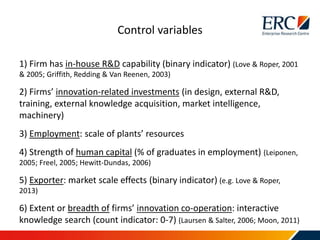
1) Firm has in-house R&D capability (binary indicator) (Love & Roper, 2001
& 2005; Griffith, Redding & Van Reenen, 2003)
2) Firms’ innovation-related investments (in design, external R&D,
training, external knowledge acquisition, market intelligence,
machinery)
3) Employment: scale of plants’ resources
4) Strength of human capital (% of graduates in employment) (Leiponen,
2005; Freel, 2005; Hewitt-Dundas, 2006)
5) Exporter: market scale effects (binary indicator) (e.g. Love & Roper,
2013)
6) Extent or breadth of firms’ innovation co-operation: interactive
knowledge search (count indicator: 0-7) (Laursen & Salter, 2006; Moon, 2011)
Control variables
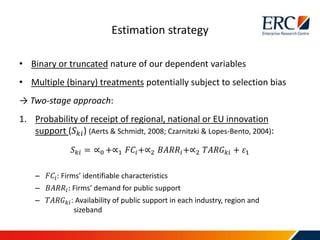
• Binary or truncated nature of our dependent variables
• Multiple (binary) treatments potentially subject to selection bias
→ Two-stage approach:
1. Probability of receipt of regional, national or EU innovation
support (𝑆 𝑘𝑖) (Aerts & Schmidt, 2008; Czarnitzki & Lopes-Bento, 2004):
𝑆 𝑘𝑖 = ∝0 +∝1 𝐹𝐶𝑖+∝2 𝐵𝐴𝑅𝑅𝑖+∝2 𝑇𝐴𝑅𝐺 𝑘𝑖 + 𝜀1
– 𝐹𝐶𝑖: Firms’ identifiable characteristics
– 𝐵𝐴𝑅𝑅𝑖: Firms’ demand for public support
– 𝑇𝐴𝑅𝐺 𝑘𝑖: Availability of public support in each industry, region and
sizeband
Estimation strategy
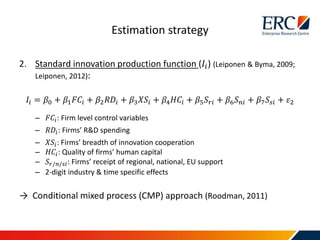
2. Standard innovation production function (𝐼𝑖) (Leiponen & Byma, 2009;
Leiponen, 2012):
𝐼𝑖 = 𝛽0 + 𝛽1 𝐹𝐶𝑖 + 𝛽2 𝑅𝐷𝑖 + 𝛽3 𝑋𝑆𝑖 + 𝛽4 𝐻𝐶𝑖 + 𝛽5 𝑆𝑟𝑖 + 𝛽6 𝑆 𝑛𝑖 + 𝛽7 𝑆𝑠𝑖 + 𝜀2
– 𝐹𝐶𝑖: Firm level control variables
– 𝑅𝐷𝑖: Firms’ R&D spending
– 𝑋𝑆𝑖: Firms’ breadth of innovation cooperation
– 𝐻𝐶𝑖: Quality of firms’ human capital
– 𝑆𝑟/𝑛/𝑠𝑖: Firms’ receipt of regional, national, EU support
– 2-digit industry & time specific effects
→ Conditional mixed process (CMP) approach (Roodman, 2011)
Estimation strategy
Notes: +/- indicate statistically significant effect, *** p<0.01, ** p<0.05, * p<0.1. Parentheses indicate effect is not
statistically significant
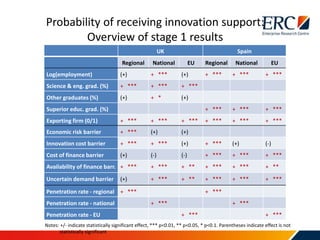
Probability of receiving innovation support:
Overview of stage 1 results
UK Spain
Regional National EU Regional National EU
Log(employment) (+) + *** (+) + *** + *** + ***
Science & eng. grad. (%) + *** + *** + ***
Other graduates (%) (+) + * (+)
Superior educ. grad. (%) + *** + *** + ***
Exporting firm (0/1) + *** + *** + *** + *** + *** + ***
Economic risk barrier + *** (+) (+)
Innovation cost barrier + *** + *** (+) + *** (+) (-)
Cost of finance barrier (+) (-) (-) + *** + *** + ***
Availability of finance barr. + *** + *** + ** + *** + *** + **
Uncertain demand barrier (+) + *** + ** + *** + *** + ***
Penetration rate - regional + *** + ***
Penetration rate - national + *** + ***
Penetration rate - EU + *** + ***
Notes: +/- indicate statistically significant effect, *** p<0.01, ** p<0.05, * p<0.1. Parentheses indicate effect is not
statistically significant
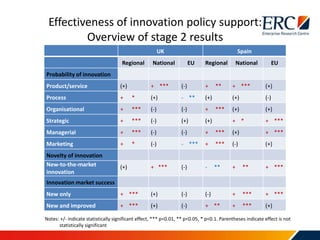
Effectiveness of innovation policy support:
Overview of stage 2 results
UK Spain
Regional National EU Regional National EU
Probability of innovation
Product/service (+) + *** (-) + ** + *** (+)
Process + * (+) - ** (+) (+) (-)
Organisational + *** (-) (-) + *** (+) (+)
Strategic + *** (-) (+) (+) + * + ***
Managerial + *** (-) (-) + *** (+) + ***
Marketing + * (-) - *** + *** (-) (+)
Novelty of innovation
New-to-the-market
innovation
(+) + *** (-) - ** + ** + ***
Innovation market success
New only + *** (+) (-) (-) + *** + ***
New and improved + *** (+) (-) + ** + *** (+)
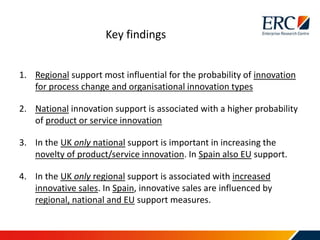
1. Regional support most influential for the probability of innovation
for process change and organisational innovation types
2. National innovation support is associated with a higher probability
of product or service innovation
3. In the UK only national support is important in increasing the
novelty of product/service innovation. In Spain also EU support.
4. In the UK only regional support is associated with increased
innovative sales. In Spain, innovative sales are influenced by
regional, national and EU support measures.
Key findings
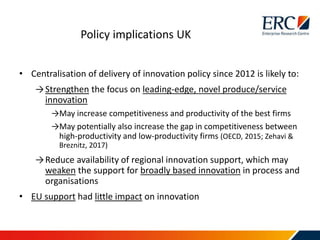
• Centralisation of delivery of innovation policy since 2012 is likely to:
→Strengthen the focus on leading-edge, novel produce/service
innovation
→May increase competitiveness and productivity of the best firms
→May potentially also increase the gap in competitiveness between
high-productivity and low-productivity firms (OECD, 2015; Zehavi &
Breznitz, 2017)
→Reduce availability of regional innovation support, which may
weaken the support for broadly based innovation in process and
organisations
• EU support had little impact on innovation
Policy implications UK
Thank you!
Work in progress: Comments welcome.
Bettina Becker, b.becker@aston.ac.uk
Stephen Roper, stephen.roper@wbs.ac.uk
Jim Love, jim.love@wbs.ac.uk
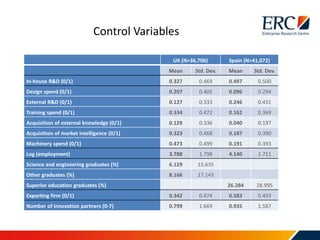
Control Variables
UK (N>36,706) Spain (N>41,072)
Mean Std. Dev. Mean Std. Dev.
In-house R&D (0/1) 0.327 0.469 0.497 0.500
Design spend (0/1) 0.207 0.405 0.096 0.294
External R&D (0/1) 0.127 0.333 0.246 0.431
Training spend (0/1) 0.334 0.472 0.162 0.369
Acquisition of external knowledge (0/1) 0.129 0.336 0.040 0.197
Acquisition of market intelligence (0/1) 0.323 0.468 0.187 0.390
Machinery spend (0/1) 0.473 0.499 0.191 0.393
Log (employment) 3.788 1.798 4.140 1.711
Science and engineering graduates (%) 6.129 15.635
Other graduates (%) 8.166 17.143
Superior education graduates (%) 26.284 28.995
Exporting firm (0/1) 0.342 0.474 0.583 0.493
Number of innovation partners (0-7) 0.799 1.669 0.935 1.587
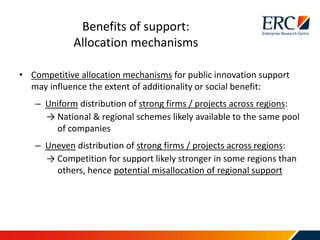
• Competitive allocation mechanisms for public innovation support
may influence the extent of additionality or social benefit:
– Uniform distribution of strong firms / projects across regions:
→ National & regional schemes likely available to the same pool
of companies
– Uneven distribution of strong firms / projects across regions:
→ Competition for support likely stronger in some regions than
others, hence potential misallocation of regional support
Benefits of support:
Allocation mechanisms
• A: Firms’ private optimum without government support
• B: Firms’ private optimum with national, region-specific, government support: GA > GB
• C: Firms’ private optimum with regional, average-level, government support: GA > G > GB
• MPB: marginal private benefit; MCC: marginal cost of capital; MSB: marginal social benefit
(Haapanaen, Lenihan & Mariani, 2014)
Benefits of support:
Equity considerations
MPBA
MSBA MCCA
MCCA
-GA
MCCA
-G
MPBB
MSBB
MCCB
MCCB
-GB
MCCB
-G
Region A: High social benefit Region B: Low social benefit
A
A
C
C
B
B
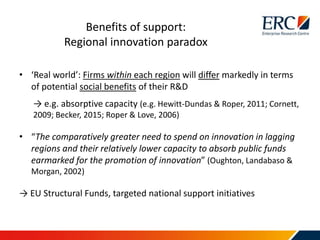
• ‘Real world’: Firms within each region will differ markedly in terms
of potential social benefits of their R&D
→ e.g. absorptive capacity (e.g. Hewitt-Dundas & Roper, 2011; Cornett,
2009; Becker, 2015; Roper & Love, 2006)
• “The comparatively greater need to spend on innovation in lagging
regions and their relatively lower capacity to absorb public funds
earmarked for the promotion of innovation” (Oughton, Landabaso &
Morgan, 2002)
→ EU Structural Funds, targeted national support initiatives
Benefits of support:
Regional innovation paradox

ERC seminar presentation. 14.02.2017. Bettina Becker

  • 1.
    The Effectiveness ofRegional, National and EU Support for Innovation in the UK and Spain Bettina Becker, ERC and Aston Business School Stephen Roper, ERC and Warwick Business School Jim Love, ERC and Warwick Business School ERC Research Paper No. 52, 2017
  • 2.
    • Innovation andR&D increase growth and productivity at the firm, industry and country level (supported by large body of work) • Social and private benefits (e.g. Mohnen, 1996; Ceh, 2009) • Classic public goods problem means innovative firms are unable to appropriate the full value of these benefits • Hence market failure justification for corrective public interventions (e.g. Arrow, 1962; Rigby & Ramlogan, 2013) • UK: Government Green Paper on Industrial Strategy (January 2017) Why support innovation?
  • 3.
    • Labour market:Innovation in modern production processes can lead to greater inequality in opportunity and earnings (‘Second Machine Age’ by Brynjlofsson & McAfee) • Support allocation mechanisms: Public innovation support, especially at national level, is often awarded through competitions → tends to reward the best projects and best firms → may increase gap in firms’ competitiveness and productivity (OECD, 2015; Czarnitzki & Ebersberger, 2010) • ‘Distribution sensitive innovation policies’ could include regional support targeted at under-developed regions (Zehavi & Breznitz, 2017) Though is innovation necessarily ‘a good thing’?
  • 4.
    1. Examine simultaneouslythe effects of firms’ receipt of policy support from regional, national and EU sources 2. Consider policy effects at both the extensive and intensive margin, i.e. % of innovating firms and % of innovative sales 3. Provide insights into the innovation policy effects of two very different innovation support regimes: UK & Spain 4. Consider sample of innovators & non-innovators, thus avoiding selection bias; innovators-only as robustness check Contribution
  • 5.
    Contrasting institutional andpolicy structures → disparities in firms’ behaviour and performance (Royo, 2007; Hall & Soskice, 2001): • Public intervention in innovation more intensive in Spain than in the UK (e.g. Mate-Sanchez-Val & Harris, 2014) Total R&D investment (% of GDP) Source: OECD Science and Technology Indicators database Research context: UK and Spain − Public sector vs market influences
  • 6.
    Business investment inR&D (% of GDP) Source: OECD Science and Technology Indicators database Research context: UK and Spain Public sector vs market influences
  • 7.
    Government funding ofbusiness R&D (% of GDP) Source: OECD Science and Technology Indicators database Research context: UK and Spain − Public sector vs market influences
  • 8.
    • UK: -Liberal market economy (Hassel, 2014) - IP either corrective, i.e. designed to address market failures, or creative, i.e. designed to enable leading-edge innovation Spain : - Mixed market economy (Molina & Rhodes, 2007) - IP either compensatory, i.e. offsetting competitive or financial shocks, or creative • Support is more regional in Spain and more national in the UK (especially since abolition of RDAs in 2010) • Regulation facing firms is more intensive in Spain than in the UK Research context: UK and Spain – Nature of economy, Regional vs national, Regulation
  • 9.
    • UK andSpain contributions to EU Community Innovation Survey: UKIS and PITEC • UKIS conducted every two years, PITEC annually, each with 3- year reference period • Both apply the definitions and type of questions defined in the OECD Oslo Manual (2005) • Sample period (panel, matching waves): 2004-2012 • Over 35,000 company returns in the UK and over 52,000 in Spain Data
  • 10.
    Innovation and policyvariables UK (N>36,706) Spain (N>41,072) Mean Std. Dev. Mean Std. Dev. Innovation indicators Product or service innovation (0/1) 0.308 0.462 0.482 0.500 Process innovation (0/1) 0.196 0.397 0.382 0.486 Organisational innovation (0/1) 0.214 0.410 0.154 0.361 Strategic innovation (0/1) 0.210 0.407 0.350 0.477 Management innovation (0/1) 0.201 0.401 0.341 0.474 Marketing innovation (0/1) 0.227 0.419 0.255 0.436 Novelty of produce/service innovation indicator New to market product or service innovation (0/1) 0.250 0.433 0.580 0.494 Innovation market success indicators % of innovative sales - new products 5.615 15.946 8.045 20.876 % of innovative sales - new and improved products 9.641 22.695 19.259 32.908 Policy support measures Regional or local innovation support (0/1) 0.059 0.235 0.194 0.395 National innovation support (0/1) 0.050 0.218 0.183 0.387 EU innovation support (0/1) 0.017 0.128 0.051 0.221
  • 11.
    1) Firm hasin-house R&D capability (binary indicator) (Love & Roper, 2001 & 2005; Griffith, Redding & Van Reenen, 2003) 2) Firms’ innovation-related investments (in design, external R&D, training, external knowledge acquisition, market intelligence, machinery) 3) Employment: scale of plants’ resources 4) Strength of human capital (% of graduates in employment) (Leiponen, 2005; Freel, 2005; Hewitt-Dundas, 2006) 5) Exporter: market scale effects (binary indicator) (e.g. Love & Roper, 2013) 6) Extent or breadth of firms’ innovation co-operation: interactive knowledge search (count indicator: 0-7) (Laursen & Salter, 2006; Moon, 2011) Control variables
  • 12.
    • Binary ortruncated nature of our dependent variables • Multiple (binary) treatments potentially subject to selection bias → Two-stage approach: 1. Probability of receipt of regional, national or EU innovation support (𝑆 𝑘𝑖) (Aerts & Schmidt, 2008; Czarnitzki & Lopes-Bento, 2004): 𝑆 𝑘𝑖 = ∝0 +∝1 𝐹𝐶𝑖+∝2 𝐵𝐴𝑅𝑅𝑖+∝2 𝑇𝐴𝑅𝐺 𝑘𝑖 + 𝜀1 – 𝐹𝐶𝑖: Firms’ identifiable characteristics – 𝐵𝐴𝑅𝑅𝑖: Firms’ demand for public support – 𝑇𝐴𝑅𝐺 𝑘𝑖: Availability of public support in each industry, region and sizeband Estimation strategy
  • 13.
    2. Standard innovationproduction function (𝐼𝑖) (Leiponen & Byma, 2009; Leiponen, 2012): 𝐼𝑖 = 𝛽0 + 𝛽1 𝐹𝐶𝑖 + 𝛽2 𝑅𝐷𝑖 + 𝛽3 𝑋𝑆𝑖 + 𝛽4 𝐻𝐶𝑖 + 𝛽5 𝑆𝑟𝑖 + 𝛽6 𝑆 𝑛𝑖 + 𝛽7 𝑆𝑠𝑖 + 𝜀2 – 𝐹𝐶𝑖: Firm level control variables – 𝑅𝐷𝑖: Firms’ R&D spending – 𝑋𝑆𝑖: Firms’ breadth of innovation cooperation – 𝐻𝐶𝑖: Quality of firms’ human capital – 𝑆𝑟/𝑛/𝑠𝑖: Firms’ receipt of regional, national, EU support – 2-digit industry & time specific effects → Conditional mixed process (CMP) approach (Roodman, 2011) Estimation strategy
  • 14.
    Notes: +/- indicatestatistically significant effect, *** p<0.01, ** p<0.05, * p<0.1. Parentheses indicate effect is not statistically significant Probability of receiving innovation support: Overview of stage 1 results UK Spain Regional National EU Regional National EU Log(employment) (+) + *** (+) + *** + *** + *** Science & eng. grad. (%) + *** + *** + *** Other graduates (%) (+) + * (+) Superior educ. grad. (%) + *** + *** + *** Exporting firm (0/1) + *** + *** + *** + *** + *** + *** Economic risk barrier + *** (+) (+) Innovation cost barrier + *** + *** (+) + *** (+) (-) Cost of finance barrier (+) (-) (-) + *** + *** + *** Availability of finance barr. + *** + *** + ** + *** + *** + ** Uncertain demand barrier (+) + *** + ** + *** + *** + *** Penetration rate - regional + *** + *** Penetration rate - national + *** + *** Penetration rate - EU + *** + ***
  • 15.
    Notes: +/- indicatestatistically significant effect, *** p<0.01, ** p<0.05, * p<0.1. Parentheses indicate effect is not statistically significant Effectiveness of innovation policy support: Overview of stage 2 results UK Spain Regional National EU Regional National EU Probability of innovation Product/service (+) + *** (-) + ** + *** (+) Process + * (+) - ** (+) (+) (-) Organisational + *** (-) (-) + *** (+) (+) Strategic + *** (-) (+) (+) + * + *** Managerial + *** (-) (-) + *** (+) + *** Marketing + * (-) - *** + *** (-) (+) Novelty of innovation New-to-the-market innovation (+) + *** (-) - ** + ** + *** Innovation market success New only + *** (+) (-) (-) + *** + *** New and improved + *** (+) (-) + ** + *** (+)
  • 16.
    1. Regional supportmost influential for the probability of innovation for process change and organisational innovation types 2. National innovation support is associated with a higher probability of product or service innovation 3. In the UK only national support is important in increasing the novelty of product/service innovation. In Spain also EU support. 4. In the UK only regional support is associated with increased innovative sales. In Spain, innovative sales are influenced by regional, national and EU support measures. Key findings
  • 17.
    • Centralisation ofdelivery of innovation policy since 2012 is likely to: →Strengthen the focus on leading-edge, novel produce/service innovation →May increase competitiveness and productivity of the best firms →May potentially also increase the gap in competitiveness between high-productivity and low-productivity firms (OECD, 2015; Zehavi & Breznitz, 2017) →Reduce availability of regional innovation support, which may weaken the support for broadly based innovation in process and organisations • EU support had little impact on innovation Policy implications UK
  • 18.
    Thank you! Work inprogress: Comments welcome. Bettina Becker, b.becker@aston.ac.uk Stephen Roper, stephen.roper@wbs.ac.uk Jim Love, jim.love@wbs.ac.uk
  • 19.
    Control Variables UK (N>36,706)Spain (N>41,072) Mean Std. Dev. Mean Std. Dev. In-house R&D (0/1) 0.327 0.469 0.497 0.500 Design spend (0/1) 0.207 0.405 0.096 0.294 External R&D (0/1) 0.127 0.333 0.246 0.431 Training spend (0/1) 0.334 0.472 0.162 0.369 Acquisition of external knowledge (0/1) 0.129 0.336 0.040 0.197 Acquisition of market intelligence (0/1) 0.323 0.468 0.187 0.390 Machinery spend (0/1) 0.473 0.499 0.191 0.393 Log (employment) 3.788 1.798 4.140 1.711 Science and engineering graduates (%) 6.129 15.635 Other graduates (%) 8.166 17.143 Superior education graduates (%) 26.284 28.995 Exporting firm (0/1) 0.342 0.474 0.583 0.493 Number of innovation partners (0-7) 0.799 1.669 0.935 1.587
  • 20.
    • Competitive allocationmechanisms for public innovation support may influence the extent of additionality or social benefit: – Uniform distribution of strong firms / projects across regions: → National & regional schemes likely available to the same pool of companies – Uneven distribution of strong firms / projects across regions: → Competition for support likely stronger in some regions than others, hence potential misallocation of regional support Benefits of support: Allocation mechanisms
  • 21.
    • A: Firms’private optimum without government support • B: Firms’ private optimum with national, region-specific, government support: GA > GB • C: Firms’ private optimum with regional, average-level, government support: GA > G > GB • MPB: marginal private benefit; MCC: marginal cost of capital; MSB: marginal social benefit (Haapanaen, Lenihan & Mariani, 2014) Benefits of support: Equity considerations MPBA MSBA MCCA MCCA -GA MCCA -G MPBB MSBB MCCB MCCB -GB MCCB -G Region A: High social benefit Region B: Low social benefit A A C C B B
  • 22.
    • ‘Real world’:Firms within each region will differ markedly in terms of potential social benefits of their R&D → e.g. absorptive capacity (e.g. Hewitt-Dundas & Roper, 2011; Cornett, 2009; Becker, 2015; Roper & Love, 2006) • “The comparatively greater need to spend on innovation in lagging regions and their relatively lower capacity to absorb public funds earmarked for the promotion of innovation” (Oughton, Landabaso & Morgan, 2002) → EU Structural Funds, targeted national support initiatives Benefits of support: Regional innovation paradox