#2014-024
Millennium Development Goals: 
Tool or token of global social governance? 
 
Mueid Al Raee, Elvis Amoateng, Elvis Korku Avenyo, Youssef Beshay,  
Mira Bierbaum, Charlotte Keijser and Rashmi Sinha 


Maastricht Economic and social Research institute on Innovation and Technology (UNU‐MERIT) 
email: info@merit.unu.edu | website: http://www.merit.unu.edu 
 
Maastricht Graduate School of Governance (MGSoG) 
email: info‐governance@maastrichtuniversity.nl | website: http://mgsog.merit.unu.edu 
 
Keizer Karelplein 19, 6211 TC Maastricht, The Netherlands 
Tel: (31) (43) 388 4400, Fax: (31) (43) 388 4499 
UNU‐MERIT Working Paper Series 
 
 
UNU-MERIT Working Papers 
ISSN 1871-9872
Maastricht Economic and social Research Institute on Innovation and Technology,
UNU-MERIT
Maastricht Graduate School of Governance
MGSoG
UNU-MERIT Working Papers intend to disseminate preliminary results of research
carried out at UNU-MERIT and MGSoG to stimulate discussion on the issues raised.


Millennium				Development				Goals					
	 	
Tool		or				Token				of				Global				Social				Governance?					


				Prepared				by					
Mueid	Al	Raee,	Elvis	Amoateng,	Elvis	Korku	Avenyo,	Youssef	Beshay,		
Mira	Bierbaum,	Charlotte	Keijser	and	Rashmi	Sinha		


Abstract	
In	this	paper	we	argue	that	the	 Millennium	Development	Goals	(MDGs)	 experience	suggests	
that	Global	Social	Governance	(GSG)	exists	and	that	the	MDGs	have	been	an	effective	tool	in	
creating	 a	 global	 accountability	 framework	 despite	 shortcomings	 mainly	 arising	 in	 the	
formulation	process.	The	paper	first	discusses	the	historical	emergence	of	the	MDGs,	leading	to	
questions	 of	 ownership	 and	 responsibilities	 of	 developing	 and	 developed	 countries	
respectively.	Subsequently,	we	assess	whether	the	MDGs	comprehensively	reflect	development	
concepts	and	address	the	question	whether	the	MDGs	had	an	impact	on	national	policies,	and	
ultimately	 on	 people’s	 lives.	 Eventually,	 these	 questions	 and	 their	 answers	 are	 intended	 to	
stimulate	 and	 inform	 discussions	 on	 the	 post‐2015	 development	 agenda	 as	 a	 –	 potentially	
improved	–	GSG	tool.	
JEL‐Classification:	F53,	I38	
Keywords:	Millennium	Development	Goals,	Global	Social	Governance,	post‐2015	development	
agenda
  1
Introduction
As the year 2015 approaches and the international community deliberates the post-2015 development
agenda, the need to evaluate the impact of the Millennium Development Goals (MDGs)1 on social
policies and the lives of people comes to the forefront. According to Ban Ki-Moon, the United Nations
(UN) Secretary-General, “the Millennium Development Goals (MDGs) have been the most successful
global anti-poverty push in history” (UN, 2013b, p. 3). The idea to end human deprivation in modern
times traces back at least to Roosevelt’s ‘Four Freedoms Speech’ in 1941 and the Universal Declaration
of Human Rights in 1948 (Hulme, 2009, pp. 7-8). The MDG experience has been remarkable in
directing the international community towards embracing concrete social development objectives in the
form of goals, targets, and indicators. At the same time, the world today is still marked by egregious
social and economic inequities. Thus, should we conclude that the MDG experience is an indicator that
Global Social Governance (GSG) fails or exists, and if so, that it is effective?
Conceptually one can think of governance in a three-dimensional way: It includes the private
sector and civil society as actors beyond the state; encompasses the three legs of economic, political, and
administrative decision-making; and takes place at the sub-national, national, and global level (cf.
UNDP, 1997). In this paper, we focus on the latter level and refer to Global Governance as “the sum of
laws, norms, policies, and institutions that define, constitute, and mediate trans-border relations
between states, cultures, citizens, intergovernmental and nongovernmental organizations, and the
market” (Weiss, 2009, pp. 1-2). Global Social Governance (GSG), in turn, concerns Global Governance
in the social sphere, including social protection, education, health, and habitat (Deacon, Ollila,
Koivusalo, & Stubbs, 2003, p. 15).
The importance of GSG stems from the fact that not only economies have become increasingly
interdependent, but, as a result, also social policy issues have been subject to globalization (Deacon et
al., 2003). Consequently, nation states alone are constrained in their efforts to deliver on the social rights
stipulated by the Universal Declaration of Human Rights and need to be backed up by a system of
GSG. This relates to the notion of commons defined as the “vast range of resources that people
collectively own, but which are rapidly being enclosed: privatized, traded in the market, and abused”
(Bollier, 2002; as cited in Blin & Marín, 2012, p. 7). If one acknowledges that globalization has created a
gap that neither the nation state nor the global market have the power to close, than we need to find
new modes of governance around the commons to fill in this void (cf. Blin & Marín, 2012, p. 17).
In this paper we argue that the MDG experience suggests that GSG indeed exists and that the
MDGs have been an effective tool in creating a global accountability framework despite shortcomings
mainly arising in the formulation process. The paper first discusses the historical emergence of the
MDGs, leading to questions of ownership and responsibilities of developing and developed countries
respectively. The second section assesses whether the MDGs comprehensively reflect development
concepts. Subsequently, the question whether the MDGs had an impact on national policies, and
ultimately on people’s lives, is addressed in section three. The conclusion revisits the question of
whether the MDGs are a tool of effective GSG, or whether they are solely a token, rather indicating
that GSG does not exist or is ineffective. Eventually, these questions and their answers are intended to
stimulate and inform discussions on the post-2015 development agenda as a – potentially improved –
GSG tool.


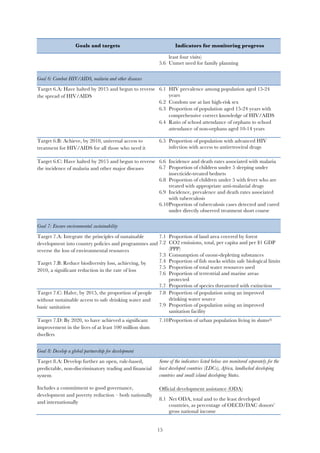
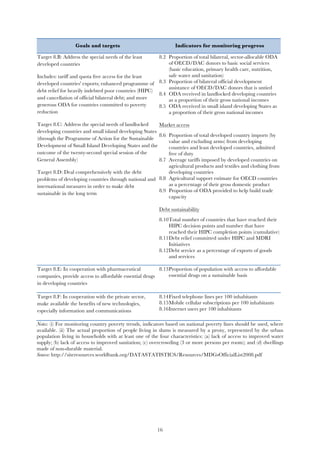
1 Table A 1 in the appendix lists the eight MDGs and the respective targets and indicators.
  2
Section 1: The emergence of the world’s largest promise
The MDGs are referred to as the world’s largest promise – an agreement and roadmap towards poverty
reduction and social development through international cooperation (Hulme, 2009, p. 4). The process
of their emergence, though, raises a number of issues regarding their appropriateness and inclusiveness,
culminating in questions of ownership of these goals and the responsibilities to deliver upon them. This
section therefore contextualizes the process of the formulation of MDGs that has recurrently been
described as a complex, incremental and fuzzy development (cf. Bradford, 2002; Bradford, 2006;
Hulme, 2009).
The 1980s have been considered a lost decade of development. The UN lost part of their
influence vis-à-vis the World Bank (WB) and the International Monetary Fund (IMF) that imposed
Structural Adjustment Policies (SAP) on many developing countries that needed their assistance to cope
with deficits and debts (Hulme, 2009, p. 8; Jolly, 2010, pp. 4-5). Yet, the floor opened up again for the
UN when the failure of SAPs became increasingly apparent at the end of the 1980s (Hulme, 2009, p. 8).
The 1990s turned into a decade that brought a more comprehensive view on human wellbeing back
onto the global development agenda. The WB’s 1990 World Development Report and the UNDP’s
1990 Human Development Report emphasized that economic growth was not an end in itself, but a
means to improve people’s lives. Moreover, a series of UN summits and conferences paved the way for
the MDGs. Most notably, these include the World Summit for Children in 1990, the World Summit on
Social Development in 1995, and Habitat II in 1996 (Hulme, 2009, pp. 8-9).
The commitments made by political leaders at these summits stood in stark contrast to decreasing
aid budgets around the world that became especially problematic for the Development Assistance
Committee (DAC) of the Organisation for Economic Cooperation and Development (OECD) in the
mid 1990s. In an endeavor to set a new vision for global development aid and to mobilize public and
political support, the DAC published the 1996 Report Shaping the 21st Century: Contribution of Development
Cooperation. The document contained a list of International Development Goals (IDGs) that were largely
drawn from declarations at UN summits and approved by all OECD member countries. Hence, the
idea was born that “an authoritative list of concrete development goals could be drawn up and used as a
mechanism to rapidly reduce global poverty” (Hulme, 2009, p. 21). While the IDGs’ practical relevance
remained relatively limited at first, they gained momentum as political leaders in ministries in the
United Kingdom, the Netherlands, Norway, and Germany picked them up as a device for focusing
development efforts (Hulme, 2009, pp. 21-25).
In parallel, in 1998 the UN started to plan for the UN Millennium Assembly that would be held
in 2000. In an exercise very similar to the OECD, the UN launched the 2000 Report We the Peoples: The
Role of the United Nations in the 21st Century. The report was equally based on UN conference and summit
declarations and supposed to lead towards the Millennium Declaration. The list of included goals,
however, differed from the IDGs. Particularly gender equality and women’s empowerment,
reproductive health and health issues did not prominently appear in the report, for political reasons.
Economic growth, technology, goals for rich countries and a focus on Africa were topics that did not
appear on the IDGs list. Following intense negotiations over the summer, the Millennium Declaration
was approved on September 8, 2000 (Hulme, 2009, pp. 33-36).
In the same year, the IMF, OECD, UN, and WB also jointly published the Report A Better World
For All that basically reiterated the IDGs. The co-occurrence of the Millennium Declaration and this
  3
report exemplifies that there had been a twin track process going on in which both the OECD and the
UN were working on competing sets of goals (Hulme, 2009, pp. 31-33). As proceeding further with
these two separate tracks risked confusion that could result in chaos and loss of credibility among
political leaders, donors, and the public, action was required. Eventually, a decision was reached to
reconcile the IDGs and the Millennium Declaration Goals into what would become known as the
MDGs, delegating this assignment to a task force with members from the DAC, WB, IMF, and UNDP.
Importantly, Hulme (2009) stressed that what was presented as a solely technical exercise was once
again heavily guided by political deliberations (p. 40). Furthermore, based on a comparison of the IDGs
and the Millennium Declaration, he concluded that the MDGs were based on the IDGs. It was finally
in September 2001 that Kofi Annan reported to the UN General Assembly that the MDGs had been
specified, so that they were finally ready to be implemented (Hulme, 2009, p. 42).
The process of the emergence of the MDGs sheds a critical light on the issue of ownership of
these goals. Hulme’s conclusion that the MDGs were based on the IDGs is in line with Bradford’s
(2006) argument that the goals were set by developed for developing countries. What initially started as
goals for development aid by the Club of the Rich turned into goals for development for the Club of All,
finally mainly worked out by bureaucrats as a Club of the Few. That transformation, however, was not
sufficiently accompanied by an open debate and involvement of those countries to which these goals
would finally apply. Authors including Bissio (2003, p. 157), Fukuda-Parr and Hulme (2009, p. 18), and
Nelson (2007, p. 2046) criticized the MDGs for being weak on donor accountability and excluding
systemic issues of global governance. Notably, only goal 8 of the MDGs refers to the responsibilities of
developed countries, and it is also exactly this goal for which no time-bound targets are set (Hulme,
2009, p. 41). The question of ownership therefore directly leads to considerations of responsibilities and
highlights the striking imbalance between the obligations that arise for developing and developed
countries respectively. Consequently, the answer to the question of whose goals the MDGs are
comprises two aspects, namely that they are goals of developed countries for developing countries.
Section 2: Concepts of development and the comprehensiveness of MDGs
After briefly tracing the process of the emergence of the MDGs, this section aims to assess the
comprehensiveness of the final list of MDGs and the extent to which they reflect benchmark notions of
development. The concept of development has evolved over time and has been subject to ongoing
discussions about what constitutes development, adequate measurement, and how it should be achieved
(cf. Laderchi, Saith, & Stewart, 2003). For the present purpose, the concept of Human Development
(HD) as discussed in the UNDP’s 1990 Human Development Report is used as a benchmark.
Compared to traditional, growth-based understandings of development, HD extends beyond monetary
aspects and stresses that development entails a process of enlarging people's choices. According to
UNDP (1990):
“Human Development is a process of enlarging people’s choices…the three essential ones are for people to
lead a long and healthy life, to acquire knowledge and to have access to resources needed for a decent
standard of living…Additional choices…range from political, economic and social freedom to
opportunities for being creative and productive, and enjoying personal self-respect and guaranteed human
rights” (UNDP, 1990, p. 10).
  4
While this definition recognizes the importance of “society's human freedom in the pursuit of material
and social goals” (UNDP, 1990, p. 16), adding a procedural component, it is notable that these
dimensions are referred to as additional choices on top of the most critical dimensions. Moreover, the
importance of sustainability and environmental protection for development are not specifically reflected
in this definition, though reference to these topics is made in the report.
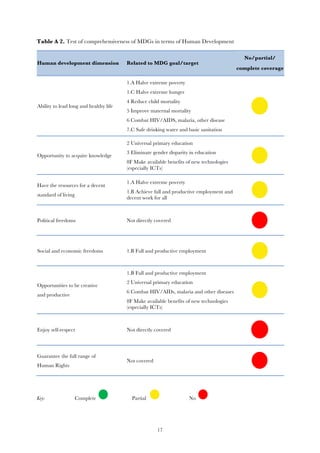
In order to assess the comprehensiveness of the MDGs in terms of HD, we matched goals and
indicators of the MDGs and the dimensions of HD (see Table A 2 in the appendix). Clearly, many of
the indicators relate to more than one dimension of HD, highlighting their strong interconnectedness.
The purpose of this matching exercise was to establish whether the different dimensions of HD are
‘completely’, ‘partially’, or not at all covered by the MDGs. For instance, the ability to lead a long and
healthy life is addressed by the MDGs that refer to reducing extreme poverty and hunger, reducing
child mortality and improving maternal mortality, combating diseases, and providing safe drinking
water and basic sanitation. The MDG coverage of this dimension has been assessed as ‘partial’ because
‘complete’ coverage would arguably require universal access to basic health care. This test of
comprehensiveness yields three major results. First, none of the dimensions of HD is completely covered
by the MDGs. Second, the MDGs reflect, to a large extent, the dimensions of HD that are defined as
the ‘critical’ ones by the UNDP as opposed to the ‘additional’ ones. Third, the MDGs do not address
the dimensions of Human Rights (HR) and political freedoms.
Evidently, the MDGs are not a comprehensive reflection of a notion of HD; and an
understanding of why some goals are included – and others are not – requires a historical approach as
presented by Hulme (2009) and described in the previous section. Before turning to the discussion on
whether comprehensiveness can be our aim, two further observations emerge. Except for input-based
targets on a global development partnership, all MDGs refer to outcomes. Any reference to HR or
political freedoms that could guide the process towards achievements is omitted. This directly leads to
the second observation that the MDGs address symptoms rather than causes. In line with Nelson’s
(2007) argument, MDGs could be considered a “quick impact versus root causes” (p. 2046) approach to
development, reflecting mainly symptoms of poverty rather than strategies that expand individual
opportunities and address the multiple causes of poverty.
The finding that the MDGs only partially reflect the notion of HD warrants a more nuanced
reflection. To do some justice to the MDGs and the process of how they emerged, it would be
impossible to find universally agreed upon conceptual or even philosophical approach to development
among the actors involved. The challenge therefore is to find a common denominator to which
governments, that are themselves constrained in their decision-making, can agree. Thus,
comprehensiveness is not a realistic goal neither looking back to assessing the MDGs nor moving ahead
towards the post-2015 agenda. What the post-2015 should strive for is consistency and coherence within
the agreed upon common denominator. The MDG framework can be criticized precisely for lacking
alignment between goals, targets and indicators and for inconsistencies in the way the goals were
defined (UN, 2013a, p. 3).
As mentioned above, notions of development have been constantly evolving. With the multiple
and interconnected crises the world is facing today – be it food, energy, climate, or jobs and
employment– the notion of Sustainable Development (SD) has gained force. This is reflected in the
increased awareness for environmental objectives along-side poverty-reduction goals (Sachs, 2012, p.
2206). More attention is being paid to the various inter-linkages between social, economic, and
  5
environmental dimensions (UN System Task Team on the Post-2015 Development Agenda, 2012, p.
10) and the “triple bottom line”2 (Sachs, 2012, p. 2206). The basic idea of SD is to embrace this triple
bottom line, while at the same time balancing interests in an equitable manner across space and time,
i.e. within and across generations (Sachs, 2012; Soubbotina, 2004; UN System Task Team on the Post-
2015 Development Agenda, 2012).
This conceptual shift of development has implications for the post-2015 development agenda. In
fact, following the RIO+ Summit in 2012, UN Secretary-General Ban Ki-Moon issued a report
recommending that the next round of global goals should contain a set of Sustainable Development
Goals (SDGs) (Sachs, 2012, p. 2206). On the one hand, the inclusion of sustainability would change the
distribution of responsibilities. As discussed in the previous chapter, the MDGs are mainly development
goals for less developed countries, whereas the SDGs would not let the advanced countries off the hook
anymore (Sachs, 2012, p. 2208). The notion of SD could thus change the debate of whose goals these
are, and for whom they are, and potentially make new development goals truly global objectives. On
the other hand, however, references to HR and social, economic and political freedoms seem to have
gotten lost with the shift from HD to SD. Consequently, exactly those dimensions of HD that could
guide the process of achieving goals are no longer explicitly acknowledged in the concept of SD. This
also relates to an apparent dissonance between lessons learnt from the MDGs formulation process and
current international goal setting; for instance giving more voice to those whose stakes are discussed,
while not incorporating those voice in overall notions of development and the list of goals.
Therefore, if we are concerned not only about outcomes, but also about how these outcomes are
achieved, the negligence or even loss of this dimension is worrying. Yet, this does not necessarily need to
be the case. First, Anand and Sen (2000) argue in favor of Sustainable Human Development, as there is,
“in principle, no basic difficulty in broadening the concept of human development to accommodate the
claims of future generations and the urgency of environmental protection” (p. 2030). Sachs (2012), in
turn, claims that the triple bottom line needs to be enriched by a fourth SDG, namely good governance.
According to Sachs, good governance (including commitment to the rule of law, HR, transparency,
inclusion and trust) will be needed in order to truly achieve the goals of social inclusion, economic
development, and environmental sustainability (Sachs, 2012, pp. 2208-2210). Overall, both approaches
would ensure that the concept of SD would include procedural aspects that could guide the
achievement of SDGs.
Section 3: The social policy and development impact of MDGs – Did they change people’s lives?
Moving on from concepts of development and the comprehensiveness of MDGs, the question arises
whether MDGs had an impact on social policies at the global and national level, and, ultimately, on
peoples’ lives. The answers to these questions are non-trivial as virtually all countries in the world
embraced the MDGs. As a consequence, we lack a true counterfactual for comparison purposes, that
is, a world without MDGs. This fact, in addition to limitations arising from lack of data availability and
quality, greatly complicates the establishment of a causal link between MDGs and observed policies and


2 The triple bottom line approach to human well-being refers to the “aim for a combination of economic
development, environmental sustainability, and social inclusion” (Sachs, 2012, p. 2206). The specific balance
that is sought may differ within and across societies.
  6
development outcomes. The evaluation of MDGs, as distinct from monitoring progress towards MDGs,
is therefore a complex and to date, a rarely undertaken exercise (see Box 1). All discussions in this
section are therefore carefully presented in order not to infer causation from correlation.
To determine the impact of MDGs on social policies at the global level, Official Development
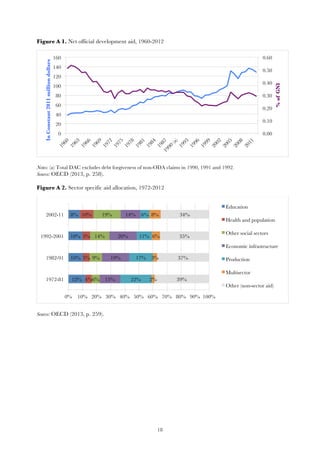
Assistance (ODA) is used as a proxy. A time series representation of ODA from 1960 to 2012 tells two
stories. On the one hand, net ODA in constant 2011 prices rose from US$ 84 billion in 2000 to US$
129 billion in 2012 (see Figure A 1 in the appendix). This positive trend could possibly indicate a
boosting influence of the MDGs. On the other hand, ODA as a percentage of Gross National Income
(GNI) increased from 0.22 percent in 2000 to 0.32 percent in 2010, and has since then fallen to 0.29
percent in 2012. This marginal increase falls far short of the targets envisioned at the Monterrey
conference on financing development in 2002 that urged countries to direct 0.7 percent of their Gross
National Product to developing countries in the form of ODA (UN, 2002, p. 14). In terms of trends in
sector-specific aid, aid allocation towards health and population doubled between 1992-2001 and 2002-
2011 from 5 to 10 percent, and increased over the same period from 14 to 19 percent for other social
sectors (excluding education that slightly lost in relative terms from 10 to 8 percent) (see Figure A 2 in
the appendix). Taken together with respective losses in economic infrastructure (20 to 14 percent) and
production (11 to 6 percent), these trends may reflect some level of commitment of international donor
agencies and high-income countries to finance the achievement of MDGs.
In order to examine the policy and development impact at the national level, three country cases
are considered that contrast the MDG experience of Brazil and South Africa as two non-aid-dependent
countries and of Ghana as a heavily aid-dependent country. In doing so, references in national policy
documents to MDGs as well as public expenditure trends and changes in sectoral policies before and
after the introduction of the MDGs are taken into account.
Box 1. Did the MDGs change development impacts?
In the paper – “Causal Inference and the Millennium Development Goals (MDGs): Assessing Whether There
Was an Acceleration in MDG Development Indicators Following the MDG Declaration”, Friedman (2013)
addressed this question by checking for statistically significant interruptions in the trends of indicators that
were followed over time. He then identified if any trends accelerated or decelerated before or after the
declaration of MDGs in September 2000. Friedman found no statistically significant accelerations in MDG
indicators after 2000. About half of the MDG indicators studied did not exhibit any acceleration or
deceleration, and about one-third had accelerated before 2001.
The methodology used by Friedman, however, does not allow analysis of the counterfactual of lack
of downward trends in the indicators as a result of the MDGs. It is furthermore important to consider
whether the same methodology is suitable for each goal. For example, progress in reducing child mortality
rates follows a hyperbolic curve and improvements in child mortality becomes more expensive and harder to
achieve, the further a country progresses. Consequently, even maintaining child mortality rates at a steady
level may have significant value. There were also issues with regard to indicator selection; out of 44 indicators
only 19 matched the inclusion criteria for this study. As a result, some of the most important indicators, such as
poverty reduction and primary education, were not analyzed.
As Friedman acknowledges, further value could be added by decomposing the results by regions. Analysis
could also be extended and improved by decomposing by initial levels of development (that is, separating and
studying late achievers in the MDGs context). This is inspired by the idea that the MDGs themselves did not
emerge because some countries were achieving, but because some countries were not achieving.
	
  
  7
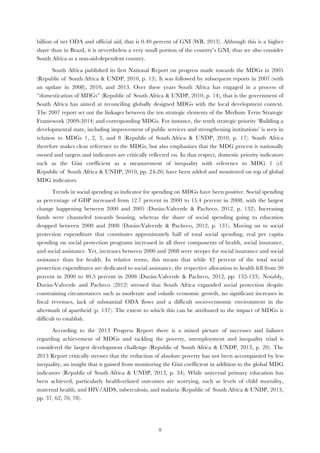
Case I: Brazil
Brazil is an upper-middle income country with a GNI per capita of US$ 11,630 (Atlas method, in
current prices) and a population of 198.7 million people in 2012 (WB, 2013). As net ODA and official
aid received was US$ 0.83 billion in 2011, amounting to merely 0.04 percent of GNI (WB, 2013), we
refer to it as a non-aid-dependent country.
Brazil has been collecting systematic information on the achievement of MDGs since 2004 when
the first of a series of National Monitoring Reports on the MDGs was published. From 2007 onwards
these reports list the main federal government initiatives that contribute to achieving the respective
goals (cf. for example Presidency of the Republic, 2007). It is therefore possible to link national policies
that are related to achieving MDGs and identify potential gaps. The famous Bolsa Família program is
supposed to contribute to halving extreme poverty and hunger (MDG 1) and the Unified Health System
(SUS) is listed in relation to reducing child mortality (MDG 4) (Presidency of the Republic, 2007, pp.
36, 74). The 2007 Report makes very clear reference to the achievement of MDGs as justification for
huge investments in basic sanitation (nearly US$ 21 billion) and slum upgrading (approximately US$ 56
billion) within the Growth Acceleration Program (Presidency of the Republic, 2007, p. 9). Overall,
Brazil has clearly undertaken efforts to benchmark their development programs and initiatives against
the MDGs.
Another way of looking at possible impacts of MDGs on national policies is to consider social
spending as an indication for spending on MDGs. Between 2000 and 2008 social spending as a
percentage of GDP increased considerably from 21.1 to 26.1 percent (Durán-Valverde & Pacheco,
2012, p. 58). Major investments were made in the health sector where the SUS has been continuously
expanded in terms of coverage and spending. Real per capita expenditure (in 1998 prices) increased
from 230.2 R$ in 2000 to 366.6 R$ in 2008 (Durán-Valverde & Pacheco, 2012, p. 61). A further
observation in this respect is the launch and subsequent expansion of the Bolsa Família program, a
conditional cash transfer (CCT) program targeted at poor families, that tripled its coverage from 3.6 to
10.5 million families between 2003 and 2008. Between 2005 and 2008 alone expenditure on CCTs
doubled (Durán-Valverde & Pacheco, 2012, p. 62). While it is clearly not possible to establish any
causality, these positive developments in social spending followed chronologically after the launch of the
MDGs.
What were the development outcomes in Brazil? In 2010, the country reported that it had
achieved halving extreme poverty and hunger (MDG 1), made fast progress towards reducing child
mortality (MDG 4) and improving maternal health (MDG 5), and slowly progressed towards achieving
the remaining goals (UNDP, 2011). In particularly with regard to MDG 1 Brazil was well ahead of
schedule and has since then striven for achieving stricter poverty reduction targets (Paes de Sousa
(2010); as referred to in Durán-Valverde & Pacheco, 2012, p. 71). Although a clear-cut attribution of
these improvements to MDGs is not possible, the lives of many people have certainly changed since the
MDGs were adopted.
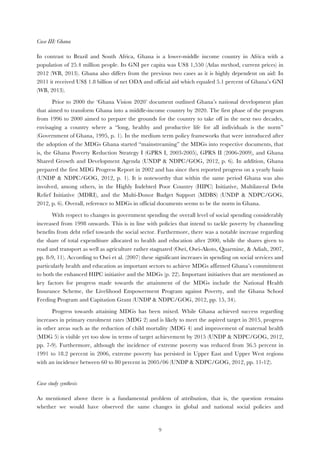
Case II: South Africa
With a GNI per capita of US$ 7,610 (Atlas method, current prices) in 2012 South Africa is an upper-
middle income country populated by 51.2 million people (WB, 2013). In 2011 it received US$ 1.4
  8
billion of net ODA and official aid, that is 0.40 percent of GNI (WB, 2013). Although this is a higher
share than in Brazil, it is nevertheless a very small portion of the country’s GNI; thus we also consider
South Africa as a non-aid-dependent country.
South Africa published its first National Report on progress made towards the MDGs in 2005
(Republic of South Africa & UNDP, 2010, p. 13). It was followed by subsequent reports in 2007 (with
an update in 2008), 2010, and 2013. Over these years South Africa has engaged in a process of
“domestication of MDGs” (Republic of South Africa & UNDP, 2010, p. 14), that is the government of
South Africa has aimed at reconciling globally designed MDGs with the local development context.
The 2007 report set out the linkages between the ten strategic elements of the Medium Term Strategic
Framework (2009-2014) and corresponding MDGs. For instance, the tenth strategic priority ‘Building a
developmental state, including improvement of public services and strengthening institutions’ is seen in
relation to MDGs 1, 2, 3, and 8 (Republic of South Africa & UNDP, 2010, p. 17). South Africa
therefore makes clear reference to the MDGs, but also emphasizes that the MDG process is nationally
owned and targets and indicators are critically reflected on. In that respect, domestic priority indicators
such as the Gini coefficient as a measurement of inequality with reference to MDG 1 (cf.
Republic of South Africa & UNDP, 2010, pp. 24-26) have been added and monitored on top of global
MDG indicators.
Trends in social spending as indicator for spending on MDGs have been positive. Social spending
as percentage of GDP increased from 12.7 percent in 2000 to 15.4 percent in 2008, with the largest
change happening between 2000 and 2005 (Durán-Valverde & Pacheco, 2012, p. 132). Increasing
funds were channeled towards housing, whereas the share of social spending going to education
dropped between 2000 and 2008 (Durán-Valverde & Pacheco, 2012, p. 131). Moving on to social
protection expenditure that constitutes approximately half of total social spending, real per capita
spending on social protection programs increased in all three components of health, social insurance,
and social assistance. Yet, increases between 2000 and 2008 were steeper for social insurance and social
assistance than for health. In relative terms, this means that while 42 percent of the total social
protection expenditures are dedicated to social assistance, the respective allocation to health fell from 50
percent in 2000 to 40.5 percent in 2008 (Durán-Valverde & Pacheco, 2012, pp. 132-133). Notably,
Durán-Valverde and Pacheco (2012) stressed that South Africa expanded social protection despite
constraining circumstances such as moderate and volatile economic growth, no significant increases in
fiscal revenues, lack of substantial ODA flows and a difficult socio-economic environment in the
aftermath of apartheid (p. 137). The extent to which this can be attributed to the impact of MDGs is
difficult to establish.
According to the 2013 Progress Report there is a mixed picture of successes and failures
regarding achievement of MDGs and tackling the poverty, unemployment and inequality triad is
considered the largest development challenge (Republic of South Africa & UNDP, 2013, p. 20). The
2013 Report critically stresses that the reduction of absolute poverty has not been accompanied by less
inequality, an insight that is gained from monitoring the Gini coefficient in addition to the global MDG
indicators (Republic of South Africa & UNDP, 2013, p. 34). While universal primary education has
been achieved, particularly health-related outcomes are worrying, such as levels of child mortality,
maternal health, and HIV/AIDS, tuberculosis, and malaria (Republic of South Africa & UNDP, 2013,
pp. 37, 62, 70, 78).
  9
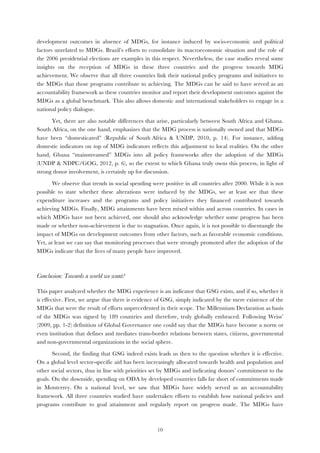
Case III: Ghana
In contrast to Brazil and South Africa, Ghana is a lower-middle income country in Africa with a
population of 25.4 million people. Its GNI per capita was US$ 1,550 (Atlas method, current prices) in
2012 (WB, 2013). Ghana also differs from the previous two cases as it is highly dependent on aid: In
2011 it received US$ 1.8 billion of net ODA and official aid which equaled 5.1 percent of Ghana’s GNI
(WB, 2013).
Prior to 2000 the ‘Ghana Vision 2020’ document outlined Ghana’s national development plan
that aimed to transform Ghana into a middle-income country by 2020. The first phase of the program
from 1996 to 2000 aimed to prepare the grounds for the country to take off in the next two decades,
envisaging a country where a “long, healthy and productive life for all individuals is the norm”
(Government of Ghana, 1995, p. 1). In the medium term policy frameworks that were introduced after
the adoption of the MDGs Ghana started “mainstreaming” the MDGs into respective documents, that
is, the Ghana Poverty Reduction Strategy I (GPRS I, 2003-2005), GPRS II (2006-2009), and Ghana
Shared Growth and Development Agenda (UNDP & NDPC/GOG, 2012, p. 6). In addition, Ghana
prepared the first MDG Progress Report in 2002 and has since then reported progress on a yearly basis
(UNDP & NDPC/GOG, 2012, p. 1). It is noteworthy that within the same period Ghana was also
involved, among others, in the Highly Indebted Poor Country (HIPC) Initiative, Multilateral Debt
Relief Initiative (MDRI), and the Multi-Donor Budget Support (MDBS) (UNDP & NDPC/GOG,
2012, p. 6). Overall, reference to MDGs in official documents seems to be the norm in Ghana.
With respect to changes in government spending the overall level of social spending considerably
increased from 1998 onwards. This is in line with policies that intend to tackle poverty by channeling
benefits from debt relief towards the social sector. Furthermore, there was a notable increase regarding
the share of total expenditure allocated to health and education after 2000, while the shares given to
road and transport as well as agriculture rather stagnated (Osei, Osei-Akoto, Quarmine, & Adiah, 2007,
pp. 8-9, 11). According to Osei et al. (2007) these significant increases in spending on social services and
particularly health and education as important sectors to achieve MDGs affirmed Ghana’s commitment
to both the enhanced HIPC initiative and the MDGs (p. 22). Important initiatives that are mentioned as
key factors for progress made towards the attainment of the MDGs include the National Health
Insurance Scheme, the Livelihood Empowerment Program against Poverty, and the Ghana School
Feeding Program and Capitation Grant (UNDP & NDPC/GOG, 2012, pp. 15, 34).
Progress towards attaining MDGs has been mixed. While Ghana achieved success regarding
increases in primary enrolment rates (MDG 2) and is likely to meet the aspired target in 2015, progress
in other areas such as the reduction of child mortality (MDG 4) and improvement of maternal health
(MDG 5) is visible yet too slow in terms of target achievement by 2015 (UNDP & NDPC/GOG, 2012,
pp. 7-9). Furthermore, although the incidence of extreme poverty was reduced from 36.5 percent in
1991 to 18.2 percent in 2006, extreme poverty has persisted in Upper East and Upper West regions
with an incidence between 60 to 80 percent in 2005/06 (UNDP & NDPC/GOG, 2012, pp. 11-12).
Case study synthesis
As mentioned above there is a fundamental problem of attribution, that is, the question remains
whether we would have observed the same changes in global and national social policies and
  10
development outcomes in absence of MDGs, for instance induced by socio-economic and political
factors unrelated to MDGs. Brazil’s efforts to consolidate its macroeconomic situation and the role of
the 2006 presidential elections are examples in this respect. Nevertheless, the case studies reveal some
insights on the reception of MDGs in these three countries and the progress towards MDG
achievement. We observe that all three countries link their national policy programs and initiatives to
the MDGs that those programs contribute to achieving. The MDGs can be said to have served as an
accountability framework as these countries monitor and report their development outcomes against the
MDGs as a global benchmark. This also allows domestic and international stakeholders to engage in a
national policy dialogue.
Yet, there are also notable differences that arise, particularly between South Africa and Ghana.
South Africa, on the one hand, emphasizes that the MDG process is nationally owned and that MDGs
have been “domesticated” (Republic of South Africa & UNDP, 2010, p. 14). For instance, adding
domestic indicators on top of MDG indicators reflects this adjustment to local realities. On the other
hand, Ghana “mainstreamed” MDGs into all policy frameworks after the adoption of the MDGs
(UNDP & NDPC/GOG, 2012, p. 6), so the extent to which Ghana truly owns this process, in light of
strong donor involvement, is certainly up for discussion.
We observe that trends in social spending were positive in all countries after 2000. While it is not
possible to state whether these alterations were induced by the MDGs, we at least see that these
expenditure increases and the programs and policy initiatives they financed contributed towards
achieving MDGs. Finally, MDG attainments have been mixed within and across countries. In cases in
which MDGs have not been achieved, one should also acknowledge whether some progress has been
made or whether non-achievement is due to stagnation. Once again, it is not possible to disentangle the
impact of MDGs on development outcomes from other factors, such as favorable economic conditions.
Yet, at least we can say that monitoring processes that were strongly promoted after the adoption of the
MDGs indicate that the lives of many people have improved.
Conclusion: Towards a world we want?
This paper analyzed whether the MDG experience is an indicator that GSG exists, and if so, whether it
is effective. First, we argue that there is evidence of GSG, simply indicated by the mere existence of the
MDGs that were the result of efforts unprecedented in their scope. The Millennium Declaration as basis
of the MDGs was signed by 189 countries and therefore, truly globally embraced. Following Weiss’
(2009, pp. 1-2) definition of Global Governance one could say that the MDGs have become a norm or
even institution that defines and mediates trans-border relations between states, citizens, governmental
and non-governmental organizations in the social sphere.
Second, the finding that GSG indeed exists leads us then to the question whether it is effective.
On a global level sector-specific aid has been increasingly allocated towards health and population and
other social sectors, thus in line with priorities set by MDGs and indicating donors’ commitment to the
goals. On the downside, spending on ODA by developed countries falls far short of commitments made
in Monterrey. On a national level, we saw that MDGs have widely served as an accountability
framework. All three countries studied have undertaken efforts to establish how national policies and
programs contribute to goal attainment and regularly report on progress made. The MDGs have
  11
arguably become a global benchmark that can drive change and open up policy space for stakeholders
in development processes who can refer to a set of clear and measurable targets. While the final
attribution of development outcomes to MDGs is a thorny issue, one can still conclude that the MDGs
have been an effective tool of GSG to create a globally acknowledged accountability framework.
Nonetheless, economic and social inequities have not vanished and many targets will not be met
by 2015 (cf. UN, 2013b). While the ultimate responsibility to implement development policies lies with
individual nation states, we still find that the way in which the MDGs were formulated contributed to
some important shortcomings. Lack of ownership of developing countries coupled with lack of
responsibility of developed countries resulted from a process during which goals for development aid
were transformed into goals for development without sufficiently taking into account the stakes of
developing countries. The post-2015 development agenda will hopefully improve on that in at least two
ways, hence further enhancing the effectiveness of GSG. First, a more participatory approach towards
goal formulation that promotes ownership and ensures consistency between goals, targets, and
indicators is needed. Second, the post-2015 development agenda that puts more emphasis on
sustainability provides the opportunity to extend the responsibility for the achievement of development
goals to the developed world alike, rendering global development goals a truly global undertaking.
  12
References
Anand, Sudhir, & Sen, Amartya. (2000). Human development and economic sustainability. World
Development, 28(12), 2029-2049.
Bissio, Roberto. (2003). Civil Society and the MDGs. Development Policy Journal, 2, 151-160.
Blin, Arnaud, & Marín, Gustavo. (2012). The commons and world governance. Toward a global social contract:
Forum for a new World Governance.
Bradford, Colin. (2002). Towards 2015: From consensus formation to implementation of the MDGs – The historical
background, 1990-2002. Mimeo. Washington, DC: The Brookings Institutes.
Bradford, Colin. (2006). History of the MDGs: A Personal Reflection. Mimeo. Washington, DC: The
Brookings Institutes.
Deacon, Bob, Ollila, Eeva, Koivusalo, Meri, & Stubbs, Paul. (2003). Global Social Governance - Themes and
Prospects. Helsinki: Globalism and Social Policy Programme (GASPP).
Durán-Valverde, Fabio, & Pacheco, José Francisco. (2012). Fiscal space and the extension of social
protection: Lessons learnt from developing countries: Bolivia, Botswana, Brazil, Costa Rica,
Lesotho, Namibia, Thailand and South Africa. ESS Extension of Social Security N°33. Geneva:
Social Security Department, International Labour Office.
Fukuda-Parr, Sakiko, & Hulme, David. (2009). International Norm Dynamics and 'the End of Poverty':
Understanding the Millennium Development Goals (MDGs). Brooks World Poverty Institute
Working Paper 96.
Government of Ghana. (1995). Ghana - Vision 2020 (The first step: 1996-2000). Presidential Report on Co-
ordinated Programme of Economic and Social Development Policies. Accra.
Hulme, David. (2009). The Millennium Development Goals (MDGs): A Short History of the World's
Biggest Promise. Brooks World Poverty Institute Working Paper 100.
Jolly, Richard. (2010). The UN and Development Policies. UN Intellectual History Project Briefing Note
Number 7.
Laderchi, Caterina Ruggeri, Saith, Ruhi, & Stewart, Frances. (2003). Does it matter that we do not
agree on the definition of poverty? A comparison of four approaches. Oxford development studies,
31(3), 243-274.
Nelson, Paul J. (2007). Human Rights, the Millennium Development Goals, and the Future of
Development Cooperation. World Development, 35(12), 2041-2055.
OECD. (2013). Development Co-operation Report 2013: Ending Poverty: OECD Publishing.
Osei, Robert Darko, Osei-Akoto, Isaac, Quarmine, William, & Adiah, George Aday-Nwoza. (2007).
Public Spending in Ghana: An Assessment of National Level Data (1995-2005). Ghana Strategy
Support Program (GSSP) Background Paper No. GSSP 0004.
  13
Presidency of the Republic. (2007). Millennium Development Goals: National Monitoring Report. Brasilia:
Institute for Applied Economic Research, Secretariat for Strategic Planning and Investment.
Republic of South Africa, & UNDP. (2010). Millennium Development Goals Country Report 2010.
Johannesburg: Republic of South Africa, UNDP.
Republic of South Africa, & UNDP. (2013). Millennium Development Goals Country Report 2013.
Johannesburg: Republic of South Africa, UNDP.
Sachs, Jeffrey D. (2012). From Millennium Development Goals to Sustainable Development Goals.
Lancet, 379, 2206-2011.
Soubbotina, Tatyana P. (2004). Beyond Economic Growth. An Introduction to Sustainable Development.
Washington, DC: World Bank.
UN. (2002). Report of the International Conference on Financing for Development. Monterrey,
Mexico, 18-22 March 2002. Retrieved 18/03/14, from
http://www.un.org/esa/ffd/monterrey/MonterreyConsensus.pdf
UN. (2013a). Lessons Learned from MDG Monitoring From a Statistical Perspective. Retrieved
18/03/14, from http://unstats.un.org/unsd/broaderprogress/pdf/Lesson Learned from MDG
Monitoring_2013-03-22 (IAEG).pdf
UN. (2013b). The Millennium Development Goals Report 2013. New York: United Nations.
UN System Task Team on the Post-2015 Development Agenda. (2012). Building on the MDGs to
bring sustainable development to the post-2015 development agenda. Thematic Think Piece. ECE,
ESCAP, UNDESA, UNEP, UNFCCC.
UNDP. (1990). Human Development Report 1990. New York, Oxford: United Nations Development
Programme, Oxford University Press.
UNDP. (1997). Governance for sustainable human development - A UNDP policy document. New
York: United Nations Development Programme. Retrieved 12/03/2014, from
http://mirror.undp.org/magnet/policy/
UNDP. (2011). MDG Report Observatory for BRAZIL (2010). Retrieved 18/03/14, from
http://www.undp.org/content/dam/undp/library/MDG/english/MDG Country
Reports/Brazil/MDG Report Observatory for Brazil 2010.pdf
UNDP, & NDPC/GOG. (2012). 2010 Ghana Millennium Development Goals. Accra: United Nations
Development Programme, Ghana, NDPC/GOG.
WB. (2013). World Development Indicators. Last updated 18-Dec-2013. Retrieved March 18, 2014,
from http://www.imf.org/external/pubs/ft/weo/2012/01/weodata/index.aspx
Weiss, Thomas G. (2009). The UN's Role in Global Governance. UN Intellectual History Project Briefing
Note Number 15.
  14
Appendix
Table A 1. List of Millennium Development Goals, targets, and indicators
Goals and targets Indicators for monitoring progress
Goal 1: Eradicate extreme poverty and hunger
Target 1.A: Halve, between 1990 and 2015, the
proportion of people whose income is less than one
dollar a day
1.1 Proportion of population below $1 (PPP) per day(i)
1.2 Poverty gap ratio
1.3 Share of poorest quintile in national consumption
Target 1.B: Achieve full and productive employment
and decent work for all, including women and young
people
1.4 Growth rate of GDP per person employed
1.5 Employment-to-population ratio
1.6 Proportion of employed people living below $1
(PPP) per day
1.7 Proportion of own-account and contributing family
workers in total employment
Target 1.C: Halve, between 1990 and 2015, the
proportion of people who suffer from hunger
1.8 Prevalence of underweight children under-five
years of age
1.9 Proportion of population below minimum level of
dietary energy consumption
Goal 2: Achieve universal primary education
Target 2.A: Ensure that, by 2015, children everywhere,
boys and girls alike, will be able to complete a full
course of primary schooling
2.1 Net enrolment ratio in primary education
2.2 Proportion of pupils starting grade 1 who reach last
grade of primary
2.3 Literacy rate of 15-24 year-olds, women and men
Goal 3: Promote gender equality and empower women
Target 3.A: Eliminate gender disparity in primary and
secondary education, preferably by 2005, and in all
levels of education no later than 2015
3.1 Ratios of girls to boys in primary, secondary and
tertiary education
3.2 Share of women in wage employment in the non-
agricultural sector
3.3 Proportion of seats held by women in national
parliament
Goal 4: Reduce child mortality
Target 4.A: Reduce by two-thirds, between 1990 and
2015, the under-five mortality rate
4.1 Under-five mortality rate
4.2 Infant mortality rate
4.3 Proportion of 1 year-old children immunised
against measles
Goal 5: Improve maternal health
Target 5.A: Reduce by three quarters, between 1990
and 2015, the maternal mortality ratio
5.1 Maternal mortality ratio
5.2 Proportion of births attended by skilled health
personnel
Target 5.B: Achieve, by 2015, universal access to
reproductive health
5.3 Contraceptive prevalence rate
5.4 Adolescent birth rate
5.5 Antenatal care coverage (at least one visit and at
  15
Goals and targets Indicators for monitoring progress
least four visits)
5.6 Unmet need for family planning
Goal 6: Combat HIV/AIDS, malaria and other diseases
Target 6.A: Have halted by 2015 and begun to reverse
the spread of HIV/AIDS
6.1 HIV prevalence among population aged 15-24
years
6.2 Condom use at last high-risk sex
6.3 Proportion of population aged 15-24 years with
comprehensive correct knowledge of HIV/AIDS
6.4 Ratio of school attendance of orphans to school
attendance of non-orphans aged 10-14 years
Target 6.B: Achieve, by 2010, universal access to
treatment for HIV/AIDS for all those who need it
6.5 Proportion of population with advanced HIV
infection with access to antiretroviral drugs
Target 6.C: Have halted by 2015 and begun to reverse
the incidence of malaria and other major diseases
6.6 Incidence and death rates associated with malaria
6.7 Proportion of children under 5 sleeping under
insecticide-treated bednets
6.8 Proportion of children under 5 with fever who are
treated with appropriate anti-malarial drugs
6.9 Incidence, prevalence and death rates associated
with tuberculosis
6.10Proportion of tuberculosis cases detected and cured
under directly observed treatment short course
Goal 7: Ensure environmental sustainability
Target 7.A: Integrate the principles of sustainable
development into country policies and programmes and
reverse the loss of environmental resources
Target 7.B: Reduce biodiversity loss, achieving, by
2010, a significant reduction in the rate of loss
7.1 Proportion of land area covered by forest
7.2 CO2 emissions, total, per capita and per $1 GDP
(PPP)
7.3 Consumption of ozone-depleting substances
7.4 Proportion of fish stocks within safe biological limits
7.5 Proportion of total water resources used
7.6 Proportion of terrestrial and marine areas
protected
7.7 Proportion of species threatened with extinction
Target 7.C: Halve, by 2015, the proportion of people
without sustainable access to safe drinking water and
basic sanitation
7.8 Proportion of population using an improved
drinking water source
7.9 Proportion of population using an improved
sanitation facility
Target 7.D: By 2020, to have achieved a significant
improvement in the lives of at least 100 million slum
dwellers
7.10Proportion of urban population living in slums(ii)
Goal 8: Develop a global partnership for development
Target 8.A: Develop further an open, rule-based,
predictable, non-discriminatory trading and financial
system
Includes a commitment to good governance,
development and poverty reduction – both nationally
and internationally
Some of the indicators listed below are monitored separately for the
least developed countries (LDCs), Africa, landlocked developing
countries and small island developing States.
Official development assistance (ODA)
8.1 Net ODA, total and to the least developed
countries, as percentage of OECD/DAC donors’
gross national income
  16
Goals and targets Indicators for monitoring progress
Target 8.B: Address the special needs of the least
developed countries
Includes: tariff and quota free access for the least
developed countries' exports; enhanced programme of
debt relief for heavily indebted poor countries (HIPC)
and cancellation of official bilateral debt; and more
generous ODA for countries committed to poverty
reduction
Target 8.C: Address the special needs of landlocked
developing countries and small island developing States
(through the Programme of Action for the Sustainable
Development of Small Island Developing States and the
outcome of the twenty-second special session of the
General Assembly)
Target 8.D: Deal comprehensively with the debt
problems of developing countries through national and
international measures in order to make debt
sustainable in the long term
8.2 Proportion of total bilateral, sector-allocable ODA
of OECD/DAC donors to basic social services
(basic education, primary health care, nutrition,
safe water and sanitation)
8.3 Proportion of bilateral official development
assistance of OECD/DAC donors that is untied
8.4 ODA received in landlocked developing countries
as a proportion of their gross national incomes
8.5 ODA received in small island developing States as
a proportion of their gross national incomes
Market access
8.6 Proportion of total developed country imports (by
value and excluding arms) from developing
countries and least developed countries, admitted
free of duty
8.7 Average tariffs imposed by developed countries on
agricultural products and textiles and clothing from
developing countries
8.8 Agricultural support estimate for OECD countries
as a percentage of their gross domestic product
8.9 Proportion of ODA provided to help build trade
capacity
Debt sustainability
8.10Total number of countries that have reached their
HIPC decision points and number that have
reached their HIPC completion points (cumulative)
8.11Debt relief committed under HIPC and MDRI
Initiatives
8.12Debt service as a percentage of exports of goods
and services
Target 8.E: In cooperation with pharmaceutical
companies, provide access to affordable essential drugs
in developing countries
8.13Proportion of population with access to affordable
essential drugs on a sustainable basis
Target 8.F: In cooperation with the private sector,
make available the benefits of new technologies,
especially information and communications
8.14Fixed telephone lines per 100 inhabitants
8.15Mobile cellular subscriptions per 100 inhabitants
8.16Internet users per 100 inhabitants
Notes: (i) For monitoring country poverty trends, indicators based on national poverty lines should be used, where
available. (ii) The actual proportion of people living in slums is measured by a proxy, represented by the urban
population living in households with at least one of the four characteristics: (a) lack of access to improved water
supply; (b) lack of access to improved sanitation; (c) overcrowding (3 or more persons per room); and (d) dwellings
made of non-durable material.
Source: http://siteresources.worldbank.org/DATASTATISTICS/Resources/MDGsOfficialList2008.pdf
  17
Table A 2. Test of comprehensiveness of MDGs in terms of Human Development
Human development dimension Related to MDG goal/target
No/partial/
complete coverage
Ability to lead long and healthy life
1.A Halve extreme poverty
1.C Halve extreme hunger
4 Reduce child mortality
5 Improve maternal mortality
6 Combat HIV/AIDS, malaria, other disease
7.C Safe drinking water and basic sanitation
Opportunity to acquire knowledge
2 Universal primary education
3 Eliminate gender disparity in education
8F Make available benefits of new technologies
(especially ICTs)
Have the resources for a decent
standard of living
1.A Halve extreme poverty
1.B Achieve full and productive employment and
decent work for all
Political freedoms Not directly covered
Social and economic freedoms 1.B Full and productive employment
Opportunities to be creative
and productive
1.B Full and productive employment
2 Universal primary education
6 Combat HIV/AIDs, malaria and other diseases
8F Make available benefits of new technologies
(especially ICTs)
Enjoy self-respect Not directly covered
Guarantee the full range of
Human Rights
Not covered
	
  
Key: Complete Partial No 	
  
  18
Figure A 1. Net official development aid, 1960-2012
	
  
Notes: (a) Total DAC excludes debt forgiveness of non-ODA claims in 1990, 1991 and 1992.
Source: OECD (2013, p. 258).
Figure A 2. Sector specific aid allocation, 1972-2012
	
  
Source: OECD (2013, p. 259).
	
  
0.00
0.10
0.20
0.30
0.40
0.50
0.60
0
20
40
60
80
100
120
140
160
%ofGNI
InConstant2011milliondollars
12%
10%
10%
8%
4%
5%
5%
10%
6%
9%
14%
19%
15%
19%
20%
14%
22%
17%
11%
6%
2%
3%
6%
8%
39%
37%
35%
34%
0%
 10%
 20%
 30%
 40%
 50%
 60%
 70%
 80%
 90%
 100%
1972-81
1982-91
1992-2001
2002-11
Education
Health and population
Other social sectors
Economic infrastructure
Production
Multisector
Other (non-sector aid)
The UNU‐MERIT WORKING Paper Series 
 
2014-01The medium‐term effect of R&D on firm growth by Marco Capasso, Tania Treibich 
and Bart Verspagen 
2014-02Diverse and uneven pathways towards transition to low carbon development: The 
case of diffusion of solar PV technology in ChinaMichiko Iizuka 
2014-03User innovators and their influence on innovation activities of firms in Finland by 
JariKuusisto, MerviNiemi and Fred Gault 
2014-04Migration, remittances and household welfare in Ethiopia by Lisa Andersson 
2014-05Path‐breaking  directions  of  nanotechnology‐based  chemotherapy  and  molecular 
cancer therapy by Mario Coccia  and Lili Wang 
2014-06Poor  trends  ‐  The  pace  of  poverty  reduction  after  the  Millennium  Development 
AgendaRichard Bluhm, Denis de Crombrugghe, Adam Szirmai 
2014-07Firms' adoption of international standards: Evidence from the Ethiopian floriculture 
sector by MuluGebreeyesu 
2014-08School  choice,  segregation,  and  forced  school  closureby  Cheng  Boon  Ong 
andKristof De Witte 
2014-09Gender  difference  in  support  for  democracy  in  Sub‐Saharan  Africa:  Do  social 
institutions matter?by MatyKonte 
2014-10Why  are  women  less  democratic  than  men?  Evidence  from  Sub‐Saharan  African 
countries by Cecilia García‐Peñalosa and MatyKonte 
2014-11Tipping  points?  Ethnic  composition  change  in  Dutch  big  city  neighbourhoods  by 
Cheng Boon Ong 
2014-12Technology life cycle and specialization patterns of latecomer countries. The case 
of the semiconductor industry by Giorgio Triulzi 
2014-13Patents as quality signals? The implications for financing constraints on R&D by 
Dirk Czarnitzki, Bronwyn H. Hall and Hanna Hottenrott 
2014-14Assessment of effectiveness of Chinese aid in competence building and financing 
development in Sudan by SamiaSatti Osman Mohamed Nour 
2014-15Education, training and skill development policies in Arab Gulf countries: Macro‐
micro overview by SamiaSatti Osman Mohamed Nour 
2014-16Structure  of  labour  market  and  unemployment  in  Sudan  by  SamiaSatti  Osman 
Mohamed Nour 
2014-17Overview  of  knowledge  transfer  in  MENA  countries  ‐  The  case  of  Egypt  by 
SamiaSatti Osman Mohamed Nour 
2014-18The impact of ICT in public and private universities in Sudanby SamiaSatti Osman 
Mohamed Nour 
2014-19End‐user  collaboration  for  process  innovation  in  services:  The  role  of  internal 
resources by Mona Ashok, Rajneesh Narula and Andrea Martinez‐Noya 
2014-20Public  investment  and  regional  politics:  The  case  of  Turkey  by  Mehmet  Guney 
Celbis, Denis de Crombrugghe and Joan Muysken 
2014-21Infrastructure  and  the  international  export  performance  of  Turkish  regions  by 
Mehmet Guney Celbis, Peter Nijkamp and Jacques Poot 
2014-22Discovering  and  explaining  work‐family  strategies  of  parents  in  Luxembourg  by 
Nevena Zhelyazkova 
2014-23Parental  leave  take  up  and  return  to  work  of  mothers  in  Luxembourg:  An 
application of the model of nested dichotomies by Nevena Zhelyazkova 
2014-24Millennium  Development  Goals:  Tool  or  token  of  global  social  governance?  by 
Mueid  Al  Raee,  Elvis  Amoateng,  Elvis  Korku  Avenyo,  Youssef  Beshay,  Mira 
Bierbaum, Charlotte Keijser and Rashmi Sinha 

Millennium Development Goals: Tool or token of global social governance?

  • 1.
  • 2.
        UNU-MERIT Working Papers  ISSN1871-9872 Maastricht Economic and social Research Institute on Innovation and Technology, UNU-MERIT Maastricht Graduate School of Governance MGSoG UNU-MERIT Working Papers intend to disseminate preliminary results of research carried out at UNU-MERIT and MGSoG to stimulate discussion on the issues raised.    
  • 3.
                                    Millennium Development Goals Tool or Token of Global Social Governance? Prepared by Mueid Al Raee, Elvis Amoateng, Elvis Korku Avenyo, Youssef Beshay, Mira Bierbaum, Charlotte Keijser and Rashmi Sinha Abstract In this paper we argue that the Millennium Development Goals (MDGs) experience suggests that Global Social Governance (GSG) exists and that the MDGs have been an effective tool in creating a global accountability framework despite shortcomings mainly arising in the formulation process. The paper first discusses the historical emergence of the MDGs, leading to questions of ownership and responsibilities of developing and developed countries respectively. Subsequently, we assess whether the MDGs comprehensively reflect development concepts and address the question whether the MDGs had an impact on national policies, and ultimately on people’s lives. Eventually, these questions and their answers are intended to stimulate and inform discussions on the post‐2015 development agenda as a – potentially improved – GSG tool. JEL‐Classification: F53, I38 Keywords: Millennium Development Goals, Global Social Governance, post‐2015 development agenda
  • 4.
      1 Introduction As theyear 2015 approaches and the international community deliberates the post-2015 development agenda, the need to evaluate the impact of the Millennium Development Goals (MDGs)1 on social policies and the lives of people comes to the forefront. According to Ban Ki-Moon, the United Nations (UN) Secretary-General, “the Millennium Development Goals (MDGs) have been the most successful global anti-poverty push in history” (UN, 2013b, p. 3). The idea to end human deprivation in modern times traces back at least to Roosevelt’s ‘Four Freedoms Speech’ in 1941 and the Universal Declaration of Human Rights in 1948 (Hulme, 2009, pp. 7-8). The MDG experience has been remarkable in directing the international community towards embracing concrete social development objectives in the form of goals, targets, and indicators. At the same time, the world today is still marked by egregious social and economic inequities. Thus, should we conclude that the MDG experience is an indicator that Global Social Governance (GSG) fails or exists, and if so, that it is effective? Conceptually one can think of governance in a three-dimensional way: It includes the private sector and civil society as actors beyond the state; encompasses the three legs of economic, political, and administrative decision-making; and takes place at the sub-national, national, and global level (cf. UNDP, 1997). In this paper, we focus on the latter level and refer to Global Governance as “the sum of laws, norms, policies, and institutions that define, constitute, and mediate trans-border relations between states, cultures, citizens, intergovernmental and nongovernmental organizations, and the market” (Weiss, 2009, pp. 1-2). Global Social Governance (GSG), in turn, concerns Global Governance in the social sphere, including social protection, education, health, and habitat (Deacon, Ollila, Koivusalo, & Stubbs, 2003, p. 15). The importance of GSG stems from the fact that not only economies have become increasingly interdependent, but, as a result, also social policy issues have been subject to globalization (Deacon et al., 2003). Consequently, nation states alone are constrained in their efforts to deliver on the social rights stipulated by the Universal Declaration of Human Rights and need to be backed up by a system of GSG. This relates to the notion of commons defined as the “vast range of resources that people collectively own, but which are rapidly being enclosed: privatized, traded in the market, and abused” (Bollier, 2002; as cited in Blin & Marín, 2012, p. 7). If one acknowledges that globalization has created a gap that neither the nation state nor the global market have the power to close, than we need to find new modes of governance around the commons to fill in this void (cf. Blin & Marín, 2012, p. 17). In this paper we argue that the MDG experience suggests that GSG indeed exists and that the MDGs have been an effective tool in creating a global accountability framework despite shortcomings mainly arising in the formulation process. The paper first discusses the historical emergence of the MDGs, leading to questions of ownership and responsibilities of developing and developed countries respectively. The second section assesses whether the MDGs comprehensively reflect development concepts. Subsequently, the question whether the MDGs had an impact on national policies, and ultimately on people’s lives, is addressed in section three. The conclusion revisits the question of whether the MDGs are a tool of effective GSG, or whether they are solely a token, rather indicating that GSG does not exist or is ineffective. Eventually, these questions and their answers are intended to stimulate and inform discussions on the post-2015 development agenda as a – potentially improved – GSG tool.                                                                                                                           1 Table A 1 in the appendix lists the eight MDGs and the respective targets and indicators.
  • 5.
      2 Section 1:The emergence of the world’s largest promise The MDGs are referred to as the world’s largest promise – an agreement and roadmap towards poverty reduction and social development through international cooperation (Hulme, 2009, p. 4). The process of their emergence, though, raises a number of issues regarding their appropriateness and inclusiveness, culminating in questions of ownership of these goals and the responsibilities to deliver upon them. This section therefore contextualizes the process of the formulation of MDGs that has recurrently been described as a complex, incremental and fuzzy development (cf. Bradford, 2002; Bradford, 2006; Hulme, 2009). The 1980s have been considered a lost decade of development. The UN lost part of their influence vis-à-vis the World Bank (WB) and the International Monetary Fund (IMF) that imposed Structural Adjustment Policies (SAP) on many developing countries that needed their assistance to cope with deficits and debts (Hulme, 2009, p. 8; Jolly, 2010, pp. 4-5). Yet, the floor opened up again for the UN when the failure of SAPs became increasingly apparent at the end of the 1980s (Hulme, 2009, p. 8). The 1990s turned into a decade that brought a more comprehensive view on human wellbeing back onto the global development agenda. The WB’s 1990 World Development Report and the UNDP’s 1990 Human Development Report emphasized that economic growth was not an end in itself, but a means to improve people’s lives. Moreover, a series of UN summits and conferences paved the way for the MDGs. Most notably, these include the World Summit for Children in 1990, the World Summit on Social Development in 1995, and Habitat II in 1996 (Hulme, 2009, pp. 8-9). The commitments made by political leaders at these summits stood in stark contrast to decreasing aid budgets around the world that became especially problematic for the Development Assistance Committee (DAC) of the Organisation for Economic Cooperation and Development (OECD) in the mid 1990s. In an endeavor to set a new vision for global development aid and to mobilize public and political support, the DAC published the 1996 Report Shaping the 21st Century: Contribution of Development Cooperation. The document contained a list of International Development Goals (IDGs) that were largely drawn from declarations at UN summits and approved by all OECD member countries. Hence, the idea was born that “an authoritative list of concrete development goals could be drawn up and used as a mechanism to rapidly reduce global poverty” (Hulme, 2009, p. 21). While the IDGs’ practical relevance remained relatively limited at first, they gained momentum as political leaders in ministries in the United Kingdom, the Netherlands, Norway, and Germany picked them up as a device for focusing development efforts (Hulme, 2009, pp. 21-25). In parallel, in 1998 the UN started to plan for the UN Millennium Assembly that would be held in 2000. In an exercise very similar to the OECD, the UN launched the 2000 Report We the Peoples: The Role of the United Nations in the 21st Century. The report was equally based on UN conference and summit declarations and supposed to lead towards the Millennium Declaration. The list of included goals, however, differed from the IDGs. Particularly gender equality and women’s empowerment, reproductive health and health issues did not prominently appear in the report, for political reasons. Economic growth, technology, goals for rich countries and a focus on Africa were topics that did not appear on the IDGs list. Following intense negotiations over the summer, the Millennium Declaration was approved on September 8, 2000 (Hulme, 2009, pp. 33-36). In the same year, the IMF, OECD, UN, and WB also jointly published the Report A Better World For All that basically reiterated the IDGs. The co-occurrence of the Millennium Declaration and this
  • 6.
      3 report exemplifiesthat there had been a twin track process going on in which both the OECD and the UN were working on competing sets of goals (Hulme, 2009, pp. 31-33). As proceeding further with these two separate tracks risked confusion that could result in chaos and loss of credibility among political leaders, donors, and the public, action was required. Eventually, a decision was reached to reconcile the IDGs and the Millennium Declaration Goals into what would become known as the MDGs, delegating this assignment to a task force with members from the DAC, WB, IMF, and UNDP. Importantly, Hulme (2009) stressed that what was presented as a solely technical exercise was once again heavily guided by political deliberations (p. 40). Furthermore, based on a comparison of the IDGs and the Millennium Declaration, he concluded that the MDGs were based on the IDGs. It was finally in September 2001 that Kofi Annan reported to the UN General Assembly that the MDGs had been specified, so that they were finally ready to be implemented (Hulme, 2009, p. 42). The process of the emergence of the MDGs sheds a critical light on the issue of ownership of these goals. Hulme’s conclusion that the MDGs were based on the IDGs is in line with Bradford’s (2006) argument that the goals were set by developed for developing countries. What initially started as goals for development aid by the Club of the Rich turned into goals for development for the Club of All, finally mainly worked out by bureaucrats as a Club of the Few. That transformation, however, was not sufficiently accompanied by an open debate and involvement of those countries to which these goals would finally apply. Authors including Bissio (2003, p. 157), Fukuda-Parr and Hulme (2009, p. 18), and Nelson (2007, p. 2046) criticized the MDGs for being weak on donor accountability and excluding systemic issues of global governance. Notably, only goal 8 of the MDGs refers to the responsibilities of developed countries, and it is also exactly this goal for which no time-bound targets are set (Hulme, 2009, p. 41). The question of ownership therefore directly leads to considerations of responsibilities and highlights the striking imbalance between the obligations that arise for developing and developed countries respectively. Consequently, the answer to the question of whose goals the MDGs are comprises two aspects, namely that they are goals of developed countries for developing countries. Section 2: Concepts of development and the comprehensiveness of MDGs After briefly tracing the process of the emergence of the MDGs, this section aims to assess the comprehensiveness of the final list of MDGs and the extent to which they reflect benchmark notions of development. The concept of development has evolved over time and has been subject to ongoing discussions about what constitutes development, adequate measurement, and how it should be achieved (cf. Laderchi, Saith, & Stewart, 2003). For the present purpose, the concept of Human Development (HD) as discussed in the UNDP’s 1990 Human Development Report is used as a benchmark. Compared to traditional, growth-based understandings of development, HD extends beyond monetary aspects and stresses that development entails a process of enlarging people's choices. According to UNDP (1990): “Human Development is a process of enlarging people’s choices…the three essential ones are for people to lead a long and healthy life, to acquire knowledge and to have access to resources needed for a decent standard of living…Additional choices…range from political, economic and social freedom to opportunities for being creative and productive, and enjoying personal self-respect and guaranteed human rights” (UNDP, 1990, p. 10).
  • 7.
      4 While thisdefinition recognizes the importance of “society's human freedom in the pursuit of material and social goals” (UNDP, 1990, p. 16), adding a procedural component, it is notable that these dimensions are referred to as additional choices on top of the most critical dimensions. Moreover, the importance of sustainability and environmental protection for development are not specifically reflected in this definition, though reference to these topics is made in the report. In order to assess the comprehensiveness of the MDGs in terms of HD, we matched goals and indicators of the MDGs and the dimensions of HD (see Table A 2 in the appendix). Clearly, many of the indicators relate to more than one dimension of HD, highlighting their strong interconnectedness. The purpose of this matching exercise was to establish whether the different dimensions of HD are ‘completely’, ‘partially’, or not at all covered by the MDGs. For instance, the ability to lead a long and healthy life is addressed by the MDGs that refer to reducing extreme poverty and hunger, reducing child mortality and improving maternal mortality, combating diseases, and providing safe drinking water and basic sanitation. The MDG coverage of this dimension has been assessed as ‘partial’ because ‘complete’ coverage would arguably require universal access to basic health care. This test of comprehensiveness yields three major results. First, none of the dimensions of HD is completely covered by the MDGs. Second, the MDGs reflect, to a large extent, the dimensions of HD that are defined as the ‘critical’ ones by the UNDP as opposed to the ‘additional’ ones. Third, the MDGs do not address the dimensions of Human Rights (HR) and political freedoms. Evidently, the MDGs are not a comprehensive reflection of a notion of HD; and an understanding of why some goals are included – and others are not – requires a historical approach as presented by Hulme (2009) and described in the previous section. Before turning to the discussion on whether comprehensiveness can be our aim, two further observations emerge. Except for input-based targets on a global development partnership, all MDGs refer to outcomes. Any reference to HR or political freedoms that could guide the process towards achievements is omitted. This directly leads to the second observation that the MDGs address symptoms rather than causes. In line with Nelson’s (2007) argument, MDGs could be considered a “quick impact versus root causes” (p. 2046) approach to development, reflecting mainly symptoms of poverty rather than strategies that expand individual opportunities and address the multiple causes of poverty. The finding that the MDGs only partially reflect the notion of HD warrants a more nuanced reflection. To do some justice to the MDGs and the process of how they emerged, it would be impossible to find universally agreed upon conceptual or even philosophical approach to development among the actors involved. The challenge therefore is to find a common denominator to which governments, that are themselves constrained in their decision-making, can agree. Thus, comprehensiveness is not a realistic goal neither looking back to assessing the MDGs nor moving ahead towards the post-2015 agenda. What the post-2015 should strive for is consistency and coherence within the agreed upon common denominator. The MDG framework can be criticized precisely for lacking alignment between goals, targets and indicators and for inconsistencies in the way the goals were defined (UN, 2013a, p. 3). As mentioned above, notions of development have been constantly evolving. With the multiple and interconnected crises the world is facing today – be it food, energy, climate, or jobs and employment– the notion of Sustainable Development (SD) has gained force. This is reflected in the increased awareness for environmental objectives along-side poverty-reduction goals (Sachs, 2012, p. 2206). More attention is being paid to the various inter-linkages between social, economic, and
  • 8.
      5 environmental dimensions(UN System Task Team on the Post-2015 Development Agenda, 2012, p. 10) and the “triple bottom line”2 (Sachs, 2012, p. 2206). The basic idea of SD is to embrace this triple bottom line, while at the same time balancing interests in an equitable manner across space and time, i.e. within and across generations (Sachs, 2012; Soubbotina, 2004; UN System Task Team on the Post- 2015 Development Agenda, 2012). This conceptual shift of development has implications for the post-2015 development agenda. In fact, following the RIO+ Summit in 2012, UN Secretary-General Ban Ki-Moon issued a report recommending that the next round of global goals should contain a set of Sustainable Development Goals (SDGs) (Sachs, 2012, p. 2206). On the one hand, the inclusion of sustainability would change the distribution of responsibilities. As discussed in the previous chapter, the MDGs are mainly development goals for less developed countries, whereas the SDGs would not let the advanced countries off the hook anymore (Sachs, 2012, p. 2208). The notion of SD could thus change the debate of whose goals these are, and for whom they are, and potentially make new development goals truly global objectives. On the other hand, however, references to HR and social, economic and political freedoms seem to have gotten lost with the shift from HD to SD. Consequently, exactly those dimensions of HD that could guide the process of achieving goals are no longer explicitly acknowledged in the concept of SD. This also relates to an apparent dissonance between lessons learnt from the MDGs formulation process and current international goal setting; for instance giving more voice to those whose stakes are discussed, while not incorporating those voice in overall notions of development and the list of goals. Therefore, if we are concerned not only about outcomes, but also about how these outcomes are achieved, the negligence or even loss of this dimension is worrying. Yet, this does not necessarily need to be the case. First, Anand and Sen (2000) argue in favor of Sustainable Human Development, as there is, “in principle, no basic difficulty in broadening the concept of human development to accommodate the claims of future generations and the urgency of environmental protection” (p. 2030). Sachs (2012), in turn, claims that the triple bottom line needs to be enriched by a fourth SDG, namely good governance. According to Sachs, good governance (including commitment to the rule of law, HR, transparency, inclusion and trust) will be needed in order to truly achieve the goals of social inclusion, economic development, and environmental sustainability (Sachs, 2012, pp. 2208-2210). Overall, both approaches would ensure that the concept of SD would include procedural aspects that could guide the achievement of SDGs. Section 3: The social policy and development impact of MDGs – Did they change people’s lives? Moving on from concepts of development and the comprehensiveness of MDGs, the question arises whether MDGs had an impact on social policies at the global and national level, and, ultimately, on peoples’ lives. The answers to these questions are non-trivial as virtually all countries in the world embraced the MDGs. As a consequence, we lack a true counterfactual for comparison purposes, that is, a world without MDGs. This fact, in addition to limitations arising from lack of data availability and quality, greatly complicates the establishment of a causal link between MDGs and observed policies and                                                                                                                           2 The triple bottom line approach to human well-being refers to the “aim for a combination of economic development, environmental sustainability, and social inclusion” (Sachs, 2012, p. 2206). The specific balance that is sought may differ within and across societies.
  • 9.
      6 development outcomes.The evaluation of MDGs, as distinct from monitoring progress towards MDGs, is therefore a complex and to date, a rarely undertaken exercise (see Box 1). All discussions in this section are therefore carefully presented in order not to infer causation from correlation. To determine the impact of MDGs on social policies at the global level, Official Development Assistance (ODA) is used as a proxy. A time series representation of ODA from 1960 to 2012 tells two stories. On the one hand, net ODA in constant 2011 prices rose from US$ 84 billion in 2000 to US$ 129 billion in 2012 (see Figure A 1 in the appendix). This positive trend could possibly indicate a boosting influence of the MDGs. On the other hand, ODA as a percentage of Gross National Income (GNI) increased from 0.22 percent in 2000 to 0.32 percent in 2010, and has since then fallen to 0.29 percent in 2012. This marginal increase falls far short of the targets envisioned at the Monterrey conference on financing development in 2002 that urged countries to direct 0.7 percent of their Gross National Product to developing countries in the form of ODA (UN, 2002, p. 14). In terms of trends in sector-specific aid, aid allocation towards health and population doubled between 1992-2001 and 2002- 2011 from 5 to 10 percent, and increased over the same period from 14 to 19 percent for other social sectors (excluding education that slightly lost in relative terms from 10 to 8 percent) (see Figure A 2 in the appendix). Taken together with respective losses in economic infrastructure (20 to 14 percent) and production (11 to 6 percent), these trends may reflect some level of commitment of international donor agencies and high-income countries to finance the achievement of MDGs. In order to examine the policy and development impact at the national level, three country cases are considered that contrast the MDG experience of Brazil and South Africa as two non-aid-dependent countries and of Ghana as a heavily aid-dependent country. In doing so, references in national policy documents to MDGs as well as public expenditure trends and changes in sectoral policies before and after the introduction of the MDGs are taken into account. Box 1. Did the MDGs change development impacts? In the paper – “Causal Inference and the Millennium Development Goals (MDGs): Assessing Whether There Was an Acceleration in MDG Development Indicators Following the MDG Declaration”, Friedman (2013) addressed this question by checking for statistically significant interruptions in the trends of indicators that were followed over time. He then identified if any trends accelerated or decelerated before or after the declaration of MDGs in September 2000. Friedman found no statistically significant accelerations in MDG indicators after 2000. About half of the MDG indicators studied did not exhibit any acceleration or deceleration, and about one-third had accelerated before 2001. The methodology used by Friedman, however, does not allow analysis of the counterfactual of lack of downward trends in the indicators as a result of the MDGs. It is furthermore important to consider whether the same methodology is suitable for each goal. For example, progress in reducing child mortality rates follows a hyperbolic curve and improvements in child mortality becomes more expensive and harder to achieve, the further a country progresses. Consequently, even maintaining child mortality rates at a steady level may have significant value. There were also issues with regard to indicator selection; out of 44 indicators only 19 matched the inclusion criteria for this study. As a result, some of the most important indicators, such as poverty reduction and primary education, were not analyzed. As Friedman acknowledges, further value could be added by decomposing the results by regions. Analysis could also be extended and improved by decomposing by initial levels of development (that is, separating and studying late achievers in the MDGs context). This is inspired by the idea that the MDGs themselves did not emerge because some countries were achieving, but because some countries were not achieving.  
  • 10.
      7 Case I:Brazil Brazil is an upper-middle income country with a GNI per capita of US$ 11,630 (Atlas method, in current prices) and a population of 198.7 million people in 2012 (WB, 2013). As net ODA and official aid received was US$ 0.83 billion in 2011, amounting to merely 0.04 percent of GNI (WB, 2013), we refer to it as a non-aid-dependent country. Brazil has been collecting systematic information on the achievement of MDGs since 2004 when the first of a series of National Monitoring Reports on the MDGs was published. From 2007 onwards these reports list the main federal government initiatives that contribute to achieving the respective goals (cf. for example Presidency of the Republic, 2007). It is therefore possible to link national policies that are related to achieving MDGs and identify potential gaps. The famous Bolsa Família program is supposed to contribute to halving extreme poverty and hunger (MDG 1) and the Unified Health System (SUS) is listed in relation to reducing child mortality (MDG 4) (Presidency of the Republic, 2007, pp. 36, 74). The 2007 Report makes very clear reference to the achievement of MDGs as justification for huge investments in basic sanitation (nearly US$ 21 billion) and slum upgrading (approximately US$ 56 billion) within the Growth Acceleration Program (Presidency of the Republic, 2007, p. 9). Overall, Brazil has clearly undertaken efforts to benchmark their development programs and initiatives against the MDGs. Another way of looking at possible impacts of MDGs on national policies is to consider social spending as an indication for spending on MDGs. Between 2000 and 2008 social spending as a percentage of GDP increased considerably from 21.1 to 26.1 percent (Durán-Valverde & Pacheco, 2012, p. 58). Major investments were made in the health sector where the SUS has been continuously expanded in terms of coverage and spending. Real per capita expenditure (in 1998 prices) increased from 230.2 R$ in 2000 to 366.6 R$ in 2008 (Durán-Valverde & Pacheco, 2012, p. 61). A further observation in this respect is the launch and subsequent expansion of the Bolsa Família program, a conditional cash transfer (CCT) program targeted at poor families, that tripled its coverage from 3.6 to 10.5 million families between 2003 and 2008. Between 2005 and 2008 alone expenditure on CCTs doubled (Durán-Valverde & Pacheco, 2012, p. 62). While it is clearly not possible to establish any causality, these positive developments in social spending followed chronologically after the launch of the MDGs. What were the development outcomes in Brazil? In 2010, the country reported that it had achieved halving extreme poverty and hunger (MDG 1), made fast progress towards reducing child mortality (MDG 4) and improving maternal health (MDG 5), and slowly progressed towards achieving the remaining goals (UNDP, 2011). In particularly with regard to MDG 1 Brazil was well ahead of schedule and has since then striven for achieving stricter poverty reduction targets (Paes de Sousa (2010); as referred to in Durán-Valverde & Pacheco, 2012, p. 71). Although a clear-cut attribution of these improvements to MDGs is not possible, the lives of many people have certainly changed since the MDGs were adopted. Case II: South Africa With a GNI per capita of US$ 7,610 (Atlas method, current prices) in 2012 South Africa is an upper- middle income country populated by 51.2 million people (WB, 2013). In 2011 it received US$ 1.4
  • 11.
      8 billion ofnet ODA and official aid, that is 0.40 percent of GNI (WB, 2013). Although this is a higher share than in Brazil, it is nevertheless a very small portion of the country’s GNI; thus we also consider South Africa as a non-aid-dependent country. South Africa published its first National Report on progress made towards the MDGs in 2005 (Republic of South Africa & UNDP, 2010, p. 13). It was followed by subsequent reports in 2007 (with an update in 2008), 2010, and 2013. Over these years South Africa has engaged in a process of “domestication of MDGs” (Republic of South Africa & UNDP, 2010, p. 14), that is the government of South Africa has aimed at reconciling globally designed MDGs with the local development context. The 2007 report set out the linkages between the ten strategic elements of the Medium Term Strategic Framework (2009-2014) and corresponding MDGs. For instance, the tenth strategic priority ‘Building a developmental state, including improvement of public services and strengthening institutions’ is seen in relation to MDGs 1, 2, 3, and 8 (Republic of South Africa & UNDP, 2010, p. 17). South Africa therefore makes clear reference to the MDGs, but also emphasizes that the MDG process is nationally owned and targets and indicators are critically reflected on. In that respect, domestic priority indicators such as the Gini coefficient as a measurement of inequality with reference to MDG 1 (cf. Republic of South Africa & UNDP, 2010, pp. 24-26) have been added and monitored on top of global MDG indicators. Trends in social spending as indicator for spending on MDGs have been positive. Social spending as percentage of GDP increased from 12.7 percent in 2000 to 15.4 percent in 2008, with the largest change happening between 2000 and 2005 (Durán-Valverde & Pacheco, 2012, p. 132). Increasing funds were channeled towards housing, whereas the share of social spending going to education dropped between 2000 and 2008 (Durán-Valverde & Pacheco, 2012, p. 131). Moving on to social protection expenditure that constitutes approximately half of total social spending, real per capita spending on social protection programs increased in all three components of health, social insurance, and social assistance. Yet, increases between 2000 and 2008 were steeper for social insurance and social assistance than for health. In relative terms, this means that while 42 percent of the total social protection expenditures are dedicated to social assistance, the respective allocation to health fell from 50 percent in 2000 to 40.5 percent in 2008 (Durán-Valverde & Pacheco, 2012, pp. 132-133). Notably, Durán-Valverde and Pacheco (2012) stressed that South Africa expanded social protection despite constraining circumstances such as moderate and volatile economic growth, no significant increases in fiscal revenues, lack of substantial ODA flows and a difficult socio-economic environment in the aftermath of apartheid (p. 137). The extent to which this can be attributed to the impact of MDGs is difficult to establish. According to the 2013 Progress Report there is a mixed picture of successes and failures regarding achievement of MDGs and tackling the poverty, unemployment and inequality triad is considered the largest development challenge (Republic of South Africa & UNDP, 2013, p. 20). The 2013 Report critically stresses that the reduction of absolute poverty has not been accompanied by less inequality, an insight that is gained from monitoring the Gini coefficient in addition to the global MDG indicators (Republic of South Africa & UNDP, 2013, p. 34). While universal primary education has been achieved, particularly health-related outcomes are worrying, such as levels of child mortality, maternal health, and HIV/AIDS, tuberculosis, and malaria (Republic of South Africa & UNDP, 2013, pp. 37, 62, 70, 78).
  • 12.
      9 Case III:Ghana In contrast to Brazil and South Africa, Ghana is a lower-middle income country in Africa with a population of 25.4 million people. Its GNI per capita was US$ 1,550 (Atlas method, current prices) in 2012 (WB, 2013). Ghana also differs from the previous two cases as it is highly dependent on aid: In 2011 it received US$ 1.8 billion of net ODA and official aid which equaled 5.1 percent of Ghana’s GNI (WB, 2013). Prior to 2000 the ‘Ghana Vision 2020’ document outlined Ghana’s national development plan that aimed to transform Ghana into a middle-income country by 2020. The first phase of the program from 1996 to 2000 aimed to prepare the grounds for the country to take off in the next two decades, envisaging a country where a “long, healthy and productive life for all individuals is the norm” (Government of Ghana, 1995, p. 1). In the medium term policy frameworks that were introduced after the adoption of the MDGs Ghana started “mainstreaming” the MDGs into respective documents, that is, the Ghana Poverty Reduction Strategy I (GPRS I, 2003-2005), GPRS II (2006-2009), and Ghana Shared Growth and Development Agenda (UNDP & NDPC/GOG, 2012, p. 6). In addition, Ghana prepared the first MDG Progress Report in 2002 and has since then reported progress on a yearly basis (UNDP & NDPC/GOG, 2012, p. 1). It is noteworthy that within the same period Ghana was also involved, among others, in the Highly Indebted Poor Country (HIPC) Initiative, Multilateral Debt Relief Initiative (MDRI), and the Multi-Donor Budget Support (MDBS) (UNDP & NDPC/GOG, 2012, p. 6). Overall, reference to MDGs in official documents seems to be the norm in Ghana. With respect to changes in government spending the overall level of social spending considerably increased from 1998 onwards. This is in line with policies that intend to tackle poverty by channeling benefits from debt relief towards the social sector. Furthermore, there was a notable increase regarding the share of total expenditure allocated to health and education after 2000, while the shares given to road and transport as well as agriculture rather stagnated (Osei, Osei-Akoto, Quarmine, & Adiah, 2007, pp. 8-9, 11). According to Osei et al. (2007) these significant increases in spending on social services and particularly health and education as important sectors to achieve MDGs affirmed Ghana’s commitment to both the enhanced HIPC initiative and the MDGs (p. 22). Important initiatives that are mentioned as key factors for progress made towards the attainment of the MDGs include the National Health Insurance Scheme, the Livelihood Empowerment Program against Poverty, and the Ghana School Feeding Program and Capitation Grant (UNDP & NDPC/GOG, 2012, pp. 15, 34). Progress towards attaining MDGs has been mixed. While Ghana achieved success regarding increases in primary enrolment rates (MDG 2) and is likely to meet the aspired target in 2015, progress in other areas such as the reduction of child mortality (MDG 4) and improvement of maternal health (MDG 5) is visible yet too slow in terms of target achievement by 2015 (UNDP & NDPC/GOG, 2012, pp. 7-9). Furthermore, although the incidence of extreme poverty was reduced from 36.5 percent in 1991 to 18.2 percent in 2006, extreme poverty has persisted in Upper East and Upper West regions with an incidence between 60 to 80 percent in 2005/06 (UNDP & NDPC/GOG, 2012, pp. 11-12). Case study synthesis As mentioned above there is a fundamental problem of attribution, that is, the question remains whether we would have observed the same changes in global and national social policies and
  • 13.
      10 development outcomesin absence of MDGs, for instance induced by socio-economic and political factors unrelated to MDGs. Brazil’s efforts to consolidate its macroeconomic situation and the role of the 2006 presidential elections are examples in this respect. Nevertheless, the case studies reveal some insights on the reception of MDGs in these three countries and the progress towards MDG achievement. We observe that all three countries link their national policy programs and initiatives to the MDGs that those programs contribute to achieving. The MDGs can be said to have served as an accountability framework as these countries monitor and report their development outcomes against the MDGs as a global benchmark. This also allows domestic and international stakeholders to engage in a national policy dialogue. Yet, there are also notable differences that arise, particularly between South Africa and Ghana. South Africa, on the one hand, emphasizes that the MDG process is nationally owned and that MDGs have been “domesticated” (Republic of South Africa & UNDP, 2010, p. 14). For instance, adding domestic indicators on top of MDG indicators reflects this adjustment to local realities. On the other hand, Ghana “mainstreamed” MDGs into all policy frameworks after the adoption of the MDGs (UNDP & NDPC/GOG, 2012, p. 6), so the extent to which Ghana truly owns this process, in light of strong donor involvement, is certainly up for discussion. We observe that trends in social spending were positive in all countries after 2000. While it is not possible to state whether these alterations were induced by the MDGs, we at least see that these expenditure increases and the programs and policy initiatives they financed contributed towards achieving MDGs. Finally, MDG attainments have been mixed within and across countries. In cases in which MDGs have not been achieved, one should also acknowledge whether some progress has been made or whether non-achievement is due to stagnation. Once again, it is not possible to disentangle the impact of MDGs on development outcomes from other factors, such as favorable economic conditions. Yet, at least we can say that monitoring processes that were strongly promoted after the adoption of the MDGs indicate that the lives of many people have improved. Conclusion: Towards a world we want? This paper analyzed whether the MDG experience is an indicator that GSG exists, and if so, whether it is effective. First, we argue that there is evidence of GSG, simply indicated by the mere existence of the MDGs that were the result of efforts unprecedented in their scope. The Millennium Declaration as basis of the MDGs was signed by 189 countries and therefore, truly globally embraced. Following Weiss’ (2009, pp. 1-2) definition of Global Governance one could say that the MDGs have become a norm or even institution that defines and mediates trans-border relations between states, citizens, governmental and non-governmental organizations in the social sphere. Second, the finding that GSG indeed exists leads us then to the question whether it is effective. On a global level sector-specific aid has been increasingly allocated towards health and population and other social sectors, thus in line with priorities set by MDGs and indicating donors’ commitment to the goals. On the downside, spending on ODA by developed countries falls far short of commitments made in Monterrey. On a national level, we saw that MDGs have widely served as an accountability framework. All three countries studied have undertaken efforts to establish how national policies and programs contribute to goal attainment and regularly report on progress made. The MDGs have
  • 14.
      11 arguably becomea global benchmark that can drive change and open up policy space for stakeholders in development processes who can refer to a set of clear and measurable targets. While the final attribution of development outcomes to MDGs is a thorny issue, one can still conclude that the MDGs have been an effective tool of GSG to create a globally acknowledged accountability framework. Nonetheless, economic and social inequities have not vanished and many targets will not be met by 2015 (cf. UN, 2013b). While the ultimate responsibility to implement development policies lies with individual nation states, we still find that the way in which the MDGs were formulated contributed to some important shortcomings. Lack of ownership of developing countries coupled with lack of responsibility of developed countries resulted from a process during which goals for development aid were transformed into goals for development without sufficiently taking into account the stakes of developing countries. The post-2015 development agenda will hopefully improve on that in at least two ways, hence further enhancing the effectiveness of GSG. First, a more participatory approach towards goal formulation that promotes ownership and ensures consistency between goals, targets, and indicators is needed. Second, the post-2015 development agenda that puts more emphasis on sustainability provides the opportunity to extend the responsibility for the achievement of development goals to the developed world alike, rendering global development goals a truly global undertaking.
  • 15.
      12 References Anand, Sudhir,& Sen, Amartya. (2000). Human development and economic sustainability. World Development, 28(12), 2029-2049. Bissio, Roberto. (2003). Civil Society and the MDGs. Development Policy Journal, 2, 151-160. Blin, Arnaud, & Marín, Gustavo. (2012). The commons and world governance. Toward a global social contract: Forum for a new World Governance. Bradford, Colin. (2002). Towards 2015: From consensus formation to implementation of the MDGs – The historical background, 1990-2002. Mimeo. Washington, DC: The Brookings Institutes. Bradford, Colin. (2006). History of the MDGs: A Personal Reflection. Mimeo. Washington, DC: The Brookings Institutes. Deacon, Bob, Ollila, Eeva, Koivusalo, Meri, & Stubbs, Paul. (2003). Global Social Governance - Themes and Prospects. Helsinki: Globalism and Social Policy Programme (GASPP). Durán-Valverde, Fabio, & Pacheco, José Francisco. (2012). Fiscal space and the extension of social protection: Lessons learnt from developing countries: Bolivia, Botswana, Brazil, Costa Rica, Lesotho, Namibia, Thailand and South Africa. ESS Extension of Social Security N°33. Geneva: Social Security Department, International Labour Office. Fukuda-Parr, Sakiko, & Hulme, David. (2009). International Norm Dynamics and 'the End of Poverty': Understanding the Millennium Development Goals (MDGs). Brooks World Poverty Institute Working Paper 96. Government of Ghana. (1995). Ghana - Vision 2020 (The first step: 1996-2000). Presidential Report on Co- ordinated Programme of Economic and Social Development Policies. Accra. Hulme, David. (2009). The Millennium Development Goals (MDGs): A Short History of the World's Biggest Promise. Brooks World Poverty Institute Working Paper 100. Jolly, Richard. (2010). The UN and Development Policies. UN Intellectual History Project Briefing Note Number 7. Laderchi, Caterina Ruggeri, Saith, Ruhi, & Stewart, Frances. (2003). Does it matter that we do not agree on the definition of poverty? A comparison of four approaches. Oxford development studies, 31(3), 243-274. Nelson, Paul J. (2007). Human Rights, the Millennium Development Goals, and the Future of Development Cooperation. World Development, 35(12), 2041-2055. OECD. (2013). Development Co-operation Report 2013: Ending Poverty: OECD Publishing. Osei, Robert Darko, Osei-Akoto, Isaac, Quarmine, William, & Adiah, George Aday-Nwoza. (2007). Public Spending in Ghana: An Assessment of National Level Data (1995-2005). Ghana Strategy Support Program (GSSP) Background Paper No. GSSP 0004.
  • 16.
      13 Presidency ofthe Republic. (2007). Millennium Development Goals: National Monitoring Report. Brasilia: Institute for Applied Economic Research, Secretariat for Strategic Planning and Investment. Republic of South Africa, & UNDP. (2010). Millennium Development Goals Country Report 2010. Johannesburg: Republic of South Africa, UNDP. Republic of South Africa, & UNDP. (2013). Millennium Development Goals Country Report 2013. Johannesburg: Republic of South Africa, UNDP. Sachs, Jeffrey D. (2012). From Millennium Development Goals to Sustainable Development Goals. Lancet, 379, 2206-2011. Soubbotina, Tatyana P. (2004). Beyond Economic Growth. An Introduction to Sustainable Development. Washington, DC: World Bank. UN. (2002). Report of the International Conference on Financing for Development. Monterrey, Mexico, 18-22 March 2002. Retrieved 18/03/14, from http://www.un.org/esa/ffd/monterrey/MonterreyConsensus.pdf UN. (2013a). Lessons Learned from MDG Monitoring From a Statistical Perspective. Retrieved 18/03/14, from http://unstats.un.org/unsd/broaderprogress/pdf/Lesson Learned from MDG Monitoring_2013-03-22 (IAEG).pdf UN. (2013b). The Millennium Development Goals Report 2013. New York: United Nations. UN System Task Team on the Post-2015 Development Agenda. (2012). Building on the MDGs to bring sustainable development to the post-2015 development agenda. Thematic Think Piece. ECE, ESCAP, UNDESA, UNEP, UNFCCC. UNDP. (1990). Human Development Report 1990. New York, Oxford: United Nations Development Programme, Oxford University Press. UNDP. (1997). Governance for sustainable human development - A UNDP policy document. New York: United Nations Development Programme. Retrieved 12/03/2014, from http://mirror.undp.org/magnet/policy/ UNDP. (2011). MDG Report Observatory for BRAZIL (2010). Retrieved 18/03/14, from http://www.undp.org/content/dam/undp/library/MDG/english/MDG Country Reports/Brazil/MDG Report Observatory for Brazil 2010.pdf UNDP, & NDPC/GOG. (2012). 2010 Ghana Millennium Development Goals. Accra: United Nations Development Programme, Ghana, NDPC/GOG. WB. (2013). World Development Indicators. Last updated 18-Dec-2013. Retrieved March 18, 2014, from http://www.imf.org/external/pubs/ft/weo/2012/01/weodata/index.aspx Weiss, Thomas G. (2009). The UN's Role in Global Governance. UN Intellectual History Project Briefing Note Number 15.
  • 17.
      14 Appendix Table A1. List of Millennium Development Goals, targets, and indicators Goals and targets Indicators for monitoring progress Goal 1: Eradicate extreme poverty and hunger Target 1.A: Halve, between 1990 and 2015, the proportion of people whose income is less than one dollar a day 1.1 Proportion of population below $1 (PPP) per day(i) 1.2 Poverty gap ratio 1.3 Share of poorest quintile in national consumption Target 1.B: Achieve full and productive employment and decent work for all, including women and young people 1.4 Growth rate of GDP per person employed 1.5 Employment-to-population ratio 1.6 Proportion of employed people living below $1 (PPP) per day 1.7 Proportion of own-account and contributing family workers in total employment Target 1.C: Halve, between 1990 and 2015, the proportion of people who suffer from hunger 1.8 Prevalence of underweight children under-five years of age 1.9 Proportion of population below minimum level of dietary energy consumption Goal 2: Achieve universal primary education Target 2.A: Ensure that, by 2015, children everywhere, boys and girls alike, will be able to complete a full course of primary schooling 2.1 Net enrolment ratio in primary education 2.2 Proportion of pupils starting grade 1 who reach last grade of primary 2.3 Literacy rate of 15-24 year-olds, women and men Goal 3: Promote gender equality and empower women Target 3.A: Eliminate gender disparity in primary and secondary education, preferably by 2005, and in all levels of education no later than 2015 3.1 Ratios of girls to boys in primary, secondary and tertiary education 3.2 Share of women in wage employment in the non- agricultural sector 3.3 Proportion of seats held by women in national parliament Goal 4: Reduce child mortality Target 4.A: Reduce by two-thirds, between 1990 and 2015, the under-five mortality rate 4.1 Under-five mortality rate 4.2 Infant mortality rate 4.3 Proportion of 1 year-old children immunised against measles Goal 5: Improve maternal health Target 5.A: Reduce by three quarters, between 1990 and 2015, the maternal mortality ratio 5.1 Maternal mortality ratio 5.2 Proportion of births attended by skilled health personnel Target 5.B: Achieve, by 2015, universal access to reproductive health 5.3 Contraceptive prevalence rate 5.4 Adolescent birth rate 5.5 Antenatal care coverage (at least one visit and at
  • 18.
      15 Goals andtargets Indicators for monitoring progress least four visits) 5.6 Unmet need for family planning Goal 6: Combat HIV/AIDS, malaria and other diseases Target 6.A: Have halted by 2015 and begun to reverse the spread of HIV/AIDS 6.1 HIV prevalence among population aged 15-24 years 6.2 Condom use at last high-risk sex 6.3 Proportion of population aged 15-24 years with comprehensive correct knowledge of HIV/AIDS 6.4 Ratio of school attendance of orphans to school attendance of non-orphans aged 10-14 years Target 6.B: Achieve, by 2010, universal access to treatment for HIV/AIDS for all those who need it 6.5 Proportion of population with advanced HIV infection with access to antiretroviral drugs Target 6.C: Have halted by 2015 and begun to reverse the incidence of malaria and other major diseases 6.6 Incidence and death rates associated with malaria 6.7 Proportion of children under 5 sleeping under insecticide-treated bednets 6.8 Proportion of children under 5 with fever who are treated with appropriate anti-malarial drugs 6.9 Incidence, prevalence and death rates associated with tuberculosis 6.10Proportion of tuberculosis cases detected and cured under directly observed treatment short course Goal 7: Ensure environmental sustainability Target 7.A: Integrate the principles of sustainable development into country policies and programmes and reverse the loss of environmental resources Target 7.B: Reduce biodiversity loss, achieving, by 2010, a significant reduction in the rate of loss 7.1 Proportion of land area covered by forest 7.2 CO2 emissions, total, per capita and per $1 GDP (PPP) 7.3 Consumption of ozone-depleting substances 7.4 Proportion of fish stocks within safe biological limits 7.5 Proportion of total water resources used 7.6 Proportion of terrestrial and marine areas protected 7.7 Proportion of species threatened with extinction Target 7.C: Halve, by 2015, the proportion of people without sustainable access to safe drinking water and basic sanitation 7.8 Proportion of population using an improved drinking water source 7.9 Proportion of population using an improved sanitation facility Target 7.D: By 2020, to have achieved a significant improvement in the lives of at least 100 million slum dwellers 7.10Proportion of urban population living in slums(ii) Goal 8: Develop a global partnership for development Target 8.A: Develop further an open, rule-based, predictable, non-discriminatory trading and financial system Includes a commitment to good governance, development and poverty reduction – both nationally and internationally Some of the indicators listed below are monitored separately for the least developed countries (LDCs), Africa, landlocked developing countries and small island developing States. Official development assistance (ODA) 8.1 Net ODA, total and to the least developed countries, as percentage of OECD/DAC donors’ gross national income
  • 19.
      16 Goals andtargets Indicators for monitoring progress Target 8.B: Address the special needs of the least developed countries Includes: tariff and quota free access for the least developed countries' exports; enhanced programme of debt relief for heavily indebted poor countries (HIPC) and cancellation of official bilateral debt; and more generous ODA for countries committed to poverty reduction Target 8.C: Address the special needs of landlocked developing countries and small island developing States (through the Programme of Action for the Sustainable Development of Small Island Developing States and the outcome of the twenty-second special session of the General Assembly) Target 8.D: Deal comprehensively with the debt problems of developing countries through national and international measures in order to make debt sustainable in the long term 8.2 Proportion of total bilateral, sector-allocable ODA of OECD/DAC donors to basic social services (basic education, primary health care, nutrition, safe water and sanitation) 8.3 Proportion of bilateral official development assistance of OECD/DAC donors that is untied 8.4 ODA received in landlocked developing countries as a proportion of their gross national incomes 8.5 ODA received in small island developing States as a proportion of their gross national incomes Market access 8.6 Proportion of total developed country imports (by value and excluding arms) from developing countries and least developed countries, admitted free of duty 8.7 Average tariffs imposed by developed countries on agricultural products and textiles and clothing from developing countries 8.8 Agricultural support estimate for OECD countries as a percentage of their gross domestic product 8.9 Proportion of ODA provided to help build trade capacity Debt sustainability 8.10Total number of countries that have reached their HIPC decision points and number that have reached their HIPC completion points (cumulative) 8.11Debt relief committed under HIPC and MDRI Initiatives 8.12Debt service as a percentage of exports of goods and services Target 8.E: In cooperation with pharmaceutical companies, provide access to affordable essential drugs in developing countries 8.13Proportion of population with access to affordable essential drugs on a sustainable basis Target 8.F: In cooperation with the private sector, make available the benefits of new technologies, especially information and communications 8.14Fixed telephone lines per 100 inhabitants 8.15Mobile cellular subscriptions per 100 inhabitants 8.16Internet users per 100 inhabitants Notes: (i) For monitoring country poverty trends, indicators based on national poverty lines should be used, where available. (ii) The actual proportion of people living in slums is measured by a proxy, represented by the urban population living in households with at least one of the four characteristics: (a) lack of access to improved water supply; (b) lack of access to improved sanitation; (c) overcrowding (3 or more persons per room); and (d) dwellings made of non-durable material. Source: http://siteresources.worldbank.org/DATASTATISTICS/Resources/MDGsOfficialList2008.pdf
  • 20.
      17 Table A2. Test of comprehensiveness of MDGs in terms of Human Development Human development dimension Related to MDG goal/target No/partial/ complete coverage Ability to lead long and healthy life 1.A Halve extreme poverty 1.C Halve extreme hunger 4 Reduce child mortality 5 Improve maternal mortality 6 Combat HIV/AIDS, malaria, other disease 7.C Safe drinking water and basic sanitation Opportunity to acquire knowledge 2 Universal primary education 3 Eliminate gender disparity in education 8F Make available benefits of new technologies (especially ICTs) Have the resources for a decent standard of living 1.A Halve extreme poverty 1.B Achieve full and productive employment and decent work for all Political freedoms Not directly covered Social and economic freedoms 1.B Full and productive employment Opportunities to be creative and productive 1.B Full and productive employment 2 Universal primary education 6 Combat HIV/AIDs, malaria and other diseases 8F Make available benefits of new technologies (especially ICTs) Enjoy self-respect Not directly covered Guarantee the full range of Human Rights Not covered   Key: Complete Partial No  
  • 21.
      18 Figure A1. Net official development aid, 1960-2012   Notes: (a) Total DAC excludes debt forgiveness of non-ODA claims in 1990, 1991 and 1992. Source: OECD (2013, p. 258). Figure A 2. Sector specific aid allocation, 1972-2012   Source: OECD (2013, p. 259).   0.00 0.10 0.20 0.30 0.40 0.50 0.60 0 20 40 60 80 100 120 140 160 %ofGNI InConstant2011milliondollars 12% 10% 10% 8% 4% 5% 5% 10% 6% 9% 14% 19% 15% 19% 20% 14% 22% 17% 11% 6% 2% 3% 6% 8% 39% 37% 35% 34% 0% 10% 20% 30% 40% 50% 60% 70% 80% 90% 100% 1972-81 1982-91 1992-2001 2002-11 Education Health and population Other social sectors Economic infrastructure Production Multisector Other (non-sector aid)
  • 22.
    The UNU‐MERIT WORKING Paper Series    2014-01The medium‐term effect of R&D on firm growth by Marco Capasso, Tania Treibich  and Bart Verspagen  2014-02Diverse and uneven pathways towards transition to low carbon development: The  case of diffusion of solar PV technology in ChinaMichiko Iizuka  2014-03User innovators and their influence on innovation activities of firms in Finland by  JariKuusisto, MerviNiemi and Fred Gault  2014-04Migration, remittances and household welfare in Ethiopia by Lisa Andersson  2014-05Path‐breaking  directions  of nanotechnology‐based  chemotherapy  and  molecular  cancer therapy by Mario Coccia  and Lili Wang  2014-06Poor  trends  ‐  The  pace  of  poverty  reduction  after  the  Millennium  Development  AgendaRichard Bluhm, Denis de Crombrugghe, Adam Szirmai  2014-07Firms' adoption of international standards: Evidence from the Ethiopian floriculture  sector by MuluGebreeyesu  2014-08School  choice,  segregation,  and  forced  school  closureby  Cheng  Boon  Ong  andKristof De Witte  2014-09Gender  difference  in  support  for  democracy  in  Sub‐Saharan  Africa:  Do  social  institutions matter?by MatyKonte  2014-10Why  are  women  less  democratic  than  men?  Evidence  from  Sub‐Saharan  African  countries by Cecilia García‐Peñalosa and MatyKonte  2014-11Tipping  points?  Ethnic  composition  change  in  Dutch  big  city  neighbourhoods  by  Cheng Boon Ong  2014-12Technology life cycle and specialization patterns of latecomer countries. The case  of the semiconductor industry by Giorgio Triulzi  2014-13Patents as quality signals? The implications for financing constraints on R&D by  Dirk Czarnitzki, Bronwyn H. Hall and Hanna Hottenrott  2014-14Assessment of effectiveness of Chinese aid in competence building and financing  development in Sudan by SamiaSatti Osman Mohamed Nour  2014-15Education, training and skill development policies in Arab Gulf countries: Macro‐ micro overview by SamiaSatti Osman Mohamed Nour  2014-16Structure  of  labour  market  and  unemployment  in  Sudan  by  SamiaSatti  Osman  Mohamed Nour  2014-17Overview  of  knowledge  transfer  in  MENA  countries  ‐  The  case  of  Egypt  by  SamiaSatti Osman Mohamed Nour  2014-18The impact of ICT in public and private universities in Sudanby SamiaSatti Osman  Mohamed Nour  2014-19End‐user  collaboration  for  process  innovation  in  services:  The  role  of  internal  resources by Mona Ashok, Rajneesh Narula and Andrea Martinez‐Noya  2014-20Public  investment  and  regional  politics:  The  case  of  Turkey  by  Mehmet  Guney  Celbis, Denis de Crombrugghe and Joan Muysken  2014-21Infrastructure  and  the  international  export  performance  of  Turkish  regions  by  Mehmet Guney Celbis, Peter Nijkamp and Jacques Poot  2014-22Discovering  and  explaining  work‐family  strategies  of  parents  in  Luxembourg  by  Nevena Zhelyazkova  2014-23Parental  leave  take  up  and  return  to  work  of  mothers  in  Luxembourg:  An  application of the model of nested dichotomies by Nevena Zhelyazkova 
  • 23.
    2014-24Millennium  Development  Goals: Tool  or  token  of  global  social  governance?  by  Mueid  Al  Raee,  Elvis  Amoateng,  Elvis  Korku  Avenyo,  Youssef  Beshay,  Mira  Bierbaum, Charlotte Keijser and Rashmi Sinha