preencoded.png
Ring Frame
By Sayan Kundu
preencoded.png
Introduction to Ring Spinning
Ring spinning is a widely used method for producing high-quality yarns. It involves
drawing out fibers and twisting them together. This creates a strong and uniform
yarn suitable for various textile applications.
Versatile
Suitable for a wide range of fibers.
High Quality
Produces strong and uniform yarn.
Widely Used
Commonly employed in textile manufacturing.
By Sayan Kundu
preencoded.png
The Spinning Process: Step-by-
Step
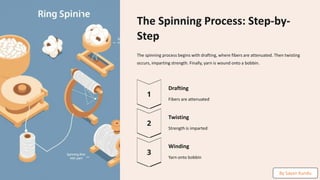
The spinning process begins with drafting, where fibers are attenuated. Then twisting
occurs, imparting strength. Finally, yarn is wound onto a bobbin.
Drafting
Fibers are attenuated
Twisting
Strength is imparted
Winding
Yarn onto bobbin
By Sayan Kundu
preencoded.png
Components of a Ring Frame
Drafting System Spindle
Traveler Winding
Mechanism
By Sayan Kundu
preencoded.png
Drafting System
Break Draft 1.12-1.4
Main Draft 30-35
Total Draft 40-50
By Sayan Kundu
preencoded.png
Double-boss top rollers are used in case of Ring spinning machine in addition to the roving frame machine
Double boss rollers are supported in their center section by weighting arm. They can swing slightly relative to the axis of the bottom
roller. They generally appear in two form:
❖ Fast boss rollers, in which the two bosses on the left and right, respectively, form a rigid unit and can be rotated only in unison.
❖ Loose boss rollers, in which the two bosses are separately mounted and can be rotated independently of one another.
Top Roller
Covering on the top rollers are made of synthetic rubber.
Soft – 60°-70° shore
Medium – 70°-90° shore
Hard – above 90° shore
By Sayan Kundu
preencoded.png
Bottom Roller
Axial Flutes Helical Flutes Knurled Flutes
Design is made to prevent from slippage
In case of simple 3 over 3 Drafting arrangements generally,
Axial Flutes presents in Middle Drafting roller
Helical Flutes presents in Back Drafting roller
Knurl Flutes presents in Front Drafting roller
By Sayan Kundu
preencoded.png
Spindle
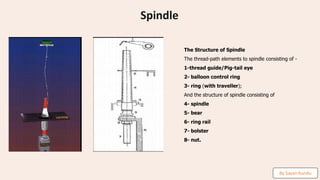
The Structure of Spindle
The thread-path elements to spindle consisting of -
1-thread guide/Pig-tail eye
2- balloon control ring
3- ring (with traveller);
And the structure of spindle consisting of
4- spindle
5- bear
6- ring rail
7- bolster
8- nut.
By Sayan Kundu
preencoded.png
Traveller
The traveler imparts twist to the yarn, and enables winding of the yarn on the cop. The
speed difference is due to lagging of the traveler relative to the spindle.
The traveler does not have a drive of its own but is dragged along behind the spindle.
High contact pressure (upto 35 cN/mm2) is generated between the ring and the traveler
during winding, mainly due to centrifugal forces. The pressure induces strong frictional
forces which in turn lead to significant generation of heat. This is the main problem. The
low mass of the traveler does not permit dissipation of the generated heat in the short
time available. As result, the operating speed of the traveler is limited.
By Sayan Kundu
preencoded.png
Winding Mechanism
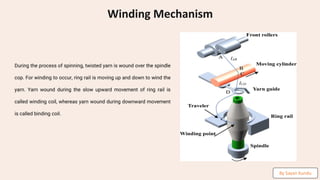
During the process of spinning, twisted yarn is wound over the spindle
cop. For winding to occur, ring rail is moving up and down to wind the
yarn. Yarn wound during the slow upward movement of ring rail is
called winding coil, whereas yarn wound during downward movement
is called binding coil.
By Sayan Kundu
preencoded.png
Yarn Properties and Quality Control
Yarn properties such as strength, evenness, and twist are critical. Quality control measures ensure these properties meet required standards.
Strength
Resistance to breaking.
Evenness
Uniformity of thickness.
Twist
Number of turns per inch.
By Sayan Kundu
preencoded.png
Advantages and Disadvantages of Ring Spinning
Ring spinning offers high yarn quality but has lower production speeds. It is versatile but can be more labor-intensive compared to other
systems.
Advantages
• High yarn quality
• Versatile fiber use
Disadvantages
• Lower production speeds
• Labor-intensive
By Sayan Kundu
preencoded.png
Ring Frame vs. Other Spinning
Systems
Ring spinning differs from rotor and air-jet spinning in yarn structure and production rate.
Each system has unique properties for different applications.
1 Ring Spinning
High Quality, lower speed.
2 Rotor Spinning
Medium Quality, medium speed.
3 Air-Jet Spinning
Lower Quality, higher speed.
By Sayan Kundu
preencoded.png
Applications and Industries
Using Ring Spun Yarn
Ring spun yarn is used in apparel, home textiles, and industrial fabrics. Its strength
and quality make it suitable for a wide range of applications.
Apparel
Clothing and fashion items.
Home Textiles
Bedding and curtains.
Industrial Fabrics
Technical textiles.
By Sayan Kundu
preencoded.png
Recent Advancements in Ring Spinning
Modern ring frames incorporate automation and improved control systems. These advancements increase efficiency and yarn quality.
1
Automation
2 Control Systems
3 Efficiency
By Sayan Kundu
preencoded.png
Conclusion and Future Trends in
Ring Spinning
Ring spinning remains a vital technology in textile manufacturing. Future trends include
greater automation and sustainable practices.
20%
Automation
Projected increase in automation.
15%
Sustainability
Growth in sustainable practices.
By Sayan Kundu
preencoded.png
By Sayan Kundu
THANK YOU

Ring-Frame-Machine-A-Comprehensive-Overview.pdf

  • 1.
  • 2.
    preencoded.png Introduction to RingSpinning Ring spinning is a widely used method for producing high-quality yarns. It involves drawing out fibers and twisting them together. This creates a strong and uniform yarn suitable for various textile applications. Versatile Suitable for a wide range of fibers. High Quality Produces strong and uniform yarn. Widely Used Commonly employed in textile manufacturing. By Sayan Kundu
  • 3.
    preencoded.png The Spinning Process:Step-by- Step The spinning process begins with drafting, where fibers are attenuated. Then twisting occurs, imparting strength. Finally, yarn is wound onto a bobbin. Drafting Fibers are attenuated Twisting Strength is imparted Winding Yarn onto bobbin By Sayan Kundu
  • 4.
    preencoded.png Components of aRing Frame Drafting System Spindle Traveler Winding Mechanism By Sayan Kundu
  • 5.
    preencoded.png Drafting System Break Draft1.12-1.4 Main Draft 30-35 Total Draft 40-50 By Sayan Kundu
  • 6.
    preencoded.png Double-boss top rollersare used in case of Ring spinning machine in addition to the roving frame machine Double boss rollers are supported in their center section by weighting arm. They can swing slightly relative to the axis of the bottom roller. They generally appear in two form: ❖ Fast boss rollers, in which the two bosses on the left and right, respectively, form a rigid unit and can be rotated only in unison. ❖ Loose boss rollers, in which the two bosses are separately mounted and can be rotated independently of one another. Top Roller Covering on the top rollers are made of synthetic rubber. Soft – 60°-70° shore Medium – 70°-90° shore Hard – above 90° shore By Sayan Kundu
  • 7.
    preencoded.png Bottom Roller Axial FlutesHelical Flutes Knurled Flutes Design is made to prevent from slippage In case of simple 3 over 3 Drafting arrangements generally, Axial Flutes presents in Middle Drafting roller Helical Flutes presents in Back Drafting roller Knurl Flutes presents in Front Drafting roller By Sayan Kundu
  • 8.
    preencoded.png Spindle The Structure ofSpindle The thread-path elements to spindle consisting of - 1-thread guide/Pig-tail eye 2- balloon control ring 3- ring (with traveller); And the structure of spindle consisting of 4- spindle 5- bear 6- ring rail 7- bolster 8- nut. By Sayan Kundu
  • 9.
    preencoded.png Traveller The traveler impartstwist to the yarn, and enables winding of the yarn on the cop. The speed difference is due to lagging of the traveler relative to the spindle. The traveler does not have a drive of its own but is dragged along behind the spindle. High contact pressure (upto 35 cN/mm2) is generated between the ring and the traveler during winding, mainly due to centrifugal forces. The pressure induces strong frictional forces which in turn lead to significant generation of heat. This is the main problem. The low mass of the traveler does not permit dissipation of the generated heat in the short time available. As result, the operating speed of the traveler is limited. By Sayan Kundu
  • 10.
    preencoded.png Winding Mechanism During theprocess of spinning, twisted yarn is wound over the spindle cop. For winding to occur, ring rail is moving up and down to wind the yarn. Yarn wound during the slow upward movement of ring rail is called winding coil, whereas yarn wound during downward movement is called binding coil. By Sayan Kundu
  • 11.
    preencoded.png Yarn Properties andQuality Control Yarn properties such as strength, evenness, and twist are critical. Quality control measures ensure these properties meet required standards. Strength Resistance to breaking. Evenness Uniformity of thickness. Twist Number of turns per inch. By Sayan Kundu
  • 12.
    preencoded.png Advantages and Disadvantagesof Ring Spinning Ring spinning offers high yarn quality but has lower production speeds. It is versatile but can be more labor-intensive compared to other systems. Advantages • High yarn quality • Versatile fiber use Disadvantages • Lower production speeds • Labor-intensive By Sayan Kundu
  • 13.
    preencoded.png Ring Frame vs.Other Spinning Systems Ring spinning differs from rotor and air-jet spinning in yarn structure and production rate. Each system has unique properties for different applications. 1 Ring Spinning High Quality, lower speed. 2 Rotor Spinning Medium Quality, medium speed. 3 Air-Jet Spinning Lower Quality, higher speed. By Sayan Kundu
  • 14.
    preencoded.png Applications and Industries UsingRing Spun Yarn Ring spun yarn is used in apparel, home textiles, and industrial fabrics. Its strength and quality make it suitable for a wide range of applications. Apparel Clothing and fashion items. Home Textiles Bedding and curtains. Industrial Fabrics Technical textiles. By Sayan Kundu
  • 15.
    preencoded.png Recent Advancements inRing Spinning Modern ring frames incorporate automation and improved control systems. These advancements increase efficiency and yarn quality. 1 Automation 2 Control Systems 3 Efficiency By Sayan Kundu
  • 16.
    preencoded.png Conclusion and FutureTrends in Ring Spinning Ring spinning remains a vital technology in textile manufacturing. Future trends include greater automation and sustainable practices. 20% Automation Projected increase in automation. 15% Sustainability Growth in sustainable practices. By Sayan Kundu
  • 17.