Anwer Khan Modern
University
Presentation on Ring
spinning
Prepared by
Nobel Hossain
Student ID: 14-211-0019
Spring: 2022
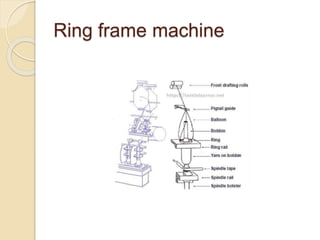
Ring frame machine
Introduction
 Ring spinning is the most widely used spinning machine due
to significant advantages in comparison with the spinning
process. Ring spinning is a method of spinning fibers, such
as cotton, flax, or wool, to make a yarn. The ring spinning
machine was invented in the year 1828 by the American
throat. Between 1860 and at the end of the nineteenth
century was a period of intense development of different
types and shapes of rings and travelers. At that time,
improved spindle type with a good lubricating system and
different ball- or roller- bearing and improved damping were
used in different places of drafting zones and spindle
respectively. In 1888 it become a perfect form and could be
given production effectively. This ring spinning was much
more productive, simpler in mechanism, easier in
manipulation and more economic. This was the origin of ring
twisting, probably the most extensively used system for the
processes of simultaneously twisting yarn and winding it onto
a package.
objective
 To draft the roving for conversion of very fine strand
of some fiber to form yarn of required count.
 To impart strength to the yarn by inserting the
necessary amount of twist.
 To collect twisted strand called yarn onto handy and
transportable.
 Any types of fibre can be processed e. g. cotton,
jute, viscose, nylon
 Wide range of spinning value: 5 Ne to 200 Ne can be
processed by ring frame, where rotor and air-jet
spinning process 10 Ne to 40 Ne yarn
Main advantageous features of
ring spinning machine:
 Most usable spinning machine in the world.
 Fine to coarse (5-1000 tex) yarn can be produced.
 Yarn has very good strength.
 Yarn is suitable for all next processes.
 More than 80% of total yarn is produced by ring
spinning machines.
Main operation of ring machine
Creeling
Drafting
Twisting
Winding
Building
Main operation of ring machine
Creeling
The number of the spindle of a ring frame mmaybe480 or 504
(short frame) & 960 or 1008 (long frame) & the creel must be 2-
5% extra.
In block creeling arrangement, the total number of creel is
divided into several numbers of groups. Each group contains
roving bobbins of the same length but different from adjacent
groups or blocks. Thus all bobbins will not exhaust at the same
time. So, there is no machine stoppage & production goes on
smoothly.
 Advantage of block creeling-
To avoid machine stoppage
To save the time
To save manpower
drafting system of ring frame
 Drafting operation reduces weight per unit length of the roving. Roving
comes from the bobbin and is passed through the drafting zone, which
may be an apron drafting system or without an apron drafting system.
In an apron drafting system, fiber controlling is better; so it is widely
used.
 Classification of the drafting system
1. Regular drafting system without the apron
a) Conventional 3 over 3 drafting system
b) Improved system
2. Drafting system with apron
A. Single apron
a) Saco Lowell
b) Improved system
drafting system of ring frame
A. Double apron
a) Casablanca
b) SKF system
SKF PK 2025
2 mm 2 mm
28 mm 25 mm 28 mm
25-27 mm
HF
25-27 mm 25-27
mm
VF 60 mm
GF max
203 mm
Figure: SKF PK - 2025
drafting system
Traveller
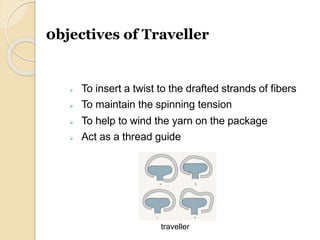
 Traveller is the tiniest and most simple mechanical element in
ring frame. It is impossible to produce yarn without its help. It
carries the most important function like simultaneous twisting,
winding, thread guiding, etc. It may be made of metal or
plastic. These are the tiny key parts of the ring-spinning frame
that travel around the ring at 30-35 m/sec and impart a twist
to the yarn. The hardness of the running traveler must be
within 650-700 Vickers. Contact pressure between ring and
traveler is up to 35N/mm². Generate high temperature (300-
400°C). the mass of travelers is 16-120gm/1000
0bjectives of Traveller
 To insert a twist to the drafted strands of fibers
 To maintain the spinning tension
 To help to wind the yarn on the package
 Act as a thread guide
traveller
Ring and traveller
Ring frame machine
spindle
 Spindle is a hollow cylindrical tube, consists of mainly two
parts (upper parts bolster) and is capable to run at high speed.
Normally upper part of the spindle is a taper, which holds the
ring cop, and bolsters are fixed to the ring rail by a nut. The
spindle is driven by tape at the position of the whorl. The
diameter of the whorl is important for high speed
 The function of the spindle
1. It holds the bobbin.
2. Helps to insert twist with aid of ring and traveler.
3. Helps to wind the yarn on the bobbin.
Spindle
Ring
 Ring
The rings are made of low carbon steel (i.e. soft steel) or of ceramic
in the form of a bar which molded into ring shape either by bending
and welding or by piecing and rolling or by pressing by means of
dies and then the stock is given the desired projection termed as ring
flange.
 The function of ring
1. Ring guides the circular run of the traveller.
2. It also helps in twisting by means of the running of the traveller.
3. It also acts as a track of traveler.
Ring diameter selection depends
on some factor
 Spindle speed
 Bobbin size
 Yarn count
Features of a good ring
 A good ring should have the following feature-
 Best quality raw material
 Good, but not too high, surface smoothness
 An even surface
 Exact roundness
 Good, even surface hardness, higher than that of the traveller
 It should have been run-in as well as possible
 Long operation lifetime
 The correct relationship between ring and bobbin tube diameters
(2:1 up to 2.2:1)
 Horizontal disposition
 It should be exactly centered relative to the spindle

Limitations of ring spinning:
• Low twisting rate
• Low production
• Small bobbin size
• Frequent doffing
• High energy consumption
• Limited speed of traveler


ENG 117 Engineering materials.pptx

  • 1.
    Anwer Khan Modern University Presentationon Ring spinning Prepared by Nobel Hossain Student ID: 14-211-0019 Spring: 2022
  • 2.
  • 3.
    Introduction  Ring spinningis the most widely used spinning machine due to significant advantages in comparison with the spinning process. Ring spinning is a method of spinning fibers, such as cotton, flax, or wool, to make a yarn. The ring spinning machine was invented in the year 1828 by the American throat. Between 1860 and at the end of the nineteenth century was a period of intense development of different types and shapes of rings and travelers. At that time, improved spindle type with a good lubricating system and different ball- or roller- bearing and improved damping were used in different places of drafting zones and spindle respectively. In 1888 it become a perfect form and could be given production effectively. This ring spinning was much more productive, simpler in mechanism, easier in manipulation and more economic. This was the origin of ring twisting, probably the most extensively used system for the processes of simultaneously twisting yarn and winding it onto a package.
  • 4.
    objective  To draftthe roving for conversion of very fine strand of some fiber to form yarn of required count.  To impart strength to the yarn by inserting the necessary amount of twist.  To collect twisted strand called yarn onto handy and transportable.  Any types of fibre can be processed e. g. cotton, jute, viscose, nylon  Wide range of spinning value: 5 Ne to 200 Ne can be processed by ring frame, where rotor and air-jet spinning process 10 Ne to 40 Ne yarn
  • 5.
    Main advantageous featuresof ring spinning machine:  Most usable spinning machine in the world.  Fine to coarse (5-1000 tex) yarn can be produced.  Yarn has very good strength.  Yarn is suitable for all next processes.  More than 80% of total yarn is produced by ring spinning machines.
  • 6.
    Main operation ofring machine Creeling Drafting Twisting Winding Building
  • 7.
    Main operation ofring machine Creeling The number of the spindle of a ring frame mmaybe480 or 504 (short frame) & 960 or 1008 (long frame) & the creel must be 2- 5% extra. In block creeling arrangement, the total number of creel is divided into several numbers of groups. Each group contains roving bobbins of the same length but different from adjacent groups or blocks. Thus all bobbins will not exhaust at the same time. So, there is no machine stoppage & production goes on smoothly.  Advantage of block creeling- To avoid machine stoppage To save the time To save manpower
  • 8.
    drafting system ofring frame  Drafting operation reduces weight per unit length of the roving. Roving comes from the bobbin and is passed through the drafting zone, which may be an apron drafting system or without an apron drafting system. In an apron drafting system, fiber controlling is better; so it is widely used.  Classification of the drafting system 1. Regular drafting system without the apron a) Conventional 3 over 3 drafting system b) Improved system 2. Drafting system with apron A. Single apron a) Saco Lowell b) Improved system
  • 9.
    drafting system ofring frame A. Double apron a) Casablanca b) SKF system SKF PK 2025 2 mm 2 mm 28 mm 25 mm 28 mm 25-27 mm HF 25-27 mm 25-27 mm VF 60 mm GF max 203 mm Figure: SKF PK - 2025 drafting system
  • 10.
    Traveller  Traveller isthe tiniest and most simple mechanical element in ring frame. It is impossible to produce yarn without its help. It carries the most important function like simultaneous twisting, winding, thread guiding, etc. It may be made of metal or plastic. These are the tiny key parts of the ring-spinning frame that travel around the ring at 30-35 m/sec and impart a twist to the yarn. The hardness of the running traveler must be within 650-700 Vickers. Contact pressure between ring and traveler is up to 35N/mm². Generate high temperature (300- 400°C). the mass of travelers is 16-120gm/1000
  • 11.
    0bjectives of Traveller To insert a twist to the drafted strands of fibers  To maintain the spinning tension  To help to wind the yarn on the package  Act as a thread guide traveller
  • 12.
  • 13.
  • 14.
    spindle  Spindle isa hollow cylindrical tube, consists of mainly two parts (upper parts bolster) and is capable to run at high speed. Normally upper part of the spindle is a taper, which holds the ring cop, and bolsters are fixed to the ring rail by a nut. The spindle is driven by tape at the position of the whorl. The diameter of the whorl is important for high speed  The function of the spindle 1. It holds the bobbin. 2. Helps to insert twist with aid of ring and traveler. 3. Helps to wind the yarn on the bobbin.
  • 15.
  • 16.
    Ring  Ring The ringsare made of low carbon steel (i.e. soft steel) or of ceramic in the form of a bar which molded into ring shape either by bending and welding or by piecing and rolling or by pressing by means of dies and then the stock is given the desired projection termed as ring flange.  The function of ring 1. Ring guides the circular run of the traveller. 2. It also helps in twisting by means of the running of the traveller. 3. It also acts as a track of traveler.
  • 17.
    Ring diameter selectiondepends on some factor  Spindle speed  Bobbin size  Yarn count
  • 18.
    Features of agood ring  A good ring should have the following feature-  Best quality raw material  Good, but not too high, surface smoothness  An even surface  Exact roundness  Good, even surface hardness, higher than that of the traveller  It should have been run-in as well as possible  Long operation lifetime  The correct relationship between ring and bobbin tube diameters (2:1 up to 2.2:1)  Horizontal disposition  It should be exactly centered relative to the spindle 
  • 19.
    Limitations of ringspinning: • Low twisting rate • Low production • Small bobbin size • Frequent doffing • High energy consumption • Limited speed of traveler 