University of Baghdad
Collage of Engineering
Civil Engineering Department
Maintenance of Highway
Presentation
Rigid Pavements Distresses
Submitted by:
Ahmed Fahim Rahi
M.Sc. Student
Under Supervisor
Prof: Saad Sarsam
Types of Distresses
• Cracking
• Joints
• Disintegration
• Distortion
• Other Distresses
1-Cracking
Cracks in rigid pavements often result from stresses caused by
expansion and contraction or warping of the pavement.
Overloading, loss of subgrade support, and insufficient and/or
improperly cut joints acting singly or in combination are also
possible causes. Several different types of cracking can occur:
1-1 Longitudinal, Transverse and Diagonal Cracking
Description: It is characterized by cracks that divide the
slab into two or three pieces.
Possible Causes: A combination of repeated loads, curling
and shrinkage stresses, poor construction techniques,
underlying pavement layers that are structurally
inadequate for the applied load, or pavement overloads,
usually causes this type of distress.
FIGURE 2.5 – EXAMPLES OF LONGITUDINAL AND DIAGONAL CRACKS
ON THE LEFT AND ON THE RIGHT TRANSVERSE AND DIAGONAL
CRACKS
Rehabilitation: Slabs with a single, narrow crack may be repaired by
crack sealing (FAA, 2007 a). More than one crack generally warrants a
full-depth patch (Pavement Interactive, 2014 b).
1-2 Durability “D” Cracking
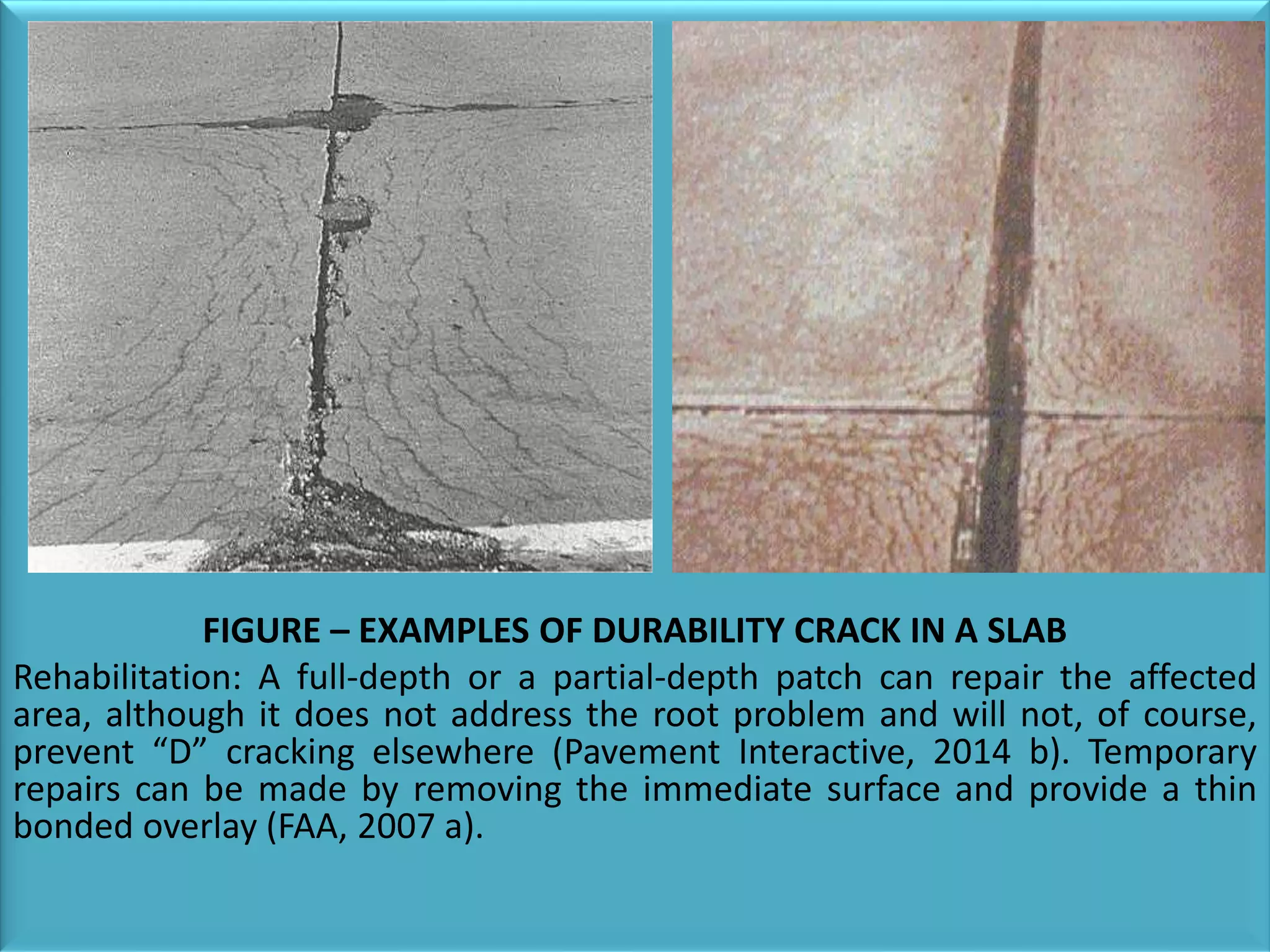
Description: "D" cracking usually appears closely
spaced, crescent-shaped cracks running in the vicinity
of and parallel to a joint, linear crack or free edges.
Since the concrete becomes saturated near joints and
cracks, a dark colored deposit can usually be found
around this type of cracking and may eventually lead
to disintegration of the concrete within 30 to 60 cm of
the joint or crack.
Possible Causes: The concrete's inability to withstand
environmental factors, such as freeze-thaw cycles
because of the expansion of the large aggregate
within the PCC slab.
FIGURE – EXAMPLES OF DURABILITY CRACK IN A SLAB
Rehabilitation: A full-depth or a partial-depth patch can repair the affected
area, although it does not address the root problem and will not, of course,
prevent “D” cracking elsewhere (Pavement Interactive, 2014 b). Temporary
repairs can be made by removing the immediate surface and provide a thin
bonded overlay (FAA, 2007 a).
1-3Corner Breaks
Description: This type of break is characterized by a
crack that intersects the joints at a distance less than,
or equal to one-half of the slab, describing
approximately a 45o angle with the direction of
traffic, measured from the corner of the slab.
Possible Causes: Load repetition, combined with loss
of support and curling stresses, usually causes cracks
at the slab corner. Lack of support may be caused by
pumping or loss of load transfer at the joint.
FIGURE – EXAMPLES OF CORNER BREAKS AT A HIGH
VOLUME TRAFFIC ROAD
Rehabilitation: Full-depth patch
1-4 Shrinkage Cracking
Description: Shrinkage cracks are hairline cracks that
are usually only a few cm long and do not extend
across the entire slab. They are formed during the
setting and curing of the concrete and usually do not
extend through the depth of the slab. Typically,
shrinkage cracks do not extend deeper than 6.4 mm
from the slab surface and may be primarily in the
finished surface paste only.
Possible Causes: All PCC will shrink as it sets and
cures, therefore shrinkage cracks are expected in rigid
pavement and provisions for their control are made.
FIGURE – EXAMPLE OF SHRINKAGE CRACKING ON NEW SLABS ON
THE LEFT AND SEVERE SHRINKAGE CRACKING ON THE RIGHT
Rehabilitation: Epoxy cement and the slab should perform
adequately
2- Joint Distresses
2-1 Joint Seal Damage
Description: Joint seal damage is any condition that enables
incompressible materials (soil or rocks) to accumulate in the
joints or that allows infiltration of water.
Possible Causes: Accumulation of materials that prevents the
slabs from expanding and may result in buckling, shattering,
or spalling. Water infiltration through joint seal damage can
cause pumping or deterioration of the sub-base. Typical types
of joint seal damage include stripping of joint sealant,
extrusion of joint sealant, hardening of the filler (oxidation),
loss of bond to the slab edges, and absence of sealant in the
joint. Joint seal damage is caused by improper joint width, use
of the wrong type of sealant, incorrect application, and/or not
properly cleaning the joint before sealing.
FIGURE – EXAMPLE OF LOW SEVERITY JOINT ON THE LEFT
AND ON THE RIGHT A MODERATE SEVERITY JOINT
Rehabilitation: When addressing joint seal damage of an
existing preformed sealant, that existing joint sealant may be
replaced with new preformed sealant depending on the
condition of the joint.
2-2 Joint Load Transfer System Deterioration
Description: Transverse crack or corner break developed
as a result of joint dowels.
Possible Causes: Load transfer dowel bars can fail for two
principal reasons:
• Corrosion. If inadequately protected, dowel bars can
corrode over time. The corrosion products occupy
volume, which creates tensile stresses around the dowel
bars, and a severely corroded dowel bar is weaker and
may fail after repeated loading.
• Misalignment. Dowel bars inserted crooked or too close
to the slab edge may create localized stresses high
enough to break the slab. Misalignment can occur during
original construction or during dowel bar retrofits.
FIGURE – EXAMPLE OF A DOWEL BAR CORROSION ON THE
LEFT AND ON THE RIGHT A PATCH OVER AN AREA OF DOWEL
BAR FAILURE
Rehabilitation: Removal and replacement of the affected joint
load transfer system followed by a full-depth patch for
affected area.
3- Disintegration
Disintegration is the breaking up of a pavement into
small, loose particles and includes the dislodging of
aggregate particles. Improper curing and finishing of
the concrete, unsuitable aggregates, and improper
mixing of the concrete can cause this distress.
Disintegration falls into several categories:
3-1 Scaling, Map Cracking or Crazing
Description: This distress refers to a network of
shallow, fine, or hair-like cracks that extend only
through the upper surface of the concrete.
Possible Causes: Construction defects, material
defects and environmental factors.
FIGURE
EXAMPLE OF SCALING
3-2 Spalling
Description: Cracking, breaking or chipping of joint/crack edges.
Usually occurs within about 0.6 m of joint/crack edge on
airports and about 0.5 m on roads and generally angles
downward to intersect the joint.
Possible Causes (Pavement Interactive, 2014 b):
• Excessive stresses at the joint/crack caused by infiltration of
incompressible materials and subsequent expansion (can also
cause blowups).
• Disintegration of the PCC from freeze-thaw action or “D”
cracking.
• Weak PCC at a joint caused by inadequate consolidation
during construction. This can sometimes occur at a construction
joint if, low quality PCC is used to fill in the last bit of slab
volume or dowels are improperly inserted.
• Misalignment or corroded dowel.
• Heavy traffic loading.
FIGURE – EXAMPLES OF SPALLING ALONG A LINEAR CRACK ON THE LEFT AND
A JOINT AND CORNER SPALLING ON THE RIGHT
Rehabilitation: Spalling less than 75 mm wide from the crack face can generally
be repaired with a partial-depth patch or filled with joint seal repair. Spalling
greater than about 75 mm from the crack face may indicated possible spalling
at the joint bottom and should be repaired with a full-depth patch
3-3 Blowups
Description: Blowups normally occur only in thin
pavement sections, although blowups can also appear at
drainage structures (manholes, inlets, etc.). They
generally occur during hot weather because of the
additional thermal expansion of the concrete. Blowups
usually occur at a transverse crack or joint that is not wide
enough to permit expansion of the concrete slabs
Possible Causes: During cold periods (winter) PCC slabs
contract leaving wider joint openings. If these openings
become filled with incompressible material (such as rocks
or soil), subsequent PCC slab expansion during hot
periods (spring, summer) may cause high compressive
stresses. If these stresses are great enough, the slabs may
buckle and shatter to relieve the stresses
FIGURE – EXAMPLES OF BLOWUP DISTRESS
Rehabilitation: Full-depth patch.
3-4 Shattered Slab/Divided Slabs
Description: A shattered slab is defined as a slab where
intersecting cracks break up the slab into four or more pieces.
Possible Causes: This is primarily caused by overloading due
to traffic and/or inadequate foundation support.
FIGURE – EXAMPLES OF A SHATTERED SLAB DISTRESS
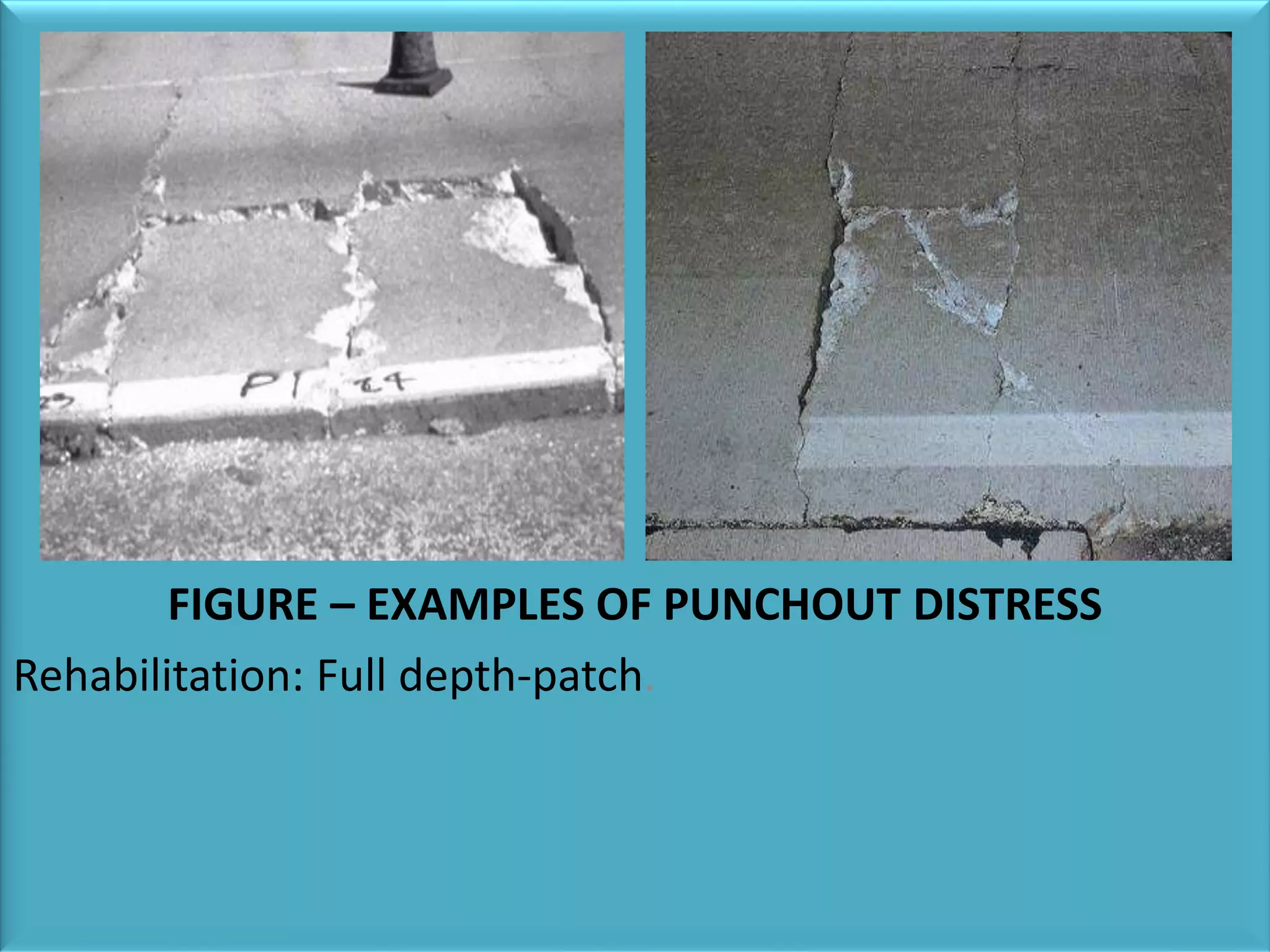
3-5 Punchout
Description: This distress is a condition that often
occurs in CRCP between two closely spaced cracks or
between a crack and a joint with usually 1.5 m wide.
The Punchout can take many different shapes and
forms, but it is usually defined by a crack and a joint.
Possible Causes: This distress is caused by heavy
repeated loads, inadequate slab thickness, loss of
foundation support, or a localized concrete
construction deficiency, for example, honeycombing.
FIGURE – EXAMPLES OF PUNCHOUT DISTRESS
Rehabilitation: Full depth-patch.
3-6 Popouts
Description: A popout is defined as a small piece of pavement
that breaks loose from the concrete surface. Popouts usually
range from approximately 25 to 100 mm in diameter and 13
to 50 mm depth. A popout may also be a singular piece of
large aggregate that breaks loose from the concrete surface
or may be clay balls in the concrete mix.
Possible Causes: This is caused by freeze-thaw action in
combination with poor aggregates. Poor durability can be a
result of a number of items such as:
• Poor aggregate freeze-thaw resistance
• Expansive aggregates
• Alkali-Aggregate Reactions
FIGURE – EXAMPLES OF POPOUTS DISTRESS
Rehabilitation: Isolated low severity popouts may not warrant
repair. Larger popouts or a group of popouts can generally be
repaired with a partial depth patch or filled with the same
materials as used for repairing cracks or joints in PCC pavements.
3-7 Patching
Description: A patch is defined as an area where the
original pavement has been removed and replaced by
a filler material.
Possible Causes: Loss of support, heavy load
repetitions, moisture, and thermal gradients can all
cause distress.
FIGURE – EXAMPLE
OF SLAB PATCHING
4- Distortion
Distortion refers to a change in the pavement
surface’s original position, and it results from
foundation settlement, expansive soils, frost-
susceptible soils, or loss of fines through improperly
designed subdrains or drainage systems. Two types of
distortion generally occur:
4-1 Pumping
Description: The deflection of the slab when loaded may
cause pumping, which is characterized by the ejection of
water and underlying material through the joints or cracks in
a pavement .
Possible Causes: Water accumulation underneath the slab.
FIGURE – ON THE LEFT IT’S AN EXAMPLE OF PUMPING IN ACTION AND
ON THE RIGHT IS AN EXAMPLE OF PUMPING DISTRESS
4-2 Settlement or Faulting
Description: Settlement or faulting is a difference in elevation at a
joint or crack, usually the approach slab is higher than the leave
slab due to pumping.
Possible Causes: Loss of load transfer device (key, dowel, etc.), or
swelling soils, soft foundation.
FIGURE – EXAMPLE OF FAULTING DISTRESS AT THE LEFT AND A
CLOSE-UP ON THE RIGHT
5- Other Distresses
-Polished Aggregates
Lane/Shoulder Dropoff
The End

rigid pavement stresses.pptx

  • 1.
    University of Baghdad Collageof Engineering Civil Engineering Department Maintenance of Highway Presentation Rigid Pavements Distresses Submitted by: Ahmed Fahim Rahi M.Sc. Student Under Supervisor Prof: Saad Sarsam
  • 2.
    Types of Distresses •Cracking • Joints • Disintegration • Distortion • Other Distresses
  • 3.
    1-Cracking Cracks in rigidpavements often result from stresses caused by expansion and contraction or warping of the pavement. Overloading, loss of subgrade support, and insufficient and/or improperly cut joints acting singly or in combination are also possible causes. Several different types of cracking can occur: 1-1 Longitudinal, Transverse and Diagonal Cracking Description: It is characterized by cracks that divide the slab into two or three pieces. Possible Causes: A combination of repeated loads, curling and shrinkage stresses, poor construction techniques, underlying pavement layers that are structurally inadequate for the applied load, or pavement overloads, usually causes this type of distress.
  • 4.
    FIGURE 2.5 –EXAMPLES OF LONGITUDINAL AND DIAGONAL CRACKS ON THE LEFT AND ON THE RIGHT TRANSVERSE AND DIAGONAL CRACKS Rehabilitation: Slabs with a single, narrow crack may be repaired by crack sealing (FAA, 2007 a). More than one crack generally warrants a full-depth patch (Pavement Interactive, 2014 b).
  • 5.
    1-2 Durability “D”Cracking Description: "D" cracking usually appears closely spaced, crescent-shaped cracks running in the vicinity of and parallel to a joint, linear crack or free edges. Since the concrete becomes saturated near joints and cracks, a dark colored deposit can usually be found around this type of cracking and may eventually lead to disintegration of the concrete within 30 to 60 cm of the joint or crack. Possible Causes: The concrete's inability to withstand environmental factors, such as freeze-thaw cycles because of the expansion of the large aggregate within the PCC slab.
  • 6.
    FIGURE – EXAMPLESOF DURABILITY CRACK IN A SLAB Rehabilitation: A full-depth or a partial-depth patch can repair the affected area, although it does not address the root problem and will not, of course, prevent “D” cracking elsewhere (Pavement Interactive, 2014 b). Temporary repairs can be made by removing the immediate surface and provide a thin bonded overlay (FAA, 2007 a).
  • 7.
    1-3Corner Breaks Description: Thistype of break is characterized by a crack that intersects the joints at a distance less than, or equal to one-half of the slab, describing approximately a 45o angle with the direction of traffic, measured from the corner of the slab. Possible Causes: Load repetition, combined with loss of support and curling stresses, usually causes cracks at the slab corner. Lack of support may be caused by pumping or loss of load transfer at the joint.
  • 8.
    FIGURE – EXAMPLESOF CORNER BREAKS AT A HIGH VOLUME TRAFFIC ROAD Rehabilitation: Full-depth patch
  • 9.
    1-4 Shrinkage Cracking Description:Shrinkage cracks are hairline cracks that are usually only a few cm long and do not extend across the entire slab. They are formed during the setting and curing of the concrete and usually do not extend through the depth of the slab. Typically, shrinkage cracks do not extend deeper than 6.4 mm from the slab surface and may be primarily in the finished surface paste only. Possible Causes: All PCC will shrink as it sets and cures, therefore shrinkage cracks are expected in rigid pavement and provisions for their control are made.
  • 10.
    FIGURE – EXAMPLEOF SHRINKAGE CRACKING ON NEW SLABS ON THE LEFT AND SEVERE SHRINKAGE CRACKING ON THE RIGHT Rehabilitation: Epoxy cement and the slab should perform adequately
  • 11.
    2- Joint Distresses 2-1Joint Seal Damage Description: Joint seal damage is any condition that enables incompressible materials (soil or rocks) to accumulate in the joints or that allows infiltration of water. Possible Causes: Accumulation of materials that prevents the slabs from expanding and may result in buckling, shattering, or spalling. Water infiltration through joint seal damage can cause pumping or deterioration of the sub-base. Typical types of joint seal damage include stripping of joint sealant, extrusion of joint sealant, hardening of the filler (oxidation), loss of bond to the slab edges, and absence of sealant in the joint. Joint seal damage is caused by improper joint width, use of the wrong type of sealant, incorrect application, and/or not properly cleaning the joint before sealing.
  • 12.
    FIGURE – EXAMPLEOF LOW SEVERITY JOINT ON THE LEFT AND ON THE RIGHT A MODERATE SEVERITY JOINT Rehabilitation: When addressing joint seal damage of an existing preformed sealant, that existing joint sealant may be replaced with new preformed sealant depending on the condition of the joint.
  • 13.
    2-2 Joint LoadTransfer System Deterioration Description: Transverse crack or corner break developed as a result of joint dowels. Possible Causes: Load transfer dowel bars can fail for two principal reasons: • Corrosion. If inadequately protected, dowel bars can corrode over time. The corrosion products occupy volume, which creates tensile stresses around the dowel bars, and a severely corroded dowel bar is weaker and may fail after repeated loading. • Misalignment. Dowel bars inserted crooked or too close to the slab edge may create localized stresses high enough to break the slab. Misalignment can occur during original construction or during dowel bar retrofits.
  • 14.
    FIGURE – EXAMPLEOF A DOWEL BAR CORROSION ON THE LEFT AND ON THE RIGHT A PATCH OVER AN AREA OF DOWEL BAR FAILURE Rehabilitation: Removal and replacement of the affected joint load transfer system followed by a full-depth patch for affected area.
  • 15.
    3- Disintegration Disintegration isthe breaking up of a pavement into small, loose particles and includes the dislodging of aggregate particles. Improper curing and finishing of the concrete, unsuitable aggregates, and improper mixing of the concrete can cause this distress. Disintegration falls into several categories:
  • 16.
    3-1 Scaling, MapCracking or Crazing Description: This distress refers to a network of shallow, fine, or hair-like cracks that extend only through the upper surface of the concrete. Possible Causes: Construction defects, material defects and environmental factors. FIGURE EXAMPLE OF SCALING
  • 17.
    3-2 Spalling Description: Cracking,breaking or chipping of joint/crack edges. Usually occurs within about 0.6 m of joint/crack edge on airports and about 0.5 m on roads and generally angles downward to intersect the joint. Possible Causes (Pavement Interactive, 2014 b): • Excessive stresses at the joint/crack caused by infiltration of incompressible materials and subsequent expansion (can also cause blowups). • Disintegration of the PCC from freeze-thaw action or “D” cracking. • Weak PCC at a joint caused by inadequate consolidation during construction. This can sometimes occur at a construction joint if, low quality PCC is used to fill in the last bit of slab volume or dowels are improperly inserted. • Misalignment or corroded dowel. • Heavy traffic loading.
  • 18.
    FIGURE – EXAMPLESOF SPALLING ALONG A LINEAR CRACK ON THE LEFT AND A JOINT AND CORNER SPALLING ON THE RIGHT Rehabilitation: Spalling less than 75 mm wide from the crack face can generally be repaired with a partial-depth patch or filled with joint seal repair. Spalling greater than about 75 mm from the crack face may indicated possible spalling at the joint bottom and should be repaired with a full-depth patch
  • 19.
    3-3 Blowups Description: Blowupsnormally occur only in thin pavement sections, although blowups can also appear at drainage structures (manholes, inlets, etc.). They generally occur during hot weather because of the additional thermal expansion of the concrete. Blowups usually occur at a transverse crack or joint that is not wide enough to permit expansion of the concrete slabs Possible Causes: During cold periods (winter) PCC slabs contract leaving wider joint openings. If these openings become filled with incompressible material (such as rocks or soil), subsequent PCC slab expansion during hot periods (spring, summer) may cause high compressive stresses. If these stresses are great enough, the slabs may buckle and shatter to relieve the stresses
  • 20.
    FIGURE – EXAMPLESOF BLOWUP DISTRESS Rehabilitation: Full-depth patch.
  • 21.
    3-4 Shattered Slab/DividedSlabs Description: A shattered slab is defined as a slab where intersecting cracks break up the slab into four or more pieces. Possible Causes: This is primarily caused by overloading due to traffic and/or inadequate foundation support. FIGURE – EXAMPLES OF A SHATTERED SLAB DISTRESS
  • 22.
    3-5 Punchout Description: Thisdistress is a condition that often occurs in CRCP between two closely spaced cracks or between a crack and a joint with usually 1.5 m wide. The Punchout can take many different shapes and forms, but it is usually defined by a crack and a joint. Possible Causes: This distress is caused by heavy repeated loads, inadequate slab thickness, loss of foundation support, or a localized concrete construction deficiency, for example, honeycombing.
  • 23.
    FIGURE – EXAMPLESOF PUNCHOUT DISTRESS Rehabilitation: Full depth-patch.
  • 24.
    3-6 Popouts Description: Apopout is defined as a small piece of pavement that breaks loose from the concrete surface. Popouts usually range from approximately 25 to 100 mm in diameter and 13 to 50 mm depth. A popout may also be a singular piece of large aggregate that breaks loose from the concrete surface or may be clay balls in the concrete mix. Possible Causes: This is caused by freeze-thaw action in combination with poor aggregates. Poor durability can be a result of a number of items such as: • Poor aggregate freeze-thaw resistance • Expansive aggregates • Alkali-Aggregate Reactions
  • 25.
    FIGURE – EXAMPLESOF POPOUTS DISTRESS Rehabilitation: Isolated low severity popouts may not warrant repair. Larger popouts or a group of popouts can generally be repaired with a partial depth patch or filled with the same materials as used for repairing cracks or joints in PCC pavements.
  • 26.
    3-7 Patching Description: Apatch is defined as an area where the original pavement has been removed and replaced by a filler material. Possible Causes: Loss of support, heavy load repetitions, moisture, and thermal gradients can all cause distress. FIGURE – EXAMPLE OF SLAB PATCHING
  • 27.
    4- Distortion Distortion refersto a change in the pavement surface’s original position, and it results from foundation settlement, expansive soils, frost- susceptible soils, or loss of fines through improperly designed subdrains or drainage systems. Two types of distortion generally occur:
  • 28.
    4-1 Pumping Description: Thedeflection of the slab when loaded may cause pumping, which is characterized by the ejection of water and underlying material through the joints or cracks in a pavement . Possible Causes: Water accumulation underneath the slab. FIGURE – ON THE LEFT IT’S AN EXAMPLE OF PUMPING IN ACTION AND ON THE RIGHT IS AN EXAMPLE OF PUMPING DISTRESS
  • 29.
    4-2 Settlement orFaulting Description: Settlement or faulting is a difference in elevation at a joint or crack, usually the approach slab is higher than the leave slab due to pumping. Possible Causes: Loss of load transfer device (key, dowel, etc.), or swelling soils, soft foundation. FIGURE – EXAMPLE OF FAULTING DISTRESS AT THE LEFT AND A CLOSE-UP ON THE RIGHT
  • 30.
    5- Other Distresses -PolishedAggregates Lane/Shoulder Dropoff
  • 31.