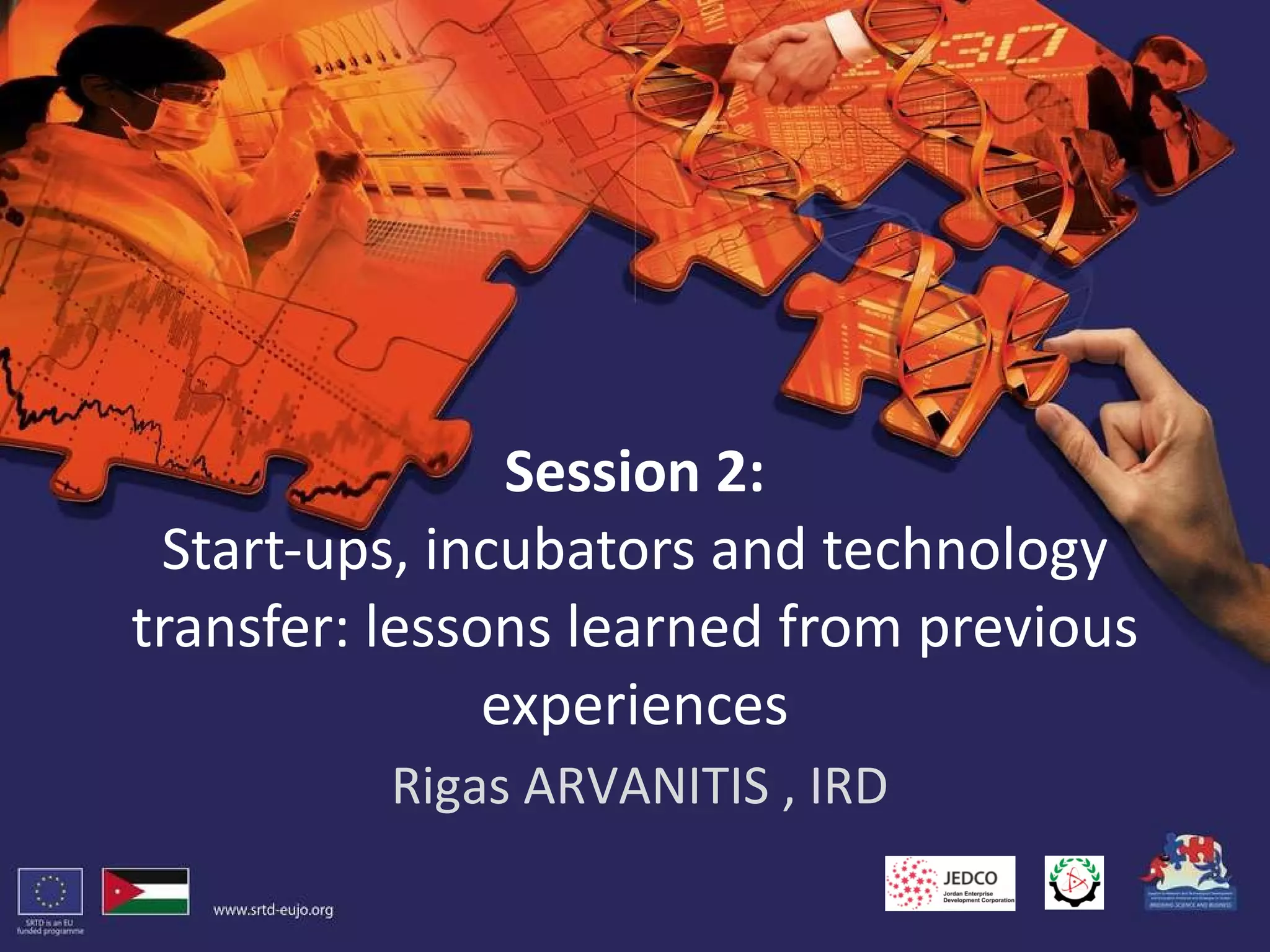
Session 2: Start-ups, incubators and technology transfer: lessons learned from previous experiences Rigas ARVANITIS , IRD
A general move Incubators, clusters, technoparks, networks… A general move from  the in close relationship with the following phenomena growth of ICTs and new technologies importance of new "extension" activities of universities Tech transfer between research and production Regional industrial policies and decentralization
Variety of forms Technoparks and technopoles Technology transfer units in universities, engineering schools,  Funding start-ups: venture capital, credit schemes Engineering networks Intermediate technical centres Business associations related to innovation and tech dev.
Fast growing experiences In most European countries and in the USA: The Silicon Valley sindrome Entrepreneurial universities (as a goal) Large consensus on the need to trigger new economic sources for employment Innovation policy: very much related to large firms Need for specific dedicated programs for SMEs
In the developing world Brazil, China, Mexico Very diverse experiences (examples) Smaller countries have emphasized : ICTs Technoparks Larger countries: close relation to industrial policy
In the Mediterranean Many experiences in MENA countries Two opposite examples Tunisia Morocco When comparing experiences, differences rather due to policy and industrial background rather than ‘cultural’ aspects
At least two differences (1/2° FIRST MAJOR DIFFERENCE Start-ups, companies related to tech transfers from large universities and R&D centres Companies incubated under a common roof, sharing common services (fair, support centre, infrastructure, legal & other services)
At least two differences (2/2) SECOND MAJOR DIFFERENCE Pre-existing geographical proximity and industrial localization (‘marshalian district’) ‘ Clustering’ created  de novo  from scrath (usually as a technopark, university incubator or policy-oriented localized grouping).
A management and policy issue ‘ Incubators’ are among other things: A management issue related to innovation and entrepreneurship A policy issue related to the institutional environment Both are different when seen from the eyes of an entreprise or a policy-maker
Technological learning of companies Incubators and clusters are related to the capacity of entreprises to adopt, adapt, and develop technologies ‘ technological learning’ rather than innovation should be the main focus ‘ localizing’ competence seems of paramount experience (‘root the experience locally’) Never forget: innovation is not only a local affaire!
Thank you !

Rigas

  • 1.
    Session 2: Start-ups,incubators and technology transfer: lessons learned from previous experiences Rigas ARVANITIS , IRD
  • 2.
    A general moveIncubators, clusters, technoparks, networks… A general move from the in close relationship with the following phenomena growth of ICTs and new technologies importance of new "extension" activities of universities Tech transfer between research and production Regional industrial policies and decentralization
  • 3.
    Variety of formsTechnoparks and technopoles Technology transfer units in universities, engineering schools, Funding start-ups: venture capital, credit schemes Engineering networks Intermediate technical centres Business associations related to innovation and tech dev.
  • 4.
    Fast growing experiencesIn most European countries and in the USA: The Silicon Valley sindrome Entrepreneurial universities (as a goal) Large consensus on the need to trigger new economic sources for employment Innovation policy: very much related to large firms Need for specific dedicated programs for SMEs
  • 5.
    In the developingworld Brazil, China, Mexico Very diverse experiences (examples) Smaller countries have emphasized : ICTs Technoparks Larger countries: close relation to industrial policy
  • 6.
    In the MediterraneanMany experiences in MENA countries Two opposite examples Tunisia Morocco When comparing experiences, differences rather due to policy and industrial background rather than ‘cultural’ aspects
  • 7.
    At least twodifferences (1/2° FIRST MAJOR DIFFERENCE Start-ups, companies related to tech transfers from large universities and R&D centres Companies incubated under a common roof, sharing common services (fair, support centre, infrastructure, legal & other services)
  • 8.
    At least twodifferences (2/2) SECOND MAJOR DIFFERENCE Pre-existing geographical proximity and industrial localization (‘marshalian district’) ‘ Clustering’ created de novo from scrath (usually as a technopark, university incubator or policy-oriented localized grouping).
  • 9.
    A management andpolicy issue ‘ Incubators’ are among other things: A management issue related to innovation and entrepreneurship A policy issue related to the institutional environment Both are different when seen from the eyes of an entreprise or a policy-maker
  • 10.
    Technological learning ofcompanies Incubators and clusters are related to the capacity of entreprises to adopt, adapt, and develop technologies ‘ technological learning’ rather than innovation should be the main focus ‘ localizing’ competence seems of paramount experience (‘root the experience locally’) Never forget: innovation is not only a local affaire!
  • 11.