ASRF
 Applied Scientific Research Fund (ASRF) is a non-
 government, non-profit organization, it is a spin-off
 from MonoJo, created by Samih Darwazah to
 promote the development of applied science and
 engineering ideas.

 Our main target investigators are colleges and
 universities in the fields of medicine, engineering,
 natural sciences, technology and others.
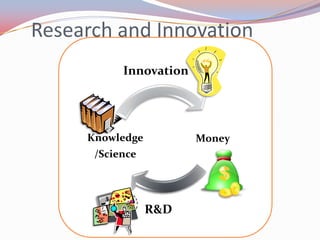
Research and Innovation
           Innovation


     Knowledge          Money
      /Science


                 R&D
Funding Schemes
There are three funding schemes at ASRF;
 Samih Darwazah Innovation Grants (SDIG),
 Proof of Concepts
 Student Competitions.
Funding Schemes
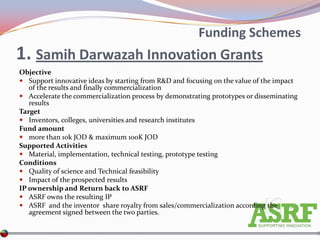
1. Samih Darwazah Innovation Grants
Objective
 Support innovative ideas by starting from R&D and focusing on the value of the impact
   of the results and finally commercialization
 Accelerate the commercialization process by demonstrating prototypes or disseminating
   results
Target
 Inventors, colleges, universities and research institutes
Fund amount
 more than 10k JOD & maximum 100K JOD
Supported Activities
 Material, implementation, technical testing, prototype testing
Conditions
 Quality of science and Technical feasibility
 Impact of the prospected results
IP ownership and Return back to ASRF
 ASRF owns the resulting IP
 ASRF and the inventor share royalty from sales/commercialization according the
   agreement signed between the two parties.
Funding Schemes
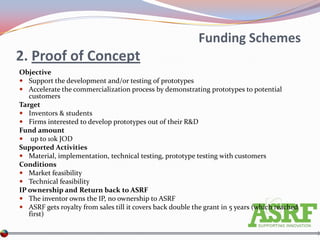
2. Proof of Concept
Objective
 Support the development and/or testing of prototypes
 Accelerate the commercialization process by demonstrating prototypes to potential
   customers
Target
 Inventors & students
 Firms interested to develop prototypes out of their R&D
Fund amount
 up to 10k JOD
Supported Activities
 Material, implementation, technical testing, prototype testing with customers
Conditions
 Market feasibility
 Technical feasibility
IP ownership and Return back to ASRF
 The inventor owns the IP, no ownership to ASRF
 ASRF gets royalty from sales till it covers back double the grant in 5 years (which reached
   first)
Funding Schemes
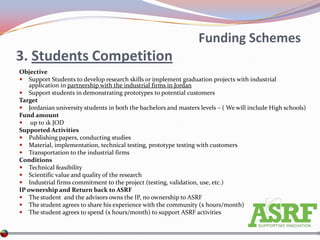
3. Students Competition
Objective
 Support Students to develop research skills or implement graduation projects with industrial
    application in partnership with the industrial firms in Jordan
 Support students in demonstrating prototypes to potential customers
Target
 Jordanian university students in both the bachelors and masters levels – ( We will include High schools)
Fund amount
 up to 1k JOD
Supported Activities
 Publishing papers, conducting studies
 Material, implementation, technical testing, prototype testing with customers
 Transportation to the industrial firms
Conditions
 Technical feasibility
 Scientific value and quality of the research
 Industrial firms commitment to the project (testing, validation, use, etc.)
IP ownership and Return back to ASRF
 The student and the advisors owns the IP, no ownership to ASRF
 The student agrees to share his experience with the community (x hours/month)
 The student agrees to spend (x hours/month) to support ASRF activities
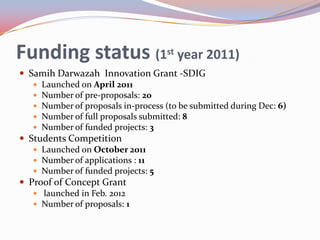
Funding status (1st year 2011)
 Samih Darwazah Innovation Grant -SDIG
    Launched on April 2011
    Number of pre-proposals: 20
    Number of proposals in-process (to be submitted during Dec: 6)
    Number of full proposals submitted: 8
    Number of funded projects: 3
 Students Competition
    Launched on October 2011
    Number of applications : 11
    Number of funded projects: 5
 Proof of Concept Grant
    launched in Feb. 2012
    Number of proposals: 1
Funded Projects
 Natural Plant Extract to Treat Multiple Sclerosis
    Private Sector
    Phase I: ~ 30,000
    Phase II: ??

 The Low-Cost Interactive Whiteboard
    Yarmouk University
    Phase I: 7, 000
    Phase II: ~ 15, 000

 Synthesis of a New Class of Iodobenzene .
    JUST University
    Joint funding with JUST
    Phase I: 7, 000
Funding
 Funding made through ASRF is primarily intended to
  provide financial support for the Principal Investigator (PI)
  and his/her team of researchers, students and technicians.

 3-5 awards are awarded annually each provide cash support
  for a limited period of one year, renewable up to a
  maximum of three years

 typically in the range of $1,000 - $100,000 US inclusive of
  overheads. This can vary depending on the type of research
  funded.
Call Types
Depending on the objectives of the call, the announced calls may make a
  distinction between different types of projects.

In general there will be announcements of three different types.
1. Specific Calls.
     These calls would address the needs of certain industries, or will be
     announced as a response to specific demands of the fast changing
     market.

2.   General Calls
     Calls that will support rising of general innovative ideas

3.   Special Calls.
     Calls that may be announced outside the schedule cycle, as a
     response to a sudden need, or to support a new idea.
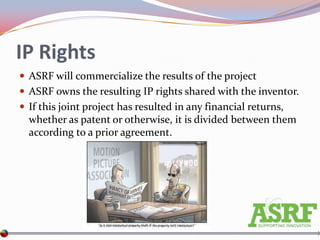
IP Rights
 ASRF will commercialize the results of the project
 ASRF owns the resulting IP rights shared with the inventor.
 If this joint project has resulted in any financial returns,
  whether as patent or otherwise, it is divided between them
  according to a prior agreement.
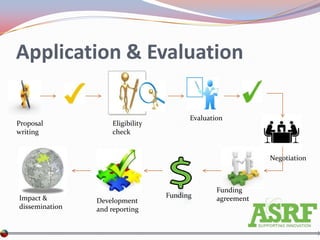
Application & Evaluation

                                        Evaluation
Proposal            Eligibility
writing             check


                                                            Negotiation


                                                Funding
Impact &                          Funding       agreement
                Development
dissemination   and reporting
Evaluation Reviewing Criteria
 Quality:
  Scientific and/or technological excellence, relevant to the
  topics/activities addressed by the call

 Implementation:
  Quality and efficiency of the implementation and the management

 Impact:
  The potential impact through the development, dissemination and use
  of project results

 Novelty:
  Innovation and novelty of the project will be tested passing through an
  IP office.
Thank You

Applied Scientific Research Fund

  • 2.
    ASRF  Applied ScientificResearch Fund (ASRF) is a non- government, non-profit organization, it is a spin-off from MonoJo, created by Samih Darwazah to promote the development of applied science and engineering ideas.  Our main target investigators are colleges and universities in the fields of medicine, engineering, natural sciences, technology and others.
  • 3.
    Research and Innovation Innovation Knowledge Money /Science R&D
  • 4.
    Funding Schemes There arethree funding schemes at ASRF;  Samih Darwazah Innovation Grants (SDIG),  Proof of Concepts  Student Competitions.
  • 5.
    Funding Schemes 1. SamihDarwazah Innovation Grants Objective  Support innovative ideas by starting from R&D and focusing on the value of the impact of the results and finally commercialization  Accelerate the commercialization process by demonstrating prototypes or disseminating results Target  Inventors, colleges, universities and research institutes Fund amount  more than 10k JOD & maximum 100K JOD Supported Activities  Material, implementation, technical testing, prototype testing Conditions  Quality of science and Technical feasibility  Impact of the prospected results IP ownership and Return back to ASRF  ASRF owns the resulting IP  ASRF and the inventor share royalty from sales/commercialization according the agreement signed between the two parties.
  • 6.
    Funding Schemes 2. Proofof Concept Objective  Support the development and/or testing of prototypes  Accelerate the commercialization process by demonstrating prototypes to potential customers Target  Inventors & students  Firms interested to develop prototypes out of their R&D Fund amount  up to 10k JOD Supported Activities  Material, implementation, technical testing, prototype testing with customers Conditions  Market feasibility  Technical feasibility IP ownership and Return back to ASRF  The inventor owns the IP, no ownership to ASRF  ASRF gets royalty from sales till it covers back double the grant in 5 years (which reached first)
  • 7.
    Funding Schemes 3. StudentsCompetition Objective  Support Students to develop research skills or implement graduation projects with industrial application in partnership with the industrial firms in Jordan  Support students in demonstrating prototypes to potential customers Target  Jordanian university students in both the bachelors and masters levels – ( We will include High schools) Fund amount  up to 1k JOD Supported Activities  Publishing papers, conducting studies  Material, implementation, technical testing, prototype testing with customers  Transportation to the industrial firms Conditions  Technical feasibility  Scientific value and quality of the research  Industrial firms commitment to the project (testing, validation, use, etc.) IP ownership and Return back to ASRF  The student and the advisors owns the IP, no ownership to ASRF  The student agrees to share his experience with the community (x hours/month)  The student agrees to spend (x hours/month) to support ASRF activities
  • 8.
    Funding status (1styear 2011)  Samih Darwazah Innovation Grant -SDIG  Launched on April 2011  Number of pre-proposals: 20  Number of proposals in-process (to be submitted during Dec: 6)  Number of full proposals submitted: 8  Number of funded projects: 3  Students Competition  Launched on October 2011  Number of applications : 11  Number of funded projects: 5  Proof of Concept Grant  launched in Feb. 2012  Number of proposals: 1
  • 9.
    Funded Projects  NaturalPlant Extract to Treat Multiple Sclerosis  Private Sector  Phase I: ~ 30,000  Phase II: ??  The Low-Cost Interactive Whiteboard  Yarmouk University  Phase I: 7, 000  Phase II: ~ 15, 000  Synthesis of a New Class of Iodobenzene .  JUST University  Joint funding with JUST  Phase I: 7, 000
  • 10.
    Funding  Funding madethrough ASRF is primarily intended to provide financial support for the Principal Investigator (PI) and his/her team of researchers, students and technicians.  3-5 awards are awarded annually each provide cash support for a limited period of one year, renewable up to a maximum of three years  typically in the range of $1,000 - $100,000 US inclusive of overheads. This can vary depending on the type of research funded.
  • 11.
    Call Types Depending onthe objectives of the call, the announced calls may make a distinction between different types of projects. In general there will be announcements of three different types. 1. Specific Calls. These calls would address the needs of certain industries, or will be announced as a response to specific demands of the fast changing market. 2. General Calls Calls that will support rising of general innovative ideas 3. Special Calls. Calls that may be announced outside the schedule cycle, as a response to a sudden need, or to support a new idea.
  • 12.
    IP Rights  ASRFwill commercialize the results of the project  ASRF owns the resulting IP rights shared with the inventor.  If this joint project has resulted in any financial returns, whether as patent or otherwise, it is divided between them according to a prior agreement.
  • 13.
    Application & Evaluation Evaluation Proposal Eligibility writing check Negotiation Funding Impact & Funding agreement Development dissemination and reporting
  • 14.
    Evaluation Reviewing Criteria Quality: Scientific and/or technological excellence, relevant to the topics/activities addressed by the call  Implementation: Quality and efficiency of the implementation and the management  Impact: The potential impact through the development, dissemination and use of project results  Novelty: Innovation and novelty of the project will be tested passing through an IP office.
  • 15.