Science Parks reality and the Italian
Association of Science Parks
Fabrizio Conicella
conicella@bioindustrypark.it
General Manager Bioindustry Park Silvano
Fumero SpA
Vicepresident bioPmed cluster association
Contents
• Science Park definition
• Science Park activities and advantages
• Science Park and startups
• Italian Association of Science Park
(APSTI)
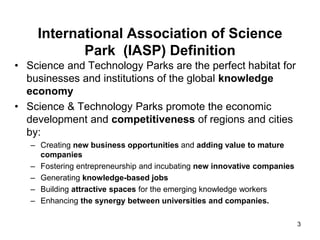
International Association of Science
Park (IASP) Definition
• Science and Technology Parks are the perfect habitat for
businesses and institutions of the global knowledge
economy
• Science & Technology Parks promote the economic
development and competitiveness of regions and cities
by:
– Creating new business opportunities and adding value to mature
companies
– Fostering entrepreneurship and incubating new innovative companies
– Generating knowledge-based jobs
– Building attractive spaces for the emerging knowledge workers
– Enhancing the synergy between universities and companies.
3
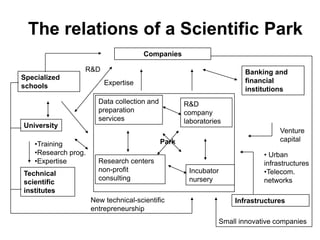
The relations of a Scientific Park
Companies
Banking and
financial
institutions
Specialized
schools
University
Technical
scientific
institutes
Infrastructures
Data collection and
preparation
services
R&D
company
laboratories
Incubator
nursery
Research centers
non-profit
consulting
Park
Small innovative companies
Venture
capital
• Urban
infrastructures
•Telecom.
networks
R&D
Expertise
•Training
•Research prog.
•Expertise
New technical-scientific
entrepreneurship
A more ‘straightforward’ and
pragmatic definition
• Infrastructures: A piece of serviced land and
buildings, hosting:
• R&D labs, possibly university departments
• Technology-based firms
• Startup and spin-off companies (within incubator
facilities)
• Services: A staff dedicated to establish and
develop sustainable relationship between the
scientific community and businesses through e.g.
strategic advice, technology transfer support and
contract research services 5
Why a Science &Technology Park
• Improving competitiveness:
• We all are part of a worldwide knowledge economy
• No country can be competitive in the mid-term only
through low labour costs
• Innovation is the key: the STP is expected to bridge the
gap between research and industry
• Beneficiaries of improved competitiveness:
• Business / industry: new sectors (ICT, biotech) as well as
‘traditional’ sectors (agrofood, textile, mechanical engineering)
• City / Region where the STP is established (and the country)
6
• Creating knowledge-based jobs:
• Through support to technology-based businesses,
start-ups and spin-offs: opportunities for new
highly qualified jobs
• Beneficiaries:
• Ph. D and post docs
• Also Master levels
• University : attracting more high level students because
of future job opportunities
• The country itself: general upgrading of human resources
7
Why a Science &Technology Park
Science Parks trends
• And now ? What are the main trends ?
• The concept of STP is getting closer to the concept of cluster:
• "Geographic concentrations of interconnected companies, specialised
suppliers, service providers, firms in related industries, and associated
institutions (for example, universities, standards agencies, and trade
associations) in particular fields that compete but also co-operate“
(Michaël Porter)
• STP can be instruments for boosting innovation within clusters,
and in some cases,, for building up a cluster
• The ‘Triple Helix’ model as a basis for boosting innovation in a
region:
• University + research /
• Business-industry
• Public authorities
• (+finance)
8
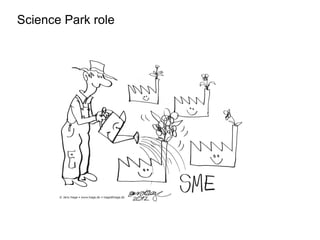
Science Park role
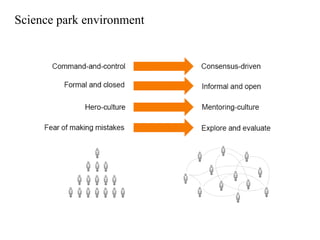
Science park environment
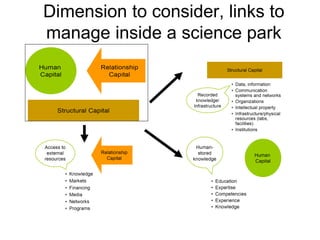
Dimension to consider, links to
manage inside a science park
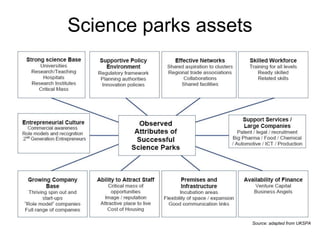
Science parks assets
Source: adapted from UKSPA
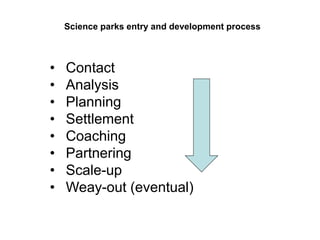
Science parks entry and development process
• Contact
• Analysis
• Planning
• Settlement
• Coaching
• Partnering
• Scale-up
• Weay-out (eventual)
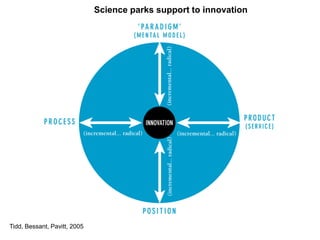
Tidd, Bessant, Pavitt, 2005
Science parks support to innovation
15
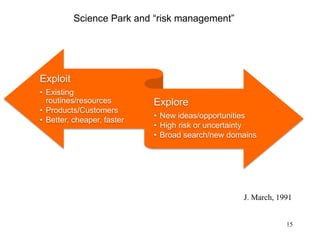
J. March, 1991
Exploit
• Existing
routines/resources
• Products/Customers
• Better, cheaper, faster
Explore
• New ideas/opportunities
• High risk or uncertainty
• Broad search/new domains
Exploit
• Existing
routines/resources
• Products/Customers
• Better, cheaper, faster
Explore
• New ideas/opportunities
• High risk or uncertainty
• Broad search/new domains
Science Park and “risk management”
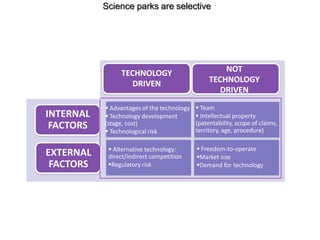
 Advantages of the technology
 Technology development
(stage, cost)
 Technological risk
TECHNOLOGY
DRIVEN
NOT
TECHNOLOGY
DRIVEN
INTERNAL
FACTORS
EXTERNAL
FACTORS
 Team
 Intellectual property
(patentability, scope of claims,
territory, age, procedure)
 Alternative technology:
direct/indirect competition
Regulatory risk
 Freedom-to-operate
Market size
Demand for technology
Science parks are selective
1
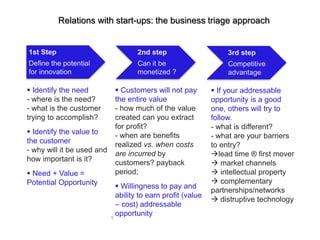
 Identify the need
- where is the need?
- what is the customer
trying to accomplish?
 Identify the value to
the customer
- why will it be used and
how important is it?
 Need + Value =
Potential Opportunity
 Customers will not pay
the entire value
- how much of the value
created can you extract
for profit?
- when are benefits
realized vs. when costs
are incurred by
customers? payback
period;
 Willingness to pay and
ability to earn profit (value
– cost) addressable
opportunity
 If your addressable
opportunity is a good
one, others will try to
follow.
- what is different?
- what are your barriers
to entry?
lead time ® first mover
 market channels
 intellectual property
 complementary
partnerships/networks
 distruptive technology
1st Step
Define the potential
for innovation
2nd step
Can it be
monetized ?
3rd step
Competitive
advantage
Relations with start-ups: the business triage approach
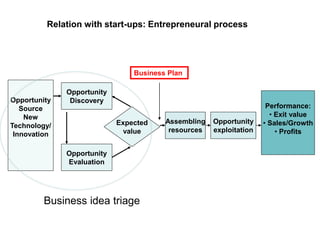
Opportunity
Source
New
Technology/
Innovation
Opportunity
Discovery
Opportunity
Evaluation
Expected
value
Assembling
resources
Opportunity
exploitation
Performance:
• Exit value
• Sales/Growth
• Profits
Business Plan
Business idea triage
Relation with start-ups: Entrepreneural process
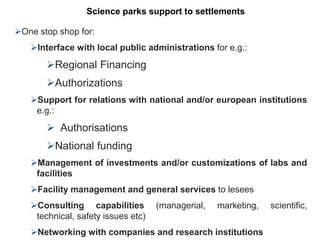
One stop shop for:
Interface with local public administrations for e.g.:
Regional Financing
Authorizations
Support for relations with national and/or european institutions
e.g.:
 Authorisations
National funding
Management of investments and/or customizations of labs and
facilities
Facility management and general services to lesees
Consulting capabilities (managerial, marketing, scientific,
technical, safety issues etc)
Networking with companies and research institutions
Science parks support to settlements
Italian Science
Park Association
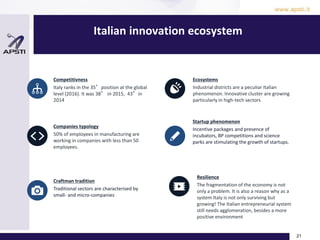
Italian innovation ecosystem
21
Competitivness
Italy ranks in the 35°position at the global
level (2016). It was 38° in 2015, 43°in
2014
Companies typology
50% of employees in manufacturing are
working in companies with less than 50
employees.
Craftman tradition
Traditional sectors are characterised by
small- and micro-companies
Ecosystems
Industrial districts are a peculiar Italian
phenomenon. Innovative cluster are growing
particularly in high-tech sectors
Startup phenomenon
Incentive packages and presence of
incubators, BP competitions and science
parks are stimulating the growth of startups.
Resilience
The fragmentation of the economy is not
only a problem. It is also a reason why as a
system Italy is not only surviving but
growing! The Italian entrepreneurial system
still needs agglomeration, besides a more
positive environment
Science park system in Italy
22
A key hub between the goal of innovating the manufacturing world and
the growth of innovative ecosystems
Conceived to support companies in the startup, scale-up and maturity
stages
Italian science parks are an opportunity for high potential companies to
concentrate in a single location and organisation the know-how, the
services and the network that they need to grow at the global level
www.apsti.it
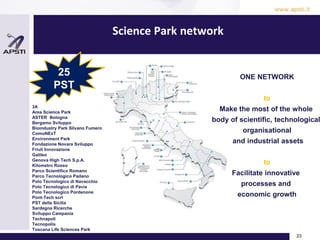
Science Park network
23
3A
Area Science Park
ASTER Bologna
Bergamo Sviluppo
Bioindustry Park Silvano Fumero
ComoNExT
Environment Park
Fondazione Novara Sviluppo
Friuli Innovazione
Galileo
Genova High Tech S.p.A.
Kilometro Rosso
Parco Scientifico Romano
Parco Tecnologico Padano
Polo Tecnologico di Navacchio
Polo Tecnologico di Pavia
Polo Tecnologico Pordenone
Pont-Tech scrl
PST della Sicilia
Sardegna Ricerche
Sviluppo Campania
Technapoli
Tecnopolis
Toscana Life Sciences Park
Trentino Sviluppo
ONE NETWORK
to
Make the most of the whole
body of scientific, technological
organisational
and industrial assets
to
Facilitate innovative
processes and
economic growth
25
PST
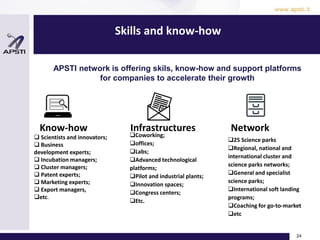
Skills and know-how
24
APSTI network is offering skils, know-how and support platforms
for companies to accelerate their growth
Know-how
 Scientists and innovators;
 Business
development experts;
 Incubation managers;
 Cluster managers;
 Patent experts;
 Marketing experts;
 Export managers,
etc.
Infrastructures
Coworking;
offices;
Labs;
Advanced technological
platforms;
Pilot and industrial plants;
Innovation spaces;
Congress centers;
Etc.
Network
25 Science parks
Regional, national and
international cluster and
science parks networks;
General and specialist
science parks;
International soft landing
programs;
Coaching for go-to-market
etc
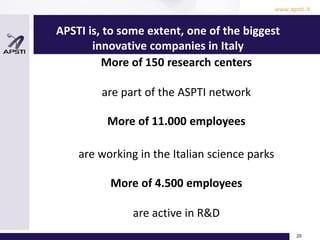
APSTI is, to some extent, one of the biggest
innovative companies in Italy
25
More of 150 research centers
are part of the ASPTI network
More of 11.000 employees
are working in the Italian science parks
More of 4.500 employees
are active in R&D
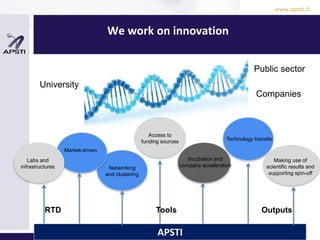
We work on innovation
26
Companies
University
Public sector
APSTI
Tools OutputsRTD
Market-driven
Networking
and clustering
Technology transfer
Access to
funding sources
Incubation and
company acceleration
Labs and
infrastructures
Making use of
scientific results and
supporting spin-off
27
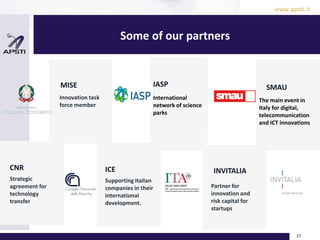
Strategic
agreement for
technology
transfer
CNR
Supporting Italian
companies in their
international
development.
ICE
International
network of science
parks
IASP
Partner for
innovation and
risk capital for
startups
INVITALIA
Innovation task
force member
MISE
Some of our partners
SMAUCards
The main event in
Italy for digital,
telecommunication
and ICT innovations
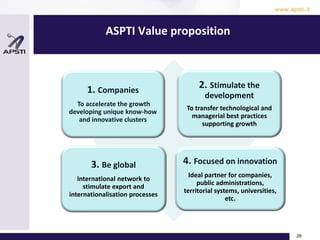
ASPTI Value proposition
28
1. Companies
To accelerate the growth
developing unique know-how
and innovative clusters
2. Stimulate the
development
To transfer technological and
managerial best practices
supporting growth
3. Be global
International network to
stimulate export and
internationalisation processes
4. Focused on innovation
Ideal partner for companies,
public administrations,
territorial systems, universities,
etc.
PTP Science Park,
via Einstein, 26900 Lodi (Italia)
E-Mail : info@apsti.it - www.apsti.it
Tel: 0371 4662 212 / 229
Managing Board Member
Fabrizio Conicella
conicella@bioindustrypark.it

#ISVwebinars n°2: APSTI - Fabrizio Conicella

  • 1.
    Science Parks realityand the Italian Association of Science Parks Fabrizio Conicella conicella@bioindustrypark.it General Manager Bioindustry Park Silvano Fumero SpA Vicepresident bioPmed cluster association
  • 2.
    Contents • Science Parkdefinition • Science Park activities and advantages • Science Park and startups • Italian Association of Science Park (APSTI)
  • 3.
    International Association ofScience Park (IASP) Definition • Science and Technology Parks are the perfect habitat for businesses and institutions of the global knowledge economy • Science & Technology Parks promote the economic development and competitiveness of regions and cities by: – Creating new business opportunities and adding value to mature companies – Fostering entrepreneurship and incubating new innovative companies – Generating knowledge-based jobs – Building attractive spaces for the emerging knowledge workers – Enhancing the synergy between universities and companies. 3
  • 4.
    The relations ofa Scientific Park Companies Banking and financial institutions Specialized schools University Technical scientific institutes Infrastructures Data collection and preparation services R&D company laboratories Incubator nursery Research centers non-profit consulting Park Small innovative companies Venture capital • Urban infrastructures •Telecom. networks R&D Expertise •Training •Research prog. •Expertise New technical-scientific entrepreneurship
  • 5.
    A more ‘straightforward’and pragmatic definition • Infrastructures: A piece of serviced land and buildings, hosting: • R&D labs, possibly university departments • Technology-based firms • Startup and spin-off companies (within incubator facilities) • Services: A staff dedicated to establish and develop sustainable relationship between the scientific community and businesses through e.g. strategic advice, technology transfer support and contract research services 5
  • 6.
    Why a Science&Technology Park • Improving competitiveness: • We all are part of a worldwide knowledge economy • No country can be competitive in the mid-term only through low labour costs • Innovation is the key: the STP is expected to bridge the gap between research and industry • Beneficiaries of improved competitiveness: • Business / industry: new sectors (ICT, biotech) as well as ‘traditional’ sectors (agrofood, textile, mechanical engineering) • City / Region where the STP is established (and the country) 6
  • 7.
    • Creating knowledge-basedjobs: • Through support to technology-based businesses, start-ups and spin-offs: opportunities for new highly qualified jobs • Beneficiaries: • Ph. D and post docs • Also Master levels • University : attracting more high level students because of future job opportunities • The country itself: general upgrading of human resources 7 Why a Science &Technology Park
  • 8.
    Science Parks trends •And now ? What are the main trends ? • The concept of STP is getting closer to the concept of cluster: • "Geographic concentrations of interconnected companies, specialised suppliers, service providers, firms in related industries, and associated institutions (for example, universities, standards agencies, and trade associations) in particular fields that compete but also co-operate“ (Michaël Porter) • STP can be instruments for boosting innovation within clusters, and in some cases,, for building up a cluster • The ‘Triple Helix’ model as a basis for boosting innovation in a region: • University + research / • Business-industry • Public authorities • (+finance) 8
  • 9.
  • 10.
  • 11.
    Dimension to consider,links to manage inside a science park
  • 12.
    Science parks assets Source:adapted from UKSPA
  • 13.
    Science parks entryand development process • Contact • Analysis • Planning • Settlement • Coaching • Partnering • Scale-up • Weay-out (eventual)
  • 14.
    Tidd, Bessant, Pavitt,2005 Science parks support to innovation
  • 15.
    15 J. March, 1991 Exploit •Existing routines/resources • Products/Customers • Better, cheaper, faster Explore • New ideas/opportunities • High risk or uncertainty • Broad search/new domains Exploit • Existing routines/resources • Products/Customers • Better, cheaper, faster Explore • New ideas/opportunities • High risk or uncertainty • Broad search/new domains Science Park and “risk management”
  • 16.
     Advantages ofthe technology  Technology development (stage, cost)  Technological risk TECHNOLOGY DRIVEN NOT TECHNOLOGY DRIVEN INTERNAL FACTORS EXTERNAL FACTORS  Team  Intellectual property (patentability, scope of claims, territory, age, procedure)  Alternative technology: direct/indirect competition Regulatory risk  Freedom-to-operate Market size Demand for technology Science parks are selective
  • 17.
    1  Identify theneed - where is the need? - what is the customer trying to accomplish?  Identify the value to the customer - why will it be used and how important is it?  Need + Value = Potential Opportunity  Customers will not pay the entire value - how much of the value created can you extract for profit? - when are benefits realized vs. when costs are incurred by customers? payback period;  Willingness to pay and ability to earn profit (value – cost) addressable opportunity  If your addressable opportunity is a good one, others will try to follow. - what is different? - what are your barriers to entry? lead time ® first mover  market channels  intellectual property  complementary partnerships/networks  distruptive technology 1st Step Define the potential for innovation 2nd step Can it be monetized ? 3rd step Competitive advantage Relations with start-ups: the business triage approach
  • 18.
  • 19.
    One stop shopfor: Interface with local public administrations for e.g.: Regional Financing Authorizations Support for relations with national and/or european institutions e.g.:  Authorisations National funding Management of investments and/or customizations of labs and facilities Facility management and general services to lesees Consulting capabilities (managerial, marketing, scientific, technical, safety issues etc) Networking with companies and research institutions Science parks support to settlements
  • 20.
  • 21.
    Italian innovation ecosystem 21 Competitivness Italyranks in the 35°position at the global level (2016). It was 38° in 2015, 43°in 2014 Companies typology 50% of employees in manufacturing are working in companies with less than 50 employees. Craftman tradition Traditional sectors are characterised by small- and micro-companies Ecosystems Industrial districts are a peculiar Italian phenomenon. Innovative cluster are growing particularly in high-tech sectors Startup phenomenon Incentive packages and presence of incubators, BP competitions and science parks are stimulating the growth of startups. Resilience The fragmentation of the economy is not only a problem. It is also a reason why as a system Italy is not only surviving but growing! The Italian entrepreneurial system still needs agglomeration, besides a more positive environment
  • 22.
    Science park systemin Italy 22 A key hub between the goal of innovating the manufacturing world and the growth of innovative ecosystems Conceived to support companies in the startup, scale-up and maturity stages Italian science parks are an opportunity for high potential companies to concentrate in a single location and organisation the know-how, the services and the network that they need to grow at the global level www.apsti.it
  • 23.
    Science Park network 23 3A AreaScience Park ASTER Bologna Bergamo Sviluppo Bioindustry Park Silvano Fumero ComoNExT Environment Park Fondazione Novara Sviluppo Friuli Innovazione Galileo Genova High Tech S.p.A. Kilometro Rosso Parco Scientifico Romano Parco Tecnologico Padano Polo Tecnologico di Navacchio Polo Tecnologico di Pavia Polo Tecnologico Pordenone Pont-Tech scrl PST della Sicilia Sardegna Ricerche Sviluppo Campania Technapoli Tecnopolis Toscana Life Sciences Park Trentino Sviluppo ONE NETWORK to Make the most of the whole body of scientific, technological organisational and industrial assets to Facilitate innovative processes and economic growth 25 PST
  • 24.
    Skills and know-how 24 APSTInetwork is offering skils, know-how and support platforms for companies to accelerate their growth Know-how  Scientists and innovators;  Business development experts;  Incubation managers;  Cluster managers;  Patent experts;  Marketing experts;  Export managers, etc. Infrastructures Coworking; offices; Labs; Advanced technological platforms; Pilot and industrial plants; Innovation spaces; Congress centers; Etc. Network 25 Science parks Regional, national and international cluster and science parks networks; General and specialist science parks; International soft landing programs; Coaching for go-to-market etc
  • 25.
    APSTI is, tosome extent, one of the biggest innovative companies in Italy 25 More of 150 research centers are part of the ASPTI network More of 11.000 employees are working in the Italian science parks More of 4.500 employees are active in R&D
  • 26.
    We work oninnovation 26 Companies University Public sector APSTI Tools OutputsRTD Market-driven Networking and clustering Technology transfer Access to funding sources Incubation and company acceleration Labs and infrastructures Making use of scientific results and supporting spin-off
  • 27.
    27 Strategic agreement for technology transfer CNR Supporting Italian companiesin their international development. ICE International network of science parks IASP Partner for innovation and risk capital for startups INVITALIA Innovation task force member MISE Some of our partners SMAUCards The main event in Italy for digital, telecommunication and ICT innovations
  • 28.
    ASPTI Value proposition 28 1.Companies To accelerate the growth developing unique know-how and innovative clusters 2. Stimulate the development To transfer technological and managerial best practices supporting growth 3. Be global International network to stimulate export and internationalisation processes 4. Focused on innovation Ideal partner for companies, public administrations, territorial systems, universities, etc.
  • 29.
    PTP Science Park, viaEinstein, 26900 Lodi (Italia) E-Mail : info@apsti.it - www.apsti.it Tel: 0371 4662 212 / 229 Managing Board Member Fabrizio Conicella conicella@bioindustrypark.it