Local and Regional Innovation
OECD Capacity Building Seminar
Supporting SMEs in a Time of Crisis
Jay Mitra
13 October, 2009
Definitional Issues


Entrepreneurship = new opportunity identification & realisation


(for the purpose of this paper ‘E’ = new business creation)



Innovation = successful exploitation of a new idea



Culture = a set of attitudes/beliefs common to a group



Culture = a set of activities concerned with moral, aesthetic, and
intellectual aspects of life (activities include some element of
creativity in production, communication of meaning & intellectual
property)



Culture = a diverse way of life (from beef steak to Beethoven to
Eminem)




Entrepreneurial Culture = diverse set of attitudes, beliefs, systems,
institutions and structures that are connected together with a view to
supporting new venture creation, innovation and growth in a
particular environment & in regional innovation systems.
Why Innovation Systems?



Innovation is non-linear but involves interaction
between many actors



Interest resulting from research on the success of
the Japanese model (Freeman, 1987)



Emergence of “innovation systems” models
(Freeman, 1987)
Key Models of Innovation Systems


National innovation systems (Freeman, 1987; Lundvall, 2007)



Regional innovation systems (Cooke 1992; Braczyk et al.,
1998)
Some Stylised Facts and Assumptions
F/A 1: Innovation = source of economic growth
 The

endogenous model)– critical importance of
technological change in economic growth ( total
factor productivity accounted for 87.5% of
economic growth – Solow, 1957) Romer, 1990,
OECD 2003

 Strong

emphasis on role of R&D, skilled labour
& knowledge spillovers – greater productivity,
product quality dependent on innovation
Some Stylised Facts and Assumptions
F/A 2: Innovation is not evenly spread but spatially
concentrated
Well-known concentrations = Oxford; Cambridge; SE, UK;
Lombardy; Bangalore, Shanghai
High urban focus – OCED countries
Significant local differences within countries (Camagni &
Capello, 1997; Keeble, 1996; Acs, 2002)
Different measures – innovation output (patent
applications) & input/output (employment in high
technology manufacturing & knowledge-intensive
industries)
Subnational Variations in European Patent Applications, 2002

Source: adapted from Eurostat

Top Territories

Patent
Applications
per million
inhabitants.

Bottom territories

Patent
Applications
per million
inhabitants

Zuid Nederland,
Netherlands

797

Noreste, Spain

34

Baden Wuttenburg,
Germany

597

Sud, Italy

14

Bayern, Germany

473

Attiki, Greece

13

Isole, Italy

11

Ile de France, France 313
Maner Suomi, Finland

312

French Overseas
Departments

6

Eastern, UK

253

Continente, Portugal

5

Westosterreich, Austria

223

Kentriki Ellada, Greece

4

SE, UK

205

Madeira, Portugal

1

Mean

131

Acores, Portugal

0

Median

96
Subnational Variations in Innovation-Related Employment- High Tech
Manufacturing , 2003

Source: Eurostat

Top territories

Employees in
HT
manufacturing
(% of total
Manufacturing
employees)

Bottom Territories

Employees in
HT
manufacturing
(% of total
Manufacturing
employees)

Aland, Finland

69

Centro, Spain

38

London, UK

61

Sur, Spain

38

Manner Suomi, Finland

59

Continente, Portugal

37

Hamburg, Germany

57

Voreia Ellada, Greece

36

SE, UK

57

Acores, Portugal

34

Brussels, Belgium

56

Canarias, Spain

33

Ile de France, France

56

Madeira, Portugal

32

SW, UK

55

Kentriki Ellada, Greece

29

Eastern, UK

54

Nisia Aigaiou, Kriti,
Greece

28

Mean

47

Median

48
Subnational Variations in Innovation-Related Employment –
Knowledge Intensive Industries
Bottom Territories

A*

17

Vlaams Gewest,
Belgium

5

Berlin, Germany

16

WM, UK

5

Scotland, UK

14

Sud, Italy

4

Schieswig Holstein,
Germany

14

Centro, Italy

4

Dunantul, Hungary

13

Yorkshire & Humber,
UK

4

Ile de France, France

13

Attiki, Greece

4

Kozep Magyarorszag,
Hungary

12

Este, Spain

3

Sudosterrrich, Austria

11

Sur, Spain

2

Baden Wurttermburg,
Germany

11

Noreste, Spain

2

Mean

8

Continente, Portugal

2

Median

7

* A = Employees In KI services
as % of total employees

A*

SE, UK
Source: Eurostata

Top Territories
Some Stylised Facts and Assumptions
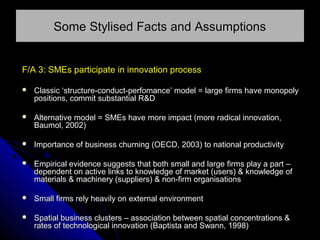
F/A 3: SMEs participate in innovation process


Classic ‘structure-conduct-perfomance’ model = large firms have monopoly
positions, commit substantial R&D



Alternative model = SMEs have more impact (more radical innovation,
Baumol, 2002)



Importance of business churning (OECD, 2003) to national productivity



Empirical evidence suggests that both small and large firms play a part –
dependent on active links to knowledge of market (users) & knowledge of
materials & machinery (suppliers) & non-firm organisations



Small firms rely heavily on external environment



Spatial business clusters – association between spatial concentrations &
rates of technological innovation (Baptista and Swann, 1998)
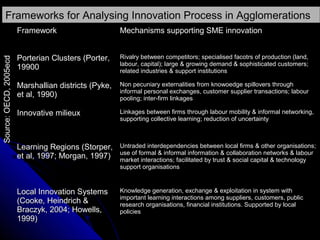
Frameworks for Analysing Innovation Process in Agglomerations

Source: OECD, 2005ecd

Framework

Mechanisms supporting SME innovation

Porterian Clusters (Porter,
19900

Rivalry between competitors; specialised facotrs of production (land,
labour, capital); large & growing demand & sophisticated customers;
related industries & support institutions

Marshallian districts (Pyke,
et al, 1990)

Non pecuniary externalities from knowoedge spillovers through
informal personal exchanges, customer supplier transactions; labour
pooling; inter-firm linkages

Innovative milieux

Linkages between firms through labour mobility & informal networking,
supporting collective learning; reduction of uncertainty

Learning Regions (Storper,
et al, 1997; Morgan, 1997)

Untraded interdependencies between local firms & other organisations;
use of formal & informal information & collaboration networks & labour
market interactions; facilitated by trust & social capital & technology
support organisations

Local Innovation Systems
(Cooke, Heindrich &
Braczyk, 2004; Howells,
1999)

Knowledge generation, exchange & exploitation in system with
important learning interactions among suppliers, customers, public
research organisations, financial institutions. Supported by local
policies
Why is a Regional Innovation System important?



Innovation = 80% of productivity growth and comparable figure for GDP
(Freeman, 1994)



Regional disparities in innovation & GDP (Acs, 2002; Cooke et al., 2002)



Innovation = higher in regions with more knowledge generation e.g. R&D by
firms & institutions (Acs, 2002)



Region = new focus of economic policy (Cooke et al. 2003)
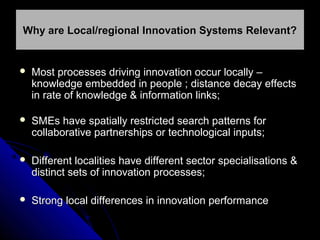
Why are Local/regional Innovation Systems Relevant?



Most processes driving innovation occur locally –
knowledge embedded in people ; distance decay effects
in rate of knowledge & information links;



SMEs have spatially restricted search patterns for
collaborative partnerships or technological inputs;



Different localities have different sector specialisations &
distinct sets of innovation processes;



Strong local differences in innovation performance
Market Failures and SME Innovation
Nature of Failure

Potential local policy
actions

Information failure

Source: OECD, 2005

Type of Failure

Barriers to flow of information on
innovation opps. Lead to missing markets
& constraints for SMEs in obtaining
finance, partners, etc.

Promotion of networks &
partnerships. Public support to
SME research projects

Public goods

Undersupply of non rival goods & non
excludable goods that contribute to SME
innovation – e.g. university research

Public policy of basic
innovation infrastructure locally

Externalities

Undersupply of activities that benefit
others in addition to producers – e.g.
training of highly skilled labour; reduced
incentives to SME innovation

Direct public support for SME
research projects for training of
highly skilled labour in local
specialisms

Monopolies

Incumbent firms restrict entry through
branding & other behaviour, constraining
ability of innovative, new & small firms to
enter market & compete

“Second best” policies
supporting SMEs in order to
“level the playing field”.
Support of new firm entry in
local sector specialsims.

Indivisibilities

Indivisible cost in creating knowledge. If
marginal cost pricing is used fixed cost is
irrecoverable, constraining production of
knowledge by SMEs & others

Public funding of public &
private research projects with
Potential spin offs for SMEs
System Failures & SME Innovation

source: OECD, 2005, Lundvall & Borras, 1997

Type of Failure

Nature of Failure

Potential Local policy action

Infrastructure Provision

Underinvestment in local infrastructure with
which firms interact – e.g. communications
infrastructure

Incentives for private or public communications &
knowledge transfer infrastructures

Transition & lock in
failures

Firms & localities are highly capable in their own
technological areas but in related ones. Unable
to switch from existing technologies

Incentives for technological activities that broaden
firm & organisational capabilities & nurturing of
emerging systems

Institutional failures

Institutional & regulatory context has unexpected
negative impact

Monitoring & adjusting local institutions &
regulations

Learning failures

Firms may not be able to learn rapidly &
effectively

Developing firm capabilities through human capital
programmes, support for R&D 7 technology
dissemination policies. Opening channels to
knowledge sources

Suboptimal balance bet.
exploitation &
exploration

Local innovation concentrations may work too
much on exploitation & not enough on
exploration (or vice versa)

Using public procurement & funding to support
exploration, introducing diversity in industry by
supporting new & small firms; supporting variety
through dissemination of codified information

Suboptimal balance bet.
selection & variety

Local innovation concentrations may have too
rapid selection whereby underperforming firms
close, & too little variety, in terms of firms &
activities carrying potentially promising
technologies

Strengthening competition policies & use industrial
& technological policies to support new firms
carrying potentially promising technologies ( or
weaken competition policies & limit use of
industrial & technological policies supporting firms
that are likely to fail)

Appropriability traps

Too stringent appropriability may limit
spread of knowledge within innovation
system

Encouraging local knowledge transfers

Complementarities
failures

The appropriate complementarities may not be
present in local innovation system

Formation of R&D networks; industry university
interfaces & bridging systems
What is Regional Innovation System?



“Regional innovation system consists of interacting






knowledge generation
and
exploitation sub-systems linked to global, national and other
regional innovation systems for commercializing new
knowledge” (Cooke, 2004 p.3)
Emphasis: Firms in interaction with other firms & knowledge
infrastructure at regional level.
Regional Innovation Systems (RIS)
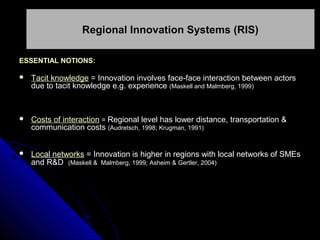
ESSENTIAL NOTIONS:


Tacit knowledge = Innovation involves face-face interaction between actors
due to tacit knowledge e.g. experience (Maskell and Malmberg, 1999)



Costs of interaction = Regional level has lower distance, transportation &
communication costs (Audretsch, 1998; Krugman, 1991)



Local networks = Innovation is higher in regions with local networks of SMEs
and R&D (Maskell & Malmberg, 1999; Asheim & Gertler, 2004)
Sub-Systems of RIS

1.

Knowledge Generation:



Universities & Colleges for scientific & technical training



2.

Public & private research laboratories

Firms that transfer knowledge

Knowledge Exploitation:


Firms with regional & global value chain relationships



Venture capitalists



Consultants
Adapted from: Cooke et. al., (2003)
Basic Arguments of RIS

1.

Innovation process is social



Innovation = involves face-face interaction
between actors internal & external to the firm (Maskell
and Malmberg, 1999)
Basic Arguments of RIS

2. Region facilitates interaction


Region = lower distance, transportation & communication costs for
interaction (Krugman, 1993)



Face-to-face interaction and cooperation are easier at the regional
level
Basic Arguments of RIS
3. Regional concentration of R&D firms & institutions boosts
innovation



Combination of knowledge generation (e.g. by universities) &
exploitation (by SMEs with local networks) boosts innovation



Local concentration increases capacity to use external knowledge
for innovation

Adapted from: Cooke et al., 2003 ; Asheim & Gertler, 2004
Basic Arguments of RIS
4. External Links boost innovation


Entering global markets



Sourcing Knowledge from global sources (e.g. R&D)
Links between RIS and Entrepreneurship


Entrepreneurship – requires knowledge and resource seeking (e.g.
technical knowledge, finance, consultancy etc.)



Innovative activity of firms and entrepreneurs are largely based on localised
resources (Asheim et. al., 2003; Cooke et. al., 2000)



RIS provides access to critical resources for entrepreneurship within
proximity
RIS Public Governance System


Grass roots – SME dominated or industrial district (less public
governance)



Networked – Associated between regional governance & industry
pronounced



Centralist – Governance is strongly centralised
Cooke et. al (2003)
Problem of RIS: Few Regions in the world are high-tech clusters
Typology of Regional Innovation Systems

California

North-Rhine Westphalia

Mid-Pyrenees

Interactive

n o t av o n n s s e n s u B
i
i
i

Globalist

Catalonia

Baden-Wurttemberg

Quebec

Localist

Tuscany

Tampere

Northern Ireland

Grassroots

Networked

Centralist

Public Governance System
Source: Braczyk et. al. 1998; Cooke et. al. (2003 p.368)
Developing Innovation Systems


Identify Strong Sectors/Candidate Clusters



Investigate Regional Clusters



Identify Competitive Advantage



Identify Innovation Practices



Cooperative or Individualistic?



Innovation Support System
Conditions for Assessing RIS

1.

Infrastructure issues

2.

Superstructure
Conditions for Higher & Lower RIS Potential
Higher RIS potential
Infrastructure level
 Regional private equity
 Policy influence on infrastructure
 Regional university-industry strategy
Superstructural level
Institutional dimension
 Co-operative culture
 Interactive learning
 Associative consensus
Organisational Dimension (firms)
 Worker mentoring
 Externalisation
 Interactive innovation
Organisational dimension (policy)
 Monitoring
 Consultative
 Networking

Lower RIS potential
















Decentralised spending
National financing organisation
Limited influence on infrastructure

Competitive culture
Individualistic
Institutional dissension

Self acquired skills
Internationalisation
Stand alone R&D

Reacting
Authoritative
Hierarchical
Adapted from: Cooke et. al. (2001)
Regional Enterprise Support System for Innovation
National Policy
Ministrics
Programme
approval

Assembly

Legitimation
Information

National
technology
agency

Information

Advice

Reporting

Requirement

Proposals

National
Research
Institutes

Information

Strategy
SME Agency
FDI Agency

Business associates
Regional steering
Committee

Trade Board

Universities

Measures
Social partners
Venture Capitalists
Technology Consultants

Training agency

Coordination
Local Cooperative Forum

Research Community
Local Government
Chambers of commerce

Source: Braczyk, Cooke and Heinreich, eds. (1998)
Policy Levers to Strengthen Local Innovation Systems
Creation & strengthening of
local networks
Encouraging local innovation
collaborations
Creation of bridging institutions
Ensuring openness of local
innovation system to sources of
knowledge outside system

Connectivities

Assets

Public investment in technology
development
Creation of S&T parks
Attracting inward investment
Supporting access to finance

Capabilities
Education & Training of individuals
Advice, training & consultancy to SMEs
Influencing motivation & abilities of universities &
Research organisations in collaborative research with SMEs
Comparison RIS & other Regional Models
Concepts

Regional
cluster

Definitions and differences

•

A concentration o f ‘interdependent’ firms within the same or adjacent
industrial sectors in a small geographic area

Regional
innovation
network

•

Increasingly organised co-operation (agreements) between firms, stimulated
by trust, norms and conventions

Regional
innovation
system

•

Co-operation between firms and different organisations for knowledge
development and diffusion

•

Increasingly organised co-operation with a broader set of civil organisations
and public authorities that are embedded in social and regional structures.

Learning
regions
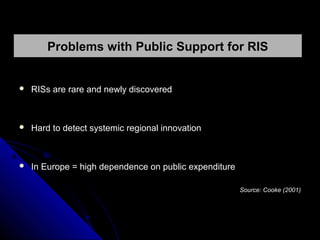
Problems with Public Support for RIS



RISs are rare and newly discovered



Hard to detect systemic regional innovation



In Europe = high dependence on public expenditure
Source: Cooke (2001)
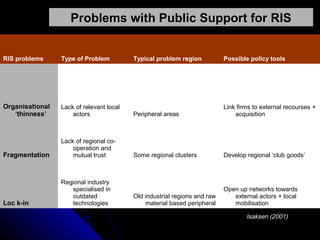
Problems with Public Support for RIS
RIS problems

Type of Problem

Typical problem region

Possible policy tools

Organisational
‘thinness’

Lack of relevant local
actors

Peripheral areas

Link firms to external recourses +
acquisition

Fragmentation

Lack of regional cooperation and
mutual trust

Some regional clusters

Develop regional ‘club goods’

Loc k-in

Regional industry
specialised in
outdated
technologies

Old industrial regions and raw
material based peripheral

Open up networks towards
external actors + local
mobilisation

Isaksen (2001)
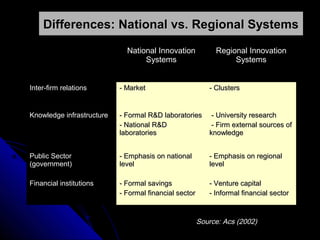
Differences: National vs. Regional Systems
National Innovation
Systems

Regional Innovation
Systems

Inter-firm relations

- Market

- Clusters

Knowledge infrastructure

- Formal R&D laboratories
- National R&D
laboratories

- University research
- Firm external sources of
knowledge

Public Sector
(government)

- Emphasis on national
level

- Emphasis on regional
level

Financial institutions

- Formal savings
- Formal financial sector

- Venture capital
- Informal financial sector

Source: Acs (2002)
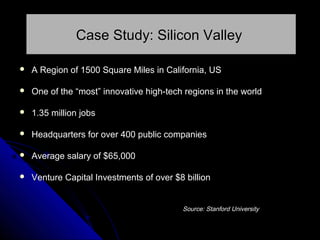
Case Study: Silicon Valley


A Region of 1500 Square Miles in California, US



One of the “most” innovative high-tech regions in the world



1.35 million jobs



Headquarters for over 400 public companies



Average salary of $65,000



Venture Capital Investments of over $8 billion
Source: Stanford University
“knowledge generation” in Silicon Valley (1)

Past:
 Linkages to Federal funding agencies and flood of Government Sponsored
Research at universities (Cold war effect in1950s)
Present:


Cutting-edge education to company employees



Small Business Innovation Research (SBIR) grants: Over $2B awarded in
U.S. in 2006

Source: Stanford University
“knowledge generation” in Silicon Valley (2)
Figure 5: Engineering School Ph.D. Production
180

160

140

120

100
Electrical
Ph.D. Total in Enginerring

80

60

40

20

19
51
19
52
19
53
19
54
19
55
19
56
19
57
19
58
19
59
19
60
19
61
19
62
19
63
19
64
19
65
19
66
19
67
19
68
19
69
19
70
19
71
19
72
19
73
19
74
19
75
19
76
19
77
19
78
19
79
19
80
19
81

0

Source: Stanford University
“knowledge Exploitation” in Silicon Valley



Stanford graduates, faculty & staff have launched approximately
1200 companies in the last 50 years



More than 50% of Silicon Valley product is due to companies started
by Stanford alumni

Source: Stanford University
Silicon Valley Innovations: Past & Present

Source: Stanford University
Some Silicon Valley companies
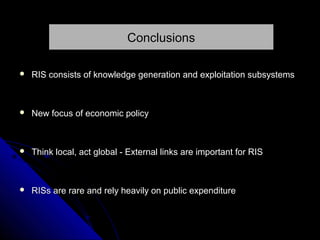
Conclusions


RIS consists of knowledge generation and exploitation subsystems



New focus of economic policy



Think local, act global - External links are important for RIS



RISs are rare and rely heavily on public expenditure
Some Preliminary Questions
 Can/does

higher education make a
difference?

 Does

it make a difference by itself or in
collaboration with other institutions?

 Do

small businesses interact with this
collaborative venture?
University Culture and
Entrepreneurship
 What

unites academics more? Car Parking or
intellectual discourse?

 What

price entrepreneurship?

 “Loosely

coupled systems” (Weick 1976)

 Collegial

academy of chaos

 Four

cultures of “collegium”, “bureaucracy”,
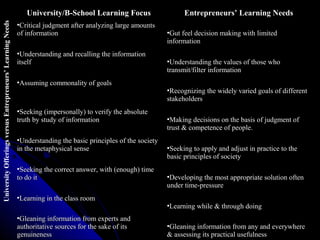
University Offerings versus Entrepreneurs’ Learning Needs

University/B-School Learning Focus
Critical judgment after analyzing large amounts

of information

Understanding and recalling the information

itself

Assuming commonality of goals

Entrepreneurs’ Learning Needs
Gut feel decision making with limited

information

Understanding the values of those who

transmit/filter information

Recognizing the widely varied goals of different

stakeholders
Seeking (impersonally) to verify the absolute

truth by study of information

Understanding the basic principles of the society

in the metaphysical sense

Seeking the correct answer, with (enough) time

to do it

Learning in the class room
Gleaning information from experts and

authoritative sources for the sake of its
genuineness

Making decisions on the basis of judgment of

trust & competence of people.

Seeking to apply and adjust in practice to the

basic principles of society

Developing the most appropriate solution often

under time-pressure

Learning while & through doing
Gleaning information from any and everywhere

& assessing its practical usefulness
Some Stylised Observations 1/2
 Patterns

of use of university (especially
research) output:

 Economic

stability = pure research; instability =
commercialisation

 But

note a few caveats:

 a)

Origins of university activity– industry focused
 Technische Mittelschulen, Technische Hochschulen,
Fachhoschulen in Germany; USA – University of
Akron (polymers & elastomers), Cornell’s electrical
engineering dept.
Some stylised observations
2/2


Economic sectors with most rapid growth are closest
to science – microelectronics, software, biotech and
new materials.



Above industries also have high ‘social qualities’ –
high wages, good environmental characteristics, low
barriers to entry for small firms, relative
independence from geographic constraints



Universities benefit from government policy to
encourage entrepreneurship (licensed inventions
from govt. grants (Mowrey, Nelson & Sampat, 1999)



Real spur to entrepreneurship in universities =
business opportunity from basic science
The Forces At Work Regionalisation


New & diverse client bases for teaching & research



From traditional relationships with large corporations to
regional clusters of firms (not just money but changes in
nature & scope of technologies)



Regionalisation of regulating institutions leads to regional
networking & institutional capacity building



Universities as regional intermediaries & commentators



Regional networking as institutional survival
The Forces at Work – Forms of
Learning
 New

mode of learning production from
inter-disciplinary research centres &
reliance on external funding (Gibbon,
1994)

 Interactive

forms of learning inherently
bound in time & space – regional context
for learning & knowledge

 International

research transferred to
Forces at Work – The New
Culture


The new student – decentred world & multiple lives



Diverse forms of preparation



Episodic & fragmented engagement not holistic, intense, linear
forms of learning



Research generated in heterogeneous environments of producers,
brokers and users



Knowledge is more contextualised & intensely reflexive



Communicative culture – from cerebral, objective, codified &
symbolic (logos) to visual, intuitive, volatile, subjective



Wider social distribution of knowledge generation


The Knowledge Economy Factor
R&D, Universities, Small Firms, Skills Sets and
ICT
A Role For Learning, Research
and Higher Education;
Catalysts For An Entrepreneurial Culture?
The East of England

Ocde Innovation and networks

  • 1.
    Local and RegionalInnovation OECD Capacity Building Seminar Supporting SMEs in a Time of Crisis Jay Mitra 13 October, 2009
  • 2.
    Definitional Issues  Entrepreneurship =new opportunity identification & realisation  (for the purpose of this paper ‘E’ = new business creation)  Innovation = successful exploitation of a new idea  Culture = a set of attitudes/beliefs common to a group  Culture = a set of activities concerned with moral, aesthetic, and intellectual aspects of life (activities include some element of creativity in production, communication of meaning & intellectual property)  Culture = a diverse way of life (from beef steak to Beethoven to Eminem)   Entrepreneurial Culture = diverse set of attitudes, beliefs, systems, institutions and structures that are connected together with a view to supporting new venture creation, innovation and growth in a particular environment & in regional innovation systems.
  • 3.
    Why Innovation Systems?  Innovationis non-linear but involves interaction between many actors  Interest resulting from research on the success of the Japanese model (Freeman, 1987)  Emergence of “innovation systems” models (Freeman, 1987)
  • 4.
    Key Models ofInnovation Systems  National innovation systems (Freeman, 1987; Lundvall, 2007)  Regional innovation systems (Cooke 1992; Braczyk et al., 1998)
  • 5.
    Some Stylised Factsand Assumptions F/A 1: Innovation = source of economic growth  The endogenous model)– critical importance of technological change in economic growth ( total factor productivity accounted for 87.5% of economic growth – Solow, 1957) Romer, 1990, OECD 2003  Strong emphasis on role of R&D, skilled labour & knowledge spillovers – greater productivity, product quality dependent on innovation
  • 6.
    Some Stylised Factsand Assumptions F/A 2: Innovation is not evenly spread but spatially concentrated Well-known concentrations = Oxford; Cambridge; SE, UK; Lombardy; Bangalore, Shanghai High urban focus – OCED countries Significant local differences within countries (Camagni & Capello, 1997; Keeble, 1996; Acs, 2002) Different measures – innovation output (patent applications) & input/output (employment in high technology manufacturing & knowledge-intensive industries)
  • 7.
    Subnational Variations inEuropean Patent Applications, 2002 Source: adapted from Eurostat Top Territories Patent Applications per million inhabitants. Bottom territories Patent Applications per million inhabitants Zuid Nederland, Netherlands 797 Noreste, Spain 34 Baden Wuttenburg, Germany 597 Sud, Italy 14 Bayern, Germany 473 Attiki, Greece 13 Isole, Italy 11 Ile de France, France 313 Maner Suomi, Finland 312 French Overseas Departments 6 Eastern, UK 253 Continente, Portugal 5 Westosterreich, Austria 223 Kentriki Ellada, Greece 4 SE, UK 205 Madeira, Portugal 1 Mean 131 Acores, Portugal 0 Median 96
  • 8.
    Subnational Variations inInnovation-Related Employment- High Tech Manufacturing , 2003 Source: Eurostat Top territories Employees in HT manufacturing (% of total Manufacturing employees) Bottom Territories Employees in HT manufacturing (% of total Manufacturing employees) Aland, Finland 69 Centro, Spain 38 London, UK 61 Sur, Spain 38 Manner Suomi, Finland 59 Continente, Portugal 37 Hamburg, Germany 57 Voreia Ellada, Greece 36 SE, UK 57 Acores, Portugal 34 Brussels, Belgium 56 Canarias, Spain 33 Ile de France, France 56 Madeira, Portugal 32 SW, UK 55 Kentriki Ellada, Greece 29 Eastern, UK 54 Nisia Aigaiou, Kriti, Greece 28 Mean 47 Median 48
  • 9.
    Subnational Variations inInnovation-Related Employment – Knowledge Intensive Industries Bottom Territories A* 17 Vlaams Gewest, Belgium 5 Berlin, Germany 16 WM, UK 5 Scotland, UK 14 Sud, Italy 4 Schieswig Holstein, Germany 14 Centro, Italy 4 Dunantul, Hungary 13 Yorkshire & Humber, UK 4 Ile de France, France 13 Attiki, Greece 4 Kozep Magyarorszag, Hungary 12 Este, Spain 3 Sudosterrrich, Austria 11 Sur, Spain 2 Baden Wurttermburg, Germany 11 Noreste, Spain 2 Mean 8 Continente, Portugal 2 Median 7 * A = Employees In KI services as % of total employees A* SE, UK Source: Eurostata Top Territories
  • 10.
    Some Stylised Factsand Assumptions F/A 3: SMEs participate in innovation process  Classic ‘structure-conduct-perfomance’ model = large firms have monopoly positions, commit substantial R&D  Alternative model = SMEs have more impact (more radical innovation, Baumol, 2002)  Importance of business churning (OECD, 2003) to national productivity  Empirical evidence suggests that both small and large firms play a part – dependent on active links to knowledge of market (users) & knowledge of materials & machinery (suppliers) & non-firm organisations  Small firms rely heavily on external environment  Spatial business clusters – association between spatial concentrations & rates of technological innovation (Baptista and Swann, 1998)
  • 11.
    Frameworks for AnalysingInnovation Process in Agglomerations Source: OECD, 2005ecd Framework Mechanisms supporting SME innovation Porterian Clusters (Porter, 19900 Rivalry between competitors; specialised facotrs of production (land, labour, capital); large & growing demand & sophisticated customers; related industries & support institutions Marshallian districts (Pyke, et al, 1990) Non pecuniary externalities from knowoedge spillovers through informal personal exchanges, customer supplier transactions; labour pooling; inter-firm linkages Innovative milieux Linkages between firms through labour mobility & informal networking, supporting collective learning; reduction of uncertainty Learning Regions (Storper, et al, 1997; Morgan, 1997) Untraded interdependencies between local firms & other organisations; use of formal & informal information & collaboration networks & labour market interactions; facilitated by trust & social capital & technology support organisations Local Innovation Systems (Cooke, Heindrich & Braczyk, 2004; Howells, 1999) Knowledge generation, exchange & exploitation in system with important learning interactions among suppliers, customers, public research organisations, financial institutions. Supported by local policies
  • 12.
    Why is aRegional Innovation System important?  Innovation = 80% of productivity growth and comparable figure for GDP (Freeman, 1994)  Regional disparities in innovation & GDP (Acs, 2002; Cooke et al., 2002)  Innovation = higher in regions with more knowledge generation e.g. R&D by firms & institutions (Acs, 2002)  Region = new focus of economic policy (Cooke et al. 2003)
  • 13.
    Why are Local/regionalInnovation Systems Relevant?  Most processes driving innovation occur locally – knowledge embedded in people ; distance decay effects in rate of knowledge & information links;  SMEs have spatially restricted search patterns for collaborative partnerships or technological inputs;  Different localities have different sector specialisations & distinct sets of innovation processes;  Strong local differences in innovation performance
  • 14.
    Market Failures andSME Innovation Nature of Failure Potential local policy actions Information failure Source: OECD, 2005 Type of Failure Barriers to flow of information on innovation opps. Lead to missing markets & constraints for SMEs in obtaining finance, partners, etc. Promotion of networks & partnerships. Public support to SME research projects Public goods Undersupply of non rival goods & non excludable goods that contribute to SME innovation – e.g. university research Public policy of basic innovation infrastructure locally Externalities Undersupply of activities that benefit others in addition to producers – e.g. training of highly skilled labour; reduced incentives to SME innovation Direct public support for SME research projects for training of highly skilled labour in local specialisms Monopolies Incumbent firms restrict entry through branding & other behaviour, constraining ability of innovative, new & small firms to enter market & compete “Second best” policies supporting SMEs in order to “level the playing field”. Support of new firm entry in local sector specialsims. Indivisibilities Indivisible cost in creating knowledge. If marginal cost pricing is used fixed cost is irrecoverable, constraining production of knowledge by SMEs & others Public funding of public & private research projects with Potential spin offs for SMEs
  • 15.
    System Failures &SME Innovation source: OECD, 2005, Lundvall & Borras, 1997 Type of Failure Nature of Failure Potential Local policy action Infrastructure Provision Underinvestment in local infrastructure with which firms interact – e.g. communications infrastructure Incentives for private or public communications & knowledge transfer infrastructures Transition & lock in failures Firms & localities are highly capable in their own technological areas but in related ones. Unable to switch from existing technologies Incentives for technological activities that broaden firm & organisational capabilities & nurturing of emerging systems Institutional failures Institutional & regulatory context has unexpected negative impact Monitoring & adjusting local institutions & regulations Learning failures Firms may not be able to learn rapidly & effectively Developing firm capabilities through human capital programmes, support for R&D 7 technology dissemination policies. Opening channels to knowledge sources Suboptimal balance bet. exploitation & exploration Local innovation concentrations may work too much on exploitation & not enough on exploration (or vice versa) Using public procurement & funding to support exploration, introducing diversity in industry by supporting new & small firms; supporting variety through dissemination of codified information Suboptimal balance bet. selection & variety Local innovation concentrations may have too rapid selection whereby underperforming firms close, & too little variety, in terms of firms & activities carrying potentially promising technologies Strengthening competition policies & use industrial & technological policies to support new firms carrying potentially promising technologies ( or weaken competition policies & limit use of industrial & technological policies supporting firms that are likely to fail) Appropriability traps Too stringent appropriability may limit spread of knowledge within innovation system Encouraging local knowledge transfers Complementarities failures The appropriate complementarities may not be present in local innovation system Formation of R&D networks; industry university interfaces & bridging systems
  • 16.
    What is RegionalInnovation System?  “Regional innovation system consists of interacting     knowledge generation and exploitation sub-systems linked to global, national and other regional innovation systems for commercializing new knowledge” (Cooke, 2004 p.3) Emphasis: Firms in interaction with other firms & knowledge infrastructure at regional level.
  • 17.
    Regional Innovation Systems(RIS) ESSENTIAL NOTIONS:  Tacit knowledge = Innovation involves face-face interaction between actors due to tacit knowledge e.g. experience (Maskell and Malmberg, 1999)  Costs of interaction = Regional level has lower distance, transportation & communication costs (Audretsch, 1998; Krugman, 1991)  Local networks = Innovation is higher in regions with local networks of SMEs and R&D (Maskell & Malmberg, 1999; Asheim & Gertler, 2004)
  • 18.
    Sub-Systems of RIS 1. KnowledgeGeneration:   Universities & Colleges for scientific & technical training  2. Public & private research laboratories Firms that transfer knowledge Knowledge Exploitation:  Firms with regional & global value chain relationships  Venture capitalists  Consultants Adapted from: Cooke et. al., (2003)
  • 19.
    Basic Arguments ofRIS 1. Innovation process is social  Innovation = involves face-face interaction between actors internal & external to the firm (Maskell and Malmberg, 1999)
  • 20.
    Basic Arguments ofRIS 2. Region facilitates interaction  Region = lower distance, transportation & communication costs for interaction (Krugman, 1993)  Face-to-face interaction and cooperation are easier at the regional level
  • 21.
    Basic Arguments ofRIS 3. Regional concentration of R&D firms & institutions boosts innovation  Combination of knowledge generation (e.g. by universities) & exploitation (by SMEs with local networks) boosts innovation  Local concentration increases capacity to use external knowledge for innovation Adapted from: Cooke et al., 2003 ; Asheim & Gertler, 2004
  • 22.
    Basic Arguments ofRIS 4. External Links boost innovation  Entering global markets  Sourcing Knowledge from global sources (e.g. R&D)
  • 23.
    Links between RISand Entrepreneurship  Entrepreneurship – requires knowledge and resource seeking (e.g. technical knowledge, finance, consultancy etc.)  Innovative activity of firms and entrepreneurs are largely based on localised resources (Asheim et. al., 2003; Cooke et. al., 2000)  RIS provides access to critical resources for entrepreneurship within proximity
  • 24.
    RIS Public GovernanceSystem  Grass roots – SME dominated or industrial district (less public governance)  Networked – Associated between regional governance & industry pronounced  Centralist – Governance is strongly centralised Cooke et. al (2003)
  • 25.
    Problem of RIS:Few Regions in the world are high-tech clusters
  • 26.
    Typology of RegionalInnovation Systems California North-Rhine Westphalia Mid-Pyrenees Interactive n o t av o n n s s e n s u B i i i Globalist Catalonia Baden-Wurttemberg Quebec Localist Tuscany Tampere Northern Ireland Grassroots Networked Centralist Public Governance System Source: Braczyk et. al. 1998; Cooke et. al. (2003 p.368)
  • 27.
    Developing Innovation Systems  IdentifyStrong Sectors/Candidate Clusters  Investigate Regional Clusters  Identify Competitive Advantage  Identify Innovation Practices  Cooperative or Individualistic?  Innovation Support System
  • 28.
    Conditions for AssessingRIS 1. Infrastructure issues 2. Superstructure
  • 29.
    Conditions for Higher& Lower RIS Potential Higher RIS potential Infrastructure level  Regional private equity  Policy influence on infrastructure  Regional university-industry strategy Superstructural level Institutional dimension  Co-operative culture  Interactive learning  Associative consensus Organisational Dimension (firms)  Worker mentoring  Externalisation  Interactive innovation Organisational dimension (policy)  Monitoring  Consultative  Networking Lower RIS potential             Decentralised spending National financing organisation Limited influence on infrastructure Competitive culture Individualistic Institutional dissension Self acquired skills Internationalisation Stand alone R&D Reacting Authoritative Hierarchical Adapted from: Cooke et. al. (2001)
  • 30.
    Regional Enterprise SupportSystem for Innovation National Policy Ministrics Programme approval Assembly Legitimation Information National technology agency Information Advice Reporting Requirement Proposals National Research Institutes Information Strategy SME Agency FDI Agency Business associates Regional steering Committee Trade Board Universities Measures Social partners Venture Capitalists Technology Consultants Training agency Coordination Local Cooperative Forum Research Community Local Government Chambers of commerce Source: Braczyk, Cooke and Heinreich, eds. (1998)
  • 31.
    Policy Levers toStrengthen Local Innovation Systems Creation & strengthening of local networks Encouraging local innovation collaborations Creation of bridging institutions Ensuring openness of local innovation system to sources of knowledge outside system Connectivities Assets Public investment in technology development Creation of S&T parks Attracting inward investment Supporting access to finance Capabilities Education & Training of individuals Advice, training & consultancy to SMEs Influencing motivation & abilities of universities & Research organisations in collaborative research with SMEs
  • 32.
    Comparison RIS &other Regional Models Concepts Regional cluster Definitions and differences • A concentration o f ‘interdependent’ firms within the same or adjacent industrial sectors in a small geographic area Regional innovation network • Increasingly organised co-operation (agreements) between firms, stimulated by trust, norms and conventions Regional innovation system • Co-operation between firms and different organisations for knowledge development and diffusion • Increasingly organised co-operation with a broader set of civil organisations and public authorities that are embedded in social and regional structures. Learning regions
  • 33.
    Problems with PublicSupport for RIS  RISs are rare and newly discovered  Hard to detect systemic regional innovation  In Europe = high dependence on public expenditure Source: Cooke (2001)
  • 34.
    Problems with PublicSupport for RIS RIS problems Type of Problem Typical problem region Possible policy tools Organisational ‘thinness’ Lack of relevant local actors Peripheral areas Link firms to external recourses + acquisition Fragmentation Lack of regional cooperation and mutual trust Some regional clusters Develop regional ‘club goods’ Loc k-in Regional industry specialised in outdated technologies Old industrial regions and raw material based peripheral Open up networks towards external actors + local mobilisation Isaksen (2001)
  • 35.
    Differences: National vs.Regional Systems National Innovation Systems Regional Innovation Systems Inter-firm relations - Market - Clusters Knowledge infrastructure - Formal R&D laboratories - National R&D laboratories - University research - Firm external sources of knowledge Public Sector (government) - Emphasis on national level - Emphasis on regional level Financial institutions - Formal savings - Formal financial sector - Venture capital - Informal financial sector Source: Acs (2002)
  • 36.
    Case Study: SiliconValley  A Region of 1500 Square Miles in California, US  One of the “most” innovative high-tech regions in the world  1.35 million jobs  Headquarters for over 400 public companies  Average salary of $65,000  Venture Capital Investments of over $8 billion Source: Stanford University
  • 37.
    “knowledge generation” inSilicon Valley (1) Past:  Linkages to Federal funding agencies and flood of Government Sponsored Research at universities (Cold war effect in1950s) Present:  Cutting-edge education to company employees  Small Business Innovation Research (SBIR) grants: Over $2B awarded in U.S. in 2006 Source: Stanford University
  • 38.
    “knowledge generation” inSilicon Valley (2) Figure 5: Engineering School Ph.D. Production 180 160 140 120 100 Electrical Ph.D. Total in Enginerring 80 60 40 20 19 51 19 52 19 53 19 54 19 55 19 56 19 57 19 58 19 59 19 60 19 61 19 62 19 63 19 64 19 65 19 66 19 67 19 68 19 69 19 70 19 71 19 72 19 73 19 74 19 75 19 76 19 77 19 78 19 79 19 80 19 81 0 Source: Stanford University
  • 39.
    “knowledge Exploitation” inSilicon Valley  Stanford graduates, faculty & staff have launched approximately 1200 companies in the last 50 years  More than 50% of Silicon Valley product is due to companies started by Stanford alumni Source: Stanford University
  • 40.
    Silicon Valley Innovations:Past & Present Source: Stanford University
  • 41.
  • 42.
    Conclusions  RIS consists ofknowledge generation and exploitation subsystems  New focus of economic policy  Think local, act global - External links are important for RIS  RISs are rare and rely heavily on public expenditure
  • 43.
    Some Preliminary Questions Can/does higher education make a difference?  Does it make a difference by itself or in collaboration with other institutions?  Do small businesses interact with this collaborative venture?
  • 44.
    University Culture and Entrepreneurship What unites academics more? Car Parking or intellectual discourse?  What price entrepreneurship?  “Loosely coupled systems” (Weick 1976)  Collegial academy of chaos  Four cultures of “collegium”, “bureaucracy”,
  • 45.
    University Offerings versusEntrepreneurs’ Learning Needs University/B-School Learning Focus Critical judgment after analyzing large amounts of information Understanding and recalling the information itself Assuming commonality of goals Entrepreneurs’ Learning Needs Gut feel decision making with limited information Understanding the values of those who transmit/filter information Recognizing the widely varied goals of different stakeholders Seeking (impersonally) to verify the absolute truth by study of information Understanding the basic principles of the society in the metaphysical sense Seeking the correct answer, with (enough) time to do it Learning in the class room Gleaning information from experts and authoritative sources for the sake of its genuineness Making decisions on the basis of judgment of trust & competence of people. Seeking to apply and adjust in practice to the basic principles of society Developing the most appropriate solution often under time-pressure Learning while & through doing Gleaning information from any and everywhere & assessing its practical usefulness
  • 46.
    Some Stylised Observations1/2  Patterns of use of university (especially research) output:  Economic stability = pure research; instability = commercialisation  But note a few caveats:  a) Origins of university activity– industry focused  Technische Mittelschulen, Technische Hochschulen, Fachhoschulen in Germany; USA – University of Akron (polymers & elastomers), Cornell’s electrical engineering dept.
  • 47.
    Some stylised observations 2/2  Economicsectors with most rapid growth are closest to science – microelectronics, software, biotech and new materials.  Above industries also have high ‘social qualities’ – high wages, good environmental characteristics, low barriers to entry for small firms, relative independence from geographic constraints  Universities benefit from government policy to encourage entrepreneurship (licensed inventions from govt. grants (Mowrey, Nelson & Sampat, 1999)  Real spur to entrepreneurship in universities = business opportunity from basic science
  • 48.
    The Forces AtWork Regionalisation  New & diverse client bases for teaching & research  From traditional relationships with large corporations to regional clusters of firms (not just money but changes in nature & scope of technologies)  Regionalisation of regulating institutions leads to regional networking & institutional capacity building  Universities as regional intermediaries & commentators  Regional networking as institutional survival
  • 49.
    The Forces atWork – Forms of Learning  New mode of learning production from inter-disciplinary research centres & reliance on external funding (Gibbon, 1994)  Interactive forms of learning inherently bound in time & space – regional context for learning & knowledge  International research transferred to
  • 50.
    Forces at Work– The New Culture  The new student – decentred world & multiple lives  Diverse forms of preparation  Episodic & fragmented engagement not holistic, intense, linear forms of learning  Research generated in heterogeneous environments of producers, brokers and users  Knowledge is more contextualised & intensely reflexive  Communicative culture – from cerebral, objective, codified & symbolic (logos) to visual, intuitive, volatile, subjective  Wider social distribution of knowledge generation 
  • 51.
    The Knowledge EconomyFactor R&D, Universities, Small Firms, Skills Sets and ICT A Role For Learning, Research and Higher Education; Catalysts For An Entrepreneurial Culture? The East of England