From Projectile Points to Pump Stations
Take that, Belloq! Oh wait… I
don’t have my permit yet…
Which agency is reviewing this?
Anyone? I’ll wing it...
Presented at the
2015 Texas Water Conservation
Association Annual Convention
by: Mason D. Miller, M.A.
AmaTerra Environmental, Inc.
Austin, TX - Las Cruces, NM
Managing Cultural Resources in
Water Infrastructure through the
Framework of the TRWD/DWU IPL
Project
What is the IPL Project?
● Water pipeline sponsored by the
Tarrant Regional Water District
(TRWD) and the Dallas Water Utilities
(DWU)
● Will eventually bring water from Lake
Palestine in Anderson County, Cedar
Creek Lake in Henderson County,
and Richland-Chambers Reservoir in
Navarro County to the Dallas-Fort
Worth Metroplex.
● Segments 9-17 are permitted.
○ 93 miles of pipeline (108-inch)
○ Various pump stations, booster
pump stations, and balancing
reservoirs
○ 2,716 acres of project footprint
● AmaTerra provided cultural resource
survey and coordination for the
project.
Archeology
Prehistoric Stone Axe Blade
Paleoindian Site at Zilker
Park, Austin
World War I Cargo Vessel
Wreck
Texas Governor’s Mansion,
Austin
Trinity Parkway Bridge,
Dallas
Spirit Mountain, Nevada:
Center of Creation for Yuman
Cultures
History
Traditional Cultural
Property
What are “Cultural
Resources”?
What Cultural Resource Laws Apply?
Federal Level
● Section 106 of the
National Historic
Preservation Act of 1966
● National Environmental
Policy Act (NEPA)
● Others…
○ Native American Graves
Protection and Repatriation
Act (NAGPRA)
○ Archaeological Resource
Protection Act (ARPA)
Section 106 of the National Historic Preservation Act
Funding
Permitting
● Bureau of Reclamation grant for water
infrastructure improvements.
● Bank stabilization grant issued through the
US Fish and Wildlife Service
Direct Action
● Construction of new runway at Randolph Air
Force Base
● Construction of a reservoir facility on BLM-
managed land.
● 404 Permit for pipeline issued through the US
Army Corps of Engineers
● Endangered Species Incidental Take Permit
issued through US Fish and Wildlife Service
● Decision document issued through NEPA
Federal Agency
“If I do this, what is this going to do to
significant resources?” - Federal Agency
Through Section 106, agencies ONLY account for
impacts to significant resources.
● Significant = “Historic Property” = Resources
considered eligible for listing on the National Register
of Historic Places.
● Determine significance through consultation with
local parties
○ State Historic Preservation Offices
○ Tribal Historic Preservation Officers
Effects from Federal Actions/Undertakings
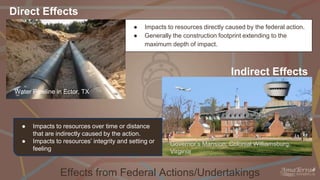
Direct Effects
Indirect Effects
● Impacts to resources directly caused by the federal action.
● Generally the construction footprint extending to the
maximum depth of impact.
● Impacts to resources over time or distance
that are indirectly caused by the action.
● Impacts to resources’ integrity and setting or
feeling.
Water Pipeline in Ector, TX
Governor’s Mansion, Colonial Williamsburg,
Virginia
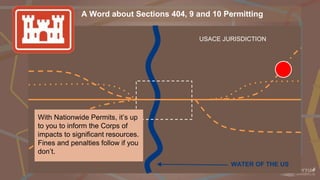
WATER OF THE US
USACE JURISDICTION
A Word about Sections 404, 9 and 10 Permitting
With Nationwide Permits, it’s up
to you to inform the Corps of
impacts to significant resources.
Fines and penalties follow if you
don’t.
Antiquities Code of Texas
● Focused on Direct Impacts Only on
Lands/Easements Owned by a Political
Subdivision of the State of Texas
(including submerged lands)
● Permit Required to Conduct Survey
● Can and often does overlap with Section
106 review process
Texas Water Development Board
Texas Administrative Code Section 26.26
“...TWDB will ensure that applicants for financial
assistance provide the TWDB with documentation of
appropriate coordination with the THC … for review of
potential impacts to cultural resources on lands belonging to
or controlled by any...political subdivision of the State of
Texas that may be impacted by proposed development
projects funded in whole or in part by TWDB.”
Section 106 and Antiquities Code
Reviews are Processes Only...
When the process is initiated, there is no guarantee of:
1. Outcome
2. Timeline
3. Cost
There’s only the guarantee that you have to do it.
Coordination Only (30
Days, Typically)
Limited Field Investigations
(3-6+ months)
Something More
Extensive (6+ months)
Mitigation Excavations
at Site in Bexar County,
Texas
Shovel test recording on
IPL pipeline survey.
Antiquities Permit!!!
IPL Cultural Resource Field Survey
WPA plaque on a
concrete culvert in
Tarrant County, Texas.
The historic-age Mankin
Cemetery, the last remnant of the
small Henderson County, Texas
community.
Corrugated metal pole barn in Navarro County
photographed in a manner typical of historic survey.
Backhoe trenching along the banks of
the Trinity River in Henderson County,
Texas.
Examining the
Trinity River
cutbank.
Surface inspection on
transect in Ellis County,
Texas.
Recording pole barn in
southern Tarrant County,
Texas.
Strong preference for avoidance and survey results
factored into route selection.
What worked well on IPL?
“...No Adverse Effects to
Historic Properties…”
“...No Adverse Effects to
Historic Properties…”
Suggestions for water utilities...
● Don’t just think about permanent
rights-of-way.
o Permanent and Temporary
easements must be evaluated.
● Pipeline replacement may be
considered unlikely to cause effect.
o Keep construction trenches as
small as possible.
● Avoid impacts to significant
resources in three dimensions
(where possible).
Suggestions for navigation
districts...
● Both Section 106 and ACT
compliance doesn’t stop at
the water’s edge.
o Be aware of the
potential for
shipwrecks and ferry
landings.
● Coordinate with the State
Marine Archaeologist,
Amy Borgens, early
Suggestions for flood control
districts...
● Repairs to existing facilities may require
Section 106 evaluation if there’s federal
involvement.
● Follow National Parks Service guidelines
for tree plantings in archaeologically
sensitive areas.
● Sediment dredging in existing detention
ponds/basins
o Could be ACT trigger
o Focus coordination on lack of
potential for impacts (only excavate
to just above the known maximum
depth of in-fill).
● Property buyouts could require Section
106 coordination if there are federal funds.
… and now he’s in a bit of trouble.
So, when Indiana decided to do this...
… he didn’t go through the process ...Don’t let this happen to
your project!
Thank You!
Contact me, Mason Miller, at
mmiller (at) amaterra.com
or 512-329-0031
This will also be available online. Scan the
QR Code above or copy down the URL.
Thank You!
http://goo.gl/MmzYuI

From Projectile to Pump Station

  • 1.
    From Projectile Pointsto Pump Stations Take that, Belloq! Oh wait… I don’t have my permit yet… Which agency is reviewing this? Anyone? I’ll wing it... Presented at the 2015 Texas Water Conservation Association Annual Convention by: Mason D. Miller, M.A. AmaTerra Environmental, Inc. Austin, TX - Las Cruces, NM Managing Cultural Resources in Water Infrastructure through the Framework of the TRWD/DWU IPL Project
  • 3.
    What is theIPL Project? ● Water pipeline sponsored by the Tarrant Regional Water District (TRWD) and the Dallas Water Utilities (DWU) ● Will eventually bring water from Lake Palestine in Anderson County, Cedar Creek Lake in Henderson County, and Richland-Chambers Reservoir in Navarro County to the Dallas-Fort Worth Metroplex. ● Segments 9-17 are permitted. ○ 93 miles of pipeline (108-inch) ○ Various pump stations, booster pump stations, and balancing reservoirs ○ 2,716 acres of project footprint ● AmaTerra provided cultural resource survey and coordination for the project.
  • 4.
    Archeology Prehistoric Stone AxeBlade Paleoindian Site at Zilker Park, Austin World War I Cargo Vessel Wreck Texas Governor’s Mansion, Austin Trinity Parkway Bridge, Dallas Spirit Mountain, Nevada: Center of Creation for Yuman Cultures History Traditional Cultural Property What are “Cultural Resources”?
  • 5.
    What Cultural ResourceLaws Apply? Federal Level ● Section 106 of the National Historic Preservation Act of 1966 ● National Environmental Policy Act (NEPA) ● Others… ○ Native American Graves Protection and Repatriation Act (NAGPRA) ○ Archaeological Resource Protection Act (ARPA)
  • 6.
    Section 106 ofthe National Historic Preservation Act Funding Permitting ● Bureau of Reclamation grant for water infrastructure improvements. ● Bank stabilization grant issued through the US Fish and Wildlife Service Direct Action ● Construction of new runway at Randolph Air Force Base ● Construction of a reservoir facility on BLM- managed land. ● 404 Permit for pipeline issued through the US Army Corps of Engineers ● Endangered Species Incidental Take Permit issued through US Fish and Wildlife Service ● Decision document issued through NEPA Federal Agency “If I do this, what is this going to do to significant resources?” - Federal Agency Through Section 106, agencies ONLY account for impacts to significant resources. ● Significant = “Historic Property” = Resources considered eligible for listing on the National Register of Historic Places. ● Determine significance through consultation with local parties ○ State Historic Preservation Offices ○ Tribal Historic Preservation Officers
  • 7.
    Effects from FederalActions/Undertakings Direct Effects Indirect Effects ● Impacts to resources directly caused by the federal action. ● Generally the construction footprint extending to the maximum depth of impact. ● Impacts to resources over time or distance that are indirectly caused by the action. ● Impacts to resources’ integrity and setting or feeling. Water Pipeline in Ector, TX Governor’s Mansion, Colonial Williamsburg, Virginia
  • 8.
    WATER OF THEUS USACE JURISDICTION A Word about Sections 404, 9 and 10 Permitting With Nationwide Permits, it’s up to you to inform the Corps of impacts to significant resources. Fines and penalties follow if you don’t.
  • 9.
    Antiquities Code ofTexas ● Focused on Direct Impacts Only on Lands/Easements Owned by a Political Subdivision of the State of Texas (including submerged lands) ● Permit Required to Conduct Survey ● Can and often does overlap with Section 106 review process
  • 10.
    Texas Water DevelopmentBoard Texas Administrative Code Section 26.26 “...TWDB will ensure that applicants for financial assistance provide the TWDB with documentation of appropriate coordination with the THC … for review of potential impacts to cultural resources on lands belonging to or controlled by any...political subdivision of the State of Texas that may be impacted by proposed development projects funded in whole or in part by TWDB.”
  • 11.
    Section 106 andAntiquities Code Reviews are Processes Only... When the process is initiated, there is no guarantee of: 1. Outcome 2. Timeline 3. Cost There’s only the guarantee that you have to do it. Coordination Only (30 Days, Typically) Limited Field Investigations (3-6+ months) Something More Extensive (6+ months) Mitigation Excavations at Site in Bexar County, Texas Shovel test recording on IPL pipeline survey. Antiquities Permit!!!
  • 12.
    IPL Cultural ResourceField Survey WPA plaque on a concrete culvert in Tarrant County, Texas. The historic-age Mankin Cemetery, the last remnant of the small Henderson County, Texas community. Corrugated metal pole barn in Navarro County photographed in a manner typical of historic survey. Backhoe trenching along the banks of the Trinity River in Henderson County, Texas. Examining the Trinity River cutbank. Surface inspection on transect in Ellis County, Texas. Recording pole barn in southern Tarrant County, Texas.
  • 13.
    Strong preference foravoidance and survey results factored into route selection. What worked well on IPL? “...No Adverse Effects to Historic Properties…” “...No Adverse Effects to Historic Properties…”
  • 14.
    Suggestions for waterutilities... ● Don’t just think about permanent rights-of-way. o Permanent and Temporary easements must be evaluated. ● Pipeline replacement may be considered unlikely to cause effect. o Keep construction trenches as small as possible. ● Avoid impacts to significant resources in three dimensions (where possible).
  • 15.
    Suggestions for navigation districts... ●Both Section 106 and ACT compliance doesn’t stop at the water’s edge. o Be aware of the potential for shipwrecks and ferry landings. ● Coordinate with the State Marine Archaeologist, Amy Borgens, early
  • 16.
    Suggestions for floodcontrol districts... ● Repairs to existing facilities may require Section 106 evaluation if there’s federal involvement. ● Follow National Parks Service guidelines for tree plantings in archaeologically sensitive areas. ● Sediment dredging in existing detention ponds/basins o Could be ACT trigger o Focus coordination on lack of potential for impacts (only excavate to just above the known maximum depth of in-fill). ● Property buyouts could require Section 106 coordination if there are federal funds.
  • 17.
    … and nowhe’s in a bit of trouble. So, when Indiana decided to do this... … he didn’t go through the process ...Don’t let this happen to your project!
  • 18.
    Thank You! Contact me,Mason Miller, at mmiller (at) amaterra.com or 512-329-0031 This will also be available online. Scan the QR Code above or copy down the URL. Thank You! http://goo.gl/MmzYuI

Editor's Notes

  • #2 This is a presentation covering the exciting world of Cultural Resource Management in Water Infrastructure. This presentation covers the legal setting in the State of Texas primarily, and should serve as a good general reference. As much as possible, I tried to use images from AmaTerra’s work across the region, I’ve also added a number of links (such as the one here to our company’s website). Click those for further reading.
  • #5 Cultural resources fall into three main categories and are loosely described as elements of the human environment created by humans or human activity and/or are significant to human cultures. Archaeological Resources Artifacts, features, other elements made by humans generally in the ground. National Park Service guidelines call for sites to be at least 50 years of age. This is not a hard and fast rule as some resources may be younger than that and be considered archaeological sites, but these are rare (I’ve actually never dealt with it, personally). Historic Resources Buildings, objects, other elements made by humans generally above ground surface. The same National Park Service guidelines apply here as well (50 years of age). Traditional Cultural Properties/TCPs Natural or artificial components of an area that carry particular cultural significance to a group or groups. These cultural resources are one component of the larger human environment that is generally considered in the National Environmental Policy Act (NEPA) federal decision-making system. Generally 50 years of age or older as defined by the National Parks Service and most often found in the ground. Includes prehistoric sites and artifacts such as this Arrow Point, and shipwrecks such as this sector scan sonar image of a World War I cargo vessel near an I-10 Bridge in Beaumont. Additionally, there are historic resources that are usually defined as those resources older than 50 years in age that stand above the ground. These may include houses, neighborhoods, districts, or architectural features like this bridge. Additionally, there are significant resources like the Texas Governor’s mansion. TCPs are those cultural resources that don’t fit into the other categories. They are generally considered places or features on the landscape that carry cultural and/or religious significance to a group such as these mountains in Nevada that are considered to be the center of creation to Yuman cultures.
  • #6 So, when a project comes across your desk, what cultural resource laws might apply? At the federal level, the main one is Section 106 of the NHPA. This link provides an excellent overview of the Section 106 process, the rules, and other information. It’s provided by the Advisory Council on Historic Preservation (ACHP) which is the federal agency overseeing Section 106. Other laws include the National Environmental Policy Act (NEPA), but even that one simply requires that agencies complete Section 106. Here’s a link to a handy NEPA integration handbook recently issued by the White House and the ACHP. Other laws, including NAGPRA and ARPA may come into play but those really are relatively rare occurrences on standard civil engineering projects. There actually are many more federal laws in place as well, but those too rarely come into play. If you run into these situations, it’s best to get a cultural resource specialist involved. At the state level, the main law is the Antiquities Code of Texas (ACT).
  • #7 Section 106 involves agencies accounting for the the impacts their actions cause on significant cultural resources. Actions (or “undertakings” as they’re defined). Actions include direct action like construction on a military base, funding such as grants or construction funding, or permits such as a Clean Water Act permit through the USACE. In every case it is important to note that Section 106 does not prohibit impacts to significant cultural resources; it only requires agencies account for those impacts in one way or another. Federal agencies consult with local groups as part of the Section 106 process. The most important of those local consulting parties are the State Historic Preservation Officers (SHPOs) for which there is one for every state. Others include Tribal Historic Preservation Officers and local consulting parties (if applicable). And overseeing it all from the perspective of the federal government is the Advisory Council on Historic Preservation. They make sure that the Section 106 process is followed and serve as an intermediary if there’s a disagreement along the consultation process.
  • #8 There are two main types of effects: Direct and Indirect. Direct effects are just that. They are the actual footprint of all physical impacts directly caused by construction. This footprint is both horizontal and vertical. A pipeline’s direct effects APE can be understood as the footprint of the construction easement to the maximum depth of the trench in which the pipe will be installed. They are often most closely associated with archaeological resources (versus historic resources) Indirect effects are a bit more nebulous. They are the effects from a project that are not directly caused by construction but are separated by time or distance from that resource but still negatively impact the setting, feeling, or other sense of place for that resource. This is not a real example, but it shows what an indirect effect might look like if the FAA permitted the construction of an airport next to Colonial Williamsburg, Virginia.
  • #10 Primarily Concerned with Direct Impacts to Archaeological Resources Only Applies to Construction on Lands and/or Easements Owned by a Political Subdivision of the State of Texas State Agencies Municipalities and Counties Utilities and MUDs Generally any Agency with Taxing Authority Antiquities Permits Issued for Field Investigations on these Lands State Antiquities Landmarks (SALs) are the State version of the National Register of Historic Places Follows a similar review process that may overlap and coincide with Section 106. State agencies consulting with the Texas Historical Commission (the SHPO) as the representative of local interests. May proceed along with Section 106 on projects that have a federal trigger (NHPA) and are at least partially located on land under the jurisdiction of the State of Texas (ACT). May not be involved at all if a project is entirely on non-state lands. The THC maintains a good site that covers both Antiquities Code and Section 106 guidelines in one place.
  • #12 With both federal and state cultural resource laws, there is no guarantee of an outcome. Reviewing agencies are not in the business of stopping projects. They are, however, in the business of making sure that cultural resources are accounted for and the impacts to those resources are known.
  • #13 Since cultural resources include non-archaeological resources. Survey for historic-age resources is similar to archaeological survey… but different. For Historic Resource survey, investigators typically have to account for direct and indirect impacts. The work doesn’t require a permit since all the work is being conducted just for NHPA compliance. Surveyors travel the direct and indirect impact corridor and photographically document the standing structures and objects that are at least 50 years of age (dated by the proposed letting date) within those APEs. They also determine what types of design styles, historical themes, and individuals are important to a particular region and compare those to the resources that were identified. If any resources fit within the larger significance trends of an area, they may require additional documentation.
  • #18 So, don’t be like Indiana Jones. Bypass cultural resource laws at your peril!