RichACL & Gluster
Rajesh Joseph
GlusterFS Dev Team
05/22/15
AGENDA
● Unix Permission Model
● POSIX. 1e ACL
● Windows ACL
● NFSv4 ACL
● RichACL
● Gluster & RichACL
● Q&A
05/22/15
Unix Permission Model
● Standardized in POSIX. 1
● Permissions based on three classes:
– User
– Group
– Others
● Read (r), Write (w) and execute (x) permission bits
● Separate namespaces for UIDs and GIDs
05/22/15
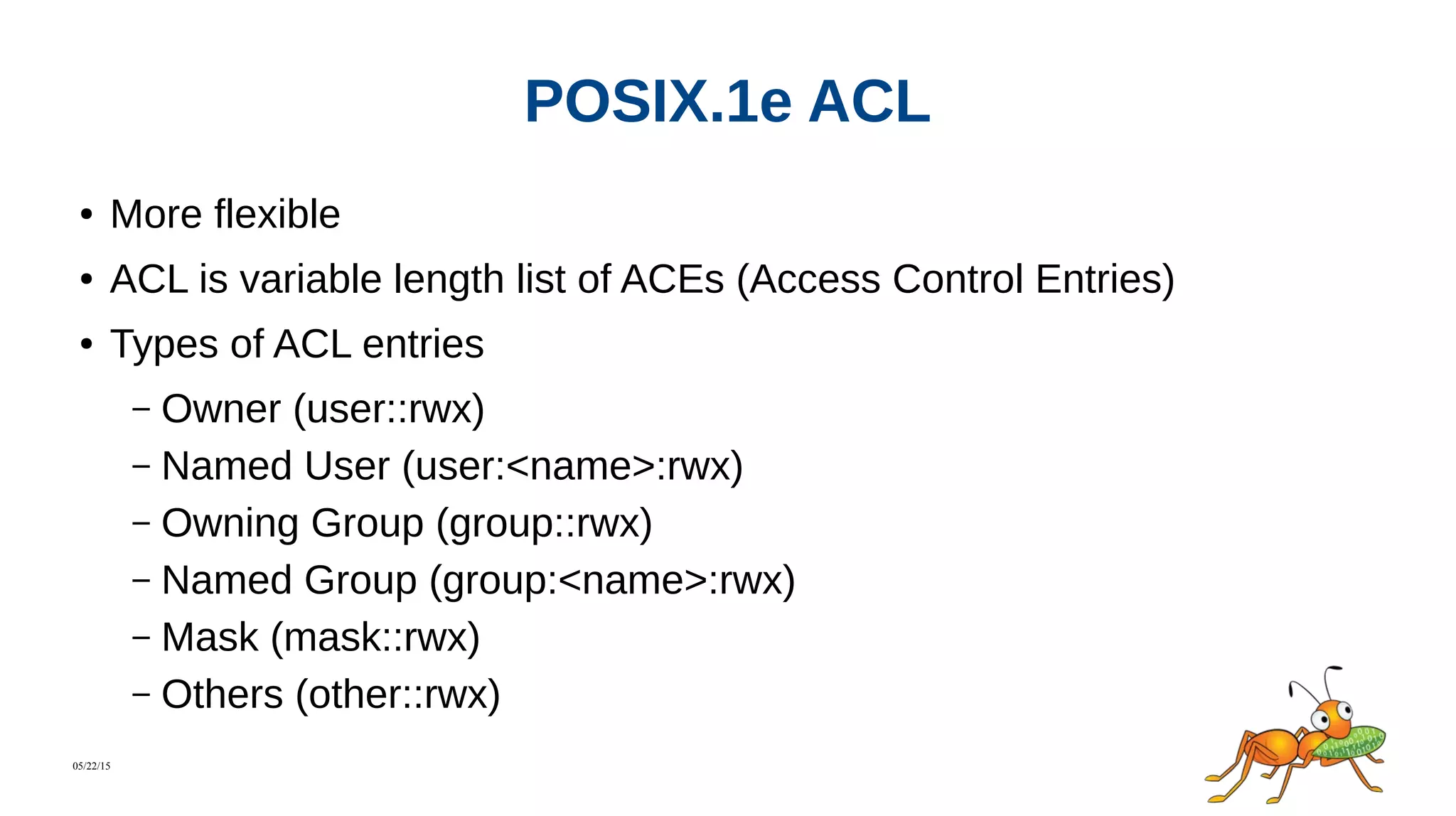
POSIX.1e ACL
● More flexible
● ACL is variable length list of ACEs (Access Control Entries)
● Types of ACL entries
– Owner (user::rwx)
– Named User (user:<name>:rwx)
– Owning Group (group::rwx)
– Named Group (group:<name>:rwx)
– Mask (mask::rwx)
– Others (other::rwx)
05/22/15
POSIX.1e ACL
● Only ALLOW mode with three permission bits
– Read (r)
– Write (w)
– Execute (x)
● Minimal ACL
● Extended ACL
POSIX.1e ACL
r w - r - - - - -
O
w
ner C
lass
O
ther C
lass
G
roup
C
lass
Minimal
Acess Control List
User::rw-
Other::r--
Group::r--
POSIX.1e ACL
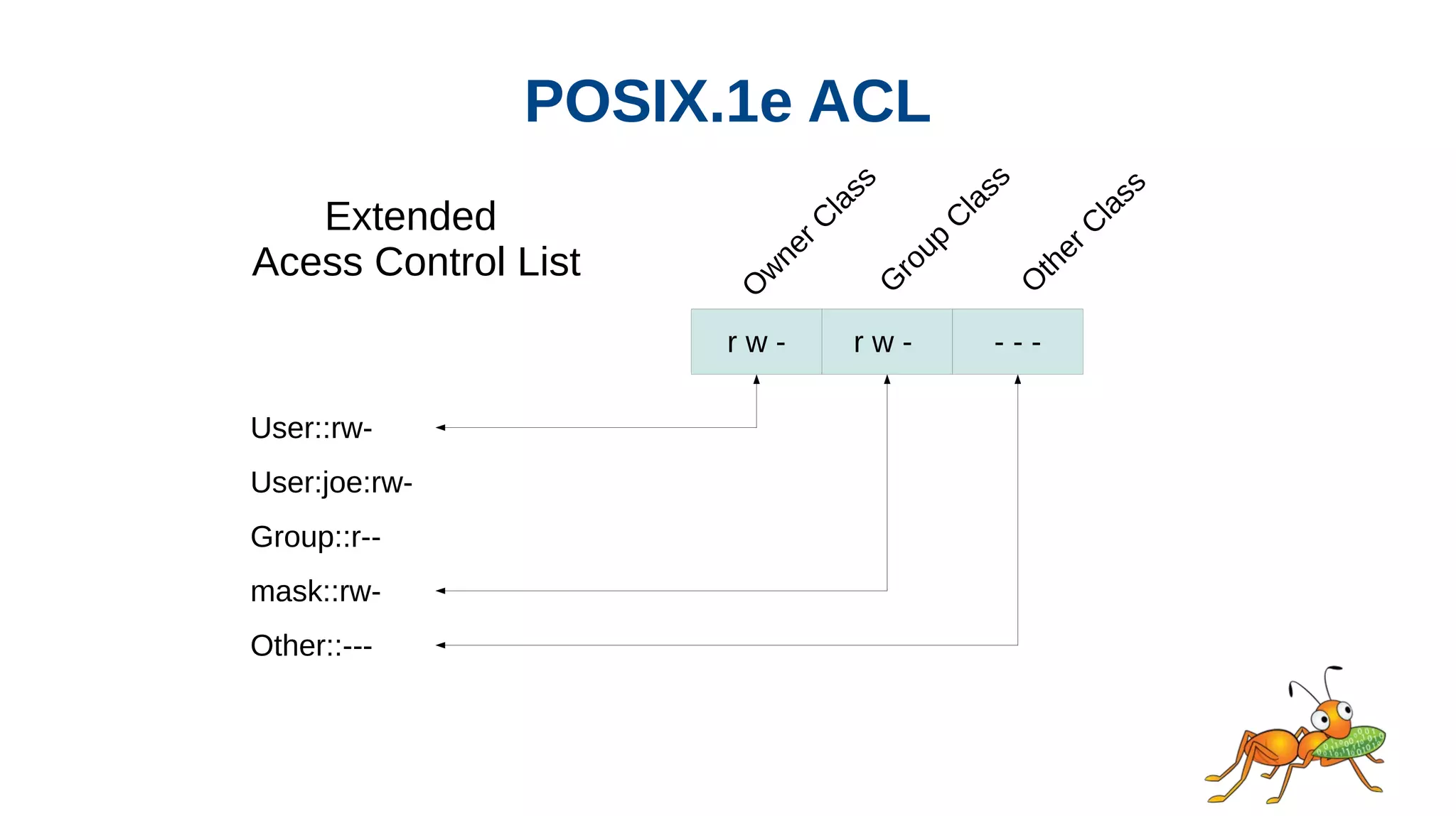
r w - r w - - - -
O
w
ner C
lass
O
ther C
lass
G
roup
C
lass
Extended
Acess Control List
User::rw-
Group::r--
User:joe:rw-
Other::---
mask::rw-
05/22/15
POSIX.1e ACL
● Directories have another ACL – Default ACL
– Looks similar to normal ACL
– Not user for enforcing
● Effects of Default ACL
– A subdirectory inherits the default ACLs of the parent directory both
as its default ACLs and as an access ACLs
– A file inherits the default ACLs as its access ACLs.
05/22/15
Windows ACL
● Two types of ACL
– Discretionary Access Control List (DACL)
– System Access Control List (SACL)
● Users, groups identified by Security Identifiers (SID)
– Users and groups share the same namespace
● Three types of ACE (Access Control Entries)
– Access Allowed (ALLOW)
– Access Denied (DENY)
– System Audit (AUDIT)
05/22/15
Windows ACL
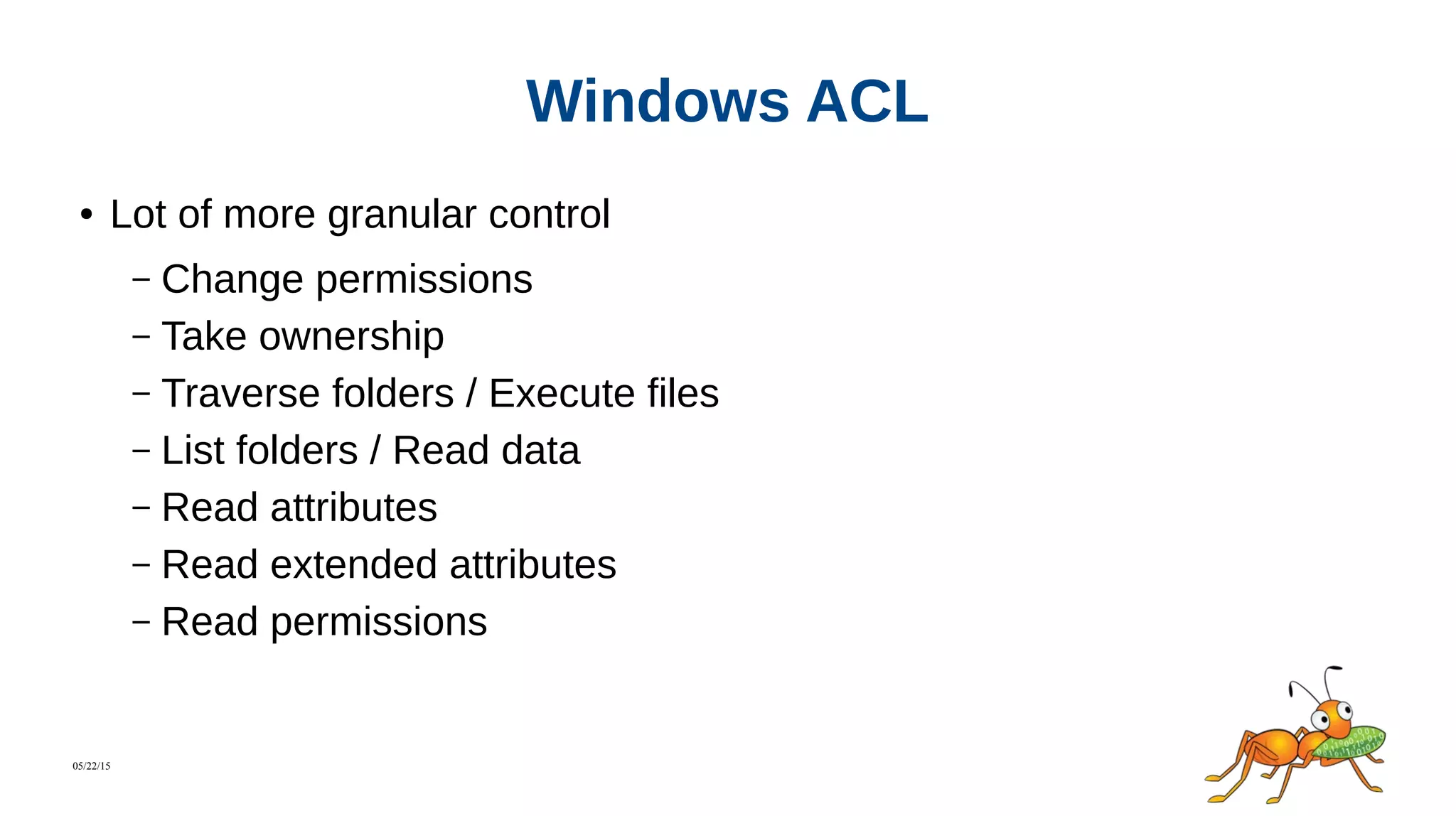
● Lot of more granular control
– Change permissions
– Take ownership
– Traverse folders / Execute files
– List folders / Read data
– Read attributes
– Read extended attributes
– Read permissions
05/22/15
Windows ACL
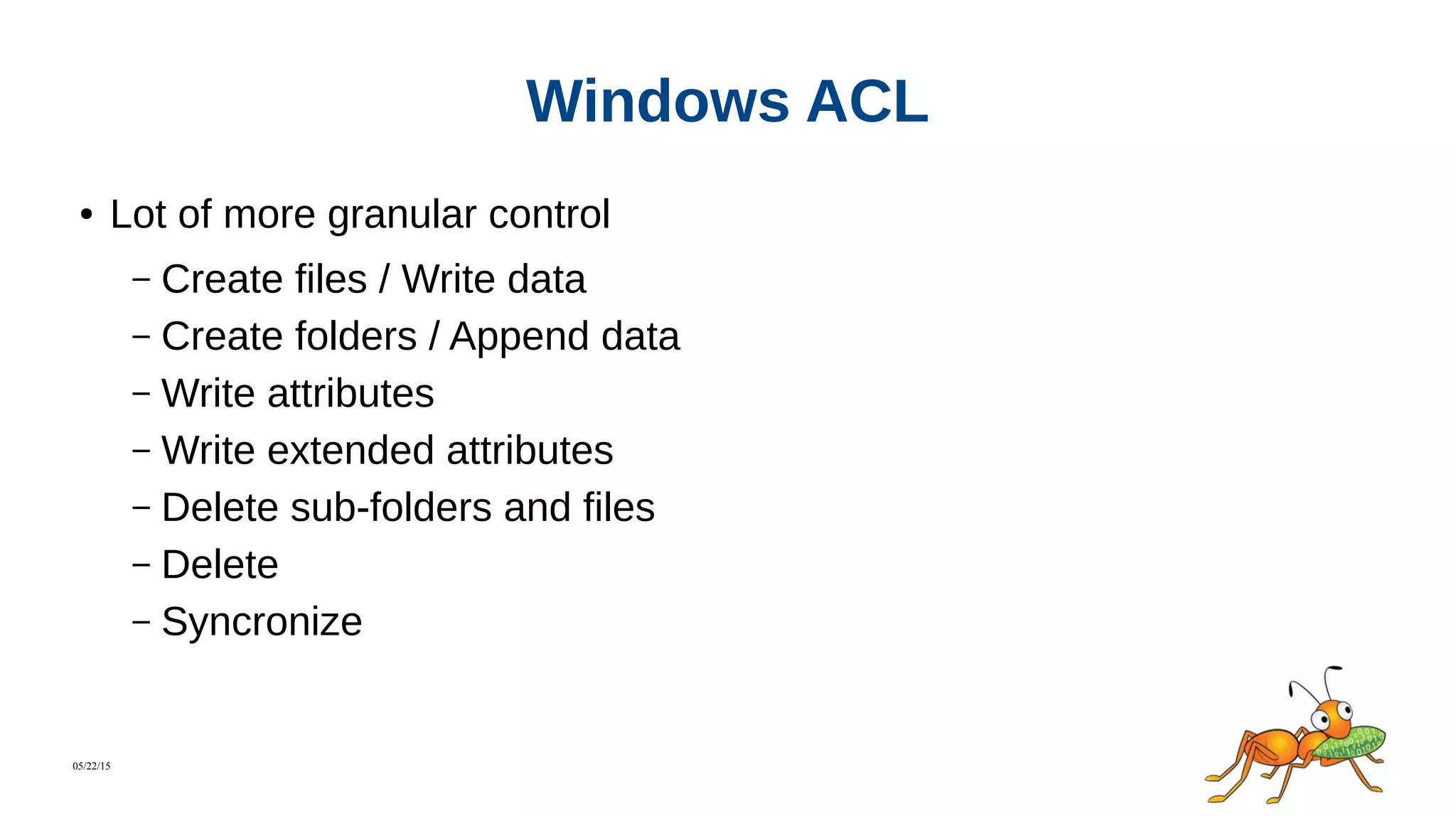
● Lot of more granular control
– Create files / Write data
– Create folders / Append data
– Write attributes
– Write extended attributes
– Delete sub-folders and files
– Delete
– Syncronize
05/22/15
Windows ACL
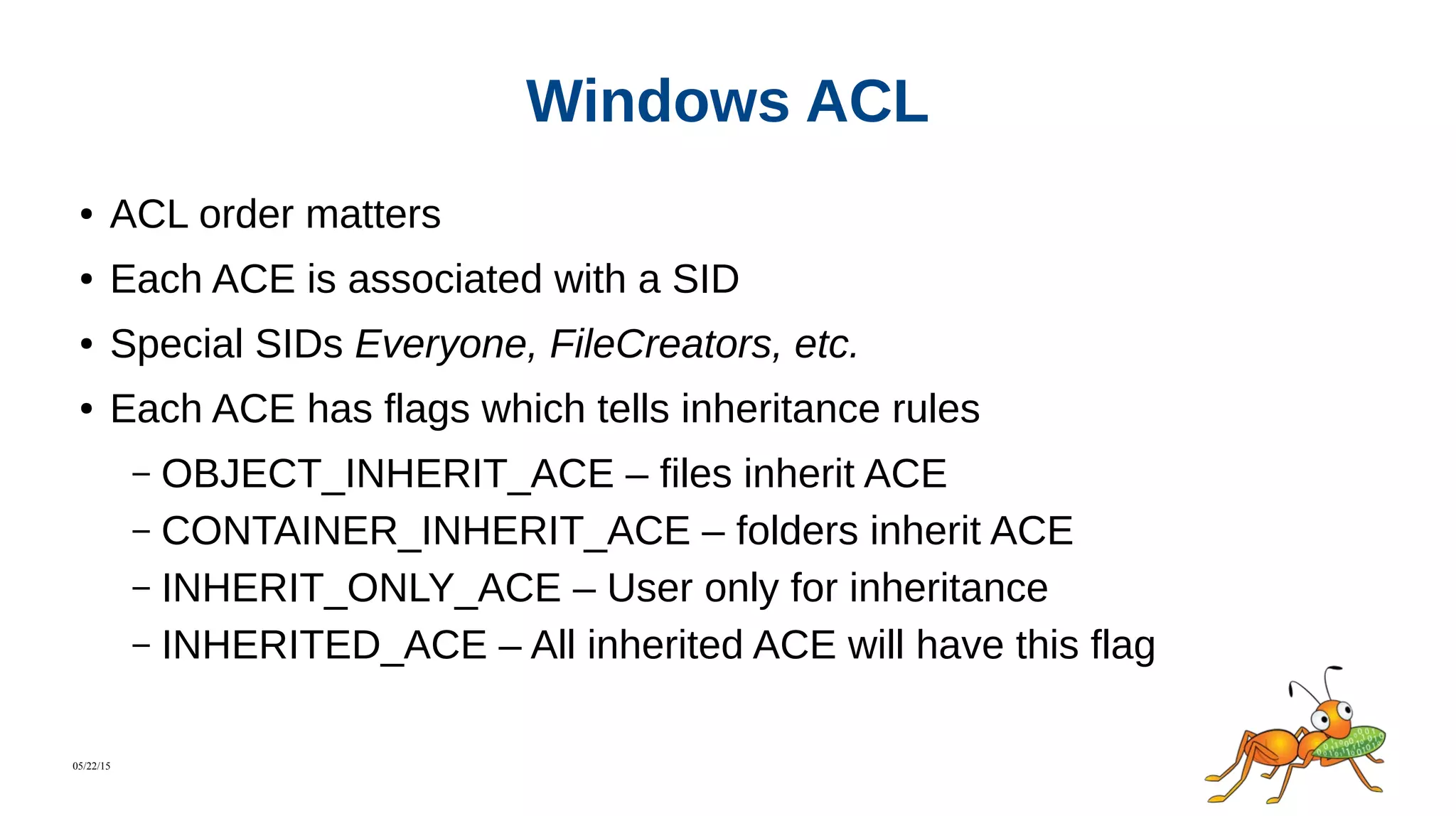
● ACL order matters
● Each ACE is associated with a SID
● Special SIDs Everyone, FileCreators, etc.
● Each ACE has flags which tells inheritance rules
– OBJECT_INHERIT_ACE – files inherit ACE
– CONTAINER_INHERIT_ACE – folders inherit ACE
– INHERIT_ONLY_ACE – User only for inheritance
– INHERITED_ACE – All inherited ACE will have this flag
05/22/15
NFSv4 ACL
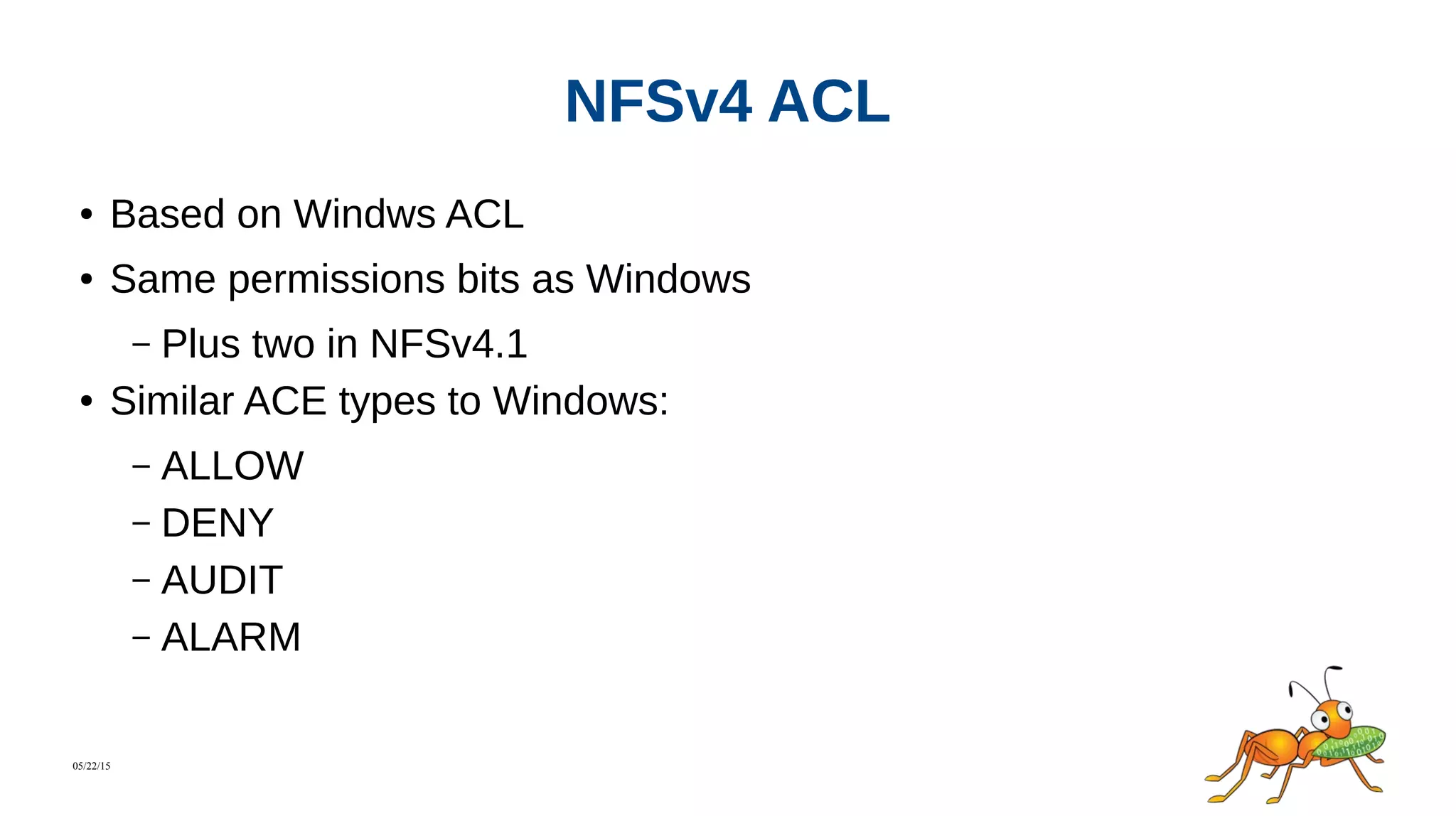
● Based on Windws ACL
● Same permissions bits as Windows
– Plus two in NFSv4.1
● Similar ACE types to Windows:
– ALLOW
– DENY
– AUDIT
– ALARM
05/22/15
NFSv4 ACL
● Users, groups identified by principals.
● A principal is either
– Named user (e.g. joe@example.com)
– Group
– Special principals
– OWNER@
– GROUP@
– EVERYONE@
● Use ACE flags similar to Windows
05/22/15
RichACL
● Similar to NFSv4 ACL
● Users, groups identified by Unix numerical IDs.
● ACE order is important
● Same 14 permission bits as NFsv4
● Supports same three file class as POSIX.1
– owner
– group
– others
05/22/15
RichACL
● Each file class is associated with a file mask (16b) for each RichACL
permission
● Each mask is an upper bound on granted permissions for its class
● RichACL supports EVERYONE@ instead of OTHER class
05/22/15
GlusterFS ACL
● Gluster supports POSIX ACL
● Implemented as a translator
● ACLs are stored in back-end file-system using EA (Extended
attributes)
● To support POSIX ACL, the volume must be mounted with acl option
mount –t glusterfs ­o acl <severname:volume­id> <mount point>
05/22/15
GlusterFS & RichACL
● Gluster supports multiple access protocols - Fuse, NFS, SMB.
● All three access protocols uses different ACLs
● POSIX.1e cannot represent NFSv4 and SMB (Windows) ACL because
of its limited set of permission bits.
● RichACL is one step closer towards multi-protocol access.
05/22/15
GlusterFS & RichACL
● Challenges and/or design considerations
– Gluster can support either POSIX.1e ACL or RichACL, but not both
– File-system migration needed to convert existing ACL to RichACL
– Once converted to RichACL the file-system cannot be converted
back to POSIX.1e ACL without information loss.
– RichACL Enforcement logic should go in Gluster to support
underlying file-system which does not support RichACL.
– Limited size of extended attributes (EA)
05/22/15
References
● http://www.bestbits.at/richacl/
● http://www.fmeh.org/ols-2010-implementing-richacl-paper.pdf
● https://github.com/andreas-gruenbacher/richacl/
05/22/15
Q & A

RichACL & GlusterFS

  • 1.
    RichACL & Gluster RajeshJoseph GlusterFS Dev Team
  • 2.
    05/22/15 AGENDA ● Unix PermissionModel ● POSIX. 1e ACL ● Windows ACL ● NFSv4 ACL ● RichACL ● Gluster & RichACL ● Q&A
  • 3.
    05/22/15 Unix Permission Model ●Standardized in POSIX. 1 ● Permissions based on three classes: – User – Group – Others ● Read (r), Write (w) and execute (x) permission bits ● Separate namespaces for UIDs and GIDs
  • 4.
    05/22/15 POSIX.1e ACL ● Moreflexible ● ACL is variable length list of ACEs (Access Control Entries) ● Types of ACL entries – Owner (user::rwx) – Named User (user:<name>:rwx) – Owning Group (group::rwx) – Named Group (group:<name>:rwx) – Mask (mask::rwx) – Others (other::rwx)
  • 5.
    05/22/15 POSIX.1e ACL ● OnlyALLOW mode with three permission bits – Read (r) – Write (w) – Execute (x) ● Minimal ACL ● Extended ACL
  • 6.
    POSIX.1e ACL r w- r - - - - - O w ner C lass O ther C lass G roup C lass Minimal Acess Control List User::rw- Other::r-- Group::r--
  • 7.
    POSIX.1e ACL r w- r w - - - - O w ner C lass O ther C lass G roup C lass Extended Acess Control List User::rw- Group::r-- User:joe:rw- Other::--- mask::rw-
  • 8.
    05/22/15 POSIX.1e ACL ● Directorieshave another ACL – Default ACL – Looks similar to normal ACL – Not user for enforcing ● Effects of Default ACL – A subdirectory inherits the default ACLs of the parent directory both as its default ACLs and as an access ACLs – A file inherits the default ACLs as its access ACLs.
  • 9.
    05/22/15 Windows ACL ● Twotypes of ACL – Discretionary Access Control List (DACL) – System Access Control List (SACL) ● Users, groups identified by Security Identifiers (SID) – Users and groups share the same namespace ● Three types of ACE (Access Control Entries) – Access Allowed (ALLOW) – Access Denied (DENY) – System Audit (AUDIT)
  • 10.
    05/22/15 Windows ACL ● Lotof more granular control – Change permissions – Take ownership – Traverse folders / Execute files – List folders / Read data – Read attributes – Read extended attributes – Read permissions
  • 11.
    05/22/15 Windows ACL ● Lotof more granular control – Create files / Write data – Create folders / Append data – Write attributes – Write extended attributes – Delete sub-folders and files – Delete – Syncronize
  • 12.
    05/22/15 Windows ACL ● ACLorder matters ● Each ACE is associated with a SID ● Special SIDs Everyone, FileCreators, etc. ● Each ACE has flags which tells inheritance rules – OBJECT_INHERIT_ACE – files inherit ACE – CONTAINER_INHERIT_ACE – folders inherit ACE – INHERIT_ONLY_ACE – User only for inheritance – INHERITED_ACE – All inherited ACE will have this flag
  • 13.
    05/22/15 NFSv4 ACL ● Basedon Windws ACL ● Same permissions bits as Windows – Plus two in NFSv4.1 ● Similar ACE types to Windows: – ALLOW – DENY – AUDIT – ALARM
  • 14.
    05/22/15 NFSv4 ACL ● Users,groups identified by principals. ● A principal is either – Named user (e.g. joe@example.com) – Group – Special principals – OWNER@ – GROUP@ – EVERYONE@ ● Use ACE flags similar to Windows
  • 15.
    05/22/15 RichACL ● Similar toNFSv4 ACL ● Users, groups identified by Unix numerical IDs. ● ACE order is important ● Same 14 permission bits as NFsv4 ● Supports same three file class as POSIX.1 – owner – group – others
  • 16.
    05/22/15 RichACL ● Each fileclass is associated with a file mask (16b) for each RichACL permission ● Each mask is an upper bound on granted permissions for its class ● RichACL supports EVERYONE@ instead of OTHER class
  • 17.
    05/22/15 GlusterFS ACL ● Glustersupports POSIX ACL ● Implemented as a translator ● ACLs are stored in back-end file-system using EA (Extended attributes) ● To support POSIX ACL, the volume must be mounted with acl option mount –t glusterfs ­o acl <severname:volume­id> <mount point>
  • 18.
    05/22/15 GlusterFS & RichACL ●Gluster supports multiple access protocols - Fuse, NFS, SMB. ● All three access protocols uses different ACLs ● POSIX.1e cannot represent NFSv4 and SMB (Windows) ACL because of its limited set of permission bits. ● RichACL is one step closer towards multi-protocol access.
  • 19.
    05/22/15 GlusterFS & RichACL ●Challenges and/or design considerations – Gluster can support either POSIX.1e ACL or RichACL, but not both – File-system migration needed to convert existing ACL to RichACL – Once converted to RichACL the file-system cannot be converted back to POSIX.1e ACL without information loss. – RichACL Enforcement logic should go in Gluster to support underlying file-system which does not support RichACL. – Limited size of extended attributes (EA)
  • 20.
  • 21.

Editor's Notes

  • #5 ACLs equivalent with the file mode permission bits are called minimal ACLs. ACLs with more than the three entries are called extended ACLs.
  • #10 Windows ACL control all sorts of OS objects and not just FS objects System Audit (AUDIT) – Only for SACL
  • #11 Windows ACL control all sorts of OS objects and not just FS objects System Audit (AUDIT) – Only for SACL
  • #12 Windows ACL control all sorts of OS objects and not just FS objects System Audit (AUDIT) – Only for SACL
  • #13 Windows ACL control all sorts of OS objects and not just FS objects System Audit (AUDIT) – Only for SACL
  • #14 Windows ACL control all sorts of OS objects and not just FS objects System Audit (AUDIT) – Only for SACL NFSv4.1 adds two more per- mission bits ( ACE4_WRITE_RETENTION_HOLD and ACE4_WRITE_RETENTION )
  • #15 Windows ACL control all sorts of OS objects and not just FS objects System Audit (AUDIT) – Only for SACL
  • #16 Windows ACL control all sorts of OS objects and not just FS objects System Audit (AUDIT) – Only for SACL
  • #17 Windows ACL control all sorts of OS objects and not just FS objects System Audit (AUDIT) – Only for SACL
  • #18 Windows ACL control all sorts of OS objects and not just FS objects System Audit (AUDIT) – Only for SACL
  • #19 Windows ACL control all sorts of OS objects and not just FS objects System Audit (AUDIT) – Only for SACL
  • #20 Windows ACL control all sorts of OS objects and not just FS objects System Audit (AUDIT) – Only for SACL
  • #21 Windows ACL control all sorts of OS objects and not just FS objects System Audit (AUDIT) – Only for SACL