RHYTH
M
RHYTHMIC
ACTIVITIES
DANCE
DANCING
Every individual has rhythm. It is found in all of nature and is
natural to every individual. Rhythm is most clearly seen through
dance- the art of movement
RHYTH
M
RHYTHMIC
ACTIVITIES
DANCE
DANCING
RHYTHM
RHYTH
M
RHYTHMIC
ACTIVITIES
DANCE
DANCING are the physical manifestations of the mental and emotional
response of the individual to rhythm. They are activities which
a child responds to physically, socially, and mentally to regular
patterns of sound. They are also a source of enjoyment for
people of all ages. Through these activities, skills and the sense
of rhythm are acquired and developed, feelings are expressed,
basic principles of time, space and force can be experienced.
RHYTHMIC
ACTIVITIES
RHYTH
M
RHYTHMIC
ACTIVITIES
DANCE
DANCING
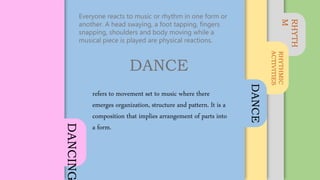
Everyone reacts to music or rhythm in one form or
another. A head swaying, a foot tapping, fingers
snapping, shoulders and body moving while a
musical piece is played are physical reactions.
DANCE
refers to movement set to music where there
emerges organization, structure and pattern. It is a
composition that implies arrangement of parts into
a form.
RHYTH
M
RHYTHMIC
ACTIVITIES
DANCE
DANCING
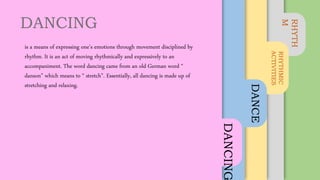
DANCING
is a means of expressing one’s emotions through movement disciplined by
rhythm. It is an act of moving rhythmically and expressively to an
accompaniment. The word dancing came from an old German word “
danson” which means to “ stretch”. Essentially, all dancing is made up of
stretching and relaxing.
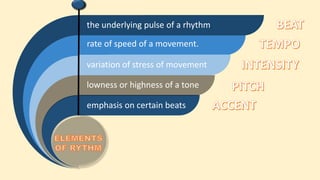
the underlying pulse of a rhythm.
rate of speed of a movement.
variation of stress of movement
lowness or highness of a tone
emphasis on certain beats
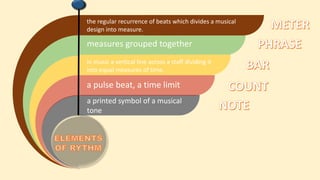
the regular recurrence of beats which divides a musical
design into measure.
measures grouped together
in music a vertical line across a staff dividing it
into equal measures of time.
a pulse beat, a time limit
a printed symbol of a musical
tone
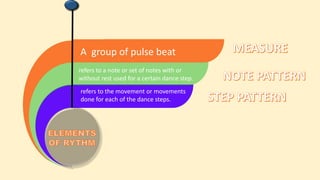
A group of pulse beat
refers to a note or set of notes with or
without rest used for a certain dance step.
refers to the movement or movements
done for each of the dance steps.
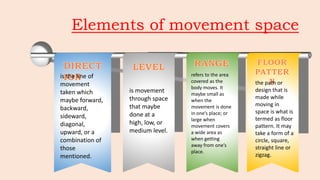
Elements of movement space
is the line of
movement
taken which
maybe forward,
backward,
sideward,
diagonal,
upward, or a
combination of
those
mentioned.
is movement
through space
that maybe
done at a
high, low, or
medium level.
refers to the area
covered as the
body moves. It
maybe small as
when the
movement is done
in one’s place; or
large when
movement covers
a wide area as
when getting
away from one’s
place.
the path or
design that is
made while
moving in
space is what is
termed as floor
pattern. It may
take a form of a
circle, square,
straight line or
zigzag.
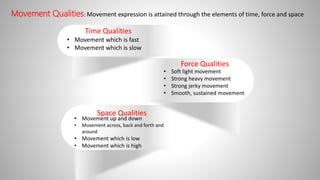
Time Qualities
• Movement which is fast
• Movement which is slow
Force Qualities
• Soft light movement
• Strong heavy movement
• Strong jerky movement
• Smooth, sustained movement
Space Qualities
• Movement up and down
• Movement across, back and forth and
around
• Movement which is low
• Movement which is high
Movement Qualities: Movement expression is attained through the elements of time, force and space
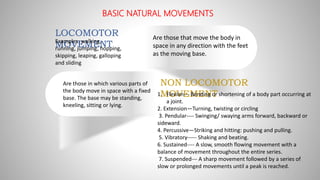
BASIC NATURAL MOVEMENTS
LOCOMOTOR
MOVEMENT
NON LOCOMOTOR
MOVEMENT
Are those that move the body in
space in any direction with the feet
as the moving base.
Examples: walking,
running, jumping, hopping,
skipping, leaping, galloping
and sliding
Are those in which various parts of
the body move in space with a fixed
base. The base may be standing,
kneeling, sitting or lying.
1. Flexion--- Bending or shortening of a body part occurring at
a joint.
2. Extension—Turning, twisting or circling
3. Pendular---- Swinging/ swaying arms forward, backward or
sideward.
4. Percussive—Striking and hitting: pushing and pulling.
5. Vibratory----- Shaking and beating.
6. Sustained---- A slow, smooth flowing movement with a
balance of movement throughout the entire series.
7. Suspended--- A sharp movement followed by a series of
slow or prolonged movements until a peak is reached.
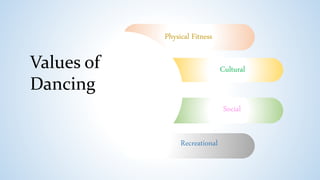
Physical Fitness
Cultural
Social
Recreational
Values of
Dancing

Rhythm

  • 1.
    RHYTH M RHYTHMIC ACTIVITIES DANCE DANCING Every individual hasrhythm. It is found in all of nature and is natural to every individual. Rhythm is most clearly seen through dance- the art of movement
  • 2.
  • 3.
    RHYTH M RHYTHMIC ACTIVITIES DANCE DANCING are thephysical manifestations of the mental and emotional response of the individual to rhythm. They are activities which a child responds to physically, socially, and mentally to regular patterns of sound. They are also a source of enjoyment for people of all ages. Through these activities, skills and the sense of rhythm are acquired and developed, feelings are expressed, basic principles of time, space and force can be experienced. RHYTHMIC ACTIVITIES
  • 4.
    RHYTH M RHYTHMIC ACTIVITIES DANCE DANCING Everyone reacts tomusic or rhythm in one form or another. A head swaying, a foot tapping, fingers snapping, shoulders and body moving while a musical piece is played are physical reactions. DANCE refers to movement set to music where there emerges organization, structure and pattern. It is a composition that implies arrangement of parts into a form.
  • 5.
    RHYTH M RHYTHMIC ACTIVITIES DANCE DANCING DANCING is a meansof expressing one’s emotions through movement disciplined by rhythm. It is an act of moving rhythmically and expressively to an accompaniment. The word dancing came from an old German word “ danson” which means to “ stretch”. Essentially, all dancing is made up of stretching and relaxing.
  • 6.
    the underlying pulseof a rhythm. rate of speed of a movement. variation of stress of movement lowness or highness of a tone emphasis on certain beats
  • 7.
    the regular recurrenceof beats which divides a musical design into measure. measures grouped together in music a vertical line across a staff dividing it into equal measures of time. a pulse beat, a time limit a printed symbol of a musical tone
  • 8.
    A group ofpulse beat refers to a note or set of notes with or without rest used for a certain dance step. refers to the movement or movements done for each of the dance steps.
  • 9.
    Elements of movementspace is the line of movement taken which maybe forward, backward, sideward, diagonal, upward, or a combination of those mentioned. is movement through space that maybe done at a high, low, or medium level. refers to the area covered as the body moves. It maybe small as when the movement is done in one’s place; or large when movement covers a wide area as when getting away from one’s place. the path or design that is made while moving in space is what is termed as floor pattern. It may take a form of a circle, square, straight line or zigzag.
  • 10.
    Time Qualities • Movementwhich is fast • Movement which is slow Force Qualities • Soft light movement • Strong heavy movement • Strong jerky movement • Smooth, sustained movement Space Qualities • Movement up and down • Movement across, back and forth and around • Movement which is low • Movement which is high Movement Qualities: Movement expression is attained through the elements of time, force and space
  • 11.
    BASIC NATURAL MOVEMENTS LOCOMOTOR MOVEMENT NONLOCOMOTOR MOVEMENT Are those that move the body in space in any direction with the feet as the moving base. Examples: walking, running, jumping, hopping, skipping, leaping, galloping and sliding Are those in which various parts of the body move in space with a fixed base. The base may be standing, kneeling, sitting or lying. 1. Flexion--- Bending or shortening of a body part occurring at a joint. 2. Extension—Turning, twisting or circling 3. Pendular---- Swinging/ swaying arms forward, backward or sideward. 4. Percussive—Striking and hitting: pushing and pulling. 5. Vibratory----- Shaking and beating. 6. Sustained---- A slow, smooth flowing movement with a balance of movement throughout the entire series. 7. Suspended--- A sharp movement followed by a series of slow or prolonged movements until a peak is reached.
  • 12.