Understanding Job SkillsUnderstanding Job Skills
JobsDhamaka
India’s No.1 Jobs Portal
1
Goal of PresentationGoal of Presentation
• Introduce Job Skills methodology and data
 Data Source
 What are Job Skills?
 Job Skills Uses
 Determining Career Ladders/Pathways
 Skill Gaps and Employment Projections
• CWIA, Center for Workforce Information & Analysis, (bureau within L&I)
produces workforce and economic statistics and analysis. CWIA’s key
roles:
 Provide labor market information (LMI) products &
services to wide range of customers
 Produce reports on Pennsylvania’s labor force (employment &
unemployment), employers, industries, occupations, and wages 2
Data SourceData Source
3
O*NetO*Net
• O*NET – The Occupational Information Network
 The nation's primary source of occupational information
 A free online database that contains hundreds of occupational definitions
to help students, job seekers, businesses and workforce development
professionals to understand today's world of work
 Sponsored by the U.S. Department of Labor and ETA
 Compiled by occupational analysts and experts and by surveying a broad
range of workers from each occupation
 Two main branches of information: Worker Attributes (Person) and
Occupational Requirements (Job)
 Describes occupations in terms of the skills and knowledge required, how
the work is performed, and typical work settings.
4
O*NetO*Net
• For each job, O*NET provides the following information:
 Worker Attributes:
 Personal requirements: the skills and knowledge required to perform the
work
 Personal characteristics: the abilities, interests and values needed to
perform the work
 Experience requirements: the training and level of licensing and experience
needed for the work
 Occupational Requirements:
 Job requirements: the work activities and context, including the physical,
social, and organizational factors involved in the work
 Labor market: the occupational outlook and the pay scale for the work
 Job specific information: occupation specific tasks and tools and
technologies
5
What are Job Skills?What are Job Skills?
6
What aWhat are job skills?What are job skills?
Job Skills?
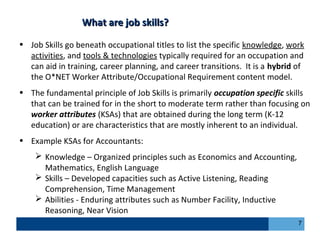
• Job Skills go beneath occupational titles to list the specific knowledge, work
activities, and tools & technologies typically required for an occupation and
can aid in training, career planning, and career transitions. It is a hybrid of
the O*NET Worker Attribute/Occupational Requirement content model.
• The fundamental principle of Job Skills is primarily occupation specific skills
that can be trained for in the short to moderate term rather than focusing on
worker attributes (KSAs) that are obtained during the long term (K-12
education) or are characteristics that are mostly inherent to an individual.
• Example KSAs for Accountants:
 Knowledge – Organized principles such as Economics and Accounting,
Mathematics, English Language
 Skills – Developed capacities such as Active Listening, Reading
Comprehension, Time Management
 Abilities - Enduring attributes such as Number Facility, Inductive
Reasoning, Near Vision
7
Job Skills
Job Skills:
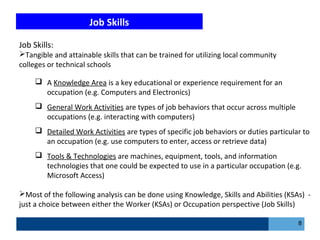
Tangible and attainable skills that can be trained for utilizing local community
colleges or technical schools
 A Knowledge Area is a key educational or experience requirement for an
occupation (e.g. Computers and Electronics)
 General Work Activities are types of job behaviors that occur across multiple
occupations (e.g. interacting with computers)
 Detailed Work Activities are types of specific job behaviors or duties particular to
an occupation (e.g. use computers to enter, access or retrieve data)
 Tools & Technologies are machines, equipment, tools, and information
technologies that one could be expected to use in a particular occupation (e.g.
Microsoft Access)
Most of the following analysis can be done using Knowledge, Skills and Abilities (KSAs) -
just a choice between either the Worker (KSAs) or Occupation perspective (Job Skills)
8
Job Skills Example - Accounts
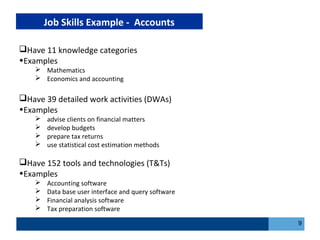
Have 11 knowledge categories
•Examples
 Mathematics
 Economics and accounting
Have 39 detailed work activities (DWAs)
•Examples
 advise clients on financial matters
 develop budgets
 prepare tax returns
 use statistical cost estimation methods
Have 152 tools and technologies (T&Ts)
•Examples
 Accounting software
 Data base user interface and query software
 Financial analysis software
 Tax preparation software
9
Job Skills UsesJob Skills Uses
10
Most Needed Jobs Skills
11
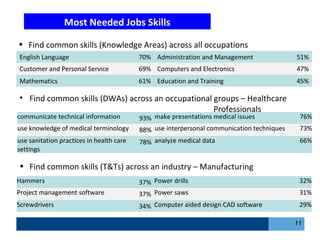
English Language 70% Administration and Management 51%
Customer and Personal Service 69% Computers and Electronics 47%
Mathematics 61% Education and Training 45%
• Find common skills (Knowledge Areas) across all occupations
• Find common skills (DWAs) across an occupational groups – Healthcare
Professionals
communicate technical information 93% make presentations medical issues 76%
use knowledge of medical terminology 88% use interpersonal communication techniques 73%
use sanitation practices in health care
settings
78% analyze medical data 66%
• Find common skills (T&Ts) across an industry – Manufacturing
Hammers 37% Power drills 32%
Project management software 37% Power saws 31%
Screwdrivers 34% Computer aided design CAD software 29%
Find Related Occupations
12
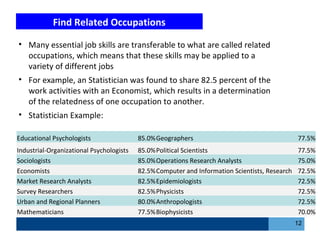
Educational Psychologists 85.0%Geographers 77.5%
Industrial-Organizational Psychologists 85.0%Political Scientists 77.5%
Sociologists 85.0%Operations Research Analysts 75.0%
Economists 82.5%Computer and Information Scientists, Research 72.5%
Market Research Analysts 82.5%Epidemiologists 72.5%
Survey Researchers 82.5%Physicists 72.5%
Urban and Regional Planners 80.0%Anthropologists 72.5%
Mathematicians 77.5%Biophysicists 70.0%
• Many essential job skills are transferable to what are called related
occupations, which means that these skills may be applied to a
variety of different jobs
• For example, an Statistician was found to share 82.5 percent of the
work activities with an Economist, which results in a determination
of the relatedness of one occupation to another.
• Statistician Example:
Determining Career Pathways
13
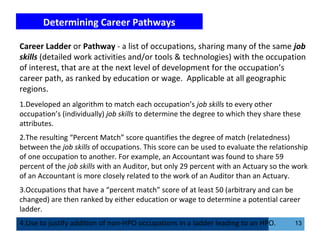
Career Ladder or Pathway - a list of occupations, sharing many of the same job
skills (detailed work activities and/or tools & technologies) with the occupation
of interest, that are at the next level of development for the occupation’s
career path, as ranked by education or wage. Applicable at all geographic
regions.
1.Developed an algorithm to match each occupation’s job skills to every other
occupation’s (individually) job skills to determine the degree to which they share these
attributes.
2.The resulting “Percent Match” score quantifies the degree of match (relatedness)
between the job skills of occupations. This score can be used to evaluate the relationship
of one occupation to another. For example, an Accountant was found to share 59
percent of the job skills with an Auditor, but only 29 percent with an Actuary so the work
of an Accountant is more closely related to the work of an Auditor than an Actuary.
3.Occupations that have a “percent match” score of at least 50 (arbitrary and can be
changed) are then ranked by either education or wage to determine a potential career
ladder.
4.Use to justify addition of non-HPO occupations in a ladder leading to an HPO.
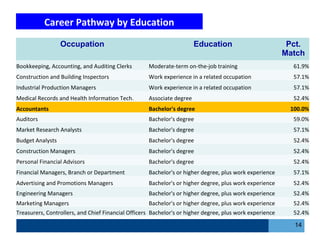
Career Pathway by Education
14
Occupation Education Pct.
Match
Bookkeeping, Accounting, and Auditing Clerks Moderate-term on-the-job training 61.9%
Construction and Building Inspectors Work experience in a related occupation 57.1%
Industrial Production Managers Work experience in a related occupation 57.1%
Medical Records and Health Information Tech. Associate degree 52.4%
Accountants Bachelor's degree 100.0%
Auditors Bachelor's degree 59.0%
Market Research Analysts Bachelor's degree 57.1%
Budget Analysts Bachelor's degree 52.4%
Construction Managers Bachelor's degree 52.4%
Personal Financial Advisors Bachelor's degree 52.4%
Financial Managers, Branch or Department Bachelor's or higher degree, plus work experience 57.1%
Advertising and Promotions Managers Bachelor's or higher degree, plus work experience 52.4%
Engineering Managers Bachelor's or higher degree, plus work experience 52.4%
Marketing Managers Bachelor's or higher degree, plus work experience 52.4%
Treasurers, Controllers, and Chief Financial Officers Bachelor's or higher degree, plus work experience 52.4%
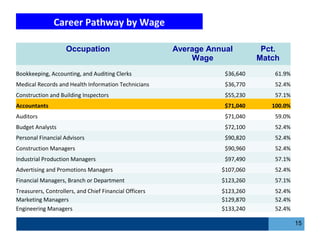
Career Pathway by Wage
15
Occupation Average Annual
Wage
Pct.
Match
Bookkeeping, Accounting, and Auditing Clerks $36,640 61.9%
Medical Records and Health Information Technicians $36,770 52.4%
Construction and Building Inspectors $55,230 57.1%
Accountants $71,040 100.0%
Auditors $71,040 59.0%
Budget Analysts $72,100 52.4%
Personal Financial Advisors $90,820 52.4%
Construction Managers $90,960 52.4%
Industrial Production Managers $97,490 57.1%
Advertising and Promotions Managers $107,060 52.4%
Financial Managers, Branch or Department $123,260 57.1%
Treasurers, Controllers, and Chief Financial Officers $123,260 52.4%
Marketing Managers $129,870 52.4%
Engineering Managers $133,240 52.4%
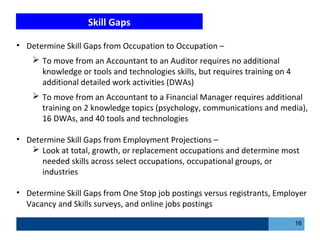
Skill Gaps
16
• Determine Skill Gaps from Occupation to Occupation –
 To move from an Accountant to an Auditor requires no additional
knowledge or tools and technologies skills, but requires training on 4
additional detailed work activities (DWAs)
 To move from an Accountant to a Financial Manager requires additional
training on 2 knowledge topics (psychology, communications and media),
16 DWAs, and 40 tools and technologies
• Determine Skill Gaps from Employment Projections –
 Look at total, growth, or replacement occupations and determine most
needed skills across select occupations, occupational groups, or
industries
• Determine Skill Gaps from One Stop job postings versus registrants, Employer
Vacancy and Skills surveys, and online jobs postings
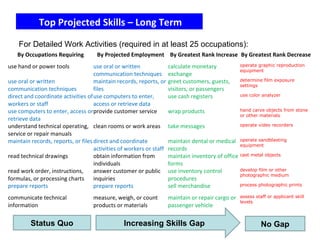
Top Projected Skills – Long Term
By Occupations Requiring By Projected Employment By Greatest Rank Increase By Greatest Rank Decrease
use hand or power tools use oral or written
communication techniques
calculate monetary
exchange
operate graphic reproduction
equipment
use oral or written
communication techniques
maintain records, reports, or
files
greet customers, guests,
visitors, or passengers
determine film exposure
settings
direct and coordinate activities of
workers or staff
use computers to enter,
access or retrieve data
use cash registers use color analyzer
use computers to enter, access or
retrieve data
provide customer service wrap products hand carve objects from stone
or other materials
understand technical operating,
service or repair manuals
clean rooms or work areas take messages operate video recorders
maintain records, reports, or filesdirect and coordinate
activities of workers or staff
maintain dental or medical
records
operate sandblasting
equipment
read technical drawings obtain information from
individuals
maintain inventory of office
forms
cast metal objects
read work order, instructions,
formulas, or processing charts
answer customer or public
inquiries
use inventory control
procedures
develop film or other
photographic medium
prepare reports prepare reports sell merchandise process photographic prints
communicate technical
information
measure, weigh, or count
products or materials
maintain or repair cargo or
passenger vehicle
assess staff or applicant skill
levels
Increasing Skills GapStatus Quo
For Detailed Work Activities (required in at least 25 occupations):
No Gap
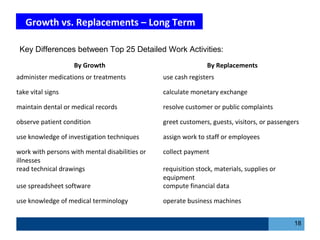
Growth vs. Replacements – Long Term
By Growth By Replacements
administer medications or treatments use cash registers
take vital signs calculate monetary exchange
maintain dental or medical records resolve customer or public complaints
observe patient condition greet customers, guests, visitors, or passengers
use knowledge of investigation techniques assign work to staff or employees
work with persons with mental disabilities or
illnesses
collect payment
read technical drawings requisition stock, materials, supplies or
equipment
use spreadsheet software compute financial data
use knowledge of medical terminology operate business machines
Key Differences between Top 25 Detailed Work Activities:
18
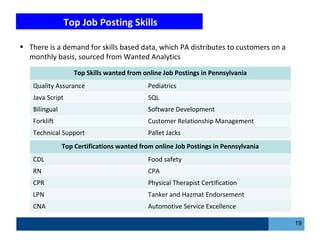
Top Job Posting Skills
19
Top Skills wanted from online Job Postings in Pennsylvania
Quality Assurance Pediatrics
Java Script SQL
Bilingual Software Development
Forklift Customer Relationship Management
Technical Support Pallet Jacks
Top Certifications wanted from online Job Postings in Pennsylvania
CDL Food safety
RN CPA
CPR Physical Therapist Certification
LPN Tanker and Hazmat Endorsement
CNA Automotive Service Excellence
• There is a demand for skills based data, which PA distributes to customers on a
monthly basis, sourced from Wanted Analytics
CWIA Contact Information
Find out more at : JobsDhamaka
Customer Response Line: 0120-485-0200 or
Email:
support@jobsdhamaka.com
On the web: www.jobsdhamaka.net, see Job Skills
under left hand navigation menu
20

Job skills

  • 1.
    Understanding Job SkillsUnderstandingJob Skills JobsDhamaka India’s No.1 Jobs Portal 1
  • 2.
    Goal of PresentationGoalof Presentation • Introduce Job Skills methodology and data  Data Source  What are Job Skills?  Job Skills Uses  Determining Career Ladders/Pathways  Skill Gaps and Employment Projections • CWIA, Center for Workforce Information & Analysis, (bureau within L&I) produces workforce and economic statistics and analysis. CWIA’s key roles:  Provide labor market information (LMI) products & services to wide range of customers  Produce reports on Pennsylvania’s labor force (employment & unemployment), employers, industries, occupations, and wages 2
  • 3.
  • 4.
    O*NetO*Net • O*NET –The Occupational Information Network  The nation's primary source of occupational information  A free online database that contains hundreds of occupational definitions to help students, job seekers, businesses and workforce development professionals to understand today's world of work  Sponsored by the U.S. Department of Labor and ETA  Compiled by occupational analysts and experts and by surveying a broad range of workers from each occupation  Two main branches of information: Worker Attributes (Person) and Occupational Requirements (Job)  Describes occupations in terms of the skills and knowledge required, how the work is performed, and typical work settings. 4
  • 5.
    O*NetO*Net • For eachjob, O*NET provides the following information:  Worker Attributes:  Personal requirements: the skills and knowledge required to perform the work  Personal characteristics: the abilities, interests and values needed to perform the work  Experience requirements: the training and level of licensing and experience needed for the work  Occupational Requirements:  Job requirements: the work activities and context, including the physical, social, and organizational factors involved in the work  Labor market: the occupational outlook and the pay scale for the work  Job specific information: occupation specific tasks and tools and technologies 5
  • 6.
    What are JobSkills?What are Job Skills? 6
  • 7.
    What aWhat arejob skills?What are job skills? Job Skills? • Job Skills go beneath occupational titles to list the specific knowledge, work activities, and tools & technologies typically required for an occupation and can aid in training, career planning, and career transitions. It is a hybrid of the O*NET Worker Attribute/Occupational Requirement content model. • The fundamental principle of Job Skills is primarily occupation specific skills that can be trained for in the short to moderate term rather than focusing on worker attributes (KSAs) that are obtained during the long term (K-12 education) or are characteristics that are mostly inherent to an individual. • Example KSAs for Accountants:  Knowledge – Organized principles such as Economics and Accounting, Mathematics, English Language  Skills – Developed capacities such as Active Listening, Reading Comprehension, Time Management  Abilities - Enduring attributes such as Number Facility, Inductive Reasoning, Near Vision 7
  • 8.
    Job Skills Job Skills: Tangibleand attainable skills that can be trained for utilizing local community colleges or technical schools  A Knowledge Area is a key educational or experience requirement for an occupation (e.g. Computers and Electronics)  General Work Activities are types of job behaviors that occur across multiple occupations (e.g. interacting with computers)  Detailed Work Activities are types of specific job behaviors or duties particular to an occupation (e.g. use computers to enter, access or retrieve data)  Tools & Technologies are machines, equipment, tools, and information technologies that one could be expected to use in a particular occupation (e.g. Microsoft Access) Most of the following analysis can be done using Knowledge, Skills and Abilities (KSAs) - just a choice between either the Worker (KSAs) or Occupation perspective (Job Skills) 8
  • 9.
    Job Skills Example- Accounts Have 11 knowledge categories •Examples  Mathematics  Economics and accounting Have 39 detailed work activities (DWAs) •Examples  advise clients on financial matters  develop budgets  prepare tax returns  use statistical cost estimation methods Have 152 tools and technologies (T&Ts) •Examples  Accounting software  Data base user interface and query software  Financial analysis software  Tax preparation software 9
  • 10.
    Job Skills UsesJobSkills Uses 10
  • 11.
    Most Needed JobsSkills 11 English Language 70% Administration and Management 51% Customer and Personal Service 69% Computers and Electronics 47% Mathematics 61% Education and Training 45% • Find common skills (Knowledge Areas) across all occupations • Find common skills (DWAs) across an occupational groups – Healthcare Professionals communicate technical information 93% make presentations medical issues 76% use knowledge of medical terminology 88% use interpersonal communication techniques 73% use sanitation practices in health care settings 78% analyze medical data 66% • Find common skills (T&Ts) across an industry – Manufacturing Hammers 37% Power drills 32% Project management software 37% Power saws 31% Screwdrivers 34% Computer aided design CAD software 29%
  • 12.
    Find Related Occupations 12 EducationalPsychologists 85.0%Geographers 77.5% Industrial-Organizational Psychologists 85.0%Political Scientists 77.5% Sociologists 85.0%Operations Research Analysts 75.0% Economists 82.5%Computer and Information Scientists, Research 72.5% Market Research Analysts 82.5%Epidemiologists 72.5% Survey Researchers 82.5%Physicists 72.5% Urban and Regional Planners 80.0%Anthropologists 72.5% Mathematicians 77.5%Biophysicists 70.0% • Many essential job skills are transferable to what are called related occupations, which means that these skills may be applied to a variety of different jobs • For example, an Statistician was found to share 82.5 percent of the work activities with an Economist, which results in a determination of the relatedness of one occupation to another. • Statistician Example:
  • 13.
    Determining Career Pathways 13 CareerLadder or Pathway - a list of occupations, sharing many of the same job skills (detailed work activities and/or tools & technologies) with the occupation of interest, that are at the next level of development for the occupation’s career path, as ranked by education or wage. Applicable at all geographic regions. 1.Developed an algorithm to match each occupation’s job skills to every other occupation’s (individually) job skills to determine the degree to which they share these attributes. 2.The resulting “Percent Match” score quantifies the degree of match (relatedness) between the job skills of occupations. This score can be used to evaluate the relationship of one occupation to another. For example, an Accountant was found to share 59 percent of the job skills with an Auditor, but only 29 percent with an Actuary so the work of an Accountant is more closely related to the work of an Auditor than an Actuary. 3.Occupations that have a “percent match” score of at least 50 (arbitrary and can be changed) are then ranked by either education or wage to determine a potential career ladder. 4.Use to justify addition of non-HPO occupations in a ladder leading to an HPO.
  • 14.
    Career Pathway byEducation 14 Occupation Education Pct. Match Bookkeeping, Accounting, and Auditing Clerks Moderate-term on-the-job training 61.9% Construction and Building Inspectors Work experience in a related occupation 57.1% Industrial Production Managers Work experience in a related occupation 57.1% Medical Records and Health Information Tech. Associate degree 52.4% Accountants Bachelor's degree 100.0% Auditors Bachelor's degree 59.0% Market Research Analysts Bachelor's degree 57.1% Budget Analysts Bachelor's degree 52.4% Construction Managers Bachelor's degree 52.4% Personal Financial Advisors Bachelor's degree 52.4% Financial Managers, Branch or Department Bachelor's or higher degree, plus work experience 57.1% Advertising and Promotions Managers Bachelor's or higher degree, plus work experience 52.4% Engineering Managers Bachelor's or higher degree, plus work experience 52.4% Marketing Managers Bachelor's or higher degree, plus work experience 52.4% Treasurers, Controllers, and Chief Financial Officers Bachelor's or higher degree, plus work experience 52.4%
  • 15.
    Career Pathway byWage 15 Occupation Average Annual Wage Pct. Match Bookkeeping, Accounting, and Auditing Clerks $36,640 61.9% Medical Records and Health Information Technicians $36,770 52.4% Construction and Building Inspectors $55,230 57.1% Accountants $71,040 100.0% Auditors $71,040 59.0% Budget Analysts $72,100 52.4% Personal Financial Advisors $90,820 52.4% Construction Managers $90,960 52.4% Industrial Production Managers $97,490 57.1% Advertising and Promotions Managers $107,060 52.4% Financial Managers, Branch or Department $123,260 57.1% Treasurers, Controllers, and Chief Financial Officers $123,260 52.4% Marketing Managers $129,870 52.4% Engineering Managers $133,240 52.4%
  • 16.
    Skill Gaps 16 • DetermineSkill Gaps from Occupation to Occupation –  To move from an Accountant to an Auditor requires no additional knowledge or tools and technologies skills, but requires training on 4 additional detailed work activities (DWAs)  To move from an Accountant to a Financial Manager requires additional training on 2 knowledge topics (psychology, communications and media), 16 DWAs, and 40 tools and technologies • Determine Skill Gaps from Employment Projections –  Look at total, growth, or replacement occupations and determine most needed skills across select occupations, occupational groups, or industries • Determine Skill Gaps from One Stop job postings versus registrants, Employer Vacancy and Skills surveys, and online jobs postings
  • 17.
    Top Projected Skills– Long Term By Occupations Requiring By Projected Employment By Greatest Rank Increase By Greatest Rank Decrease use hand or power tools use oral or written communication techniques calculate monetary exchange operate graphic reproduction equipment use oral or written communication techniques maintain records, reports, or files greet customers, guests, visitors, or passengers determine film exposure settings direct and coordinate activities of workers or staff use computers to enter, access or retrieve data use cash registers use color analyzer use computers to enter, access or retrieve data provide customer service wrap products hand carve objects from stone or other materials understand technical operating, service or repair manuals clean rooms or work areas take messages operate video recorders maintain records, reports, or filesdirect and coordinate activities of workers or staff maintain dental or medical records operate sandblasting equipment read technical drawings obtain information from individuals maintain inventory of office forms cast metal objects read work order, instructions, formulas, or processing charts answer customer or public inquiries use inventory control procedures develop film or other photographic medium prepare reports prepare reports sell merchandise process photographic prints communicate technical information measure, weigh, or count products or materials maintain or repair cargo or passenger vehicle assess staff or applicant skill levels Increasing Skills GapStatus Quo For Detailed Work Activities (required in at least 25 occupations): No Gap
  • 18.
    Growth vs. Replacements– Long Term By Growth By Replacements administer medications or treatments use cash registers take vital signs calculate monetary exchange maintain dental or medical records resolve customer or public complaints observe patient condition greet customers, guests, visitors, or passengers use knowledge of investigation techniques assign work to staff or employees work with persons with mental disabilities or illnesses collect payment read technical drawings requisition stock, materials, supplies or equipment use spreadsheet software compute financial data use knowledge of medical terminology operate business machines Key Differences between Top 25 Detailed Work Activities: 18
  • 19.
    Top Job PostingSkills 19 Top Skills wanted from online Job Postings in Pennsylvania Quality Assurance Pediatrics Java Script SQL Bilingual Software Development Forklift Customer Relationship Management Technical Support Pallet Jacks Top Certifications wanted from online Job Postings in Pennsylvania CDL Food safety RN CPA CPR Physical Therapist Certification LPN Tanker and Hazmat Endorsement CNA Automotive Service Excellence • There is a demand for skills based data, which PA distributes to customers on a monthly basis, sourced from Wanted Analytics
  • 20.
    CWIA Contact Information Findout more at : JobsDhamaka Customer Response Line: 0120-485-0200 or Email: support@jobsdhamaka.com On the web: www.jobsdhamaka.net, see Job Skills under left hand navigation menu 20