IT Hiring and Compensation Trends 2010 © 2009 Robert Half Technology.  An Equal Opportunity Employer  Kelly O’Connell Branch Manager
Robert Half International Founded in 1948 Pioneer in specialized staffing services Ranked number one in our industry in FORTUNE ®  magazine’s list of the “ World’s Most Admired Companies”  (March 16, 2009) Robert Half Technology Provides highly skilled IT professionals  Conducts ongoing research on  IT workplace trends Respected resource on IT hiring  and employment Company Overview
Today’s Discussion The IT Hiring Environment Technical Skills in Demand 2010 Salary Trends The Value of Certifications Soft Skills in Demand Staffing During a Recession The Benefits of Flexible Staffing
The  2010 Salary Guide National starting salary ranges for IT positions in the United States and Canada Trends affecting IT hiring Review of in-demand skills and attributes Advice on building strong IT teams and maintaining employee morale Staffing for success
Sources of the Data Interim and full-time placements made throughout the year from our offices in the United States and Canada Local insight from our staffing and recruiting professionals throughout our branch network Exclusive workplace research we conduct among CIOs A review of actual starting salaries in 2009  An extrapolation of current trends into 2010
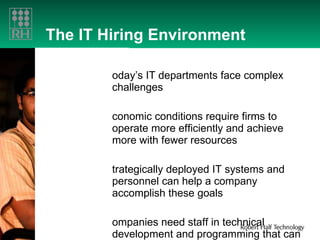
The IT Hiring Environment   Today’s IT departments face complex challenges Economic conditions require firms to operate more efficiently and achieve more with fewer resources Strategically deployed IT systems and personnel can help a company accomplish these goals Companies need staff in technical development and programming that can result in  cost savings
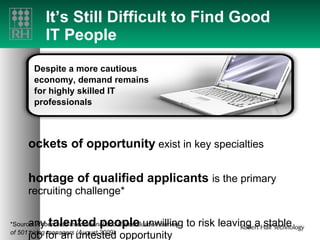
It’s Still Difficult to Find Good  IT People Pockets of opportunity  exist in key specialties Shortage of qualified applicants  is the primary recruiting challenge* Many  talented people  unwilling to risk leaving a stable job for an untested opportunity *Source:  Robert Half International and CareerBuilder ®  survey  of 501 hiring managers (August 2009) Despite a more cautious economy, demand remains for highly skilled IT professionals
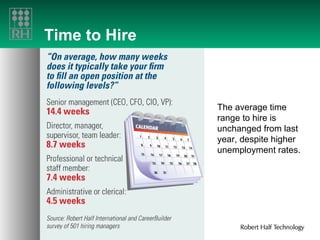
Time to Hire The average time range to hire is unchanged from last year, despite higher unemployment rates.
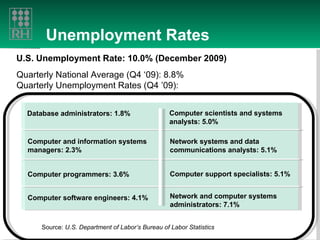
Unemployment Rates Source:  U.S. Department of Labor’s   Bureau of Labor Statistics U.S. Unemployment Rate: 10.0% (December 2009) Quarterly National Average (Q4 ‘09): 8.8% Quarterly Unemployment Rates (Q4 ’09): Computer software engineers: 4.1%  Computer and information systems managers: 2.3% Computer programmers: 3.6%  Computer support specialists: 5.1%  Network systems and data communications analysts: 5.1% Database administrators: 1.8%  Computer scientists and systems analysts: 5.0%  Network and computer systems administrators: 7.1%
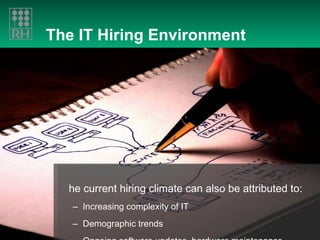
The IT Hiring Environment   The current hiring climate can also be attributed to: Increasing complexity of IT Demographic trends Ongoing software updates, hardware maintenance
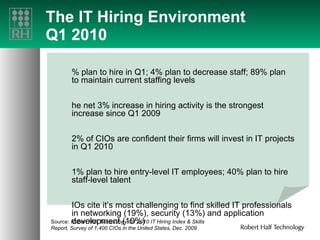
The IT Hiring Environment  Q1 2010 7% plan to hire in Q1; 4% plan to decrease staff; 89% plan to maintain current staffing levels The net 3% increase in hiring activity is the strongest increase since Q1 2009 42% of CIOs are confident their firms will invest in IT projects in Q1 2010 41% plan to hire entry-level IT employees; 40% plan to hire staff-level talent CIOs cite it’s most challenging to find skilled IT professionals in networking (19%), security (13%) and application development (10%) Source:  Robert Half Technology Q1 2010 IT Hiring Index & Skills Report, Survey of 1,400 CIOs in the United States, Dec. 2009
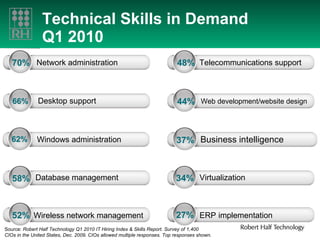
Technical Skills in Demand  Q1 2010 Source:  Robert Half Technology Q1 2010 IT Hiring Index & Skills Report. Survey of 1,400  CIOs in the United States, Dec. 2009. CIOs allowed multiple responses. Top responses shown. Network administration 70% 66% Desktop support 62% Windows administration 58% Database management 48% Telecommunications support 44% Web development/website design 34% Virtualization 52% Wireless network management 27% ERP   implementation 37% Business intelligence
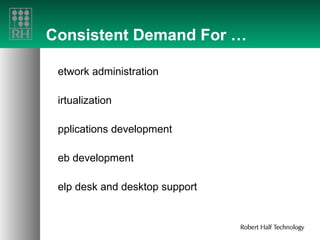
Consistent Demand For … Network administration Virtualization Applications development Web development Help desk and desktop support
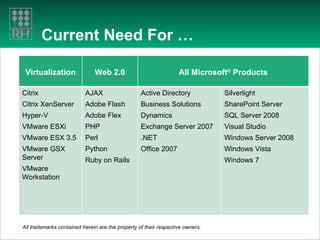
Current Need For … All trademarks contained herein are the property of their respective owners. Virtualization Web 2.0 All Microsoft ®  Products Citrix Citrix XenServer Hyper-V VMware ESXi VMware ESX 3.5 VMware GSX Server VMware Workstation AJAX Adobe Flash Adobe Flex PHP Perl Python Ruby on Rails Active Directory Business Solutions Dynamics Exchange Server 2007 .NET Office 2007 Silverlight SharePoint Server SQL Server 2008 Visual Studio Windows Server 2008 Windows Vista Windows 7
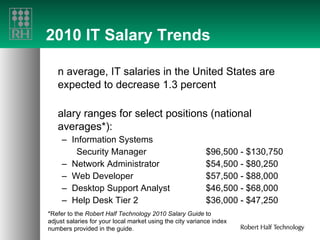
2010 IT Salary Trends On average, IT salaries in the United States are expected to decrease 1.3 percent Salary ranges for select positions (national averages*): Information Systems  Security Manager  $96,500 - $130,750 Network Administrator  $54,500 - $80,250 Web Developer  $57,500 - $88,000 Desktop Support Analyst  $46,500 - $68,000 Help Desk Tier 2  $36,000 - $47,250 *Refer to the  Robert Half Technology 2010 Salary Guide  to adjust salaries for your local market using the city variance index numbers provided in the guide.
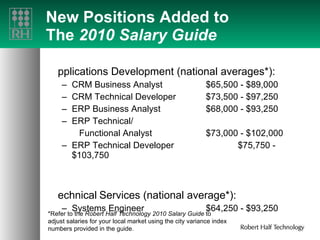
New Positions Added to  The  2010 Salary Guide Applications Development (national averages*): CRM Business Analyst $65,500 - $89,000 CRM Technical Developer $73,500 - $97,250 ERP Business Analyst $68,000 - $93,250 ERP Technical/   Functional Analyst $73,000 - $102,000 ERP Technical Developer $75,750 - $103,750 Technical   Services (national average*): Systems Engineer $64,250 - $93,250 *Refer to the  Robert Half Technology 2010 Salary Guide  to adjust salaries for your local market using the city variance index numbers provided in the guide.
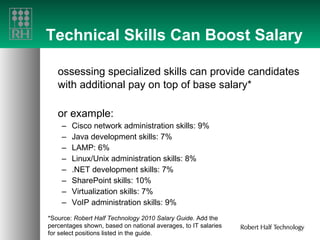
Technical Skills Can Boost Salary Possessing specialized skills can provide candidates with additional pay on top of base salary*  For example: Cisco network administration skills: 9% Java development skills: 7% LAMP: 6% Linux/Unix administration skills: 8%  .NET development skills: 7% SharePoint skills: 10% Virtualization skills: 7% VoIP administration skills: 9% *Source:  Robert Half Technology 2010 Salary Guide.  Add the percentages shown, based on national averages, to IT salaries for select positions listed in the guide.
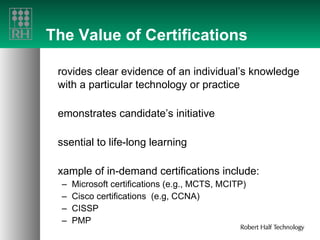
The Value of Certifications Provides clear evidence of an individual’s knowledge with a particular technology or practice Demonstrates candidate’s initiative Essential to life-long learning Example of in-demand certifications include: Microsoft certifications (e.g., MCTS, MCITP) Cisco certifications  (e.g, CCNA) CISSP PMP
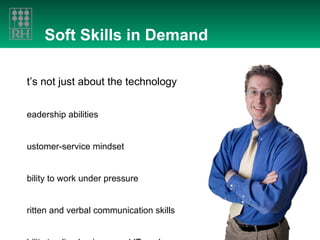
Soft Skills in Demand It’s not just about the technology Leadership abilities Customer-service mindset Ability to work under pressure Written and verbal communication skills Ability to align business and IT goals Versatility
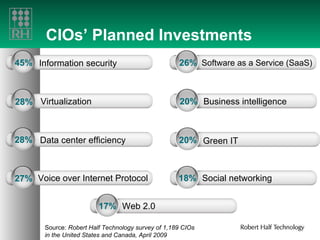
CIOs’ Planned Investments Source:  Robert Half Technology survey of 1,189 CIOs  in the United States and Canada, April 2009 Information security 45% 28% Virtualization 28% Data center efficiency 27% Voice over Internet Protocol 26% Software as a Service (SaaS) 20% Business intelligence 18% Social networking 17% Web 2.0 20% Green IT
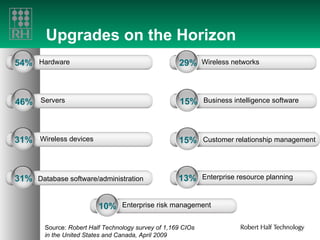
Upgrades on the Horizon Source:  Robert Half Technology survey of 1,169 CIOs  in the United States and Canada, April 2009 Hardware 54% 46% Servers 31% Wireless devices 31% Database software/administration 29% Wireless networks 15% Business intelligence software 13% Enterprise resource planning 10% Enterprise risk management 15% Customer relationship management
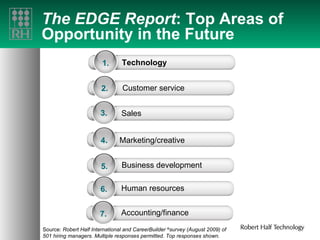
The EDGE Report : Top Areas of Opportunity in the Future  Source:  Robert Half International and CareerBuilder  ® survey (August 2009) of  501 hiring managers. Multiple responses permitted. Top responses shown. Technology 1. 2. Customer service 3. Sales 5. Business development 6. Human resources 7. Accounting/finance 4 . Marketing/creative
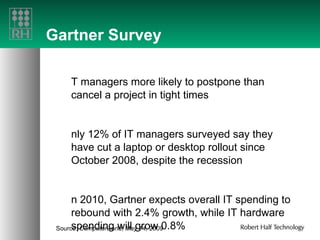
Gartner Survey IT managers more likely to postpone than cancel a project in tight times  Only 12% of IT managers surveyed say they have cut a laptop or desktop rollout since October 2008, despite the recession  In 2010, Gartner expects overall IT spending to rebound with 2.4% growth, while IT hardware spending will grow 0.8% Source:  Computerworld ,  May 14, 2009
Staffing During a Recession Many companies closely examining fixed personnel costs, one of their largest areas of spending Many firms downsizing The Challenge :  How do you maintain the staff levels you need to keep productivity and service levels high while, at the same time, keeping personnel costs in check?
The Current Economic Environment Before the recession, many firms overhired After the financial crisis, many companies cut staff too deeply Laying off full-time workers was the only way to reduce human resources costs The Solution: Flexible Staffing
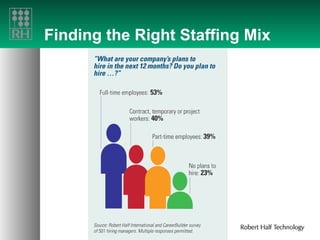
Finding the Right Staffing Mix
Staffing Flexibility: A Perennial Advantage Staffing flexibility requires a holistic view of both short- and long-term needs Broadly implemented personnel reductions can result in the loss of talent you may need in the future Hiring quickly can cause you to overlook how conditions may have changed since a position was last filled First, look internally Add full-time hires for long-term needs and contract professionals for shorter-term, project roles or expertise you only need occasionally
Advantages of Flexible Staffing Cost savings Improved competitive position Higher retention rates Reduced burden on full-time staff Wider choices Opportunity to evaluate potential hires
Hiring Plans in Action Outline clear skills requirements for the position Remain actively involved throughout the recruitment process Focus on professional networking – both online and in person Conduct phone interviews with applicants Work with a specialized staffing firm
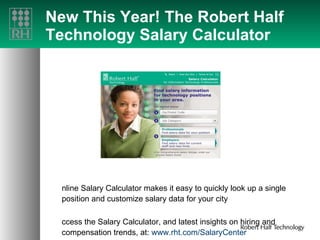
New This Year! The Robert Half Technology Salary Calculator Online Salary Calculator makes it easy to quickly look up a single position and customize salary data for your city Access the Salary Calculator, and latest insights on hiring and compensation trends, at:  www.rht.com/SalaryCenter
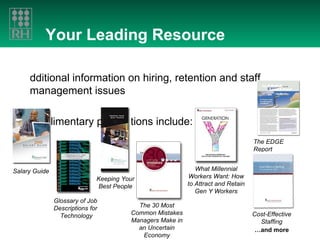
Your Leading Resource ` Additional information on hiring, retention and staff management issues Complimentary publications include: Salary Guide Glossary of Job Descriptions for  Technology Keeping Your Best People The 30 Most Common Mistakes Managers Make in an Uncertain Economy What Millennial Workers Want: How to Attract and Retain Gen Y Workers Cost-Effective Staffing … and more The EDGE Report
How We Can Help Refine salary packages for your market Offer additional information on local trends Provide guidance on staffing strategically Benefits of working with Robert Half Technology: We have the best reputation in the business We can fill your needs fast We custom match professional skills to your needs We represent highly skilled candidates
© 2009 Robert Half Technology.  An Equal Opportunity Employer  IT Hiring and Compensation Trends 2010 rht.com

RHT 2010 Hiring And Comp Trends (US)

  • 1.
    IT Hiring andCompensation Trends 2010 © 2009 Robert Half Technology. An Equal Opportunity Employer Kelly O’Connell Branch Manager
  • 2.
    Robert Half InternationalFounded in 1948 Pioneer in specialized staffing services Ranked number one in our industry in FORTUNE ® magazine’s list of the “ World’s Most Admired Companies” (March 16, 2009) Robert Half Technology Provides highly skilled IT professionals Conducts ongoing research on IT workplace trends Respected resource on IT hiring and employment Company Overview
  • 3.
    Today’s Discussion TheIT Hiring Environment Technical Skills in Demand 2010 Salary Trends The Value of Certifications Soft Skills in Demand Staffing During a Recession The Benefits of Flexible Staffing
  • 4.
    The 2010Salary Guide National starting salary ranges for IT positions in the United States and Canada Trends affecting IT hiring Review of in-demand skills and attributes Advice on building strong IT teams and maintaining employee morale Staffing for success
  • 5.
    Sources of theData Interim and full-time placements made throughout the year from our offices in the United States and Canada Local insight from our staffing and recruiting professionals throughout our branch network Exclusive workplace research we conduct among CIOs A review of actual starting salaries in 2009 An extrapolation of current trends into 2010
  • 6.
    The IT HiringEnvironment Today’s IT departments face complex challenges Economic conditions require firms to operate more efficiently and achieve more with fewer resources Strategically deployed IT systems and personnel can help a company accomplish these goals Companies need staff in technical development and programming that can result in cost savings
  • 7.
    It’s Still Difficultto Find Good IT People Pockets of opportunity exist in key specialties Shortage of qualified applicants is the primary recruiting challenge* Many talented people unwilling to risk leaving a stable job for an untested opportunity *Source: Robert Half International and CareerBuilder ® survey of 501 hiring managers (August 2009) Despite a more cautious economy, demand remains for highly skilled IT professionals
  • 8.
    Time to HireThe average time range to hire is unchanged from last year, despite higher unemployment rates.
  • 9.
    Unemployment Rates Source: U.S. Department of Labor’s Bureau of Labor Statistics U.S. Unemployment Rate: 10.0% (December 2009) Quarterly National Average (Q4 ‘09): 8.8% Quarterly Unemployment Rates (Q4 ’09): Computer software engineers: 4.1% Computer and information systems managers: 2.3% Computer programmers: 3.6% Computer support specialists: 5.1% Network systems and data communications analysts: 5.1% Database administrators: 1.8% Computer scientists and systems analysts: 5.0% Network and computer systems administrators: 7.1%
  • 10.
    The IT HiringEnvironment The current hiring climate can also be attributed to: Increasing complexity of IT Demographic trends Ongoing software updates, hardware maintenance
  • 11.
    The IT HiringEnvironment Q1 2010 7% plan to hire in Q1; 4% plan to decrease staff; 89% plan to maintain current staffing levels The net 3% increase in hiring activity is the strongest increase since Q1 2009 42% of CIOs are confident their firms will invest in IT projects in Q1 2010 41% plan to hire entry-level IT employees; 40% plan to hire staff-level talent CIOs cite it’s most challenging to find skilled IT professionals in networking (19%), security (13%) and application development (10%) Source: Robert Half Technology Q1 2010 IT Hiring Index & Skills Report, Survey of 1,400 CIOs in the United States, Dec. 2009
  • 12.
    Technical Skills inDemand Q1 2010 Source: Robert Half Technology Q1 2010 IT Hiring Index & Skills Report. Survey of 1,400 CIOs in the United States, Dec. 2009. CIOs allowed multiple responses. Top responses shown. Network administration 70% 66% Desktop support 62% Windows administration 58% Database management 48% Telecommunications support 44% Web development/website design 34% Virtualization 52% Wireless network management 27% ERP implementation 37% Business intelligence
  • 13.
    Consistent Demand For… Network administration Virtualization Applications development Web development Help desk and desktop support
  • 14.
    Current Need For… All trademarks contained herein are the property of their respective owners. Virtualization Web 2.0 All Microsoft ® Products Citrix Citrix XenServer Hyper-V VMware ESXi VMware ESX 3.5 VMware GSX Server VMware Workstation AJAX Adobe Flash Adobe Flex PHP Perl Python Ruby on Rails Active Directory Business Solutions Dynamics Exchange Server 2007 .NET Office 2007 Silverlight SharePoint Server SQL Server 2008 Visual Studio Windows Server 2008 Windows Vista Windows 7
  • 15.
    2010 IT SalaryTrends On average, IT salaries in the United States are expected to decrease 1.3 percent Salary ranges for select positions (national averages*): Information Systems Security Manager $96,500 - $130,750 Network Administrator $54,500 - $80,250 Web Developer $57,500 - $88,000 Desktop Support Analyst $46,500 - $68,000 Help Desk Tier 2 $36,000 - $47,250 *Refer to the Robert Half Technology 2010 Salary Guide to adjust salaries for your local market using the city variance index numbers provided in the guide.
  • 16.
    New Positions Addedto The 2010 Salary Guide Applications Development (national averages*): CRM Business Analyst $65,500 - $89,000 CRM Technical Developer $73,500 - $97,250 ERP Business Analyst $68,000 - $93,250 ERP Technical/ Functional Analyst $73,000 - $102,000 ERP Technical Developer $75,750 - $103,750 Technical Services (national average*): Systems Engineer $64,250 - $93,250 *Refer to the Robert Half Technology 2010 Salary Guide to adjust salaries for your local market using the city variance index numbers provided in the guide.
  • 17.
    Technical Skills CanBoost Salary Possessing specialized skills can provide candidates with additional pay on top of base salary* For example: Cisco network administration skills: 9% Java development skills: 7% LAMP: 6% Linux/Unix administration skills: 8% .NET development skills: 7% SharePoint skills: 10% Virtualization skills: 7% VoIP administration skills: 9% *Source: Robert Half Technology 2010 Salary Guide. Add the percentages shown, based on national averages, to IT salaries for select positions listed in the guide.
  • 18.
    The Value ofCertifications Provides clear evidence of an individual’s knowledge with a particular technology or practice Demonstrates candidate’s initiative Essential to life-long learning Example of in-demand certifications include: Microsoft certifications (e.g., MCTS, MCITP) Cisco certifications (e.g, CCNA) CISSP PMP
  • 19.
    Soft Skills inDemand It’s not just about the technology Leadership abilities Customer-service mindset Ability to work under pressure Written and verbal communication skills Ability to align business and IT goals Versatility
  • 20.
    CIOs’ Planned InvestmentsSource: Robert Half Technology survey of 1,189 CIOs in the United States and Canada, April 2009 Information security 45% 28% Virtualization 28% Data center efficiency 27% Voice over Internet Protocol 26% Software as a Service (SaaS) 20% Business intelligence 18% Social networking 17% Web 2.0 20% Green IT
  • 21.
    Upgrades on theHorizon Source: Robert Half Technology survey of 1,169 CIOs in the United States and Canada, April 2009 Hardware 54% 46% Servers 31% Wireless devices 31% Database software/administration 29% Wireless networks 15% Business intelligence software 13% Enterprise resource planning 10% Enterprise risk management 15% Customer relationship management
  • 22.
    The EDGE Report: Top Areas of Opportunity in the Future Source: Robert Half International and CareerBuilder ® survey (August 2009) of 501 hiring managers. Multiple responses permitted. Top responses shown. Technology 1. 2. Customer service 3. Sales 5. Business development 6. Human resources 7. Accounting/finance 4 . Marketing/creative
  • 23.
    Gartner Survey ITmanagers more likely to postpone than cancel a project in tight times Only 12% of IT managers surveyed say they have cut a laptop or desktop rollout since October 2008, despite the recession In 2010, Gartner expects overall IT spending to rebound with 2.4% growth, while IT hardware spending will grow 0.8% Source: Computerworld , May 14, 2009
  • 24.
    Staffing During aRecession Many companies closely examining fixed personnel costs, one of their largest areas of spending Many firms downsizing The Challenge : How do you maintain the staff levels you need to keep productivity and service levels high while, at the same time, keeping personnel costs in check?
  • 25.
    The Current EconomicEnvironment Before the recession, many firms overhired After the financial crisis, many companies cut staff too deeply Laying off full-time workers was the only way to reduce human resources costs The Solution: Flexible Staffing
  • 26.
    Finding the RightStaffing Mix
  • 27.
    Staffing Flexibility: APerennial Advantage Staffing flexibility requires a holistic view of both short- and long-term needs Broadly implemented personnel reductions can result in the loss of talent you may need in the future Hiring quickly can cause you to overlook how conditions may have changed since a position was last filled First, look internally Add full-time hires for long-term needs and contract professionals for shorter-term, project roles or expertise you only need occasionally
  • 28.
    Advantages of FlexibleStaffing Cost savings Improved competitive position Higher retention rates Reduced burden on full-time staff Wider choices Opportunity to evaluate potential hires
  • 29.
    Hiring Plans inAction Outline clear skills requirements for the position Remain actively involved throughout the recruitment process Focus on professional networking – both online and in person Conduct phone interviews with applicants Work with a specialized staffing firm
  • 30.
    New This Year!The Robert Half Technology Salary Calculator Online Salary Calculator makes it easy to quickly look up a single position and customize salary data for your city Access the Salary Calculator, and latest insights on hiring and compensation trends, at: www.rht.com/SalaryCenter
  • 31.
    Your Leading Resource` Additional information on hiring, retention and staff management issues Complimentary publications include: Salary Guide Glossary of Job Descriptions for Technology Keeping Your Best People The 30 Most Common Mistakes Managers Make in an Uncertain Economy What Millennial Workers Want: How to Attract and Retain Gen Y Workers Cost-Effective Staffing … and more The EDGE Report
  • 32.
    How We CanHelp Refine salary packages for your market Offer additional information on local trends Provide guidance on staffing strategically Benefits of working with Robert Half Technology: We have the best reputation in the business We can fill your needs fast We custom match professional skills to your needs We represent highly skilled candidates
  • 33.
    © 2009 RobertHalf Technology. An Equal Opportunity Employer IT Hiring and Compensation Trends 2010 rht.com