E- Human Resources Management (E-HRM)  Practices in Small Medium EnterprisesPuspaSetiaPratiwi(QGC 100009)
Background“ Serious need in the development/ application of HRM concepts in the environment of SME’s which probably the most important assets for smaller companies to stay competitive.”Source : Huselid, 2003
Objectives of StudyTo identify :What are the purposes of the SMEs in using e-HRM applications?What are the full advantages of for SMEs are ?To what extent e-HRM improves HR processes?
Definition of E-HRMThe use of ICT in HRM is often referred to as e-HRM, Web-based HR, or virtual HRA network-based structure built on partnership and typically mediated by information technology to help organizations acquire, develop and deploy intellectual capital				Source: Lepak and Snell (1998)
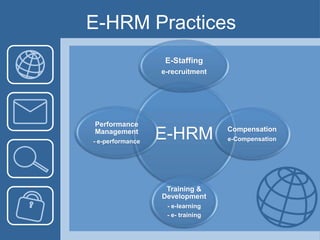
E-HRM Practices
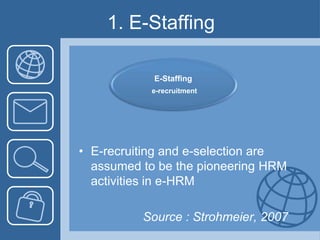
1. E-StaffingE-recruiting and e-selection are assumed to be the pioneering HRM activities in e-HRM 			Source : Strohmeier, 2007E-Staffinge-recruitment
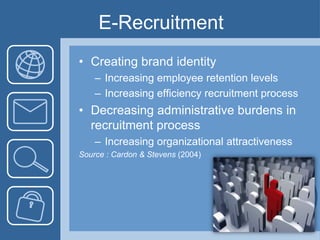
E-RecruitmentCreating brand identityIncreasing employee retention levelsIncreasing efficiency recruitment processDecreasing administrative burdens in recruitment processIncreasing organizational attractivenessSource : Cardon & Stevens (2004)
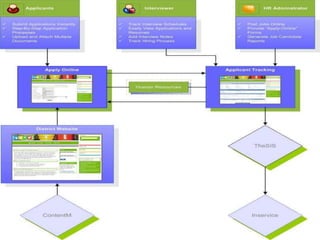
E-Recruitment SystemsTrack demographics and select potential recruits according to a predefined criteria through applicant	tracking systems Use job boards and corporate Websites to select the most compatible recruit for a specified job through hiring management systems	(HMS) Source : Bussler& Davis (2001/2002)
Source: http://www.allofe.com
2. E-CompensationEffectively designing, administering and communicating compensation programsEnabling to look at external paymentsAnalyzing market salary dataStreamlining bureaucratic tasksGreater access to knowledge management databasesInternal information process quickerSource: Cardon & Stevens (2004)
3. E-PerformanceGenerating figures and statistics about Performance more easilyEnlarging span of control for managersFacilitating process of writing reviews and generating feedbackSource: Cardon & Stevens (2004)
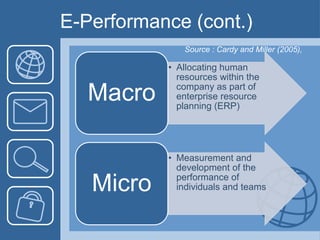
E-Performance (cont.)Source : Cardy and Miller (2005),
Example of Employee Performance Management SoftwareCourtesy : youtube.com
4. E- TrainingUse of distance learning technology : e.g.: Tutored-Video InstructionFirms able to train their culturally-diverse, geographically-diverse workforcesSource : Murray, L. W. & Efendioglu, A.M. (2009)
E-LearningDelivering information about learning, knowledge, and skillsEnabling web based collaborative learningMore flexible & cost efficient than normal training & developmentSource: Cardon & Stevens (2004)
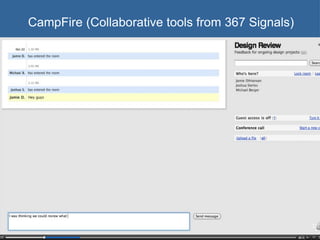
CampFire (Collaborative tools from 367 Signals)
Conclusions
E-HRM Improves on…Integrate the IT and business planning processes more effectivelyDevelop reliable and cost effective applications that support the business needs of the firm faster than competition(3) Communicate and work with business units more efficiently(4) Anticipate future business needs of the firm and innovate valuable new product features before competitors.
Thank YouThe future belongs to those who give the next generation reason for hope…(Anonymous)

A study on e human resources practices in

  • 1.
    E- Human ResourcesManagement (E-HRM) Practices in Small Medium EnterprisesPuspaSetiaPratiwi(QGC 100009)
  • 2.
    Background“ Serious needin the development/ application of HRM concepts in the environment of SME’s which probably the most important assets for smaller companies to stay competitive.”Source : Huselid, 2003
  • 3.
    Objectives of StudyToidentify :What are the purposes of the SMEs in using e-HRM applications?What are the full advantages of for SMEs are ?To what extent e-HRM improves HR processes?
  • 4.
    Definition of E-HRMTheuse of ICT in HRM is often referred to as e-HRM, Web-based HR, or virtual HRA network-based structure built on partnership and typically mediated by information technology to help organizations acquire, develop and deploy intellectual capital Source: Lepak and Snell (1998)
  • 5.
  • 6.
    1. E-StaffingE-recruiting ande-selection are assumed to be the pioneering HRM activities in e-HRM Source : Strohmeier, 2007E-Staffinge-recruitment
  • 7.
    E-RecruitmentCreating brand identityIncreasingemployee retention levelsIncreasing efficiency recruitment processDecreasing administrative burdens in recruitment processIncreasing organizational attractivenessSource : Cardon & Stevens (2004)
  • 8.
    E-Recruitment SystemsTrack demographicsand select potential recruits according to a predefined criteria through applicant tracking systems Use job boards and corporate Websites to select the most compatible recruit for a specified job through hiring management systems (HMS) Source : Bussler& Davis (2001/2002)
  • 9.
  • 10.
    2. E-CompensationEffectively designing,administering and communicating compensation programsEnabling to look at external paymentsAnalyzing market salary dataStreamlining bureaucratic tasksGreater access to knowledge management databasesInternal information process quickerSource: Cardon & Stevens (2004)
  • 11.
    3. E-PerformanceGenerating figuresand statistics about Performance more easilyEnlarging span of control for managersFacilitating process of writing reviews and generating feedbackSource: Cardon & Stevens (2004)
  • 12.
    E-Performance (cont.)Source :Cardy and Miller (2005),
  • 13.
    Example of EmployeePerformance Management SoftwareCourtesy : youtube.com
  • 14.
    4. E- TrainingUseof distance learning technology : e.g.: Tutored-Video InstructionFirms able to train their culturally-diverse, geographically-diverse workforcesSource : Murray, L. W. & Efendioglu, A.M. (2009)
  • 15.
    E-LearningDelivering information aboutlearning, knowledge, and skillsEnabling web based collaborative learningMore flexible & cost efficient than normal training & developmentSource: Cardon & Stevens (2004)
  • 16.
  • 17.
  • 18.
    E-HRM Improves on…Integratethe IT and business planning processes more effectivelyDevelop reliable and cost effective applications that support the business needs of the firm faster than competition(3) Communicate and work with business units more efficiently(4) Anticipate future business needs of the firm and innovate valuable new product features before competitors.
  • 19.
    Thank YouThe futurebelongs to those who give the next generation reason for hope…(Anonymous)