Rhodomicrobium sp.
Methanobacterium sp.
Microbial Diversity and Taxonomy
Chinnathambi. S
22316017
I M.Sc., Microbiology
Introduction:Rhodomicrobiumsp.
• Rhodomicrobium is a genus of bacteria that comes under the family
Hyphomicrobiaceae.
• In Greek “Rhodo” comes from ‘rhodon’meaning rose.
• Microbium means a community of the microorganisms that can usually be
found living together in any given habitat.
Rhodomicrobium
• It is a purple, non-sulfur, microaerobic to anaerobic genus of bacteria that
forms clusters.
• It is a thermophilic photoheterotroph bacterium that can fix the atmospheric
Nitrogen.
BEST FOR You
O R G A N I C S C O M P A N Y
Historyanddiscovery
Rhodomicrobium bacteria was discovered by the two
scientists namely Esther duchow and h. c. Douglas in
1949 at department of microbiology, university of
Washington, USA.
3
BEST FOR You
O R G A N I C S C O M P A N Y
Scientificclassification
 Domain Bacteria
 Phylum Pseudomonadota
 Class Alphaproteobacteria
 Order Hyphomicrobiales
 Family Hyphomicrobiceae
 Genus Rhodomicrobium
Species
 Rhodomicrobium vannielii
 Rhodomicrobium udaipurense
 Rhodomicrobium lacus
BEST FOR You
O R G A N I C S C O M P A N Y
Rhodomicrobiumvannielii
5
» Rhodomicrobium vannielii is a Gram-negative, purple
non-sulphur, motile, thermophilic photoheterotroph
bacterium. R.vannielii is thought to have potential
application in treatment and Bioremediation under high-
temperature conditions.
BEST FOR You
O R G A N I C S C O M P A N Y
Morphology
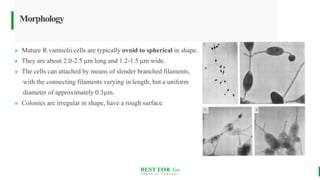
» Mature R.vannielii cells are typically ovoid to spherical in shape.
» They are about 2.0-2.5 µm long and 1.2-1.5 µm wide.
» The cells can attached by means of slender branched filaments,
with the connecting filaments varying in length, but a uniform
diameter of approximately 0.3µm.
» Colonies are irregular in shape, have a rough surface.
BEST FOR You
O R G A N I C S C O M P A N Y
Pigmentation
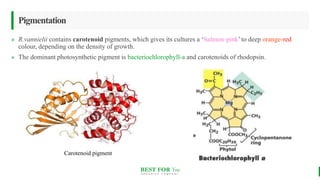
» R.vannielii contains carotenoid pigments, which gives its cultures a ‘Salmon-pink’ to deep orange-red
colour, depending on the density of growth.
» The dominant photosynthetic pigment is bacteriochlorophyll-a and carotenoids of rhodopsin.
Carotenoid pigment
BEST FOR You
O R G A N I C S C O M P A N Y
Metabolism
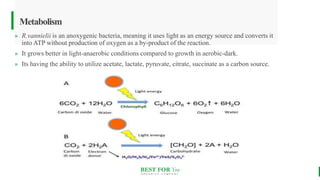
» R.vannielii is an anoxygenic bacteria, meaning it uses light as an energy source and converts it
into ATP without production of oxygen as a by-product of the reaction.
» It grows better in light-anaerobic conditions compared to growth in aerobic-dark.
» Its having the ability to utilize acetate, lactate, pyruvate, citrate, succinate as a carbon source.
BEST FOR You
O R G A N I C S C O M P A N Y
Rhodomicrobium udaipurense
Rhodomicrobium udaipurense (u.dai.pur.en’se. N.L.neut.adj. udaipurense
of belonging to Udaipur, a place in the Indian Himalayas, from where the
strain was isolated).
9
BEST FOR You
O R G A N I C S C O M P A N Y
Morphology
» Cells are ovoid to swollen rods 1.2-1.4 µm wide and 3.0-3.5 µm long, and individual cells are motile and
multiply by budding.
» Exposure-like structures are present.
» Phototrophic cultures are reddish-brown.
» Older cells form complex aggregates due to entanglement of long prosthecae.
BEST FOR You
O R G A N I C S C O M P A N Y
Generalcharacteristics
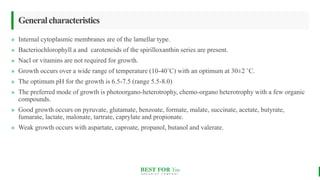
» Internal cytoplasmic membranes are of the lamellar type.
» Bacteriochlorophyll a and carotenoids of the spirilloxanthin series are present.
» Nacl or vitamins are not required for growth.
» Growth occurs over a wide range of temperature (10-40˚C) with an optimum at 30±2 ˚C.
» The optimum pH for the growth is 6.5-7.5 (range 5.5-8.0)
» The preferred mode of growth is photoorgano-heterotrophy, chemo-organo heterotrophy with a few organic
compounds.
» Good growth occurs on pyruvate, glutamate, benzoate, formate, malate, succinate, acetate, butyrate,
fumarate, lactate, malonate, tartrate, caprylate and propionate.
» Weak growth occurs with aspartate, caproate, propanol, butanol and valerate.
BEST FOR You
O R G A N I C S C O M P A N Y
Methanobacteriumsp
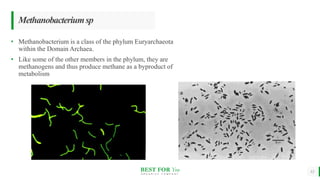
• Methanobacterium is a class of the phylum Euryarchaeota
within the Domain Archaea.
• Like some of the other members in the phylum, they are
methanogens and thus produce methane as a byproduct of
metabolism
12
BEST FOR You
O R G A N I C S C O M P A N Y
Scientificclassification
» Domain: Archaea
» Kingdom: Euryarchaeota
» Class: Methanobacteria
» Order: Methanobacteriales
» Family: Methanobacteriaceae
» Genus: Methanobacterium
Species(Examples)
M.bryantii
M.formicicum
M.veterum
M.thermoautotrophium
BEST FOR You
O R G A N I C S C O M P A N Y
GeneralCharacteristics
» Optimum temperature ranges from 35-70˚C (moderate thermophile with an optimum growth
temperature of 60˚C.
» Optimum pH ranges from 6.0-8.5.
» Strictly anaerobic.
» Straight or slightly curved rods, but not helical.
» Cells stain Gram negative.
» Non-motile
» Endospores aren’t present.
» Cell envelop composition is mostly pseudomurein.
» Methanobacteria are chemoautotrophs
» Requires only CO2,H2 and salts for growth.
» All use ammonium, sulfide and elemental Sulphur.
» Habitat contains low NaCl concentrations.
» Positioned near the ‘center’ of methanogen evolutionary tree.
BEST FOR You
O R G A N I C S C O M P A N Y
Methanogenesis
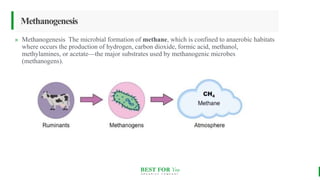
» Methanogenesis The microbial formation of methane, which is confined to anaerobic habitats
where occurs the production of hydrogen, carbon dioxide, formic acid, methanol,
methylamines, or acetate—the major substrates used by methanogenic microbes
(methanogens).
BEST FOR You
O R G A N I C S C O M P A N Y
Methaneformationinruminants
» Methanobacterium formicicum (Methanobacteriaceae family) is an endosymbiotic
methanogenic Archaean found in the digestive tracts of ruminants and elsewhere. It has been
significantly implicated in global CH4emission during enteric fermentation processes.
BEST FOR You
O R G A N I C S C O M P A N Y
ApplicationsofMethanobacteria
» Natural gas or Biogas production
» Bio-remediation
» Sewage treatment facilities
» Bio-degradation
Thank You
Chinnathambi S
+919360603431
chinnaselvamc345@gmail.com

Rhodobacterium and Methanobacterium.pptx

  • 1.
    Rhodomicrobium sp. Methanobacterium sp. MicrobialDiversity and Taxonomy Chinnathambi. S 22316017 I M.Sc., Microbiology
  • 2.
    Introduction:Rhodomicrobiumsp. • Rhodomicrobium isa genus of bacteria that comes under the family Hyphomicrobiaceae. • In Greek “Rhodo” comes from ‘rhodon’meaning rose. • Microbium means a community of the microorganisms that can usually be found living together in any given habitat. Rhodomicrobium • It is a purple, non-sulfur, microaerobic to anaerobic genus of bacteria that forms clusters. • It is a thermophilic photoheterotroph bacterium that can fix the atmospheric Nitrogen.
  • 3.
    BEST FOR You OR G A N I C S C O M P A N Y Historyanddiscovery Rhodomicrobium bacteria was discovered by the two scientists namely Esther duchow and h. c. Douglas in 1949 at department of microbiology, university of Washington, USA. 3
  • 4.
    BEST FOR You OR G A N I C S C O M P A N Y Scientificclassification  Domain Bacteria  Phylum Pseudomonadota  Class Alphaproteobacteria  Order Hyphomicrobiales  Family Hyphomicrobiceae  Genus Rhodomicrobium Species  Rhodomicrobium vannielii  Rhodomicrobium udaipurense  Rhodomicrobium lacus
  • 5.
    BEST FOR You OR G A N I C S C O M P A N Y Rhodomicrobiumvannielii 5 » Rhodomicrobium vannielii is a Gram-negative, purple non-sulphur, motile, thermophilic photoheterotroph bacterium. R.vannielii is thought to have potential application in treatment and Bioremediation under high- temperature conditions.
  • 6.
    BEST FOR You OR G A N I C S C O M P A N Y Morphology » Mature R.vannielii cells are typically ovoid to spherical in shape. » They are about 2.0-2.5 µm long and 1.2-1.5 µm wide. » The cells can attached by means of slender branched filaments, with the connecting filaments varying in length, but a uniform diameter of approximately 0.3µm. » Colonies are irregular in shape, have a rough surface.
  • 7.
    BEST FOR You OR G A N I C S C O M P A N Y Pigmentation » R.vannielii contains carotenoid pigments, which gives its cultures a ‘Salmon-pink’ to deep orange-red colour, depending on the density of growth. » The dominant photosynthetic pigment is bacteriochlorophyll-a and carotenoids of rhodopsin. Carotenoid pigment
  • 8.
    BEST FOR You OR G A N I C S C O M P A N Y Metabolism » R.vannielii is an anoxygenic bacteria, meaning it uses light as an energy source and converts it into ATP without production of oxygen as a by-product of the reaction. » It grows better in light-anaerobic conditions compared to growth in aerobic-dark. » Its having the ability to utilize acetate, lactate, pyruvate, citrate, succinate as a carbon source.
  • 9.
    BEST FOR You OR G A N I C S C O M P A N Y Rhodomicrobium udaipurense Rhodomicrobium udaipurense (u.dai.pur.en’se. N.L.neut.adj. udaipurense of belonging to Udaipur, a place in the Indian Himalayas, from where the strain was isolated). 9
  • 10.
    BEST FOR You OR G A N I C S C O M P A N Y Morphology » Cells are ovoid to swollen rods 1.2-1.4 µm wide and 3.0-3.5 µm long, and individual cells are motile and multiply by budding. » Exposure-like structures are present. » Phototrophic cultures are reddish-brown. » Older cells form complex aggregates due to entanglement of long prosthecae.
  • 11.
    BEST FOR You OR G A N I C S C O M P A N Y Generalcharacteristics » Internal cytoplasmic membranes are of the lamellar type. » Bacteriochlorophyll a and carotenoids of the spirilloxanthin series are present. » Nacl or vitamins are not required for growth. » Growth occurs over a wide range of temperature (10-40˚C) with an optimum at 30±2 ˚C. » The optimum pH for the growth is 6.5-7.5 (range 5.5-8.0) » The preferred mode of growth is photoorgano-heterotrophy, chemo-organo heterotrophy with a few organic compounds. » Good growth occurs on pyruvate, glutamate, benzoate, formate, malate, succinate, acetate, butyrate, fumarate, lactate, malonate, tartrate, caprylate and propionate. » Weak growth occurs with aspartate, caproate, propanol, butanol and valerate.
  • 12.
    BEST FOR You OR G A N I C S C O M P A N Y Methanobacteriumsp • Methanobacterium is a class of the phylum Euryarchaeota within the Domain Archaea. • Like some of the other members in the phylum, they are methanogens and thus produce methane as a byproduct of metabolism 12
  • 13.
    BEST FOR You OR G A N I C S C O M P A N Y Scientificclassification » Domain: Archaea » Kingdom: Euryarchaeota » Class: Methanobacteria » Order: Methanobacteriales » Family: Methanobacteriaceae » Genus: Methanobacterium Species(Examples) M.bryantii M.formicicum M.veterum M.thermoautotrophium
  • 14.
    BEST FOR You OR G A N I C S C O M P A N Y GeneralCharacteristics » Optimum temperature ranges from 35-70˚C (moderate thermophile with an optimum growth temperature of 60˚C. » Optimum pH ranges from 6.0-8.5. » Strictly anaerobic. » Straight or slightly curved rods, but not helical. » Cells stain Gram negative. » Non-motile » Endospores aren’t present. » Cell envelop composition is mostly pseudomurein. » Methanobacteria are chemoautotrophs » Requires only CO2,H2 and salts for growth. » All use ammonium, sulfide and elemental Sulphur. » Habitat contains low NaCl concentrations. » Positioned near the ‘center’ of methanogen evolutionary tree.
  • 15.
    BEST FOR You OR G A N I C S C O M P A N Y Methanogenesis » Methanogenesis The microbial formation of methane, which is confined to anaerobic habitats where occurs the production of hydrogen, carbon dioxide, formic acid, methanol, methylamines, or acetate—the major substrates used by methanogenic microbes (methanogens).
  • 16.
    BEST FOR You OR G A N I C S C O M P A N Y Methaneformationinruminants » Methanobacterium formicicum (Methanobacteriaceae family) is an endosymbiotic methanogenic Archaean found in the digestive tracts of ruminants and elsewhere. It has been significantly implicated in global CH4emission during enteric fermentation processes.
  • 17.
    BEST FOR You OR G A N I C S C O M P A N Y ApplicationsofMethanobacteria » Natural gas or Biogas production » Bio-remediation » Sewage treatment facilities » Bio-degradation
  • 18.