A strategic approach to scholarly research in South 
Africa 
Applying scientific thinking 
in the service of society 
S Veldsman 
Director: SPU 
Rhodes University 
21 Sept 2014
Open Access in South Africa: in a nutshell 
• Berlin Declaration: 
RSA 14, ROF 22 
• Institutional repositories: SA 24 
• Limited APC funds: Univ. Pretoria, Cape Town and 
Stellenbosch
Open Access in South Africa: in a nutshell 
• Berlin Declaration: 
RSA 14, ROF 22 
• Institutional repositories: SA 24 
• Limited APC funds: Univ. Pretoria, Cape Town and 
Stellenbosch
JOURNALS @ RU 
7 editors of journals published through 
societies or commercial publishers
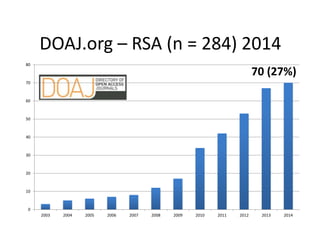
DOAJ.org – RSA (n = 284) 2014 
70 (27%) 
80 
70 
60 
50 
40 
30 
20 
10 
0 
2003 2004 2005 2006 2007 2008 2009 2010 2011 2012 2013 2014
Towards a new quality assurance system in South 
Africa 
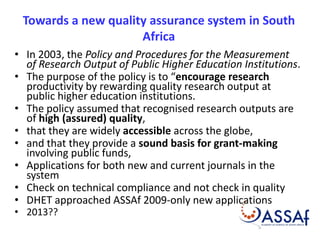
• In 2003, the Policy and Procedures for the Measurement 
of Research Output of Public Higher Education Institutions. 
• The purpose of the policy is to “encourage research 
productivity by rewarding quality research output at 
public higher education institutions. 
• The policy assumed that recognised research outputs are 
of high (assured) quality, 
• that they are widely accessible across the globe, 
• and that they provide a sound basis for grant-making 
involving public funds, 
• Applications for both new and current journals in the 
system 
• Check on technical compliance and not check in quality 
• DHET approached ASSAf 2009-only new applications 
• 2013??
Government funding for research output 
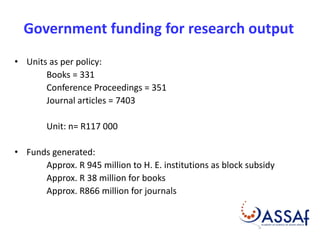
• Units as per policy: 
Books = 331 
Conference Proceedings = 351 
Journal articles = 7403 
Unit: n= R117 000 
• Funds generated: 
Approx. R 945 million to H. E. institutions as block subsidy 
Approx. R 38 million for books 
Approx. R866 million for journals
Improving quality and quantity of research 
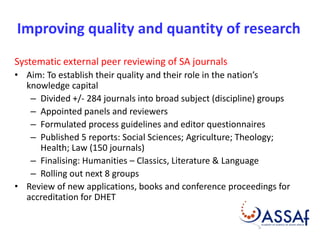
Systematic external peer reviewing of SA journals 
• Aim: To establish their quality and their role in the nation’s 
knowledge capital 
– Divided +/- 284 journals into broad subject (discipline) groups 
– Appointed panels and reviewers 
– Formulated process guidelines and editor questionnaires 
– Published 5 reports: Social Sciences; Agriculture; Theology; 
Health; Law (150 journals) 
– Finalising: Humanities – Classics, Literature & Language 
– Rolling out next 8 groups 
• Review of new applications, books and conference proceedings for 
accreditation for DHET
“Accredited” journals (262) 
• 2003 - 2014 
– RSA DOE list – application process (202) 
– ISI (Thompson Reuters WoS)/IBSS (60) 
• 2015 (?) 
– SciELO SA 
– Scopus 
– Norwegian Register for Scientific Journals 
– RSA list = “developmental” (5 years)
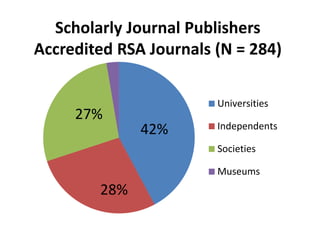
Scholarly Journal Publishers 
Accredited RSA Journals (N = 284) 
Universities 
Independents 
Societies 
Museums 
28% 
42% 
27%
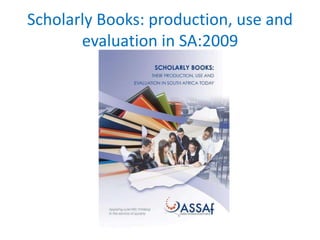
Scholarly Books: production, use and 
evaluation in SA:2009
Findings in book report: 
• Analysis of monograph data: 60 p.a; static; 80% in 
Hum/SocSci; 50% local publisher 
• Analysis of collected works: increasing; 80% Hum/SocSci; 
only 20% local; 50% commercial 
• Books highly rated by Hum/SocSci scholars = effort on 
one monograph much more than 5 articles 
• Books small % of accredited outputs (e.g. 331 ex 8062)
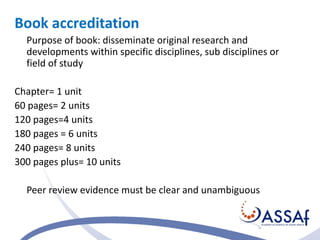
Book accreditation 
Purpose of book: disseminate original research and 
developments within specific disciplines, sub disciplines or 
field of study 
Chapter= 1 unit 
60 pages= 2 units 
120 pages=4 units 
180 pages = 6 units 
240 pages= 8 units 
300 pages plus= 10 units 
Peer review evidence must be clear and unambiguous
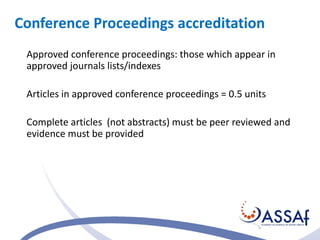
Conference Proceedings accreditation 
Approved conference proceedings: those which appear in 
approved journals lists/indexes 
Articles in approved conference proceedings = 0.5 units 
Complete articles (not abstracts) must be peer reviewed and 
evidence must be provided
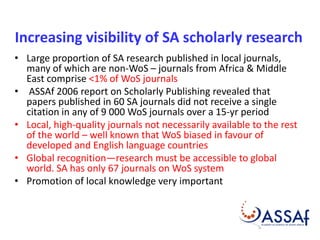
Increasing visibility of SA scholarly research 
• Large proportion of SA research published in local journals, 
many of which are non-WoS – journals from Africa & Middle 
East comprise <1% of WoS journals 
• ASSAf 2006 report on Scholarly Publishing revealed that 
papers published in 60 SA journals did not receive a single 
citation in any of 9 000 WoS journals over a 15-yr period 
• Local, high-quality journals not necessarily available to the rest 
of the world – well known that WoS biased in favour of 
developed and English language countries 
• Global recognition—research must be accessible to global 
world. SA has only 67 journals on WoS system 
• Promotion of local knowledge very important
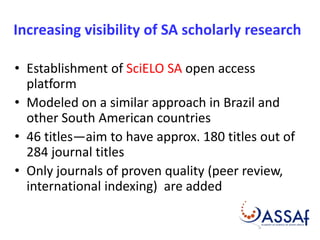
Increasing visibility of SA scholarly research 
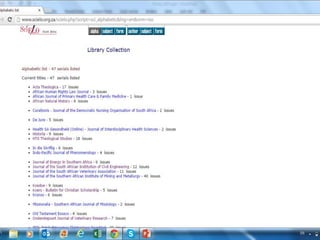
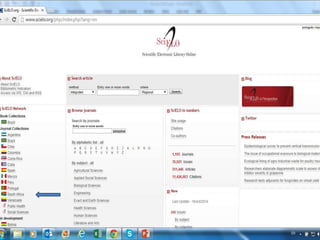
• Establishment of SciELO SA open access 
platform 
• Modeled on a similar approach in Brazil and 
other South American countries 
• 46 titles—aim to have approx. 180 titles out of 
284 journal titles 
• Only journals of proven quality (peer review, 
international indexing) are added
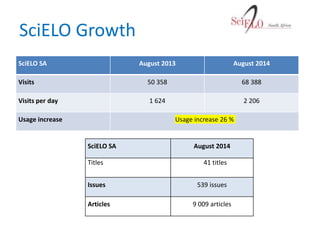
SciELO Growth 
SciELO SA August 2013 August 2014 
Visits 50 358 68 388 
Visits per day 1 624 2 206 
Usage increase Usage increase 26 % 
SciELO SA August 2014 
Titles 41 titles 
Issues 539 issues 
Articles 9 009 articles
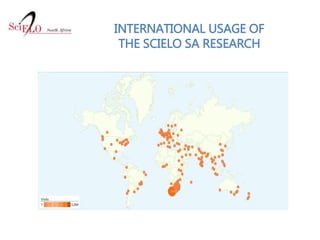
INTERNATIONAL USAGE OF 
THE SCIELO SA RESEARCH
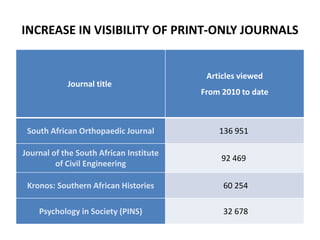
INCREASE IN VISIBILITY OF PRINT-ONLY JOURNALS 
Journal title 
Articles viewed 
From 2010 to date 
South African Orthopaedic Journal 136 951 
Journal of the South African Institute 
of Civil Engineering 
92 469 
Kronos: Southern African Histories 60 254 
Psychology in Society (PINS) 32 678
Important developments to ensure continued 
quality assurance, visibility and accessibility for 
South African journals 
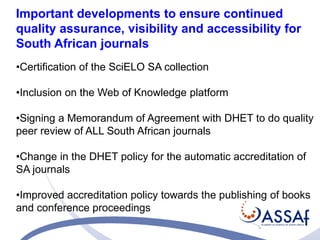
•Certification of the SciELO SA collection 
•Inclusion on the Web of Knowledge platform 
•Signing a Memorandum of Agreement with DHET to do quality 
peer review of ALL South African journals 
•Change in the DHET policy for the automatic accreditation of 
SA journals 
•Improved accreditation policy towards the publishing of books 
and conference proceedings
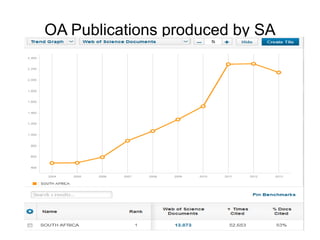
OA Publications produced by SA
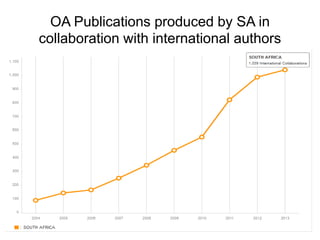
OA Publications produced by SA in 
collaboration with international authors
Access to knowledge resources 
• South Africa's higher education system is confronted with 
three major priorities: 
– (1) to produce a highly qualified human resource base which is 
needed for national development, 
– (2) to develop the next generation of academics to sustain and 
transform the system; and 
– (3) to produce high-quality research and innovation outputs that 
can enhance the country’s global competitiveness. 
• All three priorities are absolutely dependent on access to 
papers published by other scholars, local and international, 
in leading journals. 
• Many of these journals are high-cost, commercial titles 
published by large multi-national corporations.
Access to knowledge resources 
• The equitable model will be a more cost-effective 
and sustainable route for facilitating 
access to the intellectual resources required 
for achieving our higher education priorities. 
• Without this, or the investment of billions of 
additional Rands in higher education, we are 
unlikely to succeed in developing an 
equitable, diverse human resource base on 
which to build the knowledge economy.
The road ahead…… 
• Open Access Policy 
• Article Processing Charges 
• Perception of poor quality of OA 
 “Science” Sting! 
 Journal high-jacking “Bothalia” 
• Impact Factor “pressure” vs OA encouragement - Govt & 
Univ 
• Data management 
• New trends (video journals, crowd-sourced 
peer-review, early cite, publish 
article immediately following peer-review)
Thank you 
Website: www.assaf.org.za 
28

A strategic approach to scholarly research in South Africa - S Veldsman (ASSAf)

  • 1.
    A strategic approachto scholarly research in South Africa Applying scientific thinking in the service of society S Veldsman Director: SPU Rhodes University 21 Sept 2014
  • 2.
    Open Access inSouth Africa: in a nutshell • Berlin Declaration: RSA 14, ROF 22 • Institutional repositories: SA 24 • Limited APC funds: Univ. Pretoria, Cape Town and Stellenbosch
  • 3.
    Open Access inSouth Africa: in a nutshell • Berlin Declaration: RSA 14, ROF 22 • Institutional repositories: SA 24 • Limited APC funds: Univ. Pretoria, Cape Town and Stellenbosch
  • 4.
    JOURNALS @ RU 7 editors of journals published through societies or commercial publishers
  • 5.
    DOAJ.org – RSA(n = 284) 2014 70 (27%) 80 70 60 50 40 30 20 10 0 2003 2004 2005 2006 2007 2008 2009 2010 2011 2012 2013 2014
  • 6.
    Towards a newquality assurance system in South Africa • In 2003, the Policy and Procedures for the Measurement of Research Output of Public Higher Education Institutions. • The purpose of the policy is to “encourage research productivity by rewarding quality research output at public higher education institutions. • The policy assumed that recognised research outputs are of high (assured) quality, • that they are widely accessible across the globe, • and that they provide a sound basis for grant-making involving public funds, • Applications for both new and current journals in the system • Check on technical compliance and not check in quality • DHET approached ASSAf 2009-only new applications • 2013??
  • 7.
    Government funding forresearch output • Units as per policy: Books = 331 Conference Proceedings = 351 Journal articles = 7403 Unit: n= R117 000 • Funds generated: Approx. R 945 million to H. E. institutions as block subsidy Approx. R 38 million for books Approx. R866 million for journals
  • 8.
    Improving quality andquantity of research Systematic external peer reviewing of SA journals • Aim: To establish their quality and their role in the nation’s knowledge capital – Divided +/- 284 journals into broad subject (discipline) groups – Appointed panels and reviewers – Formulated process guidelines and editor questionnaires – Published 5 reports: Social Sciences; Agriculture; Theology; Health; Law (150 journals) – Finalising: Humanities – Classics, Literature & Language – Rolling out next 8 groups • Review of new applications, books and conference proceedings for accreditation for DHET
  • 9.
    “Accredited” journals (262) • 2003 - 2014 – RSA DOE list – application process (202) – ISI (Thompson Reuters WoS)/IBSS (60) • 2015 (?) – SciELO SA – Scopus – Norwegian Register for Scientific Journals – RSA list = “developmental” (5 years)
  • 10.
    Scholarly Journal Publishers Accredited RSA Journals (N = 284) Universities Independents Societies Museums 28% 42% 27%
  • 11.
    Scholarly Books: production,use and evaluation in SA:2009
  • 12.
    Findings in bookreport: • Analysis of monograph data: 60 p.a; static; 80% in Hum/SocSci; 50% local publisher • Analysis of collected works: increasing; 80% Hum/SocSci; only 20% local; 50% commercial • Books highly rated by Hum/SocSci scholars = effort on one monograph much more than 5 articles • Books small % of accredited outputs (e.g. 331 ex 8062)
  • 13.
    Book accreditation Purposeof book: disseminate original research and developments within specific disciplines, sub disciplines or field of study Chapter= 1 unit 60 pages= 2 units 120 pages=4 units 180 pages = 6 units 240 pages= 8 units 300 pages plus= 10 units Peer review evidence must be clear and unambiguous
  • 14.
    Conference Proceedings accreditation Approved conference proceedings: those which appear in approved journals lists/indexes Articles in approved conference proceedings = 0.5 units Complete articles (not abstracts) must be peer reviewed and evidence must be provided
  • 15.
    Increasing visibility ofSA scholarly research • Large proportion of SA research published in local journals, many of which are non-WoS – journals from Africa & Middle East comprise <1% of WoS journals • ASSAf 2006 report on Scholarly Publishing revealed that papers published in 60 SA journals did not receive a single citation in any of 9 000 WoS journals over a 15-yr period • Local, high-quality journals not necessarily available to the rest of the world – well known that WoS biased in favour of developed and English language countries • Global recognition—research must be accessible to global world. SA has only 67 journals on WoS system • Promotion of local knowledge very important
  • 16.
    Increasing visibility ofSA scholarly research • Establishment of SciELO SA open access platform • Modeled on a similar approach in Brazil and other South American countries • 46 titles—aim to have approx. 180 titles out of 284 journal titles • Only journals of proven quality (peer review, international indexing) are added
  • 18.
    SciELO Growth SciELOSA August 2013 August 2014 Visits 50 358 68 388 Visits per day 1 624 2 206 Usage increase Usage increase 26 % SciELO SA August 2014 Titles 41 titles Issues 539 issues Articles 9 009 articles
  • 19.
    INTERNATIONAL USAGE OF THE SCIELO SA RESEARCH
  • 20.
    INCREASE IN VISIBILITYOF PRINT-ONLY JOURNALS Journal title Articles viewed From 2010 to date South African Orthopaedic Journal 136 951 Journal of the South African Institute of Civil Engineering 92 469 Kronos: Southern African Histories 60 254 Psychology in Society (PINS) 32 678
  • 22.
    Important developments toensure continued quality assurance, visibility and accessibility for South African journals •Certification of the SciELO SA collection •Inclusion on the Web of Knowledge platform •Signing a Memorandum of Agreement with DHET to do quality peer review of ALL South African journals •Change in the DHET policy for the automatic accreditation of SA journals •Improved accreditation policy towards the publishing of books and conference proceedings
  • 23.
  • 24.
    OA Publications producedby SA in collaboration with international authors
  • 25.
    Access to knowledgeresources • South Africa's higher education system is confronted with three major priorities: – (1) to produce a highly qualified human resource base which is needed for national development, – (2) to develop the next generation of academics to sustain and transform the system; and – (3) to produce high-quality research and innovation outputs that can enhance the country’s global competitiveness. • All three priorities are absolutely dependent on access to papers published by other scholars, local and international, in leading journals. • Many of these journals are high-cost, commercial titles published by large multi-national corporations.
  • 26.
    Access to knowledgeresources • The equitable model will be a more cost-effective and sustainable route for facilitating access to the intellectual resources required for achieving our higher education priorities. • Without this, or the investment of billions of additional Rands in higher education, we are unlikely to succeed in developing an equitable, diverse human resource base on which to build the knowledge economy.
  • 27.
    The road ahead…… • Open Access Policy • Article Processing Charges • Perception of poor quality of OA  “Science” Sting!  Journal high-jacking “Bothalia” • Impact Factor “pressure” vs OA encouragement - Govt & Univ • Data management • New trends (video journals, crowd-sourced peer-review, early cite, publish article immediately following peer-review)
  • 28.
    Thank you Website:www.assaf.org.za 28