MICROBIOLOGY
PRESENTATION
TOPIC RHIZOBIUM
BY RASHIKA SOOD
What is Rhizobium?
Rhizobium are symbiotic
diazotrophs (prokaryotic
organisms that carry out dinitrogen
fixation) that form a endoymbiotic
association with legumes.
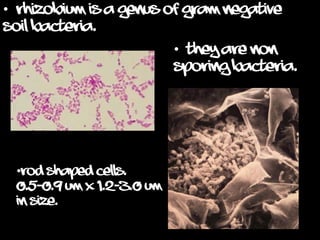
• Rhizobium is a genus of Gram negative
Soil Bacteria.
• They are non
sporing bacteria.
•Rod shaped cells.
0.5-0.9 um x 1.2-3.0 um
in size.
WHO DISCOVERED RHIZOBIUM?
Martinus Beijerinck (1851–1931) was one of the great general
microbiologists who
made fundamental contributions to microbial ecology and
many
other fields. He isolated the aerobic nitrogen-fixing bacterium
Bacillus radicicola a root nodule bacterium also capable of
fixing nitrogen (later named Rhizobium)
Rhizobium can be
found in Root
nodules of legumes.
Legumes are herbaceous woody
plants that produce seeds in
pods; examples of legumes include
peas, beans, alfalfa, vetches,
clovers, lupines, trefoils, locust,
and mimosa. (fabaceae)
It is difficult to isolate rhizobium
from the soil..
Rhizobium are predominantly
aerobic chemoorganotrophs and
grow well in the presence of
oxygen and utilize a wide range of
relatively simple carbohydrates
and amino compounds.
What is
Rhizobium’s
Nutrition?
The rhizobia doesn’t
grow wellwell on the
peptone media used
routinely.
Yeast mannitol (YM) is
the most generally
suitable for their growth.
Optimal growth of most
strains occurs at a
temperature range of 25-
30° C and at a pH of 6.0-
7.0
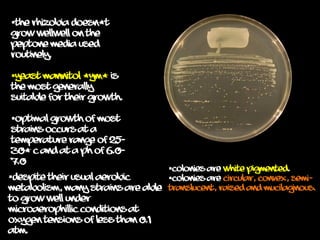
Colonies are white pigmented.
Colonies are circular, convex, semi-
translucent, raised and mucilaginous.
Despite their usual aerobic
metabolism, many strains are able
to grow well under
microaerophillic conditions at
oxygen tensions of less than 0.1
atm.
Mobile by a single polar flagellum
or two to six peritrichous
flagella.
MOBILITY
PROTECTION
OF
RHIZOBIUM
•Rhizobium is surrounded by
a slimy capsule made of
exopolysaccharide, which
protects it from drying out.
And also helps the
bacterium stick to root
hairs during various stages
of its life cycle.
•Rhizobium contains nitrogenase,
which is irreversibly damaged by
exposure to oxygen.
But Rhizobium is aerobic and
requires large amount of energy
for Nitrogen fixation.
It solves this “oxygen dilemma” by
protecting the nitrogenase
through Oxygen Scavenging
Chemicals, specifically
Leghaemoglobin a transport
protein which effectively removes
oxygen from module.
It also has exceptionally fast and
efficient aerobic metabolism so
very little Oxygen is stockpiled.
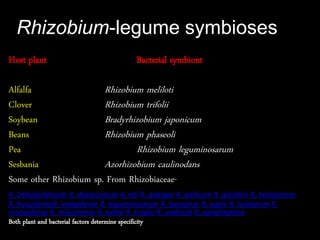
Host plant Bacterial symbiont
Alfalfa Rhizobium meliloti
Clover Rhizobium trifolii
Soybean Bradyrhizobium japonicum
Beans Rhizobium phaseoli
Pea Rhizobium leguminosarum
Sesbania Azorhizobium caulinodans
Some other Rhizobium sp. From Rhizobiaceae-
R. Cellulosilyticum R. daejeonense R. etli R. galegae R. gallicum R. giardinii R. hainanense
R. huautlenseR. Indigoferae R. leguminosarum R. loessense R. lupini R. lusitanum R.
mongolense R. miluonense R. sullae R. tropici R. undicola R. yanglingense
Both plant and bacterial factors determine specificity
Rhizobium-legume symbioses
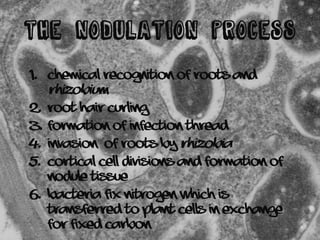
The Nodulation Process
1. Chemical recognition of roots and
Rhizobium
2. Root hair curling
3. Formation of infection thread
4. Invasion of roots by Rhizobia
5. cortical cell divisions and formation of
nodule tissue
6. Bacteria fix nitrogen which is
transferred to plant cells in exchange
for fixed carbon
RhizosphereFlavonoids
nod-gene
inducers
Nod-factor
Chemical recognition of roots and rhizobium.
Very early event.
Tip of a
clover root
hair.
The rhizobia shown here are clustered on the surface
of the root. Soon they will start to invade the roots
and begin a symbiotic partnership that will benefit
both organisms.
2. Root hair curling.
Root hair curls to trap the colony of rhizobium.
3. Formation of infection thread to penetrate root cortex and
reach vascular tissue.
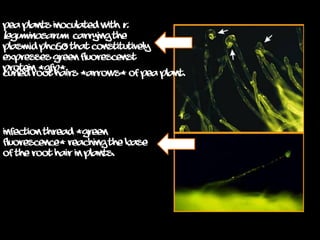
Pea plants inoculated with R.
leguminosarum carrying the
plasmid pHC60 that constitutively
expresses green fluorescenst
protein (GFP).
Curled root hairs (arrows) of pea plant.
Infection thread (green
fluorescence) reaching the base
of the root hair in plants.
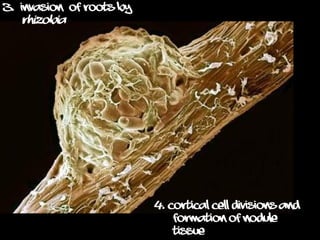
3. Invasion of roots by
Rhizobia
4. cortical cell divisions and
formation of nodule
tissue
Bacteria converts to
bacteroids and begin to
form nitrogenase
enzyme.
Rhizobium fixes nitrogen
which is transferred to
plant cells in exchange
for fixed carbon
Hope you
Enjoyed
N’ learnt
something!


Rhizobium Microbiology Science Learning Educative Presentation

  • 1.
  • 2.
  • 3.
    Rhizobium are symbiotic diazotrophs(prokaryotic organisms that carry out dinitrogen fixation) that form a endoymbiotic association with legumes.
  • 4.
    • Rhizobium isa genus of Gram negative Soil Bacteria. • They are non sporing bacteria. •Rod shaped cells. 0.5-0.9 um x 1.2-3.0 um in size.
  • 5.
  • 6.
    Martinus Beijerinck (1851–1931)was one of the great general microbiologists who made fundamental contributions to microbial ecology and many other fields. He isolated the aerobic nitrogen-fixing bacterium Bacillus radicicola a root nodule bacterium also capable of fixing nitrogen (later named Rhizobium)
  • 8.
    Rhizobium can be foundin Root nodules of legumes.
  • 9.
    Legumes are herbaceouswoody plants that produce seeds in pods; examples of legumes include peas, beans, alfalfa, vetches, clovers, lupines, trefoils, locust, and mimosa. (fabaceae) It is difficult to isolate rhizobium from the soil.. Rhizobium are predominantly aerobic chemoorganotrophs and grow well in the presence of oxygen and utilize a wide range of relatively simple carbohydrates and amino compounds.
  • 10.
  • 11.
    The rhizobia doesn’t growwellwell on the peptone media used routinely. Yeast mannitol (YM) is the most generally suitable for their growth. Optimal growth of most strains occurs at a temperature range of 25- 30° C and at a pH of 6.0- 7.0 Colonies are white pigmented. Colonies are circular, convex, semi- translucent, raised and mucilaginous. Despite their usual aerobic metabolism, many strains are able to grow well under microaerophillic conditions at oxygen tensions of less than 0.1 atm.
  • 12.
    Mobile by asingle polar flagellum or two to six peritrichous flagella. MOBILITY
  • 13.
  • 14.
    •Rhizobium is surroundedby a slimy capsule made of exopolysaccharide, which protects it from drying out. And also helps the bacterium stick to root hairs during various stages of its life cycle.
  • 15.
    •Rhizobium contains nitrogenase, whichis irreversibly damaged by exposure to oxygen. But Rhizobium is aerobic and requires large amount of energy for Nitrogen fixation. It solves this “oxygen dilemma” by protecting the nitrogenase through Oxygen Scavenging Chemicals, specifically Leghaemoglobin a transport protein which effectively removes oxygen from module. It also has exceptionally fast and efficient aerobic metabolism so very little Oxygen is stockpiled.
  • 18.
    Host plant Bacterialsymbiont Alfalfa Rhizobium meliloti Clover Rhizobium trifolii Soybean Bradyrhizobium japonicum Beans Rhizobium phaseoli Pea Rhizobium leguminosarum Sesbania Azorhizobium caulinodans Some other Rhizobium sp. From Rhizobiaceae- R. Cellulosilyticum R. daejeonense R. etli R. galegae R. gallicum R. giardinii R. hainanense R. huautlenseR. Indigoferae R. leguminosarum R. loessense R. lupini R. lusitanum R. mongolense R. miluonense R. sullae R. tropici R. undicola R. yanglingense Both plant and bacterial factors determine specificity Rhizobium-legume symbioses
  • 19.
    The Nodulation Process 1.Chemical recognition of roots and Rhizobium 2. Root hair curling 3. Formation of infection thread 4. Invasion of roots by Rhizobia 5. cortical cell divisions and formation of nodule tissue 6. Bacteria fix nitrogen which is transferred to plant cells in exchange for fixed carbon
  • 20.
  • 21.
    Tip of a cloverroot hair. The rhizobia shown here are clustered on the surface of the root. Soon they will start to invade the roots and begin a symbiotic partnership that will benefit both organisms.
  • 22.
    2. Root haircurling. Root hair curls to trap the colony of rhizobium. 3. Formation of infection thread to penetrate root cortex and reach vascular tissue.
  • 24.
    Pea plants inoculatedwith R. leguminosarum carrying the plasmid pHC60 that constitutively expresses green fluorescenst protein (GFP). Curled root hairs (arrows) of pea plant. Infection thread (green fluorescence) reaching the base of the root hair in plants.
  • 25.
    3. Invasion ofroots by Rhizobia 4. cortical cell divisions and formation of nodule tissue
  • 26.
    Bacteria converts to bacteroidsand begin to form nitrogenase enzyme. Rhizobium fixes nitrogen which is transferred to plant cells in exchange for fixed carbon
  • 27.