Managing Change in the Human Environment Pressure at the rural-urban fringe How can pressure at the rural-urban fringe be managed?
Who are the players at the RUF? Business people – want to develop in the best place for them Government – makes planning regulations and requires the building of new houses Local authority – manages planning and developments and follows government guidelines NGOs – such as Friends of the Earth have a national view Local people – live there and have an opinion on what should happen Many groups are involved in managing the changes and conflicts in the RUF Urban sprawl can be managed using several different tactics, including green belts and new settlements. Special environments can be protected through law. In cities, redevelopments and the use of brownfield sites can help reduce the pressure to develop at the rural-urban fringe
Managing the pressure at the RUF? New Towns New Towns have been built to relieve overcrowding and urban sprawl in large cities and to attract new industries to provide employment. Planners try to make the towns self contained and ensure that everything residents need are in the town. Green belts Are bands of farmland/green land can be preserved around the city. However, development has jumped the green belt so commuting has increased and pressure on city land has increased because the city can not grow outwards. Protected Areas Some areas at the RUF can be designated SSSIs (special sites of scientific interest), when special habitats are threatened by developments. Some local ‘pressure’ groups may campaign for areas not to be developed for conservation reasons. CBD/ brownfield site development Major new shopping areas and housing developments in the CBD and on brownfield sites encourage people to these areas reducing pressure on the rural-urban fringe.
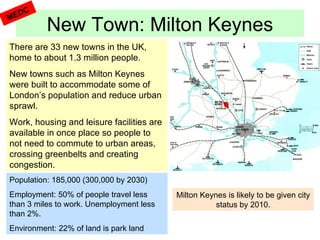
New Town: Milton Keynes MEDC There are 33 new towns in the UK, home to about 1.3 million people. New towns such as Milton Keynes were built to accommodate some of London’s population and reduce urban sprawl. Work, housing and leisure facilities are available in once place so people to not need to commute to urban areas, crossing greenbelts and creating congestion.  Population: 185,000 (300,000 by 2030) Employment: 50% of people travel less than 3 miles to work. Unemployment less than 2%. Environment: 22% of land is park land Milton Keynes is likely to be given city status by 2010.

Rfu3

  • 1.
    Managing Change inthe Human Environment Pressure at the rural-urban fringe How can pressure at the rural-urban fringe be managed?
  • 2.
    Who are theplayers at the RUF? Business people – want to develop in the best place for them Government – makes planning regulations and requires the building of new houses Local authority – manages planning and developments and follows government guidelines NGOs – such as Friends of the Earth have a national view Local people – live there and have an opinion on what should happen Many groups are involved in managing the changes and conflicts in the RUF Urban sprawl can be managed using several different tactics, including green belts and new settlements. Special environments can be protected through law. In cities, redevelopments and the use of brownfield sites can help reduce the pressure to develop at the rural-urban fringe
  • 3.
    Managing the pressureat the RUF? New Towns New Towns have been built to relieve overcrowding and urban sprawl in large cities and to attract new industries to provide employment. Planners try to make the towns self contained and ensure that everything residents need are in the town. Green belts Are bands of farmland/green land can be preserved around the city. However, development has jumped the green belt so commuting has increased and pressure on city land has increased because the city can not grow outwards. Protected Areas Some areas at the RUF can be designated SSSIs (special sites of scientific interest), when special habitats are threatened by developments. Some local ‘pressure’ groups may campaign for areas not to be developed for conservation reasons. CBD/ brownfield site development Major new shopping areas and housing developments in the CBD and on brownfield sites encourage people to these areas reducing pressure on the rural-urban fringe.
  • 4.
    New Town: MiltonKeynes MEDC There are 33 new towns in the UK, home to about 1.3 million people. New towns such as Milton Keynes were built to accommodate some of London’s population and reduce urban sprawl. Work, housing and leisure facilities are available in once place so people to not need to commute to urban areas, crossing greenbelts and creating congestion. Population: 185,000 (300,000 by 2030) Employment: 50% of people travel less than 3 miles to work. Unemployment less than 2%. Environment: 22% of land is park land Milton Keynes is likely to be given city status by 2010.