RFID & ITS
APPLICATION
Members:
1. Alice Lee(15232032)
2. Bob Chan(15332343)
3. Cathy Mak(15322323)
FLOW OF PRESENTATION
15 October 2015RFID & its Applications 2
RFID
• RFID = Radio Frequency Identification
• Electronic labeling and wireless identification of objects using radio frequency
• Tag carries with its information
• a serial number
• Model number
• Color or any other imaginable data
• When these tags pass through a field generated by a compatible reader, they
transmit this information back to the reader, thereby identifying the object
15 October 2015RFID & its Applications 3
RFID COMPONENTS
• A basic RFID system consists of these components:
• A programmable RFID tag/inlay for storing item data;
• Consisting of an RFID chip for data storage
• an antenna to facilitate communication with the RFID chip
• A reader/antenna system to interrogate the RFID inlay
• Application software and a host computer system
15 October 2015RFID & its Applications 4
RFID TAG
• The RFID tag consists of an integrated circuit (IC) embedded in a thin film medium.
• Information stored in the memory of the RFID chip is transmitted by the antenna
circuit embedded in the RFID inlay via radio frequencies, to an RFID reader
• 3 types
• Passive
• Semi-passive
• Active
15 October 2015RFID & its Applications 5
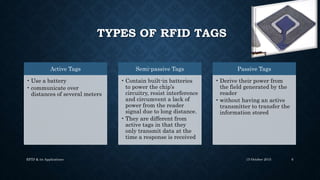
TYPES OF RFID TAGS
Active Tags
• Use a battery
• communicate over
distances of several meters
Semi-passive Tags
• Contain built-in batteries
to power the chip’s
circuitry, resist interference
and circumvent a lack of
power from the reader
signal due to long distance.
• They are different from
active tags in that they
only transmit data at the
time a response is received
Passive Tags
• Derive their power from
the field generated by the
reader
• without having an active
transmitter to transfer the
information stored
15 October 2015RFID & its Applications 6
APPLICATIONS
Frequency Appx. Read Range Data Speed Cost of
Tags
Application
Low Frequency (125kHz) <5cm
(passive)
Low High • Animal Identification
• Access Control
High Frequency (13.56
Mhz)
10 cm – 1m
(passive)
Low to Moderate Medium to
Low
• Smart Cards
• Payment (paywave)
Ultra High Frequency
(433, 868-928 Mhz)
3m -7m
(passive)
Moderate to High Low • Logistics and Supply Chain
• Baggage Tracking
Microwave (2.45 & 5.8
Ghz)
10m -15m
(passive)
20m – 40m
(active)
High High • Electronic toll collection (Autotoll)
• Container Tracking
15 October 2015RFID & its Applications 7
CURRENT APPLICATIONS
15 October 2015RFID & its Applications 8
APPLICATIONS
Credit Cards with RFID
(Paywave function)
Octopus (Smart Card)
15 October 2015RFID & its Applications 9
APPLICATIONS
Autotoll (Electronic toll collection)
Access Control
15 October 2015RFID & its Applications 10
ONLINE SURVEY
• Target: SME
• Information: Opinion on RFID and its applications
• Site:
• http://qtrial.qualtrics.com/SE/?SID=SV_9N5UPRZuyuWtsk4
15 October 2015RFID & its Applications 11
SURVEY RESULT
Logistics and Supply
Chain Management
20%
Pharmaceutic
manufacturing
industries
15%
Library Management
21%
Inventory Control
10%
Document Management
8%
Security
8%
Customer Services
5%
Hotel Management
5%
Banking and Finance
5%
Social Services
3%
Other
18%
TYPES OF INDUSTRIES THAT RESPONDENTS
THINK
IT IS POSSIBLE TO APPLY RFID TECHNOLOGY
15 October 2015RFID & its Applications 12
FURTHER DEVELOPMENT
• In medical uses and library management
15 October 2015RFID & its Applications 13
VIDEO
15 October 2015RFID & its Applications 14
CONCLUSION
• Positive
• RFID is a contactless reading technology and can read through other
materials
• Hold more data than barcode does
• RFID tags data can be changed or added
• More effective, bring lots of convenience to us
• Negative
• Cost is relatively remain high (compare to barcode)
• RFID signals may have problems with some materials
• RFID standards are still being developed
15 October 2015RFID & its Applications 15

RFID Application

  • 1.
    RFID & ITS APPLICATION Members: 1.Alice Lee(15232032) 2. Bob Chan(15332343) 3. Cathy Mak(15322323)
  • 2.
    FLOW OF PRESENTATION 15October 2015RFID & its Applications 2
  • 3.
    RFID • RFID =Radio Frequency Identification • Electronic labeling and wireless identification of objects using radio frequency • Tag carries with its information • a serial number • Model number • Color or any other imaginable data • When these tags pass through a field generated by a compatible reader, they transmit this information back to the reader, thereby identifying the object 15 October 2015RFID & its Applications 3
  • 4.
    RFID COMPONENTS • Abasic RFID system consists of these components: • A programmable RFID tag/inlay for storing item data; • Consisting of an RFID chip for data storage • an antenna to facilitate communication with the RFID chip • A reader/antenna system to interrogate the RFID inlay • Application software and a host computer system 15 October 2015RFID & its Applications 4
  • 5.
    RFID TAG • TheRFID tag consists of an integrated circuit (IC) embedded in a thin film medium. • Information stored in the memory of the RFID chip is transmitted by the antenna circuit embedded in the RFID inlay via radio frequencies, to an RFID reader • 3 types • Passive • Semi-passive • Active 15 October 2015RFID & its Applications 5
  • 6.
    TYPES OF RFIDTAGS Active Tags • Use a battery • communicate over distances of several meters Semi-passive Tags • Contain built-in batteries to power the chip’s circuitry, resist interference and circumvent a lack of power from the reader signal due to long distance. • They are different from active tags in that they only transmit data at the time a response is received Passive Tags • Derive their power from the field generated by the reader • without having an active transmitter to transfer the information stored 15 October 2015RFID & its Applications 6
  • 7.
    APPLICATIONS Frequency Appx. ReadRange Data Speed Cost of Tags Application Low Frequency (125kHz) <5cm (passive) Low High • Animal Identification • Access Control High Frequency (13.56 Mhz) 10 cm – 1m (passive) Low to Moderate Medium to Low • Smart Cards • Payment (paywave) Ultra High Frequency (433, 868-928 Mhz) 3m -7m (passive) Moderate to High Low • Logistics and Supply Chain • Baggage Tracking Microwave (2.45 & 5.8 Ghz) 10m -15m (passive) 20m – 40m (active) High High • Electronic toll collection (Autotoll) • Container Tracking 15 October 2015RFID & its Applications 7
  • 8.
    CURRENT APPLICATIONS 15 October2015RFID & its Applications 8
  • 9.
    APPLICATIONS Credit Cards withRFID (Paywave function) Octopus (Smart Card) 15 October 2015RFID & its Applications 9
  • 10.
    APPLICATIONS Autotoll (Electronic tollcollection) Access Control 15 October 2015RFID & its Applications 10
  • 11.
    ONLINE SURVEY • Target:SME • Information: Opinion on RFID and its applications • Site: • http://qtrial.qualtrics.com/SE/?SID=SV_9N5UPRZuyuWtsk4 15 October 2015RFID & its Applications 11
  • 12.
    SURVEY RESULT Logistics andSupply Chain Management 20% Pharmaceutic manufacturing industries 15% Library Management 21% Inventory Control 10% Document Management 8% Security 8% Customer Services 5% Hotel Management 5% Banking and Finance 5% Social Services 3% Other 18% TYPES OF INDUSTRIES THAT RESPONDENTS THINK IT IS POSSIBLE TO APPLY RFID TECHNOLOGY 15 October 2015RFID & its Applications 12
  • 13.
    FURTHER DEVELOPMENT • Inmedical uses and library management 15 October 2015RFID & its Applications 13
  • 14.
    VIDEO 15 October 2015RFID& its Applications 14
  • 15.
    CONCLUSION • Positive • RFIDis a contactless reading technology and can read through other materials • Hold more data than barcode does • RFID tags data can be changed or added • More effective, bring lots of convenience to us • Negative • Cost is relatively remain high (compare to barcode) • RFID signals may have problems with some materials • RFID standards are still being developed 15 October 2015RFID & its Applications 15