Research Ethics & Human
Subjects: Navigating the
Landscape
Welcome to this critical presentation on research ethics and human subjects. As global
research becomes increasingly complex and multidisciplinary, understanding the
foundational principles and regulatory frameworks is paramount. This presentation will
guide you through the core ethical concepts, the global governance structures, and the
unique challenges faced across different research domains like Law, Engineering, and
Social Sciences. Our goal is to ensure ethical rigor in all research involving human
participation.
Foundations: Core Ethical Principles
Informed Consent, Privacy, and Confidentiality
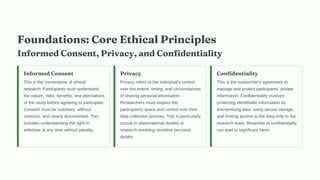
Informed Consent
This is the cornerstone of ethical
research. Participants must understand
the nature, risks, benefits, and alternatives
of the study before agreeing to participate.
Consent must be voluntary, without
coercion, and clearly documented. This
includes understanding the right to
withdraw at any time without penalty.
Privacy
Privacy refers to the individual's control
over the extent, timing, and circumstances
of sharing personal information.
Researchers must respect the
participant's space and control over their
data collection process. This is particularly
crucial in observational studies or
research involving sensitive personal
details.
Confidentiality
This is the researcher's agreement to
manage and protect participants’ private
information. Confidentiality involves
protecting identifiable information by
anonymising data, using secure storage,
and limiting access to the data only to the
research team. Breaches of confidentiality
can lead to significant harm.
Guardians of Ethics
IRBs, Ethics Committees, and Global Standards
Institutional Review Boards (IRBs)
In the US, IRBs (or Ethics Committees globally) are bodies responsible for reviewing and approving research involving human subjects. Their primary
mandate is to protect the rights and welfare of research participants by assessing the ethical adequacy of the study design.
Global Ethics Committees
Similar committees operate worldwide, ensuring that local ethical and regulatory requirements are met. They often focus on the local cultural context
and ensure that research design is equitable and relevant to the community.
International Guidelines
Documents like the Declaration of Helsinki (WMA) and the Belmont Report provide the international benchmarks for ethical conduct. They guide
researchers and committees on principles such as beneficence, justice, and respect for persons.
"Ethical oversight is not a barrier to research; it is the foundation of trustworthy and impactful inquiry."
Interdisciplinary Hurdles
Ethical Dilemmas in Diverse Research Fields
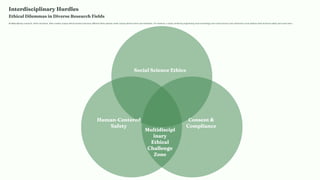
Multidisciplinary research, while innovative, often creates unique ethical tensions because different fields operate under varying ethical norms and standards. For instance, a study combining engineering (new technology) and social science (user behaviour) must address both technical safety and social harm.
Social Science Ethics
Human‑Centered
Safety
Consent &
Compliance
Multidiscipl
inary
Ethical
Challenge
Zone
Contextual Perspectives
How Law, Engineering, and Social Sciences Approach Human Research
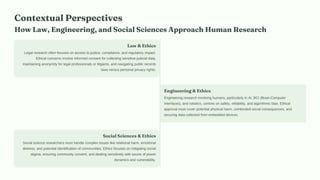
Law & Ethics
Legal research often focuses on access to justice, compliance, and regulatory impact.
Ethical concerns involve informed consent for collecting sensitive judicial data,
maintaining anonymity for legal professionals or litigants, and navigating public records
laws versus personal privacy rights.
Engineering & Ethics
Engineering research involving humans, particularly in AI, BCI (Brain-Computer
Interfaces), and robotics, centres on safety, reliability, and algorithmic bias. Ethical
approval must cover potential physical harm, unintended social consequences, and
securing data collected from embedded devices.
Social Sciences & Ethics
Social science researchers must handle complex issues like relational harm, emotional
distress, and potential identification of communities. Ethics focuses on mitigating social
stigma, ensuring community consent, and dealing sensitively with issues of power
dynamics and vulnerability.
Protecting the Vulnerable
Ethical Considerations for Special Populations
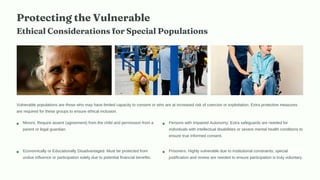
Vulnerable populations are those who may have limited capacity to consent or who are at increased risk of coercion or exploitation. Extra protective measures
are required for these groups to ensure ethical inclusion.
Minors: Require assent (agreement) from the child and permission from a
parent or legal guardian.
Persons with Impaired Autonomy: Extra safeguards are needed for
individuals with intellectual disabilities or severe mental health conditions to
ensure true informed consent.
Economically or Educationally Disadvantaged: Must be protected from
undue influence or participation solely due to potential financial benefits.
Prisoners: Highly vulnerable due to institutional constraints; special
justification and review are needed to ensure participation is truly voluntary.
Cultural Nuances
Ensuring Sensitivity in Global Research Practices
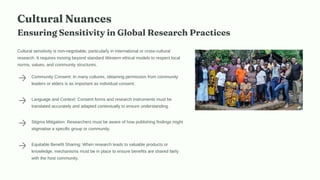
Cultural sensitivity is non-negotiable, particularly in international or cross-cultural
research. It requires moving beyond standard Western ethical models to respect local
norms, values, and community structures.
Community Consent: In many cultures, obtaining permission from community
leaders or elders is as important as individual consent.
Language and Context: Consent forms and research instruments must be
translated accurately and adapted contextually to ensure understanding.
Stigma Mitigation: Researchers must be aware of how publishing findings might
stigmatise a specific group or community.
Equitable Benefit Sharing: When research leads to valuable products or
knowledge, mechanisms must be in place to ensure benefits are shared fairly
with the host community.
Data Safeguards
Understanding GDPR and Global Data Privacy Laws
The volume and sensitivity of research data necessitate strict compliance with global data protection frameworks. The General Data Protection Regulation
(GDPR) sets a high standard for data protection, impacting any research involving subjects from the European Economic Area (EEA), regardless of where
the research takes place.
Legal Basis for Processing
GDPR requires a clear legal basis for
processing personal data, such as explicit
consent or a legitimate interest. For sensitive
data (like health or genetic information), the
requirement is even stricter.
Rights of the Data Subject
Individuals have rights to access,
rectification, erasure (the 'right to be
forgotten'), and portability of their data.
Researchers must have protocols to honour
these requests efficiently.
Data Minimisation & Security
Data should be pseudonymised or
anonymised wherever possible. Robust
security measures (encryption, restricted
access) must be implemented to prevent
breaches, aligning with principles of 'Privacy
by Design'.
GDPR's stringent rules influence research globally, often setting the gold standard for handling human subjects data.
Case Studies: Applying Ethical Wisdom
Real-world Ethical Challenges and Solutions
Wearable Tech
Challenge: Continuous, passive data
collection via wearable devices blurs the
line between research and surveillance.
Solution: Implement dynamic, tiered
consent that allows participants to control
data stream frequency and purpose, not
just initial sign-up.
Social Media Research
Challenge: Is data posted publicly on
social media truly 'public'? The ethical
ambiguity surrounding informed
consent and expectation of privacy.
Solution: IRBs often mandate that
research only use fully anonymised
aggregated data and avoid quoting
identifiable posts unless explicit
consent is obtained.
Global Vaccine Trials
Challenge: Ensuring fair distribution of
post-trial benefits (like a successful
vaccine) to the host community, even if
they are low-resource settings. Solution:
Pre-trial agreements must detail benefit-
sharing mechanisms, capacity building,
and intellectual property rights to ensure
justice.
These cases demonstrate that ethical solutions often require proactive engagement with participants and a willingness to adapt standard protocols to
complex real-world scenarios.
Key Takeaways & Future Directions
Commitment to Ethical
Integrity
We must view ethics as an ongoing dialogue, not a
checklist. The future of human subjects research
demands adaptability, interdisciplinary communication,
and a deep respect for human dignity and autonomy.
Key Takeaways:
Consent must be truly informed, especially with new
technologies.
IRBs and committees are crucial for oversight and
guidance.
Multidisciplinary research requires harmonisation of
ethical standards.
Vulnerable populations require elevated protection.
Global data laws like GDPR mandate rigorous
privacy protocols.
Future Directions:
Developing ethics guidelines for AI-driven
research and algorithmic fairness.
Promoting Global Ethical Literacy
through standardised training programs.
Fostering greater Interdisciplinary
Collaboration in ethical review
processes.
Thank you