1
KAIZEN –its Overall Outlook: LEARNING its
SUCCESSES & FAILURES
Noriyuki Murata, RIIM Chu-San-Ren
1. Kaizen enhances discipline 2,
2. POSITIVE involvement to Challenges vs. PASSIVITY, impeding IDEA CREATION 3,
3. Which side is your “mindset” facing, assume responsibility or try avoiding one? 4,
4. Winners & Losers in performing KAIZEN? 4,
5. Discussion with H.H. Dalai Lama 6,
6. What we are used to speak about in Japan’s “Kaizen” operations! 7,
7. What is a “Problem”? 9,
8. General Framework of KAIZEN Implementation 10,
9. Quality Circle differs from other Concepts - How ? 11,
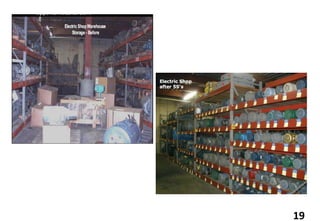
10. KAIZEN eradicates misplacement of given items 12,
11. KAIZEN saves Searching Time 13,
12. Human Errors 14,
13. Why do people make mistakes? 15,
14. Approaches to Creating a KAIZEN Culture in Our Organization 16,
15. What type is your organization? 17,
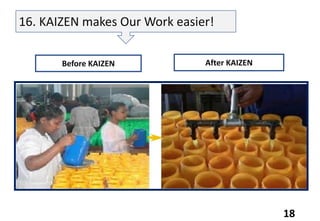
16. KAIZEN makes Our Work easier! 18-20,
17. The Company’s Culture at work! 21,
18. Conditions for successful cultural change 22,
19. DOMAINS & CAPABILITIES of EMOTIONAL INTELLIGENCE 23,
20. Domain of Personal Competence 24,
21. Domain of Social Competence 25,
22. Self-Directed Learning 26-28,
25. KAIZEN -challenge your status quo 29,
26. INDUCTION, DEDUC-TION, & HYPOTHESIZING 30,
27. On-Site Introduction 31,
28. Evaluation of KAIZEN Master Trainer 32.
2
KAIZEN is a system that involves every employee –
from upper management to junior staff.
Everyone is encouraged to make improvement (KAIZEN)
on regular basis.
1. KAIZEN Enhances Discipline
3
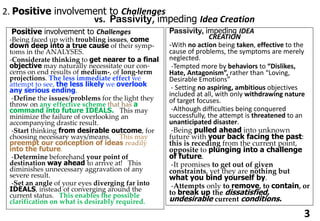
2. Positive involvement to Challenges
vs. Passivity, impeding Idea Creation
Positive involvement to Challenges
-Being faced up with troubling issues, come
down deep into a true cause of their symp-
toms in the ANALYSES.
-Considerate thinking to get nearer to a final
objective may naturally necessitate our con-
cerns on end results of medium-, of long-term
projections. The less immediate effect we
attempt to see, the less likely we overlook
any serious ending.
-Define the issues/problems for the light they
throw on any effective scheme that has a
command into future IDEALS. This may
minimize the failure of overlooking an
accompanying drastic result.
-Start thinking from desirable outcome, for
choosing necessary ways/means. This may
preempt our conception of ideas readily
into the future.
-Determine beforehand your point of
destination way ahead to arrive at! This
diminishes unnecessary aggravation of any
severe result.
-Set an angle of your eyes diverging far into
IDEALS, instead of converging around the
current status. This enables the possible
clarification on what is desirably required.
Passivity, impeding IDEA
CREATION
-With no action being taken, effective to the
cause of problems, the symptoms are merely
neglected.
-Tempted more by behaviors to “Dislikes,
Hate, Antagonism”, rather than “Loving,
Desirable Emotions”
- Setting no aspiring, ambitious objectives
included at all, with only withdrawing nature
of target focuses.
-Although difficulties being conquered
successfully, the attempt is threatened to an
unanticipated disaster.
-Being pulled ahead into unknown
future with your back facing the past:
this is receding from the current point,
opposite to plunging into a challenge
of future.
-It promises to get out of given
constraints, yet they are nothing but
what you bind yourself by.
-Attempts only to remove, to contain, or
to break up the dissatisfied,
undesirable current conditions.
4
3. Which side is your “mindset” facing, assume responsibility or try avoiding
one?
How will it be possible to make our people being altruistic seems to be a key for the
successful introduction, and for continuing the operation of Kaizen?
When a superior you report to is not a person of good leadership, the question be whether
you start complaining about how much you are unhappy, or learning his weaknesses, so that
you’ll prove showing up a capable leader yourself. It may so happen sometimes that
you may have not grown matured enough, simply because currently you report to your boss,
who happens performing a perfect leadership!
In other words, do you readily work with your responsibility you are not given to work on, or
you won‘t take responsibility on what you are not obligated to work!
4. Winners and Losers in performing KAIZEN
1. The winner is always part of the answer.
The loser is always part of the problem.
2. The winner has always a program; the loser has always an excuse.
3. The winner says, “let me do it for you”;
the loser says, “that is not my job”.
4. The winner sees a response for each problem;
the loser sees a problem for each response.
5
5. The winner says, “it may be difficult, but it is possible”,
the loser says, “it may be possible, but it is too difficult”.
6. When a winner makes a mistake, he/she says, “I was wrong”;
when a loser makes a mistake, he/she says, “It wasn’t my fault”.
7. The winner says, “I must do something”;
the loser says, “something must be done”.
8. The winner is part of the team; the loser is outside.
9. The winners organize, prepare themselves to win, the key word is
preparation; the losers don’t participate in the preparation.
10. Winners see possibilities, potential;
losers see problems and the Past.
11. Winners believe win/win;
losers believe for them to win; some must lose.
12. Winners use hard arguments, but soft words;
losers use soft arguments but hard words.
13. Winners make it happen; losers let it happen.
14. The winner knows that “Time is money”;
the loser wastes time, losing the “Money”.
15. The winner moves his/her hands and feet to achieve results;
the loser stays in an air-conditioned room and ask for results.
6
16. The winner practices SORT and SET, in order not to waste time looking for
things, the loser does not look for time to practice SORT and SET and
wastes time.
17. The winner uses existing materials to improve the situation;
the loser always looks for nonexistent materials.
18. The winner asks how to fish; the loser asks for fish.
19. The winner says, “since there is no space, I practice 5S”; the loser says, “I
can’t practice 5S, because there is no space”.
<Catch Words on “Kaizen”, TANESCO, 2016, Tanzania>
5. Discussion of H.H. Dalai Lama with Dr. Howard C. Cutler
The author of “The Art of Happiness”, Dr. Howard C. Cutler, a psychiatrist, asked His
Holiness the Dalai Lama, ‘Can you more clearly define what you mean by
“compassion” ?’ The Dalai Lama replied, ‘It is a mental attitude based on the wish
for others to be free of their suffering, and is associated with a sense of commitment,
responsibility, and respect towards others.
… In developing compassion, perhaps one could begin with the wish that oneself be
free of suffering and take that natural feeling toward oneself & cultivate it, enhance it,
extend it out to include & embrace others.’’
7
Many studies support the idea that altruism and compassion development in one’s
behaviors has a positive impact of on physical and emotional health.
It has been proven in the experiments that immunoglobulin-A, an antibody that helps
fight respiratory infections, found increased in the saliva of students who have seen a
film of Mother Teresa, working for a group of sick & poor in Calcutta.
In addition to beneficial effects on one’s physical health, there is evidence that
compassion & caring behavior contributes to good emotional health. In a 30-year
study of a group of Harvard graduates, researcher George Vaillant concluded that
adopting an altruistic lifestyle is a critical component of good mental heath.
Excerpted from “The Art of Happiness”, 1998, HH Dalai Lama & Howard C. Cutler
6. What we are used to speak about in Japan’s “Kaizen” operations!
1. Start your action in your own proposition, outgrowing the stage of
dependence on others.
2. Capture a moment of truth, for analysis to scan the status quo.
3. Give life to an idea of “incongruity”.
8
4. Go into action with the consideration, 180 degrees opposite
to the current state.
5. Get going, whatever conceived in mind.
6. Conform to authenticity, in no deviation from the set principles.
7. In building culture in organization, create structural settings.
8. Problems be resolved, with the status quo scrutinized into
processes.
9. Let the consequences well accounted for, when responsibility is
fulfilled.
10. People grow into different mindsets, as their behaviors
undergo the required changes.
9
7. What is a Problem?
10
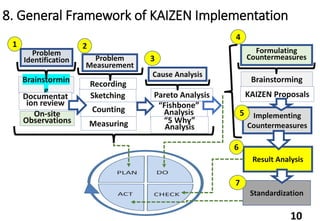
8. General Framework of KAIZEN Implementation
Implementing
Countermeasures
Result Analysis
Standardization
Problem
Identification
Brainstormin
g
On-site
Observations
Documentat
ion review
1
6
5
4
2
“Fishbone”
Analysis
“5 Why”
Analysis
Pareto Analysis
Cause Analysis
3
7
Counting
Measuring
Problem
Measurement
Sketching
Recording
Formulating
Countermeasures
Brainstorming
KAIZEN Proposals
11
9. Quality Circle differs from other
Concepts - How ?
a. Everybody participates, contributes in the process
of decision-making
b. Problems are chosen, not given
c. Decision by consensus, not by majority
d. Performance-oriented, not problem-oriented
e. Bottom-up approach
f. Management-blessed, not management-directed
g. Members are responsible, from the identification of a problem,
over to implementation of the solution i.e. for the total
performance
h. Aims at the quality of work life, for its higher level achievement
i. Does not replace or substitute any of the on-going systems or
structure
12
10. KAIZEN eradicates misplacement of given items
13
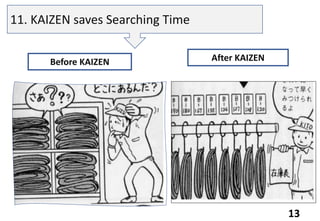
Before KAIZEN After KAIZEN
11. KAIZEN saves Searching Time
14
12. Human Errors
• Omission,
• Placement of wrong order,
• Incorrect selection, counting,
• Failure to have sensed a danger,
• Incorrect holding, positioning, orientation, motion,
• Improper holding,
• Insufficient avoidance,
• Wrong timing
15
13. Why do people make mistakes?
Cause Example
Forgetful, Locking keys left inside a car
Carelessness, Driving a car into a crossing during red signal
Misunderstanding, Braking an automobile instead of clutch while
driving automatic car
On purpose, Violation: Crossing a road while red
signal on purpose
Lack of skills or
experience (novice),
Wrong setting of a machine
Selfishness, Can you give examples?
Malfunction, Can you give examples?
16
Basic types of workplaces
14. Approaches to Creating a KAIZEN Culture in Our
Organisation
17
15. What type is
your
organization?
18
Before KAIZEN After KAIZEN
16. KAIZEN makes Our Work easier!
19
20
17. The Company’s Culture at work!
On 9/11, when the planes hit the world Trade Center, the CEO of a big U.S.
technology company was on a plane to Asia. When she heard the news
upon landing, she immediately tried to get in touch with her office in
California, but thanks to the jammed phone lines & the sixteen-hour time
difference, it was several hours before she could get through to her senior
team. When she did get them on a conference call, she laid out three
immediate priorities for them:
1 Immediately account for every employee & ensure they
are all safe,
2. Ensure that the company’s Web site & servers – the core of
their business – are secure,
3. Begin organizing a charity auction in order to support victims and
their families,
Culture is what your people do when no one is looking.
After a brief silence on the other end of the line, someone in the
conference room informed the CEO that the three priorities had not only
been identified, the first two had already been completed & the third was
well on its way.
(“Too Many Bosses, Too Few Leaders” Rajeev Peshawaria, 2011)
21
22
18. Conditions for successful cultural change
1 Clear & well-articulated reasons for changing,
2. Clear & well-articulated principles,
3. Alignment of such matters as language, policies, practices,
processes & the physical environment,
4. Overt leadership commitment through deeds,
words, to the desired/required “way we do
things here”,
5. A recognition of what degree of change is possible, given the
constraints of history, legacy, the business model, resources,
etc.,
6. Acceptance that planned culture change takes years rather
than months, and that culture is in any case changing all the
time, irrespective of any plans to change it.
(“Organisation Culture Getting it right” Naomi Stanford, 2010)
19. DOMAINS & CAPABILITIES of EMOTIONAL INTELLIGENCE
Personal & Social Competence
(Primal Leadership
D. Goleman, R. Boyatzis 2013)
23
CAPABILITIES of
SOCIAL
AWARENESS: 10.
Empathy
11. Organizational
Awareness
12. Service
-CAPABILITIES of
RELATIONSHIP
MANAGEMENT: 13.
Inspirational
leadership 14.
Influence
15. Developing others
16. Change catalyst
17. Conflict management
18. Teamwork &
collaboration
𝝱- Domain of
SOCIAL COMPETENCE <-
How do you manage
RELATIONSHIPS?>
-Capabilities
of SELF-
MANAGEMENT:
4. Emotional
Self-Control
5. Transparency
6. Adaptability
7. Achievement
8. Initiative
9. Optimism
𝝰- Domain of PERSONAL
COMPETENCE <-
How do you manage
YOURSELF?>
-Capabilities
of SELF-
AWARENESS:
1. Emotional
Self-
Awareness 2.
Accurate
Self-
Assessment
3. Self-
Confidence
< 𝝰- Personal & 𝝱- Social
Competence >
24
20. Domain of Personal Competence: 𝝰. How do you Manage yourself?
-CAPABILITIES of Self-Awareness 1. – 3.
& of Self-Management 4. – 9. :
-Capabilities of Self-
Awareness:
1. Emotional Self- Awareness
Read one’s own emotions,
recognize their impact to guide
decision by “gut sense”. Being
candid & authentic with
conviction about guiding vision.
2. Accurate Self-Assessment
Know one’s limitations in
cultivating leadership strengths,
being graceful in learning where
necessary to improve.
Welcome constructive
criticism & feedback, knowing
where to focus, when to ask for
help, exhibiting a sense of humor
about themselves.
3. Self-Confidence
Carry a sense of presence, a
self-assurance that lets them
stand out in a group, welcoming a
difficult assignment.
-Capabilities of Self-Management:
4. Emotional Self-Control Find ways to manage
disturbing emotions & impulses. Capable to stay
calm & clear headed under high stress or during a
crisis, remaining unflappable when confronted by
a trying situation.
5. Transparency Openly admit
mistakes or faults, confronting unethical behavior
in others rather than turn a blind eye.
6. Adaptability Flexible in adapting to new
challenges, nimble in adjusting to fluid change, &
limber in their thinking in the face of new data or
realities.
7. Achievement Pragmatic in setting goals
measurable, but challenging, being able to
calculate risk so that their goals are worthy but
attainable.
8. Initiative Seize opportunities –or
create them – rather than simply waiting. Never
hesitate to cut through red tape, or even bend the
rules, when necessary to create better possibilities
for the future.
9. Optimism See an opportunity rather
than a threat in a setback, expecting the best of
them, rolling with the punches,. And their “glass
half-full” outlook leads them to expect that
25
-CAPABILITIES of Relationship
Management:
13. Inspirational leadership Articulate a shared
mission, in a way that inspires others to follow. Creates
resonance & move people with a compelling vision or
shared mission.
14. Influence Be persuasive, & engaging when
addressing a group, wielding a range of tactics for
persuasion. Mindful to build buy-in from key people & a
network of support for an initiative.
15. Developing others Adept at cultivating
people’s abilities, understanding their goals, strengths, &
weaknesses. Give timely & constructive feedback, being
natural mentors or coaches.
16. Change catalyst Challenge the status quo,
champion the new order, recognizing the need for the
change. Advocate change even in the face of opposition,
making the argument for it compellingly.
17. Conflict management Acknowledge the
feelings & views of all sides, & then redirect the energy
toward a shared ideal, resolving disagreements.
18. Teamwork & collaboration Draw others into
commitment, active, enthusiastic to the collective efforts,
& build spirit & identity. Spend time, forging &
cementing close relationships beyond mere work
obligations.
-CAPABILITIES of
Social Awareness
10. Empathy Let people sense
the emotions felt, unspoken in
a person or group, attuning to
a wide range of emotional
signals. Get
along well with people of
diverse backgrounds or from
other cultures.
11. Organizational
awareness Able to
detect crucial social networks,
reading key power
relationships.
Understand the guiding
values & unspoken rules that
operate among people.
12. Service Recognize, meet
the needs of follower, client, or
customer, & foster an
emotional climate, monitoring
customer/ client satisfaction
carefully to ensure they are
getting what they need.
21. Domain of Social Competence:
𝝱. How do you Manage Relationships ?
-CAPABILITIES of Social Awareness 10. – 12.
& of Relationship Management 13. – 18. :
26
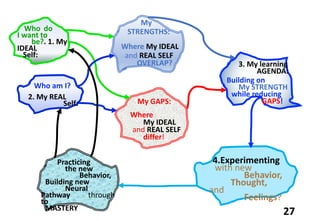
My GAPS:
Where
My IDEAL
and REAL SELF
differ!
My
STRENGTHS:
Where My IDEAL
and REAL SELF
OVERLAP?
Who do
I want to
be?.
1. My IDEAL
Self:
3. My learning
AGENDA:
Building on
My STRENGTH
while reducing
GAPS!
Who am I?
2. My REAL
Self:
22 Self-Directed Learning
27
4.Experimenting
with new
Behavior,
Thought,
and
Feelings?
My GAPS:
Where
My IDEAL
and REAL SELF
differ!
My
STRENGTHS:
Where My IDEAL
and REAL SELF
OVERLAP?
Who do
I want to
be?. 1. My
IDEAL
Self:
3. My learning
AGENDA:
Building on
My STRENGTH
while reducing
GAPS!
Who am I?
2. My REAL
Self:
Practicing
the new
Behavior,
Building new
Neural
Pathway through
to
MASTERY
28
4.Experimenting
with new
Behavior,
Thought, and
Feelings?
My GAPS:
Where My
IDEAL and
REAL SELF
differ!
My
STRENGTHS:
Where My
IDEAL
and REAL SELF
OVERLAP?
Who do I
want to be?
1. My IDEAL
Self 3. My learning
AGENDA:
Building on
My STRENGTH
while reducing
GAPS!
Who am
I? 2.
My REAL
Self:
Practicing
the new Behavior,
Building new
Neural athway
through to
MASTERY
(Richard Boyatzis’s
THEORY of
Self-Directed
LEARNING 2013)
5. Developing
Trusting
Relationship that
help, support,
and encourage
each step
in the process
29
25. KAIZEN
Challenge your status quo
26. INDUCTION, DEDUCTION, and HYPOTHESIZING
Q.C. Applications
by INDUCTION
COUNTER-
MEASURES
formulation
C
DATA
SCAN
on
CURRENT
SITUATION
A
Factual Analysis for
Problem
Definition,
Cause Detection
B
VISION Setting
-DEDUCTION
COUNTER-
MEASURES
formulation
C
VISION
SETTING
C’
SCAN
CURRENT
SITUATION
A
Cause
Analysis,
Problem
Definition
B
TARGET VALUE
Setting
SCAN
Current Situation
for Factual
Data
A
Hypothesis Building
Cause
Analysis,
Problem
Definition
Hypothesize
B
COUNTER
MEASURES
Formulation
C
30
31
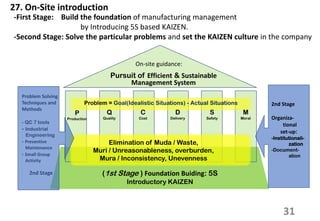
27. On-Site introduction
-First Stage: Build the foundation of manufacturing management
by Introducing 5S based KAIZEN.
-Second Stage: Solve the particular problems and set the KAIZEN culture in the company
(1st Stage ) Foundation Buiding: 5S
Introductory KAIZEN
Pursuit of Efficient & Sustainable
Management System
Elimination of Muda / Waste,
Muri / Unreasonableness, overburden,
Mura / Inconsistency, Unevenness
Problem Solving
Techniques and
Methods
- QC 7 tools
- Industrial
Engineering
- Preventive
Maintenance
- Small Group
Activity
2nd Stage
2nd Stage
Organiza-
tional
set-up:
-Institutionali-
zation
-Document-
ation
P
Production
Q
Quality
C
Cost
D
Delivery
S
Safety
M
Moral
On-site guidance:
32
0.00
1.00
2.00
3.00
4.00
5.00
I
II
III
IV
V
Average
Highest
Lowest
28. Evaluation of KAIZEN Master Trainer
Average Highest Lowest
I 3.34 4 3
II 3.70 5 1.5
III 3.50 5 1.5
IV 3.66 5 2
V 3.50 5 1.5
I II III IV V Avg
3.0 4.0 3.5 4.0 4.0 18.5 B
3.0 2.8 2.8 2.8 3.0 14.3 B
3.0 3.0 2.8 3.3 2.5 14.5 B
3.5 4.3 4.0 4.5 4.0 20.3 A
3.0 3.5 3.0 3.3 3.0 15.8 B
3.8 3.8 4.0 3.8 3.5 18.8 B
4.0 5.0 5.0 5.0 5.0 24.0 A
3.0 3.0 3.0 3.0 2.8 14.8 B
3.5 4.3 4.3 4.5 4.8 21.3 A
3.8 5.0 4.5 5.0 5.0 23.3 A
3.0 3.5 3.0 3.0 2.5 15.0 B
3.0 3.3 3.5 3.3 3.0 16.0 B
4.3 4.3 4.0 4.0 4.3 20.8 A
3.0 2.3 1.8 2.0 1.8 10.8 C
3.3 3.7 3.5 3.7 3.5 17.7
33
Ability Level Mark Explanation
I-A 5
Understand KAIZEN very well and able to guide others to use tools and methods of
KAIZEN.
I-B 3 Understand KAIZEN and able to use KAIZEN tools by oneself.
I-C 1 Understand basic KAIZEN but not able to use tools such as QC 7 tools well enough.
II-A 5
Able to make the presentation suitable for target audience and to convince them to
take actions by themselves.
II-B 3 Able to present the materials interactively and always check audience understanding.
II-C 1
Able to make the presentation with available materials but fail to have audience
understand fully.
III-A 5 Analyze gathered data and draw conclusion from analysis.
III-B 3 Ask many questions and collect necessary data to comprehend the situation.
III-C 1 Ask just a few or minimum questions. Do not collect related data of the situation.
Ⅳ-A 5 Draw workers' opinions and guide them to initiate actions.
Ⅳ-B 3
Convince workers to implement action items and verify them one by one at genba
with a KAIZEN leader.
Ⅳ-C 1 Just explain what to do without checking or encouraging them to take actions.
Ⅴ-A 5
Guide the company according to priority and make detail plan. Take a systematic
approach.
Ⅴ-B 3
Prepare all necessary items and inform the company in advance. Able to make a
plan suitable for the company.
Ⅴ-C 1 Do not prepare enough and make just a general plan (same as one in textbook).
Total points
IV Guidance
Ⅴ
Planning and
Implementation
I Understanding
II Presentation
III Information gathering

(Revised)Overall Outlook-Kaizen -2023.pdf

  • 1.
    1 KAIZEN –its OverallOutlook: LEARNING its SUCCESSES & FAILURES Noriyuki Murata, RIIM Chu-San-Ren 1. Kaizen enhances discipline 2, 2. POSITIVE involvement to Challenges vs. PASSIVITY, impeding IDEA CREATION 3, 3. Which side is your “mindset” facing, assume responsibility or try avoiding one? 4, 4. Winners & Losers in performing KAIZEN? 4, 5. Discussion with H.H. Dalai Lama 6, 6. What we are used to speak about in Japan’s “Kaizen” operations! 7, 7. What is a “Problem”? 9, 8. General Framework of KAIZEN Implementation 10, 9. Quality Circle differs from other Concepts - How ? 11, 10. KAIZEN eradicates misplacement of given items 12, 11. KAIZEN saves Searching Time 13, 12. Human Errors 14, 13. Why do people make mistakes? 15, 14. Approaches to Creating a KAIZEN Culture in Our Organization 16, 15. What type is your organization? 17, 16. KAIZEN makes Our Work easier! 18-20, 17. The Company’s Culture at work! 21, 18. Conditions for successful cultural change 22, 19. DOMAINS & CAPABILITIES of EMOTIONAL INTELLIGENCE 23, 20. Domain of Personal Competence 24, 21. Domain of Social Competence 25, 22. Self-Directed Learning 26-28, 25. KAIZEN -challenge your status quo 29, 26. INDUCTION, DEDUC-TION, & HYPOTHESIZING 30, 27. On-Site Introduction 31, 28. Evaluation of KAIZEN Master Trainer 32.
  • 2.
    2 KAIZEN is asystem that involves every employee – from upper management to junior staff. Everyone is encouraged to make improvement (KAIZEN) on regular basis. 1. KAIZEN Enhances Discipline
  • 3.
    3 2. Positive involvementto Challenges vs. Passivity, impeding Idea Creation Positive involvement to Challenges -Being faced up with troubling issues, come down deep into a true cause of their symp- toms in the ANALYSES. -Considerate thinking to get nearer to a final objective may naturally necessitate our con- cerns on end results of medium-, of long-term projections. The less immediate effect we attempt to see, the less likely we overlook any serious ending. -Define the issues/problems for the light they throw on any effective scheme that has a command into future IDEALS. This may minimize the failure of overlooking an accompanying drastic result. -Start thinking from desirable outcome, for choosing necessary ways/means. This may preempt our conception of ideas readily into the future. -Determine beforehand your point of destination way ahead to arrive at! This diminishes unnecessary aggravation of any severe result. -Set an angle of your eyes diverging far into IDEALS, instead of converging around the current status. This enables the possible clarification on what is desirably required. Passivity, impeding IDEA CREATION -With no action being taken, effective to the cause of problems, the symptoms are merely neglected. -Tempted more by behaviors to “Dislikes, Hate, Antagonism”, rather than “Loving, Desirable Emotions” - Setting no aspiring, ambitious objectives included at all, with only withdrawing nature of target focuses. -Although difficulties being conquered successfully, the attempt is threatened to an unanticipated disaster. -Being pulled ahead into unknown future with your back facing the past: this is receding from the current point, opposite to plunging into a challenge of future. -It promises to get out of given constraints, yet they are nothing but what you bind yourself by. -Attempts only to remove, to contain, or to break up the dissatisfied, undesirable current conditions.
  • 4.
    4 3. Which sideis your “mindset” facing, assume responsibility or try avoiding one? How will it be possible to make our people being altruistic seems to be a key for the successful introduction, and for continuing the operation of Kaizen? When a superior you report to is not a person of good leadership, the question be whether you start complaining about how much you are unhappy, or learning his weaknesses, so that you’ll prove showing up a capable leader yourself. It may so happen sometimes that you may have not grown matured enough, simply because currently you report to your boss, who happens performing a perfect leadership! In other words, do you readily work with your responsibility you are not given to work on, or you won‘t take responsibility on what you are not obligated to work! 4. Winners and Losers in performing KAIZEN 1. The winner is always part of the answer. The loser is always part of the problem. 2. The winner has always a program; the loser has always an excuse. 3. The winner says, “let me do it for you”; the loser says, “that is not my job”. 4. The winner sees a response for each problem; the loser sees a problem for each response.
  • 5.
    5 5. The winnersays, “it may be difficult, but it is possible”, the loser says, “it may be possible, but it is too difficult”. 6. When a winner makes a mistake, he/she says, “I was wrong”; when a loser makes a mistake, he/she says, “It wasn’t my fault”. 7. The winner says, “I must do something”; the loser says, “something must be done”. 8. The winner is part of the team; the loser is outside. 9. The winners organize, prepare themselves to win, the key word is preparation; the losers don’t participate in the preparation. 10. Winners see possibilities, potential; losers see problems and the Past. 11. Winners believe win/win; losers believe for them to win; some must lose. 12. Winners use hard arguments, but soft words; losers use soft arguments but hard words. 13. Winners make it happen; losers let it happen. 14. The winner knows that “Time is money”; the loser wastes time, losing the “Money”. 15. The winner moves his/her hands and feet to achieve results; the loser stays in an air-conditioned room and ask for results.
  • 6.
    6 16. The winnerpractices SORT and SET, in order not to waste time looking for things, the loser does not look for time to practice SORT and SET and wastes time. 17. The winner uses existing materials to improve the situation; the loser always looks for nonexistent materials. 18. The winner asks how to fish; the loser asks for fish. 19. The winner says, “since there is no space, I practice 5S”; the loser says, “I can’t practice 5S, because there is no space”. <Catch Words on “Kaizen”, TANESCO, 2016, Tanzania> 5. Discussion of H.H. Dalai Lama with Dr. Howard C. Cutler The author of “The Art of Happiness”, Dr. Howard C. Cutler, a psychiatrist, asked His Holiness the Dalai Lama, ‘Can you more clearly define what you mean by “compassion” ?’ The Dalai Lama replied, ‘It is a mental attitude based on the wish for others to be free of their suffering, and is associated with a sense of commitment, responsibility, and respect towards others. … In developing compassion, perhaps one could begin with the wish that oneself be free of suffering and take that natural feeling toward oneself & cultivate it, enhance it, extend it out to include & embrace others.’’
  • 7.
    7 Many studies supportthe idea that altruism and compassion development in one’s behaviors has a positive impact of on physical and emotional health. It has been proven in the experiments that immunoglobulin-A, an antibody that helps fight respiratory infections, found increased in the saliva of students who have seen a film of Mother Teresa, working for a group of sick & poor in Calcutta. In addition to beneficial effects on one’s physical health, there is evidence that compassion & caring behavior contributes to good emotional health. In a 30-year study of a group of Harvard graduates, researcher George Vaillant concluded that adopting an altruistic lifestyle is a critical component of good mental heath. Excerpted from “The Art of Happiness”, 1998, HH Dalai Lama & Howard C. Cutler 6. What we are used to speak about in Japan’s “Kaizen” operations! 1. Start your action in your own proposition, outgrowing the stage of dependence on others. 2. Capture a moment of truth, for analysis to scan the status quo. 3. Give life to an idea of “incongruity”.
  • 8.
    8 4. Go intoaction with the consideration, 180 degrees opposite to the current state. 5. Get going, whatever conceived in mind. 6. Conform to authenticity, in no deviation from the set principles. 7. In building culture in organization, create structural settings. 8. Problems be resolved, with the status quo scrutinized into processes. 9. Let the consequences well accounted for, when responsibility is fulfilled. 10. People grow into different mindsets, as their behaviors undergo the required changes.
  • 9.
    9 7. What isa Problem?
  • 10.
    10 8. General Frameworkof KAIZEN Implementation Implementing Countermeasures Result Analysis Standardization Problem Identification Brainstormin g On-site Observations Documentat ion review 1 6 5 4 2 “Fishbone” Analysis “5 Why” Analysis Pareto Analysis Cause Analysis 3 7 Counting Measuring Problem Measurement Sketching Recording Formulating Countermeasures Brainstorming KAIZEN Proposals
  • 11.
    11 9. Quality Circlediffers from other Concepts - How ? a. Everybody participates, contributes in the process of decision-making b. Problems are chosen, not given c. Decision by consensus, not by majority d. Performance-oriented, not problem-oriented e. Bottom-up approach f. Management-blessed, not management-directed g. Members are responsible, from the identification of a problem, over to implementation of the solution i.e. for the total performance h. Aims at the quality of work life, for its higher level achievement i. Does not replace or substitute any of the on-going systems or structure
  • 12.
    12 10. KAIZEN eradicatesmisplacement of given items
  • 13.
    13 Before KAIZEN AfterKAIZEN 11. KAIZEN saves Searching Time
  • 14.
    14 12. Human Errors •Omission, • Placement of wrong order, • Incorrect selection, counting, • Failure to have sensed a danger, • Incorrect holding, positioning, orientation, motion, • Improper holding, • Insufficient avoidance, • Wrong timing
  • 15.
    15 13. Why dopeople make mistakes? Cause Example Forgetful, Locking keys left inside a car Carelessness, Driving a car into a crossing during red signal Misunderstanding, Braking an automobile instead of clutch while driving automatic car On purpose, Violation: Crossing a road while red signal on purpose Lack of skills or experience (novice), Wrong setting of a machine Selfishness, Can you give examples? Malfunction, Can you give examples?
  • 16.
    16 Basic types ofworkplaces 14. Approaches to Creating a KAIZEN Culture in Our Organisation
  • 17.
    17 15. What typeis your organization?
  • 18.
    18 Before KAIZEN AfterKAIZEN 16. KAIZEN makes Our Work easier!
  • 19.
  • 20.
  • 21.
    17. The Company’sCulture at work! On 9/11, when the planes hit the world Trade Center, the CEO of a big U.S. technology company was on a plane to Asia. When she heard the news upon landing, she immediately tried to get in touch with her office in California, but thanks to the jammed phone lines & the sixteen-hour time difference, it was several hours before she could get through to her senior team. When she did get them on a conference call, she laid out three immediate priorities for them: 1 Immediately account for every employee & ensure they are all safe, 2. Ensure that the company’s Web site & servers – the core of their business – are secure, 3. Begin organizing a charity auction in order to support victims and their families, Culture is what your people do when no one is looking. After a brief silence on the other end of the line, someone in the conference room informed the CEO that the three priorities had not only been identified, the first two had already been completed & the third was well on its way. (“Too Many Bosses, Too Few Leaders” Rajeev Peshawaria, 2011) 21
  • 22.
    22 18. Conditions forsuccessful cultural change 1 Clear & well-articulated reasons for changing, 2. Clear & well-articulated principles, 3. Alignment of such matters as language, policies, practices, processes & the physical environment, 4. Overt leadership commitment through deeds, words, to the desired/required “way we do things here”, 5. A recognition of what degree of change is possible, given the constraints of history, legacy, the business model, resources, etc., 6. Acceptance that planned culture change takes years rather than months, and that culture is in any case changing all the time, irrespective of any plans to change it. (“Organisation Culture Getting it right” Naomi Stanford, 2010)
  • 23.
    19. DOMAINS &CAPABILITIES of EMOTIONAL INTELLIGENCE Personal & Social Competence (Primal Leadership D. Goleman, R. Boyatzis 2013) 23 CAPABILITIES of SOCIAL AWARENESS: 10. Empathy 11. Organizational Awareness 12. Service -CAPABILITIES of RELATIONSHIP MANAGEMENT: 13. Inspirational leadership 14. Influence 15. Developing others 16. Change catalyst 17. Conflict management 18. Teamwork & collaboration 𝝱- Domain of SOCIAL COMPETENCE <- How do you manage RELATIONSHIPS?> -Capabilities of SELF- MANAGEMENT: 4. Emotional Self-Control 5. Transparency 6. Adaptability 7. Achievement 8. Initiative 9. Optimism 𝝰- Domain of PERSONAL COMPETENCE <- How do you manage YOURSELF?> -Capabilities of SELF- AWARENESS: 1. Emotional Self- Awareness 2. Accurate Self- Assessment 3. Self- Confidence < 𝝰- Personal & 𝝱- Social Competence >
  • 24.
    24 20. Domain ofPersonal Competence: 𝝰. How do you Manage yourself? -CAPABILITIES of Self-Awareness 1. – 3. & of Self-Management 4. – 9. : -Capabilities of Self- Awareness: 1. Emotional Self- Awareness Read one’s own emotions, recognize their impact to guide decision by “gut sense”. Being candid & authentic with conviction about guiding vision. 2. Accurate Self-Assessment Know one’s limitations in cultivating leadership strengths, being graceful in learning where necessary to improve. Welcome constructive criticism & feedback, knowing where to focus, when to ask for help, exhibiting a sense of humor about themselves. 3. Self-Confidence Carry a sense of presence, a self-assurance that lets them stand out in a group, welcoming a difficult assignment. -Capabilities of Self-Management: 4. Emotional Self-Control Find ways to manage disturbing emotions & impulses. Capable to stay calm & clear headed under high stress or during a crisis, remaining unflappable when confronted by a trying situation. 5. Transparency Openly admit mistakes or faults, confronting unethical behavior in others rather than turn a blind eye. 6. Adaptability Flexible in adapting to new challenges, nimble in adjusting to fluid change, & limber in their thinking in the face of new data or realities. 7. Achievement Pragmatic in setting goals measurable, but challenging, being able to calculate risk so that their goals are worthy but attainable. 8. Initiative Seize opportunities –or create them – rather than simply waiting. Never hesitate to cut through red tape, or even bend the rules, when necessary to create better possibilities for the future. 9. Optimism See an opportunity rather than a threat in a setback, expecting the best of them, rolling with the punches,. And their “glass half-full” outlook leads them to expect that
  • 25.
    25 -CAPABILITIES of Relationship Management: 13.Inspirational leadership Articulate a shared mission, in a way that inspires others to follow. Creates resonance & move people with a compelling vision or shared mission. 14. Influence Be persuasive, & engaging when addressing a group, wielding a range of tactics for persuasion. Mindful to build buy-in from key people & a network of support for an initiative. 15. Developing others Adept at cultivating people’s abilities, understanding their goals, strengths, & weaknesses. Give timely & constructive feedback, being natural mentors or coaches. 16. Change catalyst Challenge the status quo, champion the new order, recognizing the need for the change. Advocate change even in the face of opposition, making the argument for it compellingly. 17. Conflict management Acknowledge the feelings & views of all sides, & then redirect the energy toward a shared ideal, resolving disagreements. 18. Teamwork & collaboration Draw others into commitment, active, enthusiastic to the collective efforts, & build spirit & identity. Spend time, forging & cementing close relationships beyond mere work obligations. -CAPABILITIES of Social Awareness 10. Empathy Let people sense the emotions felt, unspoken in a person or group, attuning to a wide range of emotional signals. Get along well with people of diverse backgrounds or from other cultures. 11. Organizational awareness Able to detect crucial social networks, reading key power relationships. Understand the guiding values & unspoken rules that operate among people. 12. Service Recognize, meet the needs of follower, client, or customer, & foster an emotional climate, monitoring customer/ client satisfaction carefully to ensure they are getting what they need. 21. Domain of Social Competence: 𝝱. How do you Manage Relationships ? -CAPABILITIES of Social Awareness 10. – 12. & of Relationship Management 13. – 18. :
  • 26.
    26 My GAPS: Where My IDEAL andREAL SELF differ! My STRENGTHS: Where My IDEAL and REAL SELF OVERLAP? Who do I want to be?. 1. My IDEAL Self: 3. My learning AGENDA: Building on My STRENGTH while reducing GAPS! Who am I? 2. My REAL Self: 22 Self-Directed Learning
  • 27.
    27 4.Experimenting with new Behavior, Thought, and Feelings? My GAPS: Where MyIDEAL and REAL SELF differ! My STRENGTHS: Where My IDEAL and REAL SELF OVERLAP? Who do I want to be?. 1. My IDEAL Self: 3. My learning AGENDA: Building on My STRENGTH while reducing GAPS! Who am I? 2. My REAL Self: Practicing the new Behavior, Building new Neural Pathway through to MASTERY
  • 28.
    28 4.Experimenting with new Behavior, Thought, and Feelings? MyGAPS: Where My IDEAL and REAL SELF differ! My STRENGTHS: Where My IDEAL and REAL SELF OVERLAP? Who do I want to be? 1. My IDEAL Self 3. My learning AGENDA: Building on My STRENGTH while reducing GAPS! Who am I? 2. My REAL Self: Practicing the new Behavior, Building new Neural athway through to MASTERY (Richard Boyatzis’s THEORY of Self-Directed LEARNING 2013) 5. Developing Trusting Relationship that help, support, and encourage each step in the process
  • 29.
  • 30.
    26. INDUCTION, DEDUCTION,and HYPOTHESIZING Q.C. Applications by INDUCTION COUNTER- MEASURES formulation C DATA SCAN on CURRENT SITUATION A Factual Analysis for Problem Definition, Cause Detection B VISION Setting -DEDUCTION COUNTER- MEASURES formulation C VISION SETTING C’ SCAN CURRENT SITUATION A Cause Analysis, Problem Definition B TARGET VALUE Setting SCAN Current Situation for Factual Data A Hypothesis Building Cause Analysis, Problem Definition Hypothesize B COUNTER MEASURES Formulation C 30
  • 31.
    31 27. On-Site introduction -FirstStage: Build the foundation of manufacturing management by Introducing 5S based KAIZEN. -Second Stage: Solve the particular problems and set the KAIZEN culture in the company (1st Stage ) Foundation Buiding: 5S Introductory KAIZEN Pursuit of Efficient & Sustainable Management System Elimination of Muda / Waste, Muri / Unreasonableness, overburden, Mura / Inconsistency, Unevenness Problem Solving Techniques and Methods - QC 7 tools - Industrial Engineering - Preventive Maintenance - Small Group Activity 2nd Stage 2nd Stage Organiza- tional set-up: -Institutionali- zation -Document- ation P Production Q Quality C Cost D Delivery S Safety M Moral On-site guidance:
  • 32.
    32 0.00 1.00 2.00 3.00 4.00 5.00 I II III IV V Average Highest Lowest 28. Evaluation ofKAIZEN Master Trainer Average Highest Lowest I 3.34 4 3 II 3.70 5 1.5 III 3.50 5 1.5 IV 3.66 5 2 V 3.50 5 1.5 I II III IV V Avg 3.0 4.0 3.5 4.0 4.0 18.5 B 3.0 2.8 2.8 2.8 3.0 14.3 B 3.0 3.0 2.8 3.3 2.5 14.5 B 3.5 4.3 4.0 4.5 4.0 20.3 A 3.0 3.5 3.0 3.3 3.0 15.8 B 3.8 3.8 4.0 3.8 3.5 18.8 B 4.0 5.0 5.0 5.0 5.0 24.0 A 3.0 3.0 3.0 3.0 2.8 14.8 B 3.5 4.3 4.3 4.5 4.8 21.3 A 3.8 5.0 4.5 5.0 5.0 23.3 A 3.0 3.5 3.0 3.0 2.5 15.0 B 3.0 3.3 3.5 3.3 3.0 16.0 B 4.3 4.3 4.0 4.0 4.3 20.8 A 3.0 2.3 1.8 2.0 1.8 10.8 C 3.3 3.7 3.5 3.7 3.5 17.7
  • 33.
    33 Ability Level MarkExplanation I-A 5 Understand KAIZEN very well and able to guide others to use tools and methods of KAIZEN. I-B 3 Understand KAIZEN and able to use KAIZEN tools by oneself. I-C 1 Understand basic KAIZEN but not able to use tools such as QC 7 tools well enough. II-A 5 Able to make the presentation suitable for target audience and to convince them to take actions by themselves. II-B 3 Able to present the materials interactively and always check audience understanding. II-C 1 Able to make the presentation with available materials but fail to have audience understand fully. III-A 5 Analyze gathered data and draw conclusion from analysis. III-B 3 Ask many questions and collect necessary data to comprehend the situation. III-C 1 Ask just a few or minimum questions. Do not collect related data of the situation. Ⅳ-A 5 Draw workers' opinions and guide them to initiate actions. Ⅳ-B 3 Convince workers to implement action items and verify them one by one at genba with a KAIZEN leader. Ⅳ-C 1 Just explain what to do without checking or encouraging them to take actions. Ⅴ-A 5 Guide the company according to priority and make detail plan. Take a systematic approach. Ⅴ-B 3 Prepare all necessary items and inform the company in advance. Able to make a plan suitable for the company. Ⅴ-C 1 Do not prepare enough and make just a general plan (same as one in textbook). Total points IV Guidance Ⅴ Planning and Implementation I Understanding II Presentation III Information gathering