Review studies of new insulin products
(Degludec (Tresiba®,
Degludec/Aspart (Ryzodeg®
and Glargine (Basaglar®))
Prepared By: Sara Abudahab
Supervised By: Dr. Amal Okor
Department Of Clinical Pharmacy University Of Jordan
Table of contents
 Introduction
 Before Insulin
 Brief History of Insulin
 New insulin products
Introduction
 Newer insulin products have advanced the evolution of
insulin replacement options to more accurately mimic natural
insulin action.
 There are new, modified, and concentrated insulins;
administration devices calibrated for both increased
concentrations and administration accuracy to improve
adherence and safety.
Before Insulin
 For thousands of years, no one knew how to live with diabetes, let alone treat or
cure it. Children with diabetes often died within days of onset and older people
dealt with devastating complications.(1)
 In 1897, the average life expectancy for a 10-year-old child with diabetes is about 1
year. (1)
 A newly diagnosed 50-year-old might live 8 more years. (1)
JL on 12/15/22 and 2 mos later
History of Insulin
Purified animal-sourced insulin was the only type of insulin available to
diabetics until genetic advances occurred later with medical
research(2)
The first genetically engineered, synthetic "human" insulin was
produced using E. coli in 1978 by the Beckman Research Institute of
the City of Hope in collaboration with Herbert Boyer at Genentech.
Genentech, founded by Swanson, Boyer and Eli Lilly and Company,
went on in 1982 to sell the first commercially available biosynthetic
human insulin under the brand name Humulin.(3)
The vast majority of insulin currently used worldwide is now
biosynthetic recombinant "human" insulin or its analogues.
Insulin Today
Insulin types(4):
 Ultra short acting (Rapid): insulin lispro, insulin aspart, insulin glulisine
 Short acting: regular insulin
 Intermediate acting: insulin NPH
 Long acting: insulin glargine, ultralente insulin, insulin detemir
 Ultra-long acting: insulin degludec
New Insulin: Degludec
 On September 25, 2015, the US Food and Drug Administration (FDA)
approved 2 drugs to improve glycemic control in adults with diabetes
mellitus— insulin degludec injection (Tresiba; Novo Nordisk) and a
combination of insulin degludec plus insulin aspart (Ryzodeg 70/30;
Novo Nordisk)
 https://www.youtube.com/watch?v=5kyEOCPnxH4
U-100 FlexTouch
U-200 FlexTouch
Degludec Pharmacology – Kinetics
 T1/2 : 25 hours
 Glucose-lowering duration : > 42 hours (compared to 18 to
26 hours provided by other marketed long-acting insulins
such as insulin glargine and insulin detemir)
 Time to steady-state : 3 days of once-daily dosing
 Peak : peakless
Method(5)
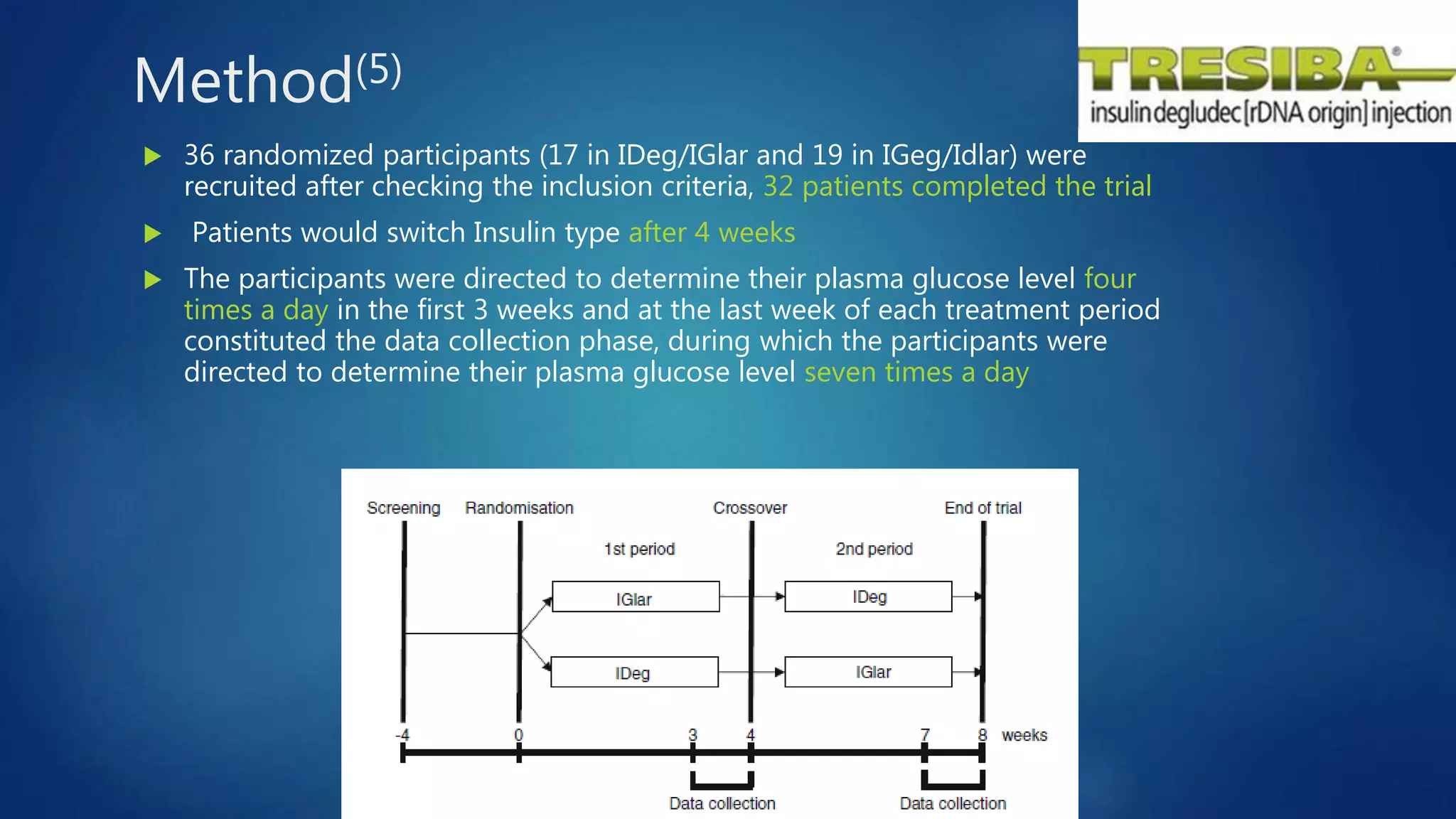
 36 randomized participants (17 in IDeg/IGlar and 19 in IGeg/Idlar) were
recruited after checking the inclusion criteria, 32 patients completed the trial
 Patients would switch Insulin type after 4 weeks
 The participants were directed to determine their plasma glucose level four
times a day in the first 3 weeks and at the last week of each treatment period
constituted the data collection phase, during which the participants were
directed to determine their plasma glucose level seven times a day
Results and conclusion(5)
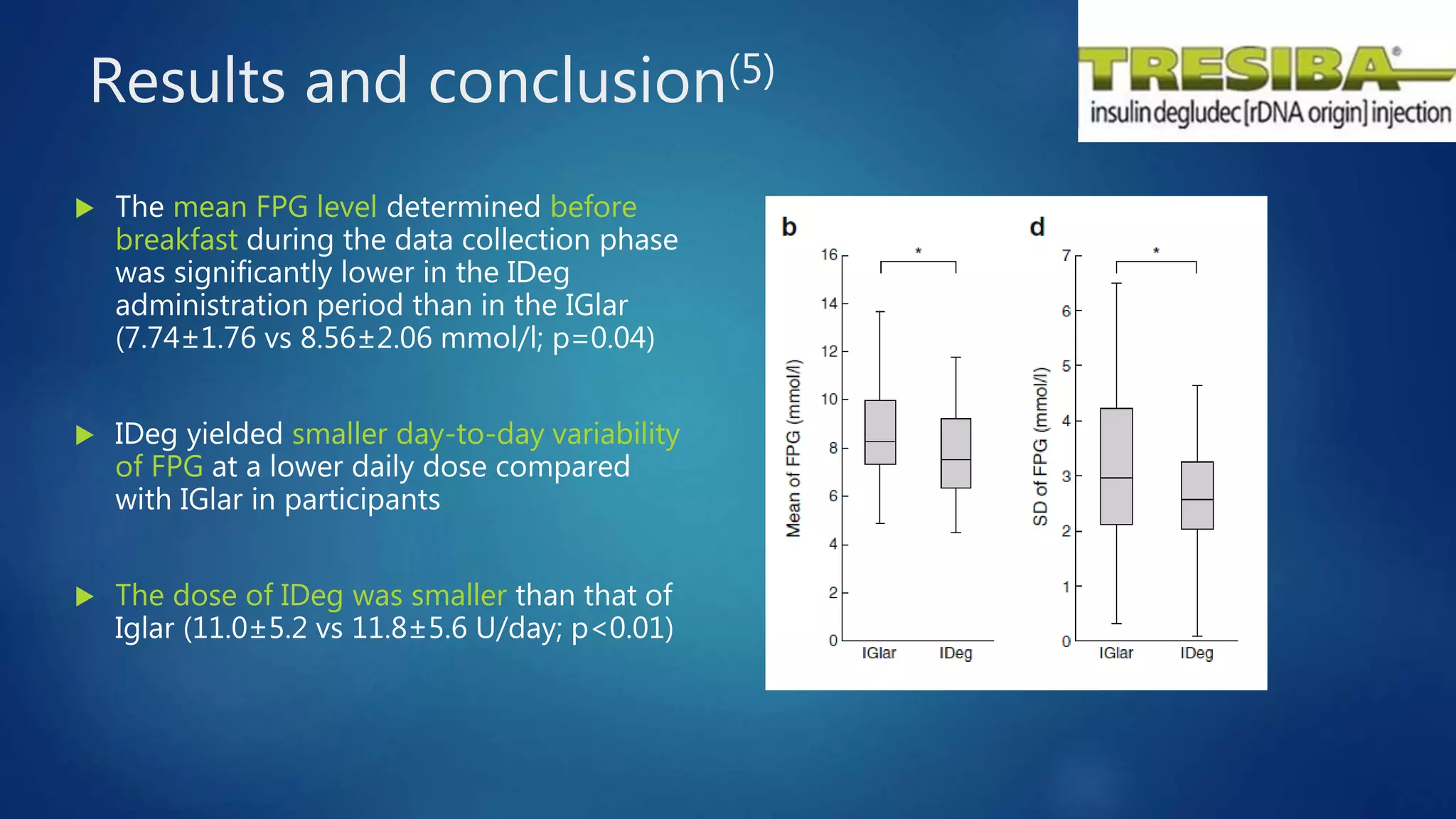
 The mean FPG level determined before
breakfast during the data collection phase
was significantly lower in the IDeg
administration period than in the IGlar
(7.74±1.76 vs 8.56±2.06 mmol/l; p=0.04)
 IDeg yielded smaller day-to-day variability
of FPG at a lower daily dose compared
with IGlar in participants
 The dose of IDeg was smaller than that of
Iglar (11.0±5.2 vs 11.8±5.6 U/day; p<0.01)
Degludec and Aspart
 70% IDeg and 30% IAsp
 IDeg exists as soluble and highly stable
dihexamers. Once injected into the
subcutaneous tissue, IAsp hexamers
immediately split into monomers that are
rapidly absorbed into the circulation, while
the IDeg dihexamers form soluble
multihexamers. These are of a molecular
size too large to be absorbed, leading to a
depot from which IDeg monomers are
slowly and continuously absorbed into the
circulation. (6)
Method(6)
 A subset of 112 insulin-naïve type 2 diabetes patients
from a randomized, parallel-group trial (IDegAsp versus
IGlar, each added to metformin)
 underwent 72 h continuous interstitial glucose (IG)
monitoring after 16 weeks of treatment.
 End points included:
 mean IG concentrations
 2 h postprandial IG increments and postprandial peak
 IG fluctuation (summed area above and below mean IG)
 within-subject coefficient of variation (day-to-day variation)
in mean nocturnal IG
 episodes of low (<3.5 mmol/liter) and high (>10 mmol/liter)
IG.
Results and conclusion (6)
 The postdinner IG increment observed with IGlar did not occur
with IDegAsp [IDegAsp - IGlar, -1.42 (-2.15, -0.70) mmol/liter].
 Nocturnal IG fluctuation was 21% lower with IDegAsp [IDegAsp/IGlar, 0.79 (0.66,
0.96) mmol/liter], with 48% fewer nocturnal high IG episodes [ratio IDegAsp/IGlar,
0.52 (0.32, 0.87)].
 IDegAsp given with the evening meal reduces postdinner glucose excursion and
provides more stable nocturnal glycemia as compared with IGlar.
No postdinner IG
increment with IDeg/IAsp
Nocturnal IG fluctuation
was 21% lower
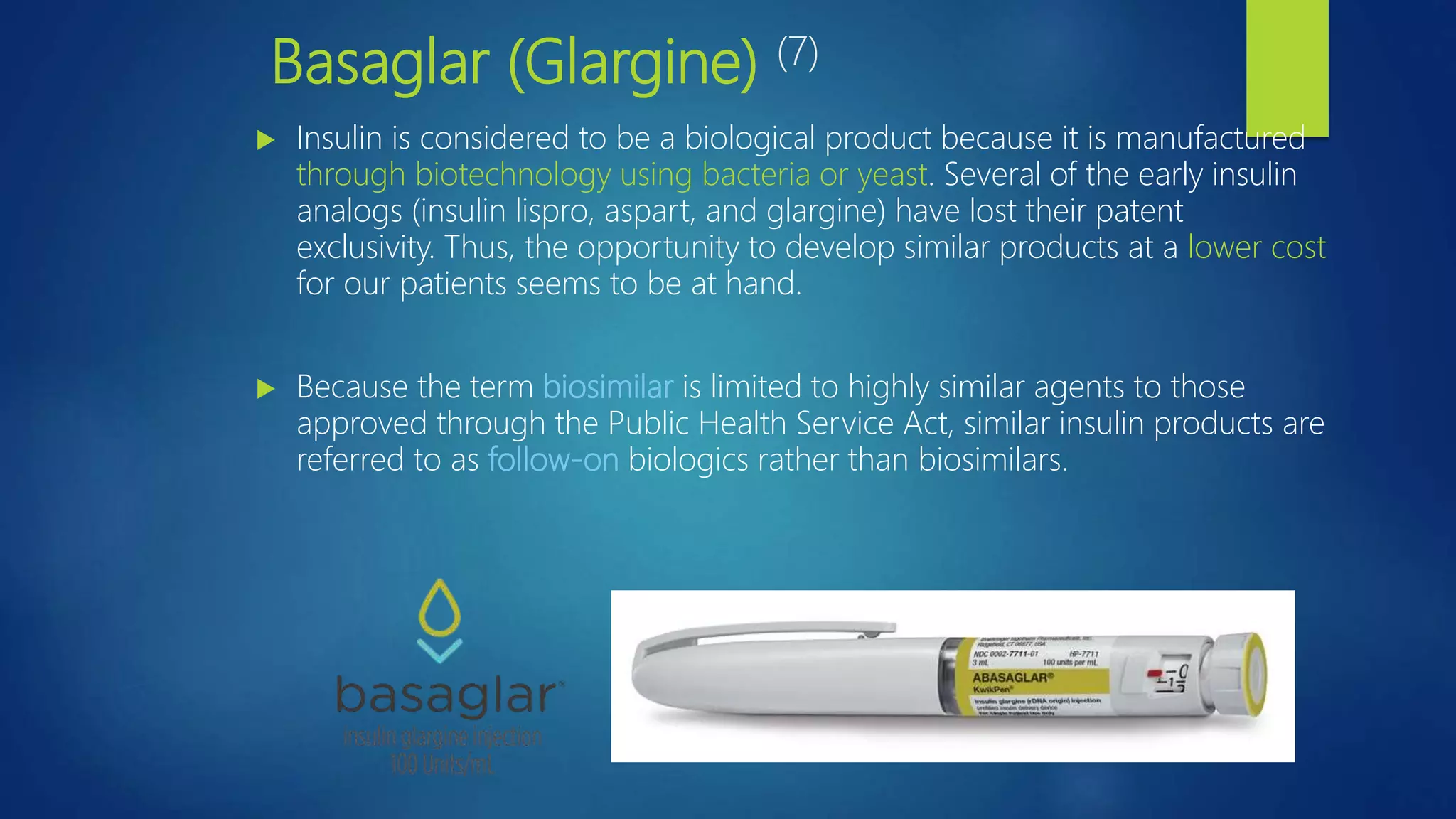
Basaglar (Glargine) (7)
 Insulin is considered to be a biological product because it is manufactured
through biotechnology using bacteria or yeast. Several of the early insulin
analogs (insulin lispro, aspart, and glargine) have lost their patent
exclusivity. Thus, the opportunity to develop similar products at a lower cost
for our patients seems to be at hand.
 Because the term biosimilar is limited to highly similar agents to those
approved through the Public Health Service Act, similar insulin products are
referred to as follow-on biologics rather than biosimilars.
Basaglar (Glargine) (7)
 The first follow-on biologic insulin was approved by the FDA in 2015 for insulin
glargine.
The preclinical pharmacokinetic/ pharmacodynamic studies were clamp studies were done in
small populations of healthy subjects and those with type 1 diabetes demonstrated
comparable effects with its reference product, glargine U-100 (Lantus). Two phase III
randomized trials compared Basaglar with glargine U-100 (Lantus). One study population had
type 1 diabetes and the other population had type 2 diabetes.
 Both insulin glargine products provided effective and comparable glucose control
with similar safety profiles.
 Owing to patent litigation agreements, Basaglar will not be available in the United
States until December of 2016. Basaglar can be dosed and adjusted similarly to its
reference product. It will only be available via a prefilled KwikPen.
References:
 (1) http://www.defeatdiabetes.org/diabetes-history/
 (2) Stretton AO (October 2002). "The first sequence. Fred Sanger and insulin". Genetics. 162 (2):
527–32.
 (3) Tof I (1994). "Recombinant DNA technology in the synthesis of human insulin". Little Tree
Publishing. Retrieved 2009-11-03.
 (4) Medscape.com
http://emedicine.medscape.com/article/2172166-overview
 (5) Diabetologia (2015) 58:2013–2019, DOI 10.1007/s00125-015-3648-y
 (6) Journal of Diabetes Science and Technology Volume 7, Issue 5, September 2013 © Diabetes
Technology Society pages (1328- 1336)
 (7) Endocrinol Metab Clin N Am 45 (2016) 845–874

Review studies of new insulin products

  • 1.
    Review studies ofnew insulin products (Degludec (Tresiba®, Degludec/Aspart (Ryzodeg® and Glargine (Basaglar®)) Prepared By: Sara Abudahab Supervised By: Dr. Amal Okor Department Of Clinical Pharmacy University Of Jordan
  • 2.
    Table of contents Introduction  Before Insulin  Brief History of Insulin  New insulin products
  • 3.
    Introduction  Newer insulinproducts have advanced the evolution of insulin replacement options to more accurately mimic natural insulin action.  There are new, modified, and concentrated insulins; administration devices calibrated for both increased concentrations and administration accuracy to improve adherence and safety.
  • 4.
    Before Insulin  Forthousands of years, no one knew how to live with diabetes, let alone treat or cure it. Children with diabetes often died within days of onset and older people dealt with devastating complications.(1)  In 1897, the average life expectancy for a 10-year-old child with diabetes is about 1 year. (1)  A newly diagnosed 50-year-old might live 8 more years. (1) JL on 12/15/22 and 2 mos later
  • 5.
    History of Insulin Purifiedanimal-sourced insulin was the only type of insulin available to diabetics until genetic advances occurred later with medical research(2) The first genetically engineered, synthetic "human" insulin was produced using E. coli in 1978 by the Beckman Research Institute of the City of Hope in collaboration with Herbert Boyer at Genentech. Genentech, founded by Swanson, Boyer and Eli Lilly and Company, went on in 1982 to sell the first commercially available biosynthetic human insulin under the brand name Humulin.(3) The vast majority of insulin currently used worldwide is now biosynthetic recombinant "human" insulin or its analogues.
  • 6.
    Insulin Today Insulin types(4): Ultra short acting (Rapid): insulin lispro, insulin aspart, insulin glulisine  Short acting: regular insulin  Intermediate acting: insulin NPH  Long acting: insulin glargine, ultralente insulin, insulin detemir  Ultra-long acting: insulin degludec
  • 7.
    New Insulin: Degludec On September 25, 2015, the US Food and Drug Administration (FDA) approved 2 drugs to improve glycemic control in adults with diabetes mellitus— insulin degludec injection (Tresiba; Novo Nordisk) and a combination of insulin degludec plus insulin aspart (Ryzodeg 70/30; Novo Nordisk)  https://www.youtube.com/watch?v=5kyEOCPnxH4 U-100 FlexTouch U-200 FlexTouch
  • 8.
    Degludec Pharmacology –Kinetics  T1/2 : 25 hours  Glucose-lowering duration : > 42 hours (compared to 18 to 26 hours provided by other marketed long-acting insulins such as insulin glargine and insulin detemir)  Time to steady-state : 3 days of once-daily dosing  Peak : peakless
  • 11.
    Method(5)  36 randomizedparticipants (17 in IDeg/IGlar and 19 in IGeg/Idlar) were recruited after checking the inclusion criteria, 32 patients completed the trial  Patients would switch Insulin type after 4 weeks  The participants were directed to determine their plasma glucose level four times a day in the first 3 weeks and at the last week of each treatment period constituted the data collection phase, during which the participants were directed to determine their plasma glucose level seven times a day
  • 12.
    Results and conclusion(5) The mean FPG level determined before breakfast during the data collection phase was significantly lower in the IDeg administration period than in the IGlar (7.74±1.76 vs 8.56±2.06 mmol/l; p=0.04)  IDeg yielded smaller day-to-day variability of FPG at a lower daily dose compared with IGlar in participants  The dose of IDeg was smaller than that of Iglar (11.0±5.2 vs 11.8±5.6 U/day; p<0.01)
  • 13.
    Degludec and Aspart 70% IDeg and 30% IAsp  IDeg exists as soluble and highly stable dihexamers. Once injected into the subcutaneous tissue, IAsp hexamers immediately split into monomers that are rapidly absorbed into the circulation, while the IDeg dihexamers form soluble multihexamers. These are of a molecular size too large to be absorbed, leading to a depot from which IDeg monomers are slowly and continuously absorbed into the circulation. (6)
  • 15.
    Method(6)  A subsetof 112 insulin-naïve type 2 diabetes patients from a randomized, parallel-group trial (IDegAsp versus IGlar, each added to metformin)  underwent 72 h continuous interstitial glucose (IG) monitoring after 16 weeks of treatment.  End points included:  mean IG concentrations  2 h postprandial IG increments and postprandial peak  IG fluctuation (summed area above and below mean IG)  within-subject coefficient of variation (day-to-day variation) in mean nocturnal IG  episodes of low (<3.5 mmol/liter) and high (>10 mmol/liter) IG.
  • 16.
    Results and conclusion(6)  The postdinner IG increment observed with IGlar did not occur with IDegAsp [IDegAsp - IGlar, -1.42 (-2.15, -0.70) mmol/liter].  Nocturnal IG fluctuation was 21% lower with IDegAsp [IDegAsp/IGlar, 0.79 (0.66, 0.96) mmol/liter], with 48% fewer nocturnal high IG episodes [ratio IDegAsp/IGlar, 0.52 (0.32, 0.87)].  IDegAsp given with the evening meal reduces postdinner glucose excursion and provides more stable nocturnal glycemia as compared with IGlar.
  • 17.
    No postdinner IG incrementwith IDeg/IAsp Nocturnal IG fluctuation was 21% lower
  • 18.
    Basaglar (Glargine) (7) Insulin is considered to be a biological product because it is manufactured through biotechnology using bacteria or yeast. Several of the early insulin analogs (insulin lispro, aspart, and glargine) have lost their patent exclusivity. Thus, the opportunity to develop similar products at a lower cost for our patients seems to be at hand.  Because the term biosimilar is limited to highly similar agents to those approved through the Public Health Service Act, similar insulin products are referred to as follow-on biologics rather than biosimilars.
  • 21.
    Basaglar (Glargine) (7) The first follow-on biologic insulin was approved by the FDA in 2015 for insulin glargine. The preclinical pharmacokinetic/ pharmacodynamic studies were clamp studies were done in small populations of healthy subjects and those with type 1 diabetes demonstrated comparable effects with its reference product, glargine U-100 (Lantus). Two phase III randomized trials compared Basaglar with glargine U-100 (Lantus). One study population had type 1 diabetes and the other population had type 2 diabetes.  Both insulin glargine products provided effective and comparable glucose control with similar safety profiles.  Owing to patent litigation agreements, Basaglar will not be available in the United States until December of 2016. Basaglar can be dosed and adjusted similarly to its reference product. It will only be available via a prefilled KwikPen.
  • 22.
    References:  (1) http://www.defeatdiabetes.org/diabetes-history/ (2) Stretton AO (October 2002). "The first sequence. Fred Sanger and insulin". Genetics. 162 (2): 527–32.  (3) Tof I (1994). "Recombinant DNA technology in the synthesis of human insulin". Little Tree Publishing. Retrieved 2009-11-03.  (4) Medscape.com http://emedicine.medscape.com/article/2172166-overview  (5) Diabetologia (2015) 58:2013–2019, DOI 10.1007/s00125-015-3648-y  (6) Journal of Diabetes Science and Technology Volume 7, Issue 5, September 2013 © Diabetes Technology Society pages (1328- 1336)  (7) Endocrinol Metab Clin N Am 45 (2016) 845–874