
Introduction
Obesity has emerged as a pervasive public health problem among the
world's children and adolescents that is increasing at an alarming rate.
In 2008, an estimated 170 million children aged less than 18 years were
found to be overweight or obese, and it has been projected that about
30% of all children will be affected by this prominent nutritional and
metabolic disorder by the year 2030.
The disorder represents fat accumulation in adipocytes following an excess
calorie intake through consumption of food that exceeds the body's
metabolic requirements for growth, development and physical activities.
An individual is considered obese if he or she becomes excessively
overweight with high level of accumulated fat in the body.
Body Mass Index (BMI), defined as weight in kg/(height in meter)2 is by far
the most commonly used measure of obesity.
Although BMI calculations are done the same way for children and adults, the
criteria for interpreting the BMI number is different for children and
adolescents from the criteria used for adults.
Unlike adults, BMI is interpreted through categories that take into account sex
and age in the case of children and adolescents.
This is based on the premise that the amount of body fat differs between
boys and girls and changes with age.
Obesity in early life is crucial as it often leads to increased morbidity and
mortality during young adulthood and posesincreased risk of being obese in
adulthood.
For instance,obesity has been associated with a number of chronic disorders
including hyperlipidaemia, hypertension, cardiovascular disease, metabolic
syndrome, glucose intolerance and kidney disorders in early childhood.
Obesity led type 2 diabetes mellitus has been shown to increase dramatically
among children over the last two decades. Obese children are also at
increased risk of suffering from several psychological problems including
depression. The economic implications of childhood obesity and its huge
burden on health systems have been reported.
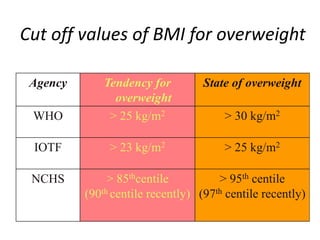
Cut off values of BMI for overweight
Agency Tendency for
overweight
State of overweight
WHO > 25 kg/m2 > 30 kg/m2
IOTF > 23 kg/m2 > 25 kg/m2
NCHS > 85thcentile
(90th centile recently)
> 95th centile
(97th centile recently)
Although global recognition about the health hazards of obesity in childhood
and adolescence is relatively recent, ithas been well established as a public
health problem in economically developed countries.
While the problem was restricted to the developed countries of the world
until recently, the situation has changed drastically in recent years with
studies reporting a pronounced increase in obesity prevalence among
children and adolescents in developing countries over the past few decades.
A recent well conducted systematic analysis of global, regional,and national
prevalence of overweight and obesity reported an increase in prevalence
rates among children and adolescents in developing countries, from 8.1% to
12.9% among boys and from 8.4% to 13.4% among girls during 1980-2013.
Although childhood obesity prevalence is comparatively higher in developed
countries, larger numbers of obese children tend to reside in low and
middle income regions of the world due to the demographic profiles of
their populations.
While countries in the South Asian region e Bangladesh, India, Pakistan, Nepal,
Maldives, Bhutan and Sri Lanka e are predominantly economically
underprivileged, an increasing trend in the prevalence of childhood obesity has
been observed in recent years in countries where data are available.
For example, prevalence of childhood obesity (5-19 yrs)increased from 9.8% to
11.7% between 2006 and 2009 in India,22 and it almost doubled among school
children (5-14 yrs) in Pakistan between 1994 and 2005.This increasing trend of
obesity prevalence among the South Asian children is beyond expectation as a
vast majority of childrenare reported to be undernourished.
The problem of obesity remain largely unrecognized in the region, and it would
seem that the individual studies do not provide sufficient evidence on their
own to warrant appropriate action.
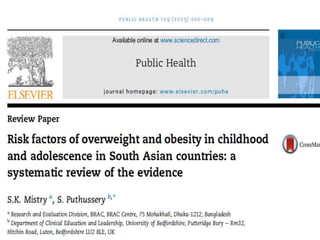
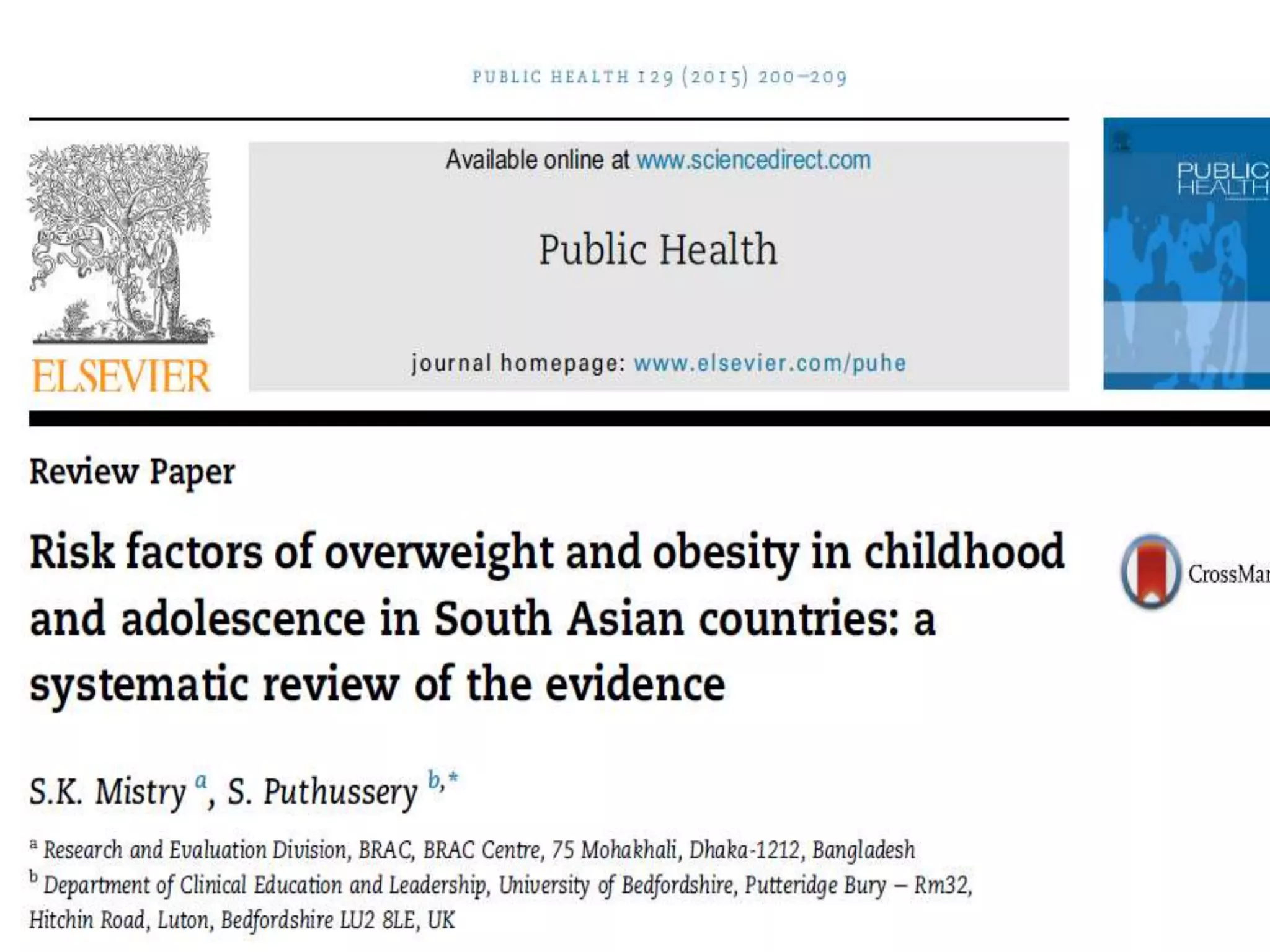
This review aims to systematically synthesize the published literature on
factors associated with overweight and obesity among children
and adolescents in South Asian countries to inform policy,
practice and future research.
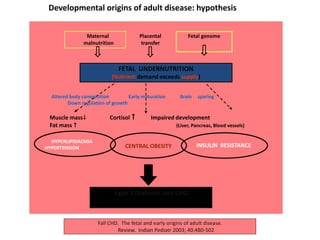
Barker’s Hypothesis FOAD 1986
• Fetal origins of adult-onset diseases (FOAD)
• Under nutrition and unfavorable intrauterine
environment at critical periods in early life can cause
permanent changes (in both structure and function)
in developing systems of the fetus (i.e.
programming).
• May manifest as disease over a period of time due to
`dysadaptation’ with changed environmental
circumstances
Barker DJP. Mothers, babies and health in later life. Edinburgh: Churchill Livingstone, 1998.
Maternal
malnutrition
FETAL UNDERNUTRITION
(Nutrient demand exceeds supply)
HYPERLIPIDAEMIA
HYPERTENSION CENTRAL OBESITY INSULIN RESISTANCE
Type 2 Diabetes and CHD
Muscle mass Cortisol  Impaired development
Fat mass  (Liver, Pancreas, Blood vessels)
Placental
transfer
Fetal genome
Altered body composition Early maturation Brain sparing
Down regulation of growth
Fall CHD. The fetal and early origins of adult disease.
Review. Indian Pediatr 2003; 40:480-502
Developmental origins of adult disease: hypothesis
Methods
A systematic review design was employed to identify, appraise and
summarize the existing evidence on factors associated with overweight and
obesity among children and adolescents for this study.
This design was considered to be advantageous as systematic reviews allow
the systematic collation and appraisal of existing evidence to generate
unbiased, accurate and reliable information.
The overall review question was framed using Population, Intervention
(exposures), Comparator, Outcome and Study design (PICOS) framework.The
population comprised of children and adolescents aged 0-18 years in South
Asian countries i.e., India, Bangladesh, Pakistan, Bhutan, Nepal, Maldives,
Afghanistan and Sri Lanka.
The primary outcome measure was overweight and obesity measured using
Body Mass Index (BMI). The study design included quantitative and
qualitative primary studies.
Data sources
A range of electronic data bases were used to locate primary studies published
between January 1990 and June 2013 from India, Pakistan, Nepal, Bangladesh,
Sri Lanka, Bhutan and The Maldives.
Searched databases included: PubMed, PubMed central, EMBASE, MEDLINE,
BioMed central, Directory of Open Access Journals (DOAJ) and the electronic
libraries of the authors‘ institutions.
Additionally a number of other specialist databases were searched, including
the Cochrane Database of Systematic Reviews, and other online resources to
identify potentially eligible primary reports, reviewarticles, and reports that
might contain relevant citations. Bibliographies of full text articles
were also inspected to find any additional relevant studies
Study selection
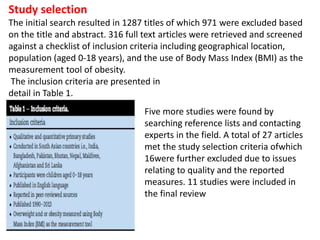
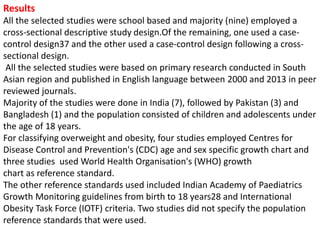
The initial search resulted in 1287 titles of which 971 were excluded based
on the title and abstract. 316 full text articles were retrieved and screened
against a checklist of inclusion criteria including geographical location,
population (aged 0-18 years), and the use of Body Mass Index (BMI) as the
measurement tool of obesity.
The inclusion criteria are presented in
detail in Table 1.
.
Five more studies were found by
searching reference lists and contacting
experts in the field. A total of 27 articles
met the study selection criteria ofwhich
16were further excluded due to issues
relating to quality and the reported
measures. 11 studies were included in
the final review
The selected studies were critically appraised for their methodological
quality using a modified Quality Assessment Tool, devised by the Effective
Public Health Practice Project (EPHPP).27 Studies were graded against four
methodological quality criteria:
•sample representativeness;
•study design and
•appropriateness of the outcomemeasure;
• aspects of data collection; data analysis and
•interpretation.
The search and selection process are illustrated in Fig. 1..
Results
All the selected studies were school based and majority (nine) employed a
cross-sectional descriptive study design.Of the remaining, one used a case-
control design37 and the other used a case-control design following a cross-
sectional design.
All the selected studies were based on primary research conducted in South
Asian region and published in English language between 2000 and 2013 in peer
reviewed journals.
Majority of the studies were done in India (7), followed by Pakistan (3) and
Bangladesh (1) and the population consisted of children and adolescents under
the age of 18 years.
For classifying overweight and obesity, four studies employed Centres for
Disease Control and Prevention's (CDC) age and sex specific growth chart and
three studies used World Health Organisation's (WHO) growth
chart as reference standard.
The other reference standards used included Indian Academy of Paediatrics
Growth Monitoring guidelines from birth to 18 years28 and International
Obesity Task Force (IOTF) criteria. Two studies did not specify the population
reference standards that were used.
Prevalence of overweight and obesity
Prevalence of overweight and obesity showed wide variations among the
included studies. Overall, prevalence of overweight ranged from 3.1% to
19.7% .
Obesity ranged between 1.2% to 14.5%. Prevalence rates for overweight
were higher than that of obesity in more than half of the
studies.
Two studies reported higher prevalence of obesity compared to overweight.
Although overweight and obesity prevalence were relatively higher among
boys compared to that of girls in many studies the difference was mostly
statistically insignificant.
Risk factors of overweight and obesity
Lack of physical activity
Eight studies examined the association between lack of physical activities and
overweight/obesity in childhood and adolescence, of which six reported a
significant positive association .
The duration of activities ranged from less than 2 hours/week32 to
less than 30 minutes/day. Although, two studies found no significant positive
correlation between physical activities and overweight/obesity, one study
found activities at home such as regular exercise for 30 minutes/day as a
protective factor against overweight/obesity.
The same study also noted a positive association between engaging in
sedentary activities for more than 4 hours/day and overweight/obesity
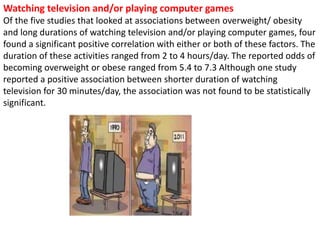
Watching television and/or playing computer games
Of the five studies that looked at associations between overweight/ obesity
and long durations of watching television and/or playing computer games, four
found a significant positive correlation with either or both of these factors. The
duration of these activities ranged from 2 to 4 hours/day. The reported odds of
becoming overweight or obese ranged from 5.4 to 7.3 Although one study
reported a positive association between shorter duration of watching
television for 30 minutes/day, the association was not found to be statistically
significant.
Dietary intake pattern
The association between dietary habits and overweight/ obesity was
assessed in five studies of which two found significant associations
between frequent consumption of calorie dense food items and
overweight and obesity.
Although another study found associations between high calorie intake
and higher prevalence of childhood obesity, relationship was statistically
insignificant.
All the four studies that examined association between frequent
consumption of fast food/junk food and the risk of overweight and
obesity found a significant positive correlation.
Mixed dietary pattern, involving high meat consumption, was examined
as a risk factors for overweight/obesity in three Studies but none found a
significant positive correlation.
Family history of obesity
Four studies examined family history of obesity as a risk factor of which
three found a significant positive association with overweight/obesity.
Participants with at least one overweight parent were nearly three times
more likely to become overweight or obese compared to those who had
none, and obese children were nearly 50 times more likely to
have a family history of obesity
Socio-economic status (SES)
Association between SES and overweight and obesity was evaluated in six
studies, of which four reported a significant positive association between
higher SES and overweight/ obesity.In general, different SES measures were
used such as the Kuppuswamy classification, place of residence
(urban/rural),monthly school fee, parent's education and occupation, wealth
tertile using sociodemographic status, socio-economic stratification,maternal
education and monthly family expenditure.
One study reported that children and adolescents with higher SES and urban
residence were 18 times more likely to become overweight or obese compared
to those with low SES and rural residence.
Although positive correlations between higher SES and increased prevalence of
overweight and obesity was reported in the remaining two studies, they failed
to establish the significance of the association.
Discussion
The present review was undertaken to synthesize the evidence on key
determinants of overweight and obesity among children and adolescents in
South Asian countries.
In spite of a comprehensive search, the authors could not find any other
reviews focussing on this issue from the South Asia region or other developing
regions, so this appears to be the first attempt in this direction.
The review indicates that obesity and overweight among children and
adolescents is an increasing problem in South Asia. This concurs with
conclusions from other recent reviews that South Asia is significantly affected
by the obesity epidemic.
The review also identifies a number of contributors to overweight and obesity
among children and adolescents in the region which are consistent with
findings reported from other developing countries.
The review showed that lack of physical activity is one of the key factors
associated with childhood obesity. Children who are likely to be involved in
physical activities such as playing general outdoor games were less at risk of
being overweight or obese.
Scarcity of safe, open recreation spaces and play areas following rapid
urbanization in South Asia region coupled with lack of time for parents to
oversee their children's play time in an era of economic transition and
increasing labour market participation could all be reasons for reduced play
time for children.
As indicated elsewhere, due to overriding concerns of safety on the roads
along with higher use of mechanized vehicles, parents may also be reluctant
to allow their children to walk or cycle to school. Lack of recreational
funds in schools and the increasing pressure to perform academically has also
been indicated as reasons for reductions in physical activity levels in schools
in recent years
Technological advances and devices such as computer games and an array of
widely accessible television channels in countries of the region appear to be
resulting in long sedentary hours at home for many children and adolescents.
This in turn appears to contribute to overweight and obesity as shown in the
review. Long hours of watching television and playing video games have been
reported as an independent risk factor of childhood overweight and obesity by
other studies as well.
Watching television for long hours also tend to promote high calorie snacking
and/or tempting children towards calorie rich unhealthy foods with flashy
advertisements.
Some TV programs for children contain frequent advertisements of unhealthy
soft drinks and energy dense food items. As came up in the review, and shown
by other studies, obesity tend to run in families and children of overweight
parents are at increased risk of being overweight or obese.
In many developing countries, overweight and obesity in general tend to be
perceived as a sign of affluence of the family. The review indicated that
children with higher SES are at increased risk of becoming overweight or
obese.
Similar findings were also reported in other studies from low and
middle income countries. Over the past few decades, most of the developing
countries have experienced improved socioeconomic status among its
population, better health has been linked to access to resources. On the other
hand, improved socio-economic status in low and middle income countries
might mean the ability to afford a more mechanized, less labour intensive daily
life routine, increased access to high calorie, fast food and a more sedentary
life style in general.
Socio-economic status of the household has also shown to be associated with
breastfeeding even though this wasn't included as a relevant factor in this
study. While prolonged breastfeeding is associated with reduced adiposity in
later childhood
higher socio-economic status of the household is a contributory factor for early
stoppage of breastfeeding in developing countires.It may be possible that
better economic position brings in higher affordability of bottle milk and
other breast milk substitutes and this coupled with a notion of ‘chubby’ babies
as mark of affluence and health tend to lead to early stoppage of breast
feeding.
The review has certain limitations, however. The selected studies were
confined to three South Asian countries e India, Pakistan and Bangladesh e as
no relevant studies were found from other countries in the region.
This may limit the generalizability of the findings to the region as a whole.
Individual studies were also confined to specific cities with participants
comprising of children and adolescents attending schools, and as such the
studies may be limited in producing a nationally representative picture of the
respective countries ontheir own.
As indicated by recent reports, there are a total of 27 million children out of
school in Bangladesh, India, Pakistan and Sri Lanka, of whom 17 million are of
primary school-age and 9.9 million of lower secondary school-age.57 As most
of the studies included in the review adopted a cross-sectional
design, the authors were unable to establish temporal association
between exposures and outcome, thus failing to confirm whether exposures
preceded or followed outcomes as in case-control or cohort studies.
Conclusion
The review provides evidence of the increasing burden of obesity and
overweight among children and adolescents in South Asia, and demonstrates a
nutritional transition that characterizes other developing countries and regions
around the world.
Rapid urbanization replacing traditional farming to industry oriented food
production and consumption of unhealthy energy-rich foods and increasing
technology mediated sedentary lifestyle with decreasing physical activities all
appear to contribute to increasing prevalence of childhood and adolescent
overweight and obesity in South Asia.
On the other hand, as mentioned before, most countries in the region
continue to have a high rate of under-nutrition among children,
and this epidemiological paradox of malnutrition and over nutrition poses
dual public health burden in the region.
The nutrition transition which is a characteristic of many developing countries
is argued to be visible not only at the country level, but also at community,
household and individual levels.
The findings from this review have important implications for a range of
stakeholders such as planners, policymakers, academics and researchers in
public health and health policy at national, regional, and international levels
towards combating the increasing problem of obesity and overweight
among children and adolescents.
As in other developing countries, there have been several attempts to
address the issue of malnutrition in the region, but the problem of obesity
remains largely unrecognized. The identified contributors point to the need
for a cross-sectoral approach involving interventions at various levels such as
home, school and the wider community.
The review also identifies a number of areas for future research. As
mentioned before, although there is adequate evidence to show that
childhood obesity and overweight is an increasing problem in the region,
there is a dearth of nationally representative data from majority of the
countries in the region to inform concerted action to tackle the
issue.
Acanthosis Nigricans
Indian studies
• This simple diagnostic marker in a clinical
examination in office practice was seen in
seen in 20% of obese adolescents,
• who also had high insulin and C-peptide levels with
normal HbA1c level
Subramaniam V, Jayashree R, Rafi M. Prevalence Overweight and obesity in Chennai 1981&
1998. Indian Pediatrics 2003; 40: 332-336.
KEY MESSAGES
• India : alarming epidemic of T2 DM, CHD & other LSD
associated with the IRS (metabolic syndrome X).
Ethnically, Indians have lower muscle mass and higher
body fat (especially central obesity).
• The fetal origins hypothesis proposes : dysadaptation
between fetal growth restriction (LBW ) & subsequent
over nutrition (obesity).
• The FOAD epidemic is potentially preventable with life
style changes in childhood and adolescence.
• Targeted effectively through school / college campaigns
to focus on healthy eating, increased physical activity
and reduction in sedentary habits.
Review article by me

Review article by me

  • 3.
    Introduction Obesity has emergedas a pervasive public health problem among the world's children and adolescents that is increasing at an alarming rate. In 2008, an estimated 170 million children aged less than 18 years were found to be overweight or obese, and it has been projected that about 30% of all children will be affected by this prominent nutritional and metabolic disorder by the year 2030. The disorder represents fat accumulation in adipocytes following an excess calorie intake through consumption of food that exceeds the body's metabolic requirements for growth, development and physical activities.
  • 4.
    An individual isconsidered obese if he or she becomes excessively overweight with high level of accumulated fat in the body. Body Mass Index (BMI), defined as weight in kg/(height in meter)2 is by far the most commonly used measure of obesity. Although BMI calculations are done the same way for children and adults, the criteria for interpreting the BMI number is different for children and adolescents from the criteria used for adults. Unlike adults, BMI is interpreted through categories that take into account sex and age in the case of children and adolescents. This is based on the premise that the amount of body fat differs between boys and girls and changes with age.
  • 5.
    Obesity in earlylife is crucial as it often leads to increased morbidity and mortality during young adulthood and posesincreased risk of being obese in adulthood. For instance,obesity has been associated with a number of chronic disorders including hyperlipidaemia, hypertension, cardiovascular disease, metabolic syndrome, glucose intolerance and kidney disorders in early childhood. Obesity led type 2 diabetes mellitus has been shown to increase dramatically among children over the last two decades. Obese children are also at increased risk of suffering from several psychological problems including depression. The economic implications of childhood obesity and its huge burden on health systems have been reported.
  • 6.
    Cut off valuesof BMI for overweight Agency Tendency for overweight State of overweight WHO > 25 kg/m2 > 30 kg/m2 IOTF > 23 kg/m2 > 25 kg/m2 NCHS > 85thcentile (90th centile recently) > 95th centile (97th centile recently)
  • 7.
    Although global recognitionabout the health hazards of obesity in childhood and adolescence is relatively recent, ithas been well established as a public health problem in economically developed countries. While the problem was restricted to the developed countries of the world until recently, the situation has changed drastically in recent years with studies reporting a pronounced increase in obesity prevalence among children and adolescents in developing countries over the past few decades. A recent well conducted systematic analysis of global, regional,and national prevalence of overweight and obesity reported an increase in prevalence rates among children and adolescents in developing countries, from 8.1% to 12.9% among boys and from 8.4% to 13.4% among girls during 1980-2013. Although childhood obesity prevalence is comparatively higher in developed countries, larger numbers of obese children tend to reside in low and middle income regions of the world due to the demographic profiles of their populations.
  • 8.
    While countries inthe South Asian region e Bangladesh, India, Pakistan, Nepal, Maldives, Bhutan and Sri Lanka e are predominantly economically underprivileged, an increasing trend in the prevalence of childhood obesity has been observed in recent years in countries where data are available. For example, prevalence of childhood obesity (5-19 yrs)increased from 9.8% to 11.7% between 2006 and 2009 in India,22 and it almost doubled among school children (5-14 yrs) in Pakistan between 1994 and 2005.This increasing trend of obesity prevalence among the South Asian children is beyond expectation as a vast majority of childrenare reported to be undernourished. The problem of obesity remain largely unrecognized in the region, and it would seem that the individual studies do not provide sufficient evidence on their own to warrant appropriate action. This review aims to systematically synthesize the published literature on factors associated with overweight and obesity among children and adolescents in South Asian countries to inform policy, practice and future research.
  • 9.
    Barker’s Hypothesis FOAD1986 • Fetal origins of adult-onset diseases (FOAD) • Under nutrition and unfavorable intrauterine environment at critical periods in early life can cause permanent changes (in both structure and function) in developing systems of the fetus (i.e. programming). • May manifest as disease over a period of time due to `dysadaptation’ with changed environmental circumstances Barker DJP. Mothers, babies and health in later life. Edinburgh: Churchill Livingstone, 1998.
  • 10.
    Maternal malnutrition FETAL UNDERNUTRITION (Nutrient demandexceeds supply) HYPERLIPIDAEMIA HYPERTENSION CENTRAL OBESITY INSULIN RESISTANCE Type 2 Diabetes and CHD Muscle mass Cortisol  Impaired development Fat mass  (Liver, Pancreas, Blood vessels) Placental transfer Fetal genome Altered body composition Early maturation Brain sparing Down regulation of growth Fall CHD. The fetal and early origins of adult disease. Review. Indian Pediatr 2003; 40:480-502 Developmental origins of adult disease: hypothesis
  • 11.
    Methods A systematic reviewdesign was employed to identify, appraise and summarize the existing evidence on factors associated with overweight and obesity among children and adolescents for this study. This design was considered to be advantageous as systematic reviews allow the systematic collation and appraisal of existing evidence to generate unbiased, accurate and reliable information. The overall review question was framed using Population, Intervention (exposures), Comparator, Outcome and Study design (PICOS) framework.The population comprised of children and adolescents aged 0-18 years in South Asian countries i.e., India, Bangladesh, Pakistan, Bhutan, Nepal, Maldives, Afghanistan and Sri Lanka. The primary outcome measure was overweight and obesity measured using Body Mass Index (BMI). The study design included quantitative and qualitative primary studies.
  • 12.
    Data sources A rangeof electronic data bases were used to locate primary studies published between January 1990 and June 2013 from India, Pakistan, Nepal, Bangladesh, Sri Lanka, Bhutan and The Maldives. Searched databases included: PubMed, PubMed central, EMBASE, MEDLINE, BioMed central, Directory of Open Access Journals (DOAJ) and the electronic libraries of the authors‘ institutions. Additionally a number of other specialist databases were searched, including the Cochrane Database of Systematic Reviews, and other online resources to identify potentially eligible primary reports, reviewarticles, and reports that might contain relevant citations. Bibliographies of full text articles were also inspected to find any additional relevant studies
  • 13.
    Study selection The initialsearch resulted in 1287 titles of which 971 were excluded based on the title and abstract. 316 full text articles were retrieved and screened against a checklist of inclusion criteria including geographical location, population (aged 0-18 years), and the use of Body Mass Index (BMI) as the measurement tool of obesity. The inclusion criteria are presented in detail in Table 1. . Five more studies were found by searching reference lists and contacting experts in the field. A total of 27 articles met the study selection criteria ofwhich 16were further excluded due to issues relating to quality and the reported measures. 11 studies were included in the final review
  • 14.
    The selected studieswere critically appraised for their methodological quality using a modified Quality Assessment Tool, devised by the Effective Public Health Practice Project (EPHPP).27 Studies were graded against four methodological quality criteria: •sample representativeness; •study design and •appropriateness of the outcomemeasure; • aspects of data collection; data analysis and •interpretation. The search and selection process are illustrated in Fig. 1..
  • 16.
    Results All the selectedstudies were school based and majority (nine) employed a cross-sectional descriptive study design.Of the remaining, one used a case- control design37 and the other used a case-control design following a cross- sectional design. All the selected studies were based on primary research conducted in South Asian region and published in English language between 2000 and 2013 in peer reviewed journals. Majority of the studies were done in India (7), followed by Pakistan (3) and Bangladesh (1) and the population consisted of children and adolescents under the age of 18 years. For classifying overweight and obesity, four studies employed Centres for Disease Control and Prevention's (CDC) age and sex specific growth chart and three studies used World Health Organisation's (WHO) growth chart as reference standard. The other reference standards used included Indian Academy of Paediatrics Growth Monitoring guidelines from birth to 18 years28 and International Obesity Task Force (IOTF) criteria. Two studies did not specify the population reference standards that were used.
  • 17.
    Prevalence of overweightand obesity Prevalence of overweight and obesity showed wide variations among the included studies. Overall, prevalence of overweight ranged from 3.1% to 19.7% . Obesity ranged between 1.2% to 14.5%. Prevalence rates for overweight were higher than that of obesity in more than half of the studies. Two studies reported higher prevalence of obesity compared to overweight. Although overweight and obesity prevalence were relatively higher among boys compared to that of girls in many studies the difference was mostly statistically insignificant.
  • 18.
    Risk factors ofoverweight and obesity Lack of physical activity Eight studies examined the association between lack of physical activities and overweight/obesity in childhood and adolescence, of which six reported a significant positive association . The duration of activities ranged from less than 2 hours/week32 to less than 30 minutes/day. Although, two studies found no significant positive correlation between physical activities and overweight/obesity, one study found activities at home such as regular exercise for 30 minutes/day as a protective factor against overweight/obesity. The same study also noted a positive association between engaging in sedentary activities for more than 4 hours/day and overweight/obesity
  • 19.
    Watching television and/orplaying computer games Of the five studies that looked at associations between overweight/ obesity and long durations of watching television and/or playing computer games, four found a significant positive correlation with either or both of these factors. The duration of these activities ranged from 2 to 4 hours/day. The reported odds of becoming overweight or obese ranged from 5.4 to 7.3 Although one study reported a positive association between shorter duration of watching television for 30 minutes/day, the association was not found to be statistically significant.
  • 20.
    Dietary intake pattern Theassociation between dietary habits and overweight/ obesity was assessed in five studies of which two found significant associations between frequent consumption of calorie dense food items and overweight and obesity. Although another study found associations between high calorie intake and higher prevalence of childhood obesity, relationship was statistically insignificant. All the four studies that examined association between frequent consumption of fast food/junk food and the risk of overweight and obesity found a significant positive correlation. Mixed dietary pattern, involving high meat consumption, was examined as a risk factors for overweight/obesity in three Studies but none found a significant positive correlation.
  • 21.
    Family history ofobesity Four studies examined family history of obesity as a risk factor of which three found a significant positive association with overweight/obesity. Participants with at least one overweight parent were nearly three times more likely to become overweight or obese compared to those who had none, and obese children were nearly 50 times more likely to have a family history of obesity
  • 22.
    Socio-economic status (SES) Associationbetween SES and overweight and obesity was evaluated in six studies, of which four reported a significant positive association between higher SES and overweight/ obesity.In general, different SES measures were used such as the Kuppuswamy classification, place of residence (urban/rural),monthly school fee, parent's education and occupation, wealth tertile using sociodemographic status, socio-economic stratification,maternal education and monthly family expenditure. One study reported that children and adolescents with higher SES and urban residence were 18 times more likely to become overweight or obese compared to those with low SES and rural residence. Although positive correlations between higher SES and increased prevalence of overweight and obesity was reported in the remaining two studies, they failed to establish the significance of the association.
  • 23.
    Discussion The present reviewwas undertaken to synthesize the evidence on key determinants of overweight and obesity among children and adolescents in South Asian countries. In spite of a comprehensive search, the authors could not find any other reviews focussing on this issue from the South Asia region or other developing regions, so this appears to be the first attempt in this direction. The review indicates that obesity and overweight among children and adolescents is an increasing problem in South Asia. This concurs with conclusions from other recent reviews that South Asia is significantly affected by the obesity epidemic. The review also identifies a number of contributors to overweight and obesity among children and adolescents in the region which are consistent with findings reported from other developing countries.
  • 24.
    The review showedthat lack of physical activity is one of the key factors associated with childhood obesity. Children who are likely to be involved in physical activities such as playing general outdoor games were less at risk of being overweight or obese. Scarcity of safe, open recreation spaces and play areas following rapid urbanization in South Asia region coupled with lack of time for parents to oversee their children's play time in an era of economic transition and increasing labour market participation could all be reasons for reduced play time for children. As indicated elsewhere, due to overriding concerns of safety on the roads along with higher use of mechanized vehicles, parents may also be reluctant to allow their children to walk or cycle to school. Lack of recreational funds in schools and the increasing pressure to perform academically has also been indicated as reasons for reductions in physical activity levels in schools in recent years
  • 25.
    Technological advances anddevices such as computer games and an array of widely accessible television channels in countries of the region appear to be resulting in long sedentary hours at home for many children and adolescents. This in turn appears to contribute to overweight and obesity as shown in the review. Long hours of watching television and playing video games have been reported as an independent risk factor of childhood overweight and obesity by other studies as well. Watching television for long hours also tend to promote high calorie snacking and/or tempting children towards calorie rich unhealthy foods with flashy advertisements. Some TV programs for children contain frequent advertisements of unhealthy soft drinks and energy dense food items. As came up in the review, and shown by other studies, obesity tend to run in families and children of overweight parents are at increased risk of being overweight or obese.
  • 26.
    In many developingcountries, overweight and obesity in general tend to be perceived as a sign of affluence of the family. The review indicated that children with higher SES are at increased risk of becoming overweight or obese. Similar findings were also reported in other studies from low and middle income countries. Over the past few decades, most of the developing countries have experienced improved socioeconomic status among its population, better health has been linked to access to resources. On the other hand, improved socio-economic status in low and middle income countries might mean the ability to afford a more mechanized, less labour intensive daily life routine, increased access to high calorie, fast food and a more sedentary life style in general.
  • 27.
    Socio-economic status ofthe household has also shown to be associated with breastfeeding even though this wasn't included as a relevant factor in this study. While prolonged breastfeeding is associated with reduced adiposity in later childhood higher socio-economic status of the household is a contributory factor for early stoppage of breastfeeding in developing countires.It may be possible that better economic position brings in higher affordability of bottle milk and other breast milk substitutes and this coupled with a notion of ‘chubby’ babies as mark of affluence and health tend to lead to early stoppage of breast feeding.
  • 28.
    The review hascertain limitations, however. The selected studies were confined to three South Asian countries e India, Pakistan and Bangladesh e as no relevant studies were found from other countries in the region. This may limit the generalizability of the findings to the region as a whole. Individual studies were also confined to specific cities with participants comprising of children and adolescents attending schools, and as such the studies may be limited in producing a nationally representative picture of the respective countries ontheir own. As indicated by recent reports, there are a total of 27 million children out of school in Bangladesh, India, Pakistan and Sri Lanka, of whom 17 million are of primary school-age and 9.9 million of lower secondary school-age.57 As most of the studies included in the review adopted a cross-sectional design, the authors were unable to establish temporal association between exposures and outcome, thus failing to confirm whether exposures preceded or followed outcomes as in case-control or cohort studies.
  • 29.
    Conclusion The review providesevidence of the increasing burden of obesity and overweight among children and adolescents in South Asia, and demonstrates a nutritional transition that characterizes other developing countries and regions around the world. Rapid urbanization replacing traditional farming to industry oriented food production and consumption of unhealthy energy-rich foods and increasing technology mediated sedentary lifestyle with decreasing physical activities all appear to contribute to increasing prevalence of childhood and adolescent overweight and obesity in South Asia. On the other hand, as mentioned before, most countries in the region continue to have a high rate of under-nutrition among children, and this epidemiological paradox of malnutrition and over nutrition poses dual public health burden in the region. The nutrition transition which is a characteristic of many developing countries is argued to be visible not only at the country level, but also at community, household and individual levels.
  • 30.
    The findings fromthis review have important implications for a range of stakeholders such as planners, policymakers, academics and researchers in public health and health policy at national, regional, and international levels towards combating the increasing problem of obesity and overweight among children and adolescents. As in other developing countries, there have been several attempts to address the issue of malnutrition in the region, but the problem of obesity remains largely unrecognized. The identified contributors point to the need for a cross-sectoral approach involving interventions at various levels such as home, school and the wider community. The review also identifies a number of areas for future research. As mentioned before, although there is adequate evidence to show that childhood obesity and overweight is an increasing problem in the region, there is a dearth of nationally representative data from majority of the countries in the region to inform concerted action to tackle the issue.
  • 31.
    Acanthosis Nigricans Indian studies •This simple diagnostic marker in a clinical examination in office practice was seen in seen in 20% of obese adolescents, • who also had high insulin and C-peptide levels with normal HbA1c level Subramaniam V, Jayashree R, Rafi M. Prevalence Overweight and obesity in Chennai 1981& 1998. Indian Pediatrics 2003; 40: 332-336.
  • 32.
    KEY MESSAGES • India: alarming epidemic of T2 DM, CHD & other LSD associated with the IRS (metabolic syndrome X). Ethnically, Indians have lower muscle mass and higher body fat (especially central obesity). • The fetal origins hypothesis proposes : dysadaptation between fetal growth restriction (LBW ) & subsequent over nutrition (obesity). • The FOAD epidemic is potentially preventable with life style changes in childhood and adolescence. • Targeted effectively through school / college campaigns to focus on healthy eating, increased physical activity and reduction in sedentary habits.