COSTHA ANNUAL FORUM 2008 March 11 – 13 th St. Petersburg, Florida
What is “Reverse Logistics”?  Definition: The return of purchased  goods for any reason
Who receives these returned goods? Manufacturer Vendor Distributor Shipper Retail Store Sales Department
Reasons for return: Damage Defective Malfunction Obsolescence Out of Business  Product recall Wrong delivery Other
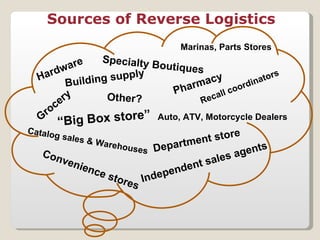
Sources of Reverse Logistics Hardware Building supply Grocery Pharmacy Department store Specialty Boutiques Convenience stores “ Big Box store” Other? Independent sales agents Catalog sales & Warehouses Recall coordinators Auto, ATV, Motorcycle Dealers Marinas, Parts Stores
Benefits of Return Logistics Incident control Verification of return or replacement  Investigate product failure Quality control
Benefits of Return Logistics  Recycling or remanufacturing Limit waste generation Ensure proper disposal (“Green initiative”)
Can these be hazardous materials? YES! In most cases, products  entering  reverse transport  need to be shipped in  accordance with regulations  governing  the safe  transport of dangerous goods.
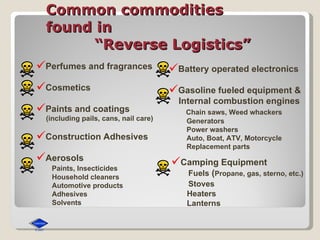
Common commodities found in    “Reverse Logistics” Perfumes and fragrances Cosmetics Paints and coatings (including pails, cans, nail care) Construction Adhesives Aerosols Paints, Insecticides Household cleaners Automotive products Adhesives Solvents Battery operated electronics Gasoline fueled equipment & Internal combustion engines Chain saws, Weed whackers Generators Power washers Auto, Boat, ATV, Motorcycle  Replacement parts Camping Equipment Fuels  ( Propane, gas, sterno, etc.) Stoves Heaters Lanterns
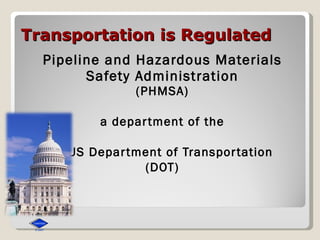
Transportation is Regulated Pipeline and Hazardous Materials Safety Administration (PHMSA) a department of the US Department of Transportation (DOT)
How Reverse Logistics Works: Preparation for Transport: “ Hazmat employee”  §171.8 and Part 172, Subpart H
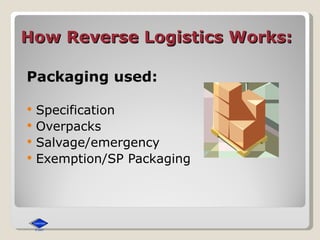
How Reverse Logistics Works: Packaging used: Specification Overpacks Salvage/emergency Exemption/SP Packaging
How Reverse Logistics Works: USPS  Air Express Common carrier  Private carrier
DOT/PHMSA’s position: “ Regulation alone is  not enough to fulfill our safety  mission.  We rely on partners,  like COSTHA members, to help  protect the public and the  environment from careless  or non-compliant shipments” “ The partnership we are entering will develop and introduce practical safety solutions that  work for the public and the regulated industry.”
COSTHA’s ROLE in REVERSE LOGISTICS: “ The industry has established an excellent safety record for regulatory compliance and safety in the distribution of hazardous materials.”
COSTHA’s ROLE in REVERSE LOGISTICS: “ We now need to examine the reverse logistics process where: the person packing the returns may not be a trained hazmat employee;  the packaging may not be the same as when it was originally shipped;  the person preparing the returns may not be aware of the hazards associated with transportation.”
Win – Win Outcome: “ Through this partnership, COSTHA and PHMSA can openly discuss the issues and provide solutions to enhance transportation safety”
Goals and objectives: Obtain industry input at: organized workshops discussion groups meetings  forums
Goals and objectives: Team with PHMSA in a creative process to: Develop acceptable and achievable standards
Desired Outcomes: Assessment of the reverse logistics issue Introduce standards and guidelines Implement systems Identify required resources to control transport risk Incident prevention
Moving Forward with Reverse Logistics: WHO? -  COSTHA Members -  Non-members WHAT? - Identify funding needs and resources - Education and Outreach  WHERE? - Scheduled meetings – COSTHA, DOT
The COSTHA partnership with PHMSA is a commitment to moving this initiative forward COME JOIN US! COSTHA
QUESTIONS?  Contact Information: COSTHA 7803 Hill House Court  Fairfax Station, VA  22039 Phone: 703/451-4031  Fax: 703/451-4207 Email:  [email_address] Presentation creatively designed by H.Skolnik and R.Jessop

Reverse Logistics1.30.2008

  • 1.
    COSTHA ANNUAL FORUM2008 March 11 – 13 th St. Petersburg, Florida
  • 2.
    What is “ReverseLogistics”? Definition: The return of purchased goods for any reason
  • 3.
    Who receives thesereturned goods? Manufacturer Vendor Distributor Shipper Retail Store Sales Department
  • 4.
    Reasons for return:Damage Defective Malfunction Obsolescence Out of Business Product recall Wrong delivery Other
  • 5.
    Sources of ReverseLogistics Hardware Building supply Grocery Pharmacy Department store Specialty Boutiques Convenience stores “ Big Box store” Other? Independent sales agents Catalog sales & Warehouses Recall coordinators Auto, ATV, Motorcycle Dealers Marinas, Parts Stores
  • 6.
    Benefits of ReturnLogistics Incident control Verification of return or replacement Investigate product failure Quality control
  • 7.
    Benefits of ReturnLogistics Recycling or remanufacturing Limit waste generation Ensure proper disposal (“Green initiative”)
  • 8.
    Can these behazardous materials? YES! In most cases, products entering reverse transport need to be shipped in accordance with regulations governing the safe transport of dangerous goods.
  • 9.
    Common commodities foundin “Reverse Logistics” Perfumes and fragrances Cosmetics Paints and coatings (including pails, cans, nail care) Construction Adhesives Aerosols Paints, Insecticides Household cleaners Automotive products Adhesives Solvents Battery operated electronics Gasoline fueled equipment & Internal combustion engines Chain saws, Weed whackers Generators Power washers Auto, Boat, ATV, Motorcycle Replacement parts Camping Equipment Fuels ( Propane, gas, sterno, etc.) Stoves Heaters Lanterns
  • 10.
    Transportation is RegulatedPipeline and Hazardous Materials Safety Administration (PHMSA) a department of the US Department of Transportation (DOT)
  • 11.
    How Reverse LogisticsWorks: Preparation for Transport: “ Hazmat employee” §171.8 and Part 172, Subpart H
  • 12.
    How Reverse LogisticsWorks: Packaging used: Specification Overpacks Salvage/emergency Exemption/SP Packaging
  • 13.
    How Reverse LogisticsWorks: USPS Air Express Common carrier Private carrier
  • 14.
    DOT/PHMSA’s position: “Regulation alone is not enough to fulfill our safety mission. We rely on partners, like COSTHA members, to help protect the public and the environment from careless or non-compliant shipments” “ The partnership we are entering will develop and introduce practical safety solutions that work for the public and the regulated industry.”
  • 15.
    COSTHA’s ROLE inREVERSE LOGISTICS: “ The industry has established an excellent safety record for regulatory compliance and safety in the distribution of hazardous materials.”
  • 16.
    COSTHA’s ROLE inREVERSE LOGISTICS: “ We now need to examine the reverse logistics process where: the person packing the returns may not be a trained hazmat employee; the packaging may not be the same as when it was originally shipped; the person preparing the returns may not be aware of the hazards associated with transportation.”
  • 17.
    Win – WinOutcome: “ Through this partnership, COSTHA and PHMSA can openly discuss the issues and provide solutions to enhance transportation safety”
  • 18.
    Goals and objectives:Obtain industry input at: organized workshops discussion groups meetings forums
  • 19.
    Goals and objectives:Team with PHMSA in a creative process to: Develop acceptable and achievable standards
  • 20.
    Desired Outcomes: Assessmentof the reverse logistics issue Introduce standards and guidelines Implement systems Identify required resources to control transport risk Incident prevention
  • 21.
    Moving Forward withReverse Logistics: WHO? - COSTHA Members - Non-members WHAT? - Identify funding needs and resources - Education and Outreach WHERE? - Scheduled meetings – COSTHA, DOT
  • 22.
    The COSTHA partnershipwith PHMSA is a commitment to moving this initiative forward COME JOIN US! COSTHA
  • 23.
    QUESTIONS? ContactInformation: COSTHA 7803 Hill House Court Fairfax Station, VA 22039 Phone: 703/451-4031 Fax: 703/451-4207 Email: [email_address] Presentation creatively designed by H.Skolnik and R.Jessop