REVERSE LOGISTIC AND
REVERSE SUPPLY CHAIN
Presented By :- USMAN IDRIS MS (MGT) RIPHAH INT UNIVERISTY
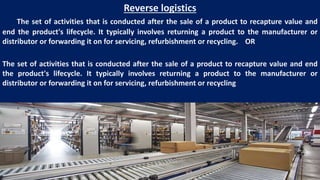
Reverse logistics
The set of activities that is conducted after the sale of a product to recapture value and
end the product's lifecycle. It typically involves returning a product to the manufacturer or
distributor or forwarding it on for servicing, refurbishment or recycling. OR
The set of activities that is conducted after the sale of a product to recapture value and end
the product's lifecycle. It typically involves returning a product to the manufacturer or
distributor or forwarding it on for servicing, refurbishment or recycling
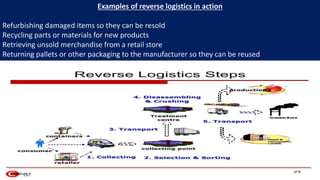
Examples of reverse logistics in action
Refurbishing damaged items so they can be resold
Recycling parts or materials for new products
Retrieving unsold merchandise from a retail store
Returning pallets or other packaging to the manufacturer so they can be reused
Returns happen for a variety of reasons, which include:
• The customer is unhappy with the product because it is not what they were
looking for or what they expected.
• The product is faulty or defective.
• The item is obsolete and has outlived its serviceability.
• Overstock that must be returned to the warehouse installation. This stock
is vital for the running of a business, although they are just used in specific
occasions.
• Seasonal stock, in other words, products that are only sold during certain
time periods (like seasonal wear or toys during Christmas) and that must
be stored the rest of the year.
• Returns entail shipping and received goods must be sorted according to
their SKU and condition. This has repercussions on staffing hours, the extra
space needed to do this work and means higher associated costs.
Why product returned
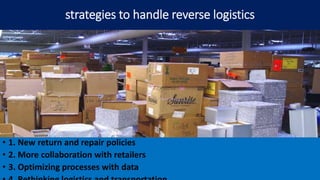
strategies to handle reverse logistics
• 1. New return and repair policies
• 2. More collaboration with retailers
• 3. Optimizing processes with data
Important Benefits of a Reverse Logistics
 Enhance Customer Service and Loyalty Improve
 Improve Sustainability with RL process
 Boost Public Perception
 Decreased costs
 Reduce waste
Reverse Logistics Problems
Reverse logistics as its name because it is the
opposite of forward logistics. As a business sells
products, they can have the products moved from a
warehouse directly to the consumer or to
distributors. Reverse logistics, as the name implies,
is exactly the opposite. It is a complex process that
presents a manufacturer with a number of problems
that fortunately can be solved by the correct
application of business software. These problems
include:
Problem 1: Tracking Value
Problem 2: Tracking warranty and routing status
Problem 3: Handling dealers and contractors
Problem 4: Driving efficiency in repair processes
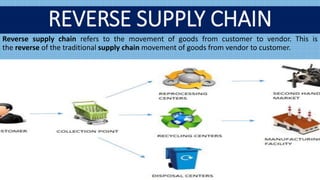
REVERSE SUPPLY CHAIN
Reverse supply chain refers to the movement of goods from customer to vendor. This is
the reverse of the traditional supply chain movement of goods from vendor to customer.
Key components of reverse supply chain
• Product Acquisition
• Reverse Logistics
• Inspection and Disposition
• Reconditioning
• Distribution and Sales
Advantages of Reverse Supply Chain
• Return on Investment…Again
• Increase in Public Perception
• Reuse Encourages Competition
in Manufacturing
• Data Protection
Reverse logistic and reverse supply chain

Reverse logistic and reverse supply chain

  • 1.
    REVERSE LOGISTIC AND REVERSESUPPLY CHAIN Presented By :- USMAN IDRIS MS (MGT) RIPHAH INT UNIVERISTY
  • 2.
    Reverse logistics The setof activities that is conducted after the sale of a product to recapture value and end the product's lifecycle. It typically involves returning a product to the manufacturer or distributor or forwarding it on for servicing, refurbishment or recycling. OR The set of activities that is conducted after the sale of a product to recapture value and end the product's lifecycle. It typically involves returning a product to the manufacturer or distributor or forwarding it on for servicing, refurbishment or recycling
  • 3.
    Examples of reverselogistics in action Refurbishing damaged items so they can be resold Recycling parts or materials for new products Retrieving unsold merchandise from a retail store Returning pallets or other packaging to the manufacturer so they can be reused
  • 4.
    Returns happen fora variety of reasons, which include: • The customer is unhappy with the product because it is not what they were looking for or what they expected. • The product is faulty or defective. • The item is obsolete and has outlived its serviceability. • Overstock that must be returned to the warehouse installation. This stock is vital for the running of a business, although they are just used in specific occasions. • Seasonal stock, in other words, products that are only sold during certain time periods (like seasonal wear or toys during Christmas) and that must be stored the rest of the year. • Returns entail shipping and received goods must be sorted according to their SKU and condition. This has repercussions on staffing hours, the extra space needed to do this work and means higher associated costs. Why product returned
  • 5.
    strategies to handlereverse logistics • 1. New return and repair policies • 2. More collaboration with retailers • 3. Optimizing processes with data
  • 6.
    Important Benefits ofa Reverse Logistics  Enhance Customer Service and Loyalty Improve  Improve Sustainability with RL process  Boost Public Perception  Decreased costs  Reduce waste
  • 7.
    Reverse Logistics Problems Reverselogistics as its name because it is the opposite of forward logistics. As a business sells products, they can have the products moved from a warehouse directly to the consumer or to distributors. Reverse logistics, as the name implies, is exactly the opposite. It is a complex process that presents a manufacturer with a number of problems that fortunately can be solved by the correct application of business software. These problems include: Problem 1: Tracking Value Problem 2: Tracking warranty and routing status Problem 3: Handling dealers and contractors Problem 4: Driving efficiency in repair processes
  • 8.
    REVERSE SUPPLY CHAIN Reversesupply chain refers to the movement of goods from customer to vendor. This is the reverse of the traditional supply chain movement of goods from vendor to customer.
  • 9.
    Key components ofreverse supply chain • Product Acquisition • Reverse Logistics • Inspection and Disposition • Reconditioning • Distribution and Sales
  • 10.
    Advantages of ReverseSupply Chain • Return on Investment…Again • Increase in Public Perception • Reuse Encourages Competition in Manufacturing • Data Protection