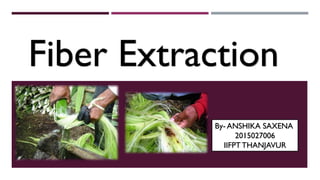
Fiber Extraction
By- ANSHIKA SAXENA
2015027006
IIFPT THANJAVUR
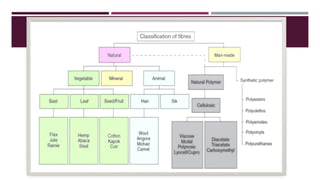
• Fibers are extracted for textiles, brushes, plaiting or coarse weaving,
stuffing material, paper and specialty goods.
• Cotton, flax, ramie, and hemp are most often used for apparel or textile
fibers.
• Jute, cotton, hemp, abacá, sisal, New Zealand flax, and Mauritius hemp
are most often used for cordage.
• Istle, sisal, piassava (palm), and broomcorn (a Sorghum bicolor cultivar)
are most often used for brushes or braiding fibers.
• Kapok, cotton, Spanish moss, and jute are most often used for filling
fibers.
Fiber Extraction
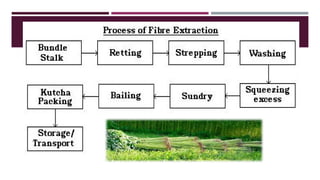
RETTING
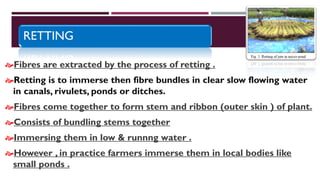
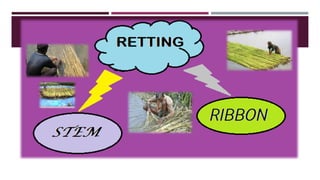
Fibres are extracted by the process of retting .
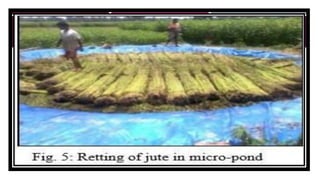
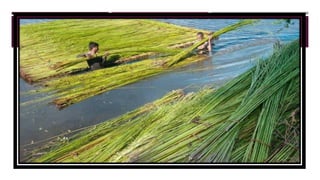
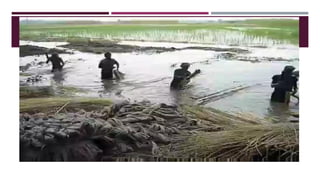
Retting is to immerse then fibre bundles in clear slow flowing water
in canals, rivulets, ponds or ditches.
Fibres come together to form stem and ribbon (outer skin ) of plant.
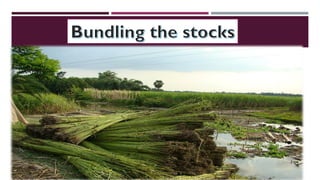
Consists of bundling stems together
Immersing them in low & runnng water .
However , in practice farmers immerse them in local bodies like
small ponds .
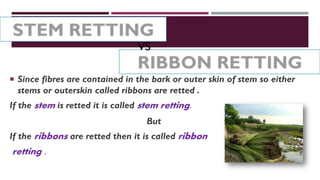
 Since fibres are contained in the bark or outer skin of stem so either
stems or outerskin called ribbons are retted .
If the stem is retted it is called stem retting.
But
If the ribbons are retted then it is called ribbon
retting .
VS
Conditions for good retting
Important conditions for good retting are :
 Water should be non saline and clear .
 Volume of water should be enough to make fibre bundles float .
 When bundles are immersed they should not touch the
bottom.
 Same Retting tank or ditch should not be used.
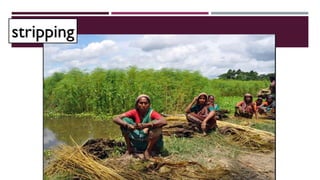
stripping
STRIPPING
 The process of removing fibres from the stalk after completion of
retting.
 To judge the right time for striping the fibers from the retted plants of
the ponds or cannels where the plants have been kept for retting.
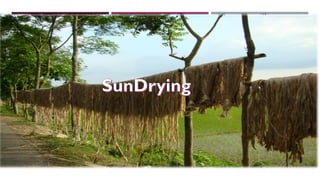
 Washing and drying of the fibers should be done as quickly as possible.
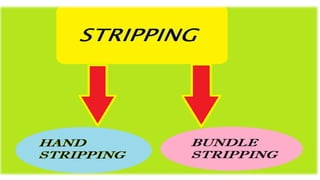
 Fibres can be removed by any one of following methods :
 Single plants are taken and their fibres are taken off .
 Handful of stalks are taken off, breaking it in a to & fro motion in
water.
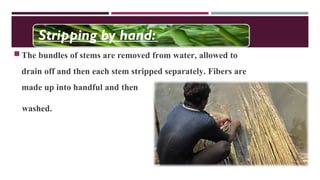
The bundles of stems are removed from water, allowed to
drain off and then each stem stripped separately. Fibers are
made up into handful and then
washed.
Stripping by hand:
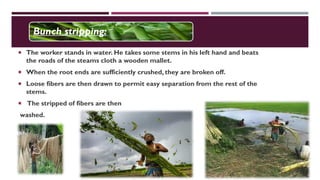
 The worker stands in water. He takes some stems in his left hand and beats
the roads of the steams cloth a wooden mallet.
 When the root ends are sufficiently crushed, they are broken off.
 Loose fibers are then drawn to permit easy separation from the rest of the
stems.
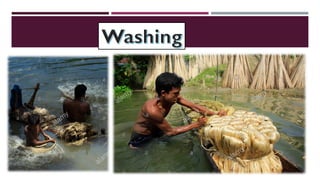
 The stripped of fibers are then
washed.
Bunch stripping:
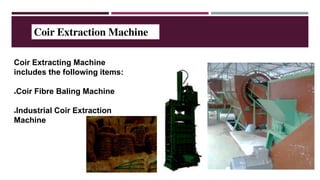
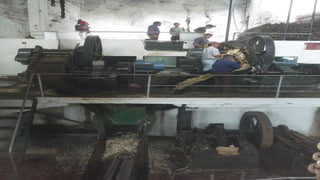
Coir Extraction Machine
Coir Extracting Machine
includes the following items:
●Coir Fibre Baling Machine
●Industrial Coir Extraction
Machine
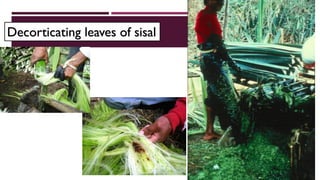
Decorticating leaves of sisal
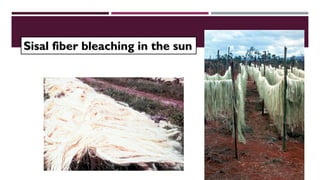
Sisal fiber bleaching in the sun
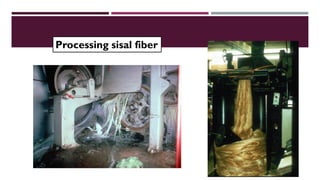
PROCESSING SISAL
FIBER
Processing sisal fiber
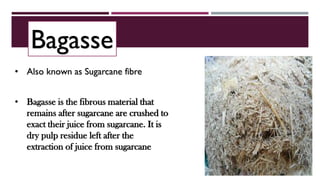
Bagasse
• Bagasse is the fibrous material that
remains after sugarcane are crushed to
exact their juice from sugarcane. It is
dry pulp residue left after the
extraction of juice from sugarcane
• Also known as Sugarcane fibre
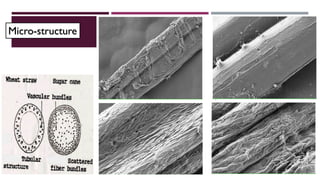
Micro-structure
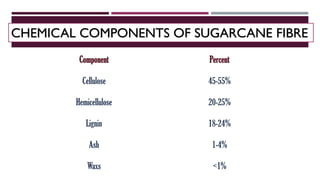
Component Percent
Cellulose 45-55%
Hemicellulose 20-25%
Lignin 18-24%
Ash 1-4%
Waxs <1%
CHEMICAL COMPONENTS OF SUGARCANE FIBRE
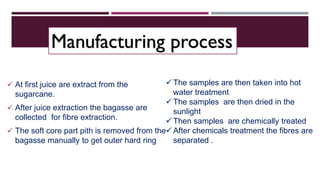
 At first juice are extract from the
sugarcane.
 After juice extraction the bagasse are
collected for fibre extraction.
 The soft core part pith is removed from the
bagasse manually to get outer hard ring
 The samples are then taken into hot
water treatment
 The samples are then dried in the
sunlight
 Then samples are chemically treated
 After chemicals treatment the fibres are
separated .
Manufacturing process
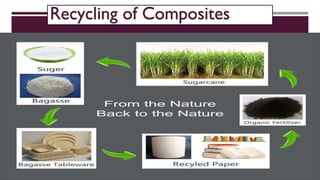
Recycling of Composites
USES
• Alcohol
• Fuel
• Board
• Pulp
• Plastic
• Board
• Textile
• Feed

Fibre extraction

  • 1.
    Fiber Extraction By- ANSHIKASAXENA 2015027006 IIFPT THANJAVUR
  • 3.
    • Fibers areextracted for textiles, brushes, plaiting or coarse weaving, stuffing material, paper and specialty goods. • Cotton, flax, ramie, and hemp are most often used for apparel or textile fibers. • Jute, cotton, hemp, abacá, sisal, New Zealand flax, and Mauritius hemp are most often used for cordage. • Istle, sisal, piassava (palm), and broomcorn (a Sorghum bicolor cultivar) are most often used for brushes or braiding fibers. • Kapok, cotton, Spanish moss, and jute are most often used for filling fibers. Fiber Extraction
  • 6.
    RETTING Fibres are extractedby the process of retting . Retting is to immerse then fibre bundles in clear slow flowing water in canals, rivulets, ponds or ditches. Fibres come together to form stem and ribbon (outer skin ) of plant. Consists of bundling stems together Immersing them in low & runnng water . However , in practice farmers immerse them in local bodies like small ponds .
  • 10.
     Since fibresare contained in the bark or outer skin of stem so either stems or outerskin called ribbons are retted . If the stem is retted it is called stem retting. But If the ribbons are retted then it is called ribbon retting . VS
  • 11.
    Conditions for goodretting Important conditions for good retting are :  Water should be non saline and clear .  Volume of water should be enough to make fibre bundles float .  When bundles are immersed they should not touch the bottom.  Same Retting tank or ditch should not be used.
  • 13.
  • 14.
    STRIPPING  The processof removing fibres from the stalk after completion of retting.  To judge the right time for striping the fibers from the retted plants of the ponds or cannels where the plants have been kept for retting.  Washing and drying of the fibers should be done as quickly as possible.  Fibres can be removed by any one of following methods :  Single plants are taken and their fibres are taken off .  Handful of stalks are taken off, breaking it in a to & fro motion in water.
  • 15.
    The bundles ofstems are removed from water, allowed to drain off and then each stem stripped separately. Fibers are made up into handful and then washed. Stripping by hand:
  • 17.
     The workerstands in water. He takes some stems in his left hand and beats the roads of the steams cloth a wooden mallet.  When the root ends are sufficiently crushed, they are broken off.  Loose fibers are then drawn to permit easy separation from the rest of the stems.  The stripped of fibers are then washed. Bunch stripping:
  • 21.
    Coir Extraction Machine CoirExtracting Machine includes the following items: ●Coir Fibre Baling Machine ●Industrial Coir Extraction Machine
  • 22.
  • 23.
  • 24.
  • 25.
    Bagasse • Bagasse isthe fibrous material that remains after sugarcane are crushed to exact their juice from sugarcane. It is dry pulp residue left after the extraction of juice from sugarcane • Also known as Sugarcane fibre
  • 26.
  • 27.
    Component Percent Cellulose 45-55% Hemicellulose20-25% Lignin 18-24% Ash 1-4% Waxs <1% CHEMICAL COMPONENTS OF SUGARCANE FIBRE
  • 28.
     At firstjuice are extract from the sugarcane.  After juice extraction the bagasse are collected for fibre extraction.  The soft core part pith is removed from the bagasse manually to get outer hard ring  The samples are then taken into hot water treatment  The samples are then dried in the sunlight  Then samples are chemically treated  After chemicals treatment the fibres are separated . Manufacturing process
  • 31.
  • 32.
    USES • Alcohol • Fuel •Board • Pulp • Plastic • Board • Textile • Feed