A good quality jute and
agronomic management
practices for producing quality
jute
Presented by-
Israt Jahan
Id- 1701050
Sadik Mahmud Saikat
Id- 1701051
Jute-
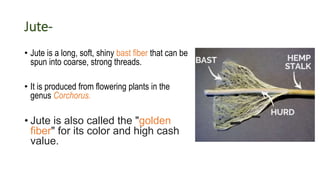
• Jute is a long, soft, shiny bast fiber that can be
spun into coarse, strong threads.
• It is produced from flowering plants in the
genus Corchorus.
• Jute is also called the "golden
fiber" for its color and high cash
value.
PROPERTIES OF GOOD QUALITY JUTE FIBER:
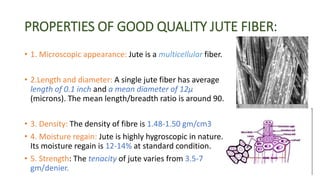
• 1. Microscopic appearance: Jute is a multicellular fiber.
• 2.Length and diameter: A single jute fiber has average
length of 0.1 inch and a mean diameter of 12µ
(microns). The mean length/breadth ratio is around 90.
• 3. Density: The density of fibre is 1.48-1.50 gm/cm3
• 4. Moisture regain: Jute is highly hygroscopic in nature.
Its moisture regain is 12-14% at standard condition.
• 5. Strength: The tenacity of jute varies from 3.5-7
gm/denier.
• 6. Colour: Varies from yellow to brown to grey depending
upon condition of growth and retting etc.
• 7. Elongation: Jute do not stretch to appreciable extent
under tension. Its breaking elongation is 1-1.2% under
normal atmospheric condition.
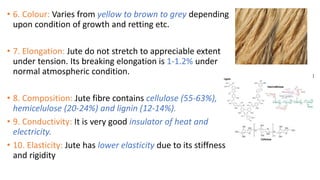
• 8. Composition: Jute fibre contains cellulose (55-63%),
hemicelulose (20-24%) and lignin (12-14%).
• 9. Conductivity: It is very good insulator of heat and
electricity.
• 10. Elasticity: Jute has lower elasticity due to its stiffness
and rigidity
AGRONOMIC MANAGEMENT PRACTICES FOR
UPGRADATION OF JUTE FIBER QUALITY:
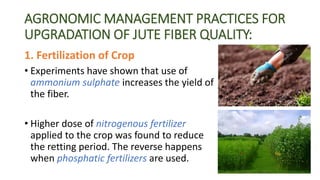
1. Fertilization of Crop
• Experiments have shown that use of
ammonium sulphate increases the yield of
the fiber.
• Higher dose of nitrogenous fertilizer
applied to the crop was found to reduce
the retting period. The reverse happens
when phosphatic fertilizers are used.
2. Harvesting of crop
Harvesting may be performed at three stages
of crop development:
(a) when the flowers begin to appear;
(b) when the plants are in full flower or fruit;
(c) when all the plants are fully mature.
Harvesting is usually carried out at the second
stage when about half of the plants have fully
developed fruit.
3. Crop treatments
• Where cuttings are a serious issue, the use
of pectinolytic post-retting fungal cultures
can be used with advantage.
• To remove dark colour staining from jute
fibres, low-cost treatments using tamarind
fruit pulp or mesta, roselle or tamarind leaf
extracts can be prepared and used.
4.Bleaching Treatments
• Mainly low-cost bleaching treatments
with the use of materials freely
available in jute-growing areas. These
consists bleaching extracts of tamarind
leaves and roselle leaves, vinegar and
the commercial bleach Clorox.
• The BJRI Bangladesh found that a
2.5% solution of tamarind leaves was
useful.
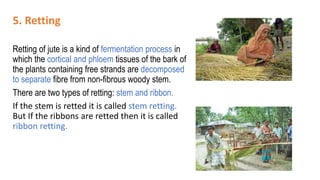
5. Retting
Retting of jute is a kind of fermentation process in
which the cortical and phloem tissues of the bark of
the plants containing free strands are decomposed
to separate fibre from non-fibrous woody stem.
There are two types of retting: stem and ribbon.
If the stem is retted it is called stem retting.
But If the ribbons are retted then it is called
ribbon retting.
References
• Das, Biswapriya, et al. "Review of some factors influencing jute fiber
quality." Journal of Natural Fibers 11.3 (2014): 268-281.
• Ahmed, Zakarja, and Firoza Akhter. "Jute retting: an overview." Online
J Biol Sci 1.7 (2001): 685-688.
A good quality jute.pptx

A good quality jute.pptx

  • 1.
    A good qualityjute and agronomic management practices for producing quality jute Presented by- Israt Jahan Id- 1701050 Sadik Mahmud Saikat Id- 1701051
  • 2.
    Jute- • Jute isa long, soft, shiny bast fiber that can be spun into coarse, strong threads. • It is produced from flowering plants in the genus Corchorus. • Jute is also called the "golden fiber" for its color and high cash value.
  • 3.
    PROPERTIES OF GOODQUALITY JUTE FIBER: • 1. Microscopic appearance: Jute is a multicellular fiber. • 2.Length and diameter: A single jute fiber has average length of 0.1 inch and a mean diameter of 12µ (microns). The mean length/breadth ratio is around 90. • 3. Density: The density of fibre is 1.48-1.50 gm/cm3 • 4. Moisture regain: Jute is highly hygroscopic in nature. Its moisture regain is 12-14% at standard condition. • 5. Strength: The tenacity of jute varies from 3.5-7 gm/denier.
  • 4.
    • 6. Colour:Varies from yellow to brown to grey depending upon condition of growth and retting etc. • 7. Elongation: Jute do not stretch to appreciable extent under tension. Its breaking elongation is 1-1.2% under normal atmospheric condition. • 8. Composition: Jute fibre contains cellulose (55-63%), hemicelulose (20-24%) and lignin (12-14%). • 9. Conductivity: It is very good insulator of heat and electricity. • 10. Elasticity: Jute has lower elasticity due to its stiffness and rigidity
  • 5.
    AGRONOMIC MANAGEMENT PRACTICESFOR UPGRADATION OF JUTE FIBER QUALITY: 1. Fertilization of Crop • Experiments have shown that use of ammonium sulphate increases the yield of the fiber. • Higher dose of nitrogenous fertilizer applied to the crop was found to reduce the retting period. The reverse happens when phosphatic fertilizers are used.
  • 6.
    2. Harvesting ofcrop Harvesting may be performed at three stages of crop development: (a) when the flowers begin to appear; (b) when the plants are in full flower or fruit; (c) when all the plants are fully mature. Harvesting is usually carried out at the second stage when about half of the plants have fully developed fruit.
  • 7.
    3. Crop treatments •Where cuttings are a serious issue, the use of pectinolytic post-retting fungal cultures can be used with advantage. • To remove dark colour staining from jute fibres, low-cost treatments using tamarind fruit pulp or mesta, roselle or tamarind leaf extracts can be prepared and used.
  • 8.
    4.Bleaching Treatments • Mainlylow-cost bleaching treatments with the use of materials freely available in jute-growing areas. These consists bleaching extracts of tamarind leaves and roselle leaves, vinegar and the commercial bleach Clorox. • The BJRI Bangladesh found that a 2.5% solution of tamarind leaves was useful.
  • 9.
    5. Retting Retting ofjute is a kind of fermentation process in which the cortical and phloem tissues of the bark of the plants containing free strands are decomposed to separate fibre from non-fibrous woody stem. There are two types of retting: stem and ribbon. If the stem is retted it is called stem retting. But If the ribbons are retted then it is called ribbon retting.
  • 10.
    References • Das, Biswapriya,et al. "Review of some factors influencing jute fiber quality." Journal of Natural Fibers 11.3 (2014): 268-281. • Ahmed, Zakarja, and Firoza Akhter. "Jute retting: an overview." Online J Biol Sci 1.7 (2001): 685-688.