RETHINKING
  ACCESSIBILITY IN E-LEARNING:
 TOWARD DIDACTIC GUIDELINES
TO DESIGN INCLUSIVE ACTIVITIES
       Eleonora Guglielman

       ATEE Winter Conference
       Genoa, 07 march 2013
The emerging issues of the research
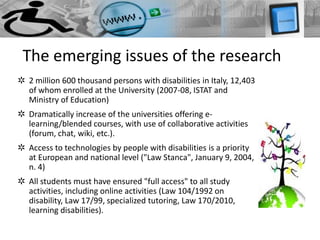
✲ 2 million 600 thousand persons with disabilities in Italy, 12,403
  of whom enrolled at the University (2007-08, ISTAT and
  Ministry of Education)
✲ Dramatically increase of the universities offering e-
  learning/blended courses, with use of collaborative activities
  (forum, chat, wiki, etc.).
✲ Access to technologies by people with disabilities is a priority
  at European and national level ("Law Stanca", January 9, 2004,
  n. 4)
✲ All students must have ensured "full access" to all study
  activities, including online activities (Law 104/1992 on
  disability, Law 17/99, specialized tutoring, Law 170/2010,
  learning disabilities).
The meaning of accessibility
 Definition: “the degree to which a product, device, service, or
 environment is available to as many people as possible”

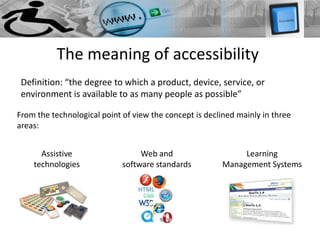
From the technological point of view the concept is declined mainly in three
areas:


      Assistive                   Web and                    Learning
    technologies             software standards         Management Systems
A bidimensional accessibility
Technological accessibility: access to HW and
SW – accessibility of websites, LMS, digital
contents.
It is defined by standards and parameters


Pedagogical accessibility:
✲ Access to contents and resources
✲ Access to interaction and collaboration tools (chat, forum, wiki)
✲ Access to activities: workshops, debates, collaborative works,
  simulations
                            not still realized
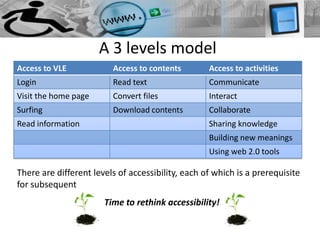
A 3 levels model
Access to VLE            Access to contents        Access to activities
Login                    Read text                 Communicate
Visit the home page      Convert files             Interact
Surfing                  Download contents         Collaborate
Read information                                   Sharing knowledge
                                                   Building new meanings
                                                   Using web 2.0 tools

There are different levels of accessibility, each of which is a prerequisite
for subsequent
                       Time to rethink accessibility!
How to address the challenge?
The solution: guidelines for the design of e-learning
courses that are accessible both at a technological
and a methodological-didactic level
The target: Students with special educational needs
(deaf, blind, motor disabilities, learning disabilities)
The paradigm: Universal Design - Services and
environments must be designed so that they are
accessible and usable for all (in educational field:
Universal Instructional Design and Universal Design
for Learning)
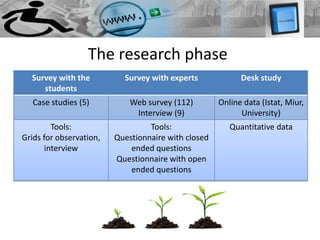
The research phase
  Survey with the          Survey with experts             Desk study
     students
   Case studies (5)          Web survey (112)        Online data (Istat, Miur,
                              Interview (9)                University)
         Tools:                   Tools:                Quantitative data
Grids for observation,   Questionnaire with closed
       interview             ended questions
                         Questionnaire with open
                             ended questions
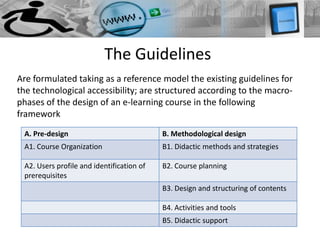
The Guidelines
Are formulated taking as a reference model the existing guidelines for
the technological accessibility; are structured according to the macro-
phases of the design of an e-learning course in the following
framework
 A. Pre-design                             B. Methodological design
 A1. Course Organization                   B1. Didactic methods and strategies

 A2. Users profile and identification of   B2. Course planning
 prerequisites
                                           B3. Design and structuring of contents

                                           B4. Activities and tools
                                           B5. Didactic support
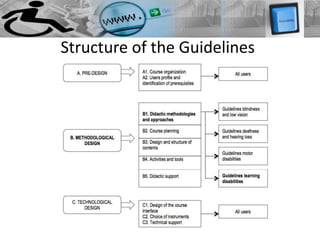
Structure of the Guidelines
Articulation of the guidelines
35 generic guidelines and 9 methodological guidelines for students with
learning disabilities
Each guideline including:
✲ Phase and macroarea
✲ Types of disability N O  &
✲ Indicator
✲ Methodological-didactic descriptors
✲ WACG 2.0 standard(s)
✲ References
Future trends
     ✲ Decline guidelines for specific
       disabilities
     ✲ Test, validate, redesign guidelines in
       online courses to their full adoption
     ✲ Make the course staff acquire
       accessibility skills
     ✲ Contribute to the dissemination of
       the culture of Universal Design
     ✲ A new professional role: the e-tutor
       expert in accessibility
Thank you for your attention

   www.guglielman.com

Rethinking Accessibility

  • 1.
    RETHINKING ACCESSIBILITYIN E-LEARNING: TOWARD DIDACTIC GUIDELINES TO DESIGN INCLUSIVE ACTIVITIES Eleonora Guglielman ATEE Winter Conference Genoa, 07 march 2013
  • 2.
    The emerging issuesof the research ✲ 2 million 600 thousand persons with disabilities in Italy, 12,403 of whom enrolled at the University (2007-08, ISTAT and Ministry of Education) ✲ Dramatically increase of the universities offering e- learning/blended courses, with use of collaborative activities (forum, chat, wiki, etc.). ✲ Access to technologies by people with disabilities is a priority at European and national level ("Law Stanca", January 9, 2004, n. 4) ✲ All students must have ensured "full access" to all study activities, including online activities (Law 104/1992 on disability, Law 17/99, specialized tutoring, Law 170/2010, learning disabilities).
  • 3.
    The meaning ofaccessibility Definition: “the degree to which a product, device, service, or environment is available to as many people as possible” From the technological point of view the concept is declined mainly in three areas: Assistive Web and Learning technologies software standards Management Systems
  • 4.
    A bidimensional accessibility Technologicalaccessibility: access to HW and SW – accessibility of websites, LMS, digital contents. It is defined by standards and parameters Pedagogical accessibility: ✲ Access to contents and resources ✲ Access to interaction and collaboration tools (chat, forum, wiki) ✲ Access to activities: workshops, debates, collaborative works, simulations not still realized
  • 5.
    A 3 levelsmodel Access to VLE Access to contents Access to activities Login Read text Communicate Visit the home page Convert files Interact Surfing Download contents Collaborate Read information Sharing knowledge Building new meanings Using web 2.0 tools There are different levels of accessibility, each of which is a prerequisite for subsequent Time to rethink accessibility!
  • 6.
    How to addressthe challenge? The solution: guidelines for the design of e-learning courses that are accessible both at a technological and a methodological-didactic level The target: Students with special educational needs (deaf, blind, motor disabilities, learning disabilities) The paradigm: Universal Design - Services and environments must be designed so that they are accessible and usable for all (in educational field: Universal Instructional Design and Universal Design for Learning)
  • 7.
    The research phase Survey with the Survey with experts Desk study students Case studies (5) Web survey (112) Online data (Istat, Miur, Interview (9) University) Tools: Tools: Quantitative data Grids for observation, Questionnaire with closed interview ended questions Questionnaire with open ended questions
  • 8.
    The Guidelines Are formulatedtaking as a reference model the existing guidelines for the technological accessibility; are structured according to the macro- phases of the design of an e-learning course in the following framework A. Pre-design B. Methodological design A1. Course Organization B1. Didactic methods and strategies A2. Users profile and identification of B2. Course planning prerequisites B3. Design and structuring of contents B4. Activities and tools B5. Didactic support
  • 9.
    Structure of theGuidelines
  • 10.
    Articulation of theguidelines 35 generic guidelines and 9 methodological guidelines for students with learning disabilities Each guideline including: ✲ Phase and macroarea ✲ Types of disability N O  & ✲ Indicator ✲ Methodological-didactic descriptors ✲ WACG 2.0 standard(s) ✲ References
  • 11.
    Future trends ✲ Decline guidelines for specific disabilities ✲ Test, validate, redesign guidelines in online courses to their full adoption ✲ Make the course staff acquire accessibility skills ✲ Contribute to the dissemination of the culture of Universal Design ✲ A new professional role: the e-tutor expert in accessibility
  • 12.
    Thank you foryour attention www.guglielman.com