www.oeclib.in
SUBMITTED BY:
ODISHA ELECRONICS CONTROL LIABRAY
Seminar
On
Restful Web Services
 Abstract
 Introduction
 What is Rest?
 Characteristics
 Principles
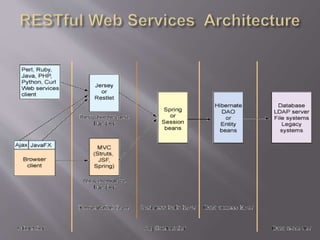
 Architecture
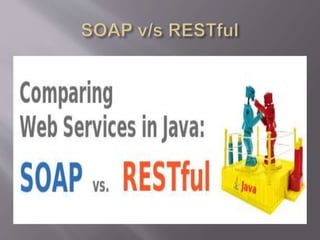
 SOAP v/s RESTful
 Advantages
 Disadvantages
 Conclusion
 By its nature, user actions within a distributed
hypermedia system require the transfer of large
amounts of data from where the data is stored
to where it is used.
 Thus, the Web architecture must be designed
for large-grain data transfer.
 A RESTFul web services are based on the
HTTP methods and the concept of REST.
 A RESTFul web service typically defines the
base URI for the services, the supported MIME-
types (XML, Text, JSON, user-defined,..) and
 The set of operations (POST, GET, PUT,
DELETE) which are supported.
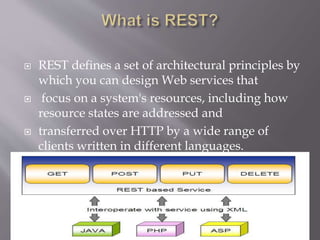
 REST defines a set of architectural principles by
which you can design Web services that
 focus on a system's resources, including how
resource states are addressed and
 transferred over HTTP by a wide range of
clients written in different languages.
 Client-Server: a pull-based interaction style:
consuming components pull representations.
 Named resources - the system is comprised of
resources which are named using a URL.
 Uniform interface: all resources are accessed
with a generic interface (e.g., HTTP GET,
POST, PUT, DELETE).
 Describe how your services are to be invoked
using either a WSDL document,
 or simply an HTML document.
 Categorize your resources according to
whether clients can just receive a
representation of the resource,
 or whether clients can modify (add to) the
resource.
 Queries should not return an
overload of data. If needed,
provide a paging
mechanism. For example, a
"product list"
 GET request should return
the first n products (e.g., the
first 10), with next/prev
links.
 Can I do a GET on the URLs that I
POST to?
 Iff so, do I get something that in
some way represents the state of
what I've been building up with the
POSTs?
 HTML forms almost always fail
miserably
 Scalable component interactions
 General interfaces
 Independently deployed connectors.
 Reduced interaction latency.
 Strengthened security.
 Safe encapsulation of legacy systems.
 Separates server implementation from the
client’s perception of resources (“Cool URIs
 Don’t Change”).
 Scales well to large numbers of clients.
 Enables transfer of data in streams of unlimited
size and type.
 It sacrifices some of the advantages of other
architectures.
 Stateful interaction with an FTP site.
 It retains a single interface for everything
 REST – clients submit requests to Web
services as HTTP requests
 SOAP – clients submit request in form of
XML document
 Service-Oriented Architecture can be
implemented in different ways.
 General focus is on whatever architecture gets
the job done.
 The decision of which to use depends entirely
on the circumstances of the application.
Thanks

Restful web services ppt

  • 1.
    www.oeclib.in SUBMITTED BY: ODISHA ELECRONICSCONTROL LIABRAY Seminar On Restful Web Services
  • 2.
     Abstract  Introduction What is Rest?  Characteristics  Principles  Architecture  SOAP v/s RESTful  Advantages  Disadvantages  Conclusion
  • 3.
     By itsnature, user actions within a distributed hypermedia system require the transfer of large amounts of data from where the data is stored to where it is used.  Thus, the Web architecture must be designed for large-grain data transfer.
  • 4.
     A RESTFulweb services are based on the HTTP methods and the concept of REST.  A RESTFul web service typically defines the base URI for the services, the supported MIME- types (XML, Text, JSON, user-defined,..) and  The set of operations (POST, GET, PUT, DELETE) which are supported.
  • 5.
     REST definesa set of architectural principles by which you can design Web services that  focus on a system's resources, including how resource states are addressed and  transferred over HTTP by a wide range of clients written in different languages.
  • 6.
     Client-Server: apull-based interaction style: consuming components pull representations.  Named resources - the system is comprised of resources which are named using a URL.  Uniform interface: all resources are accessed with a generic interface (e.g., HTTP GET, POST, PUT, DELETE).
  • 7.
     Describe howyour services are to be invoked using either a WSDL document,  or simply an HTML document.  Categorize your resources according to whether clients can just receive a representation of the resource,  or whether clients can modify (add to) the resource.
  • 10.
     Queries shouldnot return an overload of data. If needed, provide a paging mechanism. For example, a "product list"  GET request should return the first n products (e.g., the first 10), with next/prev links.
  • 11.
     Can Ido a GET on the URLs that I POST to?  Iff so, do I get something that in some way represents the state of what I've been building up with the POSTs?  HTML forms almost always fail miserably
  • 12.
     Scalable componentinteractions  General interfaces  Independently deployed connectors.  Reduced interaction latency.  Strengthened security.  Safe encapsulation of legacy systems.
  • 13.
     Separates serverimplementation from the client’s perception of resources (“Cool URIs  Don’t Change”).  Scales well to large numbers of clients.  Enables transfer of data in streams of unlimited size and type.
  • 14.
     It sacrificessome of the advantages of other architectures.  Stateful interaction with an FTP site.  It retains a single interface for everything
  • 15.
     REST –clients submit requests to Web services as HTTP requests  SOAP – clients submit request in form of XML document
  • 16.
     Service-Oriented Architecturecan be implemented in different ways.  General focus is on whatever architecture gets the job done.  The decision of which to use depends entirely on the circumstances of the application.
  • 17.

Editor's Notes