Restaurant Valuation 
Part Art / Part Science 
December 2, 2014
Everyone has an opinion of value: 
• The bookkeeper 
• The owner 
• The owner’s spouse 
• The owner’s ex-spouse 
• The owner’s parents 
• The auditor 
• The tax preparer 
2 
Standard of Value
Purpose or need for the valuation 
• Merger or acquisition 
• Family gifting 
• Estate tax 
• Divorce 
• Shareholder oppression / dissent 
• Damages 
• Bankruptcy 
• Shareholder agreements 

• Income Tax 
• Financial statement reporting 
3 
Standard of Value
• Fair Market Value 
• Investment Value 
• Fair Value 
4 
Standard of Value
• Going Concern Value 
• Liquidation Value: 
 Orderly 
 Forced 
5 
Premise of Value
VALUATION THEORY 
6
FINANCIAL STATEMENT 
ANALYSIS 
7
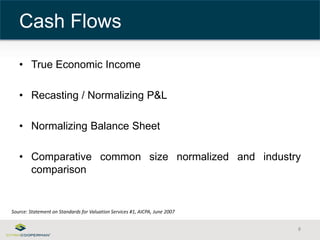
• True Economic Income 
• Recasting / Normalizing P&L 
• Normalizing Balance Sheet 
• Comparative common size normalized and industry 
comparison 
8 
Cash Flows 
Source: Statement on Standards for Valuation Services #1, AICPA, June 2007
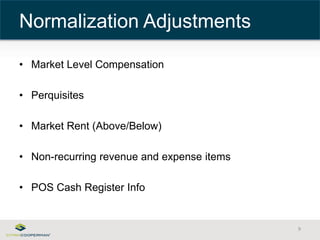
• Market Level Compensation 
• Perquisites 
• Market Rent (Above/Below) 
• Non-recurring revenue and expense items 
• POS Cash Register Info 
9 
Normalization Adjustments
VALUATION APPROACHES 
10
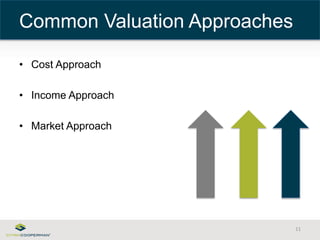
• Cost Approach 
• Income Approach 
• Market Approach 
11 
Common Valuation Approaches
• Most pertinent where a company’s value is tied directly 
to the value of its underlying assets. 
• Generally not appropriate for restaurants because 
intangible assets are not considered 
12 
Cost Approach
• Expectation 
• Requires the determination of a company’s 
representative earning power which is then discounted 
back to a present value. 
13 
Income Approach
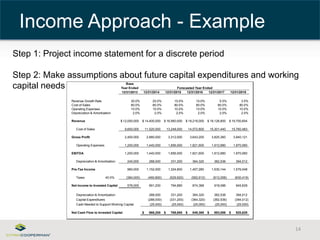
Step 1: Project income statement for a discrete period 
Step 2: Make assumptions about future capital expenditures and working 
capital needs 
14 
Income Approach - Example 
Base 
Year Ended 
Forecasted Year Ended 
12/31/2013 12/31/2014 12/31/2015 12/31/2016 12/31/2017 12/31/2018 
Revenue Growth Rate 30.0% 20.0% 15.0% 10.0% 5.0% 3.0% 
Cost of Sales 80.0% 80.0% 80.0% 80.0% 80.0% 80.0% 
Operating Expenses 10.0% 10.0% 10.0% 10.0% 10.0% 10.0% 
Depreciation & Amortization 2.0% 2.0% 2.0% 2.0% 2.0% 2.0% 
Revenue $ 12,000,000 $ 14,400,000 $ 16,560,000 $ 18,216,000 $ 19,126,800 $ 19,700,604 
Cost of Sales 9,600,000 11,520,000 13,248,000 14,572,800 15,301,440 15,760,483 
Gross Profit 2,400,000 2,880,000 3,312,000 3,643,200 3,825,360 3,940,121 
Operating Expenses 1,200,000 1,440,000 1,656,000 1,821,600 1,912,680 1,970,060 
EBITDA 1,200,000 1,440,000 1,656,000 1,821,600 1,912,680 1,970,060 
Depreciation & Amortization 240,000 288,000 331,200 364,320 382,536 394,012 
Pre-Tax Income 960,000 1,152,000 1,324,800 1,457,280 1,530,144 1,576,048 
Taxes 40.0% (384,000) (460,800) (529,920) (582,912) (612,058) (630,419) 
- - 
Net income to Invested Capital 576,000 691,200 794,880 874,368 918,086 945,629 
Depreciation & Amortization 288,000 331,200 364,320 382,536 394,012 
Capital Expenditures (288,000) (331,200) (364,320) (382,536) (394,012) 
Cash Needed to Support Working Capital (25,000) (25,000) (25,000) (25,000) (25,000) 
Net Cash Flow to Invested Capital $ 666,200 $ 769,880 $ 849,368 $ 893,086 $ 920,629
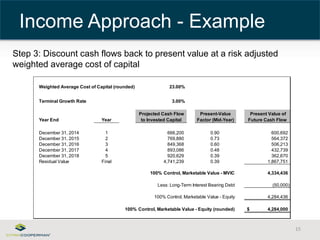
Step 3: Discount cash flows back to present value at a risk adjusted 
weighted average cost of capital 
15 
Income Approach - Example 
Weighted Average Cost of Capital (rounded) 23.00% 
Terminal Growth Rate 3.00% 
Year End Year 
Projected Cash Flow 
to Invested Capital 
Present-Value 
Factor (Mid-Year) 
Present Value of 
Future Cash Flow 
December 31, 2014 1 666,200 0.90 600,692 
December 31, 2015 2 769,880 0.73 564,372 
December 31, 2016 3 849,368 0.60 506,213 
December 31, 2017 4 893,086 0.48 432,739 
December 31, 2018 5 920,629 0.39 362,670 
Residual Value Final 4,741,239 0.39 1,867,751 
100% Control, Marketable Value - MVIC 4,334,436 
Less: Long-Term Interest Bearing Debt (50,000) 
100% Control, Marketable Value - Equity 4,284,436 
100% Control, Marketable Value - Equity (rounded) $ 4,284,000
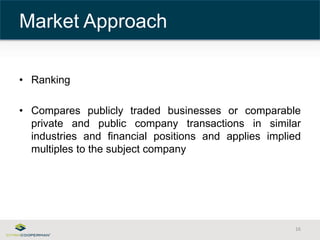
• Ranking 
• Compares publicly traded businesses or comparable 
private and public company transactions in similar 
industries and financial positions and applies implied 
multiples to the subject company 
16 
Market Approach
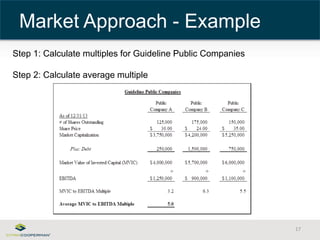
Step 1: Calculate multiples for Guideline Public Companies 
Step 2: Calculate average multiple 
17 
Market Approach - Example
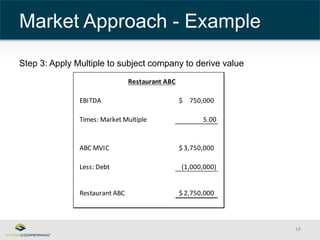
Step 3: Apply Multiple to subject company to derive value 
18 
Market Approach - Example 
Restaurant ABC 
EBITDA $ 750,000 
Times: Market Multiple 5.00 
ABC MVIC $ 3,750,000 
Less: Debt (1,000,000) 
Restaurant ABC $ 2,750,000
• Technically not a valuation method. 
• Prevalent in the restaurant industry. 
• Vary among different types of restaurants. 
• Typically used as a reasonableness check. 
19 
Rules of Thumb 
Source: BVR’s Guide to Restaurant Valuation, by Edward Moran, Business Valuation Resources, LLC, 2010
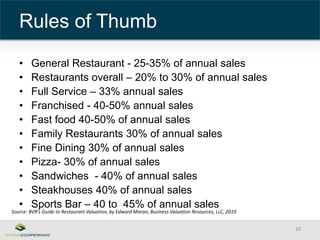
• General Restaurant - 25-35% of annual sales 
• Restaurants overall – 20% to 30% of annual sales 
• Full Service – 33% annual sales 
• Franchised - 40-50% annual sales 
• Fast food 40-50% of annual sales 
• Family Restaurants 30% of annual sales 
• Fine Dining 30% of annual sales 
• Pizza- 30% of annual sales 
• Sandwiches - 40% of annual sales 
• Steakhouses 40% of annual sales 
• Sports Bar – 40 to 45% of annual sales 
20 
Rules of Thumb 
Source: BVR’s Guide to Restaurant Valuation, by Edward Moran, Business Valuation Resources, LLC, 2010
VALUE DRIVERS 
21
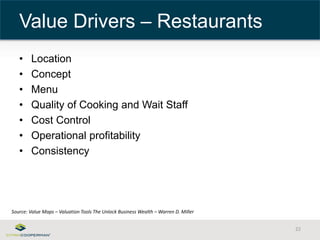
• Location 
• Concept 
• Menu 
• Quality of Cooking and Wait Staff 
• Cost Control 
• Operational profitability 
• Consistency 
22 
Value Drivers – Restaurants 
Source: Value Maps – Valuation Tools The Unlock Business Wealth – Warren D. Miller
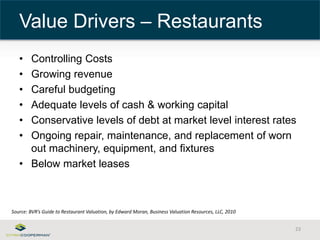
• Controlling Costs 
• Growing revenue 
• Careful budgeting 
• Adequate levels of cash & working capital 
• Conservative levels of debt at market level interest rates 
• Ongoing repair, maintenance, and replacement of worn 
out machinery, equipment, and fixtures 
• Below market leases 
23 
Value Drivers – Restaurants 
Source: BVR’s Guide to Restaurant Valuation, by Edward Moran, Business Valuation Resources, LLC, 2010
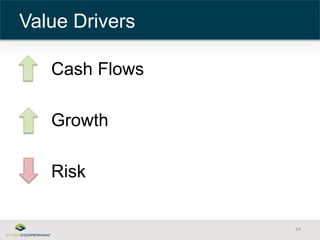
Value Drivers 
Cash Flows 
Growth 
Risk 
24
• Cash Flows 
– Monitor and the control 
– Benchmarking 
– Representative economic income 
25 
Value Drivers
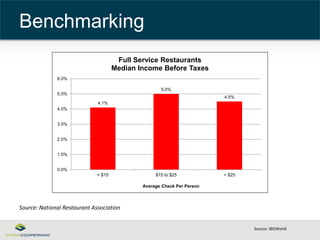
Benchmarking 
Source: IBISWorld 
4.1% 
6.0% 
5.0% 
4.0% 
3.0% 
2.0% 
1.0% 
Full Service Restaurants 
Median Income Before Taxes 
Source: National Restaurant Association 
5.0% 
4.5% 
0.0% 
< $15 $15 to $25 > $25 
Average Check Per Person
Source: American Staffing Association and IBISWorld 
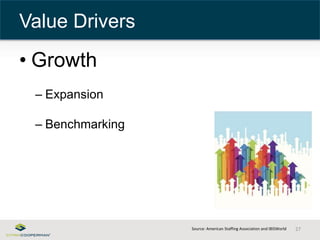
• Growth 
– Expansion 
– Benchmarking 
27 
Value Drivers
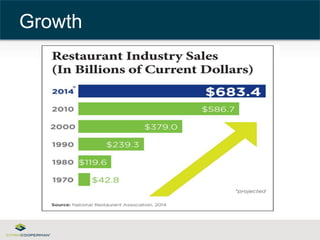
Growth
Growth 
• Income – the #1 driver of restaurant spending. 
• Age – the presence of young children in a household 
reduces restaurant spending. 
• Geography – variations in cost of living, general 
economy and lifestyles. 
Source: IBISWorld 
Source: National Restaurant Association
30 
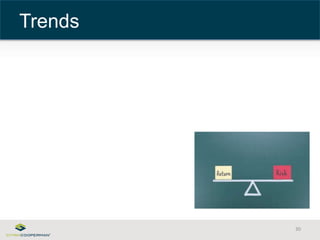
Trends
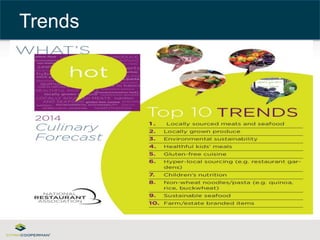
Trends
• Interact via Social media (e.g. Facebook, Twitter, etc.) 
• View menus or make reservations online 
• In-store ordering kiosks 
• Smartphone apps 
32 
Trends 
Source: National Restaurant Association
OWNERSHIP 
CHARACTERISTICS OF 
INTEREST BEING SOLD 
33
• Determine the type of ownership interest 
• Understand the classes of equity ownership 
• Consider valuation adjustments - Discounts 
34 
Ownership Characteristics 
Source: Statement on Standards for Valuation Services #1, AICPA, June 2007
• One size fits all 
• Mis-matching multiples 
• Misjudging the risk 
• Ignoring Management 
• Ignoring Real Estate / Lease 
35 
Common Errors
BEST PRACTICES 
36
• Report income 
• Fully use your POS system 
• Measure of success 
• Financial statements 
• Health inspection reports 
• Brag book 
• Lease negotiations 
37 
Best Practices
38 
QUESTIONS?
About the Presenters 
GARY M. KARLITZ, CPA, ABV, CBA, ASA 
• Gary is the practice leader of Citrin Cooperman's VFS 
group valuation services, forensic services, and forensic 
accounting for the firm. He is located in the firm’s New 
York City and Westchester offices. 
• For more than 30 years; he has negotiated on behalf of 
clients in merger and acquisition matters and in divorce 
proceedings, in which he has provided accounting, 
taxation, and valuation support. Gary has also served as 
a court-appointed referee and neutral valuator and 
testifies frequently as an expert witness in various 
courts. 
• Gary is a past member of the AICPA’s Valuation Exam 
Committee (1999-2008). As part of that national 
committee of valuation services experts, Gary was 
responsible for the preparation of the Accredited in 
Business Valuation (ABV) specialty examination. 
39
About the Presenters 
MANDEEP SIHOTA, CFA, ASA 
• Mandeep, is a principal in Citrin Cooperman's VFS group. She leads the 
valuation team and manages the preparation and delivery of valuations of 
businesses, private equity, professional practices and income generating 
assets such as derivatives and intellectual property. 
• She has prepared hundreds of complex valuations and economic 
damages calculations for a variety of purposes including: mergers and 
acquisitions, estate and gift tax planning, corporate financial planning, 
shareholder actions, matrimonial actions, commercial damages and other 
disputes. 
• Mandeep has experience in a diverse range of industry verticals including 
staffing, hedge funds and other alternative investments, technology, 
construction, hospitality and a broad variety of service, manufacturing, 
and wholesale distribution industries. 
• Mandeep has an Bcomm from the University of Toronto and an MBA 
from the Schulich School of Business, York University in Canada. She is 
a Chartered Financial Analyst (CFA) designation holder, an Accredited 
Senior Appraiser (ASA) with the American Society of Appraisers and a 
member of the CFA Institute and the New York Society of Security 
Analysts. 
• Mandeep is qualified as an expert witness before the Supreme Court of 
the State of New York and testified before the September 11th Victim 
Compensation Fund regarding the economic damages suffered as a 
result of the wrongful death of a New York City firefighter, during the 
September 11, 2001 terrorist attack. 
40
CONNECTICUT | NEW JERSEY | NEW YORK | PENNSYLVANIA 
CITRINCOOPERMAN.COM

Restaurant Valuation: Part Art, Part Science

  • 1.
    Restaurant Valuation PartArt / Part Science December 2, 2014
  • 2.
    Everyone has anopinion of value: • The bookkeeper • The owner • The owner’s spouse • The owner’s ex-spouse • The owner’s parents • The auditor • The tax preparer 2 Standard of Value
  • 3.
    Purpose or needfor the valuation • Merger or acquisition • Family gifting • Estate tax • Divorce • Shareholder oppression / dissent • Damages • Bankruptcy • Shareholder agreements • Income Tax • Financial statement reporting 3 Standard of Value
  • 4.
    • Fair MarketValue • Investment Value • Fair Value 4 Standard of Value
  • 5.
    • Going ConcernValue • Liquidation Value:  Orderly  Forced 5 Premise of Value
  • 6.
  • 7.
  • 8.
    • True EconomicIncome • Recasting / Normalizing P&L • Normalizing Balance Sheet • Comparative common size normalized and industry comparison 8 Cash Flows Source: Statement on Standards for Valuation Services #1, AICPA, June 2007
  • 9.
    • Market LevelCompensation • Perquisites • Market Rent (Above/Below) • Non-recurring revenue and expense items • POS Cash Register Info 9 Normalization Adjustments
  • 10.
  • 11.
    • Cost Approach • Income Approach • Market Approach 11 Common Valuation Approaches
  • 12.
    • Most pertinentwhere a company’s value is tied directly to the value of its underlying assets. • Generally not appropriate for restaurants because intangible assets are not considered 12 Cost Approach
  • 13.
    • Expectation •Requires the determination of a company’s representative earning power which is then discounted back to a present value. 13 Income Approach
  • 14.
    Step 1: Projectincome statement for a discrete period Step 2: Make assumptions about future capital expenditures and working capital needs 14 Income Approach - Example Base Year Ended Forecasted Year Ended 12/31/2013 12/31/2014 12/31/2015 12/31/2016 12/31/2017 12/31/2018 Revenue Growth Rate 30.0% 20.0% 15.0% 10.0% 5.0% 3.0% Cost of Sales 80.0% 80.0% 80.0% 80.0% 80.0% 80.0% Operating Expenses 10.0% 10.0% 10.0% 10.0% 10.0% 10.0% Depreciation & Amortization 2.0% 2.0% 2.0% 2.0% 2.0% 2.0% Revenue $ 12,000,000 $ 14,400,000 $ 16,560,000 $ 18,216,000 $ 19,126,800 $ 19,700,604 Cost of Sales 9,600,000 11,520,000 13,248,000 14,572,800 15,301,440 15,760,483 Gross Profit 2,400,000 2,880,000 3,312,000 3,643,200 3,825,360 3,940,121 Operating Expenses 1,200,000 1,440,000 1,656,000 1,821,600 1,912,680 1,970,060 EBITDA 1,200,000 1,440,000 1,656,000 1,821,600 1,912,680 1,970,060 Depreciation & Amortization 240,000 288,000 331,200 364,320 382,536 394,012 Pre-Tax Income 960,000 1,152,000 1,324,800 1,457,280 1,530,144 1,576,048 Taxes 40.0% (384,000) (460,800) (529,920) (582,912) (612,058) (630,419) - - Net income to Invested Capital 576,000 691,200 794,880 874,368 918,086 945,629 Depreciation & Amortization 288,000 331,200 364,320 382,536 394,012 Capital Expenditures (288,000) (331,200) (364,320) (382,536) (394,012) Cash Needed to Support Working Capital (25,000) (25,000) (25,000) (25,000) (25,000) Net Cash Flow to Invested Capital $ 666,200 $ 769,880 $ 849,368 $ 893,086 $ 920,629
  • 15.
    Step 3: Discountcash flows back to present value at a risk adjusted weighted average cost of capital 15 Income Approach - Example Weighted Average Cost of Capital (rounded) 23.00% Terminal Growth Rate 3.00% Year End Year Projected Cash Flow to Invested Capital Present-Value Factor (Mid-Year) Present Value of Future Cash Flow December 31, 2014 1 666,200 0.90 600,692 December 31, 2015 2 769,880 0.73 564,372 December 31, 2016 3 849,368 0.60 506,213 December 31, 2017 4 893,086 0.48 432,739 December 31, 2018 5 920,629 0.39 362,670 Residual Value Final 4,741,239 0.39 1,867,751 100% Control, Marketable Value - MVIC 4,334,436 Less: Long-Term Interest Bearing Debt (50,000) 100% Control, Marketable Value - Equity 4,284,436 100% Control, Marketable Value - Equity (rounded) $ 4,284,000
  • 16.
    • Ranking •Compares publicly traded businesses or comparable private and public company transactions in similar industries and financial positions and applies implied multiples to the subject company 16 Market Approach
  • 17.
    Step 1: Calculatemultiples for Guideline Public Companies Step 2: Calculate average multiple 17 Market Approach - Example
  • 18.
    Step 3: ApplyMultiple to subject company to derive value 18 Market Approach - Example Restaurant ABC EBITDA $ 750,000 Times: Market Multiple 5.00 ABC MVIC $ 3,750,000 Less: Debt (1,000,000) Restaurant ABC $ 2,750,000
  • 19.
    • Technically nota valuation method. • Prevalent in the restaurant industry. • Vary among different types of restaurants. • Typically used as a reasonableness check. 19 Rules of Thumb Source: BVR’s Guide to Restaurant Valuation, by Edward Moran, Business Valuation Resources, LLC, 2010
  • 20.
    • General Restaurant- 25-35% of annual sales • Restaurants overall – 20% to 30% of annual sales • Full Service – 33% annual sales • Franchised - 40-50% annual sales • Fast food 40-50% of annual sales • Family Restaurants 30% of annual sales • Fine Dining 30% of annual sales • Pizza- 30% of annual sales • Sandwiches - 40% of annual sales • Steakhouses 40% of annual sales • Sports Bar – 40 to 45% of annual sales 20 Rules of Thumb Source: BVR’s Guide to Restaurant Valuation, by Edward Moran, Business Valuation Resources, LLC, 2010
  • 21.
  • 22.
    • Location •Concept • Menu • Quality of Cooking and Wait Staff • Cost Control • Operational profitability • Consistency 22 Value Drivers – Restaurants Source: Value Maps – Valuation Tools The Unlock Business Wealth – Warren D. Miller
  • 23.
    • Controlling Costs • Growing revenue • Careful budgeting • Adequate levels of cash & working capital • Conservative levels of debt at market level interest rates • Ongoing repair, maintenance, and replacement of worn out machinery, equipment, and fixtures • Below market leases 23 Value Drivers – Restaurants Source: BVR’s Guide to Restaurant Valuation, by Edward Moran, Business Valuation Resources, LLC, 2010
  • 24.
    Value Drivers CashFlows Growth Risk 24
  • 25.
    • Cash Flows – Monitor and the control – Benchmarking – Representative economic income 25 Value Drivers
  • 26.
    Benchmarking Source: IBISWorld 4.1% 6.0% 5.0% 4.0% 3.0% 2.0% 1.0% Full Service Restaurants Median Income Before Taxes Source: National Restaurant Association 5.0% 4.5% 0.0% < $15 $15 to $25 > $25 Average Check Per Person
  • 27.
    Source: American StaffingAssociation and IBISWorld • Growth – Expansion – Benchmarking 27 Value Drivers
  • 28.
  • 29.
    Growth • Income– the #1 driver of restaurant spending. • Age – the presence of young children in a household reduces restaurant spending. • Geography – variations in cost of living, general economy and lifestyles. Source: IBISWorld Source: National Restaurant Association
  • 30.
  • 31.
  • 32.
    • Interact viaSocial media (e.g. Facebook, Twitter, etc.) • View menus or make reservations online • In-store ordering kiosks • Smartphone apps 32 Trends Source: National Restaurant Association
  • 33.
    OWNERSHIP CHARACTERISTICS OF INTEREST BEING SOLD 33
  • 34.
    • Determine thetype of ownership interest • Understand the classes of equity ownership • Consider valuation adjustments - Discounts 34 Ownership Characteristics Source: Statement on Standards for Valuation Services #1, AICPA, June 2007
  • 35.
    • One sizefits all • Mis-matching multiples • Misjudging the risk • Ignoring Management • Ignoring Real Estate / Lease 35 Common Errors
  • 36.
  • 37.
    • Report income • Fully use your POS system • Measure of success • Financial statements • Health inspection reports • Brag book • Lease negotiations 37 Best Practices
  • 38.
  • 39.
    About the Presenters GARY M. KARLITZ, CPA, ABV, CBA, ASA • Gary is the practice leader of Citrin Cooperman's VFS group valuation services, forensic services, and forensic accounting for the firm. He is located in the firm’s New York City and Westchester offices. • For more than 30 years; he has negotiated on behalf of clients in merger and acquisition matters and in divorce proceedings, in which he has provided accounting, taxation, and valuation support. Gary has also served as a court-appointed referee and neutral valuator and testifies frequently as an expert witness in various courts. • Gary is a past member of the AICPA’s Valuation Exam Committee (1999-2008). As part of that national committee of valuation services experts, Gary was responsible for the preparation of the Accredited in Business Valuation (ABV) specialty examination. 39
  • 40.
    About the Presenters MANDEEP SIHOTA, CFA, ASA • Mandeep, is a principal in Citrin Cooperman's VFS group. She leads the valuation team and manages the preparation and delivery of valuations of businesses, private equity, professional practices and income generating assets such as derivatives and intellectual property. • She has prepared hundreds of complex valuations and economic damages calculations for a variety of purposes including: mergers and acquisitions, estate and gift tax planning, corporate financial planning, shareholder actions, matrimonial actions, commercial damages and other disputes. • Mandeep has experience in a diverse range of industry verticals including staffing, hedge funds and other alternative investments, technology, construction, hospitality and a broad variety of service, manufacturing, and wholesale distribution industries. • Mandeep has an Bcomm from the University of Toronto and an MBA from the Schulich School of Business, York University in Canada. She is a Chartered Financial Analyst (CFA) designation holder, an Accredited Senior Appraiser (ASA) with the American Society of Appraisers and a member of the CFA Institute and the New York Society of Security Analysts. • Mandeep is qualified as an expert witness before the Supreme Court of the State of New York and testified before the September 11th Victim Compensation Fund regarding the economic damages suffered as a result of the wrongful death of a New York City firefighter, during the September 11, 2001 terrorist attack. 40
  • 41.
    CONNECTICUT | NEWJERSEY | NEW YORK | PENNSYLVANIA CITRINCOOPERMAN.COM