o What is My Business Worth?
o The Valuation Process
o Asset Approach
o Income Approach
o Market Approach
o Maximize Your Value
o Manufacturing Specific
BUSINESS VALUATION
1
Question: What is my Business
Worth?
• Answer: What do you mean by “business?”
o Hint: There is no right or wrong answer to this question!
www.hbcpas.com
2
What Do You Mean By
“Business?”
• Does it include or exclude these assets?
o Cash
o Receivables
o Real Estate
o A company car
o Life insurance policies
• Does it include or exclude these liabilities?
o Accounts payable
o BANK DEBT
www.hbcpas.com
3
Are Buyer and Seller Talking
About the Same Thing?
• Buyer and Seller can agree on a “price,” but that doesn’t
mean they are on the same page!
o #1 – Buyer wants to buy assets of the company for $7 million
o #2 – Seller wants to sell stock for $7 million (which includes $5 million
of bank debt)
• Both “prices” are $7 million, but the asset price is $7 million in
#1 vs. $12 million in #2—That’s $5 million off (40%)!
o Assets = Equity (Stock) + Liabilities
o Asset Price = Cash Paid for Stock + Liabilities Assumed
o $7 million in stock + $5 million in bank debt = $12 million in assets
www.hbcpas.com
4
Company “Equity”
1. Cash
2. Current Assets (AR, inventory)
• Prepaid insurance?
3. Current Liabilities (AP, accruals)
4. Property and Equipment
• Real estate?
5. Intangibles and Goodwill
• Trained and assembled workforce
• Customer relationships
• Backlog of work
• Trade name
6. Interest Bearing Debt
#1 & #6 - not part of the deal in an asset purchase
#2 & #3 – usually part of the deal - defined as “noncash working capital”
#4 & #5 – usually part of the deal
#5 is the real thing we are trying to value
www.hbcpas.com
5
The Takeaway?
• Involve the accountants and clarify what assets and liabilities
you are buying or selling
• Be sure Buyer and Seller are talking about the same assets
and/or liabilities
www.hbcpas.com
6
What is a Business Valuation?
• Giving an opinion as to the value of an ownership interest
(usually shares of stock) of a business
o Generally, all assets and liabilities of a company
(theoretical equity value)
• Fair Market Value – consider both sides – willing buyer and
seller
www.hbcpas.com
7
The Business Valuation Process
• Internal Company Information
• Economic and Industry Analysis
• Valuation Approaches
o Asset
o Income
o Market
• Value Conclusion
www.hbcpas.com
8
The Business Valuation Process:
Internal Company Information
• Review of past five years’ financials statements
• Interviews with management
• General investigation of major assets, liabilities and
business operations
• Identifying strengths and weaknesses
www.hbcpas.com
9
The Business Valuation Process:
Economic and Industry Analysis
• Primary purpose: Help quantify risks associated with the
Company’s operations
• Identify key external factors (interest rates, inflation,
competition, etc.) that may have a direct effect on the
Company’s value
• Compare the Company to its industry (Benchmarking)
www.hbcpas.com
10
The Business Valuation Process:
Valuation Approach – Asset
• Value the Company’s assets and liabilities at fair
market value (FMV)
o Appraisals are usually obtained (real estate, equipment, etc.)
o FMV of liabilities typically equals book value
• Evaluated as if the Company liquidated in an orderly
fashion (Can set a floor for value)
• Not necessarily what Seller would realize in aftertax
sale proceeds
www.hbcpas.com
11
Asset Approach
www.hbcpas.com
12
FMV Fair Market
Book Value Adjustments Value
Cash 608,740$ -$ 608,740$
Accounts receivable 667,510 - 667,510
Inventories 314,482 - 314,482
Other 120,585 - 120,585
Total Current Assets 1,711,317 - 1,711,317
Equipment 483,289 716,711 1,200,000
Real estate 610,408 139,592 750,000
Other assets (life insurance) - - -
Total Assets 2,805,014 856,303 3,661,317
Note payable 620,000 - 620,000
Accounts payable 41,009 - 41,009
Accrued liabilities 171,221 - 171,221
Total Current Liabilities 832,230 - 832,230
Deferred income taxes - 600,000 600,000
Total Liabilities 832,230 600,000 1,432,230
Rounding 20,913
Net Book Value 1,972,784$ 256,303$
Net Asset Value of Business 2,250,000$
Liabilities
Assets
The Business Valuation Process:
Valuation Approach – Income
• Value today = future cash flow discounted at the
opportunity cost of capital
• Economic vs. Accounting Income:
Normalization Adjustments
o Officer’s salary
o Rent
o Charitable contributions
o Extraordinary items
www.hbcpas.com
13
Income Approach
• Just because profits are reported correctly in
accordance with accounting standards does not indicate
it reflects economic reality
• If I am a buyer, what cash flow will be available for me
to pay back the debt incurred on the purchase?
• Future cash flow is discounted back to the present at a
determined discount rate
• Discount rate reflects the risk of the future cash flow
• Example: Picking up a quarter that is two feet away
from you vs. a $100 bill that is across a busy city street.
Risk! www.hbcpas.com
14
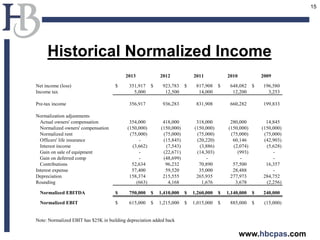
Historical Normalized Income
www.hbcpas.com
15
2013 2012 2011 2010 2009
Net income (loss) 351,917$ 923,783$ 817,908$ 648,082$ 196,580$
Income tax 5,000 12,500 14,000 12,200 3,253
Pre-tax income 356,917 936,283 831,908 660,282 199,833
Normalization adjustments
Actual owners' compensation 354,000 418,000 318,000 280,000 14,845
Normalized owners' compensation (150,000) (150,000) (150,000) (150,000) (150,000)
Normalized rent (75,000) (75,000) (75,000) (75,000) (75,000)
Officers' life insurance - (15,845) (20,220) 60,146 (42,903)
Interest income (3,662) (7,543) (3,886) (2,074) (5,628)
Gain on sale of equipment - (22,671) (14,303) (993) -
Gain on deferred comp - (48,699) - - -
Contributions 52,634 96,232 70,890 57,500 16,357
Interest expense 57,400 59,520 35,000 28,488 -
Depreciation 158,374 215,555 265,935 277,973 284,752
Rounding (663) 4,168 1,676 3,678 (2,256)
Normalized EBITDA 750,000$ 1,410,000$ 1,260,000$ 1,140,000$ 240,000$
Normalized EBIT 615,000$ 1,215,000$ 1,015,000$ 885,000$ (15,000)$
Note: Normalized EBIT has $25K in building depreciation added back
Income Approach
www.hbcpas.com
16
EBITDA (next year's) 1,000,000$
Less: interest expense (35,000)
Less: depreciation expense (200,000)
Pretax Income 765,000
Income taxes (40%) (306,000)
Net Income 459,000
Add: depreciation expense 200,000
Less: required capital expenditures (200,000)
Changes in working capital/interest bearing debt -
Net Cash Flow to Capitalize (next year's) 459,000
Capitalization Rate (Appendix E) 17.0%
Operating Equity Value 2,700,000
Non-Operating Assets:
Excess cash 608,000
Real estate 750,000
Life insurance -
Rounding (8,000)
Total Equity Value of Company 4,050,000$
The Business Valuation Process:
Valuation Approach – Market
• The stock market can provide objective evidence
of value
• Search for similar companies and determine valuation
multiples
• Common Multiples:
o Revenues
o Net income – aka “P/E multiple”
o EBITDA (Earnings before Interest, Taxes, Depreciation and Amortization)
o EBIT
www.hbcpas.com
17
Market Approach
• Private broker reporting databases of nonpublic
companies
• Difficult to see how truly comparable they are – but can
prove useful in certain industries
• Key is to know what is included in the “price” reported
by the broker (possibility of errors)
www.hbcpas.com
18
Market Approach
www.hbcpas.com
19
Company Chosen Formula
Operating Measure Amount Multiple Value
EBIT 800,000$ x 5.0 = 4,000,000$
Add: excess cash 608,000
Less: interest bearing debt (620,000)
Add: life insurance -
Add: real estate 750,000
Rounding (38,000)
Total Equity Value of Company 4,700,000$
The Business Valuation Process:
Value Conclusion
• Reconcile the different approaches
• Sanity checks/Rules of thumb
• Decide on value
www.hbcpas.com
20
Value Conclusion
www.hbcpas.com
21
Weighted
Method Equity Value Weighting Value
Asset Approach 2,250,000$ 0% -$
Income Approach 4,050,000 75% 3,037,500$
Market Approach 4,700,000 25% 1,175,000
100% 4,212,500
Rounding (12,500)
Total Equity Value 4,200,000$
Equity Value Reconciliation
www.hbcpas.com
22
Cash 608,740$
Working Capital (Non-Cash, Debt Free) 890,347
Real Estate 750,000
Equipment 1,200,000
Intangibles 1,970,913
Total Assets 5,420,000$
Interest Bearing Debt (620,000)
Deferred Income Taxes (600,000)
Equity 4,200,000$
Maximize Your Business Value
• Clean up as much personal expenses as you can
o Be sure you are running it like a business
• Look to sell or distribute non-operating assets (considering
income tax ramifications). Excess cash – not protected from
creditors/lawsuits.
• Know/Tell your story
o Why would a buyer be interested in you? Processes/structure has
value.
o Have good answers to tough questions (customer concentration).
• All key management positions filled by someone other than
the owner. Succession plan in place.
www.hbcpas.com
23
Working Capital
• Working capital is critically important in the operation of a
business and often implicit in determining a company’s value
• Example: 2 businesses are both generating $500,000 in net
profit in the manufacturing industry
• Company A needs $1 million of noncash working capital to operate
• Company B needs $1.5 million of noncash working capital to operate
• Why would this be?
• Which Company is more attractive?
www.hbcpas.com
24
Working Capital
• Manage your business to minimize your investment in these
noncash assets
o Ultimately, this may increase your sales price
• KEY POINT: If you can show your business needs less cash
to operate, Buyer will be willing to pay you more
www.hbcpas.com
25
Manufacturing
• Generally higher multiples observed vs. other industries
• How capital intensive is your business? Future capital
expenditures needed to support future projections.
• Working capital
• AR – customer payment terms. The shorter the payment period, the less cash tied up
in the business and the higher the return on assets.
• Inventory – inventory turnover.
• Real estate – does it have separate value from business?
• Proprietary products with dealer or customer network vs.
something closer to a job shop which work is rebid every few
years
• Production capabilities
www.hbcpas.com
26
Manufacturing Multiples:
Manufacturing vs. Other Industries
www.hbcpas.com
27
Manufacturing Multiples:
Public vs. Private Buyers
www.hbcpas.com
28
Questions?
Glen E. Birnbaum
CPA, CVA, ABV, AM
www.hbcpas.com309·694·4251
29

Business valuation imec7 22-14-final

  • 1.
    o What isMy Business Worth? o The Valuation Process o Asset Approach o Income Approach o Market Approach o Maximize Your Value o Manufacturing Specific BUSINESS VALUATION 1
  • 2.
    Question: What ismy Business Worth? • Answer: What do you mean by “business?” o Hint: There is no right or wrong answer to this question! www.hbcpas.com 2
  • 3.
    What Do YouMean By “Business?” • Does it include or exclude these assets? o Cash o Receivables o Real Estate o A company car o Life insurance policies • Does it include or exclude these liabilities? o Accounts payable o BANK DEBT www.hbcpas.com 3
  • 4.
    Are Buyer andSeller Talking About the Same Thing? • Buyer and Seller can agree on a “price,” but that doesn’t mean they are on the same page! o #1 – Buyer wants to buy assets of the company for $7 million o #2 – Seller wants to sell stock for $7 million (which includes $5 million of bank debt) • Both “prices” are $7 million, but the asset price is $7 million in #1 vs. $12 million in #2—That’s $5 million off (40%)! o Assets = Equity (Stock) + Liabilities o Asset Price = Cash Paid for Stock + Liabilities Assumed o $7 million in stock + $5 million in bank debt = $12 million in assets www.hbcpas.com 4
  • 5.
    Company “Equity” 1. Cash 2.Current Assets (AR, inventory) • Prepaid insurance? 3. Current Liabilities (AP, accruals) 4. Property and Equipment • Real estate? 5. Intangibles and Goodwill • Trained and assembled workforce • Customer relationships • Backlog of work • Trade name 6. Interest Bearing Debt #1 & #6 - not part of the deal in an asset purchase #2 & #3 – usually part of the deal - defined as “noncash working capital” #4 & #5 – usually part of the deal #5 is the real thing we are trying to value www.hbcpas.com 5
  • 6.
    The Takeaway? • Involvethe accountants and clarify what assets and liabilities you are buying or selling • Be sure Buyer and Seller are talking about the same assets and/or liabilities www.hbcpas.com 6
  • 7.
    What is aBusiness Valuation? • Giving an opinion as to the value of an ownership interest (usually shares of stock) of a business o Generally, all assets and liabilities of a company (theoretical equity value) • Fair Market Value – consider both sides – willing buyer and seller www.hbcpas.com 7
  • 8.
    The Business ValuationProcess • Internal Company Information • Economic and Industry Analysis • Valuation Approaches o Asset o Income o Market • Value Conclusion www.hbcpas.com 8
  • 9.
    The Business ValuationProcess: Internal Company Information • Review of past five years’ financials statements • Interviews with management • General investigation of major assets, liabilities and business operations • Identifying strengths and weaknesses www.hbcpas.com 9
  • 10.
    The Business ValuationProcess: Economic and Industry Analysis • Primary purpose: Help quantify risks associated with the Company’s operations • Identify key external factors (interest rates, inflation, competition, etc.) that may have a direct effect on the Company’s value • Compare the Company to its industry (Benchmarking) www.hbcpas.com 10
  • 11.
    The Business ValuationProcess: Valuation Approach – Asset • Value the Company’s assets and liabilities at fair market value (FMV) o Appraisals are usually obtained (real estate, equipment, etc.) o FMV of liabilities typically equals book value • Evaluated as if the Company liquidated in an orderly fashion (Can set a floor for value) • Not necessarily what Seller would realize in aftertax sale proceeds www.hbcpas.com 11
  • 12.
    Asset Approach www.hbcpas.com 12 FMV FairMarket Book Value Adjustments Value Cash 608,740$ -$ 608,740$ Accounts receivable 667,510 - 667,510 Inventories 314,482 - 314,482 Other 120,585 - 120,585 Total Current Assets 1,711,317 - 1,711,317 Equipment 483,289 716,711 1,200,000 Real estate 610,408 139,592 750,000 Other assets (life insurance) - - - Total Assets 2,805,014 856,303 3,661,317 Note payable 620,000 - 620,000 Accounts payable 41,009 - 41,009 Accrued liabilities 171,221 - 171,221 Total Current Liabilities 832,230 - 832,230 Deferred income taxes - 600,000 600,000 Total Liabilities 832,230 600,000 1,432,230 Rounding 20,913 Net Book Value 1,972,784$ 256,303$ Net Asset Value of Business 2,250,000$ Liabilities Assets
  • 13.
    The Business ValuationProcess: Valuation Approach – Income • Value today = future cash flow discounted at the opportunity cost of capital • Economic vs. Accounting Income: Normalization Adjustments o Officer’s salary o Rent o Charitable contributions o Extraordinary items www.hbcpas.com 13
  • 14.
    Income Approach • Justbecause profits are reported correctly in accordance with accounting standards does not indicate it reflects economic reality • If I am a buyer, what cash flow will be available for me to pay back the debt incurred on the purchase? • Future cash flow is discounted back to the present at a determined discount rate • Discount rate reflects the risk of the future cash flow • Example: Picking up a quarter that is two feet away from you vs. a $100 bill that is across a busy city street. Risk! www.hbcpas.com 14
  • 15.
    Historical Normalized Income www.hbcpas.com 15 20132012 2011 2010 2009 Net income (loss) 351,917$ 923,783$ 817,908$ 648,082$ 196,580$ Income tax 5,000 12,500 14,000 12,200 3,253 Pre-tax income 356,917 936,283 831,908 660,282 199,833 Normalization adjustments Actual owners' compensation 354,000 418,000 318,000 280,000 14,845 Normalized owners' compensation (150,000) (150,000) (150,000) (150,000) (150,000) Normalized rent (75,000) (75,000) (75,000) (75,000) (75,000) Officers' life insurance - (15,845) (20,220) 60,146 (42,903) Interest income (3,662) (7,543) (3,886) (2,074) (5,628) Gain on sale of equipment - (22,671) (14,303) (993) - Gain on deferred comp - (48,699) - - - Contributions 52,634 96,232 70,890 57,500 16,357 Interest expense 57,400 59,520 35,000 28,488 - Depreciation 158,374 215,555 265,935 277,973 284,752 Rounding (663) 4,168 1,676 3,678 (2,256) Normalized EBITDA 750,000$ 1,410,000$ 1,260,000$ 1,140,000$ 240,000$ Normalized EBIT 615,000$ 1,215,000$ 1,015,000$ 885,000$ (15,000)$ Note: Normalized EBIT has $25K in building depreciation added back
  • 16.
    Income Approach www.hbcpas.com 16 EBITDA (nextyear's) 1,000,000$ Less: interest expense (35,000) Less: depreciation expense (200,000) Pretax Income 765,000 Income taxes (40%) (306,000) Net Income 459,000 Add: depreciation expense 200,000 Less: required capital expenditures (200,000) Changes in working capital/interest bearing debt - Net Cash Flow to Capitalize (next year's) 459,000 Capitalization Rate (Appendix E) 17.0% Operating Equity Value 2,700,000 Non-Operating Assets: Excess cash 608,000 Real estate 750,000 Life insurance - Rounding (8,000) Total Equity Value of Company 4,050,000$
  • 17.
    The Business ValuationProcess: Valuation Approach – Market • The stock market can provide objective evidence of value • Search for similar companies and determine valuation multiples • Common Multiples: o Revenues o Net income – aka “P/E multiple” o EBITDA (Earnings before Interest, Taxes, Depreciation and Amortization) o EBIT www.hbcpas.com 17
  • 18.
    Market Approach • Privatebroker reporting databases of nonpublic companies • Difficult to see how truly comparable they are – but can prove useful in certain industries • Key is to know what is included in the “price” reported by the broker (possibility of errors) www.hbcpas.com 18
  • 19.
    Market Approach www.hbcpas.com 19 Company ChosenFormula Operating Measure Amount Multiple Value EBIT 800,000$ x 5.0 = 4,000,000$ Add: excess cash 608,000 Less: interest bearing debt (620,000) Add: life insurance - Add: real estate 750,000 Rounding (38,000) Total Equity Value of Company 4,700,000$
  • 20.
    The Business ValuationProcess: Value Conclusion • Reconcile the different approaches • Sanity checks/Rules of thumb • Decide on value www.hbcpas.com 20
  • 21.
    Value Conclusion www.hbcpas.com 21 Weighted Method EquityValue Weighting Value Asset Approach 2,250,000$ 0% -$ Income Approach 4,050,000 75% 3,037,500$ Market Approach 4,700,000 25% 1,175,000 100% 4,212,500 Rounding (12,500) Total Equity Value 4,200,000$
  • 22.
    Equity Value Reconciliation www.hbcpas.com 22 Cash608,740$ Working Capital (Non-Cash, Debt Free) 890,347 Real Estate 750,000 Equipment 1,200,000 Intangibles 1,970,913 Total Assets 5,420,000$ Interest Bearing Debt (620,000) Deferred Income Taxes (600,000) Equity 4,200,000$
  • 23.
    Maximize Your BusinessValue • Clean up as much personal expenses as you can o Be sure you are running it like a business • Look to sell or distribute non-operating assets (considering income tax ramifications). Excess cash – not protected from creditors/lawsuits. • Know/Tell your story o Why would a buyer be interested in you? Processes/structure has value. o Have good answers to tough questions (customer concentration). • All key management positions filled by someone other than the owner. Succession plan in place. www.hbcpas.com 23
  • 24.
    Working Capital • Workingcapital is critically important in the operation of a business and often implicit in determining a company’s value • Example: 2 businesses are both generating $500,000 in net profit in the manufacturing industry • Company A needs $1 million of noncash working capital to operate • Company B needs $1.5 million of noncash working capital to operate • Why would this be? • Which Company is more attractive? www.hbcpas.com 24
  • 25.
    Working Capital • Manageyour business to minimize your investment in these noncash assets o Ultimately, this may increase your sales price • KEY POINT: If you can show your business needs less cash to operate, Buyer will be willing to pay you more www.hbcpas.com 25
  • 26.
    Manufacturing • Generally highermultiples observed vs. other industries • How capital intensive is your business? Future capital expenditures needed to support future projections. • Working capital • AR – customer payment terms. The shorter the payment period, the less cash tied up in the business and the higher the return on assets. • Inventory – inventory turnover. • Real estate – does it have separate value from business? • Proprietary products with dealer or customer network vs. something closer to a job shop which work is rebid every few years • Production capabilities www.hbcpas.com 26
  • 27.
    Manufacturing Multiples: Manufacturing vs.Other Industries www.hbcpas.com 27
  • 28.
    Manufacturing Multiples: Public vs.Private Buyers www.hbcpas.com 28
  • 29.
    Questions? Glen E. Birnbaum CPA,CVA, ABV, AM www.hbcpas.com309·694·4251 29