Vine Valuations Inc.
Christine Minelli CA•CBV, CFI
chrism@vine.on.ca
(905) 549-8463 or (905)517-3741
www.vine.on.ca


Offices in Hamilton, Burlington and
             Kitchener
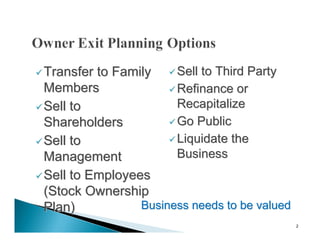
 Transfer to Family  Sell to Third Party
  Members               Refinance or

 Sell to                Recapitalize
  Shareholders          Go Public

 Sell to               Liquidate the

  Management             Business
 Sell to Employees
  (Stock Ownership
  Plan)           Business needs to be valued
                                                2
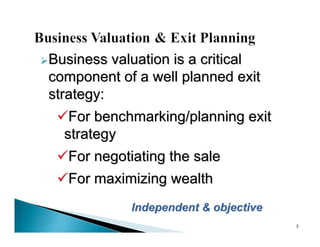
 Business valuation is a critical
 component of a well planned exit
 strategy:
  For benchmarking/planning exit
    strategy
  For negotiating the sale
  For maximizing wealth
             Independent & objective
                                       3
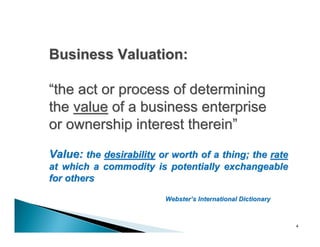
Business Valuation:

“the act or process of determining
the value of a business enterprise
or ownership interest therein”
Value: the desirability or worth of a thing; the rate
at which a commodity is potentially exchangeable
for others

                         Webster’s International Dictionary


                                                              4
Business Owner:
   “What’s the value of my
 business?”
Business Valuator:
    “ It depends…”


                             5
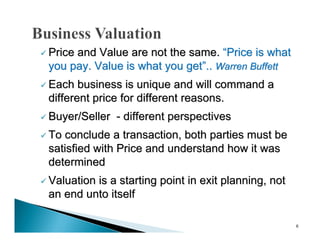
 Price
      and Value are not the same. “Price is what
 you pay. Value is what you get”.. Warren Buffett
 Each  business is unique and will command a
 different price for different reasons.
 Buyer/Seller   - different perspectives
 Toconclude a transaction, both parties must be
 satisfied with Price and understand how it was
 determined
 Valuation
          is a starting point in exit planning, not
 an end unto itself

                                                      6
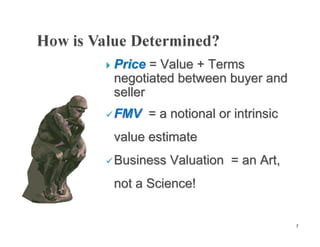
   Price = Value + Terms
    negotiated between buyer and
    seller
 FMV    = a notional or intrinsic
    value estimate
 Business   Valuation = an Art,
    not a Science!


                                     7
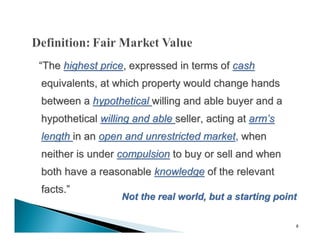
“The highest price, expressed in terms of cash
equivalents, at which property would change hands
between a hypothetical willing and able buyer and a
hypothetical willing and able seller, acting at arm’s
length in an open and unrestricted market, when
neither is under compulsion to buy or sell and when
both have a reasonable knowledge of the relevant
facts.”
                  Not the real world, but a starting point

                                                         8
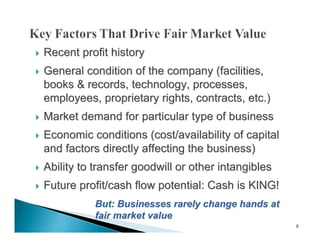
   Recent profit history
   General condition of the company (facilities,
    books & records, technology, processes,
    employees, proprietary rights, contracts, etc.)
   Market demand for particular type of business
   Economic conditions (cost/availability of capital
    and factors directly affecting the business)
   Ability to transfer goodwill or other intangibles
   Future profit/cash flow potential: Cash is KING!
               But: Businesses rarely change hands at
               fair market value
                                                        9
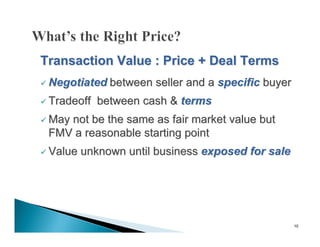
Transaction Value : Price + Deal Terms
 Negotiated between   seller and a specific buyer
 Tradeoff   between cash & terms
 May
    not be the same as fair market value but
 FMV a reasonable starting point
 Value   unknown until business exposed for sale


                                                     10
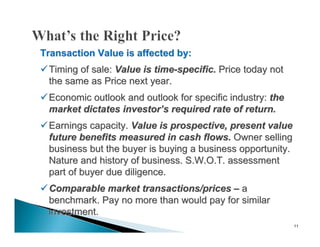
Transaction Value is affected by:
 Timing of sale: Value is time-specific. Price today not
  the same as Price next year.
 Economic outlook and outlook for specific industry: the
  market dictates investor’s required rate of return.
 Earnings capacity. Value is prospective, present value
  future benefits measured in cash flows. Owner selling
  business but the buyer is buying a business opportunity.
  Nature and history of business. S.W.O.T. assessment
  part of buyer due diligence.
 Comparable market transactions/prices – a
  benchmark. Pay no more than would pay for similar
  investment.
                                                             11
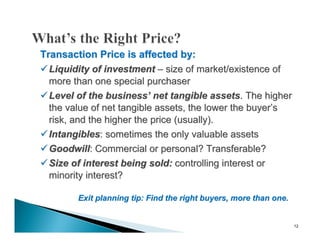
Transaction Price is affected by:
 Liquidity of investment – size of market/existence of
  more than one special purchaser
 Level of the business’ net tangible assets. The higher
  the value of net tangible assets, the lower the buyer’s
  risk, and the higher the price (usually).
 Intangibles: sometimes the only valuable assets
 Goodwill: Commercial or personal? Transferable?
 Size of interest being sold: controlling interest or
  minority interest?

        Exit planning tip: Find the right buyers, more than one.


                                                                   12
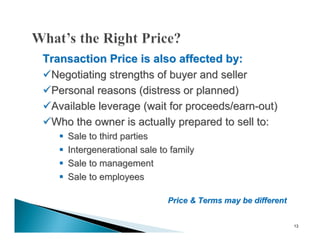
Transaction Price is also affected by:
Negotiating strengths of buyer and seller
Personal reasons (distress or planned)
Available leverage (wait for proceeds/earn-out)
Who the owner is actually prepared to sell to:
      Sale to third parties
      Intergenerational sale to family
      Sale to management
      Sale to employees

                                Price & Terms may be different


                                                                 13
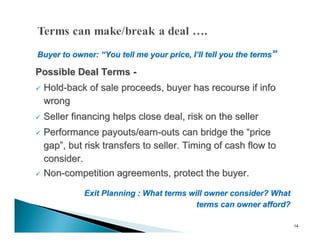
Buyer to owner: “You tell me your price, I’ll tell you the terms”

Possible Deal Terms -
   Hold-back of sale proceeds, buyer has recourse if info
    wrong
   Seller financing helps close deal, risk on the seller
 Performance payouts/earn-outs can bridge the “price
  gap”, but risk transfers to seller. Timing of cash flow to
  consider.
 Non-competition agreements, protect the buyer.


             Exit Planning : What terms will owner consider? What
                                          terms can owner afford?

                                                                    14
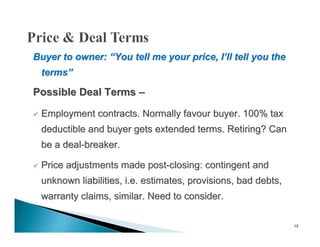
Buyer to owner: “You tell me your price, I’ll tell you the
    terms”

Possible Deal Terms –

   Employment contracts. Normally favour buyer. 100% tax
    deductible and buyer gets extended terms. Retiring? Can
    be a deal-breaker.

   Price adjustments made post-closing: contingent and
    unknown liabilities, i.e. estimates, provisions, bad debts,
    warranty claims, similar. Need to consider.

                                                                  15
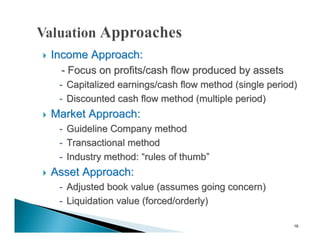
   Income Approach:
     - Focus on profits/cash flow produced by assets
     - Capitalized earnings/cash flow method (single period)
     - Discounted cash flow method (multiple period)
   Market Approach:
     - Guideline Company method
     - Transactional method
     - Industry method: “rules of thumb”
   Asset Approach:
     - Adjusted book value (assumes going concern)
     - Liquidation value (forced/orderly)

                                                           16
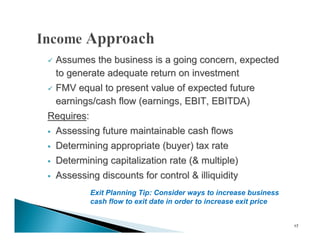
 Assumes the business is a going concern, expected
  to generate adequate return on investment
 FMV equal to present value of expected future

  earnings/cash flow (earnings, EBIT, EBITDA)
Requires:
   Assessing future maintainable cash flows
   Determining appropriate (buyer) tax rate
   Determining capitalization rate (& multiple)
   Assessing discounts for control & illiquidity
            Exit Planning Tip: Consider ways to increase business
            cash flow to exit date in order to increase exit price


                                                                     17
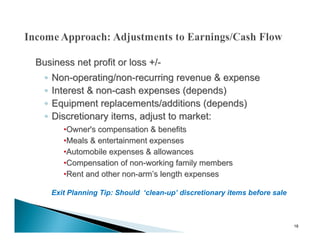
Business net profit or loss +/-
  ◦   Non-operating/non-recurring revenue & expense
  ◦   Interest & non-cash expenses (depends)
  ◦   Equipment replacements/additions (depends)
  ◦   Discretionary items, adjust to market:
         •Owner's compensation & benefits
         •Meals & entertainment expenses
         •Automobile expenses & allowances
         •Compensation of non-working family members
         •Rent and other non-arm’s length expenses

      Exit Planning Tip: Should ‘clean-up’ discretionary items before sale


                                                                             18
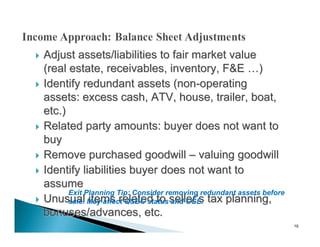
   Adjust assets/liabilities to fair market value
    (real estate, receivables, inventory, F&E …)
   Identify redundant assets (non-operating
    assets: excess cash, ATV, house, trailer, boat,
    etc.)
   Related party amounts: buyer does not want to
    buy
   Remove purchased goodwill – valuing goodwill
   Identify liabilities buyer does not want to
    assume
          Exit Planning Tip: Consider removing redundant assets before
   Unusual May affect QSBC status seller’s tax planning,
          sale. items related to and CGE.
    bonuses/advances, etc.
                                                                         19
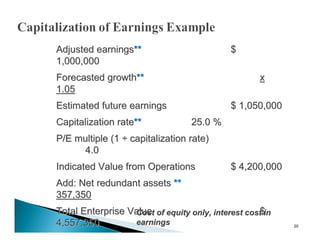
Adjusted earnings**                         $
1,000,000
Forecasted growth**                                 x
1.05
Estimated future earnings                   $ 1,050,000
Capitalization rate**             25.0 %
P/E multiple (1 ÷ capitalization rate)
     4.0
Indicated Value from Operations             $ 4,200,000
Add: Net redundant assets **
357,350
Total Enterprise Value of equity only, interest cost$in
                  Cost
4,557,350         earnings                                20
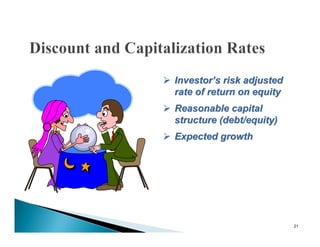
 Investor’s risk adjusted
  rate of return on equity
 Reasonable capital
  structure (debt/equity)
 Expected growth


                             21
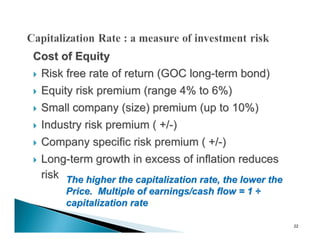
Cost of Equity
 Risk free rate of return (GOC long-term bond)

   Equity risk premium (range 4% to 6%)
   Small company (size) premium (up to 10%)
   Industry risk premium ( +/-)
   Company specific risk premium ( +/-)
   Long-term growth in excess of inflation reduces
    risk The higher the capitalization rate, the lower the
         Price. Multiple of earnings/cash flow = 1 ÷
         capitalization rate

                                                             22
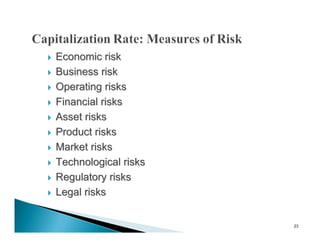
   Economic risk
   Business risk
   Operating risks
   Financial risks
   Asset risks
   Product risks
   Market risks
   Technological risks
   Regulatory risks
   Legal risks


                          23
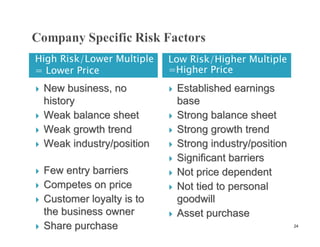
High Risk/Lower Multiple     Low Risk/Higher Multiple
= Lower Price                =Higher Price
   New business, no            Established earnings
    history                      base
   Weak balance sheet          Strong balance sheet
   Weak growth trend           Strong growth trend
   Weak industry/position      Strong industry/position
                                Significant barriers
   Few entry barriers          Not price dependent
   Competes on price           Not tied to personal
   Customer loyalty is to       goodwill
    the business owner          Asset purchase
   Share purchase                                          24
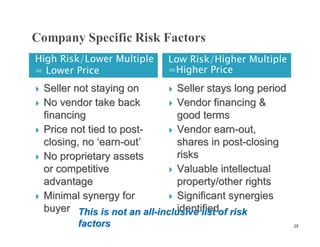
High Risk/Lower Multiple       Low Risk/Higher Multiple
= Lower Price                  =Higher Price
   Seller not staying on        Seller stays long period
   No vendor take back          Vendor financing &
    financing                     good terms
   Price not tied to post-      Vendor earn-out,
    closing, no ‘earn-out’        shares in post-closing
   No proprietary assets         risks
    or competitive               Valuable intellectual
    advantage                     property/other rights
   Minimal synergy for          Significant synergies
    buyer This is not an all-inclusive list of risk
                                  identified
           factors                                           25
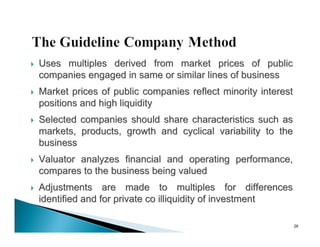
   Uses multiples derived from market prices of public
    companies engaged in same or similar lines of business
   Market prices of public companies reflect minority interest
    positions and high liquidity
   Selected companies should share characteristics such as
    markets, products, growth and cyclical variability to the
    business
   Valuator analyzes financial and operating performance,
    compares to the business being valued
   Adjustments are made to multiples for differences
    identified and for private co illiquidity of investment

                                                                  26
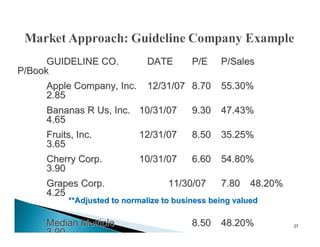
GUIDELINE CO.          DATE        P/E    P/Sales
P/Book
     Apple Company, Inc.     12/31/07 8.70      55.30%
     2.85
     Bananas R Us, Inc. 10/31/07         9.30   47.43%
     4.65
     Fruits, Inc.          12/31/07      8.50   35.25%
     3.65
     Cherry Corp.          10/31/07      6.60   54.80%
     3.90
     Grapes Corp.                  11/30/07     7.80    48.20%
     4.25
          **Adjusted to normalize to business being valued

     Median Multiple                     8.50   48.20%           27
     3.90
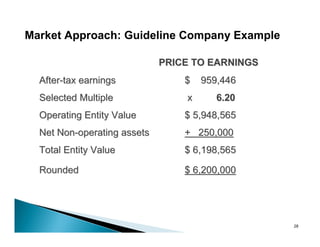
Market Approach: Guideline Company Example

                             PRICE TO EARNINGS
  After-tax earnings             $   959,446
  Selected Multiple              x      6.20
  Operating Entity Value         $ 5,948,565
  Net Non-operating assets       + 250,000
  Total Entity Value             $ 6,198,565

  Rounded                        $ 6,200,000


                                                 28
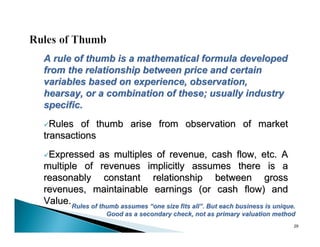
A rule of thumb is a mathematical formula developed
from the relationship between price and certain
variables based on experience, observation,
hearsay, or a combination of these; usually industry
specific.
Rules   of thumb arise from observation of market
transactions
Expressed      as multiples of revenue, cash flow, etc. A
multiple of revenues implicitly assumes there is a
reasonably constant relationship between gross
revenues, maintainable earnings (or cash flow) and
Value. Rules of thumb assumes “one size fits all”. But each business is unique.
                   Good as a secondary check, not as primary valuation method
                                                                              29
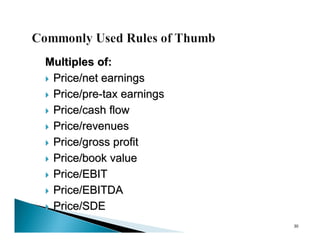
Multiples of:
 Price/net earnings

 Price/pre-tax earnings

 Price/cash flow

 Price/revenues

 Price/gross profit

 Price/book value

 Price/EBIT

 Price/EBITDA

 Price/SDE

                           30
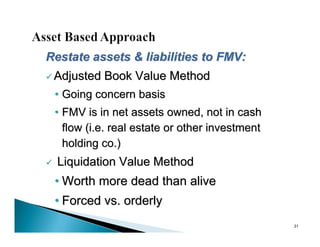
Restate assets & liabilities to FMV:
 Adjusted    Book Value Method
    • Going concern basis
    • FMV is in net assets owned, not in cash
      flow (i.e. real estate or other investment
      holding co.)
   Liquidation Value Method
    • Worth more dead than alive
    • Forced vs. orderly
                                                   31
Business Owner:
   “What’s the value of my
 business?”
Business valuator:
    “ It depends…”


                             32
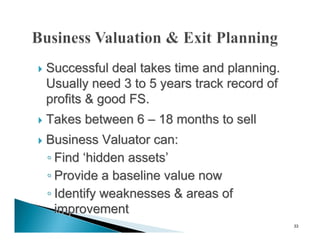
   Successful deal takes time and planning.
    Usually need 3 to 5 years track record of
    profits & good FS.
   Takes between 6 – 18 months to sell
   Business Valuator can:
    ◦ Find ‘hidden assets’
    ◦ Provide a baseline value now
    ◦ Identify weaknesses & areas of
      improvement
                                                33
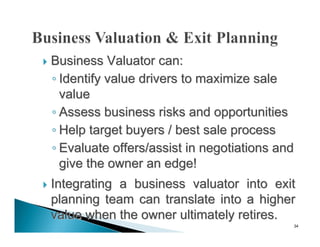
   Business Valuator can:
    ◦ Identify value drivers to maximize sale
      value
    ◦ Assess business risks and opportunities
    ◦ Help target buyers / best sale process
    ◦ Evaluate offers/assist in negotiations and
      give the owner an edge!
   Integrating a business valuator into exit
    planning team can translate into a higher
    value when the owner ultimately retires.
                                               34
Vine Valuations Inc.
Christine Minelli CA•CBV, CFI
chrism@vine.on.ca
(905) 549-8463 or (905)517-3741
www.vine.on.ca


 Offices in Hamilton, Burlington and
              Kitchener

Succession Planning Esop Assoc. 2008

  • 1.
    Vine Valuations Inc. ChristineMinelli CA•CBV, CFI chrism@vine.on.ca (905) 549-8463 or (905)517-3741 www.vine.on.ca Offices in Hamilton, Burlington and Kitchener
  • 2.
     Transfer toFamily  Sell to Third Party Members  Refinance or  Sell to Recapitalize Shareholders  Go Public  Sell to  Liquidate the Management Business  Sell to Employees (Stock Ownership Plan) Business needs to be valued 2
  • 3.
     Business valuationis a critical component of a well planned exit strategy: For benchmarking/planning exit strategy For negotiating the sale For maximizing wealth Independent & objective 3
  • 4.
    Business Valuation: “the actor process of determining the value of a business enterprise or ownership interest therein” Value: the desirability or worth of a thing; the rate at which a commodity is potentially exchangeable for others Webster’s International Dictionary 4
  • 5.
    Business Owner: “What’s the value of my business?” Business Valuator: “ It depends…” 5
  • 6.
     Price and Value are not the same. “Price is what you pay. Value is what you get”.. Warren Buffett  Each business is unique and will command a different price for different reasons.  Buyer/Seller - different perspectives  Toconclude a transaction, both parties must be satisfied with Price and understand how it was determined  Valuation is a starting point in exit planning, not an end unto itself 6
  • 7.
    Price = Value + Terms negotiated between buyer and seller  FMV = a notional or intrinsic value estimate  Business Valuation = an Art, not a Science! 7
  • 8.
    “The highest price,expressed in terms of cash equivalents, at which property would change hands between a hypothetical willing and able buyer and a hypothetical willing and able seller, acting at arm’s length in an open and unrestricted market, when neither is under compulsion to buy or sell and when both have a reasonable knowledge of the relevant facts.” Not the real world, but a starting point 8
  • 9.
    Recent profit history  General condition of the company (facilities, books & records, technology, processes, employees, proprietary rights, contracts, etc.)  Market demand for particular type of business  Economic conditions (cost/availability of capital and factors directly affecting the business)  Ability to transfer goodwill or other intangibles  Future profit/cash flow potential: Cash is KING! But: Businesses rarely change hands at fair market value 9
  • 10.
    Transaction Value :Price + Deal Terms  Negotiated between seller and a specific buyer  Tradeoff between cash & terms  May not be the same as fair market value but FMV a reasonable starting point  Value unknown until business exposed for sale 10
  • 11.
    Transaction Value isaffected by:  Timing of sale: Value is time-specific. Price today not the same as Price next year.  Economic outlook and outlook for specific industry: the market dictates investor’s required rate of return.  Earnings capacity. Value is prospective, present value future benefits measured in cash flows. Owner selling business but the buyer is buying a business opportunity. Nature and history of business. S.W.O.T. assessment part of buyer due diligence.  Comparable market transactions/prices – a benchmark. Pay no more than would pay for similar investment. 11
  • 12.
    Transaction Price isaffected by:  Liquidity of investment – size of market/existence of more than one special purchaser  Level of the business’ net tangible assets. The higher the value of net tangible assets, the lower the buyer’s risk, and the higher the price (usually).  Intangibles: sometimes the only valuable assets  Goodwill: Commercial or personal? Transferable?  Size of interest being sold: controlling interest or minority interest? Exit planning tip: Find the right buyers, more than one. 12
  • 13.
    Transaction Price isalso affected by: Negotiating strengths of buyer and seller Personal reasons (distress or planned) Available leverage (wait for proceeds/earn-out) Who the owner is actually prepared to sell to:  Sale to third parties  Intergenerational sale to family  Sale to management  Sale to employees Price & Terms may be different 13
  • 14.
    Buyer to owner:“You tell me your price, I’ll tell you the terms” Possible Deal Terms -  Hold-back of sale proceeds, buyer has recourse if info wrong  Seller financing helps close deal, risk on the seller  Performance payouts/earn-outs can bridge the “price gap”, but risk transfers to seller. Timing of cash flow to consider.  Non-competition agreements, protect the buyer. Exit Planning : What terms will owner consider? What terms can owner afford? 14
  • 15.
    Buyer to owner:“You tell me your price, I’ll tell you the terms” Possible Deal Terms –  Employment contracts. Normally favour buyer. 100% tax deductible and buyer gets extended terms. Retiring? Can be a deal-breaker.  Price adjustments made post-closing: contingent and unknown liabilities, i.e. estimates, provisions, bad debts, warranty claims, similar. Need to consider. 15
  • 16.
    Income Approach: - Focus on profits/cash flow produced by assets - Capitalized earnings/cash flow method (single period) - Discounted cash flow method (multiple period)  Market Approach: - Guideline Company method - Transactional method - Industry method: “rules of thumb”  Asset Approach: - Adjusted book value (assumes going concern) - Liquidation value (forced/orderly) 16
  • 17.
     Assumes thebusiness is a going concern, expected to generate adequate return on investment  FMV equal to present value of expected future earnings/cash flow (earnings, EBIT, EBITDA) Requires:  Assessing future maintainable cash flows  Determining appropriate (buyer) tax rate  Determining capitalization rate (& multiple)  Assessing discounts for control & illiquidity Exit Planning Tip: Consider ways to increase business cash flow to exit date in order to increase exit price 17
  • 18.
    Business net profitor loss +/- ◦ Non-operating/non-recurring revenue & expense ◦ Interest & non-cash expenses (depends) ◦ Equipment replacements/additions (depends) ◦ Discretionary items, adjust to market: •Owner's compensation & benefits •Meals & entertainment expenses •Automobile expenses & allowances •Compensation of non-working family members •Rent and other non-arm’s length expenses Exit Planning Tip: Should ‘clean-up’ discretionary items before sale 18
  • 19.
    Adjust assets/liabilities to fair market value (real estate, receivables, inventory, F&E …)  Identify redundant assets (non-operating assets: excess cash, ATV, house, trailer, boat, etc.)  Related party amounts: buyer does not want to buy  Remove purchased goodwill – valuing goodwill  Identify liabilities buyer does not want to assume Exit Planning Tip: Consider removing redundant assets before  Unusual May affect QSBC status seller’s tax planning, sale. items related to and CGE. bonuses/advances, etc. 19
  • 20.
    Adjusted earnings** $ 1,000,000 Forecasted growth** x 1.05 Estimated future earnings $ 1,050,000 Capitalization rate** 25.0 % P/E multiple (1 ÷ capitalization rate) 4.0 Indicated Value from Operations $ 4,200,000 Add: Net redundant assets ** 357,350 Total Enterprise Value of equity only, interest cost$in Cost 4,557,350 earnings 20
  • 21.
     Investor’s riskadjusted rate of return on equity  Reasonable capital structure (debt/equity)  Expected growth 21
  • 22.
    Cost of Equity Risk free rate of return (GOC long-term bond)  Equity risk premium (range 4% to 6%)  Small company (size) premium (up to 10%)  Industry risk premium ( +/-)  Company specific risk premium ( +/-)  Long-term growth in excess of inflation reduces risk The higher the capitalization rate, the lower the Price. Multiple of earnings/cash flow = 1 ÷ capitalization rate 22
  • 23.
    Economic risk  Business risk  Operating risks  Financial risks  Asset risks  Product risks  Market risks  Technological risks  Regulatory risks  Legal risks 23
  • 24.
    High Risk/Lower Multiple Low Risk/Higher Multiple = Lower Price =Higher Price  New business, no  Established earnings history base  Weak balance sheet  Strong balance sheet  Weak growth trend  Strong growth trend  Weak industry/position  Strong industry/position  Significant barriers  Few entry barriers  Not price dependent  Competes on price  Not tied to personal  Customer loyalty is to goodwill the business owner  Asset purchase  Share purchase 24
  • 25.
    High Risk/Lower Multiple Low Risk/Higher Multiple = Lower Price =Higher Price  Seller not staying on  Seller stays long period  No vendor take back  Vendor financing & financing good terms  Price not tied to post-  Vendor earn-out, closing, no ‘earn-out’ shares in post-closing  No proprietary assets risks or competitive  Valuable intellectual advantage property/other rights  Minimal synergy for  Significant synergies buyer This is not an all-inclusive list of risk identified factors 25
  • 26.
    Uses multiples derived from market prices of public companies engaged in same or similar lines of business  Market prices of public companies reflect minority interest positions and high liquidity  Selected companies should share characteristics such as markets, products, growth and cyclical variability to the business  Valuator analyzes financial and operating performance, compares to the business being valued  Adjustments are made to multiples for differences identified and for private co illiquidity of investment 26
  • 27.
    GUIDELINE CO. DATE P/E P/Sales P/Book Apple Company, Inc. 12/31/07 8.70 55.30% 2.85 Bananas R Us, Inc. 10/31/07 9.30 47.43% 4.65 Fruits, Inc. 12/31/07 8.50 35.25% 3.65 Cherry Corp. 10/31/07 6.60 54.80% 3.90 Grapes Corp. 11/30/07 7.80 48.20% 4.25 **Adjusted to normalize to business being valued Median Multiple 8.50 48.20% 27 3.90
  • 28.
    Market Approach: GuidelineCompany Example PRICE TO EARNINGS After-tax earnings $ 959,446 Selected Multiple x 6.20 Operating Entity Value $ 5,948,565 Net Non-operating assets + 250,000 Total Entity Value $ 6,198,565 Rounded $ 6,200,000 28
  • 29.
    A rule ofthumb is a mathematical formula developed from the relationship between price and certain variables based on experience, observation, hearsay, or a combination of these; usually industry specific. Rules of thumb arise from observation of market transactions Expressed as multiples of revenue, cash flow, etc. A multiple of revenues implicitly assumes there is a reasonably constant relationship between gross revenues, maintainable earnings (or cash flow) and Value. Rules of thumb assumes “one size fits all”. But each business is unique. Good as a secondary check, not as primary valuation method 29
  • 30.
    Multiples of:  Price/netearnings  Price/pre-tax earnings  Price/cash flow  Price/revenues  Price/gross profit  Price/book value  Price/EBIT  Price/EBITDA  Price/SDE 30
  • 31.
    Restate assets &liabilities to FMV:  Adjusted Book Value Method • Going concern basis • FMV is in net assets owned, not in cash flow (i.e. real estate or other investment holding co.)  Liquidation Value Method • Worth more dead than alive • Forced vs. orderly 31
  • 32.
    Business Owner: “What’s the value of my business?” Business valuator: “ It depends…” 32
  • 33.
    Successful deal takes time and planning. Usually need 3 to 5 years track record of profits & good FS.  Takes between 6 – 18 months to sell  Business Valuator can: ◦ Find ‘hidden assets’ ◦ Provide a baseline value now ◦ Identify weaknesses & areas of improvement 33
  • 34.
    Business Valuator can: ◦ Identify value drivers to maximize sale value ◦ Assess business risks and opportunities ◦ Help target buyers / best sale process ◦ Evaluate offers/assist in negotiations and give the owner an edge!  Integrating a business valuator into exit planning team can translate into a higher value when the owner ultimately retires. 34
  • 35.
    Vine Valuations Inc. ChristineMinelli CA•CBV, CFI chrism@vine.on.ca (905) 549-8463 or (905)517-3741 www.vine.on.ca Offices in Hamilton, Burlington and Kitchener