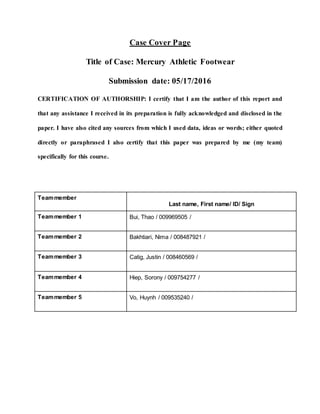
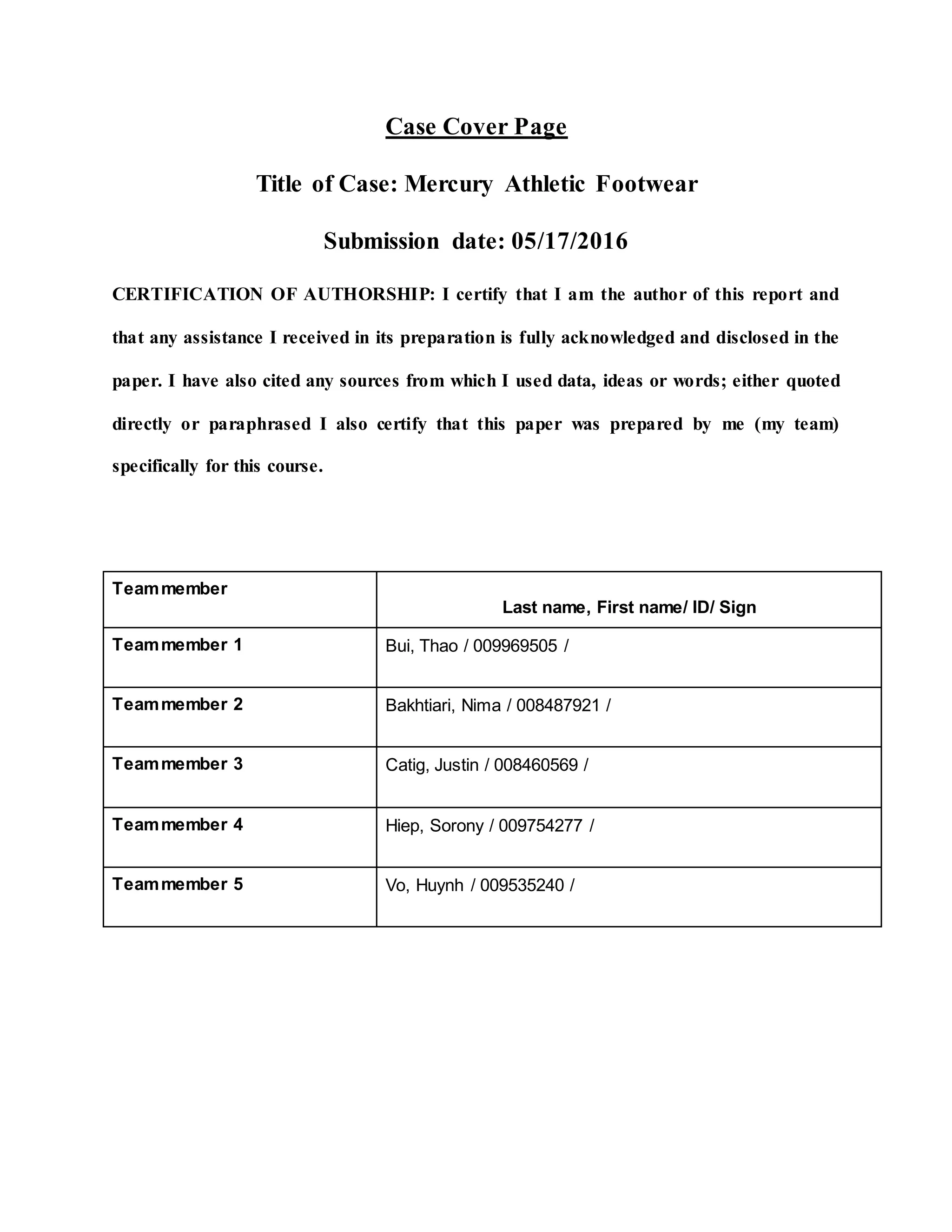
Case Cover Page
Title of Case: Mercury Athletic Footwear
Submission date: 05/17/2016
CERTIFICATION OF AUTHORSHIP: I certify that I am the author of this report and
that any assistance I received in its preparation is fully acknowledged and disclosed in the
paper. I have also cited any sources from which I used data, ideas or words; either quoted
directly or paraphrased I also certify that this paper was prepared by me (my team)
specifically for this course.
Teammember
Last name, First name/ ID/ Sign
Teammember 1 Bui, Thao / 009969505 /
Teammember 2 Bakhtiari, Nima / 008487921 /
Teammember 3 Catig, Justin / 008460569 /
Teammember 4 Hiep, Sorony / 009754277 /
Teammember 5 Vo, Huynh / 009535240 /
2
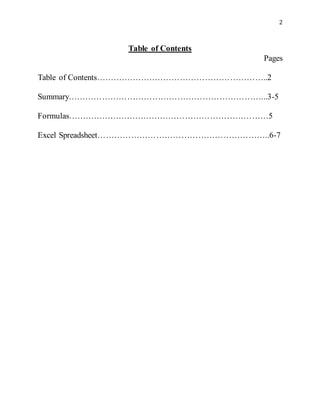
Table of Contents
Pages
Table of Contents……………………………………………………..2
Summary……………………………………………………………...3-5
Formulas………………………………………………………………5
Excel Spreadsheet……………………………………………………..6-7
3
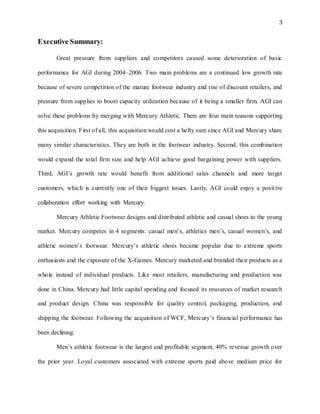
Executive Summary:
Great pressure from suppliers and competitors caused some deterioration of basic
performance for AGI during 2004–2006. Two main problems are a continued low growth rate
because of severe competition of the mature footwear industry and rise of discount retailers, and
pressure from supplies to boost capacity utilization because of it being a smaller firm. AGI can
solve these problems by merging with Mercury Athletic. There are four main reasons supporting
this acquisition. First of all, this acquisition would cost a hefty sum since AGI and Mercury share
many similar characteristics. They are both in the footwear industry. Second, this combination
would expand the total firm size and help AGI achieve good bargaining power with suppliers.
Third, AGI’s growth rate would benefit from additional sales channels and more target
customers, which is currently one of their biggest issues. Lastly, AGI could enjoy a positive
collaboration effort working with Mercury.
Mercury Athletic Footwear designs and distributed athletic and casual shoes to the young
market. Mercury competes in 4 segments: casual men’s, athletics men’s, casual women’s, and
athletic women’s footwear. Mercury’s athletic shoes became popular due to extreme sports
enthusiasts and the exposure of the X-Games. Mercury marketed and branded their products as a
whole instead of individual products. Like most retailers, manufacturing and production was
done in China. Mercury had little capital spending and focused its resources of market research
and product design. China was responsible for quality control, packaging, production, and
shipping the footwear. Following the acquisition of WCF, Mercury’s financial performance has
been declining.
Men’s athletic footwear is the largest and profitable segment, 40% revenue growth over
the prior year. Loyal customers associated with extreme sports paid above medium price for
4
Mercury footwear. Men’s casual footwear peaked in 2004 and had declined since with a 6.25%
average rate of return. The decline in sales is attributed to shipping problems and cannibalization.
However, the Men’s casual segment posted Mercury’s highest profit margins due to marketing
and distribution strategy. Compared to the Men’s athletic line, the Women’s athletic line saw
subpar performance. Operating margins average above 10% with an industry average of 11.9%.
The lack of sales can be attributed to the lack of women participants in extreme sports. In
addition, prior to the WCF acquisition, marketing for the women line has not been a focus.
Women’s casual footwear was Mercury’s worst performing business segment. Between 2004-
2006, sales dropped tremendously, which led to inventory write-downs. The end of 2006
considered the women’s casual footwear segment considered all but dead.
Overview of Problems:
The footwear industry is in the mature stage of the business cycle. The Footwear industry
is highly competitive with low growth but luckily has stable profit margins. Active Gear Inc. was
among the most profitable firms in the footwear industry which shows solid performance and
strength in the company. However they also face potential problems. Currently, pressure from
suppliers and competitors are causing some worsening of basic performance for AGI during
2004–2006. There are two main problems. One is that AGI is smaller than other competitors,
which is becoming a competitive disadvantage. Another is that the rise of “big box” large
retailers threatened AGI’s growth. One of solution is to acquire Mercury Athletic, which a
division of West Coast Fashions, Inc., a large business of men’s and women’s and represents a
similar market share in footwear industry. Men’s athletic footwear is the leading product for
Mercury Athletic. Women’s casual footwear is Mercury’s worst performing product and post-
acquisition the line may be discontinued by Active Gear. The acquisition of the Mercury Athletic
5
division has sources of potential including an increase in Active Gear’s revenue, an increase in
leverage with contract manufacturers, boosting capacity utilization and expanding its presence
with retailers and distributors.
Formulas:
 CAPM=Risk Free Rate + Beta (MRP)
 WACC=[Debt*Cost of Debt (1-Tax rate)]+(Equity*CAPM)
Networking Capital=CURRENT ASSETS-CURRENT LIABILITIES
 CHANGES IN Networking Capital=YEAR 2 NWC-YEAR 1 NWC
 Net reinvestment=(Capital Expenditure +Change in net NWC)/NOPAT
 FCF=EBIT*(1-tax)+DEPR-change in NWC-Capital expenditure
 Terminal Value=Last value of stock*(1+Growth Rate)/(WACC-Growth Rate)
 Enterprise Value=
6
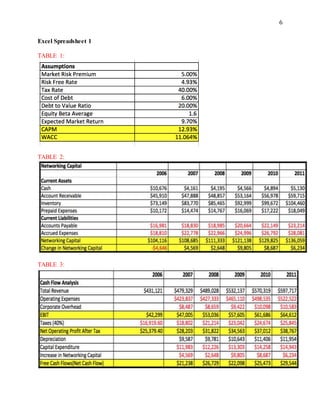
Excel Spreadsheet 1
TABLE 1:
TABLE 2:
TABLE 3:
7
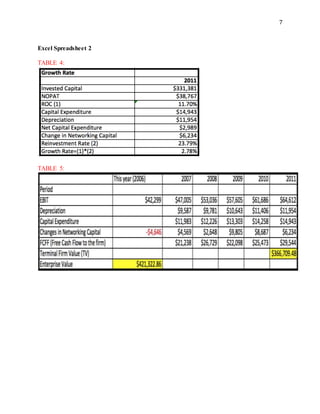
Excel Spreadsheet 2
TABLE 4:
TABLE 5:

Mercury case

  • 1.
    Case Cover Page Titleof Case: Mercury Athletic Footwear Submission date: 05/17/2016 CERTIFICATION OF AUTHORSHIP: I certify that I am the author of this report and that any assistance I received in its preparation is fully acknowledged and disclosed in the paper. I have also cited any sources from which I used data, ideas or words; either quoted directly or paraphrased I also certify that this paper was prepared by me (my team) specifically for this course. Teammember Last name, First name/ ID/ Sign Teammember 1 Bui, Thao / 009969505 / Teammember 2 Bakhtiari, Nima / 008487921 / Teammember 3 Catig, Justin / 008460569 / Teammember 4 Hiep, Sorony / 009754277 / Teammember 5 Vo, Huynh / 009535240 /
  • 2.
    2 Table of Contents Pages Tableof Contents……………………………………………………..2 Summary……………………………………………………………...3-5 Formulas………………………………………………………………5 Excel Spreadsheet……………………………………………………..6-7
  • 3.
    3 Executive Summary: Great pressurefrom suppliers and competitors caused some deterioration of basic performance for AGI during 2004–2006. Two main problems are a continued low growth rate because of severe competition of the mature footwear industry and rise of discount retailers, and pressure from supplies to boost capacity utilization because of it being a smaller firm. AGI can solve these problems by merging with Mercury Athletic. There are four main reasons supporting this acquisition. First of all, this acquisition would cost a hefty sum since AGI and Mercury share many similar characteristics. They are both in the footwear industry. Second, this combination would expand the total firm size and help AGI achieve good bargaining power with suppliers. Third, AGI’s growth rate would benefit from additional sales channels and more target customers, which is currently one of their biggest issues. Lastly, AGI could enjoy a positive collaboration effort working with Mercury. Mercury Athletic Footwear designs and distributed athletic and casual shoes to the young market. Mercury competes in 4 segments: casual men’s, athletics men’s, casual women’s, and athletic women’s footwear. Mercury’s athletic shoes became popular due to extreme sports enthusiasts and the exposure of the X-Games. Mercury marketed and branded their products as a whole instead of individual products. Like most retailers, manufacturing and production was done in China. Mercury had little capital spending and focused its resources of market research and product design. China was responsible for quality control, packaging, production, and shipping the footwear. Following the acquisition of WCF, Mercury’s financial performance has been declining. Men’s athletic footwear is the largest and profitable segment, 40% revenue growth over the prior year. Loyal customers associated with extreme sports paid above medium price for
  • 4.
    4 Mercury footwear. Men’scasual footwear peaked in 2004 and had declined since with a 6.25% average rate of return. The decline in sales is attributed to shipping problems and cannibalization. However, the Men’s casual segment posted Mercury’s highest profit margins due to marketing and distribution strategy. Compared to the Men’s athletic line, the Women’s athletic line saw subpar performance. Operating margins average above 10% with an industry average of 11.9%. The lack of sales can be attributed to the lack of women participants in extreme sports. In addition, prior to the WCF acquisition, marketing for the women line has not been a focus. Women’s casual footwear was Mercury’s worst performing business segment. Between 2004- 2006, sales dropped tremendously, which led to inventory write-downs. The end of 2006 considered the women’s casual footwear segment considered all but dead. Overview of Problems: The footwear industry is in the mature stage of the business cycle. The Footwear industry is highly competitive with low growth but luckily has stable profit margins. Active Gear Inc. was among the most profitable firms in the footwear industry which shows solid performance and strength in the company. However they also face potential problems. Currently, pressure from suppliers and competitors are causing some worsening of basic performance for AGI during 2004–2006. There are two main problems. One is that AGI is smaller than other competitors, which is becoming a competitive disadvantage. Another is that the rise of “big box” large retailers threatened AGI’s growth. One of solution is to acquire Mercury Athletic, which a division of West Coast Fashions, Inc., a large business of men’s and women’s and represents a similar market share in footwear industry. Men’s athletic footwear is the leading product for Mercury Athletic. Women’s casual footwear is Mercury’s worst performing product and post- acquisition the line may be discontinued by Active Gear. The acquisition of the Mercury Athletic
  • 5.
    5 division has sourcesof potential including an increase in Active Gear’s revenue, an increase in leverage with contract manufacturers, boosting capacity utilization and expanding its presence with retailers and distributors. Formulas:  CAPM=Risk Free Rate + Beta (MRP)  WACC=[Debt*Cost of Debt (1-Tax rate)]+(Equity*CAPM) Networking Capital=CURRENT ASSETS-CURRENT LIABILITIES  CHANGES IN Networking Capital=YEAR 2 NWC-YEAR 1 NWC  Net reinvestment=(Capital Expenditure +Change in net NWC)/NOPAT  FCF=EBIT*(1-tax)+DEPR-change in NWC-Capital expenditure  Terminal Value=Last value of stock*(1+Growth Rate)/(WACC-Growth Rate)  Enterprise Value=
  • 6.
    6 Excel Spreadsheet 1 TABLE1: TABLE 2: TABLE 3:
  • 7.