Histology of the Lower Respiratory Tract
(Trachea, Bronchi, Bronchioles) & the Lung
Color index:
Slides.. Important ..Notes ..Extra..
Objectives :
The microscopic structures of the wall of:
Trachea.
Primary or extrapulmonary bronchi.
Intrapulmonary (secondary and tertiary) bronchi.
Bronchioles
The microscopic structures of :
Interalveolar septum.
Alveolar phagocytes.
Pleura.
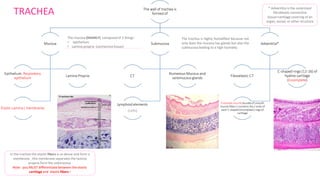
TRACHEA The wall of trachea is
formed of
Mucosa
Epithelium: Respiratory
epithelium
Lamina Propria
Elastic Lamina ( membrane)
Submucosa
C.T
Numerous Mucous and
seromucous glands
Lymphoid elements
(cells)
Adventitia*
Fibroelastic C.T
C-shaped rings (12-16) of
hyaline cartilage
(incomplete)
Trachealis muscle (bundle of smooth
muscle fibers ) connects the 2 ends of
each C-shaped(incomplete) rings of
cartilage
In the trachea the elastic fibers is so dense and form a
membrane , this membrane separates the lamina
propria form the submucosa.
Note : you MUST differentiate between the elastic
cartilage and elastic fibers !
The mucosa (MAINLY) composed of 2 things :
• epithelium
• Lamina propria (connective tissue)
* Adventitia is the outermost
fibroblastic connective
tissue+cartilage covering of an
organ, vessel, or other structure
The trachea is highly humidified because not
only does the mucosa has glands but also the
submucosaleading to a high humidity
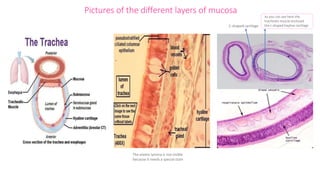
Pictures of the different layers of mucosa
As you can see here the
trachealis muscle enclosed
the c-shapedhayline cartilage
The elastic lamina is not visible
because it needs a special stain
C-shapedcartilage
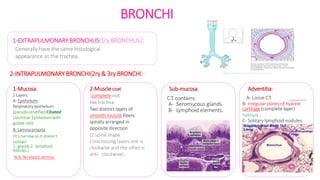
1-Mucosa:
2 Layers:
A- Epithelium:
Respiratory epithelium
(pseudo-stratified Ciliated
columnar Epithelium with
goblet cell).
B- Lamina propria.
(It’s narrow so it doesn’t
contain
1- glands 2- lymphoid
follicles.)
N.B.No elasticlamina.
2-Musclecoat
(complete)not
like trachea:
Two distinct layers of
smooth muscle fibers
spirally arranged in
opposite direction
(2 spiral shape
crisscrossing layers one is
clockwise and the other is
anti- clockwise).
Adventitia:
Sub-mucosa:
C.T
. contains:
A- Seromucous glands.
B- Lymphoid elements.
A- Loose C.T.
B- Irregular plates of hyaline
cartilage (complete layer)
hallmark .
C- Solitary lymphoid nodules.
1-EXTRAPULMONARY BRONCHUS(1ry BRONCHUS):
Generally have the same histological
appearance as the trachea.
2-INTRAPULMONARY BRONCHI(2ry & 3ry BRONCHI):
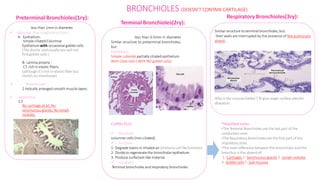
BRONCHI
less than 0.5mm in diameter
.
Similar structure to preterminal bronchioles,
but:
Epithelium:
Simple cuboidal partially ciliated epithelium
With Clara cells ( With NO goblet cells).
CLARA CELLS:
 Structure:
columnar cells (non ciliated).
 Function:
1- Degrade toxins in inhaled air
. (immune cell likefunction)
2- Divideto regenerate the bronchiolar epithelium.
3- Produce surfactant-like material.
 Location:
Terminal bronchioles and respiratory bronchioles.
*Important notes :
•The Terminal Bronchioles are the last part of the
conduction zone .
•The RespiratoryBronchiolesare the first part of the
respiratory zone.
•The main differencebetween the bronchioles and the
bronchus is the absent of:
1- Cartilages 2- Seromucous glands 3- Lymph nodules
4- Goblet cells 5- Sub-mucosa
B- Lamina propria :
C.T
. rich in elastic fibers.
(although it’s rich in elastic fiber but
there’s no membrane)
 Muscle coat:
2 helically arranged smooth muscle layers.
 Adventitia:
C.T.
No cartilage at all, No
seromucous glands, No lymph
nodules.
Preterminal Bronchioles(1ry):
less than 1mm in diameter
.
 Mucosa: (has longitudinal folds )
A- Epithelium:
Simple ciliated Columnar
Epithelium with occasional goblet cells.
(The doctor said usually you will not
find goblet cells )
their walls are interrupted by the presence of few pulmonary
alveoli.
Why is the mucosa folded ? To give larger surface area for
dilatation.
BRONCHIOLES (DOESN’T CONTAIN CARTILAGE)
Respiratory Bronchioles(3ry):
Terminal Bronchioles(2ry):
Similarstructure to terminal bronchioles,but:
EXTRA
‫بع‬
‫ش‬
‫ال‬
‫ت‬
‫ف‬
‫ر‬
‫ع‬
‫د‬
‫ا‬
‫ز‬
‫ا‬
‫م‬
‫ل‬
‫ك‬
‫و‬
‫تق‬
‫م‬
‫ع‬
‫ت‬
‫ا‬
‫م‬
‫ل‬
‫ك‬
‫هنا‬
‫ي‬‫ف‬
‫ك‬
‫ك‬
‫ل‬
‫حضوي‬
‫انه‬
‫يوكت‬‫ن‬‫ه‬‫ا‬
‫ف‬
‫ي‬
‫ةلخادال‬
‫ءايشالا‬
‫و‬
‫تال‬‫ر‬‫ا‬‫ك‬‫ي‬‫ب‬
‫كدنع‬
‫ت‬
‫ن‬
‫ق‬
‫ص‬
‫ةيئاوهال‬
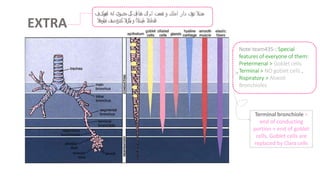
Note-team435-: Special
features of everyone of them:
Pretermenal > Goblet cells
Terminal > NO goblet cells ,
Rispiratory > Alveoli
Bronchioles
Terminal bronchiole =
end of conducting
portion + end of goblet
cells, Goblet cells are
replaced by Clara cells
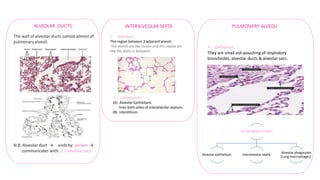
ALVEOLAR DUCTS
The wall of alveolar ducts consist almost of
pulmonaryalveoli.
N.B. Alveolar duct → ends by: atrium →
communicates with: 2-3 alveolar sacs
PULMONARY ALVEOLI
 Definition:
They are small out-pouching of respiratory
bronchioles, alveolar ducts & alveolar sacs.
INTERALVEOLAR SEPTA
 Definition:
The region between 2 adjacentalveoli.
the alveoli are like rooms and the septas are
like the walls in between
 Components:
(A) Alveolar Epithelium:
lines both sides of interalveolar septum.
(B) Interstitium.
PULMONARY ALVEOLI
Alveolar epithelium. Interalveolar septa.
Alveolar phagocytes
(Lung macrophages).
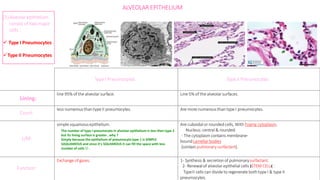
(1)Alveolarepithelium
consist of twomajor
cells :
 Type I Pneumocytes
Type II Pneumocytes
Type I Pneumocytes Type IIPneumocytes
line 95% of the alveolarsurface. Line 5% of the alveolarsurfaces.
Count:
less numerous than type II pneumocytes. Are more numerousthan type I pneumocytes.
L/M:
Are cuboidal or roundedcells, With Foamy cytoplasm.
Nucleus:central & rounded.
- The cytoplasm contains membrane-
boundLamellar bodies
(contain pulmonary surfactant).
Function:
Exchange ofgases. 1- Synthesis & secretionof pulmonarysurfactant.
2- Renewalof alveolar epithelial cells )STEM CELL( :
TypeII cells can divide to regenerate both type I & type II
pneumocytes.
ALVEOLAR EPITHELIUM
Lining:
simple squamousepithelium.
The number of type I pneumocyte in alveolar epithelium is less then type 2
but its lining surface is greater , why ?
Simply because the epithelium of pneumocyte type 1 is SIMPLE
SAQUAMOUS and since it’s SQUAMOUS it can fill the space with less
number of cells  .
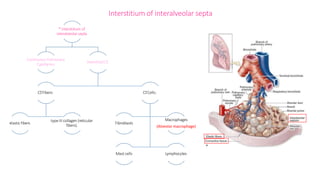
* Interstitium of
interalveolar septa
Continuous Pulmonary
Capillaries.
InterstitialC.T
.
C.
T
.Fibers:
elastic fibers
type III collagen (reticular
fibers).
C.
T
.Cells:
Fibroblasts
Macrophages
(Alveolar macrophage)
Mast cells Lymphocytes
Interstitium of interalveolar septa
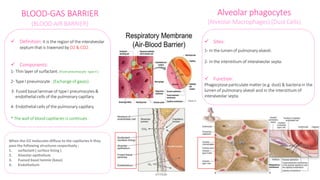
BLOOD-GAS BARRIER
(BLOOD-AIR BARRIER)
 Definition: It is the region of the interalveolar
septum that is traversed by O2 & CO2 .
 Components:
1- Thin layer of surfactant. (frompneumocyte type II )
2- Type I pneumocyte . (Exchange of gases)
3- Fused basal laminae of typeI pneumocytes&
endothelial cells of the pulmonary capillary.
4- Endothelial cells of the pulmonary capillary.
* The wall of blood capillaries is continues.
Alveolar phagocytes
(Alveolar Macrophages) (Dust Cells)
 Sites:
1- In the lumenof pulmonary alveoli.
2- In the interstitium of interalveolar septa.
 Function:
Phagocytoseparticulate matter (e.g. dust) & bacteria in the
lumen of pulmonary alveoli and in the interstitium of
interalveolar septa.
When the O2 molecules diffuse to the capillaries it they
pass the following structures respectively :
1. surfactant ( surface lining )
2. Alveolar epithelium
3. Fuesed basel lamnie (base)
4. Endothelium
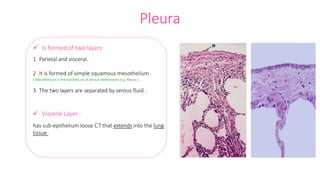
Pleura
 Is formed of two layers:
1 Parietal and visceral.
2 It is formed of simple squamous mesothelium .
( Mesothelium is the epithelium of serous membranes e.g. Pleura )
3 The two layers are separated by serous fluid .
 Visceral Layer :
has sub-epithelium loose C.T that extends into the lung
tissue .
Mind Map
Thanks to our dear fellow student Norah Alshabib for sharing!
FULL MIND MAP
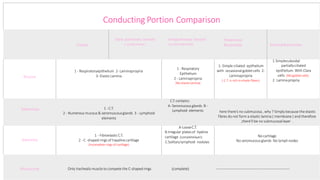
Conducting Portion Comparison
Trachea
Extra-pulmonary bronchi
( 1ryBronchus)
Intrapulmonary bronchi
(2ry &3ryBronchi)
Preterminal
Bronchioles TerminalBronchioles
Mucosa
1 - Respiratoryepithelium 2- Laminapropria
3- ElasticLamina
1 -Respiratory
Epithelium
2 - Laminapropria
(No elasticlamina)
1- Simple ciliated epithelium
with occasional gobletcells 2-
Laminapropria
( C.T. is rich in elsatic fibers)
1 Simplecuboidal
partiallyciliated
epithelium With Clara
cells (NO gobletcells).
2 Laminapropria
Submucosa 1 -C.T.
2 - Numerous mucous & seromuscousglands 3 - Lymphoid
elements
C.T.contains:
A- Seromucousglands B -
Lymphoid elements here there’s no submucosa , why ? Simply because the elastic
fibres do not form a elastic lamina ( membrane ) and therefore
,there’ll be no submucosallayer .
Adventitia
1 - FibroelasticC.T.
2 - C -shaped rings of hayalinecartilage
(incomplete rings of cartilage)
A-LooseC.T.
B.Irregular platesof hyaline
cartilage (completelayer).
C.Solitarylymphoid nodules
Nocartilage
No seromucousglands No lymphnodes
Muscle coat Only trachealis muscle to compete the C-shapedrings (complete) ---------------------------------------------------------------
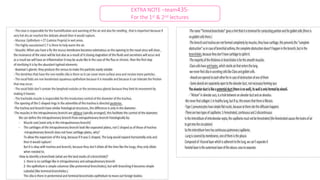
EXTRA NOTE –team435-
For the 1st & 2nd lectures
Videos :
We recommend watching this 5min video:
https://www.youtube.com/watch?v=UDIgNteqVag
Full playlist for respiratory system :
https://www.youtube.com/watch?v=23_aHo4X2Vs&list=PLEf8wmJpS_1HmywDPF1Ve0zRhWfHCH
COy
Links to help you !
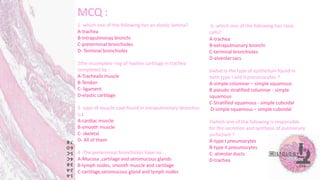
MCQ :
1 which one of the following has an elastic lamina?
A-trachea
B-Intrapulmonay bronchi
C-preterminal bronchioles
D- Terminal bronchioles
2the incomplete ring of hyaline cartilage in trachea
completed by :
A-Trachealis muscle
B-Tendon
C- ligament
D-elastic cartilage
3 type of muscle coat found in intrapulmonary bronchus
is :
A-cardiac muscle
B-smooth muscle
C- skeletal
D- All of them
4 -The preterminal bronchioles have no …
A-Mucosa ,cartilage and seromucous glands
B-lymph nodes, smooth muscle and cartilage
C-cartilage,seromucous gland and lymph nodes
5- which one of the following has clara
cells?
A-trachea
B-extrapulmonary bronchi
C-terminal bronchioles
D-alveolar sacs
6what is the type of epithelium found in
both type I and II pneumocytes ?
A-simple columnar – simple squamous
B pseudo stratified columnar - simple
squamous
C-Stratified squamous - simple cuboidal
D-simple squamous – simple cuboidal
7which one of the following is responsible
for the secretion and synthesis of pulmonary
surfactant ?
A-type I pneumocytes
B-type II pneumocytes
C- alveolar ducts
D-trachea
Thank you & good luck
- Histology team
Done by :
 Ahmed Badahdah
 Mutasem Alhasani
 Omar Turkistani
 Nawaf Aldarweesh
 Mohammed Khojah
 Shahad Alanzan
Team leaders:
Reema Alotaibi
Faisal Alrabaii
Please if you need anything or even further explanation contact us on :
HistologyTeam436@gmail.com
@histology436

2-Lower Respiratory Tract (3).pptx

  • 1.
    Histology of theLower Respiratory Tract (Trachea, Bronchi, Bronchioles) & the Lung Color index: Slides.. Important ..Notes ..Extra..
  • 2.
    Objectives : The microscopicstructures of the wall of: Trachea. Primary or extrapulmonary bronchi. Intrapulmonary (secondary and tertiary) bronchi. Bronchioles The microscopic structures of : Interalveolar septum. Alveolar phagocytes. Pleura.
  • 3.
    TRACHEA The wallof trachea is formed of Mucosa Epithelium: Respiratory epithelium Lamina Propria Elastic Lamina ( membrane) Submucosa C.T Numerous Mucous and seromucous glands Lymphoid elements (cells) Adventitia* Fibroelastic C.T C-shaped rings (12-16) of hyaline cartilage (incomplete) Trachealis muscle (bundle of smooth muscle fibers ) connects the 2 ends of each C-shaped(incomplete) rings of cartilage In the trachea the elastic fibers is so dense and form a membrane , this membrane separates the lamina propria form the submucosa. Note : you MUST differentiate between the elastic cartilage and elastic fibers ! The mucosa (MAINLY) composed of 2 things : • epithelium • Lamina propria (connective tissue) * Adventitia is the outermost fibroblastic connective tissue+cartilage covering of an organ, vessel, or other structure The trachea is highly humidified because not only does the mucosa has glands but also the submucosaleading to a high humidity
  • 4.
    Pictures of thedifferent layers of mucosa As you can see here the trachealis muscle enclosed the c-shapedhayline cartilage The elastic lamina is not visible because it needs a special stain C-shapedcartilage
  • 5.
    1-Mucosa: 2 Layers: A- Epithelium: Respiratoryepithelium (pseudo-stratified Ciliated columnar Epithelium with goblet cell). B- Lamina propria. (It’s narrow so it doesn’t contain 1- glands 2- lymphoid follicles.) N.B.No elasticlamina. 2-Musclecoat (complete)not like trachea: Two distinct layers of smooth muscle fibers spirally arranged in opposite direction (2 spiral shape crisscrossing layers one is clockwise and the other is anti- clockwise). Adventitia: Sub-mucosa: C.T . contains: A- Seromucous glands. B- Lymphoid elements. A- Loose C.T. B- Irregular plates of hyaline cartilage (complete layer) hallmark . C- Solitary lymphoid nodules. 1-EXTRAPULMONARY BRONCHUS(1ry BRONCHUS): Generally have the same histological appearance as the trachea. 2-INTRAPULMONARY BRONCHI(2ry & 3ry BRONCHI): BRONCHI
  • 6.
    less than 0.5mmin diameter . Similar structure to preterminal bronchioles, but: Epithelium: Simple cuboidal partially ciliated epithelium With Clara cells ( With NO goblet cells). CLARA CELLS:  Structure: columnar cells (non ciliated).  Function: 1- Degrade toxins in inhaled air . (immune cell likefunction) 2- Divideto regenerate the bronchiolar epithelium. 3- Produce surfactant-like material.  Location: Terminal bronchioles and respiratory bronchioles. *Important notes : •The Terminal Bronchioles are the last part of the conduction zone . •The RespiratoryBronchiolesare the first part of the respiratory zone. •The main differencebetween the bronchioles and the bronchus is the absent of: 1- Cartilages 2- Seromucous glands 3- Lymph nodules 4- Goblet cells 5- Sub-mucosa B- Lamina propria : C.T . rich in elastic fibers. (although it’s rich in elastic fiber but there’s no membrane)  Muscle coat: 2 helically arranged smooth muscle layers.  Adventitia: C.T. No cartilage at all, No seromucous glands, No lymph nodules. Preterminal Bronchioles(1ry): less than 1mm in diameter .  Mucosa: (has longitudinal folds ) A- Epithelium: Simple ciliated Columnar Epithelium with occasional goblet cells. (The doctor said usually you will not find goblet cells ) their walls are interrupted by the presence of few pulmonary alveoli. Why is the mucosa folded ? To give larger surface area for dilatation. BRONCHIOLES (DOESN’T CONTAIN CARTILAGE) Respiratory Bronchioles(3ry): Terminal Bronchioles(2ry): Similarstructure to terminal bronchioles,but:
  • 7.
  • 8.
    ALVEOLAR DUCTS The wallof alveolar ducts consist almost of pulmonaryalveoli. N.B. Alveolar duct → ends by: atrium → communicates with: 2-3 alveolar sacs PULMONARY ALVEOLI  Definition: They are small out-pouching of respiratory bronchioles, alveolar ducts & alveolar sacs. INTERALVEOLAR SEPTA  Definition: The region between 2 adjacentalveoli. the alveoli are like rooms and the septas are like the walls in between  Components: (A) Alveolar Epithelium: lines both sides of interalveolar septum. (B) Interstitium. PULMONARY ALVEOLI Alveolar epithelium. Interalveolar septa. Alveolar phagocytes (Lung macrophages).
  • 9.
    (1)Alveolarepithelium consist of twomajor cells:  Type I Pneumocytes Type II Pneumocytes Type I Pneumocytes Type IIPneumocytes line 95% of the alveolarsurface. Line 5% of the alveolarsurfaces. Count: less numerous than type II pneumocytes. Are more numerousthan type I pneumocytes. L/M: Are cuboidal or roundedcells, With Foamy cytoplasm. Nucleus:central & rounded. - The cytoplasm contains membrane- boundLamellar bodies (contain pulmonary surfactant). Function: Exchange ofgases. 1- Synthesis & secretionof pulmonarysurfactant. 2- Renewalof alveolar epithelial cells )STEM CELL( : TypeII cells can divide to regenerate both type I & type II pneumocytes. ALVEOLAR EPITHELIUM Lining: simple squamousepithelium. The number of type I pneumocyte in alveolar epithelium is less then type 2 but its lining surface is greater , why ? Simply because the epithelium of pneumocyte type 1 is SIMPLE SAQUAMOUS and since it’s SQUAMOUS it can fill the space with less number of cells  .
  • 10.
    * Interstitium of interalveolarsepta Continuous Pulmonary Capillaries. InterstitialC.T . C. T .Fibers: elastic fibers type III collagen (reticular fibers). C. T .Cells: Fibroblasts Macrophages (Alveolar macrophage) Mast cells Lymphocytes Interstitium of interalveolar septa
  • 11.
    BLOOD-GAS BARRIER (BLOOD-AIR BARRIER) Definition: It is the region of the interalveolar septum that is traversed by O2 & CO2 .  Components: 1- Thin layer of surfactant. (frompneumocyte type II ) 2- Type I pneumocyte . (Exchange of gases) 3- Fused basal laminae of typeI pneumocytes& endothelial cells of the pulmonary capillary. 4- Endothelial cells of the pulmonary capillary. * The wall of blood capillaries is continues. Alveolar phagocytes (Alveolar Macrophages) (Dust Cells)  Sites: 1- In the lumenof pulmonary alveoli. 2- In the interstitium of interalveolar septa.  Function: Phagocytoseparticulate matter (e.g. dust) & bacteria in the lumen of pulmonary alveoli and in the interstitium of interalveolar septa. When the O2 molecules diffuse to the capillaries it they pass the following structures respectively : 1. surfactant ( surface lining ) 2. Alveolar epithelium 3. Fuesed basel lamnie (base) 4. Endothelium
  • 12.
    Pleura  Is formedof two layers: 1 Parietal and visceral. 2 It is formed of simple squamous mesothelium . ( Mesothelium is the epithelium of serous membranes e.g. Pleura ) 3 The two layers are separated by serous fluid .  Visceral Layer : has sub-epithelium loose C.T that extends into the lung tissue .
  • 13.
    Mind Map Thanks toour dear fellow student Norah Alshabib for sharing! FULL MIND MAP
  • 14.
    Conducting Portion Comparison Trachea Extra-pulmonarybronchi ( 1ryBronchus) Intrapulmonary bronchi (2ry &3ryBronchi) Preterminal Bronchioles TerminalBronchioles Mucosa 1 - Respiratoryepithelium 2- Laminapropria 3- ElasticLamina 1 -Respiratory Epithelium 2 - Laminapropria (No elasticlamina) 1- Simple ciliated epithelium with occasional gobletcells 2- Laminapropria ( C.T. is rich in elsatic fibers) 1 Simplecuboidal partiallyciliated epithelium With Clara cells (NO gobletcells). 2 Laminapropria Submucosa 1 -C.T. 2 - Numerous mucous & seromuscousglands 3 - Lymphoid elements C.T.contains: A- Seromucousglands B - Lymphoid elements here there’s no submucosa , why ? Simply because the elastic fibres do not form a elastic lamina ( membrane ) and therefore ,there’ll be no submucosallayer . Adventitia 1 - FibroelasticC.T. 2 - C -shaped rings of hayalinecartilage (incomplete rings of cartilage) A-LooseC.T. B.Irregular platesof hyaline cartilage (completelayer). C.Solitarylymphoid nodules Nocartilage No seromucousglands No lymphnodes Muscle coat Only trachealis muscle to compete the C-shapedrings (complete) ---------------------------------------------------------------
  • 15.
    EXTRA NOTE –team435- Forthe 1st & 2nd lectures
  • 16.
    Videos : We recommendwatching this 5min video: https://www.youtube.com/watch?v=UDIgNteqVag Full playlist for respiratory system : https://www.youtube.com/watch?v=23_aHo4X2Vs&list=PLEf8wmJpS_1HmywDPF1Ve0zRhWfHCH COy Links to help you !
  • 17.
    MCQ : 1 whichone of the following has an elastic lamina? A-trachea B-Intrapulmonay bronchi C-preterminal bronchioles D- Terminal bronchioles 2the incomplete ring of hyaline cartilage in trachea completed by : A-Trachealis muscle B-Tendon C- ligament D-elastic cartilage 3 type of muscle coat found in intrapulmonary bronchus is : A-cardiac muscle B-smooth muscle C- skeletal D- All of them 4 -The preterminal bronchioles have no … A-Mucosa ,cartilage and seromucous glands B-lymph nodes, smooth muscle and cartilage C-cartilage,seromucous gland and lymph nodes 5- which one of the following has clara cells? A-trachea B-extrapulmonary bronchi C-terminal bronchioles D-alveolar sacs 6what is the type of epithelium found in both type I and II pneumocytes ? A-simple columnar – simple squamous B pseudo stratified columnar - simple squamous C-Stratified squamous - simple cuboidal D-simple squamous – simple cuboidal 7which one of the following is responsible for the secretion and synthesis of pulmonary surfactant ? A-type I pneumocytes B-type II pneumocytes C- alveolar ducts D-trachea
  • 18.
    Thank you &good luck - Histology team Done by :  Ahmed Badahdah  Mutasem Alhasani  Omar Turkistani  Nawaf Aldarweesh  Mohammed Khojah  Shahad Alanzan Team leaders: Reema Alotaibi Faisal Alrabaii Please if you need anything or even further explanation contact us on : HistologyTeam436@gmail.com @histology436